
Child Custody Attorneys in Rockwall County, Texas

A Texas court does not decide child custody by choosing a winning parent or comparing report cards. It allocates conservatorship, meaning parental rights and decision-making authority, and possession and access, meaning parenting time and contact. When families consult Child Custody Attorneys in Rockwall County Texas, they need to understand how those separate decisions can shape a child’s daily routine, emotional stability, and academic performance. Under Texas Family Code Chapter 153, a Rockwall County judge evaluates each issue according to the child’s best interest.
If you are facing a custody dispute, you are probably asking a more personal question: will the decisions made during this case give my child the stability needed to succeed? School enrollment, transportation, weekday possession, access to educational records, tutoring, special services, and communication between parents can all become part of that answer. A custody order cannot eliminate every difficulty caused by divorce, but it can establish clear responsibilities and reduce preventable disruption.
Understanding which issue is actually affecting your child gives the case a clearer shape. This article explains how divorce may influence academic performance, how Texas courts consider educational stability, and how thoughtfully structured custody orders can protect your child’s well-being while helping your family move forward with greater clarity and peace of mind.
Quick Answer
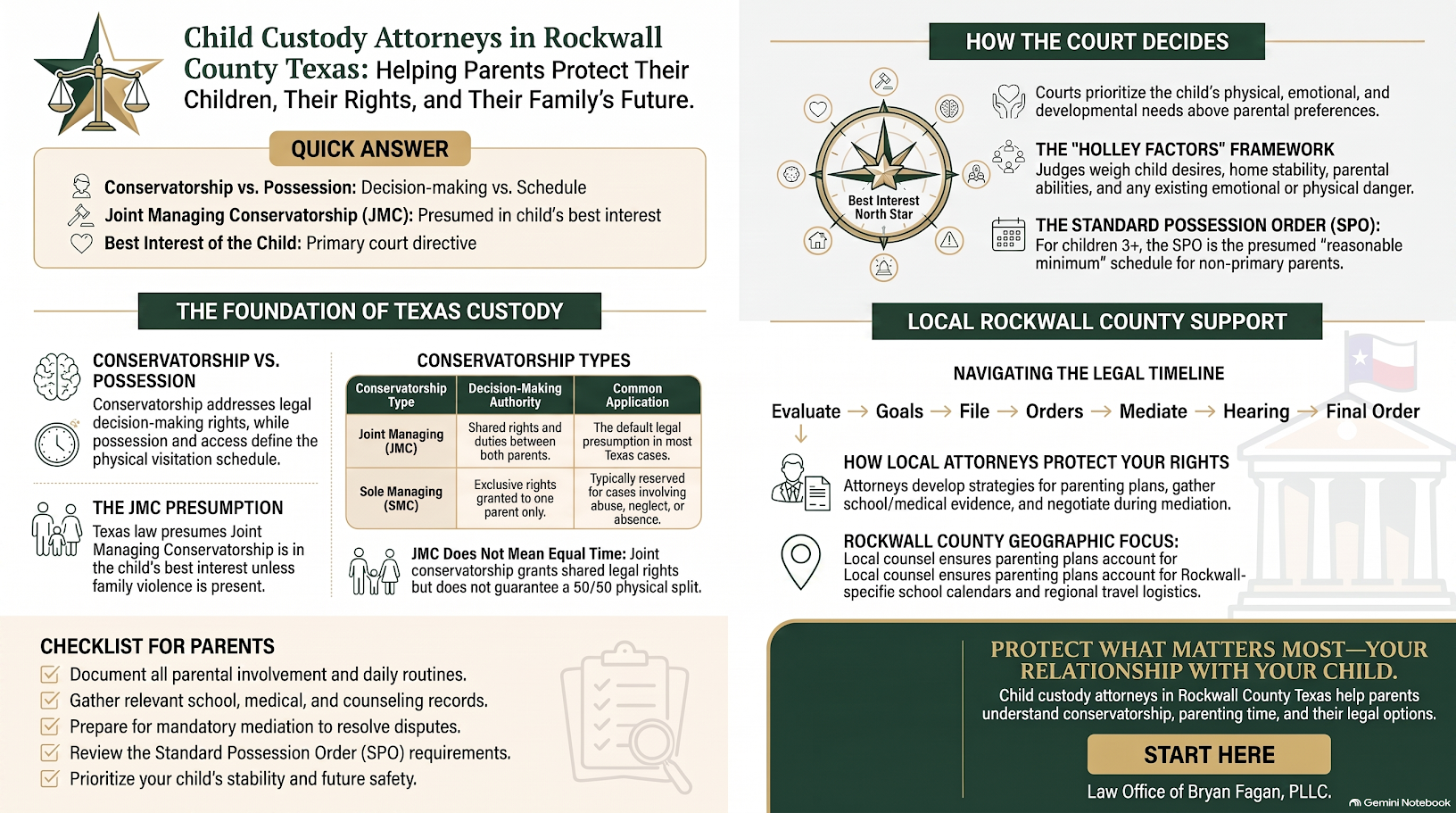
A Texas court does not award “custody” as a single thing. It decides three questions separately. First, conservatorship — which parent holds which rights and duties, and which are exercised jointly. Section 153.005 lets the court appoint a sole managing conservator or joint managing conservators. Second, possession and access — the schedule, and contact outside it. Third, and governing both, §153.002 makes the child’s best interest the primary consideration. Our Rockwall office represents parents in conservatorship, possession and access matters filed in Rockwall County.
Schedule a Consultation Or call (972) 379-9791Key Takeaways
- Texas custody orders are generally framed in terms of conservatorship, possession and access. Those concepts determine parental rights and duties, parenting time, and contact with the child.
- Texas law starts with strong presumptions favoring a parent over a nonparent. §153.131(a) requires appointment of a parent unless the statutory significant-impairment standard is met.
- Joint managing conservatorship is not a 50/50 schedule. §153.135 is titled Equal Possession Not Required.
- A 12-year-old is heard, not obeyed. §153.009 gives the interview; it does not diminish the court’s discretion.
- Rockwall’s standing orders apply from filing — before any hearing, and before anyone sees a judge.
Our Rockwall Office
Law Office of Bryan Fagan, PLLC
908 N Goliad St, Rockwall, TX 75087 · Rockwall County
Office hours: Monday–Friday, 8:00am–6:00pm
Phone and intake available 24/7
Is Child Custody the Same as Conservatorship in Texas?

Rockwall County Texas explain these cases through three connected concepts: conservatorship, meaning parental rights and duties; possession, meaning scheduled parenting time; and access, meaning contact with the child.
Texas Family Code §153.071 requires an order appointing both parents as conservators to specify how their rights and duties will be exercised. Some decisions may be made independently, some may require joint agreement, and others may belong exclusively to one parent. The court must also address who may determine the child’s primary residence, whether a geographic restriction applies, and what possession schedule the family will follow.
In straightforward situations, parents may agree on most of that structure and need help creating a clear, enforceable order. In more complex cases, disputes over decision-making, primary residence, possession, or safety may require additional evidence and court involvement. Texas Family Code §153.004 requires courts to consider qualifying evidence of family violence or sexual abuse, which can affect conservatorship and access. When the same alleged conduct may also create a separate criminal case, our guide to assault-related legal issues in Rockwall County explains that distinct part of the situation.
The practical question is therefore not simply, “Who gets custody?” It is which parental rights are disputed, what schedule protects the child’s best interest, and what evidence supports the requested arrangement. Lisa Kreider and our Rockwall family-law team help parents identify those issues, pursue workable resolutions when appropriate, and prepare for court when agreement is not realistic.
| What you would say | What the order says | Where it comes from |
|---|---|---|
| Who makes the decisions about school, doctors and counseling | Conservatorship — the allocation of parental rights and duties | Texas Family Code §153.071, §153.132 |
| Which days the child is with me | Possession — the scheduled periods a parent has the child | Texas Family Code §153.006, Subchapters E and F |
| Whether I can call or video-chat with my child between visits | Electronic communication, which a court may award to supplement a conservator’s periods of possession | Texas Family Code §153.015 |
| Whether I can see school and medical records | Information, records and consultation rights a parent conservator holds at all times unless limited by court order | Texas Family Code §153.073 |
| Who the child mainly lives with | The exclusive right to designate the child’s primary residence — commonly referred to as being “primary” | Texas Family Code §153.132(1), §153.134(b)(1) |
Who Does a Texas Court Appoint as Conservator?
That depends first on whether the dispute is between two parents or between a parent and a nonparent. Parent or nonparent. Texas law starts strongly in a parent’s favor. Under Texas Family Code §153.131(a), subject to the prohibition in §153.004, a parent shall be appointed sole managing conservator, or both parents shall be appointed joint managing conservators, unless the court finds the appointment would significantly impair the child’s physical health or emotional development and so not be in the child’s best interest. That is a high statutory threshold.
Between parents. Separately, Texas Family Code §153.131(b) creates a rebuttable presumption that appointing both parents as joint managing conservators is in the child’s best interest; a finding of a history of family violence involving the parents removes that presumption. Most disputes between two parents proceed under this parent-v-parent conservatorship framework; cases in which a nonparent seeks managing conservatorship raise additional statutory presumptions and evidentiary requirements.
Current-law note. Section 153.132 was amended effective September 1, 2025 to add a school-designation and enrollment right, for matters within the amendment’s application provision.
| Sole managing conservator | Joint managing conservators | |
|---|---|---|
| Decision-making | One parent holds the exclusive rights listed in §153.132, including specified medical, educational, legal and primary-residence decisions | Rights and duties are allocated between the parents — some independent, some by joint agreement, some exclusive to one — under §153.071 and §153.134(b) |
| Where the child lives | The sole managing conservator holds the exclusive right to designate the primary residence, §153.132(1) | One of the two is still designated to hold that right, and the order sets a geographic area or expressly sets none, §153.134(b)(1) |
| How it is ordered | May be ordered where joint managing conservatorship is not appropriate under the governing best-interest and statutory rules, including the circumstances addressed by §§153.004 and 153.131 | By an agreed parenting plan meeting the requirements of §153.133, or by the court on the factors listed in §153.134(a) |
| The other parent | Appointed a possessory conservator under §153.191 unless the court finds both that the appointment is not in the child’s best interest and that possession or access would endanger the child | Both parents are conservators; the order allocates rights between them rather than naming a possessory conservator |
| Child support | The sole managing conservator has the right to receive and hold periodic support payments, §153.132(4) | The court may still order one joint managing conservator to pay support to the other, §153.138 |
Does Joint Managing Conservatorship Mean 50/50 Possession?

No. Texas Family Code §153.135 is titled Equal Possession Not Required: joint managing conservatorship does not require equal or nearly equal periods of physical possession and access. It shares rights and duties, not a schedule.
The schedule comes from elsewhere, and it is a floor rather than a ceiling. Texas Family Code §153.251(a) describes the standard possession order guidelines as guiding courts in setting possession for a possessory conservator or as the minimum possession for a joint managing conservator. Distance can change the applicable possession framework: for a possessory conservator living 50 miles or less from the child’s primary residence, Texas Family Code §153.3171 generally provides the alternative beginning and ending times — broadly, periods starting when school lets out and ending when school resumes — unless a statutory exception applies, including where that conservator declines them or the court finds them not in the child’s best interest.
Not Sure Which Rights Are Actually in Dispute?
Tell us what is happening with your children and we can help you work out which parts of a Texas custody order are genuinely contested.
Schedule a ConsultationCan a 12-Year-Old Choose Which Parent to Live With?
No. Under Texas Family Code §153.009(a), on the application of a party, the amicus attorney or the attorney ad litem, the court shall interview a child 12 or older in chambers, and may interview a younger child, to learn that child’s wishes about conservatorship or about who holds the exclusive right to determine primary residence.
Being heard is not deciding. Section 153.009(c) provides that the interview does not diminish the court’s discretion, and Texas Family Code §153.134(a)(6) makes that preference one factor among several, and only as to who designates the primary residence.
What Does “Best Interest of the Child” Actually Mean in Texas?
It is the controlling standard, but Texas law does not supply one universal checklist for every custody decision. Texas Family Code §153.002 provides that the best interest of the child shall always be the primary consideration of the court in determining conservatorship and possession of and access to the child. As amended effective September 1, 2025, it also sets a rebuttable presumption in a suit between a parent and a nonparent that a parent acts in the child’s best interest, which a nonparent must overcome by clear and convincing evidence of significant impairment. What the section does not contain is a general checklist of best-interest factors.
What the Code does supply is factor lists tied to specific decisions. When a Texas court orders joint managing conservatorship without an agreed plan, Texas Family Code §153.134(a) lists several considerations, including each parent’s ability to give first priority to the child and reach shared decisions, whether each can encourage a positive relationship with the other, and the geographical proximity of the parents’ residences. For a child under three, Texas Family Code §153.254(a) supplies a different and longer list. Where a Texas court departs from the standard possession order, Texas Family Code §153.256 gives a third, shorter list.
What evidence matters therefore depends on what the court is actually being asked to decide. A dispute over decision-making authority may turn on different facts from a dispute over possession or the child’s primary residence. Section 153.134 directs a court considering court-ordered joint managing conservatorship to examine matters such as each parent’s ability to put the child first, reach shared decisions, encourage the child’s relationship with the other parent, and the geographic proximity of the parents’ homes.
Beyond those, best interest is a standard developed by Texas appellate courts, and the factors they weigh are non-exhaustive. The consequence to hold on to: there is no single checklist that determines every conservatorship decision. Which list applies depends on what is being decided, and preparing the right evidence for the right list is the work. Current as of August 2026.
Listen to Our Texas Family Law Podcast
Prefer listening? In this episode, we discuss child custody in Rockwall County, Texas, including how custody decisions are made, what factors may affect parenting arrangements, and how an attorney can help protect your parental rights.
What Does Not Automatically Decide Custody?
These beliefs are wrong as a matter of statute. Knowing which is which changes where you spend your energy.
| What people believe | What Texas law provides |
|---|---|
| Texas courts favor mothers | Texas Family Code §153.003 requires the court to consider the parties’ qualifications without regard to the sex of the party or the child, including when setting the terms and conditions of possession and access |
| A child aged 12 gets to choose | §153.009(a) entitles a child 12 or older to be interviewed on request; §153.009(c) provides that the interview does not diminish the court’s discretion |
| Joint conservatorship means equal time | §153.135 states that joint managing conservatorship does not require equal or nearly equal periods of physical possession and access |
| Missed child support ends the other parent’s time | §153.001(b) provides that a court may not render an order conditioning a conservator’s right to possession or access on the payment of child support |
| “Primary custody” is the legal term to fight over | The right that exists in the statute is the exclusive right to designate the child’s primary residence, allocated under §153.132(1), §153.133(a)(1) or §153.134(b)(1) |
What Happens When There Is Family Violence or Abuse?

Family violence can change both who may be appointed conservator and what possession or access the court allows. Texas Family Code §153.004 is more specific than “abuse means you lose custody.” Section 153.004(a) requires the court to consider evidence of the intentional use of abusive physical force, or of sexual abuse, against a spouse, a parent of the child, or any person under 18, in the two years preceding filing or during the case.
The effects are graded.
Joint managing conservatorship. In the circumstances stated in Texas Family Code §153.004(b), the court may not appoint the parents joint managing conservators.
Sole managing conservatorship and primary residence. Section 153.004(b) can also create a rebuttable presumption against appointing that parent sole managing conservator, or giving that parent the exclusive right to designate the child’s primary residence.
Possession and access. Section 153.004(d) can restrict access where the statutory family-violence showing is made, subject to the protective-possession provisions of subsection (d-1).
Unsupervised visitation. Section 153.004(e) contains a separate rebuttable presumption concerning unsupervised visitation, and it extends to others living in that parent’s household.
Texas Family Code §153.0071(f) also lets a party object to a mediation referral on family-violence grounds, with safety measures required if it is referred anyway. If this is your situation, our Rockwall County domestic violence page covers the protective order side of it. Where the Department of Family and Protective Services becomes involved, or where a parent’s rights themselves are at stake, those are separate proceedings — see CPS defense and termination of parental rights.
A Custody Order Is Not the Only Order in Your Case
Several things that feel like part of a custody case are separate proceedings with their own standards. Changing an order that already exists is a modification, and enforcing one the other parent is ignoring is an enforcement action, each with its own test. Where a child has been taken to or kept in another country, international child custody runs under a different framework again. And where a stepparent or relative wants to become a legal parent, that is an adoption, not a custody order. If custody is being decided inside a divorce, the property side runs alongside it — see our Rockwall County divorce page — and child support in Rockwall County is calculated separately.
Before You Call
Preparing to Talk With an Attorney About Custody
If you are getting ready to discuss a custody matter, it helps to organize:
- ›any current court orders
- ›the child’s current parenting schedule
- ›school and day-care information
- ›relevant communications between the parents
- ›a short timeline of important events
- ›specific concerns about safety, stability, decision-making, possession or access
- ›what outcome or parenting arrangement you believe needs to be established, clarified, or changed
What matters in a particular case depends on the facts. This is simply a practical starting point for organizing the conversation with your attorney.
Once you know which part of the parenting relationship is actually disputed, the next question is how to build a strategy around it.
Meet Lisa Kreider, Your Rockwall Child Custody Attorney
Your Rockwall Attorney
Lisa Kreider
Rockwall Child Custody Attorney · Rockwall Office
Lisa Kreider represents clients in child-custody matters from our Rockwall office, including cases involving conservatorship, possession, access, mediation, contested hearings, and related parenting issues. Her family-law experience includes temporary-order hearings, contested evidentiary matters, mediation and final trials. Her approach is to listen first, identify what is actually disputed, pursue resolution where appropriate, and prepare for court when necessary.
She has been licensed in Texas since 2017 and practices from our Rockwall office.
Read Lisa’s Full ProfileTexas Family Code §153.0071(c) lets a Texas court refer a custody case to mediation on the parties’ written agreement or on its own motion, and Texas Family Code §153.0071(d) provides that a mediated settlement agreement meeting the statutory formalities is binding, subject to the other provisions of §153.0071. But it needs saying clearly: the mediator is a neutral third party who does not represent either parent. In mediation Lisa is there as your attorney and advocate, not as the neutral. Those are different jobs, and it matters which one is sitting next to you.
No attorney can promise you a particular outcome in a custody case, and you should be wary of anyone who does. What we commit to is preparation, straight answers about where you stand, and representation that treats your relationship with your child as the thing worth protecting.
Meeting with us in person? Plan your visit to our Rockwall office.
What Happens When a Child Custody Case Is Filed in Rockwall County?
Rockwall County has standing orders that take effect when an original petition is filed, before the court holds an ordinary merits hearing, and they can affect what parents may do with the children while the case is pending. Family law cases here are heard through the county’s district courts and county courts at law, and both have adopted those orders. See also our other Rockwall County family law services.
The Rockwall County Standing Order Regarding Children, Property and Conduct of the Parties, effective July 31, 2020, orders both parents to refrain from a specific list of things: removing the children from Texas without the written agreement of both parties or a court order; withdrawing them from their school or day-care; hiding the children from the other parent; making disparaging remarks about the other parent or their family, expressly including grandparents, aunts, uncles and stepparents; and discussing the litigation with the children or in front of them. In an original divorce petition or original suit affecting the parent-child relationship, it also orders that no one a parent is romantically involved with may remain overnight while that parent has the child, defining overnight as 10:00 to 7:00 a.m.
It runs as a temporary restraining order for fourteen days; absent a contested hearing with evidence in that window, it continues as a temporary injunction until the court orders otherwise. Where any part of it differs from a protective order, the protective order controls.
There is a second order people miss. Under the Rockwall County Standing Order Regarding Parenting Class, effective June 7, 2019, all parties to all divorce and original suits affecting the parent-child relationship involving children must complete a parent education and family stabilization course meeting Texas Family Code §105.009, with the certificate filed before the case is finalized, and the order asks for it within 60 days of filing. Because the certificate must be filed before finalization, failing to file it can delay entry of a final order.
Not sure what kind of custody help you need?
Answer a few short questions about what is happening — what the matter involves, where you are in the process, and whether children are involved — and your answers help us identify the type of help you may need and the appropriate local team. For Rockwall County matters, that may include our Rockwall office. It takes about a minute, and there is no obligation.
Start Here — Answer a Few Questions Or schedule a consultationSources and Legal Resources
Statutory provisions cited on this page were checked against current Texas legislative materials and the most recent amendment history available for the cited sections. Rockwall County standing orders were reviewed through the Texas Office of Court Administration’s local-rules repository. Current as of August 2026; statutes and local orders can change, so the current text should always be confirmed before relying on a provision.
All Rockwall County family law services
| Divorce | Divorce in Rockwall County · Uncontested divorce · Contested divorce · High-net-worth divorce · Business owner divorce · Collaborative divorce · Family law mediation · Annulment · Common law divorce |
|---|---|
| Property, debt and support | Property division · Asset division · Debt division · Alimony and spousal support · Child support |
| Children and parenting | Parental visitation · Parental alienation · International child custody · Fathers’ rights · Mothers’ rights · Grandparents’ rights · Paternity actions · Termination of parental rights · Adoption · Child Protective Services defense |
| Agreements, orders and protection | Postnuptial agreements · Gestational agreements · Divorce modifications · Domestic violence and protective orders · Legacy planning |
Start at the Rockwall County family law guide if you are not sure which applies.
Conclusion:
A custody order should do more than divide parenting time. It should clearly allocate parental rights, establish a workable schedule, and give the child as much stability as the circumstances allow. Child Custody Attorneys in Rockwall County Texas help parents identify which parts of that structure are genuinely disputed and what type of legal strategy may be appropriate.
In straightforward situations, parents may agree on conservatorship, possession, school, and decision-making but need help creating a clear, enforceable order. In more complex cases, relocation, family violence, substance misuse, contested primary residence, or repeated violations may require additional evidence and court involvement. If alcohol-related conduct also creates a separate criminal matter, our guide to DWI and DUI matters in Rockwall County explains that distinct side of the situation.
Lisa Kreider and our Rockwall family-law team can help you understand where your case stands, determine what needs attention first, and choose a path that fits the level of conflict involved. That may mean an agreed parenting plan, mediation, temporary orders, modification, enforcement, or preparation for a contested hearing. The goal is to replace uncertainty with a practical plan that protects your relationship with your child and gives your family greater clarity about what comes next.
About the Author
Bryan Fagan
Founder & Managing Attorney
Texas Family Law · Licensed in Texas Since 2012
Bryan Fagan founded the Law Office of Bryan Fagan, PLLC in 2012 and practices Texas family law, including divorce, child custody, property division, and related family-law matters. He built the firm around helping families understand the legal process, make informed decisions, and have a clear strategy for what comes next.
J.D., South Texas College of Law · Licensed by the State Bar of Texas since 2012
About Our Firm
The Law Office of Bryan Fagan, PLLC serves families across Texas through a growing network of local offices, including our Rockwall office. That structure is the point: you have access to a Rockwall-based family-law attorney, backed by one of the largest family law firms in Texas and its 170+ legal professionals.
For the firm’s history, values, and full attorney roster, see about the Law Office of Bryan Fagan. For Rockwall specifically, start with the attorneys at our Rockwall office.
Frequently Asked Questions
Conservatorship is the allocation of parental rights and duties — who decides about school, medical care and counseling. Possession is when the child is physically with each parent. Texas Family Code Chapter 153 treats them as separate questions, and a Rockwall County order addresses each on its own terms.
No. Texas Family Code §153.003 requires the court to consider the qualifications of the parties without regard to their marital status or to the sex of the party or the child, and that applies to appointing a sole managing conservator, to whether joint managing conservatorship is ordered, and to the terms and conditions of possession and access.
Texas law does not make equal possession automatic. Texas Family Code §153.135 expressly provides that joint managing conservatorship does not require equal or nearly equal periods of possession. The schedule is determined under the applicable Chapter 153 provisions and the child’s best interest, and agreed schedules may vary from the standard possession order under Texas Family Code §153.255.
There is no age at which a child decides. Under Texas Family Code §153.009(a) the court must interview a child 12 or older in chambers on request to learn the child’s wishes, and §153.009(c) provides that the interview does not diminish the court’s discretion. Under §153.134(a)(6) the preference of a child 12 or older is one factor among several that the court weighs.
It is the possession schedule set out in Subchapter F of Texas Family Code Chapter 153. Texas Family Code §153.252 creates a rebuttable presumption that it provides reasonable minimum possession for a possessory conservator or joint managing conservator and is in the child’s best interest, and §153.251(d) provides that it is designed to apply to a child three years of age or older.
Not always. Texas Family Code §153.007 provides that if the court finds an agreed parenting plan is in the child’s best interest, it shall render an order in accordance with it, and Texas Family Code §153.0071(c) lets a Texas court refer a case to mediation. Rockwall County’s standing order regarding children, property and conduct expressly encourages parties to settle without court intervention and to use alternative dispute resolution.
Ready to Understand Where You Actually Stand?
Our Rockwall office can help you understand which parental rights are actually in dispute, what parenting-time framework may apply, what Rockwall County’s standing orders already require, and what your next step should be.
Schedule a Consultationor call (972) 379-9791
This page provides general information about Texas child custody, conservatorship, and family law and about our services. It is not legal advice, and reading it does not create an attorney-client relationship. No attorney can promise a particular outcome in a family-law case; what we commit to is representation, preparation, and clear communication about where your case stands.
