
Fathers’ Rights Attorneys in Rockwall County, Texas

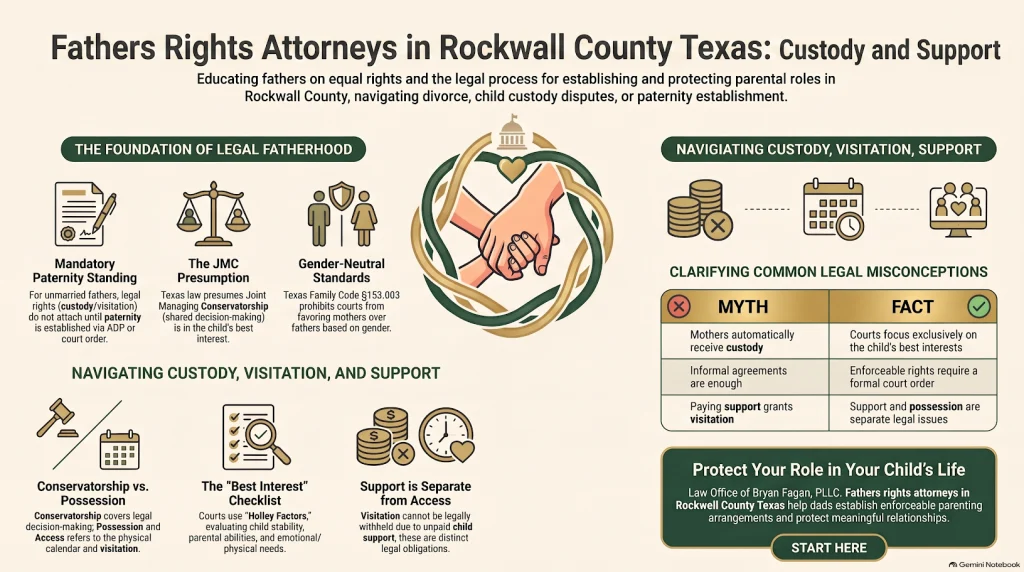
There is no separate body of Texas law that gives fathers a special set of custody rights—and Texas law does not allow courts to favor mothers simply because they are mothers. For fathers searching for Fathers rights Attorneys in Rockwall County Texas, that distinction matters: Texas Family Code §153.003 expressly prohibits sex-based discrimination when courts make decisions about conservatorship, possession, and access.
One of the first questions many fathers ask is, “Does the mother have an advantage in a Texas custody case?” Section 153.003 provides a clear starting point. A court must consider the qualifications of the parents without regard to their sex or marital status. But the statute does not create an advantage for fathers either. Instead, it requires the court to evaluate the parents under the same legal framework, with the child’s best interest guiding conservatorship decisions.
For a father facing a paternity, custody, modification, or enforcement dispute in Rockwall County, the more useful question is not whether Texas favors mothers or fathers. It is: Where do I legally stand right now? That begins with determining whether legal paternity has been established, whether a court order already exists, what rights and duties that order gives each parent, and whether the father needs to establish, modify, or enforce those rights. Once those questions are answered, the focus can shift from assumptions about fathers’ rights to the facts and evidence that may actually shape the case.
Quick Answer
Texas law does not give mothers a sex-based preference in conservatorship decisions. Section 153.003 requires the court to consider the parties’ qualifications without regard to their marital status or to the sex of the party or the child. What decides a father’s case is what decides any parent’s: the child’s best interest under §153.002, and what the evidence shows. Our Rockwall office represents clients in family-law matters in Rockwall County.
Schedule a Consultation Or call (972) 379-9791Key Takeaways
- §153.003 forbids sex-based and marital-status-based discrimination in conservatorship, possession and access decisions. It is the statute, not a policy.
- There is no separate “fathers’ rights” statute. Texas allocates parental rights and duties through the same conservatorship framework regardless of the parent’s sex.
- If the parents were never married, first determine whether legal parentage has already been established. Chapter 160 sets out how the father-child relationship is established; where legal parentage has not yet been established, that issue generally must be resolved before a court can enter enforceable orders allocating parental rights and duties to the man.
- A presumption of paternity can arise without marriage — §160.204 includes a route based on residing with the child and holding the child out as his own during the child’s first two years.
- An effective acknowledgment of paternity can establish the father-child relationship without an adjudication, subject to Chapter 160’s requirements and its rescission and challenge provisions.
- The practical work is evidence and involvement, documented before there is a dispute rather than reconstructed after one.
Our Rockwall Office
Law Office of Bryan Fagan, PLLC — Rockwall Office
908 N. Goliad Street, Rockwall, TX 75087 · Rockwall County
Coming to see us? For directions, arrival information, and what to expect when you visit, see our Plan Your Visit – Rockwall Office guide.
A Father’s First Three Questions
- Am I already the legal father?
- Is there already a court order?
- Do I need to establish, change, or enforce something?
Those three answers identify the legal lane before anyone starts arguing about “fathers’ rights.”
Does Texas Law Favor Mothers Over Fathers?
No — and the Code says so directly.

No. Texas law does not give mothers an automatic advantage over fathers in conservatorship or possession decisions. For parents searching for Fathers rights Attorneys in Rockwall County Texas, the starting point is Texas Family Code §153.003, which requires courts to evaluate the qualifications of the parents without regard to their sex or marital status.
Section 153.003 does something important, but it does not guarantee a particular outcome for either parent. It removes gender from the court’s decision-making process; it does not replace the best-interest analysis required by Texas Family Code §153.002. A father’s history of involvement, the child’s needs, the stability each parent can provide, and the evidence presented can therefore matter far more than whether the parent is the mother or father.
That distinction becomes especially important when parents are separating or pursuing a divorce in Rockwall County. A father who has consistently cared for his child does not need a special “fathers’ rights” rule to make that involvement relevant. Likewise, §153.003 does not erase a history of limited involvement simply because the parent asking for additional rights is the father. The statute requires equal consideration; the evidence helps the court decide what arrangement serves the child’s best interest.
For fathers who need to understand how conservatorship, primary residence, and parental decision-making are determined, our guide to child custody in Rockwall County addresses those issues in greater detail. Questions about parenting schedules, the Standard Possession Order, and distance provisions are covered separately in our parental visitation in Rockwall County resource.
What Rights Does a Father Have Under Texas Law?
Texas does not give fathers a lesser category of parental rights because they are men. It does not maintain a separate list of paternal rights either. Texas allocates parental rights and duties between conservators, and a father holds whichever of them the court assigns him.
Chapter 153 works by specifying rights and duties and then saying which conservator holds each of them, and when. Some are held by a parent at all times; others attach to the period when the child is in that parent’s care. Which of them a father holds is a question about the order in his case, not about fathers as a category — and where an order already exists, the answer is in the order rather than in the statute.
That framing matters more than it sounds. A father asking “what are my rights” is generally asking one of two different questions. If he is a legal parent already, the question is about allocation — which rights he holds, on what schedule, and whether that should change. If legal parentage has not yet been established, parentage may need to be resolved before the court can determine what parental rights and duties should be allocated to him.
Do Fathers Have Equal Rights in Texas?
Texas does not assign a lesser set of conservatorship rights to fathers because they are men. Section 153.003 requires sex-neutral consideration. Equal legal treatment does not mean each parent automatically receives identical rights, decision-making authority or possession time — those are determined under the conservatorship and best-interest rules that apply to both parents.
Can a Father Be Named the Parent Who Determines the Child’s Primary Residence?
Yes. Texas law does not bar a father from receiving that right because of his sex. Which parent receives it depends on the facts and the court’s best-interest analysis — the subject of child custody in Rockwall County.
What If the Parents Were Never Married?

For unmarried fathers, the first question is whether legal parentage has already been established. Fathers searching for Fathers rights Attorneys in Rockwall County Texas should not assume that being the biological father—or being unmarried to the child’s mother—by itself answers what legal rights or enforceable parenting time they currently have. Texas Family Code Chapter 160 governs how the father-child relationship may be legally established.
Under §160.201, the father-child relationship can be established in several ways, including an unrebutted presumption of paternity, an effective Acknowledgment of Paternity, or a court adjudication. An unmarried father may therefore already have legal status without realizing it, while another biological father may still need to establish paternity before obtaining enforceable orders concerning conservatorship, possession, support, and other parental rights.
The distinction is important: paternity establishes the legal father-child relationship; it does not by itself tell the parents when the child will live with each of them or who will make particular decisions. Those issues may require a court order. Section 160.202 separately makes clear that a child born to unmarried parents has the same rights under Texas law as a child born to married parents.
In more complex cases, parentage questions can overlap with family violence allegations, protective orders, or even a related assault matter in Rockwall County. Those issues should not be treated as interchangeable: establishing paternity, determining conservatorship, and addressing an alleged criminal offense involve different legal questions and procedures. The first step is identifying which issues actually exist so the father can pursue the appropriate legal path while keeping the child’s safety and best interest at the center of the case.
Can an Unmarried Man Be a Presumed Father in Texas?
Yes — marriage is not the only route.
A presumption can arise without a marriage. Section 160.204 includes a nonmarital route: where, during the first two years of the child’s life, the man continuously resided in the household in which the child resided and represented to others that the child was his own. A father who lived with the child and never signed anything may fall inside it without realizing.
Where Does an Unmarried Father Start?
Being unmarried does not tell you which case to file. Your existing legal status does.
Where Does an Unmarried Father Start?
Being unmarried does not tell you which case to file. Your existing legal status does.
| Your situation | Starting question |
|---|---|
| An acknowledgment of paternity is already effective | Parentage may already be established — the question is what orders are needed |
| An existing paternity or parentage order | Read the order, then determine whether the issue is conservatorship, possession, modification or enforcement |
| You may be a presumed father under §160.204 | Determine whether the statutory presumption applies to your facts |
| No parentage established by any route | Parentage is the threshold issue before parental rights and duties can be allocated to him |
Legal Father vs Court Order: What Is the Difference?
| Question | What it answers |
|---|---|
| Has paternity been established? | Whether the man is legally recognized as the father |
| Is there a court order? | Who holds which rights and duties, the possession schedule, support and related terms |
| Is the order being followed? | Whether enforcement may be the issue |
| Does the order need to change? | Whether modification may be the issue |
Paternity answers who the legal father is. A court order answers what each parent may or must do. An effective acknowledgment establishes legal paternity; it does not by itself create a custody or possession order. Conservatorship, parenting time and support may still need to be addressed through a court proceeding.
The route most families reach for first is the acknowledgment of paternity. It can become more complicated where another man is already a presumed father, such as a current or recent husband; in that situation an AOP may require the presumed father to complete the denial portion before the biological father’s paternity can be established through that route. Under §160.301, the mother and a man claiming to be the biological father may sign one with the intent to establish his paternity — establishing the legal relationship by signature rather than by suit. An AOP is not merely a private form the parents sign and keep. The Texas Attorney General explains that AOP services are provided through certified entities that assist with completing and submitting the acknowledgment.
An AOP is also not necessarily irrevocable. Under §160.307 a signatory may rescind before the earlier of the 60th day after the acknowledgment’s effective date — which §160.304 sets as the later of the child’s birth or the filing of the document with the vital statistics unit — or the date a proceeding to which the signatory is a party is initiated before a court to adjudicate an issue relating to the child, including a proceeding that establishes child support. After that period, §160.308 permits a signatory to challenge the acknowledgment only on the basis of fraud, duress, or material mistake of fact, with the burden on the party challenging, and only before an order affecting the child issues.
Before the record is made
Not Sure Where You Stand as a Father?
Tell us whether an order exists, whether parentage has been established, and what your involvement has actually looked like — and we can help you work out what your case turns on.
Schedule a ConsultationWhat Should a Father Do First?

Start by answering two questions: Has legal parentage been established, and is there already a court order? For fathers searching for Fathers rights Attorneys in Rockwall County Texas, those answers can determine whether the next step involves establishing parentage, obtaining initial conservatorship orders, modifying an existing order, or enforcing one that is not being followed.
If there is no established parentage and no order, Texas Family Code Chapter 160 may be the starting point. If parentage is established but no conservatorship order exists, an original SAPCR may address conservatorship, possession, child support, and related rights. An order that no longer fits the circumstances may require modification under Chapter 156, while an order that is being violated may present an enforcement issue under Chapter 157.
At the same time, start preserving the record. Keep the current order, original messages, parenting calendars, records of exchanges, payments, medical involvement, and other documents showing what has actually happened. If a separate issue such as an arrest or DWI or DUI matter in Rockwall County is involved, preserve those records as well rather than assuming the allegation automatically determines custody; the family court still evaluates conservatorship and possession under the applicable Texas Family Code standards and the child’s best interest.
The goal is not to collect paperwork for its own sake. It is to identify the correct legal path and build an accurate record before memories fade and facts become disputed. In more complex cases involving contested primary residence, repeated enforcement problems, safety allegations, or trial, that early organization can become an important part of developing the case strategy.
What Do Fathers Get Wrong in a Texas Case?
One mistake is arguing the statute instead of building the record. Section 153.003 is worth knowing, and it is worth citing. It is not worth building a case around, because it removes an obstacle rather than supplying an argument. A court still has to resolve the disputed issues under the applicable law and evidence.
None of that is about being a father. It is about turning a concern into facts and legal issues a court can evaluate. §153.003 clears the ground; the record is what gets built on it.
| Mistake | Why it matters |
|---|---|
| Assuming being unmarried means you have no status | You may already be a legal or presumed father under Chapter 160 |
| Signing an acknowledgment while paternity is uncertain | The Texas Attorney General instructs AOP-certified entities that testing should be addressed before an AOP is completed |
| Assuming a birth certificate settles the question | Legal paternity should be confirmed from the mechanism that actually established it |
| Relying on an informal parenting arrangement | It is not the same thing as an enforceable court order |
| Arguing “fathers’ rights” instead of evidence | §153.003 removes sex from the analysis; the remaining issues turn on the applicable law and evidence |
Before You Call
Preparing to Talk With an Attorney as a Father
If you are getting ready to discuss your situation, it helps to organize:
- ›whether you were married to the child’s mother, and when
- ›whether you signed an acknowledgment of paternity, are named on the birth certificate, or have an existing parentage order
- ›any current order, and the decree or suit it came from
- ›a dated record of the time you have actually had with the child
- ›what you have paid, and how — support, expenses, insurance
- ›school and medical contacts you are listed on, or want to be
- ›what outcome you believe needs to be established or changed
What matters in a particular case depends on the facts. This is simply a practical starting point for organizing the conversation with your attorney.
Meet Lisa Kreider, Your Rockwall Family Law Attorney
The strength of a father’s case can depend heavily on how well the record is built and how clearly the facts are presented — what the involvement has actually been, what was paid, what was agreed, and what happened when it was not. For a Rockwall County case, that makes local execution as important as knowing the statewide framework.
Your Rockwall Attorney
Lisa Kreider
Rockwall Family Law Attorney · Rockwall Office
Lisa Kreider represents clients in family-law matters from our Rockwall office. Her family-law experience includes temporary-order hearings, contested evidentiary matters, mediation and final trials. Her approach is to listen first, identify what is actually disputed, pursue resolution where appropriate, and prepare for court when necessary.
She has been licensed in Texas since 2017.
Read Lisa’s Full ProfileIf a Father Is Not Named Primary, What Rights Can He Still Have?

A father who is not designated as the parent with the exclusive right to determine the child’s primary residence can still have substantial parental rights. For fathers searching for Fathers rights Attorneys in Rockwall County Texas, the key is to look beyond the “primary parent” label and read the entire conservatorship order to determine what rights, duties, and periods of possession it actually provides.
The primary-residence designation is only one part of Texas conservatorship. Depending on the order, a non-primary father may still have rights involving possession and access, information about the child’s health and education, medical records, school records, consultation with professionals, and important decisions affecting the child. The precise allocation matters, which is why our guide to child custody in Rockwall County explains conservatorship and parental decision-making in greater detail.
In more complex cases, serious safety concerns or criminal allegations can affect the court’s best-interest analysis and requests concerning conservatorship or possession. For example, when a family-law dispute overlaps with an allegation as serious as a homicide case in Rockwall County, the criminal matter and the custody case remain separate proceedings, but the underlying facts may become relevant to questions involving the child’s safety and best interest. An allegation alone should not be treated as a substitute for evidence or as an automatic custody determination.
The practical lesson is simple: not being named primary does not mean losing your role as a parent. A father should identify every right the existing order gives him, understand his possession schedule, and determine whether the issue is following the current order, enforcing it, or seeking a modification when the applicable Texas legal requirements are met.
What Local Rules Apply in a Rockwall County Case?
Rockwall County has a Standing Order Regarding Children, Property and Conduct, effective 31 July 2020 and adopted by the 382nd and 439th District Courts and County Courts at Law No. 1 and No. 2. It takes effect upon filing and remains operative according to its terms unless modified or superseded by the court. Its provisions yield to a protective order.
The county also has a Standing Order Regarding Parenting Class, effective 7 June 2019, which applies in qualifying divorce and original SAPCR matters and requires a certificate of completion before finalization. Neither order decides conservatorship, but both govern conduct while a case is pending.
Not sure what kind of help you need?
Answer a few short questions about what is happening — what the matter involves, where you are in the process, and what has already been ordered — and your answers help us identify the type of help you may need and the appropriate local team. For Rockwall County matters, that may include our Rockwall office. It takes about a minute, and there is no obligation.
Start Here — Answer a Few Questions Or schedule a consultationSources and Legal Resources
Statutory provisions cited on this page were checked against current Texas legislative materials and the most recent amendment history available for each section. Current as of August 2026; statutes change, so the current text should be confirmed before it is relied on.
- Texas Family Code Chapter 153 — official full-chapter text: conservatorship, possession and access, including §153.003 and the best-interest standard
- Texas Family Code Chapter 160 — official full-chapter text: the Uniform Parentage Act, including presumption, acknowledgment and adjudication of paternity
- Texas Attorney General — Paternity — the state’s consumer guidance on establishing legal fatherhood, including the acknowledgment process
- Texas Office of Court Administration — Rockwall County court documents — the county’s standing orders
- Rockwall County District Clerk — Civil and Family — local court and filing information
Conclusion:
A fathers’ rights case is rarely just about proving that fathers deserve a meaningful role in their children’s lives. The more useful question is what the law, the existing order, and the facts mean for your family right now. If you are searching for Fathers rights Attorneys in Rockwall County Texas, start by identifying what actually needs to happen next. In straightforward situations, that may mean establishing paternity, obtaining clear conservatorship and possession orders, or enforcing a schedule that already exists. Understanding that legal starting point can replace uncertainty with a much clearer path forward.
In more complex cases, the strategy may look very different. If your case involves disputed paternity, a request for primary or 50/50 possession, relocation, repeated interference with parenting time, modification of an existing order, family-violence allegations, significant financial issues, or a contested hearing or trial, the experience and level of legal strategy required may increase with the stakes. The Law Office of Bryan Fagan, PLLC can help identify the nature and complexity of the dispute and connect you with the appropriate attorney and legal team for the work ahead.
You do not have to begin with every answer. Begin by understanding where you stand, what you want to protect, and what the next legal step requires. Our Rockwall family law team can help you evaluate the order, the evidence, and the available options so you can make informed decisions about your child and your future with greater clarity and confidence.
Listen to Our Texas Family Law Podcast
Prefer listening? In this episode, we discuss fathers’ rights in Texas for Rockwall families, including custody, visitation, decision-making, and what dads should know about protecting their parental rights.
About the Author
Bryan Fagan
Founder & Managing Attorney
Texas Family Law · Licensed in Texas Since 2012
Bryan Fagan founded the Law Office of Bryan Fagan, PLLC in 2012 and practices Texas family law, including divorce, child custody, property division, and related family-law matters. He built the firm around helping families understand the legal process, make informed decisions, and have a clear strategy for what comes next.
J.D., South Texas College of Law · Licensed by the State Bar of Texas since 2012
About Our Firm
The Law Office of Bryan Fagan, PLLC serves families across Texas through a growing network of local offices, including our Rockwall office. That structure is the point: you have access to a Rockwall-based family-law attorney, backed by one of the largest family law firms in Texas and its 170+ legal professionals.
For the firm’s history, values, and full attorney roster, see about the Law Office of Bryan Fagan. For Rockwall specifically, start with the attorneys at our Rockwall office.
Frequently Asked Questions
No. Section 153.003 requires the court to consider the parties’ qualifications without regard to their marital status or to the sex of the party or the child, and §153.002 makes the child’s best interest the primary consideration.
Not as a separate statute. Texas allocates parental rights and duties between conservators rather than assigning a distinct set of rights to fathers. What exists is §153.003’s prohibition on sex-based and marital-status-based discrimination, together with the general conservatorship framework in Chapter 153 that applies to both parents.
Once parentage is established, the same rights any parent may be allocated. The first step is therefore to determine whether legal parentage has already been established — an unmarried father may already be a legal or presumed father. Section 160.201 identifies several ways the father-child relationship may be established, including an unrebutted presumption, an effective acknowledgment of paternity, and adjudication.
Yes, in one situation the statute describes. Most of the presumption routes in §160.204 involve marriage, but the section also provides for a presumption where, during the first two years of the child’s life, the man continuously resided in the household in which the child resided and represented to others that the child was his own.
It can be rescinded, and after the rescission period §160.308 allows a signatory to challenge it only on the basis of fraud, duress, or material mistake of fact, with the burden on the party challenging. Rescission and later challenges are subject to statutory timing requirements, so the current provisions should be checked for the applicable deadline. An effective acknowledgment that has not been rescinded or successfully challenged establishes paternity.
Support and possession are separate obligations. A parent who is behind on support still has whatever rights of possession and access the order gives him, and a parent being denied time still owes support. Each is addressed through its own proceeding rather than by withholding the other.
Where to go from here
What You Can Show Decides What a Court Can Do.
Our Rockwall office can help you work out whether parentage needs establishing, what the record already supports, and what has to be in front of the court before it decides.
Schedule a Consultationor call (972) 379-9791
This page provides general information about Texas conservatorship, possession, access and parentage and about our services. It is not legal advice, and reading it does not create an attorney-client relationship. No attorney can promise a particular outcome in a family-law case; what we commit to is representation, preparation, and clear communication about where your case stands.
