
Child Support Attorneys in Rockwall County Texas
When a family separates, the child-support question rarely begins with a statute. It begins at the kitchen table—with rent, groceries, childcare, health insurance, and two parents trying to understand what life will cost in two households. For parents searching for Child Support Attorneys in Rockwall County Texas, the concern is usually immediate and personal: how much will I pay, or how much should I receive? Our Rockwall office represents parents on both sides of that calculation and helps families replace uncertainty with a clearer path forward.
Texas child support starts with one parent’s net monthly resources under Texas Family Code §154.062. The court then applies the guideline percentages in §154.125 up to the applicable ceiling and considers whether the factors in §154.123 justify a different result. The immediate takeaway is that the guideline calculation is a starting point—not always the final answer. Knowing whether your case turns on the income figure, the guideline itself, or a reason to depart from it can change both the evidence you need and the strategy you pursue.
The Law Office of Bryan Fagan, PLLC was founded in Houston and is led by Bryan Joseph Fagan, a South Texas College of Law graduate and recognized authority on Texas divorce and custody law. Through its local Rockwall office, the firm combines statewide family-law experience with compassionate, community-based guidance. Our purpose is not simply to explain a percentage. It is to educate parents, simplify a complicated process, and help families protect their children and regain peace of mind during a difficult transition.
This article will walk you through what Texas counts as resources, how the guideline calculation works, when a judge may order more or less, and which facts may matter most in your case. Once you understand where the real disagreement lies, the child-support question becomes easier to evaluate—and the next step becomes much clearer.
Quick Answer
Texas child support is a three-step calculation, not a single figure. First, the court determines the obligor’s net resources under Section 154.062. Second, it applies the guideline schedule in §154.125 to those resources up to a statutory ceiling. Third, under §154.122 the guideline amount is rebuttably presumed to be in the child’s best interest — which means it is a starting point a party can challenge. Our Rockwall office represents clients in child-support and related family-law matters in Rockwall County.
Schedule a Consultation Or call (972) 379-9791Key Takeaways
- Child support is calculated from net resources, not from gross pay. §154.062 defines what counts and what is deducted.
- The guideline amount is a rebuttable starting point, not an automatic final result. §154.122 makes it rebuttable, and §154.123 lists factors a court may consider in varying from it.
- The guideline ceiling is not a fixed number in the statute. §154.125 ties it to an amount the Title IV-D agency publishes in the Texas Register, adjusted periodically. Confirm the current figure when support is calculated.
- Support and possession are separate obligations. §154.011 is titled Support Not Conditioned on Possession or Access. Withholding one because of the other is not a remedy.
- Rockwall County publishes standing orders that may apply when child support is part of an original family-law case. Those orders can regulate conduct involving the children while the case is pending.
Our Rockwall Office
Law Office of Bryan Fagan, PLLC — Rockwall Office
908 N. Goliad Street, Rockwall, TX 75087 · Rockwall County
(972) 379-9791
Coming to see us? Plan your visit to our Rockwall office.
How Is Child Support Calculated in Texas?
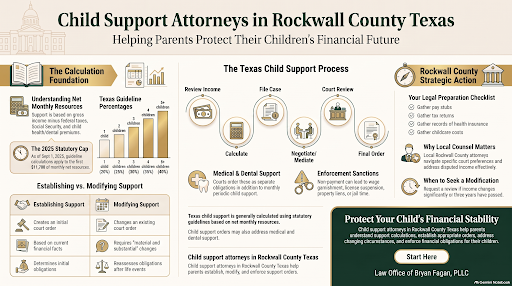
Texas calculates child support in three steps: determine the paying parent’s net monthly resources, apply the appropriate guideline percentage, and decide whether the evidence supports a different amount. Child Support Attorneys in Rockwall County Texas help parents identify which part of that framework is disputed, because the percentage alone does not determine the final order.
First, the court determines net monthly resources under Texas Family Code §154.062. Pay records and tax documents may provide the answer in a straightforward case, while self-employment, bonuses, irregular earnings, or compensation through a closely held business may require a more detailed financial review.
Second, the court applies the percentage schedule in Texas Family Code §154.125. The percentage depends on the number of children and may change when the paying parent supports children in another household. The firm’s Texas Child Support Calculator can provide a useful estimate, but it cannot resolve disputed income or create an enforceable court order.
Third, Texas Family Code §154.122 creates a rebuttable presumption that the guideline amount is in the child’s best interest. A court may order more or less when evidence tied to the factors in §154.123—such as childcare costs, extraordinary medical needs, or the parents’ financial circumstances—shows that the ordinary result would be unjust or inappropriate.
Child support may also be one part of a broader legal dispute. If the matter includes a separate allegation of violence or a criminal charge, the firm’s information about Rockwall County assault defense explains that distinct process. Evaluating each issue separately—and then coordinating the overall strategy—helps parents focus on the evidence most likely to affect each part of the case.
Texas Child Support Tool
Estimate Texas Child Support
Want to see what the Texas guideline calculation may look like using your numbers? Our Texas Child Support Calculator can estimate guideline support based on the financial information you provide and the number of children involved.
The calculator provides an estimate, not a court order. Disputed income, self-employment, multiple households, statutory deviation factors, high-income and proven-needs issues, medical or dental support, and other circumstances can affect what a court ultimately orders.
Calculate Texas Child SupportNot Sure Which Step Your Case Turns On?
Tell us what the income picture looks like and we can help you work out whether the dispute is really about resources, the guideline, or a departure.
Schedule a ConsultationWhat Happens When Income Exceeds the Guideline Ceiling?
The guideline percentages stop at the ceiling; the court’s authority does not. Section 154.126 provides that where net resources exceed the amount in §154.125(a), the court presumptively applies the percentage guidelines to the portion up to that amount, and may order additional support depending on the income of the parties and the proven needs of the child.
Two parts of that rule deserve special attention. The additional amount is tied to proven needs, which means evidence rather than assertion. And the section caps the exposure: the obligor may not be required to pay more than the greater of the presumptive amount or an amount equal to 100 percent of the proven needs of the child. High-income support cases are therefore evidentiary cases about the child’s actual needs, not arguments about what a percentage of a large income would produce.
Can a Judge Order More or Less Than Guideline Support?
Yes, in either direction, and the statute anticipates it. Section 154.123 is titled Additional Factors for Court to Consider and sets out the considerations relevant to whether application of the guidelines would be unjust or inappropriate in a particular case. A departure argument is built on those factors and on evidence, not on a party’s sense of fairness.
A departure creates a paperwork consequence. Section 154.130 governs findings in a child support order and requires specified findings where the order varies from the guideline amount — including the net resources of each party and the reasons for the variance. Those findings can also provide an important record of the financial assumptions and reasons underlying the original support order if modification is later requested.
Parents can also agree. Under §154.124, parents may agree on support terms, but the court must still determine that the agreement is in the child’s best interest before rendering an order in accordance with it. An agreed calculation should therefore be reviewed for both the arithmetic and the terms that will appear in the order.
What If a Parent Supports Children in More Than One Household?
Texas may adjust the ordinary guideline percentage when the paying parent has a legal duty to support children in more than one household. Child Support Attorneys in Rockwall County Texas help parents determine which children count under the multiple-family guidelines and how those obligations may affect the calculation in the pending case.
Texas Family Code §154.128 provides one method for calculating support when an obligor has children in more than one household, while §154.129 permits an alternative method in the circumstances described by that provision. The correct approach depends on the number of children before the court and the number of other children the parent has a legal duty to support. Section 154.130 also contemplates findings identifying both groups, making complete and accurate information about every support obligation important.
In straightforward cases, existing orders and reliable records may establish the adjustment. In more complex matters, the parties may disagree about whether another child qualifies, whether an obligation is current, or which calculation applies. If the family is simultaneously facing a homicide investigation or charge, the firm’s information about Rockwall County homicide defense addresses that separate legal process; it should be evaluated independently while counsel coordinates the broader case strategy.
Does 50/50 Possession Eliminate Child Support?
No. Possession and support are different questions answered by different chapters, and an even schedule does not by itself cancel a support obligation. Conservatorship and possession sit in Chapter 153, which our Rockwall child custody page covers; support sits in Chapter 154 and runs off net resources.
The reverse is also true, and it is the more dangerous misunderstanding. Section 154.011 is titled Support Not Conditioned on Possession or Access. A parent who stops paying because visits are being refused, or who refuses visits because payments have stopped, is not exercising a remedy — they are creating a second problem. A violation of a possession or support order should be addressed through the appropriate legal enforcement process rather than by withholding the other obligation.
How Long Does Child Support Last?
For many children the ordinary endpoint is not simply the eighteenth birthday. Texas Family Code §154.001 allows support until the child turns 18 or graduates from high school, whichever occurs later, subject to that section’s other terminating events and provisions. Section 154.002 addresses support through high-school graduation after age 18 and includes enrollment and attendance requirements, and the request may be made before or after the child’s eighteenth birthday.
How Are Medical and Dental Support Handled in Texas?
Medical and dental support are additional child-support obligations. Section 154.183 provides that an amount ordered as medical or dental support under Chapter 154 is in addition to guideline child support, is itself a child-support obligation, and may be enforced by any means available for enforcing child support. Section 154.064 makes the same point from the other direction: the guidelines are built on the assumption that the court will order medical and dental support on top of the calculated amount. Section 154.183 also directs the court to allocate unreimbursed health-care expenses and copayments between the parties as additional child support.
Can a Support Order Be Changed Later?
Yes, but through a filing rather than an arrangement. Modification of an existing order is governed by Chapter 156 and is a separate proceeding with its own standards — which is why the findings a court made under §154.130 when the order was entered matter years later. An informal agreement between parents to pay a different amount does not change the order. Until a support order is modified through the proper legal process, the existing order remains the operative order and can continue generating obligations according to its terms. If your situation is a change to an existing order rather than a first one, start with modifications in Rockwall County. If the issue is not changing the amount but collecting support that has not been paid, that is an enforcement matter governed by separate procedures, and it is worth raising as an enforcement question rather than a modification one.
Before You Call
Preparing to Talk With an Attorney About Child Support
If you are getting ready to discuss a support matter, it helps to organize:
- ›any current support or possession order
- ›recent pay records, and tax returns if either parent is self-employed
- ›what health and dental coverage exists for the children, and who pays for it
- ›how many children each parent supports, in this case and any other
- ›a record of what has actually been paid or received, and when
- ›what outcome you believe needs to be established, clarified, or changed
What matters in a particular case depends on the facts. This is simply a practical starting point for organizing the conversation with your attorney.
Once you know whether your case is about the income figure, the guideline, or a departure from it, the next question is how to build a strategy around it.
Meet Lisa Kreider, Your Rockwall Child Support Attorney
Your Rockwall Attorney
Lisa Kreider
Rockwall Child Support Attorney · Rockwall Office
Lisa Kreider represents clients in child-support and related family-law matters from our Rockwall office. Her family-law experience includes temporary-order hearings, contested evidentiary matters, mediation and final trials. Her approach is to listen first, identify what is actually disputed, pursue resolution where appropriate, and prepare for court when necessary.
She has been licensed in Texas since 2017 and practices from our Rockwall office.
Read Lisa’s Full ProfileChild-support disputes may be resolved through mediation, and it is worth being clear about the roles. The mediator is a neutral third party who does not represent either parent and does not decide anything. Lisa is there as your attorney and advocate. If a case does settle at mediation, the agreement still has to produce an order a court will sign.
What Local Rules May Apply in a Rockwall Child Support Case?
When child support is part of an original divorce or suit affecting the parent-child relationship in Rockwall County, local standing orders may take effect when the original petition is filed and can regulate the parties’ conduct while the case is pending. Family-law matters in Rockwall County are heard through the county’s district courts and county courts at law. Rockwall County publishes standing orders applicable to specified family-law proceedings.
The Standing Order Regarding Children, Property and Conduct, published through the Texas Office of Court Administration’s local-rules repository, restricts conduct including removing the children from Texas, disrupting or withdrawing them from school or day-care, hiding them from the other parent, disparaging the other parent in the children’s presence, and discussing the litigation with or in front of the children. The standing order takes effect upon filing and remains operative according to its terms unless modified or superseded by the court. Its provisions yield to a protective order.
There is also a parenting-class requirement, and it has a deadline attached to it. For qualifying divorce and original SAPCR matters involving children, Rockwall County also publishes a Standing Order Regarding Parenting Class requiring the parties to complete a qualifying parent-education course, with the certificate filed before the case is finalized. Because the certificate must be filed before finalization, failing to file it can delay entry of a final order.
Our office is at 908 N. Goliad Street in Rockwall. For directions, arrival information, and what to expect when you visit, see our Plan Your Visit – Rockwall Office guide. See also our other Rockwall County family law services, including divorce and domestic violence and protective orders.
Not sure what kind of child support help you need?
Answer a few short questions about what is happening — what the matter involves, where you are in the process, and whether children are involved — and your answers help us identify the type of help you may need and the appropriate local team. For Rockwall County matters, that may include our Rockwall office. It takes about a minute, and there is no obligation.
Start Here — Answer a Few Questions Or schedule a consultationListen to Our Texas Family Law Podcast
Prefer listening? In this episode, we discuss child support in Rockwall County, including how support may be calculated, what factors can affect payment amounts, and what parents should know about enforcement and modification.
Sources and Legal Resources
Statutory provisions cited on this page were checked against current Texas legislative materials and the most recent amendment history available for the cited sections. Rockwall County standing orders were reviewed through the Texas Office of Court Administration’s local-rules repository. Current as of August 2026; statutes, agency-published figures and local orders can change, so the current text should always be confirmed before relying on a provision.
Primary legal resources used for this page:
- ›Texas Family Code Chapter 154 — official full-chapter text from the Texas Legislature (PDF): guidelines, resources, deviation factors, and medical and dental support
- ›Texas Office of Court Administration — Rockwall County court documents — the county’s standing orders
- ›Rockwall County District Clerk — Civil and Family — local court and filing information
Conclusion:
The Child Support Attorneys in Rockwall County Texas at our firm begin by identifying what is actually in dispute. In straightforward situations, that may mean confirming net resources, applying the correct guideline percentage, and preparing a clear order. In more complex cases, the central issue may be self-employment income, hidden compensation, multiple households, high-income needs, underemployment, arrears, modification, or enforcement.
Lisa Kreider provides local Rockwall guidance focused on practical resolution, careful preparation, and courtroom execution when necessary. If the family-law matter also involves a separate intoxication-related charge, our information about Rockwall County DWI and DUI defense explains that distinct process. Each issue should be evaluated on its own while the overall legal strategy remains coordinated.
A conversation with our Rockwall office can help you understand the likely calculation, determine which evidence matters, and assess the options available before deciding how to proceed. The goal is to give you the clarity and strategic guidance needed to protect your child’s stability and move forward with greater control and peace of mind.
About the Author
Bryan Fagan
Founder & Managing Attorney
Texas Family Law · Licensed in Texas Since 2012
Bryan Fagan founded the Law Office of Bryan Fagan, PLLC in 2012 and practices Texas family law, including divorce, child custody, property division, and related family-law matters. He built the firm around helping families understand the legal process, make informed decisions, and have a clear strategy for what comes next.
J.D., South Texas College of Law · Licensed by the State Bar of Texas since 2012
About Our Firm
The Law Office of Bryan Fagan, PLLC serves families across Texas through a growing network of local offices, including our Rockwall office. That structure is the point: you have access to a Rockwall-based family-law attorney, backed by one of the largest family law firms in Texas and its 170+ legal professionals.
For the firm’s history, values, and full attorney roster, see about the Law Office of Bryan Fagan. For Rockwall specifically, start with the attorneys at our Rockwall office.
Ready to Find Out What the Number Should Actually Be?
Our Rockwall office can help you understand what counts as net resources in your situation, where the guideline starts, whether a departure is worth arguing, and what your next step should be.
Schedule a Consultationor call (972) 379-9791
This page provides general information about Texas child support and family law and about our services. It is not legal advice, and reading it does not create an attorney-client relationship. No attorney can promise a particular outcome in a family-law case; what we commit to is representation, preparation, and clear communication about where your case stands.
Frequently Asked Questions
Neither exactly. It is based on net resources as defined by Texas Family Code §154.062, which starts from resources and then applies the deductions that section allows. Net resources is a statutory concept, not a figure from a pay stub.
Because the ceiling is not a fixed number in the statute. Section 154.125 ties it to an amount published by the Title IV-D agency in the Texas Register and adjusted periodically, so a page stating a dollar figure can go out of date without any change in the law. Confirm the current amount when support is actually being calculated.
No. Section 154.011 is titled Support Not Conditioned on Possession or Access. Stopping payment does not enforce a possession order; it can create a separate child-support enforcement problem. A possession or support order that is not being followed should be addressed through the appropriate legal process rather than by withholding the other obligation.
Not necessarily. Section 154.001 provides for support until the child turns 18 or graduates from high school, whichever occurs later, and §154.002 allows support past 18 where the child is enrolled in an accredited secondary program leading toward a diploma, subject to that section’s requirements.
Medical and dental support are addressed separately. Section 154.183 provides that medical and dental support ordered under Chapter 154 is in addition to guideline child support and is itself a child-support obligation, enforceable as child support. Unreimbursed expenses and copayments are allocated between the parties as additional child support. An order that sets only a monthly number has not finished the job.
Self-employment does not remove a parent from the guideline framework. The court still determines resources and net resources under Chapter 154, and §154.065 addresses self-employment income specifically. Identifying the figure may require looking beyond an ordinary pay stub — §154.063 requires a party to furnish information sufficient to identify their net resources and ability to pay, including tax returns, a financial statement and current pay records. Business income and expenses can make the resource analysis more fact-dependent.