
Divorce Modifications Attorneys in Rockwall County Texas

A father agrees to a possession schedule when he works Monday through Friday. Two years later, his employer moves him to rotating night shifts, and the schedule written into the divorce decree no longer fits the family’s life. Can he change it? Divorce Modifications Attorneys in Rockwall County Texas help families answer that question by first identifying exactly which part of the divorce order needs to change—because Texas law does not treat every part of a divorce decree the same way.
A Texas divorce order is not one thing that either changes or does not. It is a collection of separate orders, and each follows its own rules. Conservatorship, possession and access, and child support can be modified when the applicable legal standard is met. Court-ordered spousal maintenance has a different standard. Property division is different again: as a general rule, once the divorce decree is final, a Texas court cannot go back and change how the property was divided.
That distinction is where people can lose time and money. A parent whose work schedule changed and a former spouse who now believes the property division was unfair may both say, “I need to modify my divorce decree.” Legally, however, they are asking for very different things. One may have a modification claim; the other may need to determine whether enforcement, clarification, or another remedy is available instead.
At the Law Office of Bryan Fagan, PLLC, we believe the first step is understanding what your order actually says and what Texas law allows you to do about it. This article explains which parts of a divorce order can change, which generally cannot, what may qualify as a material and substantial change, what evidence can support a modification, when Texas requires additional filings before a court will even hold a hearing, and how a modification suit proceeds in Rockwall County.
Life can change long after a judge signs a divorce decree. Your job can change. A parent can move. A child’s needs can change. Income can rise or fall. The important question is not simply whether your circumstances are different today. It is whether the part of your order affected by that change is legally modifiable—and whether you can satisfy the standard Texas law requires.
Quick Answer
In Texas, conservatorship, possession and access, child support and court-ordered spousal maintenance may each be modified when the standard that applies to them is met. The substantive property division cannot be modified once the decree is final. The child-related orders run through Family Code Chapter 156, which asks whether circumstances have materially and substantially changed and, for children, whether the change is in the child’s best interest. Child support has a second route that does not require proving a change at all, and maintenance has its own provision in Chapter 8.
The property division is different. Family Code §9.007 limits what a court may do after the decree is final: it may enforce the division and it may clarify an ambiguous provision, and it may not go back and change the substantive division itself. So “I want the property split redone” is not a modification request, and a court that granted it would be acting beyond its power.
Our Rockwall office is at 908 N. Goliad Street.
Key Takeaways
- A divorce order is several separate orders. Which rule applies depends on which part you want changed.
- Child-related orders are modified under Family Code Chapter 156, and the standard combines a material and substantial change with the child’s best interest.
- Child support has a second route: §156.401 also allows modification where three years have passed and the ordered amount differs from the guideline amount by a set margin.
- The property division is not modifiable. Under §9.007 a court may enforce it or clarify it, and may not change it.
- Changing which parent decides where a child primarily lives, within a year of the order, requires a sworn affidavit before a court will set a hearing (§156.102).
- A child does not choose at 12. §153.009 gives the child a private conversation with the judge, not a decision.
- Modification changes an order going forward. Enforcement makes someone comply with the order as written. They are different suits with different remedies.
Our Rockwall Office
Law Office of Bryan Fagan, PLLC
908 N. Goliad Street, Rockwall, TX 75087 · Rockwall County
(972) 379-9791
What Can Actually Be Changed, and What Cannot?
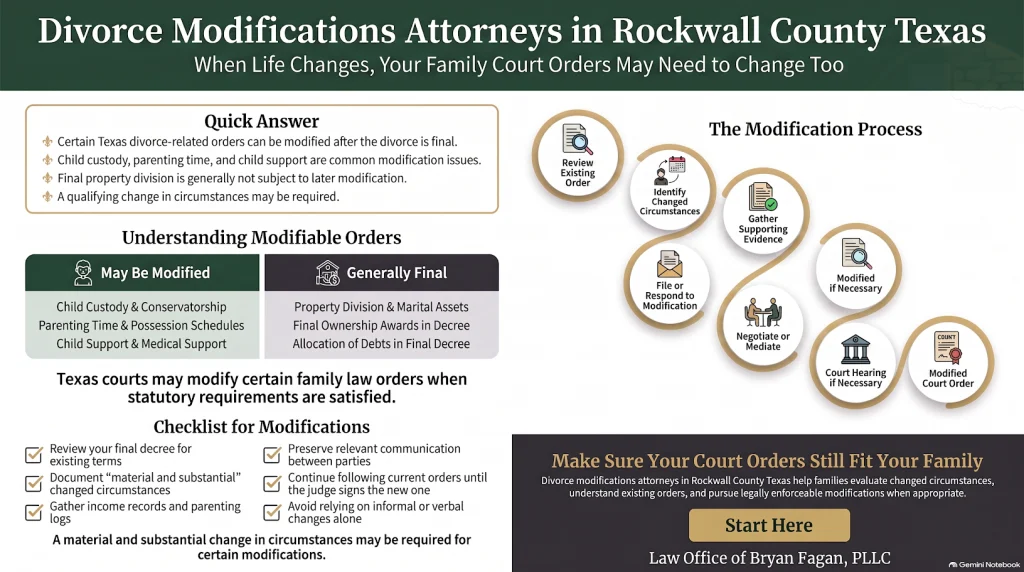
Start by identifying which order you are asking about, because the answer changes with it. A single decree can contain conservatorship terms, a possession schedule, a geographic restriction, a child support obligation, a spousal maintenance obligation and a property division. Those are governed by different provisions and, in one case, by a provision that forecloses the request.
This table summarizes which provision governs each part of a decree. Each provision contains additional requirements and exceptions, and which one applies to your order is a question about the order’s actual terms.
| The part of the order, and what governs it | |
|---|---|
| Conservatorship — who holds which rights and duties | Modifiable under §156.101 on a material and substantial change, where modification is in the child’s best interest. The statute also provides alternative grounds that do not depend on a change in circumstances. |
| Possession and access — the schedule | Same provision, same standard. §156.101 covers orders setting the terms and conditions of conservatorship and orders providing for possession of or access to a child. |
| Who decides where the child primarily lives — within one year | Modifiable, with an added requirement. §156.102 requires a sworn affidavit attached to the petition, and the court declines to schedule a hearing unless the affidavit states adequate supporting facts. |
| The geographic restriction | Modifiable as part of a conservatorship modification. While the suit is pending, §156.006(b) limits when a temporary order may create, change or eliminate that restriction. |
| Child support | Modifiable under §156.401 by either of two routes — a material and substantial change, or the elapsed-time-and-variance route described below. Health care and dental coverage orders are addressed in the same provision. |
| Spousal maintenance | Modifiable under §8.057, which sits in Chapter 8 rather than Chapter 156 and carries its own limits — including that a modification reaches only payments accruing after the motion is filed. Contractual alimony is a different instrument again. |
| Property division | Not modifiable. §9.007 limits the court’s post-decree power over the division. The court may render orders to assist in implementing or to clarify the division, and may not amend, modify, alter or change it. An order that does alter the substantive division is outside the court’s power. |
This table summarizes which provision governs each part of a decree. Each provision contains additional requirements and exceptions, and which one applies to your order is a question about the order’s actual terms.
What Does a “Material and Substantial Change” Actually Mean?
Divorce Modifications Attorneys in Rockwall County Texas evaluate a material and substantial change by comparing the circumstances that existed when the current order was established with the circumstances that exist now. Under Texas Family Code §156.101, the comparison generally begins with the earlier of the date the order was rendered or the date a mediated or collaborative law settlement agreement underlying the order was signed. That timing matters because the relevant starting point may be the settlement agreement—not the date printed on the final order.
Texas law does not provide a checklist of events that automatically qualify as material and substantial changes. Instead, the court considers whether the circumstances of the child, a conservator, or another party affected by the order have changed in a meaningful way. A major change in a parent’s work schedule, relocation, or a child’s needs may be relevant, but the significance of the change must be established with evidence rather than simply asserted.
For example, suppose a possession schedule was created when both parents worked regular weekday hours. Two years later, one parent begins working rotating overnight shifts and can no longer consistently exercise the weekday possession provided by the order. The new job does not automatically justify modification, but the resulting change in the family’s circumstances may support a request to reconsider the possession schedule.
For child-related orders, proving changed circumstances is only part of the case. Section 156.101 also requires the requested modification to be in the child’s best interest. A parent can therefore prove that life has materially changed and still fail to obtain the requested modification if the evidence does not show that the proposed new arrangement would be better for the child.
For families considering a modification in Rockwall County, the practical starting point is to identify what changed, when it changed, and how that change affects the specific provision you want modified. That creates a clearer framework for determining whether the facts support a Texas modification case rather than simply showing that life looks different today.
A Scenario
A possession schedule was entered when both parents worked conventional weekday schedules. Two years later, one parent begins working overnight shifts and cannot exercise the ordered weekday possession. The question is not simply whether the job changed. The court looks at whether the change is material and substantial, and at whether changing the schedule would serve the child’s best interest. Both have to be answered, and the second is answered with evidence about the child rather than about the parent’s calendar.
Why This Matters
The two questions get collapsed into one. “Something changed” is an argument about the first. “And this arrangement is better for my child” is an argument about the second. A petition that only explains what changed has addressed only part of the analysis. The court must still decide whether the requested modification serves the child’s best interest.
What If Your Former Spouse Filed the Modification?
If your former spouse is asking the court to modify the existing order, they have the burden to establish the legal grounds for the change they are requesting. Defending the existing order starts with testing whether they have actually met that burden. A person asking a court to change a child-related order has to establish both halves of §156.101: that circumstances have materially and substantially changed since the earlier of the order’s rendition or the signing of an underlying agreement, and that the modification would be in the child’s best interest.
So a response is built around specific questions. Has anything actually changed since the order, measured from the right date? Is the change material and substantial rather than incidental or expected? And even if it is, does the requested change serve the child better than the arrangement already in place? The existing order and evidence of how it has operated in practice are part of the factual record the court can evaluate.
One provision is worth knowing if you are considering a response of your own. Under §156.007, filing a motion to modify on the basis of a material and substantial change does not, on that basis alone, count as admitting that circumstances have materially and substantially changed as to any other matter. Responding to one request does not concede another.
How Do You Modify Conservatorship, Possession or Access?

Through a suit for modification under Chapter 156, filed in the court with continuing jurisdiction over your case. §156.101 is the provision that lets a court modify an order appointing a conservator, an order setting the terms and conditions of conservatorship, or an order providing for possession of or access to a child.
Chapter 156 also contains provisions addressing specific situations rather than general change: increased expenses arising from a change of residence, modification following a conviction for child abuse, modification following a conviction for family violence, modification connected to a conservator’s military duty or deployment, and modification after the death of a conservator. If your situation matches one of those, the analysis starts in a different place, and it is worth naming the situation at the first meeting rather than describing it as a general change in circumstances.
For the underlying framework these orders come from, see child custody in Rockwall County and parental visitation.
Why Is the First Year Different?
Divorce Modifications Attorneys in Rockwall County Texas must account for an additional threshold when a parent seeks, within the first year, to change who has the exclusive right to designate the child’s primary residence. Under Texas Family Code §156.102, a qualifying suit filed no later than one year after the earlier of the order’s rendition or the signing of an underlying mediated or collaborative law settlement agreement must include an affidavit with supporting facts.
The affidavit is more than paperwork. It must support at least one of the grounds specified in §156.102: that the child’s present environment may endanger the child’s physical health or significantly impair emotional development; that the person with the exclusive right to designate primary residence is seeking or consenting to the modification and it is in the child’s best interest; or that the person with that exclusive right has voluntarily relinquished primary care and possession for at least six months and modification is in the child’s best interest. If the affidavit does not state adequate facts, the court must deny the requested relief and refuse to schedule a hearing.
The one-year rule is narrower than many parents assume. It does not prohibit every Texas divorce modification during the first year; it applies to this particular request to change the designation of the person with the exclusive right to determine primary residence. The statute also provides that the voluntary-relinquishment ground does not apply when primary care was temporarily relinquished because of military deployment, mobilization, or temporary military duty.
For families in Rockwall County, the practical lesson is to identify precisely what you want changed before filing. If primary residence is disputed during that first year, the supporting affidavit can determine whether the request reaches a hearing at all. In more complex cases involving allegations of assault, family violence, or immediate safety concerns, those facts may also raise legal issues beyond an ordinary modification proceeding; readers facing those circumstances can review the firm’s Rockwall County assault resource while evaluating the family-law issues separately.
How Do You Modify Child Support?
§156.401 gives two routes, and the second one does not require proving that anything changed. The first is the familiar standard: the circumstances of the child or a person affected by the order have materially and substantially changed since the earlier of the order’s rendition or the signing of a mediated or collaborative law settlement agreement on which the order is based.
The second route is arithmetic. Where three years have passed since the order was rendered or last modified, and the monthly ordered amount differs from what the child support guidelines would produce by either 20 percent or $100, that difference is itself a ground for modification. This is the route people miss. It does not ask what happened in your life; it asks how far the order has drifted from the guideline figure over time.
Three further points in the same provision. If the parties agreed to an order setting support at an amount different from the guidelines, §156.401 restricts modification to the material-and-substantial-change route. An order of joint conservatorship is not, by itself, a ground for modifying support. And the statute addresses incarceration directly: incarceration of an obligor for a period exceeding 180 days is a material and substantial change for purposes of the section, and release from incarceration is as well where the obligation had been abated, reduced or suspended during it.
Filing matters, because a support modification does not reach back to the date your circumstances changed. Under §156.401(b), and subject to narrow exceptions, a support order may be modified as to the amount ordered only for obligations accruing after the earlier of the date of service of citation or an appearance in the suit to modify. A parent whose income dropped months ago and who has not filed is accruing the old amount in the meantime.
For the underlying obligation and how it is calculated, see child support in Rockwall County.
Can a 12-Year-Old Choose Which Parent to Live With?

No. A child does not choose, at 12 or at any age before adulthood. What Texas provides is different, and the difference matters to how you prepare a case. For a child 12 or older, §153.009 requires the chambers interview on a proper request when the issue concerns conservatorship or who holds the exclusive right to determine the child’s primary residence. The court has broader discretion to interview a child about possession, access or other issues in the suit.
So the child’s preference reaches the judge, privately, rather than in open court. It is information the court receives. It is not a decision the child makes, and it does not displace the best-interest analysis.
Preference does carry specific weight in one place. In §156.006, one of the conditions under which a court may enter a temporary order changing the primary-residence designation while a modification suit is pending is that the child is 12 or older and has expressed a preference to the court in chambers as provided by §153.009. That is a narrow, procedural role — not a right to decide.
Can Spousal Maintenance Be Modified After Divorce?
Court-ordered spousal maintenance can be modified, and the first question is whether what you have is court-ordered maintenance at all. Texas treats two things differently. Maintenance ordered by a court under Chapter 8 is a statutory obligation with statutory limits. Contractual alimony is an agreement the spouses made and the decree incorporated. They are modified by different mechanisms, and people use the word “alimony” for both.
For court-ordered maintenance, §8.057 governs. A party affected by the order files a motion in the court that originally rendered it, and the court may modify on a proper showing of a material and substantial change in circumstances occurring after the date of the order or decree.
Two limits in the same provision shape what a modification can achieve. The court applies the modification only to payments accruing after the motion to modify is filed — so the filing date, not the date circumstances changed, sets the reach. And the court may not increase maintenance to an amount or a duration exceeding the original order’s amount or remaining duration. Because the statute limits the amount and duration of a modified maintenance order, the relief available on modification is not symmetrical. The existing order matters as much as the changed circumstances.
Chapter 8 also addresses termination separately from modification, in §8.056. Termination and modification are different requests, and which one fits depends on what has happened rather than on which sounds stronger.
Contractual alimony sits outside §8.057. Because it is an agreement, what can be changed and how is a question about the agreement’s own terms. That is why the first step is reading the decree rather than assuming a standard applies. For the underlying obligation, see alimony and spousal support in Rockwall County.
What If One Parent Wants to Move?
If your order contains a geographic restriction, moving outside it is a modification question, not a personal decision. Many Texas orders require that a child’s primary residence stay within a defined area — a county, or a county and those adjacent to it. Changing or removing that restriction means modifying the order.
Chapter 156 also addresses a related consequence: §156.103 deals with increased expenses arising from a change of residence, which is a separate question from whether the move is permitted.
And the timing constraint is real. §156.006(b) limits a court’s power to enter a temporary order that creates, changes or eliminates the geographic area while the suit is pending, so a parent hoping to move first and litigate later is working against the statute rather than with it.
New Texas Law · Effective September 1, 2025
What If the Other Parent Keeps Denying Possession or Access?

Repeated denial is both an enforcement problem and, under a provision added by the Texas Legislature in 2025, potentially a modification ground. Enforcement is the immediate route: a motion asking the court to compel compliance with the order as written.
The 2025 change is in §156.107. As enacted, a finding that a conservator is in contempt for denial of court-ordered possession or access, where that conservator has previously been found in contempt at least three times for failing to comply with a possession or access order, constitutes a material and substantial change of circumstances sufficient to justify modification of the existing order.
Read that carefully, because the structure matters. It is a pattern provision, and it ties the modification ground to prior contempt findings. A history of denied possession does not itself create the contempt findings the statute references. Those findings arise through enforcement proceedings, which is why documenting violations and understanding when to seek enforcement can matter later. See enforcing a family law order.
Can Anything Change While the Modification Case Is Pending?
Yes, but the most consequential change is the one the statute restricts. §156.006 lets a court render a temporary order in a suit for modification. Then it carves out an exception.
Under §156.006(b), while a modification suit is pending, a court may not render a temporary order having the effect of creating or changing the designation of the person with the exclusive right to designate the child’s primary residence, or of creating, changing or eliminating the geographic area within which that residence must be maintained, unless the temporary order is in the child’s best interest and one of three conditions is met: the order is necessary because the child’s present circumstances would significantly impair the child’s physical health or emotional development; the person designated in the final order has voluntarily relinquished primary care and possession for more than six months; or the child is 12 or older and has expressed a preference to the court in chambers under §153.009.
And the first of those conditions carries its own filing requirement. §156.006(b-1) requires an affidavit attached to the motion, on personal knowledge or on belief based on representations from someone with personal knowledge, stating facts supporting the significant-impairment allegation — and directs the court to deny relief and decline to schedule a hearing unless the affidavit states adequate facts. The pattern is the same as §156.102: the document decides whether you get a hearing.
Is This a Modification or an Enforcement?
Modification changes what the order requires going forward. Enforcement makes someone do what the order already requires. Filing the wrong one costs time, and on the property division the distinction is not a matter of strategy — it is the difference between relief a court can grant and relief it cannot.
On the child-related orders, both routes exist and they answer different complaints. “The schedule no longer works because his job moved to nights” is a modification. “He is not returning our daughter on Sundays” is an enforcement.
On the property division, modification is not the route. §9.007 confines the court’s post-decree power: it may render orders to assist in implementing or to clarify the division, and it may not amend, modify, alter or change the substantive division. An order that does change the actual, substantive division is beyond the power of the divorce court and is unenforceable — not merely reversible. There is also a timing rule with two parts: the court may not render an implementation or clarification order before the 30th day after the final judgment is signed, and where a timely motion for new trial or to vacate, modify, correct or reform the decree is filed, the 30 days run instead from the order overruling that motion or its overruling by operation of law. So a former spouse who now believes the division was wrong is not looking at a modification suit, and the honest early conversation is about which of clarification, enforcement or an appellate remedy fits the facts.
Each of these treats a divorce order as a single document that either can or cannot be reopened. Texas treats it as several orders with several rules.
Six Assumptions Worth Correcting
Each of these treats a divorce order as a single document that either can or cannot be reopened. Texas treats it as several orders with several rules.
| The assumption, and what Texas law does | |
|---|---|
| “Circumstances changed, so the whole decree can be revisited.” | Chapter 156 reaches the child-related orders. §9.007 forecloses changing the property division whatever has changed. |
| “My child is 12, so she can decide.” | §153.009 provides an interview in chambers on request, not a decision. Best interest remains the court’s standard. |
| “I have to wait a year to file anything.” | §156.102’s affidavit requirement attaches to one request — changing who designates the primary residence — not to every filing. |
| “My income dropped, so support adjusts automatically.” | Support changes when a court modifies the order. Until then the existing order stands and arrears can accrue. |
| “We both agree, so we do not need the court.” | An informal arrangement is not an order. Without a modified order, the prior order is what a court enforces. |
| “He keeps withholding her, so I will stop paying support.” | Possession and support are separate obligations. Withholding one to answer the other creates a second problem rather than a remedy. |
Before You File
Which provision applies depends on what your order actually says. Bringing the order to the first conversation is worth more than describing it from memory.
What Happens After a Modification Case Is Filed?

Divorce Modifications Attorneys in Rockwall County Texas help families navigate several possible stages after a modification case is filed. The process can include filing and service, temporary orders, evidence gathering, negotiation or mediation, and a final agreed or contested order. Not every case requires every step.
The case begins with a petition filed in the court with continuing, exclusive jurisdiction over the existing order. Under Texas Family Code §156.003, a party whose rights and duties may be affected must receive notice. If the request involves changing who designates the child’s primary residence within the first year, §156.102 may also require a supporting affidavit before a hearing is scheduled.
Temporary issues can be addressed while the case is pending under §156.006, although additional restrictions apply to temporary changes involving primary residence and geographic restrictions. If the facts also involve an arrest or alleged impaired driving, those circumstances may create separate legal issues; families can learn more through our Rockwall County DWI and DUI resource.
In straightforward situations, parents may reach an agreement and present a proposed agreed order to the court. In more complex cases, discovery, disputed evidence, mediation, temporary orders, and a contested hearing may be necessary before the court determines whether the requested modification meets Texas law.
There is no single timeline for a Rockwall County modification case. How long the process takes depends on what needs to change, whether immediate relief is requested, how much the parties dispute, and whether an agreement can be reached. Identifying the disputed issues and supporting evidence early can provide a clearer path through the case.
Modification in Rockwall County
The modification standards above are Texas law statewide. Rockwall County determines where your case is heard and how the local court process operates — not a separate set of substantive modification rules.
One local point does real work in modification cases: a suit to modify is filed in the court with continuing, exclusive jurisdiction over the existing order, which is ordinarily the court that rendered it. If your existing order was entered in Rockwall County, that is where the modification belongs.
If your existing order was entered in another Texas county and the child now lives in Rockwall County, the original court’s continuing jurisdiction does not necessarily mean the case must remain there. Chapter 155 contains transfer rules for modification proceedings, including a mandatory-transfer provision when the statutory requirements are met. Whether transfer is available — and whether a motion is timely — should be addressed at the beginning of the case.
Rockwall County’s district courts — the 382nd, the 439th and the 503rd — hear family-law matters, and the county’s County Courts at Law hear family-law matters as well. The 503rd is new: the Legislature created the 503rd Judicial District for Rockwall County in 2025, and its first judge took the bench on December 1, 2025. The courthouse is at 1111 E. Yellowjacket Lane, and the District Clerk’s office holds the district court files. Appeals go to the Fifth Court of Appeals in Dallas. For court information, see the firm’s Texas family law courts resource.
One piece of local practice is worth knowing before you file: Rockwall County publishes standing orders for family-law cases. The county makes available Family Law Standing Orders for the District Courts and the County Courts at Law, and separately a Parenting Class Standing Order. A standing order is entered by the court in advance and may apply automatically to cases within its scope rather than requiring a party to request the protections individually. The principal standing order applies to child-related modification cases, and that matters from the day you file. Rockwall County’s standing order regarding children, property and conduct of the parties states that it applies to every divorce suit and every suit affecting the parent-child relationship filed in Rockwall County. A modification concerning children is a suit affecting the parent-child relationship, so the standing order applies when that modification is filed.
Read it provision by provision rather than as one undifferentiated set of rules. Some of its provisions are expressly limited to an original divorce action, which tells you the drafters knew how to narrow a provision when they intended to. The separate parenting-class order the county publishes is framed around the filing of an original petition for divorce.
That is worth raising at the first meeting for a specific reason. In a modification case you already have a final order you are living under, and a standing order can add requirements on top of it from the day the suit is filed. Ask which standing orders the assigned court applies to a modification suit, and read them before filing rather than after.
Our office at 908 N. Goliad Street is the firm’s base in the county. If you are coming in, plan your visit to our Rockwall office. Cases here connect to the rest of the county practice — divorce in Rockwall County, fathers’ rights and mothers’ rights.
Meet Lisa Kreider, Your Rockwall Family Law Attorney
Your Rockwall Attorney
Lisa Kreider
Rockwall Family Law Attorney · Rockwall Office
Lisa practices from our Rockwall office and helps clients work through divorce, child custody, child support, adoption, modifications, enforcement, contested hearings and mediation. Her approach is to listen first, get clear on what is actually happening, and help you figure out what comes next — building a plan, pursuing resolution where resolution is realistic, and preparing for court when it is not.
She has been licensed in Texas since 2017.
A modification suit is a returning case rather than a new one, and it turns on the order you already have and the record behind it. Lisa provides the local family-law connection for Rockwall County matters, with additional attorneys and legal professionals available when a case requires broader support.
Before You Call
You do not need this complete. Bringing what you have makes the first conversation about decisions instead of reconstruction — and the same records that help an attorney understand what changed are the records that help prove, or oppose, a modification.
- The current order, in full — including any mediated settlement agreement behind it.
- The date the order was signed, and the date of any agreement it was based on.
- Which county rendered it, and whether anyone has moved since.
- What specifically you want changed, stated as a provision rather than a feeling.
- What changed, and roughly when.
- For support: current income for both parents, and what the order requires now.
- Any prior enforcement filings, findings of contempt, or protective orders.
- A calendar of missed or denied periods of possession, if that is the issue.
- Pay records and employment information for either parent where income is part of the question, including former employment.
- School, daycare or medical communications where the child’s circumstances are what changed.
- Relevant communications between the parents — not everything, but what bears on the change you are describing.
Sources and Legal Resources
This page summarizes selected Texas authorities on modification of family-law orders and on the limits of a court’s power after a divorce decree is final. Individual provisions are named in the body where they are discussed, and the sources below link to the official Texas Legislature and Rockwall County publications they come from.
Texas Statutes
- Chapter 156 — modification of orders affecting the parent-child relationship, which contains:
- — §156.006, temporary orders in a suit for modification
- — §156.101, grounds for modification of conservatorship, possession and access
- — §156.102, modification of the exclusive right to designate primary residence within one year
- — §156.107, modification on a finding of contempt for denial of possession and access
- — §156.401, grounds for modification of child support
- Chapter 153 — including §153.009, interview of a child in chambers
- Chapter 8 — including §8.056, termination of a maintenance obligation, and §8.057, modification of a maintenance order
- Chapter 155 — continuing, exclusive jurisdiction and transfer of suits affecting the parent-child relationship
- Chapter 9 — including §9.007, limitation on the power of a court to enforce a property division, and §9.008, clarification orders
Recent Texas Legislation
- House Bill 3181, 89th Texas Legislature (2025) — the enrolled act that added §156.107, effective September 1, 2025
Rockwall County Resources
Authorities reviewed as of September 2026. Statutes change, and this page is general information rather than advice about your situation.
Conclusion
A divorce order may be final, but some of the obligations within it can change when Texas law allows it. Divorce Modifications Attorneys in Rockwall County Texas can help determine whether changed circumstances support a modification of conservatorship, possession, child support, or another modifiable provision—or whether the real issue calls for enforcement, clarification, or a different remedy.
In straightforward situations, parents may agree that a possession schedule needs to change and simply need to turn that agreement into an enforceable court order. In more complex cases, primary residence, relocation, substantial income changes, repeated possession problems, temporary orders, or competing evidence about a child’s best interest may require a more developed strategy. If serious criminal allegations or the death of a parent are also involved, the family-law and criminal-law issues should be evaluated separately; our Rockwall County homicide resource explains that distinct area of Texas law.
At the Law Office of Bryan Fagan, PLLC, the starting point is clarity: identify the provision you want changed, what has happened since the existing order, and what evidence supports your position. From there, our Rockwall family-law team can help determine what Texas law permits and what level of legal strategy fits your situation—so you can make the next decision with greater confidence while protecting what matters most.
Listen to Our Texas Family Law Podcast
Prefer listening? In this episode, we discuss divorce modifications in Rockwall County, including when existing court orders may be changed, what legal standards can apply, and how an attorney can help you navigate the modification process.
About the Author
Texas Family Law Attorney & Founder
Bryan Fagan
Founder, Law Office of Bryan Fagan, PLLC
Bryan Fagan is the founder of the Law Office of Bryan Fagan, PLLC and a Texas family law attorney who has represented families in divorce, child custody, property division and other family-law matters since 2012. He has built the firm around helping clients understand their legal options, develop a clear strategy, and make informed decisions during difficult family transitions.
Bryan also develops educational resources intended to make Texas family law easier to understand. This article is part of the firm’s educational resources, and its purpose is to help readers see which parts of a Texas divorce order can be changed, which cannot, and what a court requires before it will change one.
About Our Firm
The Law Office of Bryan Fagan, PLLC has served Texas families since 2012 through a network of local offices, including our Rockwall office. That structure is the point: for a Rockwall County matter you work with an attorney practicing from the Rockwall office, supported by the firm’s wider team.
For the firm’s history, values and full attorney roster, see about the Law Office of Bryan Fagan. For Rockwall specifically, start with the attorneys at our Rockwall office.
Frequently Asked Questions
No. §9.007 limits the court’s post-decree power to implementing and clarifying the division, and excludes amending, modifying, altering or changing it. An order that changes the substantive division is unenforceable. If a provision is ambiguous, clarification may be available; if someone is not complying, enforcement may be. Neither redoes the division.
There is no general waiting period, but one request carries an added requirement. Under §156.102, a suit filed within a year of the order seeking to change who has the exclusive right to designate the child’s primary residence needs a sworn affidavit, and the court declines to set a hearing unless the affidavit states adequate facts.
Not on both routes. §156.401 allows modification on a material and substantial change, and separately where three years have passed since the order was rendered or last modified and the ordered monthly amount differs from the guideline amount by 20 percent or $100. The second route is about drift from the guidelines rather than about events.
Agreement can simplify the path considerably, but it does not replace the existing court order. An informal arrangement is not itself a modified order, so the written order remains the order the court can enforce. If both parties agree to the change, the new arrangement can be presented to the court as an agreed modification rather than litigated as a contested request. Once entered, the modified order — not the informal arrangement — becomes the enforceable framework going forward.
It reaches the judge, and it does not decide the case. Under §153.009 the chambers interview is required on proper application for a child 12 or older where the issue is conservatorship or who holds the exclusive right to determine the child’s primary residence; for possession, access or other issues in the suit it is within the court’s discretion. The court still applies the best-interest standard.
Not on your own, and a temporary order doing it is restricted. §156.006(b) limits when a court may render a temporary order creating, changing or eliminating the geographic area while a modification suit is pending, and one of the available conditions carries its own affidavit requirement.
Court-ordered maintenance can be modified under §8.057 on a showing of a material and substantial change in circumstances occurring after the date of the order or decree. Two limits matter: the modification reaches only payments accruing after the motion is filed, and the court may not increase maintenance beyond the amount or the remaining duration of the original order. Contractual alimony is a different instrument and is addressed by the agreement that created it.
There is no fixed timeline. An agreed modification can resolve far sooner than a contested case that requires temporary orders, discovery, mediation and a final hearing. Timing turns on what is being changed, whether temporary relief is sought, how much of the evidence is disputed, and the assigned court’s docket.
A modification begins with the court that has continuing, exclusive jurisdiction over the child. But that does not necessarily mean the case must remain in that county. Texas Family Code Chapter 155 contains transfer rules, including circumstances in which a timely motion requires transfer when the child has lived in another Texas county for at least six months. Transfer should be evaluated before filing because the statute also contains timing requirements.
Modification in Rockwall County
Find Out Which Part of Your Order Can Actually Change
Tell us what your order says, what changed, and when. We can help you understand which provision applies and what a court would require next.
This page provides general information about Texas law and the Law Office of Bryan Fagan, PLLC. It is not legal advice, and reading it does not create an attorney-client relationship. Whether a particular approach is appropriate depends on your circumstances.