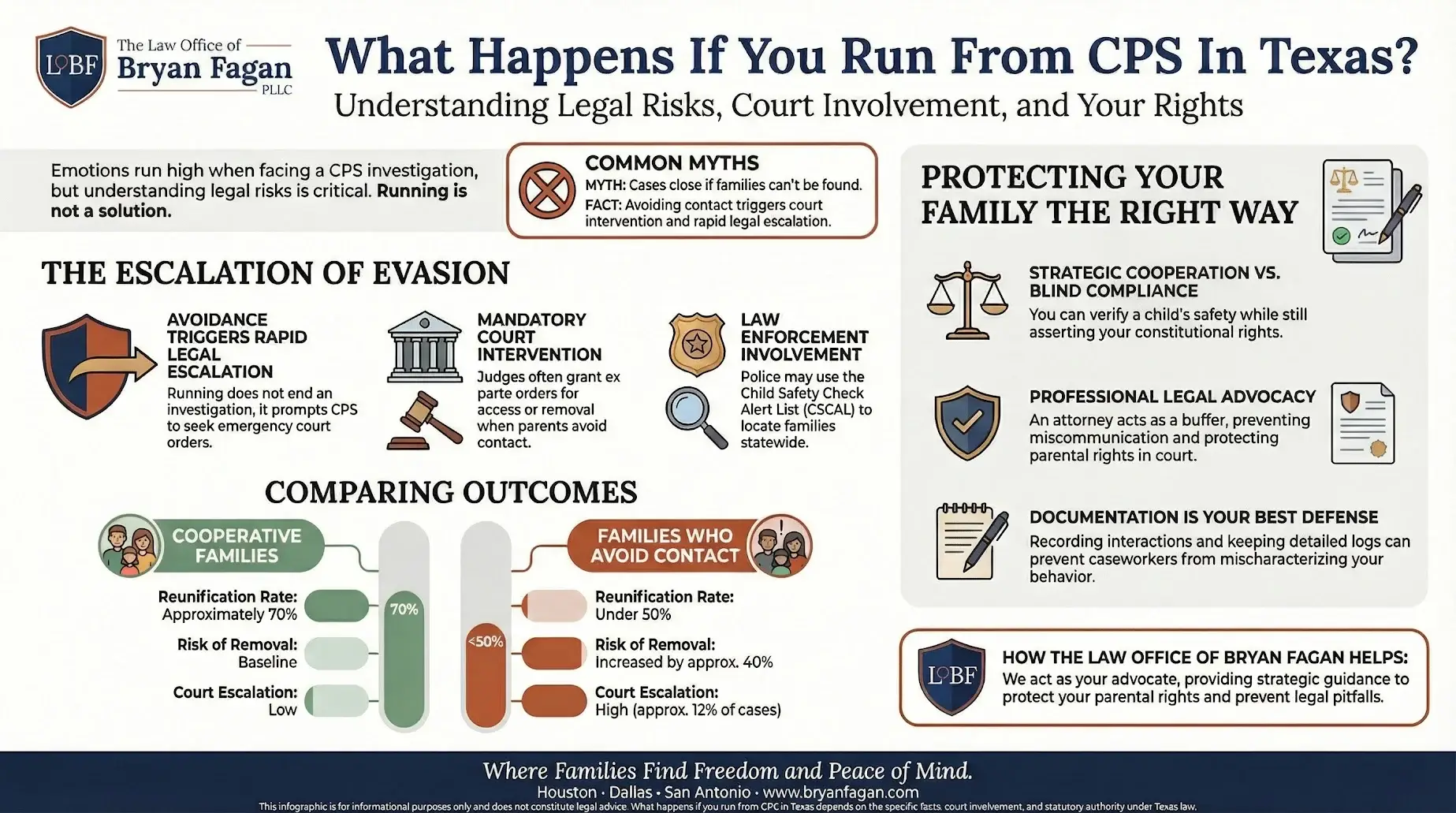

The knock came just after sunset, and Maria’s heart dropped before she even reached the door. When she saw the CPS badge, panic took over. She grabbed her phone and whispered to her sister, “They’re here. I’m leaving.” If you’ve ever wondered, What Happens If You Run From CPS In Texas, it is usually because fear is louder than logic in that moment. The immediate reality is this: leaving does not stop a CPS investigation—it often speeds up court involvement under Texas Family Code Chapters 261 and 262.
At The Law Office of Bryan Fagan, PLLC, we have seen how quickly a frightened reaction can turn a manageable situation into a legal emergency. Bryan Joseph Fagan, a South Texas College of Law graduate and a recognized authority on Texas divorce and custody law, founded this firm to guide families through uncertainty with clarity and strength. Our mission is to empower people to reclaim freedom and peace of mind during life’s hardest transitions. We do that by combining compassionate counsel with straightforward legal education so parents can make informed decisions instead of reactive ones.
Texas courts operate under a single guiding principle found in Texas Family Code §153.002: the best interest of the child. When CPS cannot verify a child’s safety because a parent avoids contact, judges may interpret that absence as a potential risk factor. What might have remained an investigation can quickly escalate into a formal lawsuit filed by the Department of Family and Protective Services (DFPS). In urgent situations, CPS may seek an ex parte order—meaning a judge can grant access or even authorize temporary removal without prior notice to the parent.
We have represented parents who believed that leaving town would protect their child, only to find themselves facing emergency hearings within days. Once court orders are issued, law enforcement can become involved to enforce them. The situation becomes more complex, more public, and more stressful than it needed to be.
In the sections that follow, you will learn exactly how the CPS process works in Texas, when an investigation becomes a lawsuit, what emergency removal really means, and how your early response can shape the entire case. Most importantly, you will discover how calm, informed action—supported by experienced legal counsel—can protect your family’s future.
If CPS has contacted you, take a breath. You are not powerless. With the right guidance, you can move forward with clarity instead of panic and protect what matters most.
Key Takeaways
- Avoiding CPS does not end an investigation—it triggers escalation that can include court orders, emergency removal, and law enforcement involvement under Texas Family Code Chapters 261-262.
- Texas courts prioritize child’s safety above parental comfort, and judges may grant ex parte orders allowing CPS access or temporary custody within hours of receiving a sworn affidavit.
- Running from CPS creates a negative perception that courts interpret as potential evidence you may be hiding safety concerns, increasing the risk of removal by approximately 40% compared to cooperative families.
- Custody is not automatically terminated for avoiding CPS, but prolonged evasion combined with other risk factors can lead to termination of parental rights under Texas Family Code §161.001.
- Cooperation combined with legal representation produces the best outcomes, with reunification rates of approximately 70% for cooperative families compared to under 50% for those who avoid contact.

Your Family’s Future Starts Here
Don’t navigate your legal journey alone. Schedule a consultation now and get the clarity and support you deserve.
What Happens If You Run From CPS In Texas? The Short Answer
Under Texas law, when parents avoid contact during a CPS investigation, the system moves quickly to protect the child’s safety. If investigators cannot physically verify that a child is safe, the Texas Department of Family and Protective Services (DFPS) may petition a district court for immediate intervention under Texas Family Code Chapters 261 and 262. For families asking What Happens If You Run From CPS In Texas, the short answer is this: the case does not disappear—it escalates.
Texas Family Code §262.101 and §262.102 authorize CPS to request ex parte relief when the agency presents a sworn affidavit establishing urgent circumstances or an inability to ensure the child’s safety. An ex parte order allows a judge to grant access to the child—or even temporary removal—without advance notice to the parent. Courts apply the “best interest of the child” standard outlined in Texas Family Code §153.002, and when a parent cannot be located or refuses access, judges may interpret that behavior as a potential risk factor. Recent updates and procedural refinements to Chapter 262 emphasize affidavit standards and judicial oversight, but the core authority remains: if safety cannot be verified, courts may act swiftly.
The practical impact is significant. Avoiding CPS contact shifts the legal dynamic. An investigation that might have concluded with minimal disruption can transform into a formal Suit Affecting the Parent-Child Relationship (SAPCR), temporary managing conservatorship awarded to DFPS, supervised visitation, and months of court monitoring. Under Texas Family Code §262.201, a full adversary hearing must occur within 14 days of an emergency removal, and parents have the right to counsel at that stage. However, early non-cooperation can shape how the court views the case moving forward.
In one Harris County matter, parents who left town after an initial CPS visit were back in court within days. The judge granted DFPS temporary managing conservatorship and restricted unsupervised access pending further review. What began as a preliminary inquiry turned into extended litigation lasting more than a year. Situations like this illustrate why informed action matters more than reactive decisions.
Families facing these circumstances deserve clear guidance grounded in Texas law. Our legal team regularly advises parents on their rights and obligations during CPS investigations, including how to respond strategically while preserving parental rights. For a deeper understanding of the investigative process, we encourage reviewing our detailed resource: Understanding CPS Investigations in Texas: What You Need to Know. Knowledge empowers parents to move from fear to informed decision-making, which is often the most effective way to protect both their children and their future.

Why CPS Must Locate the Child During an Investigation
Child Protective Services operates under a clear statutory mandate in Texas. Under Texas Family Code Chapter 261, DFPS has a legal duty to investigate reports of suspected abuse or neglect and to verify a child’s safety through direct assessment. This obligation is not designed to punish parents; it exists to ensure child welfare and to allow investigators to determine whether allegations are unfounded or require court intervention. When families search What Happens If You Run From CPS In Texas, it is often because they do not realize that CPS is legally required to complete this verification process once a report is made.
Texas law sets strict investigative timelines. In cases involving allegations of imminent danger, CPS must attempt face-to-face contact within 24 hours. For high-risk but non-immediate situations, contact is typically required within 72 hours. These requirements stem from agency policy grounded in Chapter 261 and are reinforced by procedural safeguards that ensure accountability and documentation. The caseworker must observe the child, assess living conditions, and evaluate any immediate safety concerns. Without that verification, the agency cannot close the case responsibly and may escalate under Texas Family Code Chapter 262 by seeking court-ordered access.
It is also important to understand that CPS investigates allegations, not proven facts. Reports can come from teachers, medical professionals, relatives, neighbors, or anonymous sources. The purpose of the investigation is to separate unfounded claims from genuine risk. When parents refuse access or actively interfere, CPS is prevented from completing its statutory duties. That interference can shift judicial perception and may even lead to allegations of obstructing the process. For a deeper look at the legal consequences of interference, we recommend reviewing How Your Interfering With a Child Protective Services Investigation Can Affect Your Case.
Courts interpret behavior through the lens of the Best Interest of the Child standard set out in Texas Family Code §153.002. Recent legislative updates continue to emphasize judicial oversight and due process, but they also reinforce the court’s authority to act swiftly when child safety cannot be verified. Data trends have shown that cases involving prolonged non-cooperation are more likely to escalate into removal proceedings under §262.101 or emergency hearings under §262.201. That does not mean avoidance guarantees removal, but it does increase scrutiny and risk.
Our legal team routinely counsels parents on how to protect their rights while avoiding unnecessary escalation. You can explore additional guidance through our Texas CPS legal resource center to better understand investigative timelines and court procedures. Knowledge reduces fear. Calm, informed engagement often prevents minor concerns from turning into major litigation. By understanding how Chapter 261 investigations function and responding strategically rather than reactively, families place themselves in the strongest possible position to protect both their children and their future.
What CPS Does If Parents Avoid Contact
When parents cannot be reached during a CPS investigation, the Department of Family and Protective Services does not simply close the file. Instead, the agency follows a structured escalation process designed to locate the child and fulfill its statutory duty under Texas Family Code Chapter 261. For families asking What Happens If You Run From CPS In Texas, understanding this sequence is critical because avoidance often triggers more intensive intervention rather than resolution.
Initially, caseworkers will attempt multiple home visits at varying times of day to make face-to-face contact, as required by agency protocol. They may also reach out to schools to verify attendance and, when legally permitted, interview the child. At the same time, investigators commonly contact relatives, family friends, medical providers, and other collateral sources who may have relevant information. Texas Family Code §261.202 grants CPS subpoena authority during an active investigation, allowing the agency to obtain certain records from schools, physicians, and service providers without parental consent when necessary to assess safety. Recent updates to investigative procedures continue to emphasize documentation standards and oversight, but the core authority to gather records remains firmly grounded in statute.
If those efforts fail to confirm the child’s safety, CPS may coordinate with local law enforcement to conduct welfare checks or assist in locating the child. In more serious cases, children may be entered into alert systems or assigned to specialized investigative units. Where an existing court order for conservatorship is in place, additional enforcement tools may be used to ensure compliance. Under Texas Family Code Chapter 262, continued inability to verify safety can lead to court petitions for access or emergency relief, reinforcing that non-cooperation can quickly shift the matter into formal litigation.
Data from DFPS in recent years reflects that a meaningful percentage of cases escalate specifically because contact cannot be established. While remote work and relocation trends have complicated investigations, courts consistently prioritize child safety above procedural delays. From a legal standpoint, the system is designed to move forward, not pause, when a child’s welfare cannot be confirmed.
Families navigating these situations deserve both clarity and compassion. Our firm regularly guides parents through CPS assessments and investigations with a focus on preserving rights while demonstrating stability. For a deeper look at how assessments work and how to respond effectively, we encourage you to review From Questions to Solutions: Mastering CPS Assessments in Texas. You may also find helpful insights in our broader Texas CPS Resource Center, where we explain investigative timelines, court procedures, and strategic responses in plain language.
Avoidance often feels protective in the moment, but informed action is far more powerful. By understanding how CPS investigations escalate under Texas law and responding thoughtfully rather than reactively, parents place themselves in a stronger position to protect both their children and their future.

Can CPS Get a Court Order If You Avoid Them?
Yes. Under Texas Family Code Chapter 262, CPS can file for a court order authorizing access to your child or emergency removal when you avoid contact. This process moves quickly—often within hours of filing.
The mechanism works like this: a CPS caseworker prepares a sworn affidavit detailing their failed attempts to contact you, the nature of the initial allegations, and any risk indicators suggesting the child may be in danger. This affidavit is presented to a Texas district court judge, who reviews the information and determines whether to grant access or removal authority.
These ex parte orders are issued without advance written notice to parents specifically because the court recognizes that in genuine emergency situations, providing notice could allow parents to flee or hide children. The legal standard focuses on whether CPS has demonstrated reasonable grounds to believe the child’s safety cannot be verified through voluntary cooperation.
Once an order is issued, CPS has legal authority to enter the child’s home with law enforcement assistance. If you continue to avoid contact at this stage, you transition from civil non-cooperation into potential criminal territory for interference with court proceedings.
The 2025 DFPS policy changes have tightened affidavit standards following Sunset review recommendations to reduce erroneous removals. However, the basic authority to seek court intervention when parents avoid contact remains firmly in place.
Can Law Enforcement Become Involved?
Law enforcement agencies become involved in CPS cases under two distinct circumstances: civil court enforcement and criminal investigation. Understanding this distinction is crucial for parents worried about arrest.
In civil matters, police assist CPS in executing court orders. This might include conducting welfare checks at the request of caseworkers, accompanying investigators to homes where access has been granted by court order, or helping locate children who cannot be found through normal means. These activities do not result in criminal charges against parents.
Criminal involvement occurs when parental behavior crosses specific legal lines. Under Texas Penal Code §25.06, harboring a child to prevent CPS from exercising court-ordered conservatorship can result in criminal charges. Obstruction of justice charges may apply when parents actively conceal children from court-authorized searches.
Statistics from DFPS indicate that approximately 5-10% of CPS cases involve police assistance. However, only a small fraction of those result in criminal charges. Intent matters significantly—simply being difficult to reach differs legally from actively hiding children after a court has ordered access.
In high-risk situations, particularly those involving suspected child abuse, sexual abuse, or domestic violence, law enforcement involvement increases substantially. If authorities believe a child faces immediate threat or imminent danger, they may issue alerts similar to AMBER alerts to locate the family.
Possible Legal Consequences of Avoiding CPS
The consequences of avoiding CPS cascade quickly and can affect your family for years. Understanding these outcomes helps illustrate why cooperation combined with legal counsel produces far better results.
Court Hearings: Within 14 days of emergency removal, Texas law requires an adversary hearing under Texas Family Code §262.201 where parents can challenge CPS findings and present evidence. If you are not present or represented, the court proceeds without your input.
Temporary Custody Changes: Courts frequently grant temporary custody to CPS or approved family members when parents cannot be located. This temporary arrangement can last months while the court proceedings continue.
Supervised Visitation: Even when children are not removed, courts may order that all parental contact occur under supervision until the investigation concludes and safety concerns are addressed.
Mandatory Service Plans: Courts routinely order parents to complete parenting classes, mental health services, or substance abuse treatment as conditions for reunification.
Contempt of Court: In extreme cases where parents defy court orders, judges may impose fines or jail time for contempt. This criminal record then affects future custody decisions.
Parental Rights Termination: Under Texas Family Code §161.001, chronic evasion combined with other evidence of unfitness can lead to permanent termination of parental rights. DFPS data shows terminations increased 8% among non-cooperative families compared to those who engaged with the legal process.
The timeline moves quickly. From initial contact to emergency removal to adversary hearing can span just two weeks. Families who seek legal advice immediately fare substantially better than those who try to avoid the situation.
Does Avoiding CPS Automatically Mean Losing Custody?
No, avoiding CPS contact does not automatically terminate your parental rights. Under Texas Family Code §161.001, termination requires clear and convincing evidence that a statutory ground exists and that ending the parent-child relationship is in the child’s best interest. Simply asking What Happens If You Run From CPS In Texas does not mean the outcome is predetermined. While avoidance can negatively impact how a judge views the case, it is not, by itself, grounds for permanent termination.
Texas courts evaluate the totality of the circumstances under the Best Interest of the Child standard found in Texas Family Code §153.002. Judges examine the nature of the allegations, any verified evidence of harm or risk, the parent’s overall stability, and—critically—the parent’s willingness to cooperate once court proceedings begin. Recent legislative updates and procedural refinements continue to emphasize judicial oversight and due process protections, including timely adversary hearings under §262.201 and the statutory one-year dismissal deadline under §263.401, which generally requires CPS cases to conclude within 12 months unless extended for good cause.
Statewide data consistently shows that a significant percentage of escalated cases ultimately result in reunification when parents engage in services and demonstrate improvement. The system is structured not only to protect children but also to provide parents with a path toward restoration when appropriate. Courts recognize that fear, misunderstanding, or cultural barriers may initially influence a parent’s response. Texas appellate decisions have reversed termination rulings when the evidence showed that avoidance stemmed from confusion or miscommunication rather than actual danger to the child. Once parents meaningfully participated in services and complied with court orders, reunification became possible.
That said, prolonged non-cooperation does increase risk. Cases involving extended evasion often last substantially longer and may involve temporary managing conservatorship granted to the Department of Family and Protective Services under Chapter 262. The longer a child remains in foster care or alternative placement, the more complex reunification becomes, particularly as permanency deadlines approach under Chapter 263.
Families navigating these difficult moments deserve clarity about their rights and obligations. For a deeper explanation of what parents can legally refuse and what cooperation may look like in practice, we encourage you to review What Are My Rights When CPS Comes to My House?. You may also find helpful guidance in our broader Texas CPS legal resources, where our legal team explains investigative timelines, hearings, and strategic responses in plain language.
The takeaway is this: while avoidance complicates matters, it does not automatically end your parental rights. Informed action, timely legal representation, and meaningful engagement with the court process can make a profound difference. With the right guidance, families can move from fear toward stability and, in many cases, reunification.

Common Myths About Running From CPS In Texas
Understanding legal reality versus common misconceptions can prevent families from making devastating mistakes.
Myth: “CPS can’t do anything without proof.” Reality: CPS investigations begin based on reports, not proven facts. Under Texas law, CPS authority to investigate derives from allegations meeting certain thresholds, and courts can issue ex parte orders based on sworn affidavits—not courtroom-proven evidence. The investigation itself determines whether allegations have merit.
Myth: “If you don’t answer the door, the case goes away.” Reality: Refusing entry simply triggers escalation. CPS will attempt contact repeatedly, reach out to schools and family members, and ultimately seek court orders compelling access. The investigation does not disappear—it intensifies.
Myth: “Moving to another county ends the investigation.” Reality: DFPS maintains statewide jurisdiction in Texas. Moving counties does not terminate investigations. For interstate moves, the Interstate Compact on the Placement of Children (ICPC) enables cooperation between state child welfare agencies. Running across state lines can actually escalate matters by suggesting flight risk.
Myth: “CPS needs a warrant every time.” Reality: Under Texas Family Code §262.104, CPS may remove children without a warrant when exigent circumstances suggest imminent danger. Additionally, court orders granting access do not require traditional search warrants. The legal standard differs from criminal law contexts.
Attorney surveys indicate that approximately 40% of families who escalate their situations do so based on these misconceptions. Understanding accurate legal information prevents self-sabotage.
What Parents Should Do Instead of Running From CPS
If CPS contacts you, specific lawful steps protect your rights while demonstrating cooperation.
Verify Identity: Ask to see the caseworker’s identification and business card. Request the IMPACT case number, which allows you to verify the investigation through official DFPS channels.
Stay Calm: Your demeanor matters. Hostile or aggressive behavior gets documented and can be used against you in court proceedings. Remaining composed demonstrates stability.
Document Everything: Texas is a one-party consent state for recording. You may legally record interactions with CPS caseworkers. Keep written notes of every conversation, including dates, times, and what was discussed.
Ask for Written Documentation: Request that CPS provide written notice of allegations and any requests they make. Having clear documentation helps your attorney respond appropriately.
Invoke Your Right to Counsel: Under Texas Family Code §262.007, you have the right to legal representation. You may decline to answer detailed questions until you have consulted with a family law attorney.
Provide Basic Access While Protecting Rights: Allowing CPS to visually confirm your child’s safety does not waive your constitutional rights. You can cooperate minimally—permitting observation of the child’s physical health and living conditions—while declining more intrusive searches until your attorney advises you.
Offer Safety Plan Alternatives: If CPS has legitimate safety concerns, proactively offering solutions such as temporary placement with approved family members demonstrates cooperation while maintaining family involvement.
DFPS data shows that prompt, cooperative response reduces escalation by approximately 75%, with most cooperative cases closing without removal or extended court involvement.
How a Texas CPS Attorney Can Help If CPS Is Involved
Legal representation transforms CPS interactions from frightening confrontations into manageable legal proceedings. Understanding how attorneys help explains why families who seek legal counsel immediately achieve better outcomes.
Attorneys communicate with CPS on your behalf, ensuring that your statements cannot be mischaracterized and that requests are handled through proper legal channels. This professional buffer protects you from inadvertent admissions or emotional responses that harm your case.
Your attorney reviews all affidavits and court filings, identifying due process violations, factual errors, or procedural mistakes that could form the basis for challenging CPS findings. Many cases involve misunderstandings or incomplete information that legal counsel can clarify before court hearings.
In court proceedings, your attorney presents evidence supporting your position, cross-examines CPS witnesses, and argues for outcomes that keep your family together. Without representation, parents often feel overwhelmed by legal proceedings and fail to present evidence that could change outcomes.
Most importantly, early attorney involvement prevents the escalation that occurs when families avoid CPS contact. When an attorney responds promptly on your behalf, CPS has no basis to claim non-cooperation, and courts see engaged parents working within the legal system rather than fleeing from it.
Why Choose The Law Office of Bryan Fagan, PLLC
Families who find themselves searching What Happens If You Run From CPS In Texas are often overwhelmed and unsure of what to expect next. That uncertainty is exactly why our legal team devotes so much time to educating parents about their rights under Texas Family Code Chapters 261 and 262. From the initial investigation through any potential removal under §262.101 or adversary hearing under §262.201, we guide clients step-by-step so they understand not only the legal framework but also the practical realities of how CPS cases unfold in Texas courts.
Our approach is grounded in calm, strategic, child-focused advocacy. Texas courts apply the Best Interest of the Child standard under §153.002, and recent updates to the Family Code continue to reinforce judicial oversight, permanency deadlines under §263.401, and procedural safeguards designed to protect both children and parental rights. We help families understand what these statutes mean in real life—how investigations escalate, how service plans are structured, and how to demonstrate stability in a way judges recognize. For parents wondering when a stressful case might finally end, we encourage reviewing How Do You Know If a CPS Case Is Closed?, which explains closure timelines and what to expect once DFPS completes its review.
Throughout Texas, our firm has represented parents facing everything from initial home visits to full removal proceedings and conservatorship disputes. We prioritize clear communication and informed decision-making so families feel supported rather than intimidated by the process. If you are navigating CPS contact, an active investigation, or court proceedings, our attorneys provide statewide representation and consultations designed to restore clarity and protect your future. You can also explore additional guidance through our Texas CPS legal resources to better understand your rights and next steps.
Facing CPS involvement can feel isolating, but you do not have to navigate it alone. With experienced counsel, a steady strategy, and a focus on protecting what matters most, families can move forward with confidence instead of fear.

Actionable Checklist: What to Do If CPS Contacts You in Texas
- ☐ Confirm CPS has correct contact information so they can reach you promptly
- ☐ Respond calmly and promptly to all contact attempts
- ☐ Request documentation in writing including case numbers and allegations
- ☐ Avoid confrontation or escalation during any CPS interaction
- ☐ Document all interactions with dates, times, and detailed notes
- ☐ Contact a Texas CPS attorney immediately before answering detailed questions
- ☐ Prepare your home environment to demonstrate a safe and stable environment for your children
Conclusion
When CPS shows up at your door, it can feel like the ground shifts beneath your feet. Fear is natural. Wanting to protect your child is instinct. But the strongest protection is not panic—it’s clarity. The decisions you make in those first hours can shape everything that follows, from court involvement to custody arrangements and your family’s long-term stability.
At The Law Office of Bryan Fagan, PLLC, we believe families deserve more than reaction—they deserve strategy. They deserve to understand their rights under Texas law, to know how judges apply the “best interest of the child” standard, and to move forward with a plan that protects both their parental rights and their child’s future. That is how you reclaim peace of mind during a difficult season. That is how you turn uncertainty into direction.
If CPS has contacted you—or if you are worried it might—do not try to navigate it alone. An experienced Texas Family Law Attorney can help you respond thoughtfully, protect your rights, and prevent a stressful situation from escalating unnecessarily. The right legal guidance often makes the difference between a short-term investigation and a long-term court battle.
Take a breath. Ask questions. Get informed. The future is rarely shaped by the loudest moment of fear—it is shaped by the calm decisions that follow. When you are ready to talk, our team is here to listen, guide, and stand beside you as you protect what matters most.
Frequently Asked Questions About CPS and Texas Family Law
You have important rights during a CPS investigation. You can ask to see the caseworker’s identification and request the case number. You have the right to consult with an attorney before answering detailed questions. In most situations, you may refuse entry into your home unless CPS has a court order or can demonstrate exigent circumstances. You also have the right to challenge CPS findings, including requesting administrative reviews if a “Reason to Believe” finding is issued. Because every situation is different, speaking with an experienced Texas family law attorney is one of the most effective ways to protect your rights.
The consequences depend heavily on the circumstances. If a parent simply leaves temporarily out of fear, that alone may not automatically result in criminal punishment. However, if a parent violates an existing court order, interferes with custody, or conceals a child after a judge has granted CPS access, criminal charges such as interference with child custody may apply. Penalties can range from misdemeanors to felonies depending on the facts. Legal guidance is critical if there is any possibility of criminal exposure.
Texas periodically updates child welfare statutes and DFPS policies. Recent reforms have focused on improving affidavit standards for removal, encouraging kinship placements, and increasing oversight to reduce unnecessary removals. Because these laws and policies evolve, it is important to review current provisions of the Texas Family Code or speak with an attorney who stays current on legislative changes affecting CPS investigations and removals.
A CPS investigation itself is not a criminal record. However, if CPS makes a substantiated finding of abuse or neglect, that determination may remain in agency records and could affect certain employment or licensing background checks. Parents have the right to appeal certain findings through an administrative review process. Understanding how long records remain and what remedies are available depends on the outcome of the investigation.
You may decline to answer detailed questions and request to speak with an attorney first. However, refusing all cooperation can lead CPS to seek a court order for access to your child. Courts often view reasonable cooperation more favorably than complete refusal. The safest approach is typically measured cooperation guided by legal counsel.
An unstable home is evaluated based on the totality of the circumstances. Courts and CPS may look at issues such as untreated substance abuse, domestic violence, unsafe living conditions, neglect of basic needs, chronic school absences, or exposure to criminal activity. Texas courts apply the “best interest of the child” standard under Texas Family Code §153.002 when determining whether a home environment poses risk.
The “seven-year rule” can refer to different legal concepts depending on context. In some areas of law, certain background check reporting limits or record considerations involve multi-year timelines. However, there is no single universal “seven-year rule” that applies broadly to all CPS or custody cases. The meaning depends entirely on the specific legal issue involved.
Jail is not automatic. Simply leaving out of fear does not necessarily result in criminal charges. However, violating a court order, concealing a child after a removal order, or committing related criminal offenses can lead to arrest and prosecution. If criminal statutes such as interference with child custody apply, jail time may be possible. Immediate legal advice is essential if law enforcement becomes involved.
The “51% rule” is often used informally to describe majority possession time or decision-making authority in custody situations. Texas courts, however, do not rely solely on a strict numerical formula. Judges apply the best interest standard and evaluate stability, safety, parental involvement, and other relevant factors. The practical importance of majority time depends on the specific custody issue being decided.