 Skip to content
Facing an impaired driving charge can be one of the most stressful and disorienting experiences of your life. Whether for yourself or a loved one, the confusion and worry about the future can feel overwhelming. People often use the terms DWI and DUI interchangeably, but in Texas, they are not the same. Understanding the critical difference between DWI and DUI comes down to one simple factor: the driver’s age.
A Driving While Intoxicated (DWI) charge is what adults (21 and older) face when they are accused of operating a vehicle while legally intoxicated. In contrast, a Driving Under the Influence (DUI) charge is a zero-tolerance offense aimed specifically at minors (under 21) who have any detectable amount of alcohol in their system.
Understanding Your DWI or DUI Charge in Texas
Being pulled over and charged with impaired driving instantly puts your freedom, finances, and future at risk. While DWI and DUI are often used as synonyms in conversation, under Texas law, they are two distinct offenses with different legal standards and penalties. Grasping this distinction is the first essential step toward building a strong defense and navigating the path ahead with clarity and confidence.
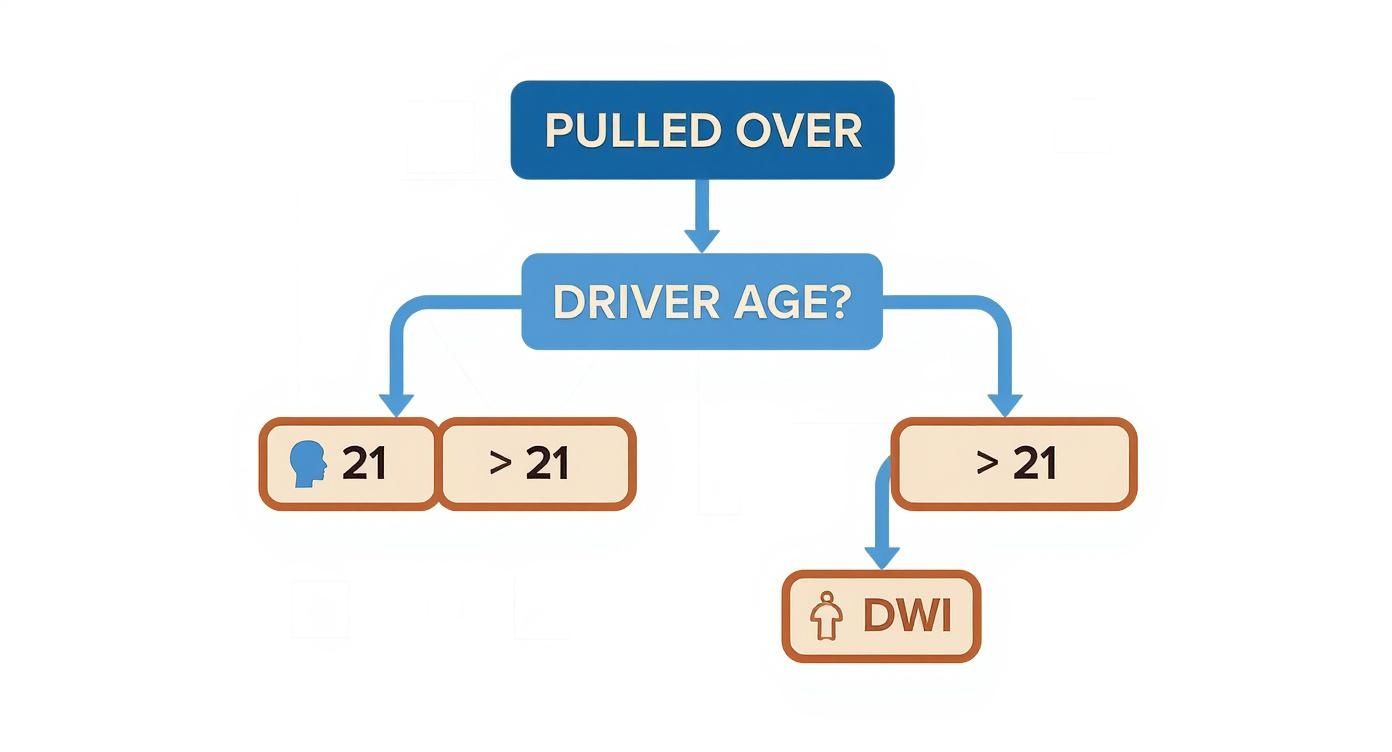
As you can see, the driver’s age is the primary factor that separates a DWI from a DUI charge. But the differences don’t stop there.
To give you a clearer picture, here is a quick breakdown of the core differences between a DWI and a DUI charge in Texas. This table helps clarify the specific legal situation you or a family member might be facing.
Quick Comparison DWI vs DUI in Texas
| Aspect | DWI (Driving While Intoxicated) | DUI (Driving Under the Influence) |
|---|---|---|
| Applicable Age | Adults 21 years of age and older. | Minors under 21 years of age. |
| Legal Standard | Intoxication must be proven (BAC of 0.08% or loss of faculties). | Any detectable amount of alcohol in the system. |
| Governing Law | Texas Penal Code § 49.04. | Texas Alcoholic Beverage Code § 106.041. |
| Typical Charge | Class B Misdemeanor (for first offense). | Class C Misdemeanor (for first offense). |
While both charges are serious, the legal threshold for a DUI is significantly lower due to the state’s zero-tolerance policy for underage drinking and driving. Understanding these fundamentals is key to protecting your rights.
What Legally Constitutes a DWI in Texas
Being pulled over and charged with Driving While Intoxicated (DWI) can make your world spin. It’s a stressful, disorienting experience. The first step toward regaining control is understanding exactly what the state must prove to secure a conviction. It’s not always as simple as a breathalyzer number; the legal standard is laid out specifically in Texas Penal Code § 49.04.
For the prosecution to make a DWI charge stick, they must prove you were “intoxicated” while operating a motor vehicle in a public place. In Texas law, “intoxicated” is not a vague or subjective term. It has three clear and distinct legal definitions.
The Three Standards for Intoxication
The state only needs to prove one of the following three standards to build its case against you:
- Loss of Mental Faculties: This standard focuses on your mental sharpness. The prosecution might argue that alcohol or drugs impaired your judgment, memory, or ability to reason. Evidence often includes things like slurred speech, confused answers to an officer’s questions, or difficulty following simple instructions.
- Loss of Physical Faculties: This standard centers on physical control. Evidence for this almost always comes from standardized field sobriety tests—the walk-and-turn, the one-leg stand. Any sign of unsteadiness, poor coordination, or fumbling can be used to argue you’ve lost the normal use of your physical abilities.
- A Specific BAC Level: This is the most black-and-white standard. If you have a blood alcohol concentration (BAC) of 0.08% or higher, you are considered legally intoxicated. No further proof of impairment is needed.
It is absolutely critical to know that you can still be charged with a DWI even if your BAC is below 0.08%. If an officer believes your performance on sobriety tests was poor or observed other clear signs of impairment, they can arrest you based on the loss of your mental or physical faculties alone.
For instance, imagine a person has a couple of glasses of wine over a long dinner. Their BAC might only be 0.06%, well under the legal limit. However, if they were swerving slightly and then stumbled during the walk-and-turn test, an officer has grounds to make a DWI arrest based on the observed loss of physical faculties.
A DWI conviction is not something to take lightly; the consequences can throw your entire life off course. The median jail sentence for DWI offenders in local jails was 5 months, and for repeat offenders, that sentence can double. Beyond jail time, a conviction hits your wallet hard. You can expect your insurance premiums to skyrocket by around 71%. You can learn more about DWI statistics and penalties from national studies.
Even for a first-offense DWI in Texas, the penalties are tough:
- Fines up to $2,000
- Jail time anywhere from 72 hours to 180 days
- Driver’s license suspension for up to one full year
With so much on the line, fighting the charge is not just an option—it’s a necessity.
How Texas Defines a DUI for Minors
For any parent or young driver, the term Driving Under the Influence (DUI) is incredibly frightening. In Texas, this charge is specifically aimed at drivers under the age of 21, and it’s built on the state’s absolute zero-tolerance policy for underage drinking and driving. It’s a critical distinction to understand because it highlights just how serious the situation is for a young person facing this charge.

Unlike an adult DWI, where the prosecution has to prove intoxication, the legal bar for a minor DUI is set dramatically lower. According to the Texas Alcoholic Beverage Code § 106.041, a minor commits a DUI simply by operating a vehicle in public with any detectable amount of alcohol in their system. This one detail is the core difference between DWI and DUI that every family needs to grasp.
The Zero-Tolerance Standard in Action
What does “zero-tolerance” actually look like? It means that even a tiny, trace amount of alcohol can trigger a criminal charge. The law isn’t concerned with whether the driver felt impaired—only with the presence of alcohol.
Here’s a practical scenario we see all too often: a teenager has one beer at a friend’s house. Hours go by, they feel perfectly fine to drive, and they get pulled over for something minor, like a burned-out taillight. If the officer suspects they’ve been drinking and a breath test shows even a 0.01% BAC, that teen can be arrested and charged with DUI on the spot.
The legal threshold isn’t about being “drunk”; it’s about having consumed any alcohol at all. This strict standard is designed to remove any gray area for underage drivers.
Penalties for a Minor DUI
While a first-offense DUI is usually a Class C Misdemeanor—less severe than an adult DWI—the consequences can still create major roadblocks in a young person’s life.
A conviction often comes with penalties like:
- A fine of up to $500
- Driver’s license suspension for 60 days or longer
- 20 to 40 hours of mandatory community service
- Required attendance at an alcohol awareness program
Perhaps the biggest blow is the criminal record a DUI conviction leaves behind. This can haunt a young person for years, causing complications with everything from college admissions and scholarship applications to future job prospects. Facing these charges demands immediate, thoughtful legal advice.
Comparing the Penalties for DWI and DUI
When you’re facing a DWI or DUI charge, one of the first things you need to understand is what’s at stake. The potential consequences are a critical part of building a defense. In Texas, the penalties for an adult DWI and a minor’s DUI are worlds apart, reflecting how the law treats adult intoxication versus a zero-tolerance violation for someone under 21.

A first-offense DWI is typically a Class B Misdemeanor, a serious charge that can absolutely disrupt your life. On the other hand, a first-offense DUI for a minor is a Class C Misdemeanor. While that’s less severe, it’s a mistake to underestimate it—a conviction can still cast a long shadow on a young person’s future.
First Offense Penalties DWI vs DUI in Texas
Seeing the potential penalties side-by-side makes the distinction crystal clear. Here is a practical breakdown of what a first-time offender can typically expect for each charge.
| Penalty | DWI (Adult First Offense) | DUI (Minor First Offense) |
|---|---|---|
| Fine | Up to $2,000 | Up to $500 |
| Jail Time | 72 hours to 180 days in county jail | No jail time for a first offense |
| License Suspension | Up to 1 year | 60 to 180 days |
| Other Requirements | Community service, probation, possible Ignition Interlock Device | Mandatory alcohol awareness course, 20-40 hours of community service |
It’s important to remember that this table only shows the starting point. DWI penalties, in particular, get much harsher with each subsequent offense.
A second DWI bumps up to a Class A Misdemeanor, and a third is a felony conviction, which can mean years in prison. Certain aggravating factors, like having a child passenger or causing an accident with injuries, can elevate even a first DWI to a felony.
The legal consequences are only one part of the story. Both a DWI and a DUI conviction can lead to court-ordered programs that go beyond fines and community service.
Fines and jail time are just the beginning. A conviction for either offense might also mean mandatory participation in substance abuse programs. Understanding what rehab is and how these programs work can give you a more complete picture of what you might be facing.
Given how much is on the line, especially with the stark differences between DWI and DUI penalties, the most important thing you can do is get skilled legal help right away.
The Long-Term Impact on Your Life and Career
A DWI or DUI conviction isn’t just a one-time event; it’s something that can follow you for years, creating obstacles long after you’ve left the courtroom. The consequences create a ripple effect, touching nearly every part of your personal and professional life. Overcoming these hurdles often takes the right kind of guidance and support.
The most immediate challenge is often professional. A criminal record from either charge is an instant red flag for employers, especially in careers requiring a professional license, a security clearance, or any kind of driving. If you’re a teacher, nurse, or commercial driver, your entire career could suddenly be on the line.
Financial and Personal Burdens
The financial strain is another heavy, long-term burden that people often underestimate. It’s not just about the initial court fines and legal fees. You’ll likely see your auto insurance premiums skyrocket for years to come. Many are also required to pay for court-ordered programs, like alcohol education courses or the installation and maintenance of an ignition interlock device.
The personal toll can be just as damaging. A conviction can seriously complicate family law matters, like a child custody dispute. In those situations, it can be used to question your judgment and fitness as a parent.
It helps to understand the safety statistics that drive these strict penalties. Back in 2018, around 10,511 people in the U.S. died in crashes involving alcohol. That figure is a major reason why enforcement remains so tough, even though the overall trend in the U.S. has improved when you look at global statistics.
For anyone trying to navigate life after a DWI or DUI, figuring out the path forward is the first step toward rebuilding. For those who need it, this alcohol recovery timeline and sobriety guide offers some great, science-backed insights into the recovery process. Given how deeply a conviction can impact every facet of your life, putting up a proactive and strategic legal defense is absolutely essential.
Building a Strong Defense Strategy in Texas
Getting arrested for DWI or DUI can feel like the world is collapsing around you. It’s an overwhelming, stressful experience, but you must remember one critical fact: an arrest is not a conviction. The actions you take in the moments and days following an arrest can drastically change the outcome.
The single most important step you can take is to exercise your constitutional right to remain silent. The urge to explain your side of the story is natural, but anything you say will almost certainly be used against you. Politely but firmly decline to answer any questions about where you were going, where you came from, or what you might have had to drink until you have spoken with an attorney.
Key Areas to Challenge the Charges
Engaging an experienced DWI attorney immediately is the best way to start examining the prosecution’s case. A solid defense begins by putting every single detail of your arrest under a microscope to find weaknesses.
Here are a few common avenues we explore when building a defense:
- Challenging the Traffic Stop: Did the officer have a legitimate reason to pull you over in the first place? They need “reasonable suspicion” to initiate a traffic stop. If that stop was unlawful, any evidence they gathered afterward—including the breath test—could be thrown out completely.
- Questioning Sobriety Test Administration: Field sobriety tests are not casual roadside exercises; they have very strict protocols for how they must be administered. A skilled attorney will investigate whether the officer followed those protocols to the letter. We’ll also examine if other factors, like bad weather, uneven pavement, or a pre-existing medical condition, could have affected your performance.
- Scrutinizing Equipment Records: The machines used for breath and blood tests are not infallible. They require constant, documented calibration and maintenance to be considered reliable. If we find that the equipment used in your case has a spotty maintenance record, we can argue that the results are simply not trustworthy.
It’s easy to feel powerless after an arrest, but understanding that there are very real ways to challenge these charges can be empowering. The key is working with a skilled attorney who knows where to look for flaws in the state’s case and can fight for the best possible outcome for you.
Got Questions About DWI and DUI? You’re Not Alone.
When you’re facing an impaired driving charge, your mind is probably racing with a million questions and worries. Getting clear, straightforward answers is the first step toward understanding what you’re up against and how to protect your rights. Here are some of the most common questions we hear from people in your exact situation.

Can I Refuse a Breathalyzer Test in Texas?
Yes, you have the right to refuse a breathalyzer test in Texas. However, you need to be aware that this decision has immediate consequences. Under the state’s “implied consent” law, refusing the test triggers an automatic driver’s license suspension. An experienced attorney can step in to help you fight that suspension at an Administrative License Revocation (ALR) hearing.
Will a DWI or DUI Charge Haunt My Record Forever?
A conviction for either DWI or DUI can indeed stay on your criminal record permanently, which is a scary thought. However, in some very specific circumstances, you might be eligible to have the record sealed from public view through an order of non-disclosure after you’ve completed your sentence and probation. Eligibility is complex and depends entirely on the unique details of your case, making professional legal guidance essential.
The seriousness of these laws makes more sense when you look at the global picture. Worldwide, a staggering 21.8% of all road deaths are alcohol-related, which works out to about 273,000 lives lost every year. You can read more about these international road casualty statistics to see why the laws are as strict as they are.
What’s the Difference Between a DWI and Intoxicated Assault?
A standard DWI charge is for operating a vehicle while intoxicated. The charge becomes much more serious, however, if that act causes serious bodily injury to another person. At that point, the charge is elevated to Intoxicated Assault. This is a third-degree felony in Texas and comes with far heavier penalties, including the real possibility of significant time in prison.
If you need help navigating a DWI or DUI charge in Texas, you don’t have to face it alone. Contact The Law Office of Bryan Fagan today for a free consultation. We are here to listen, provide clear guidance, and help you understand your rights and options.


