
Facing the future with a criminal record hanging over your head can feel like a constant weight, impacting everything from your career opportunities to where you can live. It’s a deeply personal and often overwhelming situation, and many Texans we work with feel trapped by a past mistake, worried it will define their lives forever.
But Texas law provides a powerful path to a truly fresh start. This isn’t just about hiding the past; it’s about legally erasing it, allowing you to move forward with a clean slate.
A Clean Slate Is Possible with a Texas Expunction
The legal tool that makes this possible is called an expunction. This isn’t just a simple filing; it’s a court-ordered process that compels government agencies to locate and completely destroy every single file related to a specific arrest or charge.
When a judge grants an expunction, you can legally deny the arrest ever happened. It is a complete and total erasure from public record.

It’s crucial to understand how this differs from another legal remedy, an order of nondisclosure. They sound similar, but their impact is worlds apart:
- Expunction: Your record is physically destroyed. For all legal purposes, the event never occurred.
- Nondisclosure: Your record is sealed from the public but still exists. Law enforcement and certain state agencies can still access it.
An expunction is the most complete remedy available under Texas law. It effectively erases the event from your public history, allowing you to move forward without the weight of a past mistake.
Achieving this clean slate is more than a legal victory—it’s about reclaiming control of your future. This guide is designed to walk you through how the Texas expunction process works, step-by-step, with practical information. Navigating the legal system can be intimidating, but you don’t have to do it alone.
Are You Eligible to Expunge Your Record in Texas?
Before diving into any legal process, the first and most important question is, “Am I eligible?” In Texas, eligibility for an expunction isn’t a gray area; it’s clearly defined by law and depends entirely on the final outcome of your criminal case. An expunction is a powerful tool that completely destroys the record of an arrest, but it’s reserved for specific situations where you were ultimately cleared.
The Most Common Paths to Expunction
The specific rules are outlined in the Texas Code of Criminal Procedure, Chapter 55. This statute defines exactly who qualifies. You are likely eligible for an expunction if your case ended in one of these ways:
- You Were Acquitted: If you went to trial and a judge or jury found you “not guilty,” you have an absolute right to have the records of that arrest and trial destroyed. An acquittal is the law’s declaration of your innocence.
- Your Case Was Dismissed: A prosecutor may drop a case for many reasons, such as insufficient evidence or a decision that prosecution is not in the interest of justice. If the charges against you were formally dismissed and the statute of limitations for that crime has expired, you are almost certainly eligible.
- A Grand Jury “No-Billed” You: For felony charges, a grand jury must first decide if there’s enough evidence to proceed to trial. If they review the evidence and issue a “no-bill,” it means they have rejected the charge, making you eligible for an expunction.
- You Were Pardoned: If you received a full pardon from the Governor of Texas or the U.S. President, you can have the record of that specific offense expunged.
However, an expunction is not automatic. Historically, the process has been challenging, and many eligible individuals never complete it. A study found that only about 6.5% of eligible people successfully obtained an expunction at their first opportunity, largely due to confusing rules and procedural roadblocks. You can learn more about these challenges in the Cato Institute’s research on second chances.
When an Expunction Is Not an Option
It is equally important to understand what disqualifies you from an expunction. The primary disqualifier is a conviction. If you pleaded guilty or “no contest” and were found guilty by a court, you cannot expunge that record.
This also applies if you received deferred adjudication. While successfully completing deferred adjudication prevents a final conviction from appearing on your record, the law treats it as a form of community supervision, or probation.
A key takeaway: If your case involved any form of probation, including deferred adjudication, you cannot get an expunction for that charge. However, you may qualify for another form of relief.
For those who completed deferred adjudication, Texas law offers an alternative path: an Order of Nondisclosure. This process seals your record from the public rather than destroying it. It is a valuable option but is fundamentally different from an expunction.
Deciding between an expunction and an order of nondisclosure can be confusing. This table breaks down the key differences to help you understand which path may be available to you.
Expunction vs. Nondisclosure: A Quick Comparison
| Feature | Expunction (Record Destruction) | Order of Nondisclosure (Record Sealing) |
|---|---|---|
| What Happens to the Record? | The record is permanently destroyed. All agencies must delete any trace of the arrest and case. | The record is sealed from public view. It still exists but is not accessible to private employers, landlords, etc. |
| Who Is Eligible? | Typically for arrests that did not result in a conviction or probation (e.g., acquittal, dismissal, “no-bill”). | Primarily for those who successfully completed deferred adjudication probation. Some low-level misdemeanors may also qualify. |
| Legal Effect | You can legally deny the arrest ever occurred (with very few exceptions). | You do not have to disclose the arrest on most job or housing applications. |
| Accessibility by Law Enforcement | Law enforcement and prosecutors cannot see the record. It’s gone. | Law enforcement, courts, and certain state agencies can still access the sealed record. |
Essentially, an expunction erases the past as if it never happened, while a nondisclosure puts it under lock and key, hidden from public eyes. We can help you determine which of these solutions fits your specific situation.
Once you’ve confirmed your eligibility, the real work begins. The legal process can seem complex, but with clear, step-by-step guidance, it is a manageable path. Let’s break down the journey from legal jargon into actionable steps.
Your first step is to prepare a legal document called a Petition for Expunction. This isn’t just a standard form; it’s a formal lawsuit you file against the State of Texas, asking a judge to order government agencies to destroy all records related to your arrest. The precision of this petition is critical.
Drafting and Filing Your Petition
Getting the details right in your Petition for Expunction is paramount. One incorrect date or a missed agency can bring the entire process to a halt.
Here is the essential information your petition must include:
- Your Personal Details: Full name, date of birth, driver’s license number, and social security number.
- Arrest Specifics: The exact date of arrest, the offense you were charged with, the arresting agency (e.g., Houston Police Department, Harris County Sheriff’s Office), and the case number.
- Case Resolution: The petition must clearly state how your case was resolved—whether it was dismissed, you were acquitted at trial, a grand jury no-billed you, or you received a pardon.
- The List of Agencies (Respondents): This is a critical and often overlooked step. You must identify every government agency that could possibly have a record of your arrest. This includes the arresting police department, the prosecutor’s office, the district clerk, and state-level agencies like the Texas Department of Public Safety (DPS).
Forgetting to name even one agency means their records of your arrest will survive. An experienced attorney knows how to conduct a thorough background check to ensure every entity is identified, named in the lawsuit, and properly notified.
Once the petition is meticulously drafted and verified, it is filed in the district court of the county where the arrest occurred. This act officially initiates your case.
This visual guide simplifies the initial eligibility question, showing how the outcome of your criminal case determines the correct path forward.
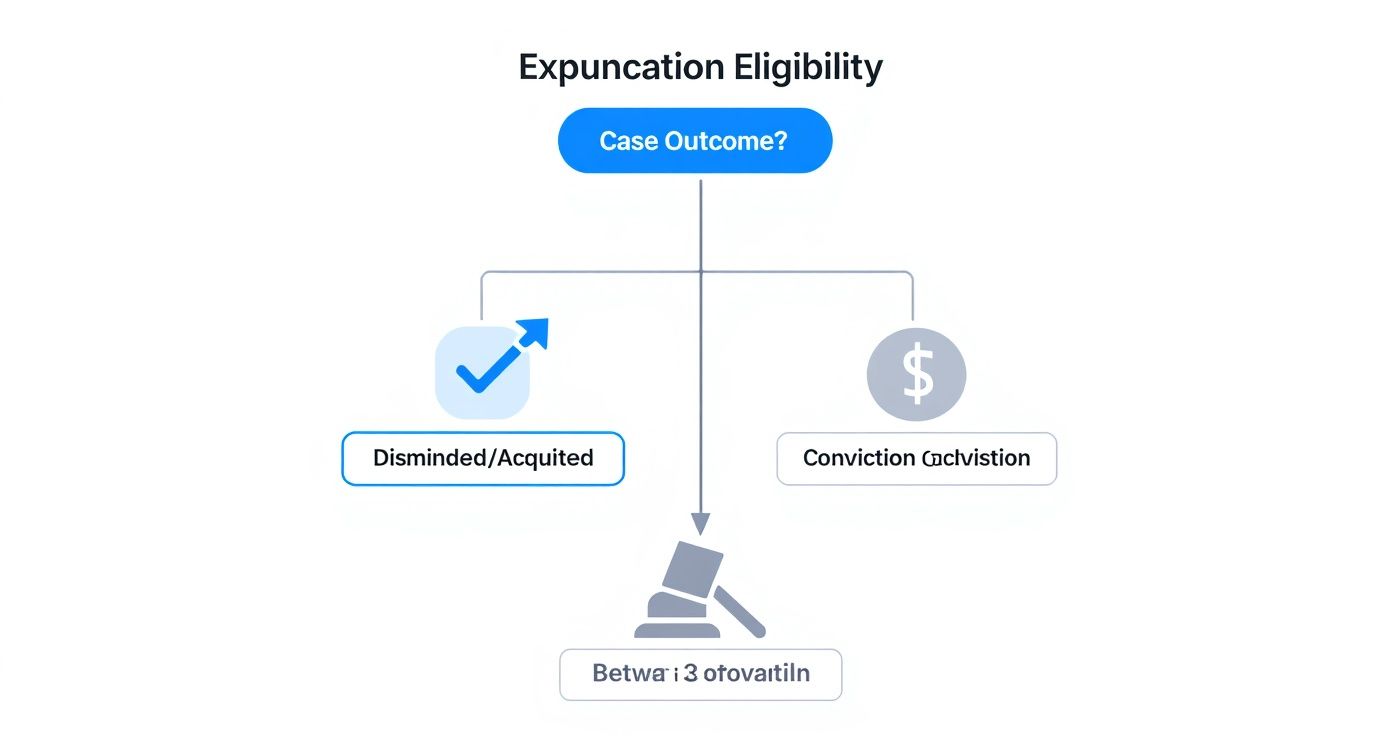
As the infographic illustrates, a case that does not result in a conviction is your key to pursuing an expunction in Texas.
Notifying Agencies and Preparing for Court
After filing your petition, all listed agencies must be formally notified through a process called “service of process.” This is a mandatory step that gives each agency an opportunity to object if they believe you do not qualify.
Typically, each agency has approximately 30 days to file an answer with the court. In most straightforward cases where eligibility is clear, the District Attorney’s office will not contest the expunction. They will review your petition, verify the case was dismissed, and agree to the order.
If no one objects, your attorney can often obtain the judge’s signature on the Final Order of Expunction without a formal hearing. However, if an agency files an objection, a hearing will be scheduled.
At the hearing, the judge will consider both sides. The prosecutor will present their reasons for objecting, and your attorney will present evidence and legal arguments demonstrating that you meet all the requirements under Texas Code of Criminal Procedure Chapter 55. The judge will then make a final ruling.
This is where having a knowledgeable attorney is invaluable. They can anticipate potential objections and prepare a strong, evidence-based argument to prove your legal right to have your record cleared, making the process feel much less uncertain.
It is also worth noting that Texas is part of a broader, positive trend. In recent years, more than two-thirds of states have expanded their laws for sealing or expunging criminal records, reflecting a growing recognition that people deserve a real second chance. If you’re interested in the national movement, you can read the full survey on expungement laws.
What Life Looks like After Your Record Is Cleared
The moment a judge signs your Expunction Order is one of profound relief. It marks the end of a long, stressful journey and represents a genuine victory. But what does this legal document actually mean for your daily life? It’s not just paper; it’s the key that unlocks a future free from the shadow of a past arrest.

Once that order is finalized, every government agency holding a record of your arrest is legally mandated to physically destroy it. This is the incredible power of an expunction: the event is literally erased from your official history. This means you can legally and confidently deny the arrest ever happened on applications for jobs, housing, loans, and higher education.
A successful expunction is about so much more than just clearing your name. It’s about restoring your ability to chase opportunities without having to explain your past. It is your legal right to a truly fresh start.
The Power to Move Forward Freely
Think about all the doors a criminal record can close. With an expunged record, those doors swing wide open again.
- Employment: You no longer have to check the dreaded box asking about past arrests. You can truthfully answer “no,” removing a significant barrier to securing the job you deserve.
- Housing: Landlords almost always run background checks. An expunction ensures your application is not rejected because of a dismissed case from years ago.
- Education: Applying for college or financial aid often involves questions about your past. Clearing your record helps ensure your application is judged on its merits.
- Professional Licenses: Many careers, from nursing to real estate, require a state license that can be jeopardized by a criminal record. An expunction is crucial for protecting your professional future.
The economic impact of this clean slate is significant. Research confirms that people who get their records expunged see tangible benefits. A University of Michigan study, for example, found that individuals who received an expungement saw their wages increase by an average of over 22% within one year.
Ensuring a Truly Clean Slate
A common and valid concern is the persistence of old information in the databases of private background check companies. While the expunction order forces government agencies to destroy their records, this outdated information can sometimes linger elsewhere.
The good news is that these companies are legally required to maintain accurate records. If an old, expunged charge still appears on a private background check, we can send a copy of the Expunction Order directly to that company, demanding they remove the inaccurate information. It is a problem with a clear solution.
Beyond the legal filing, maintaining a clean slate often involves looking at broader strategies for removing negative search results that might still be online.
An experienced attorney knows the job isn’t finished when the judge signs the order. A critical part of our service is following up with every agency to confirm they have fully complied with the court’s directive. We track the entire process and obtain confirmation letters, giving you complete peace of mind that your record is gone for good. This final step is crucial to ensuring your new beginning is absolute.
Common Hurdles in the Expunction Process
While the path to expunging your record is defined by Texas law, it isn’t always straightforward. Understanding potential challenges can make the journey feel less daunting and helps in building a strong strategy for success.
Even if your case seems perfect for eligibility, procedural hurdles can arise. The good news is that with the right legal approach, these can be overcome. Anticipating these roadblocks is the best way to keep your case moving forward.
Responding to a Prosecutor’s Objection
The most common challenge is an objection from the District Attorney’s office. Receiving this notice can be disheartening, but it is not the end of the road. Prosecutors object for specific reasons, and understanding why they are objecting is the first step in crafting a powerful counter-argument.
Common reasons for an objection include:
- The Waiting Period Hasn’t Expired: For most dismissals, you must wait for the statute of limitations on the original charge to expire before filing. Filing too early is a common and fixable mistake.
- The Case is Part of a Larger Investigation: In rare instances, if your dismissed charge is connected to a larger, ongoing criminal investigation, the state may object to destroying records they consider potential evidence.
- Clerical Errors in the Petition: A simple typo, such as an incorrect case number or disposition date, can trigger an objection until the petition is amended and corrected.
When the DA files an objection, the court will schedule a hearing. This is where having an experienced attorney is critical. We will appear in court prepared to present evidence, testimony, and legal arguments proving you meet every requirement under the Texas Code of Criminal Procedure. A prosecutor’s objection does not negate your right to an expunction; it simply means we must prove it in court.
The Problem of Strict Filing Deadlines
Timing is crucial in the legal world, and expunctions are no exception. The law imposes strict deadlines, known as statutes of limitation, which create a specific window for you to file your petition. Missing this window could permanently bar you from clearing your record.
For example, if you were acquitted at trial or received a pardon, you have an absolute right to an expunction and can file at almost any time. But for dismissed cases, the timeline is more complex and is tied to the level of the original offense.
You must file for expunction before the statute of limitations for the original crime has passed. For a Class C misdemeanor, that’s just two years. For many felonies, it can be much longer. Waiting too long is one of the most tragic and preventable reasons people lose their right to a clean slate.
This is why it is so important to act promptly after your case is resolved. We can calculate the precise deadline for your specific situation, ensuring your petition is filed well within the required timeframe to protect your opportunity for a fresh start.
Records Sent to Federal Agencies
Another challenge can arise when local or state police share arrest records with federal agencies like the FBI. A Texas state judge can order every agency in Texas to destroy their records, but that order does not have the same authority over federal agencies.
This means that even after your state and local records are wiped clean, a record of the arrest might still exist in a federal database. This can become an issue, especially when applying for federal jobs, security clearances, or dealing with immigration matters.
Addressing this requires an additional, proactive step. Your attorney can send a certified copy of the signed Expunction Order directly to the relevant federal agencies, formally requesting that they update their systems. While they are not legally compelled to comply in the same way Texas agencies are, they often will. This is a perfect example of why thoroughness matters—we aim to ensure your record is cleared as completely as possible, at every level.
Common Questions About Texas Expunctions
Navigating the legal system can feel overwhelming, and it’s completely normal to have more questions than answers. When it comes to clearing your record, you deserve straightforward information, not confusing legal jargon. We’ve compiled answers to some of the most common questions we hear to help clarify the Texas expunction process.
How Much Does It Cost to Get a Record Expunged in Texas?
The total cost for an expunction is a combination of several factors. You can expect court filing fees, which typically range from $300 to $500, depending on the Texas county. Additionally, there are smaller costs for officially serving notice to all the government agencies involved.
Attorney fees are the other main component and often depend on the complexity of your case. While there is an upfront investment, the long-term benefit of a clean slate—opening doors to better jobs, housing, and peace of mind—is truly invaluable. We always provide a clear, upfront cost estimate during a free consultation so there are no surprises.
How Long Does the Expunction Process Take from Start to Finish?
This process requires patience, as it does not happen overnight. A typical expunction in Texas takes anywhere from three to six months, from the day the petition is filed to the moment the judge signs the final order.
After the petition is filed, there is a mandatory 30-day waiting period before a hearing can be scheduled. From there, the timeline depends on the court’s calendar and whether the District Attorney’s office objects. After the judge signs the order, it can take a few more months for all agencies to confirm they have destroyed the records. An experienced attorney can help ensure there are no preventable delays.
While the legal process has a set timeline, the result is permanent. A successfully expunged record is gone for good, offering a lifetime of freedom and opportunity that makes the wait worthwhile.
Can a Felony Arrest Be Expunged in Texas?
Yes, absolutely. A felony arrest can be expunged in Texas, but eligibility hinges on one factor: the case’s outcome. If you were arrested for a felony but the case was later dismissed, no-billed by a grand jury, or you were found not guilty at trial (acquitted), you are almost always eligible for an expunction.
The crucial detail is that the case did not result in a conviction or any form of community supervision, including deferred adjudication. The seriousness of the original charge is less important than the final resolution. If you did receive deferred adjudication for a felony, an expunction is not an option, but you may be a perfect candidate for an order of nondisclosure instead.
As you look for the right lawyer for your case, it can be helpful to know a little bit about how attorneys market their services. Having some basic understanding effective marketing for criminal defense lawyers can make the process of finding an experienced professional feel less intimidating.
If you need help navigating divorce, custody, or estate planning in Texas, contact The Law Office of Bryan Fagan today for a free consultation.