 Skip to content
Divorce can be one of life’s most difficult transitions—but understanding your rights under Texas law can make it less overwhelming. At the end of this journey lies a critical legal document: the Final Decree of Divorce. Think of this decree as the official rulebook for your post-divorce life. It’s the court order that not only legally ends your marriage but also lays out, in clear and certain terms, exactly how your new life will operate separately from your former spouse.
The Role of the Final Decree of Divorce in Texas
Navigating a divorce is an emotional whirlwind, and often, what you want most is clarity and a stable path forward. The final decree is designed to provide just that. It is the culmination of every negotiation, mediation session, or court hearing you’ve been through.
Once a judge signs this document, it’s not just a piece of paper—it's a legally binding order. This means you and your ex-spouse are required by law to follow everything it says. It is the court's final word on the terms of your divorce.
The Purpose of the Decree
The primary purpose of a final decree of divorce in Texas is to eliminate ambiguity and prevent future conflict. It takes all the loose ends of a shared life and ties them up with legal precision, addressing every critical issue. A solid, well-written decree should leave no stone unturned.
Specifically, it spells out:
- Division of Property and Debts: This is the financial blueprint of your separation. The decree will state who is awarded the house, who keeps which car, how retirement accounts are split, and—just as importantly—who is responsible for the mortgage, car loans, and credit card debt.
- Child-Related Orders: If you have children, this is the most important part of the decree. It details the rights and duties of each parent (called conservatorship), a specific schedule for when the children are with each parent (the possession and access schedule), and who pays child support and in what amount.
- Financial Support: For some couples, one spouse may be ordered to pay spousal maintenance (what many people call alimony) to the other. The decree will specify the exact amount and for how long those payments must be made.
Understanding these terms is the first step to protecting yourself and your future. For many people, a key question is simply, "When is it really over?" If you're wondering about the exact timeline, you can get more details on when your Texas divorce is final.
Texas law includes a mandatory waiting period, so the earliest a judge can sign your decree is 61 days after the divorce petition was first filed. Realistically, however, most divorces—especially those involving children or complex property—take much longer. Because this document legally ends your marriage and dictates your future obligations, it’s arguably the most important document in Texas family law.
What's Inside Your Final Divorce Decree? A Section-by-Section Breakdown
Think of your Final Decree of Divorce not as an ending, but as the official rulebook for your new life. It’s the document that translates all the agreements, negotiations, and court decisions into a clear, legally binding plan. Getting familiar with its key sections is crucial because this isn't just paperwork—it’s the map you and your ex-spouse will follow for years to come.
A well-crafted decree leaves nothing to chance. Every detail is spelled out to prevent future confusion and arguments. Under Texas law, specific issues must be resolved before a judge will sign off. Let's walk through the most important parts so you know exactly what to look for in your own document.
The Division of Your Marital Estate
One of the most significant functions of the decree is to untangle your financial lives. Texas is a community property state, meaning most assets and debts you and your spouse acquired during the marriage belong to the "marital estate." The decree’s job, according to the Texas Family Code, is to divide this estate in a "just and right" manner.
This section gets incredibly specific, listing every asset and debt and clearly stating who gets what. It’s a comprehensive inventory of your shared life.
- Real Estate: Who is awarded the family home? Or will it be sold, and how will the proceeds be divided?
- Vehicles: Every car, truck, and motorcycle is assigned to one person.
- Bank Accounts: It lists checking, savings, and investment accounts—often down to the last four digits of the account number for clarity.
- Retirement Funds: This tackles 401(k)s, pensions, and IRAs. Dividing these often requires a special, separate court order called a QDRO (Qualified Domestic Relations Order).
- Personal Belongings: It can even get as granular as assigning specific furniture, art, or family heirlooms to avoid disputes.
Just as critical is the division of debt. The decree assigns responsibility for the mortgage, car payments, credit card balances, and other loans. This provision is your legal protection if a creditor attempts to collect a debt that was assigned to your former spouse.
Orders for Your Children: Conservatorship and Possession
When children are involved, the decree's primary focus shifts to creating stability and predictability for them. This is handled through orders for conservatorship and possession.
Conservatorship is the legal term for custody—it outlines each parent's rights and responsibilities. In most Texas cases, parents are named Joint Managing Conservators. This means you'll share the power to make important decisions about your children's lives, including:
- Education and school choices
- Medical, dental, and psychological care
- Religious upbringing
Even in a joint arrangement, the decree usually designates one parent as the "primary" conservator. This parent has the exclusive right to determine the children's residence (often within a certain geographic area) and is the one who receives child support payments.
The Possession and Access schedule is essentially the visitation calendar. It's a detailed blueprint of when the children will be with each parent. Most decrees use the Texas Standard Possession Order because it is presumed by law to be in the child's best interest. It maps out weekends, holidays, summer breaks, and even birthdays, all with the goal of minimizing conflict and providing a consistent routine. To get a better sense of this, you can learn more about preparing a final order in a divorce involving children and see how these complex schedules are structured.
Key Sections of a Texas Final Divorce Decree
| Component | What It Covers | Governing Texas Family Code Chapter |
|---|---|---|
| Property & Debt Division | Identifies and divides all community assets (real estate, accounts, retirement) and debts (mortgages, loans, credit cards). | Chapter 7 |
| Conservatorship | Defines the legal rights and responsibilities of each parent regarding decision-making for the children (medical, educational, etc.). | Chapter 153 |
| Possession & Access | Sets out the detailed parenting time schedule, including weekends, holidays, and summer vacations. | Chapter 153 |
| Child Support | Establishes the monthly payment amount, medical/dental insurance obligations, and how uninsured expenses are handled. | Chapter 154 |
| Spousal Maintenance | If applicable, specifies the amount, duration, and terms for post-divorce spousal support payments. | Chapter 8 |
This table shows how each piece of the puzzle fits into the larger legal framework, ensuring every critical aspect of your separation is covered with the authority of Texas law.
Financial Support for Children and Spouses
Last but not least, the decree makes all financial support obligations official and legally enforceable.
A Final Decree of Divorce is not just an ending; it is a legally enforceable beginning. It sets the ground rules for financial independence and co-parenting, providing the structure needed for families to heal and move forward.
Child support is determined using a state-mandated formula based on the non-primary parent's net monthly income and the number of children. The decree will lock in the exact dollar amount, the due date each month, and how it will be paid—almost always through wage withholding. It also details who is responsible for providing the children's health and dental insurance and how any out-of-pocket medical costs will be split between the parents.
Spousal maintenance is not automatic in Texas divorces. It is designed as temporary support for a spouse who lacks sufficient property to provide for their "minimum reasonable needs" after the divorce. If a judge awards it, the decree will clearly state the amount, how long it will be paid, and the specific circumstances that would cause the payments to stop.
How You Get to a Final Divorce Decree
Getting from a divorce filing to a signed, final decree is a journey, and in Texas, there are two primary paths you can take. Whether you and your spouse are in agreement or have significant issues to resolve, the legal system is designed to help you reach that finish line. Knowing what to expect makes the entire process feel more manageable.
It's helpful to understand how Texas law shapes this journey. Since 1970, Texas has been a no-fault divorce state, which removes much of the blame from the legal process for most couples. This legal approach directly impacts how long a divorce takes. A straightforward, uncontested divorce can conclude in 3-4 months, but a complex, contested case could easily last for a year or more. You can get a deeper dive into Texas divorce law updates and timelines on terryandrobertslaw.com.
The Path of an Uncontested Divorce
An uncontested divorce is the most direct path to obtaining your final decree. This option is available when you and your spouse have reached a complete agreement on every single issue—from who gets the house to where the children will spend holidays.
Once you have that full agreement, your attorney drafts the Final Decree of Divorce. This document does more than summarize your decisions; it translates your personal agreements into the specific, formal legal language required by the court to make it an enforceable order.
The final step is a brief court appearance known as a "prove-up" hearing. It's usually a short, low-stress proceeding where you answer a few basic questions from the judge. Once that’s done, the judge signs the decree, and it becomes a final, legally binding court order.
The Path of a Contested Divorce
If you and your spouse cannot agree on one or more key issues, you are on the path of a contested divorce. This route includes several steps designed to help you resolve those conflicts.
The goal of the legal process in a contested case is to move from disagreement to resolution. Whether through collaborative negotiation or a judge's ruling, the system is structured to create a final, enforceable plan for your family's future.
In Texas, most contested cases are required to attempt mediation. This is a structured negotiation session where a neutral third-party professional—the mediator—helps you and your spouse work through disagreements and find common ground. If you successfully resolve everything, you’ll sign a Mediated Settlement Agreement (MSA). From there, the process becomes very similar to an uncontested divorce.
But what happens if you still can't agree? If mediation does not resolve all issues, the remaining disputes will proceed to trial. This is where both sides present their case, including evidence and testimony, to a judge. The judge will then make the final decisions on the contested issues, which are then incorporated into the Final Decree of Divorce. The judge's signature makes it official.
These are the core building blocks that every final decree must address, one way or another.
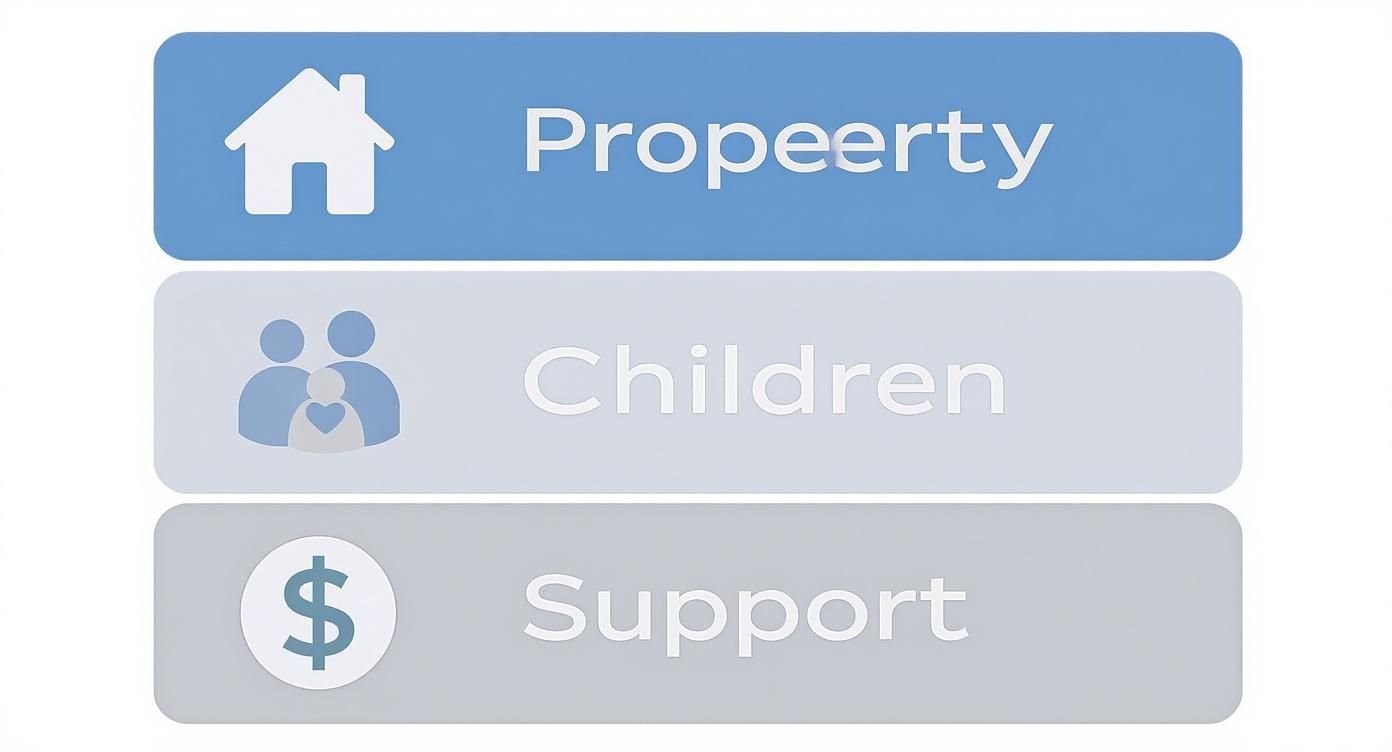
This image illustrates the three pillars of any divorce—property, children, and finances. Your journey down the uncontested or contested path is all about building a solid plan for each of these areas.
The Mandatory 60-Day Waiting Period
No matter how quickly you and your spouse reach an agreement, Texas law requires a pause. According to the Texas Family Code § 6.702, a judge cannot sign your Final Decree of Divorce until at least 60 days have passed since the original divorce petition was filed.
This "cooling-off" period is not an arbitrary delay. It serves two key purposes:
- A chance for reflection: The law builds in this time to give couples a moment to consider their decision and ensure divorce is truly what they want, away from the heat of the initial conflict.
- Time for legal process: It also ensures the other spouse has been properly served with the lawsuit and has adequate time to file a formal response.
Remember, 60 days is the absolute minimum. For most couples, especially those in contested cases, reaching a final decree will take longer. Understanding these timelines and processes from the start helps you set realistic expectations for the road ahead.
Life After the Decree Is Signed
The moment you hold the signed Final Decree of Divorce brings a mixture of relief and finality. It closes one chapter of your life, but it also opens a new one—a chapter where your rights and obligations are structured by a binding court order. But life is not static. Circumstances change, and it is completely normal to have questions about what comes next.
In our experience, the two biggest legal issues that arise after a divorce is final are straightforward: either someone isn't following the rules, or the rules no longer fit your family's life. Thankfully, Texas law has a plan for both situations: enforcement and modification. Knowing the difference is key to protecting your rights and maintaining stability for your family.
Enforcing Your Final Decree of Divorce in Texas
Think of your divorce decree as a detailed instruction manual for your post-divorce life. When your ex-spouse ignores a part of that manual, you have the right to ask the court to compel their compliance. This is what an enforcement action is for—it is the legal tool you use when the other person is not upholding their end of the bargain.
This is not about starting another conflict; it is about accountability. Some of the most common reasons people file for enforcement include:
- Unpaid support: The other parent consistently fails to pay child support or spousal maintenance.
- Property issues: They refuse to sign the deed to transfer the house into your name or fail to take the necessary steps to divide a 401(k) as ordered.
- Custody violations: They are habitually late for pickups, or worse, they deny you your court-ordered time with the children.
To begin the process, you will file a Petition for Enforcement in the same court that granted your divorce. This document must be extremely precise. You need to identify the exact provision of the decree that was violated, explain how it was violated, and when. Courts take these actions very seriously. If a judge finds your ex-spouse in contempt of court, the consequences can range from fines and paying your attorney's fees to jail time.
Modifying the Terms of Your Decree
While a decree is meant to be "final," Texas law is practical. It recognizes that life goes on. The plan that made perfect sense for your family at the time of the divorce might be unworkable a few years later. That’s where a modification comes into play.
It is critical to understand that not all parts of a decree can be changed. The property division, for instance, is almost always set in stone. Once assets and debts are divided, that division is final. But orders concerning children? That's a different story.
A Final Decree of Divorce provides a snapshot in time. A modification acknowledges that family life is a moving picture, allowing the court to adjust the frame to reflect new realities while always keeping the child's best interest in focus.
To change the orders for custody (conservatorship), visitation (possession), or child support, you must prove to the court that there has been a "material and substantial change in circumstances" since the day the original decree was signed. This is a significant legal standard. The change must be major and lasting, not just a temporary inconvenience.
What Qualifies as a Material and Substantial Change?
Every family's situation is unique, but here are some classic examples of what a court might consider a significant enough change to warrant a modification:
- Major income shifts: One parent receives a major promotion or, conversely, is laid off from a long-term job.
- Relocation of a parent: The parent with whom the children primarily live needs to move for a significant job opportunity or to be closer to family support.
- The children's needs have changed: As children grow, their needs and preferences evolve. In Texas, if a child is 12 or older, the judge can interview them to hear their preference on which parent they would like to live with primarily.
- Lifestyle changes impacting the children: A parent may remarry, take a new job with a demanding travel schedule, or experience other life events that make the old custody schedule unworkable.
Adjusting to a new life after divorce takes time and effort. For practical advice on moving forward successfully, you might find valuable insights in our guide to life after divorce and tips for living successfully.
After your final decree is signed, ensuring its secure digital storage is paramount. Exploring secure lawyer contract storage options can safeguard this vital legal document for years to come. Whether you are seeking to enforce the current rules or believe it's time for a change, navigating these post-divorce actions requires careful legal strategy.
Common Mistakes to Avoid in Your Divorce Decree
Receiving your finalized divorce decree feels like reaching the end of a long, difficult road. But that sense of relief can quickly fade if the document contains errors or vague language. The words in your final decree of divorce in Texas are not just legal formalities; they are the rules you and your ex-spouse will live by for years. A small oversight now can become a major headache later, sparking new conflicts and potentially requiring another expensive trip to court.

The best way to protect your future is to be incredibly thorough while the decree is being drafted. Working closely with your attorney to nail down every detail is an investment in your future peace of mind.
Vague Language in Property Division
One of the most common and damaging mistakes is using imprecise language when dividing property and debt. If there is room for interpretation, it will almost certainly lead to a future argument.
For example, a decree that simply says, "The parties will divide the household furniture," seems straightforward. But what happens when you both want the dining room table that was a family heirloom? A well-written decree leaves no room for guesswork.
- Be Specific: Instead of "household goods," list significant items. For instance, "Wife is awarded the antique grandfather clock located in the entryway. Husband is awarded the leather sofa located in the living room."
- Use Account Numbers: When dividing financial accounts, name the institution and include the last four digits of the account number. This prevents confusion if a person has multiple accounts at the same bank.
- Assign Every Debt: Every single loan—the mortgage, car notes, credit cards, student loans—must be clearly assigned to one party. If a debt is not assigned, you could find yourself legally responsible for a debt your ex-spouse was supposed to pay.
Overlooking Essential Follow-Up Actions
The judge’s signature on the decree is a huge milestone, but it does not automatically transfer titles or divide accounts. You must take proactive steps to put the court's orders into effect. Failing to complete these follow-up tasks can leave your assets in limbo and your financial security at risk.
Think of your final decree as the blueprint for your new life. You still have to do the construction work—like signing deeds and retitling accounts—to actually build it. Skipping these tasks is like leaving the foundation unfinished.
A perfect example is the division of a 401(k) or pension. This requires a separate, complex court order called a Qualified Domestic Relations Order (QDRO). Your decree might state that you are entitled to half of the retirement account, but the plan administrator cannot legally release the funds to you without a signed QDRO.
Don’t forget these other crucial follow-up tasks:
- Changing Deeds: To transfer ownership of a house, a Special Warranty Deed must be signed and filed with the county.
- Updating Titles: Vehicle titles must be formally signed over to the person awarded the vehicle.
- Updating Beneficiaries: This is critical. Immediately change the beneficiaries on your life insurance policies, retirement accounts, and will to reflect your new circumstances.
Failing to complete these steps can create a legal nightmare, especially if your ex-spouse passes away before everything is officially transferred. An experienced attorney can provide a post-divorce checklist to ensure every detail is handled and the assets you were awarded are legally and officially yours.
Frequently Asked Questions About Texas Divorce Decrees
Even after completing the legal process, it's completely normal to have questions about your final paperwork. It’s one thing to understand the divorce process in theory and another to hold the signed Final Decree of Divorce in your hands.
Here are answers to some of the most common, practical questions we hear from clients. Our goal is to provide clear, direct guidance so you can feel confident about what comes next.
How Do I Get a Certified Copy of My Final Divorce Decree?
You can obtain certified copies from the District Clerk’s office in the county where your divorce was finalized. You will need to provide your case number and pay a small fee per copy.
A certified copy is more than a simple photocopy; it is an official version of your decree bearing a stamp and seal from the court, verifying its authenticity. This is the version you will need for nearly all official business post-divorce, such as:
- Changing your last name on your driver's license or Social Security card.
- Selling property awarded to you in the divorce.
- Updating beneficiaries on financial accounts.
- Refinancing a mortgage to remove your ex-spouse's name from the loan.
Practical Tip: Order several certified copies immediately after your divorce is final. Storing them in a safe place will save you time and hassle later when you need them.
What Happens if There Is a Mistake in My Final Decree?
Discovering a mistake in your signed decree can be alarming, but there are legal procedures to correct it. The appropriate remedy depends on the type of error.
If it is a simple clerical error—such as a typo in a name, a transposed digit in an account number, or a minor math mistake—the fix is relatively straightforward. Your attorney can file a "Motion to Correct Judgment Nunc Pro Tunc." This is a legal request asking the court to correct the written document to reflect the judge's actual ruling.
However, if the problem is a judicial error—meaning you believe the judge misinterpreted the law or made an incorrect legal decision—the situation is far more urgent. You typically have only 30 days from the date the decree was signed to file a Motion for New Trial or begin the appeals process. This is why it is absolutely critical to review the decree with your attorney immediately upon finalization to identify any major issues while you still have legal options.
Is a Mediated Settlement Agreement the Same as a Decree?
No, they are two distinct but closely related documents. Think of it this way:
The Mediated Settlement Agreement (MSA) is the binding contract you and your spouse create and sign during mediation. It details all the terms you have agreed upon regarding your property, children, and support. Once signed, an MSA is generally irrevocable.
The Final Decree of Divorce is the official court order, signed by a judge, that incorporates the terms of your MSA and legally terminates your marriage.
The MSA is the architect's blueprint that you and your spouse design together. The final decree is the finished, legally binding house that the judge builds according to that exact blueprint.
Your attorney's role is to take the terms of your MSA and draft them into the formal legal language the court requires to create an enforceable Final Decree of Divorce.
Can I Appeal My Final Decree of Divorce in Texas?
Yes, you can appeal a final decree, but it is a difficult and complex process. An appeal is not a second chance to argue the facts of your case. The purpose of an appeal is to demonstrate that the trial judge made a significant legal error that resulted in an improper and unfair outcome.
You cannot appeal simply because you are unhappy with the result. You must identify a specific error, such as the judge misapplying a Texas statute or improperly admitting or excluding crucial evidence.
The deadline is strict: you generally have just 30 days from the signing of the decree to file a Notice of Appeal. Family law appeals are complex, expensive, and require specialized legal expertise. If you believe a serious legal error occurred in your case, you must speak with an attorney who handles appeals immediately. Waiting too long could result in losing your right to challenge the decision forever.
If you need help navigating divorce, custody, or estate planning in Texas, contact The Law Office of Bryan Fagan, PLLC today for a free consultation.


