 Skip to content
Life is rarely static, and the circumstances that existed when your original child support order was created can change dramatically over time. A job loss, a significant promotion, or a child's evolving needs can mean that the current support amount is no longer fair or appropriate. When this happens, Texas law provides a clear path for parents to seek a modification, ensuring the order reflects the reality of their current lives.
Understanding your rights and the legal process is the first step toward making a change that protects both your financial stability and your child's well-being. This guide will walk you through how to modify child support in Texas, from understanding the legal requirements to navigating the court system.
Knowing When You Can Modify Child Support
The Texas Family Code is very specific: to change a child support order, you must prove there has been a "material and substantial change in circumstances" since the last order was signed by a judge. This isn't just a minor fluctuation in income or a one-time expense; it must be a significant, ongoing event that fundamentally alters a parent's ability to pay or the needs of the child.
What Qualifies as a Material and Substantial Change?
So, what does this legal phrase actually mean in the real world? While every case is unique, Texas courts generally recognize several key situations as valid grounds for a modification. Proving one of these changes is the foundation of your entire case.
Here is a quick look at some of the most common events that Texas courts recognize as valid grounds for a child support modification.
| Reason for Modification | Common Examples | Key Consideration |
|---|---|---|
| Significant Income Change | Involuntary job loss, major promotion with a pay raise, starting a new business, a disability that impacts earning capacity. | The change in income must be significant and likely long-term, not just a temporary fluctuation. |
| Change in Child's Needs | Diagnosis of a chronic medical condition, need for expensive orthodontics, enrollment in special needs tutoring or therapy. | The new expenses must be necessary for the child's well-being and often require documentation from doctors or specialists. |
| Custody Arrangement Alters | The child moves in with the paying parent (the "obligor"), or the possession schedule changes significantly. | The support obligation typically follows the child, so if the primary parent changes, support almost always needs to be adjusted. |
| Health Insurance Costs | A dramatic increase or decrease in the monthly premium for the child's health insurance coverage. | The change in cost should be substantial enough to impact the overall support calculation. |
You can learn more in our detailed guide about how a Texas child support modification works after a job loss.
The Three-Year Rule and the 20% or $100 Guideline
In addition to a major life event, Texas law provides another avenue for review. If it has been at least three years since your child support order was last established or modified, you have the right to request a review under Texas Family Code § 156.401.
In this scenario, you don't necessarily need to prove a "material and substantial change." Instead, the court will recalculate what the child support amount would be today based on current incomes. If that new amount differs from the current order by either 20% or $100, the judge can modify it. This provision helps ensure that support orders remain fair and aligned with current financial realities over time, without requiring a crisis to prompt a change.
A word of caution: A simple handshake deal or verbal agreement with the other parent to change the support amount is completely unenforceable. Without a new court order signed by a judge, you are still legally on the hook for the original amount. The other parent could come back years later and take you to court for all the "missed" payments under the old order. Always get it in writing and approved by the court.
Taking legal action on something as personal as child support can feel intimidating, but understanding the roadmap ahead makes the whole journey much more manageable. Once you have determined that your situation likely qualifies for a modification, the next step is to begin the formal court process. This is a crucial step that ensures any changes are legally binding and protects you from future disputes.
The legal journey starts with one specific document: the Petition to Modify the Parent-Child Relationship. This is the formal request you file with the court that officially gets the ball rolling on your modification case. Think of it as the legal document that tells both the court and the other parent exactly what you're asking for and why.
Starting Your Case: The Petition and Filing
Your petition must clearly state the grounds for your request. It must explain that a material and substantial change in circumstances has occurred since the judge signed the last order. You will also need to provide basic information about yourself, the other parent, and your child, along with the details of the existing child support order you want to change.
Filing this petition is the critical first move. It must be filed with the district clerk in the county that has “continuing, exclusive jurisdiction” over your case—which is almost always the same county where your original divorce or custody order was issued. Filing officially puts your request on the court's radar and starts the clock on your case.
This graphic shows the basic flow from an old order to a new one when a major life change happens.
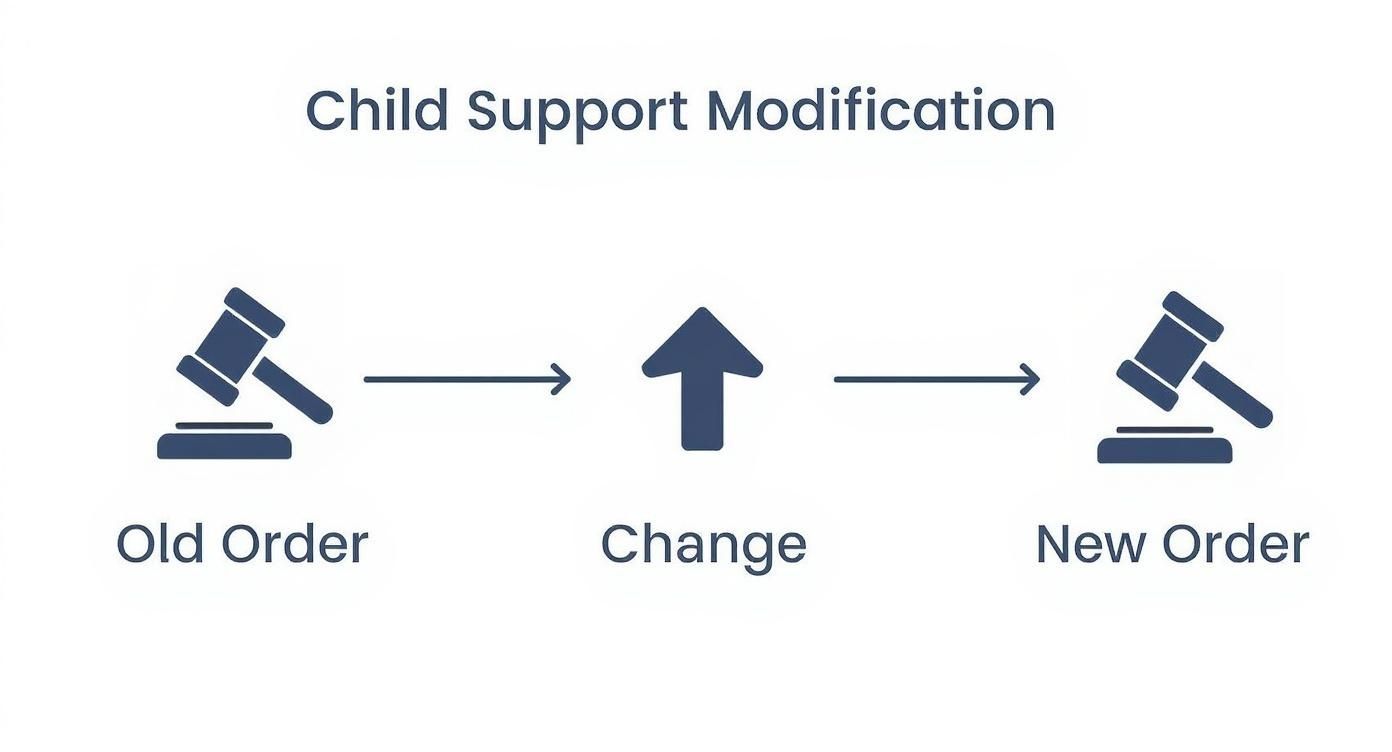
As you can see, that "change in circumstances" is the essential bridge between your current legal obligations and a new child support order that actually fits your life today.
Once the petition is filed, you must complete a crucial step known as service of process. This is the formal, legal method of notifying the other parent (the Respondent) that a lawsuit has been filed. Proper service isn't just a suggestion; it is a constitutional requirement ensuring that everyone has a fair opportunity to respond. Typically, service is completed by a constable, sheriff, or private process server who personally delivers a copy of the filed petition and a legal notice called a citation to the other parent.
Reaching an Agreement Outside of Court
Not every modification case has to end in a drawn-out courtroom battle. In fact, many parents manage to reach an agreement on their own, which can save a tremendous amount of time, money, and emotional energy.
Mediation is an incredibly effective tool for this. In mediation, a neutral third-party mediator helps you and the other parent talk through the issues and find some common ground. The mediator doesn’t make decisions for you; their job is to facilitate a productive conversation aimed at reaching a deal you can both live with. If you succeed, that agreement is written down, signed, and presented to the judge to be finalized into a new, enforceable order.
Key Insight: Even if you and the other parent are in total agreement on the new child support amount, you must get that agreement formalized in a new court order signed by a judge. A verbal agreement or a handwritten note is not enough and will not legally change your child support obligation.
Whether it’s through direct negotiation with the help of attorneys or through formal mediation, resolving the issue collaboratively is often the best path forward. It gives you control over the outcome instead of leaving the final decision in the hands of a judge, and it ensures your new arrangement is both fair and legally sound.
Building a Strong Case with the Right Documents
When you ask a court to change a child support order, you are asking a judge to make a significant legal decision. Simply telling the judge that your income has dropped or your child's needs have increased is not enough. You must prove it with clear, organized evidence. This is where building a strong case comes down to one thing: gathering the right documents to paint a factual picture of that "material and substantial change."
Think of it this way: your story is one side of a canyon, and the judge's decision is on the other. Your documents are the bridge that connects the two. Without solid proof, your argument is just a claim, and that bridge won't hold up in court.

Financial Proof for Income Changes
The most common reason for seeking a modification is a change in income. This could be a job loss, a significant pay cut, or even a promotion that substantially increases earnings. Whatever the situation, the court needs undeniable proof of that financial shift.
Here’s a practical, actionable checklist of the documents you'll absolutely need to pull together to show an income change:
- Recent Pay Stubs: Gather at least two to three of your most recent pay stubs. These are crucial because they show your current gross and net income, deductions, and hours worked.
- Tax Returns: Your last two years of federal income tax returns, including all W-2s and 1099s, give the court a bigger picture of your earning history and what you're capable of making.
- Employer Letters: If you were laid off, a termination letter or any official communication from your former employer is powerful evidence. Conversely, an offer letter for a new job can prove a change in income just as effectively.
- Unemployment Benefits Statements: If you are collecting unemployment, you will need the statements showing how much you are receiving.
- Business Records: For self-employed individuals, a recent profit-and-loss statement is non-negotiable. It’s the clearest way to show the business's current financial health.
Key Takeaway: The goal here is total transparency. The more complete your financial picture is, the easier it is for a judge to understand and sign off on the change. Trying to hide information or providing incomplete records will only hurt your credibility and sink your case.
Documenting Your Child's Evolving Needs
Sometimes, the modification isn't about your income at all—it's about the child. As children grow, their needs change. If your child has developed new needs that are more expensive, you must document every expense meticulously.
For instance, if a child is diagnosed with a new medical condition, you will need to provide:
- Medical Records and Bills: Invoices from doctors, therapists, or hospitals that break down the cost of treatment.
- Prescription Receipts: Proof of what you are spending on ongoing medications.
- Insurance Statements: Explanation of Benefits (EOB) forms are invaluable. They show exactly what insurance covers and what you are paying out-of-pocket.
The same logic applies to new educational or extracurricular needs. Collect receipts for tutoring, specialized school programs, or activity fees. The key is to draw a direct line from every expense back to your child's well-being.
The Financial Information Statement
One of the most critical documents in any modification case is the Financial Information Statement (sometimes called an Income and Expense Statement). This is a sworn court form where you list all your monthly income from all sources and all your monthly expenses.
This document gives the court a complete snapshot of your financial life, and accuracy is paramount. You must fill it out completely and honestly, as both the other parent’s attorney and the judge will scrutinize it. Attaching the supporting documents you have gathered—like pay stubs and bills—is how you validate the numbers you put on this form.
Gathering this information is part of a legal process called "discovery." Understanding the role of discovery in a Texas family law case can help you prepare. It clarifies what you need to provide and what you can request from the other parent, forming a foundational step in building a persuasive argument for modifying child support.
How Courts Recalculate Child Support Payments
When you go to court asking to change a child support order, you will naturally wonder, "What will the new amount actually be?" This uncertainty can be a significant source of stress. However, understanding how Texas courts recalculate these payments can demystify the process and give you a realistic expectation of the outcome.
Fortunately, judges do not simply pick a number. They follow a specific formula laid out in the Texas Family Code, which ensures calculations are consistent and fair for families across the state.
The Guideline Calculation Formula
The process begins by determining the non-custodial parent's (the "obligor") net monthly resources. This isn't just take-home pay; it includes all sources of income, such as wages, salary, commissions, bonuses, rental income, and even retirement benefits.
From that total income, the court subtracts specific, allowable deductions, which typically include federal income taxes, Social Security taxes, and the amount the parent pays for the child's health insurance. The remaining figure is the "net monthly resources."
Once the court has that number, it applies a straightforward percentage based on the number of children in this specific case:
- One Child: 20% of net resources
- Two Children: 25% of net resources
- Three Children: 30% of net resources
- Four Children: 35% of net resources
- Five or More Children: 40% of net resources
For a practical example, if a parent's net monthly resources are $5,000 and they have two children, the guideline child support would be $1,250 per month (25% of $5,000). For a deeper dive into the numbers, check out our guide on how to properly calculate child support in Texas.
Keeping the Income Cap in Mind
Texas law also sets a "cap" on the amount of income to which the guideline percentages are applied. This is designed to ensure child support covers the child's needs without becoming an unfair financial windfall for the other parent.
This cap is adjusted for inflation every six years. A major update occurred on September 1, 2025, when the cap on net monthly resources increased from $9,200 to $11,700. This adjustment, required by Texas Family Code §154.125, reflects economic changes and has a real impact.
For instance, a high-earning parent with one child previously had a maximum guideline support of $1,840 (20% of the old $9,200 cap). Under the new cap, that same parent's maximum guideline support is $2,340 (20% of $11,700).
If the paying parent earns more than the cap, the judge typically applies the percentages only to the capped amount. However, a judge can order support above the guidelines if the other parent can prove the child has special needs requiring it, such as expensive medical care or specialized private schooling.
A Practical Example: Imagine a father earns $15,000 in net monthly resources and has one child. The court won't automatically take 20% of his entire income. Instead, it will apply the 20% guideline to the cap of $11,700, setting the base child support at $2,340. The judge would only go higher if the mother proved the child had specific needs that justified it.
When Can a Judge Deviate from the Guidelines?
While the formula is the starting point, it’s not an unbreakable rule. A judge can order an amount that’s higher or lower than the guideline calculation if they find it is in the best interest of the child.
Judges do not take this step lightly. They must consider a wide range of factors before going "off-guideline," such as:
- The age and unique needs of the child (e.g., a child with a disability).
- The financial ability of both parents to support the child.
- How much time the child physically spends with each parent.
- Any extraordinary expenses, like private school tuition or significant healthcare costs.
Ultimately, the court’s goal is to issue an order that is fair, manageable for both parents, and, most importantly, provides for the child’s well-being based on the current reality of everyone's situation.
Timing is Everything: Retroactive Support and Temporary Orders
When a major life change impacts child support, every day counts. Waiting even a few weeks to take action can have significant financial consequences, which is why it is essential to understand two critical legal tools: retroactive modification and temporary orders. These are the mechanisms the court uses to manage support payments from the day you file your case until a judge makes a final ruling.

Many people mistakenly believe that if their income drops in January, a judge can eventually go back and adjust their child support payments to that date. Unfortunately, this is one of the biggest and most costly misconceptions in Texas family law. A judge's authority to modify support retroactively is very limited.
Under the Texas Family Code, a judge can only backdate a modification to the date the other parent was officially served with the lawsuit. Not the day you lost your job. Not the day your circumstances changed. This rule underscores why it is absolutely critical to file your Petition to Modify the moment a material and substantial change occurs.
Getting Immediate Relief with Temporary Orders
While your modification case moves through the court system—a process that can take several months—you are still legally obligated to pay the full amount in your existing child support order. This can create an impossible financial situation, especially after a job loss. This is where temporary orders can be a true lifeline.
Shortly after filing your modification suit, you can ask the court for a temporary orders hearing. At this hearing, a judge can issue a new, temporary child support amount that remains in effect until your case is finalized. This is designed to give you immediate financial breathing room based on your current reality, instead of forcing you to pay an amount you simply cannot afford.
For example, if you were laid off and your monthly income plummeted from $6,000 to only unemployment benefits, a judge could issue temporary orders that reduce your support obligation to reflect that new, lower income while the case proceeds.
How Retroactive Modification Works
Once your case is finally resolved, the judge will sign a final order. If the new, permanent child support amount is different from what was set in the temporary orders (or from the original order, if you did not get temporary orders), the judge has the power to make the new amount retroactive.
But again, that retroactivity only extends back to the date of service. If the final child support amount is lower than what you were paying under the temporary orders, you could receive a credit for the overpayment. Conversely, if the final amount is higher, you will owe the difference in back payments, which are called arrears.
This differs from the retroactive support ordered in initial cases where a parent was never paying. In those suits, Texas law allows courts to go back up to four years to ensure a child receives support. You can learn more about those initial standards and how they address child support needs. But in a modification, the look-back period is much shorter and is tied directly to when you took legal action.
Key Takeaway: The moment you realize a permanent, significant change has occurred, the clock starts ticking. Every day you wait to file a modification lawsuit is a day you might be overpaying—or under-receiving—support that you can never get back.
Acting quickly to file your case and request temporary orders is the best way to protect your financial stability and ensure the child support obligation reflects your life today, not yesterday.
Answering Your Top Questions About Child Support Modifications
When you're facing a big life change and need to adjust your child support, it's completely normal to feel overwhelmed by questions. The legal process can feel intimidating, and the outcome impacts your family's financial stability. We hear these same questions from parents just like you every day, so let's walk through some of the most common ones.
What Happens if I Lose My Job? Can I Just Stop Paying?
This is often the first and most urgent question we get, and the answer is a firm and absolute no. Your legal duty to pay child support is dictated by a court order, and that obligation doesn't just disappear when your paycheck does. It remains in full force until a judge officially changes it.
Deciding to just stop payments on your own, even for a completely valid reason like losing your job, is one of the worst mistakes you can make. It can trigger a whole host of legal problems.
The other parent can file an enforcement action against you, which could lead to:
- Wage Garnishment: Once you find a new job, the court can order your employer to take money directly from your paycheck.
- License Suspension: Texas can suspend your driver's license, any professional licenses you hold, and even your hunting and fishing licenses.
- Contempt of Court: This is a serious one. A judge could find you in contempt for willfully ignoring the order, leading to hefty fines or even jail time.
The only safe and correct path is to immediately file a Petition to Modify the Parent-Child Relationship. Taking this step shows the court you're being responsible. It allows you to formally request a temporary reduction or even a suspension of your support payments while you search for new work.
How Long Does a Modification Case Actually Take in Texas?
The timeline for changing your child support order really boils down to one simple thing: whether or not you and the other parent can agree.
If it's an uncontested modification—meaning you both agree on the new amount—the process can be surprisingly quick. Once you have a signed agreement drafted, a judge can often approve it and sign the new order within a couple of months, often without anyone needing to set foot in a courtroom.
A contested case, on the other hand, is a different animal entirely. If you can't see eye-to-eye and a judge has to make the final call, you're in for a much longer haul. Depending on how busy the court's schedule is and how complicated your financial picture is, a contested modification can easily take six months to a year, and sometimes even longer.
We're on Good Terms. Can We Just Agree on a New Amount Ourselves?
It’s tempting to try and handle this informally, especially if you and the other parent have a good co-parenting relationship. You might shake on a new amount, or even write something down and both sign it. While your intentions are good, this is a huge legal gamble. An informal agreement is not legally enforceable in Texas.
The only way to officially change your child support obligation is to have a new court order signed by a judge. Until that happens, the original court order is the only one that matters in the eyes of the law.
This creates a dangerous situation. Imagine you've been paying a lower, informally agreed-upon amount for years. The other parent could, at any time, take you back to court and demand the difference between what you paid and what the original order required. You'd be on the hook for all of those back payments, plus interest. Always, always protect yourself by getting any changes finalized through the court system.
Trying to figure all this out can be tough, but you don't have to do it by yourself. Getting the right legal advice ensures you're making smart decisions that protect both your rights and your child’s well-being.
If you need help navigating divorce, custody, or estate planning in Texas, contact The Law Office of Bryan Fagan, PLLC today for a free consultation.


