

It started on a quiet Sunday afternoon — the kind where the house finally feels still. The laundry was folded, the dog was asleep, and the only sound was the hum of the ceiling fan. But then came the email: your ex had filed to change the child support order. Suddenly, that stillness turned into worry. What does this mean? Will it affect your budget, your weekends, your child’s routine? Life after divorce is already full of adjustments — and Changing a Texas Child Support Order can feel like one more storm to navigate.
At The Law Office of Bryan Fagan, PLLC — a Houston-based family law firm founded by Bryan Joseph Fagan, a South Texas College of Law graduate and recognized authority on Texas divorce and custody law — we understand that behind every court document is a real person trying to protect their peace, their family, and their future. Our mission has always been clear: to empower people to reclaim freedom and peace of mind during life’s hardest transitions. We do this through compassionate counsel, education, and innovative legal solutions that simplify complexity, because no one should face the Texas family court system feeling alone or overwhelmed.
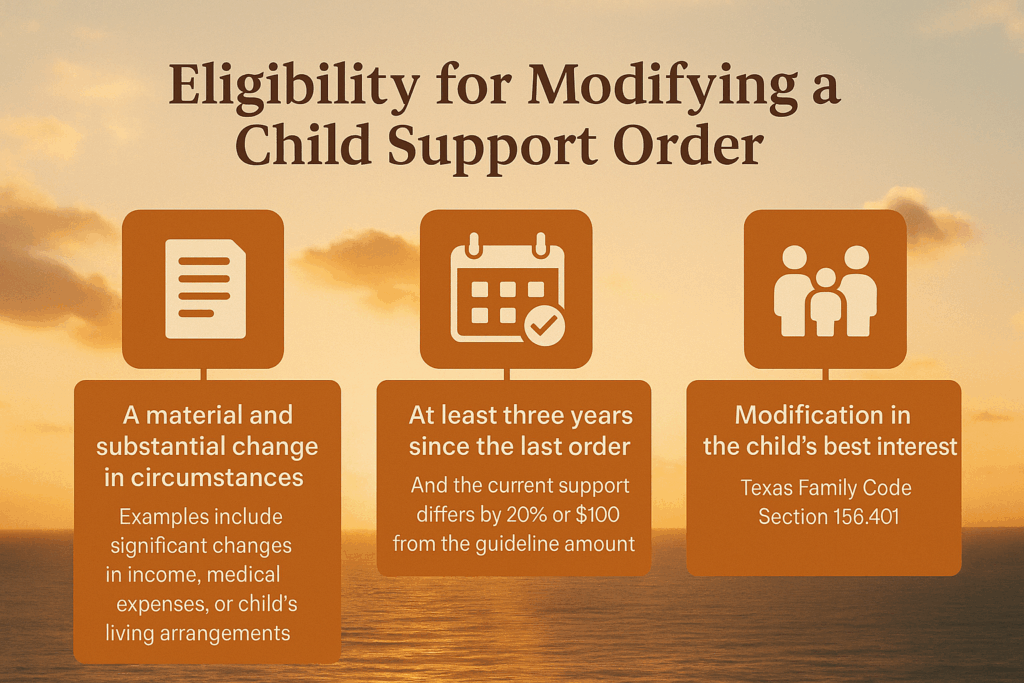
Under Texas Family Code §156.401, a child support order may be modified when a parent’s circumstances have materially and substantially changed, or when it’s been at least three years since the last order. But understanding your rights and responsibilities — from what counts as a valid change to when modifications take effect — is key to protecting both your financial stability and your child’s well-being.
In this article, we’ll walk you step-by-step through how to change a Texas child support order, what to expect from the legal process, and how thoughtful planning can restore stability to your life. Because at The Law Office of Bryan Fagan, PLLC, we don’t just handle paperwork — we help families find clarity, confidence, and peace of mind when life takes an unexpected turn.
Key Takeaways
- Eligibility for child support modification in Texas requires either parent to demonstrate significant changes in circumstances or to wait three years since the last order.
- Navigating the modification process involves filing necessary petitions, serving the other parent, and potentially attending mediation or court hearings.
- Maintaining current child support payments during the modification process is essential to avoid legal penalties and to present good faith in court.

Your Family’s Future Starts Here
Don’t navigate your legal journey alone. Schedule a consultation now and get the clarity and support you deserve.
Understanding Eligibility for Child Support Modification
Understanding eligibility is the foundation of successfully Changing a Texas Child Support Order. According to Chapter 156 of the Texas Family Code, particularly Section 156.401, a court may modify a child support order if there has been a material and substantial change in circumstances since the last order or if three years have passed and the monthly amount differs by 20% or $100 from the current guideline amount. This statute ensures that child support obligations remain fair and aligned with each parent’s financial reality and the child’s evolving needs.
Under Texas law, anyone with standing—typically either parent, a person named in the existing order, or the Texas Attorney General’s Office—can request a modification. However, these petitions must be filed in the court with continuing, exclusive jurisdiction over the case. For example, if your case originated in Harris County but both parents have since relocated, a qualified attorney can help determine whether jurisdiction should be transferred.
The law is designed to protect both parents and children from outdated or inequitable support arrangements. Modifications may be considered when one parent experiences job loss, a significant increase or decrease in income, new medical expenses arise, or a child’s living situation changes substantially. As of the 2025 updates to the Texas Family Code, the income cap for calculating guideline support under §154.125(a-1) increased to $11,700 in net monthly resources, a change that may affect many parents seeking fairer recalculations.
When navigating these issues, working with an experienced legal team—such as the professionals at The Law Office of Bryan Fagan, PLLC—ensures that every filing, affidavit, and jurisdictional step is handled correctly. The firm’s attorneys understand both the procedural nuances and the emotional weight that come with modifying a child support order. Their Montrose office also provides dedicated support for local families seeking modifications through the court system. Learn more about how they can help by visiting Modifications to Court Orders in Montrose.
Understanding these eligibility requirements—and having compassionate, knowledgeable guidance—sets the stage for a smoother legal process and a support order that truly reflects your family’s current circumstances.
Legal Procedures for Modifying Child Support Orders
Once you determine that you’re eligible, Changing a Texas Child Support Order means following precise legal procedures to ensure compliance with Texas law and accuracy in every filing. According to Texas Family Code §156.401, any modification to an existing child support order must be initiated through a formal petition filed in the same court that issued the original order, unless jurisdiction has been properly transferred. This process ensures consistency and preserves the court’s continuing, exclusive jurisdiction over the matter.
To begin, you’ll need to complete and file a Petition to Modify the Parent-Child Relationship. This document outlines your request for modification and identifies all parties to the original order, including the Office of the Attorney General of Texas, if applicable. Once filed, the opposing parent must be formally served unless they voluntarily sign a waiver of service. If the other parent fails to respond after being properly served, the court may move forward with a default judgment, provided all procedural requirements have been met under Texas Family Code §156.403.
Before the court hearing, both parties typically receive at least a 45-day notice to prepare and exchange evidence, such as updated income statements or proof of changed circumstances. Following the court’s ruling, a file-stamped copy of the modified order must be delivered to each party to ensure everyone is aware of the updated obligations. For parents facing financial hardship, Texas law allows for the filing of a Statement of Inability to Afford Payment of Court Costs under Texas Rule of Civil Procedure 145, ensuring that financial limitations do not block access to justice.
Because the modification process can be complex, working with a knowledgeable Texas family law attorney can make a critical difference. The experienced legal team at The Law Office of Bryan Fagan, PLLC helps parents navigate these legal steps with clarity and confidence. To explore how the firm assists with post-divorce and support-related changes, visit Divorce Modification Services in Texas for guidance. With professional support, you can move forward knowing your rights are protected and your family’s future remains secure.

Required Documentation for Child Support Modification
When Changing a Texas Child Support Order success often comes down to preparation—especially when it comes to documentation. The Texas Family Code requires parents seeking modification to demonstrate a material and substantial change in circumstances under §156.401, or to show that three years have passed since the last order with a difference of at least 20% or $100 from the current child support guidelines. The courts rely heavily on accurate, up-to-date documentation to verify these claims, making organization and completeness critical to your case.
Before filing a modification request, parents should gather comprehensive financial records, including recent pay stubs, tax returns, and proof of employment. Health-related documentation—such as medical bills, insurance premiums, and records of uninsured or extraordinary medical expenses—is equally important. Custody verification, childcare costs, and evidence of educational or living expense changes may also strengthen your request. Since the 2025 update to the Texas Family Code §154.125(a-1) raised the guideline cap for net monthly resources to $11,700, accurate income documentation ensures that any recalculations reflect current standards.
At The Law Office of Bryan Fagan, PLLC, our attorneys help clients streamline this process by organizing and presenting the evidence effectively—reducing the risk of costly errors or delays. Incomplete or inaccurate submissions can stall your modification and potentially undermine your credibility in court. Our team ensures that your filing meets every statutory requirement and fully supports your claim for adjustment.
For a deeper look at how Texas courts handle documentation and income verification in modification cases, explore our Texas Child Support Resource. With professional guidance and diligent preparation, you can approach your modification with confidence—knowing your paperwork, and your case, are built on solid legal footing.
The Role of Mediation and Court Hearings
Mediation offers a less adversarial and more supportive environment for resolving disputes in the child support modification process. It facilitates effective communication, ground rules setting, and a focus on the children’s best interests. The mediator facilitates discussions but does not make decisions, ensuring both parties remain in control.
If mediation fails, the next step is a court hearing where both parents present their cases, and a judge makes the final decision based on the evidence and testimonies. Legal advisors can support parents during mediation and courts processes, ensuring legal compliance and protecting their interests. It is important that both parent agree on the terms discussed.
An agreement reached in mediation often leads to a legally binding document, providing clarity and enforceability for both parties. If mediation isn’t successful, litigation follows, making it crucial to be prepared for either outcome.
Continuing Existing Payments During the Process
It’s vital to continue making payments as per the current child support order throughout the modification process. Prematurely stopping payments, even if a change seems justified, can result in legal penalties and complicate the modification process.
Termination of the parent-child relationship or discovering non-biological paternity does not eliminate the obligation to pay support already due; changes must be court-ordered. Maintaining payments demonstrates compliance and good faith, positively impacting the court’s view of your case.
Common Reasons for Child Support Modification
Life is unpredictable, and even the most carefully structured support orders may need to be revisited as families grow and circumstances evolve. When Changing a Texas Child Support Order, understanding what qualifies as a “material and substantial change” under Texas Family Code §156.401 is essential. This section of the law authorizes courts to modify support obligations when life events significantly impact a parent’s financial ability or a child’s needs—ensuring that the order remains fair and reflective of current realities.
Common reasons for modification include job loss, reduced income, or major life adjustments such as relocation or a change in custody. A parent may also seek modification when a child’s medical, educational, or developmental needs increase substantially. Additionally, the birth of a new child, changes in insurance coverage, or unexpected health conditions that affect a parent’s capacity to work can all warrant a review of the existing order. As of the 2025 Texas Family Code update, the guideline cap for calculating support has risen to $11,700 in net monthly resources under §154.125(a-1)—a critical consideration for parents seeking fair recalculations.
Taking timely action after a significant change helps avoid legal complications, missed payments, or enforcement issues. Working with a trusted legal team ensures that all documentation—income verification, medical expenses, and proof of changed circumstances—is accurately prepared and presented. The attorneys at The Law Office of Bryan Fagan, PLLC are skilled in helping families navigate these modifications with care, clarity, and efficiency. For residents of the Rice Village area, the firm offers personalized guidance through Rice Village Modifications to Court Orders, providing tailored legal support for those facing changing family or financial circumstances.
For additional insights on how Texas courts evaluate post-divorce or child support modifications, visit our Texas Child Support Resource. Acting promptly and with informed legal counsel ensures your support order reflects today’s circumstances—and protects your family’s peace of mind for tomorrow.
Why Professional Legal Guidance is Crucial
When Changing a Texas Child Support Order, professional legal guidance isn’t just helpful—it’s essential. The process of modifying child support involves strict procedural and evidentiary requirements outlined under Texas Family Code §156.401, which governs when and how a court may adjust an existing order. These cases often hinge on demonstrating a material and substantial change in circumstances or proving that the order no longer aligns with the Texas child support guidelines, updated in 2025 to reflect a new income cap of $11,700 in net monthly resources under §154.125(a-1).
At this stage, even a small procedural error—like incomplete financial disclosures or filing in the wrong jurisdiction—can delay or jeopardize your case. That’s why working with an experienced family law attorney is so valuable. The attorneys at The Law Office of Bryan Fagan, PLLC understand how to build a strong, well-documented petition that complies with every legal standard and local court requirement. They also help clients evaluate how a modification might affect related financial matters such as taxes, medical support, or government benefits—issues often overlooked when parents try to handle the process alone.
For families in the Houston Heights area, the firm’s dedicated team provides compassionate, skilled assistance through Divorce Decree Modifications in Houston Heights. Their attorneys take time to understand your family’s situation, simplify the legal complexities, and advocate for an outcome that supports your child’s best interests.
If you’re considering a modification, explore our Texas Child Support Resource to learn more about eligibility, filing steps, and recent legislative updates. With the right legal partner, you can move forward confidently—knowing your case is handled with precision, compassion, and a commitment to protecting your family’s future.

Success Stories from the Law Office of Bryan Fagan PLLC
The Law Office of Bryan Fagan PLLC has a proven track record of successfully modifying child support orders. One client, a father who lost his job, secured a reduction in his child support payments after the firm presented a compelling case demonstrating his changed financial circumstances.
Another client, a mother, needed her increased custody time reflected in her child support order and the medical support. Thanks to the firm’s effective advocacy, the modification was granted, alleviating her financial stress and aligning support obligations with her current amount.
These cases highlight the firm’s dedication to achieving the best outcomes for their clients in most cases and to serve their interests effectively.
Resources for Further Assistance
When Changing a Texas Child Support Order, having access to reliable, accurate resources can make all the difference. Texas family law is complex, and understanding where to find trustworthy guidance is key to making informed decisions. Under Texas Family Code §156.401, either parent—or another party with standing—can request a modification when there’s been a material and substantial change in circumstances, or when three years have passed since the last order and the support amount differs by at least 20% or $100 from the current guideline. Staying informed about these legal standards ensures your petition aligns with Texas law and current court expectations.
For parents navigating this process, the Texas State Disbursement Unit plays a vital role in collecting and distributing payments, ensuring accountability and recordkeeping for all support transactions. But understanding when and how to file remains a critical first step. For a detailed explanation of the legal process, review How to Petition for a Modification After a Change of Circumstances in Texas Family Law, where our attorneys break down eligibility criteria, filing procedures, and practical tips for success.
At The Law Office of Bryan Fagan, PLLC, our mission is to educate and empower families so they can approach modification cases with clarity and confidence. Whether you need help understanding child support enforcement, revising custody arrangements, or exploring the 2025 Texas Family Code updates—like the new $11,700 guideline cap under §154.125(a-1)—our legal team provides step-by-step support tailored to your situation.
To explore more helpful insights, visit our Texas Child Support Resource. Reliable information, compassionate guidance, and skilled representation are the foundation of how we help Texans protect their families and their futures.
Conclusion:
Life after divorce rarely moves in a straight line. Jobs change, kids grow, expenses shift — and sometimes, what worked a few years ago just doesn’t fit anymore. If you’re thinking about changing a Texas child support order, you’re not just reworking a legal document — you’re taking a thoughtful step toward balance and stability for your family’s next chapter.
At The Law Office of Bryan Fagan, PLLC, we believe every parent deserves clarity, compassion, and confidence when navigating family law. Our team helps Texans turn stressful legal moments into opportunities for peace of mind — guiding you through the process with empathy, precision, and a genuine understanding of what’s at stake.
If you’re unsure where to begin, that’s okay — most people are. Start by asking yourself what kind of future you want for your family, then let us help you map the legal path to get there. Because with the right support, even complicated changes can lead to a more stable, hopeful tomorrow.
And remember — in Texas, you don’t have to face these transitions alone. Reach out to The Law Office of Bryan Fagan, PLLC today to speak with an experienced family law attorney who’s dedicated to protecting what matters most: your family, your peace, and your future.
Frequently Asked Questions
In Texas, you amend a child support order by filing a petition to modify in the same court that issued your original order. You’ll need to show a material and substantial change in circumstances—such as a change in income, medical needs, or custody—or that it’s been at least three years and the difference between your current support and the guideline amount is at least 20% or $100. Once filed, the other parent is served, and the court reviews the case to determine if a modification is appropriate.
While “child arrangement order” is a U.K. term, the Texas equivalent involves modifying conservatorship or possession orders. You’ll file a modification request in the existing case and demonstrate that a change would serve the child’s best interest (Texas Family Code §153.002). If both parents agree, the court can approve the modification without a hearing; if not, a judge will decide based on the evidence presented.
To change a court order for child support, file a Petition to Modify the Parent–Child Relationship. Include updated proof of income, expenses, and relevant changes. After serving the other parent, you may attend mediation or a hearing. The court typically adjusts payments prospectively—from the filing or service date—not retroactively.
You don’t have to wait if there’s been a material and substantial change, such as job loss or custody change. Otherwise, you can file for a review every three years if your support amount differs by at least 20% or $100 from the current guideline calculation.
Good reasons include a significant change in income, medical expenses, custody, or the child’s needs. For example, if one parent loses their job or the child develops new educational or medical costs, those may qualify. The court will not grant modifications for minor or temporary changes.
A modification letter can start discussions but does not legally change your order. Clearly explain why you’re requesting a change, attach documentation (such as pay stubs or medical bills), and suggest a revised amount. To make it official, you must file a petition with the court or request a review through the Texas Attorney General’s office.
Letting personal conflict override your child’s best interest is the biggest mistake. Judges favor parents who cooperate, communicate respectfully, and comply with existing orders. Negative behavior—like withholding visitation or badmouthing the other parent—can hurt your case and damage your credibility.
You can request a modification any time there’s a material and substantial change, such as relocation, new work schedules, or concerns for a child’s safety. If the child is 12 or older, they can express a preference about their primary residence to the judge. Emergency situations may allow for temporary orders until the final decision.
In Texas, custody or support orders aren’t simply “reversed,” but they can be modified if circumstances justify it. You must show the court that conditions have materially changed and that the new arrangement serves the child’s best interest. With solid evidence, courts can shift custody, visitation schedules, and financial responsibilities accordingly.