

For families and caregivers seeking to provide financial support for a loved one with a disability, a properly structured trust offers a path to both security and peace of mind. Among the tools available, a special needs trust is uniquely designed to protect government benefits while enabling supplemental support. An important facet of this planning involves working with banking institutions and selecting appropriate banking arrangements that satisfy legal, regulatory, and practical trust-administration demands. Understanding the bank requirements tied to a special needs trust, especially when the trust will hold funds, investments or other assets in Texas, is critical to ensuring the trust functions as intended.
To make sure your special needs trust operates correctly, you need to understand what banks require before they agree to hold or manage trust funds. These requirements go beyond simple account setup. They determine how your trustee interacts with the institution, how funds are deposited and disbursed, and how compliance with benefit-eligibility laws is maintained. By clarifying these essential banking expectations from the start, you can move forward with confidence in structuring, funding, and maintaining your trust.
Understanding the Trust Bank Relationship: Fundamental Requirements
When you establish a special needs trust (SNT) through a bank or trust department, several foundational banking requirements come into play:
- The bank or trust department must be willing to serve either as trustee or co-trustee of the trust, or at least provide trust services (investment management, custodial accounts, distribution administration).
- There must be an account or accounts established in the name of the trust (not in the beneficiary’s name) so that the assets are held separate from the beneficiary’s personal holdings, preserving eligibility for benefits.
- The institution must conduct standard banking-due diligence: know-your-customer (KYC), trustee identity and authority, tax-ID for the trust, account signatures, and asset transfer documentation. Although banks may not publish special needs trust bank requirements as a unique list, these standard banking protocols apply.
- The bank must offer investment options, account statements, and reporting suitable for trust administration ensuring the trustee can meet fiduciary obligations.
In Texas, there are no additional state laws requiring banks to meet special rules just because they administer a special needs trust. This means the requirements are those of trust law, benefit-eligibility law, and standard banking/trust administration rather than unique bank licensing rules.
Thus when you explore banks for SNT services, confirm they understand the trust’s objective of preserving benefits, and ensure their internal operations align with those goals.
Bank Criteria Related to Trustee Services and Account Administration
The trustee role is central in a special needs trust, and banks often offer trustee services. When a bank is the trustee or co-trustee, several specific bank requirements emerge:
- The bank must have a written trustee agreement that clarifies its role, fee structure, responsibilities for distributions, investments, record-keeping, and successor trustee designation.
- As trustee, the bank must ensure distributions are made in a way that will not jeopardize benefit eligibility (for example, avoid giving the beneficiary direct cash if that would be counted as income or resource).
- The bank must offer investment and asset-management services tailored to the needs of someone with disabilities, including conservative portfolios, liquidity for supplemental needs, and oversight of the trust’s long-term viability.
- The bank must maintain detailed accounting and reporting for the trust, including statements, tax-reporting (IRS forms), transaction logs, and end-of-year reporting to beneficiaries or next of kin when required.
- The bank must support successor planning: if the primary trustee (bank or individual) can no longer serve, the banking institution must coordinate with the trust document to ensure continuity. Some banks reference this in their trust-services documentation.
Therefore, when selecting a bank for a special needs trust you must check that they meet these trustee-related requirements, not just standard deposit-account requirements.
Setting Up Your Bank Account and Funding the Trust
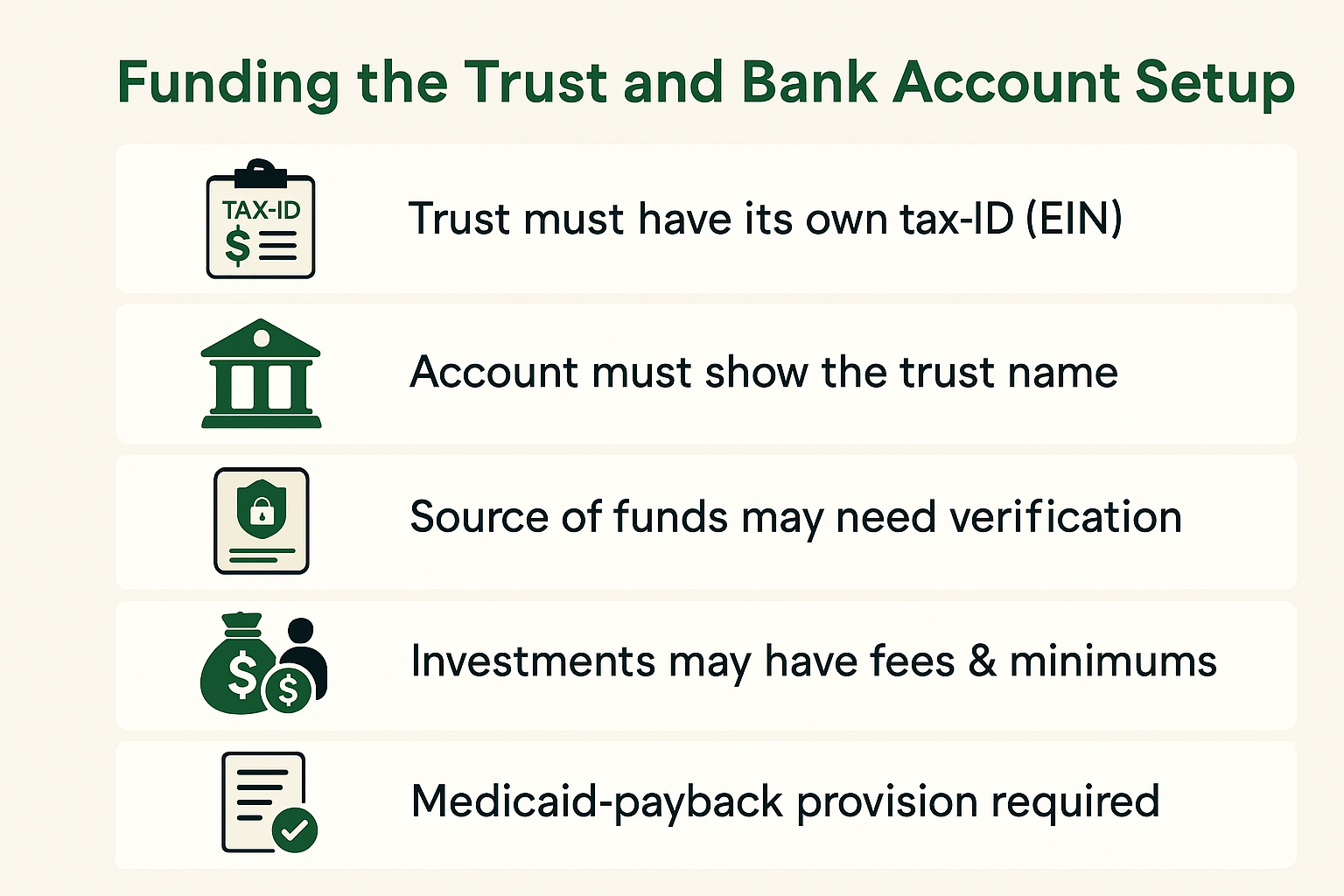
Once you establish the trust document, funding it and setting up the bank accounts are next steps. Bank requirements in this phase involve:
- The trust must have its own tax-ID (EIN) if required by the bank (many banks will require trust accounts to have a unique EIN).
- The deposit account(s) must clearly show the trust name and that the trust is the owner; the beneficiary’s name alone should not appear as the account holder.
- If the trust holds cash, securities, real estate proceeds or settlement funds, the bank may require documentation of the source of funds for anti-money-laundering (AML) and Internal Revenue Service (IRS) reasons.
- If the trust holds investments, the bank must offer custodial brokerage/investment accounts or trust-investment accounts. The bank may require minimum account sizes, ongoing fees, and review meetings.
- If the trust was funded by a settlement or inheritance, the bank may request documentation of those assets, especially in first-party trusts (where beneficiary’s own assets fund the trust) to ensure correct payback provisions for Medicaid.
In Texas specifically, when dealing with first-party trusts, banks should be aware that the trust must include a Medicaid-payback provision for those trusts funded with the beneficiary’s own assets.
As a result, you will want a bank that is aware of and comfortable servicing trusts with these special benefit-preservation rules.
Bank’s Role in Distribution Practices and Benefit Eligibility
A core reason to use a special needs trust is to preserve eligibility for benefit programs such as Supplemental Security Income (SSI) and Medicaid. The bank, if acting as trustee or administering the account, must understand how distributions interact with benefit rules. Requirements include:
- The bank/trustee must ensure the trust does not make cash payments to the beneficiary in a way that converts trust assets into countable resources or income under SSI/Medicaid rules.
- The bank must track distributions and maintain documentation showing that the funds were used for permissible supplemental expenses (for instance, therapy, mobility equipment, travel) rather than basic food and shelter which could reduce benefits.
- The bank may need to coordinate with the beneficiary’s benefit caseworker or attorney to verify that distributions remain compliant and to monitor changes in the law.
- The bank must keep detailed records for the remainder pay-back obligation (first-party trusts) so that at the beneficiary’s death, the remaining assets can be used to reimburse the state for Medicaid benefits received.
Therefore your banking partner must be aligned with the benefit-preservation goals of the trust.
Choosing the Right Banking or Trust Institution for a Special Needs Trust
When evaluating banks for your special needs trust, certain factors related to requirements stand out:
- Experience with Special Needs Trusts
Choose a bank or trust department that clearly lists special needs trust services and demonstrates knowledge of benefit-eligibility rules. For example, some Texas banks explicitly mention special needs trust services. - Fee Structure and Transparency
The bank should provide a clear fee schedule for trust administration, investment management, and trustee services. Make sure these fees are compatible with the trust size and projected funding. - Investment Strategy Suited to a Beneficiary’s Needs
The bank should offer portfolios that reflect the unique nature of the beneficiary’s life: access to cash for supplemental needs, growth potential, protection, and flexibility. - Distribution Capabilities and Reporting
Bank requirements include robust statements, online access, distribution tracking, and flexibility in payment methods (check, electronic payments, vendor pay) consistent with trust goals. - Ability to Serve as Corporate Trustee or Co-Trustee
Some families prefer the bank to act as corporate trustee (or co-trustee with a family member). A bank that can serve in that role must satisfy internal corporate trust standards and fiduciary compliance. - Understanding of State-Specific Laws (Texas)
While federal laws govern benefits, trust law is state-specific. The bank should be aware that in Texas there are no special statutory rules just for SNTs, but pay-back provisions, trustee responsibilities, and inheritance implications must still be adhered to.
By evaluating these criteria, you can ensure that the bank you choose meets the requirements necessary for effective trust management.
Additional Considerations Beyond Basic Banking Requirements
As you deepen your planning, consider these additional banking-related issues tied to special needs trusts:
- Segregation of Assets: Ensure trust assets are dotted separately from personal assets. Mistakes in pouring personal funds into the trust account can trigger counting of resources by benefit programs.
- Periodic Reviews: Because laws change (for example changes to benefit eligibility rules) and the beneficiary’s needs evolve, the bank and trustee should review the trust structure and account arrangements periodically.
- Hybrid Funding & Asset Types: If real estate, mineral rights, or non-cash assets are part of the trust, the bank may require special arrangements or coordination with other advisors.
- Successor Trustee and Bank Continuity: If you name a bank as trustee, ensure the trust document contemplates a successor trustee if the bank exits the business or you wish to change providers later.
- Technology and Access: Check the bank’s online interface, transaction capabilities, and how they handle vendor payments (for caregivers, therapies, etc.). These practical elements often matter more than formal requirements.
- Coordination with Estate Plan and Will: The trust should be integrated with your broader estate plan. The bank may need to coordinate with your attorney, and from a banking-requirement standpoint, the trust must stand on its own and hold its own assets/testamentary transfers appropriately.
- Tax Implications: Though not strictly a banking requirement, the bank must collaborate with tax advisors to provide required filings (such as Form 1099 for distributions, trust tax returns) and ensure the tax status of the trust is handled correctly.
Why It’s Important to Meet Bank Requirements
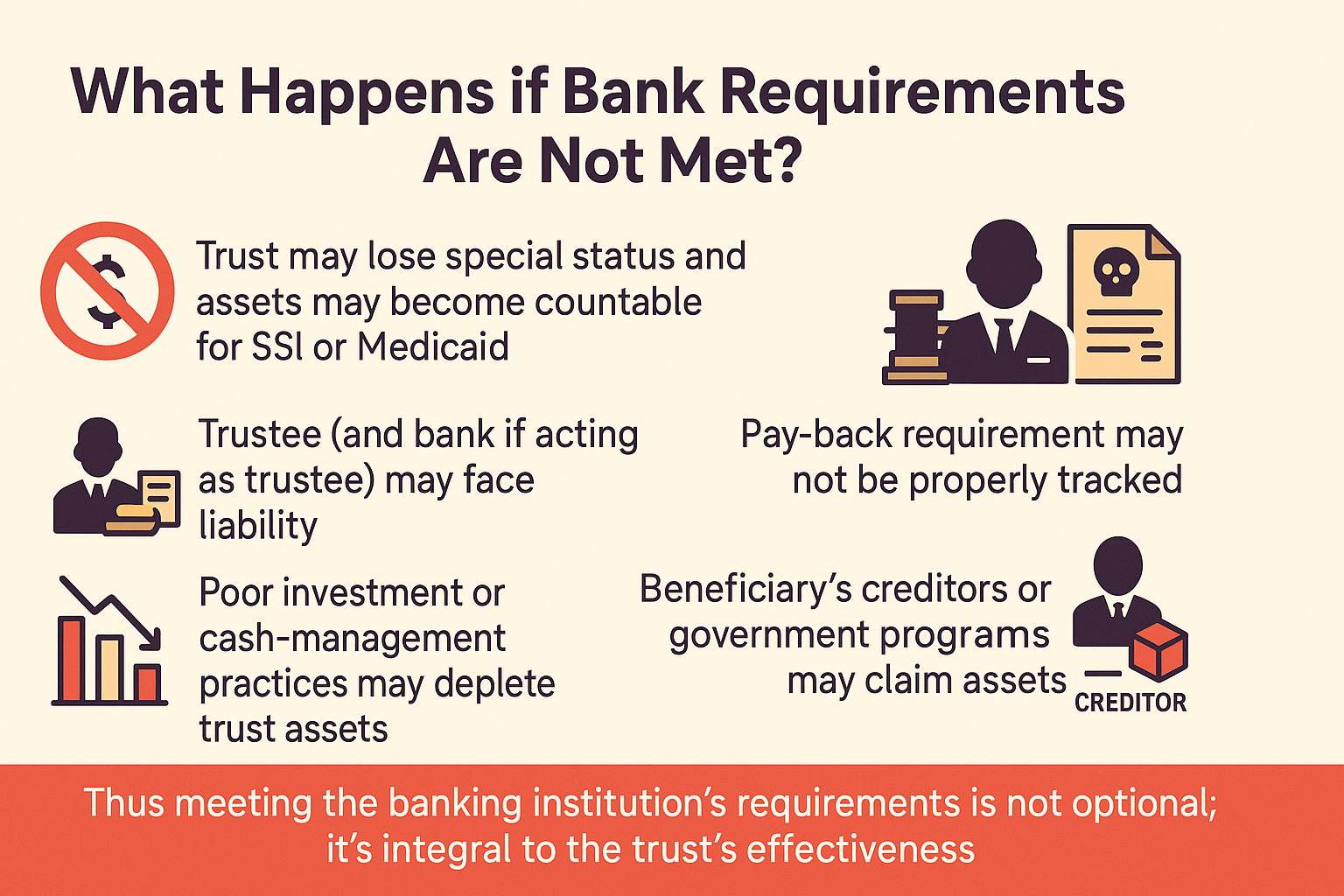
Failing to meet bank or trust-administration requirements can lead to serious consequences for the trust and the beneficiary:
- The trust may lose its special status and the assets may become countable for SSI or Medicaid, causing loss of benefits.
- The trustee (and bank if acting as trustee) may face liability for mismanagement, breaches of fiduciary duty, or failure to maintain required records.
- At the beneficiary’s death, the pay-back requirement (for first-party trusts) may not be properly tracked, leading to disputes with the state.
- Poor investment or cash-management practices may result in depletion of the trust assets, undermining its purpose.
- Without proper segregation of trust assets, the beneficiary’s creditors or government programs may claim those assets.
Thus meeting the banking institution’s requirements is not optional; it’s integral to the trust’s effectiveness.
Conclusion
Establishing and maintaining a special needs trust requires more than drafting the legal document. Your choice of banking partner and how they handle account setup, trustee services, asset management, distributions, and compliance are pivotal. By focusing on the banking requirements, from trust-account structure and trustee capabilities to distribution oversight and record-keeping, you position the trust to fulfill its goal of supporting your loved one while preserving eligibility for essential benefits. With careful selection of the bank, coordination with legal and tax advisors, and ongoing oversight, you can build a framework that offers long-term stability and meaningful support.
Other Related Posts
- How Does a Revocable Living Trust Work for Estate Planning and Asset Control
- Why You Need an Attorney for Living Will Decisions and Planning
- Finding the Right Texas Special Needs Trust Lawyer for Your Family’s Future
- Is a Living Will Legally Binding and How It Works in Real Situations
- Key Benefits of Minor Guardianship in Texas: Legal Protection and Parental Support
- Creating a Living Will: A Clear Legal Framework for Your Future Care
- How to File for Temporary Guardianship the Right Way: What You Need to Know
- Understanding the Cost of Special Needs Trust for Long-Term Planning
- How to Set Up a Living Will: Step-by-Step Legal Planning Guide
- Texas Guardianship Attorney Services: Essential Legal Support for Families
- Special Needs Trust Medicaid Guide: Protecting Benefits Without Sacrificing Support
- Advance Directives vs Living Will: A Practical Comparison for Medical Planning
Frequently Asked Questions
Typically the bank account should be titled in the name of the trust (for example “John Doe Special Needs Trust, dated [date], FBO [beneficiary’s name]”) and use the trust’s tax-ID rather than the beneficiary’s personal account. This makes clear the funds belong to the trust, not the individual directly.
Yes, if the bank has a trust department and offers fiduciary services, they can serve as trustee or co-trustee. It is essential to confirm they have experience with special needs trust administration and understand benefit-eligibility rules.
Many banks have thresholds for trust administration (for example a minimum asset size) and they may charge ongoing fees. You should ask the bank about minimums, fee schedules, and whether they will work with smaller trust sizes.
The bank/trustee must make distributions consistent with the trust instrument and in a way that does not jeopardize the beneficiary’s government benefits. This usually means paying vendors directly rather than giving cash to the beneficiary and maintaining detailed records of each distribution.
If the bank chooses to withdraw as trustee, the trust document should provide for a successor trustee. You will need to identify and engage a new trustee, transfer the trust assets into new accounts, and update any associated agreements or disclosures. It is wise to have an exit strategy and communicate with the bank about their continuity plans.