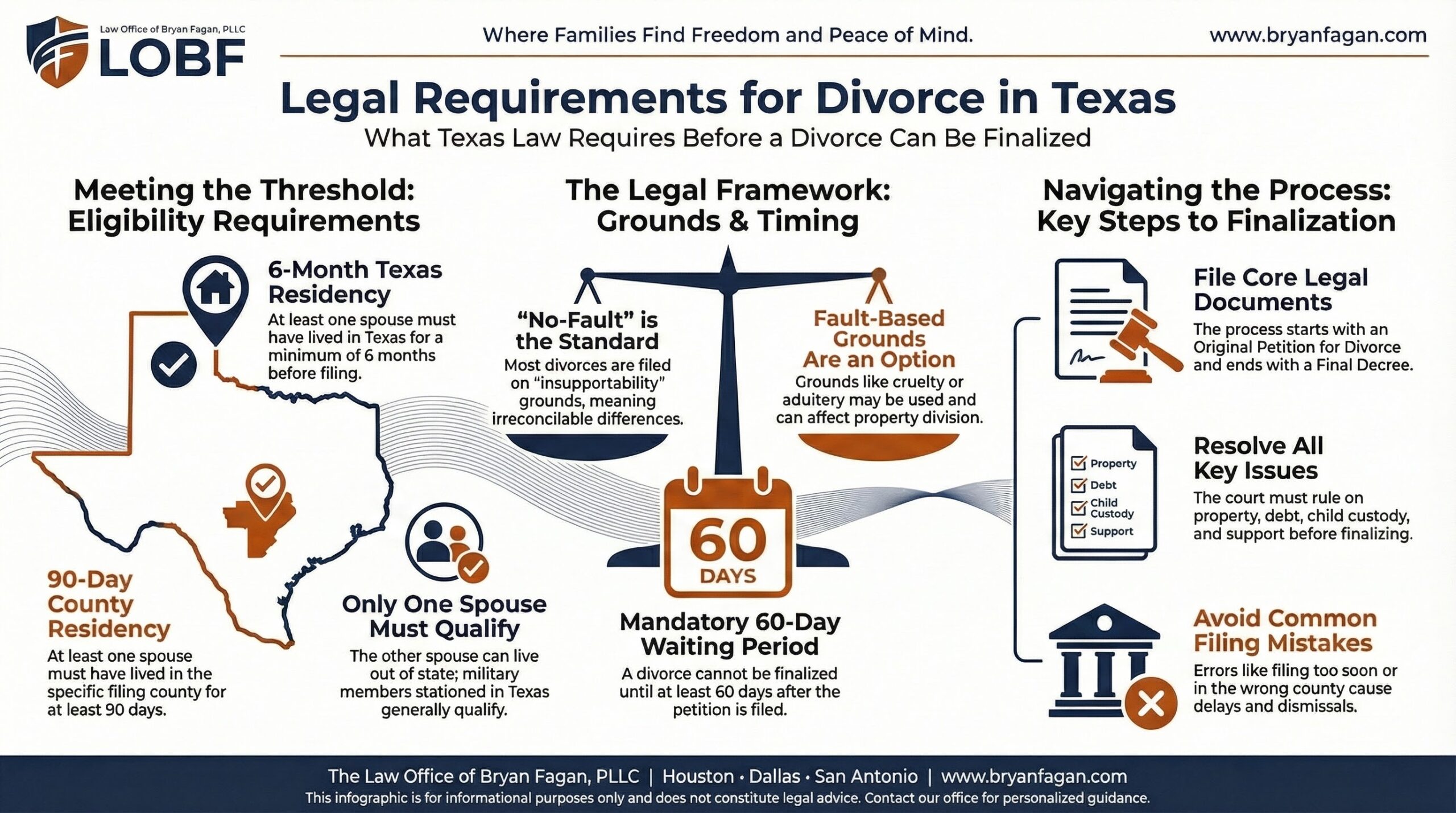

Legal Requirements for Divorce Texas often come into focus at moments when life already feels unsteady. It might be a quiet realization during a late evening at home, or a difficult conversation that finally confirms what you have been feeling for months—that your marriage is ending, and you have no idea what comes next. For many Texans, the first questions are not dramatic or legalistic. They are deeply personal: Where do I start? What happens to my children? How do I make sure I don’t make a mistake that follows my family for years?
At The Law Office of Bryan Fagan, PLLC, we have walked beside families facing these exact questions for more than a decade. Bryan Joseph Fagan, a South Texas College of Law graduate and widely respected authority on Texas divorce and custody law, built this firm on the belief that people deserve clarity and peace of mind during life’s hardest transitions. Texas divorce law is precise for a reason. Under the Texas Family Code, courts require strict compliance with residency rules, filing procedures, and child-focused protections, including the mandate in §153.002 that all decisions affecting children must serve their best interests. Understanding these requirements early can prevent unnecessary conflict, delay, and emotional strain.
This guide is designed to do more than explain statutes and procedures. It will help you understand what Texas courts actually expect, how divorce decisions can ripple through your family’s emotional stability, and why thoughtful legal planning can protect what matters most. Whether you are just beginning to consider divorce or ready to take the next step, this article will give you the knowledge, confidence, and reassurance you need to move forward with clarity—and the sense that you do not have to face this process alone.
Key Takeaways
- Residency is foundational: At least one spouse must have lived in Texas for six continuous months and in the filing county for 90 days before filing divorce papers.
- No-fault divorce is standard: Texas allows divorce based on “insupportability” (irreconcilable differences) without proving fault, though fault grounds exist and may affect property division.
- The 60-day waiting period is mandatory: Texas law requires a minimum 60-day period between filing and finalizing your divorce, with limited exceptions for family violence situations.
- Document accuracy prevents delays: Missing or incorrect required documents—including financial disclosures, parenting plans, and the final decree—are the leading cause of divorce case delays.
- Jurisdiction over children requires additional compliance: Meeting divorce eligibility does not automatically grant the court authority over child custody matters, which require separate home state jurisdiction under the UCCJEA.

Your Family’s Future Starts Here
Don’t navigate your legal journey alone. Schedule a consultation now and get the clarity and support you deserve.
What Are the Legal Requirements for Divorce Texas? (Overview)
When one or both spouses decide that a marriage has reached its end, Texas law requires strict compliance with specific legal thresholds before a court has the authority to grant a divorce. These Legal Requirements for Divorce Texas are not technical formalities or optional checkboxes—they are jurisdictional safeguards rooted in the Texas Family Code and designed to ensure fairness, consistency, and legally enforceable outcomes. Broadly speaking, Texas courts evaluate four essential areas before dissolving a marriage: residency eligibility, legally recognized grounds for divorce, procedural compliance with court rules, and the accuracy and completeness of all required documentation.
Under the Texas Family Code, including §6.301 governing residency and §§6.001–6.007 outlining permissible grounds for divorce, a judge cannot grant a divorce unless every statutory requirement has been satisfied. This remains true even when both spouses fully agree on property division, child custody, child support, and spousal support. Courts are obligated to independently verify that residency requirements are met, confirm that valid grounds exist, ensure all mandatory filings are properly completed, and enforce the statutory 60-day waiting period under §6.702 before signing a Final Decree of Divorce. An agreed divorce does not bypass these legal obligations.
Consider a scenario the team at The Law Office of Bryan Fagan, PLLC sees far too often. A Houston couple married for several years reaches a mutual decision to divorce. They agree on every issue and expect a quick, straightforward process. However, if neither spouse has lived in Texas for the required six consecutive months before filing, the court lacks jurisdiction under §6.301 and must dismiss the case outright. That dismissal forces the couple to wait, refile, and incur additional emotional and financial costs. This is why understanding Texas residency rules early is critical, and why families are encouraged to review resources such as the firm’s in-depth guide on Texas divorce residency requirements before taking their first legal step.
These statutory requirements exist to protect the integrity of Texas courts and the families who rely on them. Proper jurisdiction ensures that court orders related to property, support, and children are enforceable and respected long after the divorce is finalized. The attorneys at Bryan Fagan’s firm focus not only on meeting these legal thresholds, but on helping families understand why they matter. For those navigating child-related issues alongside divorce, the firm’s educational resources—such as its guidance on how Texas courts evaluate custody and family stability, available in the firm’s family law blog—offer valuable insight into how foundational legal requirements shape real-world outcomes. By addressing these rules proactively, families save time, reduce stress, and move forward with confidence that their case is built on solid legal ground.

Residency Requirements Under Texas Law
Residency requirements are the jurisdictional backbone of every Texas divorce case. If these thresholds are not met, a court simply lacks the legal authority to dissolve a marriage, no matter how clear the parties’ intentions may be. This is why residency rules are a central part of the Legal Requirements for Divorce Texas, and why courts examine them carefully before allowing a case to move forward.
Under Texas Family Code §6.301, at least one spouse must have lived in Texas for a continuous six-month period immediately before the divorce petition is filed. This requirement establishes the court’s jurisdiction not only over the divorce itself, but also over related matters such as community property division and child support. “Continuous” residency does not mean you must remain physically present in Texas every single day. Texas law recognizes domicile rather than constant physical presence, meaning temporary absences for work, vacation, or family obligations generally do not interrupt residency as long as Texas remains your primary home.
In practice, courts may closely scrutinize residency claims if they are challenged, which is why documentation matters. Items such as a Texas driver’s license, voter registration, lease agreements, mortgage statements, or utility bills can all help demonstrate that Texas is your true domicile. Military service members stationed in Texas receive additional consideration under the law, as deployments or temporary assignments outside the state do not automatically defeat residency when Texas remains the service member’s home base. This approach balances the realities of military life with the jurisdictional requirements imposed by the Texas Family Code.
An important point that often reassures families is that only one spouse needs to meet the six-month Texas residency requirement. If you have lived in Texas for years but your spouse recently relocated out of state, you may still file for divorce here based on your residency alone. Attorneys at Bryan Fagan’s firm regularly help clients assess whether they meet this threshold and how best to document it, drawing on resources such as Texas residency requirements for divorce: your complete guide to filing eligibility for deeper guidance.
Because residency issues frequently intersect with timing, venue, and strategic planning, families benefit from understanding these rules early. Additional educational insight is available through the firm’s broader collection of articles, including those found in its Texas family law blog, which is designed to help Texans approach divorce with clarity, confidence, and peace of mind. By addressing residency requirements thoughtfully and proactively, families place themselves on solid legal footing from the very start of the process.
Ninety-Day County Residency Rule
In addition to statewide residency, Texas law also imposes a county-level requirement that directly affects where a divorce case may be filed. Under Texas Family Code §6.302, at least one spouse must have resided in the county where the divorce petition is filed for a minimum of 90 days before filing. This venue requirement is a critical component of the Legal Requirements for Divorce Texas, because it determines which court has the authority to hear your case and issue enforceable orders related to property, support, and children.
Filing in the wrong county can create serious and avoidable setbacks. If venue is improper, the other spouse has the legal right to challenge the filing, which can result in the case being transferred to a different county or dismissed altogether. Even in an uncontested divorce where both spouses agree on every issue, judges are required to independently verify county residency before moving forward. The legal professionals at Bryan Fagan’s firm routinely see cases delayed simply because this requirement was overlooked, underscoring the importance of getting venue right from the start.
Proving county residency generally involves the same types of documentation used to establish statewide residency, including lease agreements, mortgage statements, utility bills, voter registration records, or bank statements showing a consistent county address. If you have recently moved within Texas, the law requires that you wait until the full 90-day period has passed before filing in your new county. When residency is disputed or unclear, strategic preparation becomes essential, and families benefit from reviewing guidance like the firm’s detailed article on handling residency disputes in a Texas divorce, which walks through practical steps to protect jurisdiction and avoid dismissal.
As with statewide residency under Texas Family Code §6.301, only one spouse needs to meet the county requirement, which can offer meaningful flexibility in planning where to file. For example, if one spouse still resides in Harris County while the other has recently relocated to Dallas County, the spouse who remains in Harris County may file there as long as both the six-month Texas residency and 90-day county residency requirements are satisfied. Attorneys at The Law Office of Bryan Fagan, PLLC often help families evaluate these options carefully, ensuring filings comply with current law while minimizing disruption and delay. For additional insight into how procedural rules impact divorce outcomes, readers may also find value in the firm’s broader educational resources available through its Texas family law blog, which are designed to empower families with clarity and confidence at every stage of the process.

Grounds for Divorce in Texas
Texas law recognizes multiple grounds for divorce, divided into no-fault and fault-based categories. Your choice of grounds affects the complexity of your divorce proceedings and may influence outcomes related to marital property division and spousal maintenance.
No-Fault Divorce
The overwhelming majority of Texas divorces—over 90% by most estimates—proceed on no-fault grounds. Under Texas Family Code Section 6.001, a divorce may be granted on the ground of “insupportability,” which means the marriage has become insupportable because of discord or conflict of personalities that destroys the legitimate ends of the marital relationship and prevents any reasonable expectation of reconciliation.
No-fault divorces require no proof of wrongdoing by either spouse. You do not need to demonstrate that your spouse cheating caused the marriage breakdown or that cruel treatment made living together impossible. The complaining spouse simply testifies that irreconcilable differences exist and reconciliation is not reasonably expected.
This no-fault approach reflects Texas law’s recognition that personal autonomy in marriage decisions serves families better than forcing courts to assign blame. Even if your other spouse opposes the divorce, Texas courts will grant it based on insupportability. No one can be forced to remain in a marriage against their will.
Fault-Based Divorce
While fault is not required to qualify for divorce, Texas recognizes seven grounds for fault-based divorce under Texas Family Code Sections 6.002 through 6.007. These fault grounds include:
- Adultery: One spouse voluntarily engaged in sexual intercourse with someone other than his or her spouse
- Cruelty: One spouse’s cruel treatment toward the other to such a degree that living together becomes insupportable
- Abandonment: One spouse left the other with the intention of abandonment and remained away for at least a year
- Felony conviction: One spouse was convicted of a felony, imprisoned in a state or federal penitentiary for at least one year, and has not received deferred adjudication or a pardon
- Living apart: The spouses have lived apart without cohabitation for at least three years
- Confinement in mental hospital: One spouse has been confined in a private mental hospital or state mental hospital for at least three years with a mental disorder so severe that adjustment is unlikely
Proving fault requires positive proof—clear evidence supporting your allegations. This might include witness testimony, financial records showing hidden spending, communications demonstrating adultery, medical records documenting physical or mental disability caused by cruelty, or other documentation. Fault grounds make divorce proceedings more complex, time-consuming, and expensive.
Why would anyone pursue a fault-based judgment when no-fault divorce is available? Because Texas courts may consider fault when dividing community property or awarding spousal support. A spouse who proves the other committed adultery might receive a disproportionate share of marital assets. Similarly, evidence of domestic violence or family violence can influence custody determinations and spousal maintenance awards.
Mandatory Legal Procedures
Beyond residency and grounds, the divorce process in Texas requires strict procedural compliance. Missing any step can result in case dismissal or significant delays.
Filing an Original Petition for Divorce
The divorce proceedings begin when one party files an Original Petition for Divorce with the district court in the appropriate county. This divorce petition must state that residency requirements are satisfied, identify the grounds for divorce, and specify the relief sought—including requests related to property division, child custody, child support, and spousal maintenance if applicable.
Proper Service of Process
After filing, the other spouse must receive formal notice of the divorce action. Texas law requires proper service of process through a constable, sheriff, or private process server. The server personally delivers the divorce papers to the respondent spouse.
Alternatively, if both parties cooperate, the respondent can sign a Waiver of Service—a notarized document acknowledging receipt of the divorce petition and waiving formal service. An improperly signed waiver or defective citation can invalidate the entire proceeding, potentially resulting in a default judgment being overturned later.
Exchange of Required Financial Information
Texas law mandates that both parties exchange financial disclosures during divorce proceedings. These disclosures include inventories of all marital property, separate property, community property, personal property, real property, liabilities, income, and expenses. This transparency is essential in a community property state like Texas, where marital assets are presumed jointly owned.
Completion of All Required Forms
Every Texas divorce requires specific forms to be completed accurately. Errors or omissions frequently cause delays at the prove-up hearing or result in rejected final decrees. Working with an experienced attorney significantly reduces these risks.
Attendance at Final Hearing
Even in an agreed divorce, at least one spouse must attend a final hearing (called a “prove-up”) where the judge verifies all requirements are met. The petitioner typically testifies regarding the marriage, grounds for divorce, and proposed terms. The judge then reviews and approves the final decree of divorce.
Mandatory 60-Day Waiting Period
Texas law imposes a mandatory pause in every divorce case, and understanding this timing rule is a critical part of the Legal Requirements for Divorce Texas. Under Texas Family Code §6.702, courts are prohibited from finalizing a divorce until at least 60 days have passed from the date the Original Petition for Divorce is filed. This waiting period is non-waivable in most cases, meaning that even when spouses are fully in agreement and all paperwork is complete, a judge cannot sign the Final Decree of Divorce before the statutory deadline has elapsed.
The purpose of this waiting period is both practical and protective. It allows spouses a brief opportunity for reflection and potential reconciliation, but more importantly, it provides time for the legal process to unfold correctly. During these 60 days, parties can exchange required financial disclosures, negotiate property division, and seek temporary orders addressing child support, possession schedules, spousal maintenance, and the use of marital property. For families navigating changes in living arrangements or relocation, this window is especially important, and resources like navigating divorce while transitioning residency in Texas can help clarify how timing and residency issues intersect.
Texas law does recognize limited exceptions to the waiting period, primarily in cases involving family violence. When a protective order has been issued against one spouse or when domestic violence has clearly been established, a court may finalize the divorce before the 60-day period expires. These situations are narrowly defined and require specific findings by the court, reinforcing why experienced legal guidance is essential when safety concerns are present.
While 60 days is the statutory minimum, most divorces take longer in practice. Uncontested divorces often conclude within 60 to 90 days, while contested cases involving disputes over children, property, or support can extend 12 to 18 months or more, particularly if mediation, discovery, or trial becomes necessary. Attorneys at Bryan Fagan’s firm consistently encourage clients to use the waiting period productively by organizing financial records, thinking through parenting arrangements, and exploring dispute-resolution options. For additional planning insight, the firm’s broader educational resources, including articles available through its Texas family law blog, are designed to help families protect their interests while moving forward with clarity, confidence, and peace of mind.

Required Legal Documents
Accurate, complete documentation is essential for efficient divorce proceedings. Missing or incorrect documents are a leading cause of delays, rejected prove-ups, and frustrated litigants.
Original Petition for Divorce
This foundational document initiates your case. It must accurately state residency compliance, grounds for divorce, and all relief requested.
Waiver of Service or Respondent’s Answer
If formal service is waived, the signed and notarized Waiver of Service must be filed. Otherwise, proof of service through a constable or process server is required. If the respondent contests the divorce, a Respondent’s Original Answer is filed.
Financial Disclosures
Both parties must exchange sworn inventories of assets, liabilities, income, and expenses. These disclosures ensure transparency regarding community property division and support calculations.
Parenting Plan and Child Support Worksheet
When children are involved, courts require a detailed parenting plan addressing conservatorship (custody), possession schedules, and decision-making rights. Child support calculations must follow Texas Family Code Section 154 guidelines, which base support on net monthly resources up to $9,200 (as of recent updates) and apply percentage guidelines based on the number of children.
Final Decree of Divorce
This court order officially terminates the marriage and specifies all terms regarding property division, support, and custody. The decree must be precise and complete to be enforceable.
BVS (Vital Statistics) Form
Texas requires filing Form VS-104 with the state registrar to record the divorce in official vital statistics records.
Document Preparation Tips
Review all documents carefully before filing. Ensure names, dates, and property descriptions are accurate. Verify that financial calculations are correct. Consider having an attorney review everything before submission to avoid errors that delay your case.
Jurisdiction Over Children and Property
Meeting the legal requirements for divorce in Texas does not automatically grant the court jurisdiction over all related matters. Child custody and out-of-state property may require additional legal compliance.
Jurisdiction Over Children
When minor children are involved, Texas courts must establish jurisdiction under the Uniform Child Custody Jurisdiction and Enforcement Act (UCCJEA), codified in Texas Family Code Chapter 152. The child’s “home state”—typically the state where the child has lived for six months before the proceeding—has primary jurisdiction over custody matters.
If your child lived in another state within the past six months, Texas may not have jurisdiction over custody even though it has jurisdiction over the divorce itself. These situations require careful legal analysis to determine the proper venue for custody proceedings.
Jurisdiction Over Property
Texas courts have full authority over marital assets located within Texas. However, real property or significant personal property located in other states may require ancillary proceedings in those jurisdictions. Multi-state property situations add complexity and potential costs to divorce proceedings.
When Special Jurisdiction Issues Arise
Consider these scenarios: A couple files for divorce in Texas, but their child attended school in Oklahoma until two months ago. The Texas court may grant the divorce but lack authority to determine custody without Oklahoma’s participation. Or a couple owns rental property in Colorado. The Texas divorce decree can address how to divide the property, but enforcement may require separate Colorado proceedings.
An experienced family law attorney identifies these jurisdictional complexities early and develops strategies to address them efficiently.
Common Mistakes That Violate Legal Requirements
Understanding where divorce cases commonly go wrong is one of the most effective ways to protect yourself from unnecessary expense, delay, and frustration. Many of the most frequent mistakes arise from overlooking the Legal Requirements for Divorce Texas, which are grounded in strict statutory rules that Texas courts are required to enforce. When these requirements are not met, even well-intentioned cases can be stalled or dismissed, adding emotional strain at an already difficult time.
One of the most common errors is filing before residency requirements have been satisfied. Under Texas Family Code §6.301 and §6.302, at least one spouse must meet both the six-month Texas residency requirement and the 90-day county residency requirement before filing. Courts regularly dismiss petitions filed prematurely, forcing families to start over months later and pay additional filing fees. While there are limited exceptions to these rules, they are narrowly applied and must be handled carefully, as explained in the firm’s in-depth resource on exceptions to Texas divorce residency requirements.
Another frequent problem involves filing in the wrong county. Venue errors can trigger motions to transfer or dismiss, even when both spouses agree on all terms of the divorce. Judges are required to independently verify county residency before proceeding, and overlooking this requirement can delay an otherwise straightforward case. Attorneys at Bryan Fagan’s firm routinely help clients evaluate the best and legally correct venue before filing to avoid these preventable setbacks.
Improper service of process is another issue that can unravel an entire case. Texas law requires strict compliance with service rules, and defects such as unsigned waivers, service on the wrong individual, or delivery to an incorrect address may invalidate everything that follows. In some cases, courts may even set aside default judgments years later if service was improper, underscoring why careful attention to procedure is essential from the start.
Missing mandatory documents also causes significant delays. Incomplete financial disclosures, inaccurate inventories, or missing parenting plans frequently result in continued prove-up hearings and additional court appearances. Similarly, errors in child support calculations can prevent approval of final orders. Texas Family Code Chapter 154 sets specific guidelines for calculating child support based on net resources and the number of children involved, and mistakes in these calculations may lead to unenforceable or rejected decrees. For families seeking clarity on child-related financial obligations, the firm’s educational materials, including guidance found in its Texas family law blog, offer valuable insight.
Finally, ignoring the mandatory waiting period under Texas Family Code §6.702 is a mistake that signals unfamiliarity with Texas divorce law. Courts cannot waive the 60-day waiting period except in limited family-violence situations, and attempts to finalize a divorce early only create frustration and delay. Each of these errors increases costs through added attorney time, refiling fees, and extended timelines, while prolonging the emotional uncertainty families are eager to resolve. By understanding these common pitfalls and seeking informed guidance early, families place themselves in a far stronger position to move forward with confidence, clarity, and peace of mind.

Why Legal Guidance Is Important
Navigating the legal requirements for divorce Texas presents challenges even for educated, capable individuals. Data from TexasLawHelp indicates that self-represented litigants face 50% higher dismissal rates than those with attorney representation.
How an Attorney Helps
An experienced family law attorney confirms all legal requirements for divorce Texas are satisfied before filing. This prevents embarrassing and costly dismissals for residency defects or procedural errors.
Attorneys handle complex residency or jurisdiction issues that confuse most non-lawyers. If your child recently lived in another state or you own out-of-state property, legal counsel ensures proper compliance with UCCJEA requirements and multi-jurisdictional coordination.
Lawyers draft precise, enforceable court orders that protect your rights regarding property division, child custody, child support, and spousal maintenance. A poorly drafted final decree creates enforcement nightmares for years.
Perhaps most importantly, professional guidance provides emotional benefits during an inherently stressful time. Knowing your case is handled correctly reduces anxiety and allows you to focus on your family and future.
Cost-Benefit Analysis
While attorney representation involves fees, the cost of errors often exceeds attorney costs. Refiling fees, delayed property settlements, improper child support calculations, and unenforceable orders create long-term financial consequences. For most families, professional guidance represents a sound investment in efficient, enforceable outcomes.
Why Choose the Law Office of Bryan Fagan PLLC
Guiding families through divorce requires more than filing paperwork—it demands a deep understanding of the Legal Requirements for Divorce Texas and a genuine commitment to helping people move forward with clarity and confidence. The legal team at The Law Office of Bryan Fagan, PLLC has spent years assisting families across Texas, navigating everything from basic eligibility questions to complex jurisdictional and procedural challenges that can determine the outcome of a case. That statewide experience allows the firm to anticipate issues early and address them strategically before they become costly delays.
Texas divorce law is governed by detailed provisions within the Texas Family Code, including residency requirements under §6.301, venue rules under §6.302, and procedural mandates such as proper service and the statutory waiting period outlined in §6.702. Attorneys at Bryan Fagan’s firm focus on confirming eligibility at the outset, identifying potential red flags, and crafting a legal strategy that aligns with current law and the unique circumstances of each family. Whether a case involves an uncontested divorce or a highly contested matter with significant assets, child custody concerns, or spousal maintenance issues, careful compliance with the Texas Family Code is essential to achieving enforceable and lasting results.
Efficiency is another cornerstone of the firm’s approach. Accurate document preparation, proper service of process, and strict deadline management are critical components of a successful divorce case. By closely tracking filings, discovery obligations, and court settings, the legal professionals supporting Bryan Fagan help minimize unnecessary delays and control costs for families already under stress. Clients are also educated throughout the process, with resources such as the firm’s detailed overview of the Texas divorce process providing clarity on what to expect at each stage.
Above all, the attorneys at this Texas family law firm recognize that divorce is not just a legal event—it is a life transition that affects emotional well-being, financial security, and a family’s future. Compassionate, family-focused representation means listening carefully, explaining legal options in plain language, and advocating firmly while treating everyone involved with respect. For those seeking additional guidance, the firm’s broader educational materials, including articles available through its Texas family law blog, reinforce the firm’s mission to educate families and protect futures. By blending legal precision with empathy, the team helps clients move through divorce with confidence and peace of mind.

Actionable Checklist: Legal Requirements for Divorce Texas
Use this checklist to confirm you are prepared to file:
☐ Confirm Texas residency (6 months): At least one spouse has lived in Texas continuously for six months immediately preceding the filing date.
☐ Confirm county residency (90 days): At least one spouse has lived in the filing county for at least 90 days.
☐ Identify proper grounds for divorce: Determine whether you will proceed on no-fault (insupportability) or fault grounds.
☐ Prepare and file required legal documents: Complete the Original Petition for Divorce, financial disclosures, parenting plan (if children involved), and all supporting forms.
☐ Serve the other spouse or obtain a waiver: Arrange proper service of process or have your spouse sign a notarized Waiver of Service.
☐ Observe the 60-day waiting period: Plan for at least 60 days between filing and finalization; use this time productively.
☐ Attend the final hearing: Prepare testimony regarding grounds and proposed terms for judicial approval.
Conclusion
Divorce is rarely something anyone feels fully prepared for, and that uncertainty is often the hardest part. The rules, timelines, and decisions can feel overwhelming, especially when you are trying to make the right choices for your family while everything else feels in motion. The truth is, when you understand what Texas law actually requires and why those rules exist, the process becomes far less intimidating and far more manageable.
What we hope you take away from this guide is a sense of clarity and control. Knowing the legal requirements gives you the ability to move forward thoughtfully instead of reactively. It allows you to plan, protect what matters most, and avoid unnecessary stress that can linger long after the paperwork is signed. More importantly, it reminds you that this chapter—while difficult—does not define the rest of your life.
If you find yourself at a crossroads, unsure of your next step, speaking with an experienced Texas family law attorney can make all the difference. At The Law Office of Bryan Fagan, PLLC, we believe education is empowering. Our role is not just to file documents or appear in court, but to help you understand your options, anticipate challenges, and move forward with confidence and peace of mind.
And if you are still in the “thinking it through” stage, that is okay too. Big decisions deserve time and clarity. Take a breath, ask questions, and remember that you do not have to navigate this process alone. When you are ready, our team is here to help you protect your future and begin the next chapter with confidence and hope.
Frequently Asked Questions About Divorce in Texas
To file for divorce in Texas, at least one spouse must have lived in the state for a minimum of six continuous months and in the county where the case is filed for at least 90 days. A divorce case officially begins with the filing of an Original Petition for Divorce, followed by proper service of process (or a signed waiver). Texas law also requires a mandatory 60-day waiting period from the date of filing before a judge can finalize the divorce, except in limited circumstances involving family violence. Additional requirements apply when children, property, or support issues are involved.
The “10-10-10 rule” is not an official law in Texas, but rather a concept people sometimes reference when discussing long-term marriages and financial planning. It is often used informally to describe marriages of significant duration and the potential long-term financial effects of divorce. In Texas, spousal maintenance and property division are governed by specific statutes in the Texas Family Code, not by a generalized rule, so outcomes depend on the facts of each case.
Texas is a community property state, meaning most assets and debts acquired during the marriage are presumed to belong to both spouses and are divided in a “just and right” manner. This does not automatically mean a 50/50 split. A wife’s rights depend on factors such as separate property claims, earning capacity, caregiving responsibilities, fault considerations, and the needs of any children. Each case is unique, and outcomes vary based on the evidence presented.
Texas divorce laws change periodically through legislative updates and evolving court practices. There is no single “new divorce law” that applies to every case. Changes may affect areas like child support guidelines, procedural rules, or protective orders. Because these updates can significantly impact a divorce, it is important to confirm current law with an experienced Texas family law attorney before relying on outdated or generalized information.
Texas does not have automatic divorce based on separation. Even if spouses live apart for a long period of time, a divorce does not occur unless one spouse files a case and a judge signs a final decree. While “living apart” can be alleged as a ground in limited situations, most divorces proceed on no-fault grounds, and the required 60-day waiting period applies after filing.
Rather than focusing on entitlement alone, Texas courts aim for a fair division of the community estate and appropriate orders regarding children and support. A wife may be awarded a share of community property, responsibility for certain debts, possible spousal maintenance in limited circumstances, and child-related orders such as conservatorship and child support. The final outcome depends on the facts of the marriage and how the case is presented to the court.
Moving out of the marital home is not always a mistake, but it can create unintended consequences if done without legal guidance. It may affect possession of the home, parenting time, and the “status quo” a judge considers when issuing temporary orders. In some situations, leaving is necessary for safety or emotional well-being, but it is often wise to speak with a Texas family law attorney first to understand how moving out could impact your rights.
Divorce typically affects both spouses financially because one household becomes two, and legal fees, housing costs, and ongoing support obligations can add up quickly. The financial impact depends on income differences, debt levels, child-related expenses, and how efficiently the case is handled. Reducing conflict and planning strategically can help minimize long-term financial strain for both parties.
Social Security benefits are governed by federal law, not Texas community property rules. In some cases, a divorced spouse may qualify to receive benefits based on the other spouse’s work record if certain federal requirements are met, such as the length of the marriage and age criteria. This does not necessarily reduce the other spouse’s benefit and is separate from property division in a Texas divorce. An attorney can help explain how Social Security fits into your overall divorce and retirement planning.