 Skip to content
Divorce can be one of life’s most difficult transitions—but understanding your rights under Texas law can make it less overwhelming. If you're going through a divorce, one of the biggest questions is what to do with the house. For many Texans, the idea of assuming the mortgage is a smart move, especially if you locked in a great interest rate years ago. This path lets you keep the home and your current loan terms, simply removing your ex-spouse's name from the liability. Thanks to a federal law called the Garn-St. Germain Act, this is a protected option when it's part of a divorce decree.
Choosing assumption over refinancing could literally save you thousands of dollars, a critical consideration when interest rates are much higher today than they were a few years back.
Securing Your Texas Home After Divorce

In Texas, the law generally views the family home as community property. This means that under the Texas Family Code § 7.001, a court must divide the marital estate, including your home, in a “just and right” manner. Until a judge finalizes your divorce decree, both spouses have a claim to the home's equity and a responsibility for the mortgage debt.
Getting this sorted out early in the process is key to protecting your financial future. You need to think about:
- Clear ownership: Who gets the house?
- Mortgage liability: Who is responsible for the payments moving forward?
- Credit impact: What happens if a payment is missed before everything is finalized?
Tackling these issues head-on prevents future arguments and protects both of your credit scores. For many families, keeping the house provides stability for the children and preserves important community connections.
Comparing Assumption To Refinancing
So, what's the real difference between assuming the loan and refinancing it? It mostly boils down to the interest rate and costs, and understanding this can be a game-changer for your new budget.
With an assumption, you keep the original interest rate and the remaining loan term. A refinance, on the other hand, means you're taking out a brand-new loan at whatever the current market rates are—which are likely much higher.
- Interest Rate Impact: An assumption preserves your old, low rate. A refinance resets it to today's (likely higher) rate.
- Closing Costs: You'll find that assumption fees are typically much lower than the closing costs on a full refinance.
- Qualification: Don't get this part wrong—the lender will still review your credit and income for both options to make sure you can handle the payments alone.
Let's put it in real numbers. Say you have a 3% mortgage you got five years ago. If you have to refinance today at 7%, your monthly payment could easily jump by $600 or more. That's a huge difference every single month.
Emotional And Financial Balance
The decision to keep or sell the house is packed with emotion. It's easy to feel like you're losing a piece of your shared history, and that's completely normal. But stepping back and making a clear-headed financial plan is the best way to avoid stress down the road.
Maintaining a low-rate mortgage can save Texans tens of thousands over the life of the loan.
The choices you make now will directly shape your financial stability after the divorce is final. Start talking with your attorney about an assumption strategy before the decree is signed.
Here's a quick checklist to get started:
- Find out your lender’s specific policy on mortgage assumptions.
- Work with your lawyer to draft clear language in the divorce decree awarding you the home.
- Pull your credit score and calculate your debt-to-income ratio to see where you stand.
A well-drafted decree is your most powerful tool. It provides the legal certainty you need to move forward with sole ownership and gives you financial clarity for the future.
For a deeper dive into how Texas courts handle the marital home, check out our guide on dividing the marital home in a Texas divorce. It walks through property awards, getting appraisals, and the ins and outs of community property rules.
Making the right choice between assumption and refinancing is a major step toward securing your financial future. Take the time now to see if you're eligible, and most importantly, speak with a family law attorney. They can help you draft precise settlement language that protects your interests and legally requires your ex to cooperate. This proactive approach is the best way to preserve your credit and keep your dream home.
An experienced attorney can also build deadlines for the assumption and title transfer right into your decree, which eliminates any "what-ifs" and ensures everything gets done on time.
Remember to verify all potential fees and timelines with your lender while drafting your Marital Settlement Agreement. You deserve clarity and peace of mind as you start this next chapter.
Mortgage Assumption vs. Refinancing in Texas

So, the divorce decree is final, and the house is yours. That’s a huge step, but what about the mortgage that’s still in both of your names? This is where you face a critical financial fork in the road. In Texas, your two main paths are a mortgage assumption or a mortgage refinance. Getting this choice right is absolutely crucial for your long-term financial stability.
With a mortgage assumption, you’re essentially stepping into your ex-spouse's shoes on the existing loan. The original mortgage—with its interest rate, term, and balance—stays completely intact. You just formally take it over.
Refinancing, on the other hand, means you’re taking out a brand-new loan in your name only. That new loan pays off the old joint mortgage, and you start fresh with a new interest rate and repayment schedule based on today's market.
The Financial Stakes Are High
Don't underestimate how much this decision matters. The financial weight of a mortgage is one of the biggest challenges for people starting over after a divorce. With roughly 65-70% of U.S. divorces involving real estate, well over half a million families grapple with this every year.
When interest rates are high, the difference between assuming and refinancing becomes stark. Imagine a couple with a $300,000 mortgage locked in at a 2.5% rate. Their monthly payment is about $1,265. If one spouse is forced to refinance at a 7% rate, that same payment skyrockets to $1,951—a staggering 54% jump in their housing cost.
The single biggest advantage of a mortgage assumption is locking in that original, lower interest rate. We're talking about a move that could save you hundreds of dollars every month and tens of thousands over the life of the loan.
This isn’t just about the numbers on a spreadsheet; it’s about creating stability during a time of massive upheaval. As you sort through your options, it's helpful to think about how you can renovate your loan as your life evolves to fit your new reality.
Comparing Mortgage Assumption and Refinancing in a Texas Divorce
To really see which path makes sense for you, it helps to put them side-by-side. Both options require you to qualify on your own with the lender, but the financial results can be worlds apart. This table breaks down the key differences to help guide your decision.
| Factor | Mortgage Assumption | Mortgage Refinancing |
|---|---|---|
| Interest Rate | You keep the original, often lower, interest rate of the existing loan. | You get a new loan at the current, often higher, market interest rate. |
| Closing Costs | Significantly lower, typically involving just an assumption fee. | Substantially higher, including appraisal, title, and origination fees. |
| Loan Term | The remaining term of the original mortgage continues as is. | The loan term resets, usually to a new 15 or 30-year period. |
| Qualification | You must qualify based on your sole income and credit to take over the loan. | You must qualify based on your sole income and credit for a brand new loan. |
| Equity Buyout | Does not provide funds to buy out your ex-spouse's equity. This must be handled separately. | Allows you to borrow against the home's equity to pay your ex-spouse their share. |
Ultimately, while refinancing offers the flexibility to pull cash out for an equity buyout, an assumption can provide invaluable financial stability when interest rates have climbed.
A Real-World Texas Scenario
Let’s look at a practical example. Maria is going through a divorce in Houston. She and her ex bought their home back in 2020 with a $350,000 mortgage at a fantastic 3.1% interest rate. Her principal and interest payment is $1,498 a month.
- If Maria Assumes the Mortgage: She gets to keep that 3.1% rate and her predictable $1,498 payment. For someone on a new single income, that stability is priceless.
- If Maria Refinances: At today's rates, say 7%, her new monthly payment on the same loan amount would jump to around $2,328.
That's an $830 difference every single month, adding up to $9,960 a year. For most people, that's the difference between comfortably staying in the family home and being forced to sell.
This is especially true for certain loan types. For military families, it's essential to understand what happens to a VA loan after divorce, because VA loans have specific assumption rules that can be a game-changer.
If it's an option for you, choosing to assume the mortgage could be one of the smartest financial moves you make during your divorce. It protects your budget, secures your home, and builds a solid foundation for your next chapter.
Getting the Lender on Board for a Mortgage Assumption
Taking over a mortgage after a divorce isn't a done deal until the lender gives the final okay. This step can feel pretty daunting, but knowing what to expect and understanding your rights can make all the difference. The good news is, there's a federal law specifically designed to protect you in this exact situation.
Most home loans have what's called a "due-on-sale" clause. In simple terms, this means the entire loan becomes due if you sell or transfer the property. But a powerful piece of federal legislation, the Garn-St. Germain Depository Institutions Act of 1982, carves out a critical exception for divorce. The act stops lenders from calling the loan due just because the house is transferred to you through a divorce decree.
This means the bank can't arbitrarily block you from assuming the mortgage, but there's a catch: you still have to prove you can afford the payments on your own.
Preparing for the Lender's Scrutiny
Think of qualifying for an assumption just like you're applying for a brand-new loan. The lender needs to feel confident that you, as a single borrower, can comfortably handle the monthly mortgage payments without your ex's income in the picture. They're going to take a hard look at your entire financial situation.
Getting your documents in order ahead of time is a smart move. It not only speeds up the process but also shows the lender you're organized and serious.
Here’s what they’ll almost certainly ask for:
- A Certified Copy of Your Final Divorce Decree: This is non-negotiable. It's the legal document that officially awards you the house and spells out who is responsible for the mortgage.
- Proof of Income: Get ready to show recent pay stubs, W-2s, and probably your last two years of tax returns.
- Bank Statements: The lender will want to review your recent account history to see your cash flow and verify you have some assets.
- A Full List of Your Debts: Be prepared to list everything—car payments, credit card balances, student loans, and any spousal or child support you are legally obligated to pay.
Meeting the Financial Qualification Standards
Ultimately, the lender's decision boils down to whether you meet their internal underwriting rules. The two biggest hurdles you'll face are your credit score and your debt-to-income (DTI) ratio.
Your DTI ratio is a simple percentage that shows how much of your gross monthly income is already spoken for by your monthly debt payments. Lenders are very strict about their DTI limits, and your new, single-income mortgage payment will be a major piece of that puzzle.
Actionable Tip: Before you even talk to the lender, work on lowering your DTI. Pay down some high-interest credit cards or, if possible, pay off a small personal loan completely. Every little bit you can reduce your monthly debt obligations will dramatically improve your chances of getting approved.
It's also worth remembering that the type of loan you have matters. While Garn-St. Germain is a lifesaver for conventional loans, government-backed loans like FHA and VA have always been generally assumable, as long as the new borrower qualifies. These programs have their own unique set of rules, so it's critical to understand exactly how a mortgage is handled in a Texas divorce for your specific loan type.
What Happens If Your Assumption Request Is Denied?
Getting a denial letter is tough, but it doesn't have to be the final word. If the lender turns you down, your first step should be to ask for the exact reason in writing. The most common culprits are a DTI ratio that's too high, income that's unstable or insufficient, or a credit score that's a bit too low.
If you find yourself in this spot, you may have a few other cards to play:
- Re-apply with a Co-signer: It’s not an ideal solution, but having a family member with strong credit co-sign could be enough to get you over the finish line.
- Look into Refinancing: This might mean accepting a higher interest rate than you have now, but if the assumption fails, refinancing may be the only way to get your ex-spouse's name off the loan.
- Sell the Home: This is usually the last resort. However, if keeping the house on your own just isn't in the financial cards, selling it provides a clean and final break for both you and your ex.
The lender approval stage is a critical hurdle. By getting your finances in order, gathering all your paperwork, and knowing your legal rights, you can walk into the process with a clear plan and a much better shot at success.
The Legal Steps for Transferring Your Home and Mortgage
Winning your lender's approval to assume the mortgage is a huge milestone, but you're not quite across the finish line. The next crucial phase involves translating that financial approval into solid legal paperwork that officially transfers both the house and the mortgage debt into your name alone.
This isn't a time for handshake agreements or vague promises. Securing your financial future hinges on precise, carefully drafted legal documents. Any ambiguity can create massive headaches—and expensive legal battles—down the road.
Crafting a Bulletproof Divorce Decree
Your Final Decree of Divorce is the cornerstone of this entire process. It’s not enough for the decree to simply say you get the house. It needs to be an ironclad, legally binding document that leaves your ex-spouse with no wiggle room to delay or refuse cooperation.
Think of your decree as a detailed instruction manual for dismantling your shared financial life. Clarity is your best friend; ambiguity is your worst enemy.
To truly protect yourself, make sure your decree includes:
- A hard deadline. Your ex-spouse should be required to sign all necessary transfer documents, like the deed, within a specific timeframe. Within 30 days of the judge signing the decree is a common and reasonable deadline.
- Real consequences for non-compliance. What happens if they drag their feet? The decree should explicitly state that you have the right to take them back to court to enforce the order and that they could be responsible for your attorney's fees.
- Specifics on the mortgage. The language must mandate that your ex-spouse cooperates fully and in a timely manner with the lender's entire assumption process.
The Texas Family Code is clear: a divorce decree must "order a division of the estate of the parties in a manner that the court deems just and right." This absolutely includes spelling out exactly how debts, like the mortgage, will be handled after the divorce is final.
This flowchart shows the lender approval process, which is the essential step that happens right before you can execute these final legal transfers.
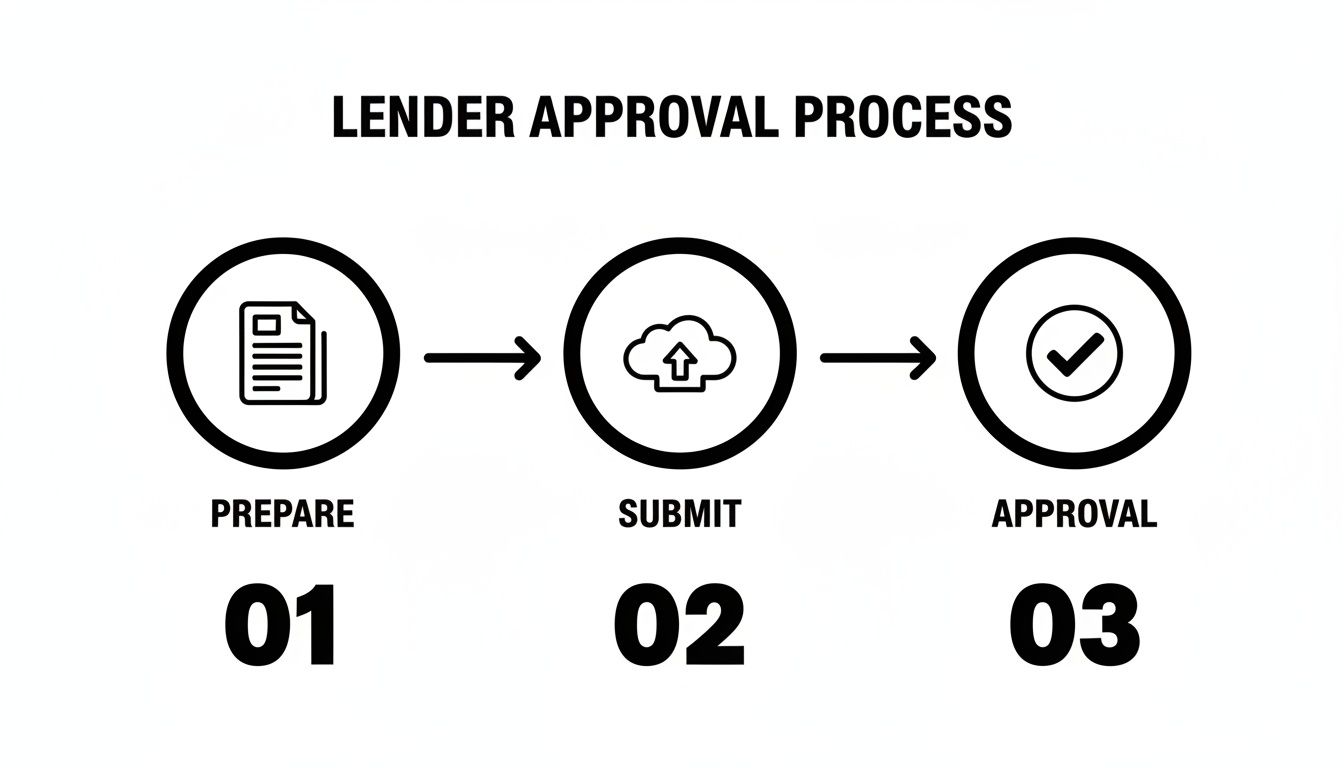
Once you have that green light from the lender, it's time to use the legal tools that will make the home officially and completely yours.
Separating Ownership from Liability: Title vs. Loan
One of the most critical things to understand is that the property title and the mortgage loan are two entirely separate things. You have to address both to truly cut financial ties with your ex.
- The Title (Who Owns It): The title, or deed, dictates who has legal ownership of the property. To get your ex off the title, they must sign a deed that transfers their ownership interest to you.
- The Loan (Who Owes It): The loan is the legal obligation to repay the lender. A successful mortgage assumption is what removes your ex-spouse's name—and their financial liability—from this debt.
Failing to handle both creates a legal minefield. If your ex stays on the title, they technically still own part of your house. If they stay on the loan, their credit is still on the line for your payments, and the lender can come after them if you default. You must sever both connections.
Using the Right Legal Tools in Texas
In Texas, we use two key documents working in tandem to transfer ownership cleanly and secure the mortgage obligation during a divorce.
- Special Warranty Deed: This is the go-to document for transferring the property itself. Your ex-spouse signs it, legally conveying all their interest in the home to you. Once signed and notarized, it gets filed with the county clerk, creating a public record that you are the sole owner.
- Deed of Trust to Secure Assumption: This document is your ex-spouse's safety net. It's signed by you and filed along with the Special Warranty Deed. It creates a temporary lien on the property in your ex's favor, which protects them in the unlikely event you default on the mortgage before the lender has formally released them from the loan. If that happens, it gives them the right to step in and foreclose to protect their credit.
Finalizing these legal steps is about more than just shuffling papers. It's about building a secure financial foundation for your next chapter. By ensuring your divorce decree is rock-solid and executing the right deeds, you can move forward with the confidence of knowing the home—and the debt—is 100% yours.
Common Mortgage Assumption Pitfalls to Avoid
Even with a detailed plan for assuming a mortgage after a divorce, the road isn't always smooth. Life happens, emotions can run high, and unexpected financial hurdles have a way of popping up. Anticipating these common pitfalls is the best way to protect yourself and make sure you can confidently move forward in the home you love.
When you know the potential challenges ahead of time, you can work with your attorney to build safeguards directly into your divorce decree. Let’s walk through some of the most frequent issues we see and talk about proactive, practical solutions.
The Uncooperative Ex-Spouse
One of the most frustrating roadblocks you can face is an ex-spouse who simply refuses to cooperate. They might drag their feet signing the Special Warranty Deed, ignore calls from the lender, or just refuse to participate in the assumption process, even when the divorce decree says they have to. This can leave you in a stressful limbo, completely unable to finalize the transfer.
This is precisely why a vaguely worded decree is so dangerous. Your divorce decree isn't a suggestion; it's a court order, and it has legal teeth.
- Your Legal Remedy: If your ex-spouse defies the court's order, your attorney can file a Motion for Enforcement.
- How it Works: This legal action asks the judge to compel your ex-spouse to comply with the decree. Under the Texas Family Code § 9.001, a court has the power to enforce the division of property laid out in a divorce decree.
- Potential Outcomes: A judge can order them to sign the documents, hold them in contempt (which can lead to hefty fines or even jail time), and may even order them to pay the attorney's fees you had to spend to bring the enforcement action.
By building in specific deadlines and clear consequences into your initial decree, you create a powerful incentive for your ex-spouse to cooperate from day one.
The Danger of Not Pre-Qualifying
Agreeing to take the house in your divorce settlement before you've confirmed you can actually assume the loan is a massive gamble. We see it all the time—people are unpleasantly surprised when they find out they don't qualify on their own, leaving them in a terrible position after the divorce is already final. This is why we so strongly advise against making any assumptions about your financial standing.
The financial landscape for a newly single person is a whole different ballgame. Lenders look at everything—your credit score, payment history, and especially your debt-to-income ratio. This is why Texas family law professionals increasingly recommend that each spouse pre-qualify for a mortgage before the divorce is finalized. You can read more about the challenges of qualifying for a mortgage after divorce to understand why this proactive step is so crucial.
A proactive financial assessment isn't just a good idea; it's a critical step to ensure your divorce agreement is built on reality, not just hope. Skipping this can trap you in a situation where you are legally on the hook for a home you can't financially secure.
Underestimating Your New Financial Reality
The divorce process itself can ding your finances in ways that directly affect your ability to qualify for a loan assumption. It’s absolutely essential to be realistic about how your financial picture is about to change.
Think about these common scenarios:
- A Sudden Drop in Credit Score: The sheer stress of divorce can sometimes lead to late payments on joint accounts, which can damage both parties' credit scores. It's vital to monitor your credit report like a hawk throughout the entire process.
- Child Support and Your DTI: While receiving child support can count as income, paying child support is considered a monthly debt obligation. Lenders will add this payment right into your debt-to-income calculation, which can sometimes be the very thing that pushes your DTI over their limit.
- Reduced Income: You’re now qualifying based on one income, not two. Be conservative with your new budget and make sure you can comfortably afford not just the mortgage, but also property taxes, insurance, and routine maintenance all on your own.
Navigating these potential landmines requires foresight and strategic legal planning. By addressing these issues head-on, you can avoid the common traps and make assuming your mortgage a successful final step in your journey.
Your Questions About Mortgage Assumption Answered
Taking over a mortgage after a divorce can feel like stepping into the unknown. It's completely normal to have a long list of questions about what comes next. Here at The Law Office of Bryan Fagan, we've found that clear, straightforward information is the best way to cut through the stress and help you make choices with confidence.
Let's walk through some of the most common questions we hear from our Texas clients, providing the kind of direct guidance you need right now.
What Happens If My Ex-Spouse Files for Bankruptcy After I Assume the Mortgage?
This is a really smart question, and it gets right to the heart of why tying up every loose end is so critical. Once you've gone through the entire mortgage assumption process and your ex's name is officially off both the loan and the property title (which is done with a Special Warranty Deed), their financial troubles are no longer your problem.
The debt is legally yours, and only yours. The lender has released them from any obligation, and the county property records show you as the sole owner. Their bankruptcy won't touch your home or your mortgage.
But—and this is a big one—if that assumption isn't finalized and their name is still on the loan, their bankruptcy could create a massive headache for you. It could trigger clauses with the lender that put your home in jeopardy. This is precisely why we push to get every legal and financial step completed promptly. Your divorce decree should also contain indemnification language, which basically means your ex agrees to protect you from any debts that were assigned to them in the divorce.
Can I Use Spousal Support as Income to Qualify for an Assumption?
Yes, in most situations, you can. Lenders will look at court-ordered spousal maintenance (what people often call alimony) and child support when they calculate your qualifying income. However, they are incredibly strict about the proof they require. You can't just tell them you're getting payments; you have to prove it with documentation.
Here’s what the lender will almost certainly ask for:
- Your Final Divorce Decree: This isn't optional. The signed court order has to spell out the exact payment amounts and how long you'll be receiving them.
- Proof of Receipt: You'll need to provide bank statements showing a consistent history of receiving these payments, typically for at least three to six months.
- Proof of Continuance: The lender wants to be sure this income stream is stable. They need to see that the payments are set to continue for at least another three years from the day you apply.
Because the rules are so black and white, it’s vital to talk this over with your attorney and a mortgage pro early on. If the support isn't structured and documented perfectly in your decree, it could torpedo your ability to qualify for the assumption.
How Long Does the Mortgage Assumption Process Take After a Divorce?
The timeline can really vary, so it helps to have realistic expectations from the start. A good rule of thumb is anywhere from 30 to 90 days—but that clock doesn't start until after you've given the lender a complete application package. "Complete" is the key word.
Delays almost always happen because of an incomplete application. Your packet needs to include the final, judge-signed divorce decree, the signed and notarized deed transferring ownership (that Special Warranty Deed we mentioned), plus all of your personal financial documents.
Here's a tip to speed things along: start gathering all of your financial paperwork while the divorce is still being finalized. Get your pay stubs, bank statements, and tax returns in order. That way, the moment the judge signs off on your decree, you can hand the lender a full and accurate package. Being proactive like this can get you to the closing table much faster so you can truly begin your next chapter.
If you need help navigating divorce, custody, or estate planning in Texas, contact The Law Office of Bryan Fagan today for a free consultation.


