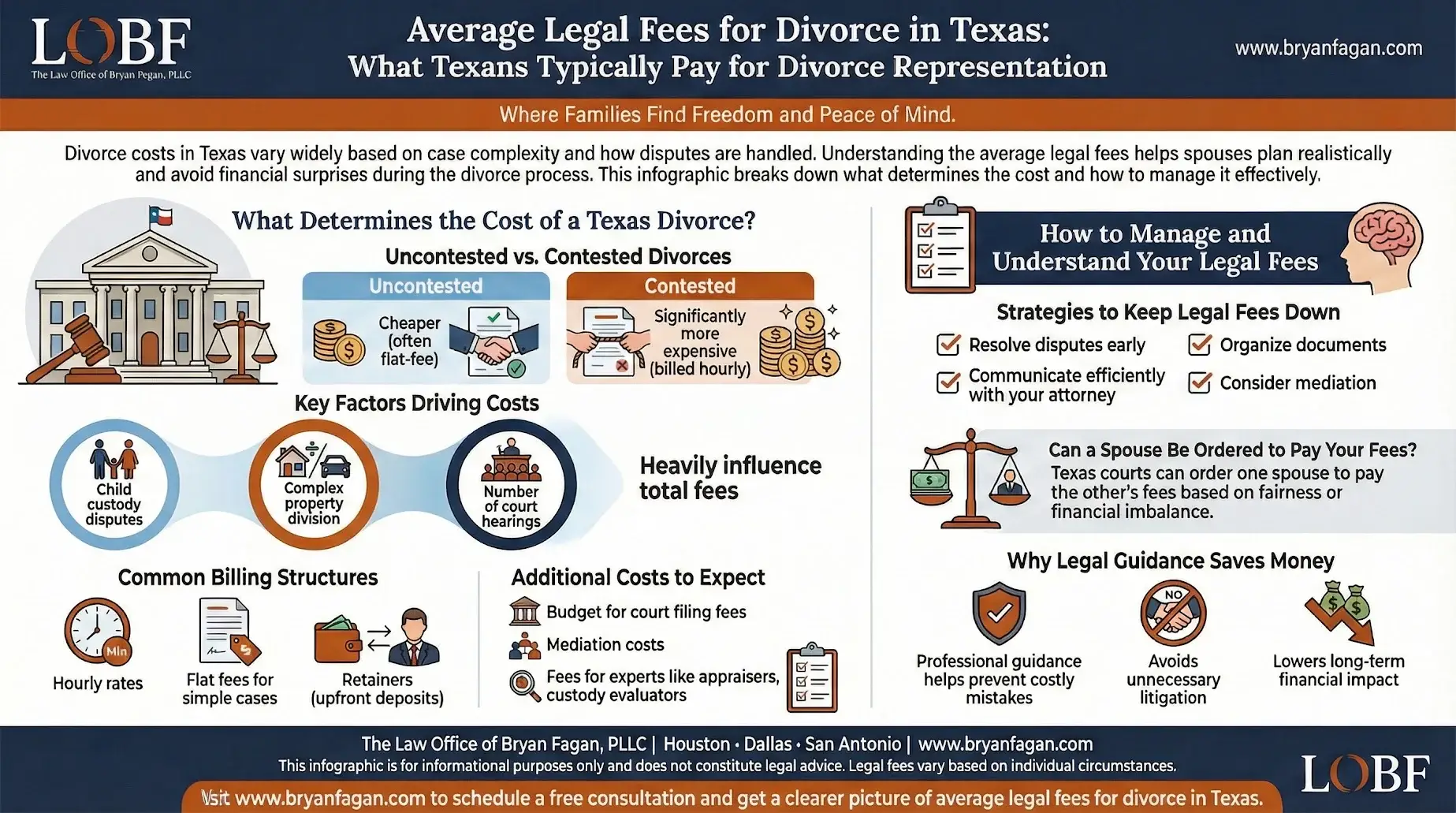

Average Legal Fees for Divorce Texas often become the focus long before anyone files paperwork or steps into a courtroom. It usually starts much earlier—during a quiet moment when the house feels heavier than usual, conversations feel strained, and you realize the marriage is no longer sustainable. You may be wondering how much this decision will cost, whether you can afford the process, and what kind of legal help you actually need. Beneath those questions sits a deeper concern: how to move through this transition without blowing up your finances, your family dynamic, or your peace of mind.
At The Law Office of Bryan Fagan, PLLC, we know divorce is not just about ending a marriage—it is about rebuilding stability when life feels uncertain. Texas law recognizes this reality. Under Texas Family Code §153.002, courts are required to prioritize the best interest of the child, but that principle also reflects a broader truth: families function best when decisions are made thoughtfully, not reactively. As a Houston-based family law firm led by Bryan Joseph Fagan, a South Texas College of Law graduate and widely respected authority on Texas divorce and custody law, we have guided thousands of Texans through moments exactly like this—when fear, finances, and emotions collide.
This article will help you understand what average divorce costs in Texas really mean, why those numbers vary so widely, and how smart legal strategy can prevent a difficult situation from becoming financially overwhelming. More importantly, it will show you how compassionate, experienced legal guidance can restore a sense of control during one of life’s hardest transitions. If you are looking for clarity instead of confusion—and a path forward that protects what matters most—you are exactly where you need to be.
Key Takeaways
- Texas divorce legal fees typically range from $1,500 to $30,000+ per spouse, with uncontested divorces at the lower end and highly contested cases involving child custody disputes or complex property division at the higher end.
- The level of conflict between spouses is the single biggest cost driver—cooperative couples can save 70% or more compared to those who litigate every issue.
- Average figures include wide-ranging case types, so understanding what services are included in a quoted fee matters more than comparing raw numbers.
- Texas courts can order one spouse to pay the other’s attorney fees under certain circumstances, particularly when there is significant income disparity or bad faith conduct.
- Preparation, organization, and early cooperation are the most effective ways to keep divorce expenses below state averages.

Your Family’s Future Starts Here
Don’t navigate your legal journey alone. Schedule a consultation now and get the clarity and support you deserve.
Average Legal Fees for Divorce Texas: What the Numbers Really Mean
Average Legal Fees for Divorce Texas are not a single flat number—they reflect the combined cost of attorney time, court filing fees, and case-specific expenses required to legally dissolve a marriage in Texas district courts. These proceedings are governed primarily by the Texas Family Code, including Chapter 6, which outlines divorce grounds and procedural requirements, and Chapter 7, which governs property division under Texas’s community property system. When children are involved, courts must also apply the “best interest of the child” standard under Texas Family Code §153.002, a factor that often increases both the complexity and overall cost of a case.
Recent statewide data continues to show a wide range of divorce costs. Median total expenses are often cited around $15,600 for divorces without children and approximately $23,500 for cases involving child custody or support issues. However, those figures can be misleading without context. A significant portion of Texas divorces resolve for $5,000 or less when spouses reach agreement early and avoid extensive litigation. On the other end of the spectrum, high-conflict cases involving disputed conservatorship, property division under Texas Family Code §7.001, or prolonged discovery can push per-spouse costs well beyond $25,000 and, in rare circumstances, into six-figure territory.
The primary driver of this disparity is case complexity rather than an attorney’s hourly rate alone. An uncontested divorce, where both spouses agree on all material terms and comply with the mandatory 60-day waiting period under Texas Family Code §6.702, may require only limited attorney involvement. By contrast, a contested divorce involving depositions, mediation, expert witnesses, and multiple hearings under Chapters 6, 7, and 153 of the Texas Family Code can require hundreds of hours of legal work over the course of a year or more.
This is why understanding what is actually included in any quoted fee—and how your situation compares to so-called averages—matters far more than focusing on a single dollar figure. The firm’s in-depth resource, Texas Divorce Attorney Fees Explained: Your Complete Guide to Understanding Legal Costs, breaks down these issues in clear, practical terms to help families make informed decisions before costs escalate. Readers may also benefit from reviewing the firm’s broader educational materials, such as this overview of the Texas divorce process, which explains how early procedural choices can directly impact both timeline and expense.

Typical Fee Ranges for Texas Divorces
Average Legal Fees for Divorce Texas generally fall into recognizable ranges based on two core factors: how complex the case is and how much conflict exists between spouses. Texas law provides the framework for these cases through the Texas Family Code, but the way a divorce unfolds in practice—whether cooperative or contentious—largely determines how much time, effort, and expense are involved.
Uncontested divorces are typically the most cost-effective option. These cases occur when spouses agree on all material issues before filing, including property division under Texas Family Code Chapter 7, parenting arrangements governed by Chapter 153, child support, and any spousal maintenance considerations. Because the process is streamlined under Texas Family Code §6.401 and subject only to the mandatory 60-day waiting period in §6.702, many uncontested divorces resolve quickly. Legal fees commonly range from $1,500 to $5,000 per spouse, often structured as flat-fee packages that cover document preparation, filing, and the final prove-up hearing. For couples seeking a deeper breakdown of how these costs add up, the firm’s resource, How Much Does an Uncontested Divorce Cost in Texas? A Step-by-Step Guide, walks through the process in clear, practical terms.
Moderately contested divorces tend to fall in the middle of the cost spectrum, usually ranging from $5,000 to $15,000 per party. These cases involve one or two unresolved issues, such as disagreements over temporary orders, possession schedules, or a specific community property dispute. While full-scale litigation may be avoided, negotiation, mediation, or limited court intervention is often required. Retainers in the $5,000 to $10,000 range are common, with hourly rates typically between $200 and $600 depending on attorney experience and location. Texas Family Code provisions addressing temporary orders and dispute resolution play a significant role at this stage, shaping both timelines and expenses.
Highly contested divorces represent the upper end of the cost range and often involve $15,000 to $30,000 or more per spouse. These cases may include extended custody disputes evaluated under the best-interest standard in Texas Family Code §153.002, complex property division issues under §7.001, business valuations, or spousal maintenance claims governed by Chapter 8. When expert witnesses such as forensic accountants or real estate appraisers are required, total costs can exceed $50,000 per party. The additional time demanded by discovery, hearings, mediation, and potential trial preparation drives these figures far beyond initial expectations.
Geography also plays a role in what families can expect to pay. Urban markets such as Houston, Dallas, and Austin often see attorney fees 20 to 30 percent higher than those in rural Texas counties due to higher overhead and increased demand for experienced family law counsel. Families looking to understand how these variables interact may benefit from reviewing broader educational materials, such as this overview of divorce costs and planning considerations in Texas, which explains how early decisions can shape both outcomes and expenses.
What Is Included in Average Legal Fees for Divorce Texas
Core services typically included in Texas divorce attorney fees encompass the full range of legal work from initial consultation through final decree.
Legal advice and case strategy form the foundation. Your attorney will analyze your specific circumstances, explain your rights under Texas divorce laws, and develop an approach tailored to your goals and budget.
Drafting pleadings and legal documents includes the original petition for divorce, answers to opposing pleadings, the final decree of divorce, and any settlement agreements or court orders required during proceedings.
Negotiation and settlement efforts involve communicating with opposing counsel to resolve disputes without court intervention, which typically saves significant time and money.
Court appearances may include temporary orders hearings, mediation sessions, status conferences, and the final prove-up hearing where the judge grants the divorce.
Discovery and document review, in contested cases, includes reviewing financial records, preparing interrogatories, and analyzing the opposing party’s disclosures.
For uncontested divorces, this might total 5 to 10 hours of attorney time. Contested cases can involve dozens or even hundreds of billable hours.
Services that may incur additional costs beyond base legal fees include expert witnesses, custody evaluations, forensic accounting, and post-divorce enforcement or modification proceedings.
Factors That Cause Divorce Legal Fees to Rise or Fall in Texas
Average Legal Fees for Divorce Texas are driven less by a fixed formula and more by how a case unfolds once the process begins. In practice, the level of conflict between spouses is the single most significant factor influencing overall cost. Couples who communicate effectively, exchange information transparently, and prioritize settlement often spend substantially less—frequently 60 to 70 percent less—than those who litigate every disputed issue. Texas courts encourage resolution where possible, and early cooperation can dramatically reduce both financial strain and emotional stress.
Disputes involving children are one of the most common reasons divorce costs escalate. Under Texas Family Code Chapter 153, courts must evaluate conservatorship, possession, and access based on the best interest of the child, a standard that often requires additional evidence and professional involvement. Cases that involve child custody evaluations, the appointment of a guardian ad litem, or prolonged litigation over parenting schedules can easily add $10,000 or more to total legal expenses. Custody evaluations alone routinely cost between $2,000 and $5,000, reflecting the time-intensive nature of these assessments and their importance in judicial decision-making.
Property and debt complexity is another major cost driver. Divorces involving multiple real estate properties, retirement accounts that require qualified domestic relations orders, family-owned businesses, or concerns about hidden assets demand more extensive discovery and expert analysis. Texas Family Code §7.001 requires courts to divide community property in a manner that is “just and right,” and meeting that standard in complex estates often involves forensic accountants, business valuators, or financial experts whose fees can range from $5,000 to $15,000 or more. These costs are not the result of attorney rates alone, but of the additional work required to ensure accuracy and fairness.
Claims for spousal maintenance under Texas Family Code Chapter 8 also tend to increase both the duration and expense of divorce proceedings. Because maintenance is limited by statute and highly fact-specific, these claims often require detailed financial analysis, negotiation, and, in some cases, court hearings to determine eligibility, amount, and duration. This added layer of complexity frequently extends timelines and increases attorney involvement.
Client organization and responsiveness play a surprisingly large role in controlling costs. Courts and attorneys operate on strict deadlines, and clients who are slow to respond, miss appointments, or provide incomplete financial information often see their legal fees increase by 20 to 50 percent due to repeated follow-ups and corrective work. By contrast, clients who gather documents early, respond promptly, and stay engaged in the process often reduce their overall costs by 25 to 30 percent. Families seeking a broader perspective on how these factors interact may benefit from reviewing Expert Insights on How Much Does a Divorce Cost in Texas?, which explores real-world cost drivers in greater depth. Additional guidance is also available through the firm’s educational resources, such as this Texas divorce planning and cost overview, which explains how informed preparation can protect both finances and peace of mind.
Uncontested vs. Contested Divorce: Fee Comparison
Average Legal Fees for Divorce Texas are often driven by one foundational distinction in Texas family law: whether a case remains uncontested or becomes contested. When spouses are able to agree on all material terms, including property division and parenting arrangements, the process is far more efficient and cost-effective. Texas law encourages this streamlined approach. Under Texas Family Code §6.401, spouses may file jointly and proceed to a final prove-up hearing without extensive court involvement, provided all issues are resolved. After satisfying the mandatory 60-day waiting period required by Texas Family Code §6.702, many uncontested divorces conclude within weeks, with legal fees commonly falling in the $1,500 to $5,000 range as predictable flat fees.
Contested divorces follow a very different—and far more expensive—path. Under Texas Family Code §6.403, a case becomes contested when spouses cannot agree on one or more significant issues, triggering temporary orders hearings, formal discovery, mediation, and sometimes trial. Each procedural step adds billable attorney time and increases court costs. When disputes involve property division under Texas Family Code §7.001 or child-related matters evaluated under the best-interest standard in Texas Family Code §153.002, cases often extend 12 to 18 months or longer, with legal fees climbing well beyond early expectations.
What makes divorce costs particularly difficult for families is how quickly an amicable case can escalate. A matter that begins cooperatively may become contested when one spouse retains separate counsel, financial disclosures raise concerns about hidden assets or debt, or disagreements over conservatorship and possession intensify. In those situations, a divorce initially expected to cost a few thousand dollars can realistically grow into a $15,000-plus legal commitment per spouse. This is why understanding court-related expenses early is so important. The firm’s educational resource, Court Fees for Divorce in Texas: A Comprehensive Legal Guide, offers families a clear explanation of filing fees, service costs, and other court-imposed expenses that are often overlooked when budgeting for divorce.
Maintaining an uncontested posture whenever possible offers meaningful advantages beyond lower bills, including faster resolution and reduced emotional strain on the entire family. By contrast, unnecessary litigation brings unpredictable costs, prolonged uncertainty, and stress that can linger long after a case concludes. Families seeking a broader understanding of how early decisions shape both outcomes and expenses may also find value in this overview of the Texas divorce process, which explains how thoughtful planning and informed legal guidance can protect both finances and futures.

Additional Costs Not Always Included in Averages
Beyond attorney fees, Texas divorces involve several additional expenses that may not be reflected in quoted fee ranges.
| Expense Category | Typical Cost Range |
|---|---|
| Court filing fees | $250–$400 (varies by county) |
| Service of process | $100–$200 |
| Mediation costs | $1,000–$5,000 per session |
| Custody evaluations | $2,000–$5,000 |
| Real estate appraisers | $300–$600 per property |
| Business valuations | $3,000–$15,000+ |
| Forensic accountants | $5,000–$15,000+ |
| Parent education courses | $50–$100 (required in child cases) |
| QDRO preparation | $500–$1,500 |
| Post-divorce modifications | $3,000–$10,000+ |
Filing fees vary significantly by county, so confirming exact costs with your local district court clerk is advisable. High-net-worth cases involving asset tracing or complex business interests can add substantial expert witness fees not captured in standard averages.
Fee waivers are available for individuals experiencing financial hardship who cannot afford court filing fees, though eligibility requirements must be met.
Can One Spouse Be Ordered to Pay Divorce Legal Fees in Texas?
Average Legal Fees for Divorce Texas are not always borne equally by both spouses, and Texas law gives courts discretion to shift attorney’s fees when fairness requires it. This authority recognizes that meaningful access to legal representation should not depend solely on which spouse controls the finances. When one party lacks resources or the other engages in conduct that unnecessarily drives up costs, courts have tools to help level the playing field.
Under Texas Family Code §6.708, a judge may order one spouse to pay reasonable attorney’s fees and litigation expenses incurred by the other. That authority extends to temporary attorney’s fees during the case under Texas Family Code §6.502, which allows a spouse with limited financial means to retain qualified counsel while the divorce is still pending. These provisions are particularly important in contested cases, where legal expenses can rise quickly and financial imbalance can otherwise distort the process.
In practice, fee-shifting is most commonly considered when there is a significant income or asset disparity between spouses, when one party acts in bad faith by concealing assets or filing frivolous motions, or when enforcement action is required to compel compliance with court orders. Although courts are not required to award fees, judges do evaluate necessity and reasonableness carefully, and a meaningful percentage of contested Texas divorces involve some form of attorney’s fee allocation based on these factors.
For families hoping to minimize the risk of escalating costs, understanding how fee awards interact with case posture is essential. Resources such as How Much Does an Uncontested Divorce Cost in Texas? Key Considerations Before Filing help explain why early cooperation and thoughtful planning often reduce both conflict and expense. Additional guidance on managing divorce costs and strategy can also be found in the firm’s broader educational materials, including this Texas divorce cost and planning overview, which outlines how legal choices made early in a case can shape financial outcomes.
If you believe your spouse should be ordered to contribute to your legal fees, it is important to raise that issue with counsel as early as possible. Thoughtful, proactive advocacy allows the court to consider fee requests within the broader context of fairness and financial balance, reinforcing the firm’s commitment to protecting families while guiding them toward more stable futures.
How to Keep Divorce Legal Fees Below the Texas Average
Practical strategies can significantly reduce your overall divorce costs, often by thousands of dollars.
Stay organized and prepared. Gather financial documents, tax returns, bank statements, and retirement account information before your first attorney meeting. Well-organized clients reduce the time attorneys spend tracking down information, potentially cutting legal fees by 25% or more.
Minimize unnecessary conflict. Before disputing an issue, consider whether the potential gain justifies the legal costs involved. Fighting over a $2,000 asset that will cost $3,000 in additional attorney fees makes no financial sense.
Use mediation efficiently. Divorce mediation and alternative dispute resolution methods resolve approximately 80% of disputed issues at a fraction of trial costs. Mediation costs typically run $1,000 to $5,000 but can save $10,000 or more in avoided litigation expenses.
Choose appropriate legal representation. For straightforward uncontested divorces, flat-fee arrangements or limited-scope representation may provide a cost effective divorce process. Complex contested cases require full representation from an experienced family law attorney.
Follow your attorney’s advice early. Attorneys who recommend settlement are not avoiding work—they are trying to save you money. Clients who reject reasonable settlement offers and insist on trial often spend significantly more without achieving better outcomes.
How a Texas Divorce Attorney Helps Clients Understand and Control Fees
Average Legal Fees for Divorce Texas are far easier to understand and control when guided by a qualified Texas divorce attorney who knows how to align legal strategy with a client’s real-world priorities. A knowledgeable attorney does more than handle paperwork—they help families make informed decisions that reduce unnecessary conflict, protect long-term stability, and prevent legal costs from escalating beyond what a case truly requires. This guidance is especially important in light of the Texas Family Code, which sets specific procedural and substantive requirements that, if mishandled, can quickly increase expenses.
Setting realistic cost expectations begins at the initial consultation. An experienced Texas family law attorney evaluates case complexity through the lens of the Texas Family Code, including whether disputes fall under Chapter 6 divorce procedures, Chapter 7 property division standards, or Chapter 153 child-related provisions. By identifying early cost drivers—such as contested conservatorship, complex community property issues, or the need for temporary orders—clients receive honest, experience-based estimates rather than vague averages that fail to reflect their circumstances.
Effective legal representation also means developing strategies that prioritize what truly matters to a client’s future. By focusing resources on high-impact issues and avoiding unnecessary litigation over minor disagreements, attorneys help keep legal fees proportional to the value of the case. This strategic approach aligns with the Texas Family Code’s preference for efficiency and fairness, particularly when parties are encouraged to resolve disputes through agreement rather than prolonged court intervention.
Preventing expensive procedural mistakes is another critical role of legal counsel. Missed deadlines, incomplete disclosures, or improperly drafted pleadings can trigger delays and additional hearings, increasing both attorney fees and emotional strain. Texas courts strictly enforce procedural compliance, and correcting avoidable errors can add thousands of dollars to an otherwise manageable case. Professional guidance helps families avoid these setbacks and move forward with confidence.
Cost-saving alternatives are also an important part of responsible representation. Attorneys often recommend mediation when appropriate, consistent with Texas Family Code provisions encouraging alternative dispute resolution, or suggest limited-scope representation for simpler matters. For families interested in how uncontested cases can remain affordable, the firm’s resource, Factors That Influence the Cost of an Uncontested Divorce in Texas, provides clear insight into how early cooperation can significantly reduce overall expenses.
Finally, when the law allows, an attorney can pursue recovery of attorney’s fees to help level the financial playing field. Texas Family Code §6.708 gives courts discretion to award attorney’s fees in appropriate circumstances, and identifying these opportunities early can make a meaningful difference for clients facing financial imbalance. Understanding average divorce costs becomes truly useful only when applied to your specific situation with professional guidance—an approach that reflects the firm’s commitment to educating families while protecting their futures.

Why Choose The Law Office of Bryan Fagan, PLLC
Average Legal Fees for Divorce Texas are not just numbers on a page—they represent real financial decisions families must make during an already uncertain time. This firm approaches every Texas divorce with a commitment to transparency, efficiency, and cost-conscious representation grounded in the Texas Family Code. From the outset, clients receive clear explanations of how divorce procedures under Chapter 6, property division rules under Chapter 7, and child-related provisions under Chapter 153 can influence both strategy and expense, allowing families to move forward with clarity instead of guesswork.
Texas families deserve honest, practical conversations about what a divorce is likely to cost and, just as importantly, what can be done to keep those costs manageable. Whether a matter qualifies as an uncontested divorce under Texas Family Code §6.401 or involves contested issues requiring court intervention, strategies are tailored to the client’s goals, budget, and long-term stability. This thoughtful approach recognizes that efficient planning and early education often prevent unnecessary litigation and escalating fees.
With statewide experience across Texas courts, the firm combines deep knowledge of local judicial practices with compassionate, responsive guidance at every stage of the case. Clients are kept informed, questions are answered promptly, and financial concerns are treated with the same seriousness as legal outcomes. For those seeking a clearer understanding of what lies ahead, the firm’s educational resource, The Texas Divorce Process Explained, walks families through each step of the journey and how procedural choices can affect both timeline and cost. Additional insight into managing divorce-related expenses and expectations can also be found in this Texas divorce cost planning overview, reinforcing the firm’s mission to educate families while protecting their futures.
Checklist: Average Legal Fees for Divorce Texas
- [ ] Identify whether your case is likely contested or uncontested based on current disputes
- [ ] Ask specifically what services are included in any quoted fees
- [ ] Prepare financial documents, tax returns, and asset information before your first meeting
- [ ] Gather parenting schedules and child-related information if custody is involved
- [ ] Consider whether mediation could resolve outstanding disputes cost-effectively
- [ ] Discuss potential fee-shifting if significant income disparity exists
- [ ] Consult with a Texas divorce attorney before filing to understand your options
Conclusion
Divorce has a way of making everything feel urgent and uncertain at the same time—especially when money, family, and the future all collide. Understanding what divorce really costs in Texas is not about memorizing numbers or comparing averages. It is about gaining enough clarity to make thoughtful decisions instead of reactive ones. When you know how legal fees work, what drives them up or down, and how strategy influences outcomes, you are no longer navigating this transition in the dark.
At The Law Office of Bryan Fagan, PLLC, we believe knowledge creates leverage and calm creates better outcomes. The right guidance can help you avoid unnecessary conflict, protect your finances, and move forward with confidence rather than fear. Working with an experienced Texas family law attorney is not just about having someone file paperwork—it is about having an advocate who understands the law, the courts, and the human side of what you are going through.
If you are standing at the edge of a major life change, consider this your permission to slow down and get informed before taking the next step. A conversation with a knowledgeable legal professional can bring clarity where there is uncertainty and direction where things feel stuck. And if you find yourself thinking, “I just want this handled the right way,” you are already asking the right question.
Frequently Asked Questions About Divorce Costs in Texas
The cost of a divorce lawyer in Texas depends largely on whether the case is uncontested or contested. Simple, agreed divorces may cost only a few thousand dollars in attorney fees, while contested divorces involving custody disputes, property division, or court hearings can become significantly more expensive. The biggest cost driver is usually conflict, not just attorney rates.
Most divorce lawyers charge an hourly rate for contested cases and require an upfront retainer. Rates vary based on experience, location, and case complexity. Flat-fee pricing is more common for uncontested divorces where all issues are already agreed upon. The more court involvement a case requires, the higher the overall legal fees tend to be.
Texas is a community property state, meaning most assets acquired during the marriage are presumed to belong to both spouses. However, Texas courts do not automatically divide property 50/50. Instead, judges divide community property in a way that is “just and right,” considering factors such as income, earning capacity, custody arrangements, and separate property claims.
The “10 year rule” usually refers to eligibility for spousal maintenance. A marriage lasting 10 years or more can support a claim for maintenance, but it does not guarantee support. Courts also evaluate whether the requesting spouse can meet basic needs and whether other legal requirements are satisfied. Duration alone is not enough.
There is no universal answer, but the financial impact often feels heavier for the spouse with lower income or fewer resources. At the same time, higher earners may face child support or spousal maintenance obligations. In many cases, both spouses lose financially due to duplicated household expenses and prolonged legal conflict.
Avoid hiding assets, ignoring court orders, posting emotionally charged content online, or making major financial decisions without legal advice. These actions can increase legal fees and negatively affect court outcomes. Judges pay close attention to behavior, especially when children or financial fairness are at issue.
Common mistakes include letting emotions drive legal decisions, refusing reasonable settlement offers, failing to gather financial documents early, and underestimating how temporary orders can shape the rest of the case. Many people also make the mistake of focusing only on short-term wins instead of long-term stability.
The most affordable divorce is typically an uncontested divorce where both spouses agree on all terms before filing. This approach minimizes court involvement and attorney time. Limited-scope legal services can also reduce costs, but they should be used carefully—especially when children or complex assets are involved.
Start by gathering financial documents such as tax returns, bank statements, pay stubs, and retirement account information. Create a realistic post-divorce budget and set aside funds for legal fees and court costs. Planning early and consulting with a Texas family law attorney can help you avoid costly financial mistakes later.