
Texas Legal Divorce Agreement Document conversations often begin in quiet, ordinary moments that do not feel legal at all. A couple sits at the kitchen table late at night, speaking in lowered voices so the kids won’t hear. They agree on who will keep the house, how bills will be paid, and how time with the children will be shared. There is a sense of relief in believing that being “amicable” is enough. Weeks later, that same family is stunned to learn that their handwritten agreement carries no legal weight in a Texas courtroom—and the uncertainty they thought they avoided is suddenly very real.
At The Law Office of Bryan Fagan, PLLC, this is a story we see far too often across Houston and surrounding communities. Bryan Joseph Fagan, a South Texas College of Law graduate and recognized authority on Texas divorce and custody law, has guided families through these moments for years. Texas law is clear that divorce agreements must meet specific statutory requirements and be approved by a judge to become enforceable. Under Texas Family Code §153.002, courts must focus on the best interest of the child, and judges expect divorce agreements to create stability, clarity, and structure for families—not confusion or future conflict.
This article will walk you through what a Texas Legal Divorce Agreement Document really is, why it matters far beyond the end of a marriage, and how it can quietly shape daily life for parents and children after divorce. Our purpose reflects the heart of our firm’s mission: to empower families with understanding, simplify a complex legal process, and help people reclaim peace of mind during one of life’s most difficult transitions. As you read on, you will gain insight into how the right legal guidance can turn uncertainty into clarity and help your family move forward with confidence.
Key Takeaways
- A Texas divorce agreement must be incorporated into the Final Decree of Divorce and signed by a judge to become legally enforceable—informal written agreements have no legal force in court
- Texas law requires specific provisions covering property division, debt allocation, child custody and support, and spousal maintenance, with missing or vague terms risking judicial rejection
- Generic online divorce settlement agreement templates typically fail Texas statutory requirements, potentially costing you thousands in corrections and delays
- Properly drafted agreements reduce post-divorce litigation by preventing disputes over ambiguous terms and ensuring compliance with the Texas Family Code
- Working with a Texas divorce attorney ensures your agreement meets all legal requirements and receives court approval without costly setbacks

Your Family’s Future Starts Here
Don’t navigate your legal journey alone. Schedule a consultation now and get the clarity and support you deserve.
What Is a Texas Legal Divorce Agreement Document?
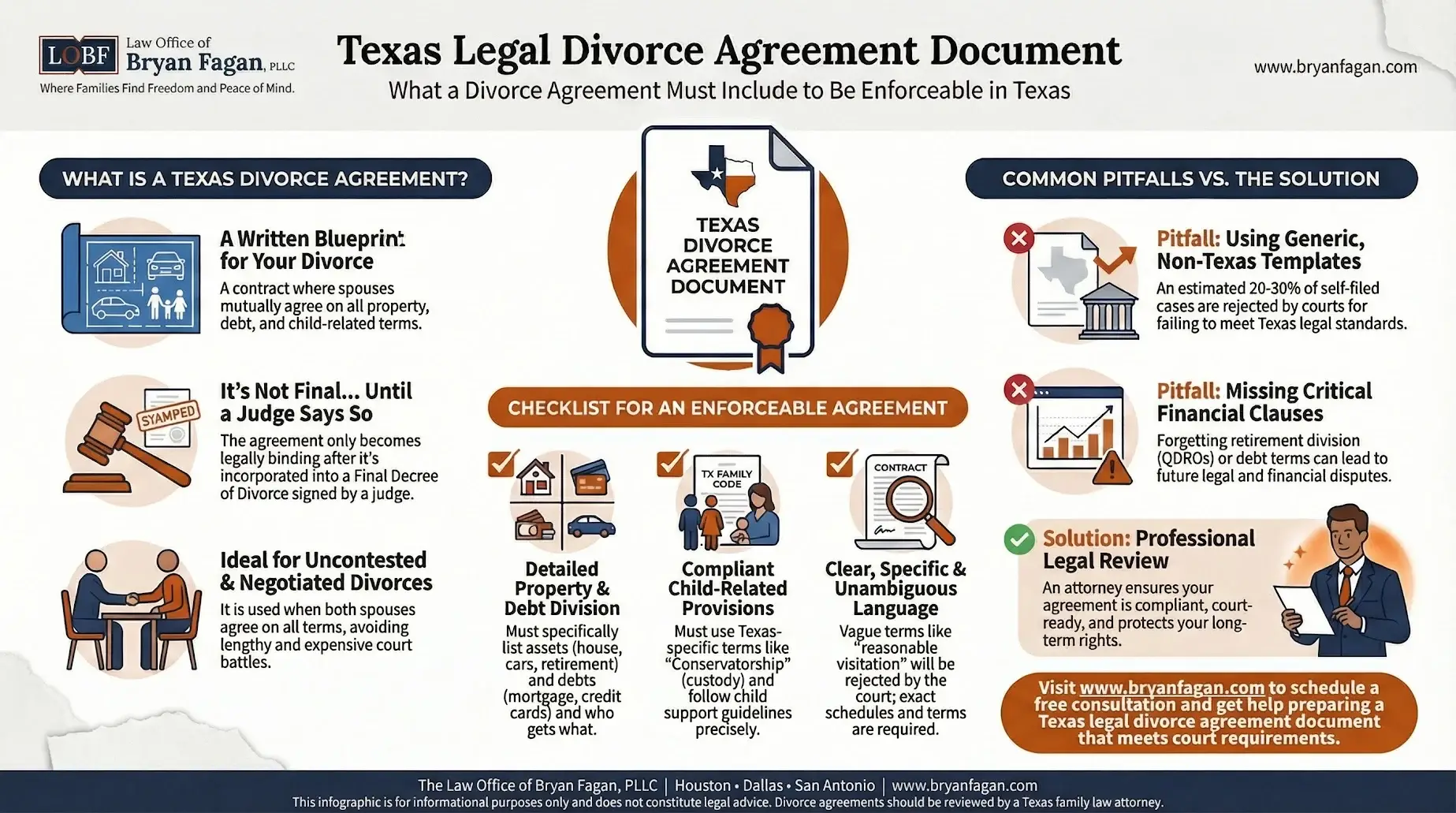
A Texas Legal Divorce Agreement Document is a carefully structured written contract—often referred to as a Marital Settlement Agreement—that spells out how all major divorce issues will be resolved. This includes the division of property and debts, parenting time and decision-making, child support, and, when applicable, spousal maintenance. Many families view it as a practical roadmap for life after divorce, one designed to replace uncertainty with clarity and reduce the risk of future disputes by putting expectations into precise, enforceable terms.
Under the Texas Family Code, this agreement has no legal force until it is formally approved by the court and incorporated into the Final Decree of Divorce. Texas Family Code §§ 6.701–6.708 govern the entry of divorce decrees, while Chapter 7 addresses property division and Chapter 153 applies to child custody and possession, including the requirement under §153.002 that all child-related provisions serve the best interest of the child. Once a judge signs the decree, the agreement transforms from a private understanding into a binding court order that Texas courts can enforce.
For families pursuing an uncontested divorce, a properly drafted settlement agreement can significantly simplify the process. After the mandatory 60-day waiting period required by Texas Family Code §6.702, cases with a complete and court-compliant agreement are often finalized more efficiently. In mediated divorces, the agreement documents the compromises reached with the help of a neutral mediator, ensuring those negotiated terms meet statutory requirements and carry lasting legal effect rather than remaining informal promises.
This distinction is one of the most misunderstood aspects of Texas divorce law. Agreements signed by both spouses—whether handwritten, exchanged by email, or even notarized—are not enforceable unless the court approves them. When an MSA is correctly incorporated into the Final Decree, it opens the door to enforcement remedies such as contempt proceedings, wage withholding for child or spousal support, and Qualified Domestic Relations Orders for dividing retirement accounts in compliance with both federal and Texas law. This is where experienced guidance from the Law Office of Bryan Fagan, PLLC can make a meaningful difference, helping families avoid costly mistakes and protect their long-term stability.
It is also important to understand how divorce agreements intersect with other marital contracts, such as premarital or postmarital agreements. Questions about how these documents affect property division frequently arise, and families may benefit from reviewing the firm’s educational resource on common questions about Texas prenuptial and marital agreements when preparing or revising settlement terms. For further insight into related issues, readers can also explore the firm’s guidance on Texas child support orders and enforcement, which explains how support provisions are evaluated and enforced under current Texas law.

Why a Texas Legal Divorce Agreement Document Is Critical
Understanding why this document matters requires looking at what happens without one—and the protection it provides when properly drafted.
Legal Significance for Property and Debts
Under Texas Family Code § 7.001, courts must divide your marital estate in a “just and right” manner. Your divorce agreement is where you define exactly what that division looks like. Without clear terms, a judge must decide for you—and judicial decisions rarely satisfy either party completely.
Consider a couple with a $400,000 home, two vehicles, retirement accounts, and $50,000 in credit card debt. A proper agreement specifies: Who gets the house? Who assumes the mortgage? How do you divide the 401(k) without triggering tax penalties? Which spouse is solely responsible for which credit cards? Each of these questions requires precise language that Texas courts will enforce.
Child Custody and Support Protections
When children are involved, the stakes multiply. Your marital settlement agreement establishes conservatorship arrangements determining who makes major decisions about education, healthcare, and religious upbringing. It creates possession and access schedules—the specific days and times each parent spends with the children. It calculates child support according to Texas guidelines and assigns responsibility for medical insurance and unreimbursed expenses.
These provisions protect both parents and children by creating clear expectations. When the other parent picks up the kids on Thursday instead of Friday, you have a court order to enforce. When child support payments stop, you have legal remedies available immediately.
Preventing Future Disputes
One of the greatest benefits of a carefully drafted Texas Legal Divorce Agreement Document is not what it says, but what it prevents. Vague phrases such as “we’ll split things fairly” or “we’ll alternate holidays” often feel cooperative in the moment, yet they almost guarantee future conflict. Texas courts expect specificity, particularly when property division falls under Texas Family Code Chapter 7 and child-related provisions must satisfy the best-interest standard in §153.002. Clear, detailed language removes guesswork, sets realistic expectations, and minimizes the risk of returning to court later over misunderstandings that could have been avoided from the start.
The effectiveness of formal agreements is reflected in statewide data. According to the Texas Office of Court Administration, more than 70 percent of Texas divorces in 2023 were resolved as uncontested cases supported by written settlement agreements, cutting average court time roughly in half compared to fully litigated divorces. These agreements work because they resolve disputes on paper before emotions escalate, and because they are drafted in a way that complies with the Texas Family Code and withstands judicial review. Families who want a deeper understanding of how enforceable agreements are structured can benefit from reviewing the firm’s educational guide on divorce agreement templates and enforceable marital settlement agreements in Texas, which explains why precision matters.
By contrast, informal agreements fail in Texas courts for a straightforward but costly reason: they lack judicial approval. Handwritten notes, email exchanges, or even notarized documents do not become enforceable unless they are incorporated into a Final Decree of Divorce signed by a judge, as required by Texas Family Code §§6.701–6.708. During enforcement proceedings, courts routinely dismiss attempts to rely on informal arrangements because they were never converted into a court order. Families often believe they reached a binding deal, only to learn later that the court views it as legally meaningless.
Texas appellate courts have reinforced this principle repeatedly. In In re Marriage of Harrison (Tex. App. 2019), the court rejected an informal divorce agreement precisely because it lacked the statutory language and judicial approval required for enforcement. The spouses believed they had resolved their divorce, but the court disagreed, leaving both parties exposed to renewed litigation. This is why experienced Texas family law counsel, such as the attorneys at the Law Office of Bryan Fagan, PLLC, emphasize formal drafting and court approval as essential safeguards rather than technical formalities. For additional insight into how Texas courts evaluate and enforce divorce orders, readers may find it helpful to explore the firm’s resource on Texas divorce and property division, which explains how courts apply current law to real families and real disputes.

Required Provisions Under Texas Law
Texas Family Code Chapters 6, 7, and 8 set out clear and detailed requirements for divorce agreements that Texas courts will approve and enforce. A Texas Legal Divorce Agreement Document must address each of these statutory elements with precision, because even one missing or unclear provision can cause a judge to reject the agreement at the prove-up hearing and require the parties to start over. Texas Family Code §6.701 governs the entry of the divorce decree, Chapter 7 controls the division of property, and Chapter 8 outlines when and how spousal maintenance may be awarded, making compliance with all three essential to a smooth and final resolution.
Property division is often where problems arise if an agreement is not drafted carefully. Texas is a community property state, which means that, under Texas Family Code §7.002, most assets and debts acquired during the marriage are presumed to belong to both spouses equally. A legally sound agreement must clearly distinguish community property from separate property, such as assets owned before marriage or received by gift or inheritance, and confirm that separate property is awarded back to its owner. Ambiguity in this area is one of the most common reasons courts question or delay approval of otherwise uncontested divorces.
Real estate provisions require particular attention. Texas courts expect divorce agreements to include full legal descriptions of property, current fair market values, and a clear assignment of ownership and mortgage responsibility. Questions such as who keeps the marital home, who is required to refinance, and what happens if refinancing is not possible should be answered directly in the agreement rather than left open to interpretation. Vehicles must also be specifically identified by year, make, model, and VIN, with responsibility for any outstanding loan balances clearly assigned, so there is no confusion after the divorce is finalized.
Financial accounts and retirement assets require the same level of detail. Bank accounts, brokerage accounts, and investment portfolios must be disclosed with current balances and a specific method of division spelled out in the agreement. Retirement accounts, including 401(k)s and pensions, involve additional legal steps. Under federal law and Texas practice, these accounts typically require a Qualified Domestic Relations Order to divide them without triggering unnecessary taxes or penalties. Without proper QDRO language referenced in the settlement terms, a spouse could face a 10 percent early withdrawal penalty and ordinary income taxes, turning what should have been a fair division into an expensive mistake.
For families seeking a straightforward, uncontested divorce, understanding these requirements can make the process far less stressful. The team at the Law Office of Bryan Fagan, PLLC regularly helps clients structure agreements that meet these statutory standards while still reflecting their real-life priorities. Readers who want a deeper explanation of how uncontested divorce agreements are drafted and approved may find it helpful to review the firm’s guide on simple divorce agreements in Texas and legally sound uncontested divorce documents. Additional context on how Texas courts divide marital property is also available in the firm’s resource on Texas divorce and property division, which walks through how current Texas law is applied in everyday cases.

Debt Allocation Provisions
Just as you divide assets, your agreement must allocate responsibility for debts. Texas law recognizes that creditors can pursue either spouse for joint debts regardless of what your divorce decree says. Your agreement should include hold harmless provisions protecting each party if the responsible spouse fails to pay.
Credit card balances, auto loans, mortgages, student loans, medical bills, and any other obligations must be specifically assigned. Which spouse pays the $15,000 Visa balance? Who continues the car payment? The agreement should answer these questions with precision.
Child-Related Provisions (When Applicable)
If you have children, your agreement must address conservatorship, possession and access, and financial support in detail.
Conservatorship determines decision-making authority. Texas courts favor joint managing conservatorship where both parents share major decisions, but one parent typically has the exclusive right to designate the children’s primary residence. Geographic restrictions—limiting where the custodial parent can relocate—protect the non-custodial parent’s access rights.
Possession and access schedules specify exactly when children are with each parent. The Texas Standard Possession Order provides a default framework, but parties can negotiate expanded or modified schedules. Holiday arrangements deserve particular attention: Who has the children on Thanksgiving in odd years? How do you handle spring break? What about the child’s birthday?
Child support calculations follow Texas Family Code § 154 guidelines. For one child, the guideline amount is 20% of the obligor’s net monthly resources. For two children, it’s 25%. Deviating from guidelines requires specific findings justifying the difference—vague agreements to pay “a fair amount” will be rejected.
Medical and dental support provisions must designate which parent provides health insurance coverage and how parents share unreimbursed medical expenses. Texas typically requires a 50/50 split of costs not covered by insurance.
Spousal Maintenance Considerations
Texas spousal maintenance (often called alimony in other states) is limited by statute. Under Texas Family Code § 8.051, maintenance is available only when specific conditions are met—typically marriages of 10 years or longer where the requesting spouse lacks sufficient property and earning capacity to meet minimum reasonable needs.
When maintenance applies, your agreement must specify the monthly amount (capped at $5,000 or 20% of the payor’s gross income, whichever is less), duration (typically 5-7 years for marriages of 10-20 years), and termination conditions (including the recipient’s remarriage or cohabitation with a romantic partner).
Texas Legal Divorce Agreement vs. Informal Agreements
Understanding the difference between a proper legal document and informal paperwork could save you thousands of dollars and months of frustration.
| Feature | Texas Legal Divorce Agreement | Informal Agreement |
|---|---|---|
| Court Approval | Required and obtained | Not present |
| Legal Enforceability | Full force as court order | None |
| Contempt Remedies | Available if violated | Not available |
| Statutory Compliance | Meets Texas Family Code | Typically deficient |
| Modification Process | Formal court procedures | No legal framework |
| Creditor Protection | Hold harmless provisions | Unprotected |
Why informal agreements fail: Without court approval, your agreement is simply a contract between private parties. Texas courts have consistently held that divorce settlements not incorporated into a Final Decree cannot be enforced through family court enforcement mechanisms. You might sue for breach of contract in civil court, but that process is expensive, slow, and uncertain.
Problems with generic templates: A sample divorce settlement agreement from a California website ignores Texas’s community property presumption. A New York State divorce form omits required Texas residency recitals. Generic divorce forms lack provisions for Texas-specific requirements like Standard Possession Order references or guideline child support calculations.
According to the Texas Bar Family Law Section, self-drafted divorce agreements fail in approximately 40% of enforcement motions due to ambiguity or non-compliance with statutory requirements. The money saved using free divorce forms often disappears—and then some—when you hire an attorney to fix the problems.
Common Mistakes That Invalidate Texas Divorce Agreements
Texas courts often reject divorce agreements for errors that could have been avoided with careful drafting and a clear understanding of state law. A Texas Legal Divorce Agreement Document must strictly comply with the Texas Family Code before a judge can approve it, and courts are not allowed to correct defective agreements on a party’s behalf. When an agreement falls short, even in an uncontested case, families can face delays, additional legal costs, and renewed uncertainty during an already stressful transition.
One of the most common problems arises from using non-Texas or generic templates. Texas Family Code §6.401 requires specific residency recitals confirming that at least one spouse meets Texas domicile and residency requirements. Templates created for other states frequently omit this language, causing agreements to fail at filing. While cost-conscious couples often search for affordable solutions, those documents must still be tailored to Texas law to be effective, which is why careful review is essential.
Retirement accounts are another area where mistakes can have serious financial consequences. Dividing a 401(k), pension, or similar plan without addressing the need for a Qualified Domestic Relations Order can trigger ordinary income taxes and a 10 percent early withdrawal penalty. Without proper QDRO language referenced in the agreement, a division intended to be fair can quickly become a costly tax mistake that undermines long-term financial stability.
Child support provisions are also closely scrutinized by Texas judges. Under Texas Family Code Chapter 154, support must be calculated using statutory guidelines based on the obligor’s net resources. An agreement that lists a flat monthly amount without showing compliance with §154.125 is likely to be rejected, because courts must be able to confirm that child support meets legal requirements and serves the child’s best interest.
Finally, even a properly drafted agreement has no legal effect unless it is incorporated into the Final Decree of Divorce and signed by the judge, as required by Texas Family Code §§6.701–6.708. Missing this step leaves families without enforceable rights, regardless of how detailed the agreement may be. Families seeking budget-friendly guidance without sacrificing enforceability may find value in the firm’s educational resource on affordable Texas divorce agreement templates for uncontested divorces, along with the Law Office of Bryan Fagan’s broader insights on Texas divorce procedures, which explain how courts evaluate and approve settlement agreements under current Texas law.

How a Texas Divorce Attorney Ensures Legal Validity
Professional legal guidance is what turns good intentions into enforceable court orders. A Texas Legal Divorce Agreement Document must do more than reflect what spouses believe is fair; it must comply with the Texas Family Code and withstand judicial scrutiny. Attorneys who regularly practice in Texas family courts understand the specific statutory recitals judges expect, how property divisions must be structured under Texas Family Code Chapter 7, and what findings are required when child support deviates from the guidelines set out in Chapter 154. That level of precision often makes the difference between a smooth approval and a frustrating rejection at the prove-up hearing.
Customization is equally important because no two families—and no two divorces—are the same. A short marriage with few assets calls for a very different agreement than a long-term marriage involving real estate, retirement accounts, or business interests. Skilled counsel tailors each agreement to the family’s unique circumstances, rather than forcing complex lives into generic templates that overlook critical details. This same principle applies when marital agreements intersect with other planning tools, such as postnuptial agreements, which can affect how property is treated in divorce. Families exploring these issues may find helpful guidance in the firm’s resource on what to include in a Texas postnuptial agreement.
Alignment between the settlement agreement and the Final Decree of Divorce is another area where experience matters. Texas Family Code §§6.701–6.708 require that the court’s decree accurately reflect the parties’ agreement, and even small discrepancies can create serious enforcement problems later. Attorneys carefully review both documents to ensure the negotiated terms appear verbatim in the court’s judgment, preserving enforceability and avoiding confusion if issues arise after the divorce is finalized.
Thoughtful drafting also plays a powerful role in dispute prevention. Experienced Texas family law attorneys anticipate common flashpoints and address them in advance. Questions about alleged interference with visitation, responsibility for future expenses, or the process for modifying child support are far easier to manage when the agreement already provides clear answers. By resolving these issues on paper now, families often avoid costly and emotionally draining litigation later.
Finally, court approval does not happen automatically. The process requires proper documentation, compliance with service rules, and a clear presentation at the prove-up hearing. Lawyers familiar with local court practices know what judges look for and how to prepare agreements that meet those expectations. Families working with the Law Office of Bryan Fagan, PLLC benefit not only from legal accuracy, but from an approach grounded in education, compassion, and a commitment to protecting their future long after the divorce is complete.
Why Choose The Law Office of Bryan Fagan PLLC
Families who work with seasoned Texas family law counsel benefit from experience that goes far beyond filling out forms. When preparing a Texas Legal Divorce Agreement Document, the attorneys at the Law Office of Bryan Fagan, PLLC draw on years of hands-on practice drafting and approving marital settlement agreements in courts across Texas. By preparing hundreds of agreements each year and guiding clients through uncontested filings, the firm consistently achieves high approval rates because documents are tailored to what Texas judges actually expect to see at the prove-up hearing.
Staying current with the Texas Family Code is a critical part of that process. Divorce agreements must comply with multiple statutory chapters, including Texas Family Code Chapter 6 for divorce procedures, Chapter 7 for property division, Chapter 8 for spousal maintenance, and Chapter 153 for child custody and possession. Recent legislative updates, including revisions affecting spousal maintenance eligibility and enforcement, reinforce the importance of working with attorneys who draft agreements based on current law rather than outdated assumptions. This ongoing attention to statutory changes helps ensure that agreements are approved the first time and remain enforceable long after the divorce is finalized.
Affordability is also an important consideration for many families. For couples who have already reached agreement on the major issues, professional drafting and review can be far more cost-effective than litigating preventable disputes later. Uncontested divorce services are often offered at predictable flat fees that are significantly lower than the costs of contested proceedings, while still providing the legal precision required for court approval. Families who want a clearer picture of what to expect at each stage may find it helpful to review the firm’s overview of the Texas divorce process, which explains how agreements fit into the larger timeline of a divorce case.
Precision drafting is a hallmark of effective representation. A well-prepared agreement addresses every required element, including clear property divisions under Chapter 7, customized custody arrangements that meet the best-interest standard of Texas Family Code §153.002, and child support calculations documented in accordance with Chapter 154 guidelines. When necessary, agreements may also incorporate forensic accounting, QDRO preparation, or deviations from standard possession schedules, all supported by the findings Texas courts require.
Equally important is a compassionate, family-centered approach that recognizes divorce as a deeply personal experience, not just a legal transaction. Clients consistently note the value of clear explanations that demystify complex concepts like conservatorship rights, retirement division, and community property presumptions. That blend of legal accuracy and human understanding reflects the firm’s broader mission: educating families, protecting futures, and helping clients move forward with clarity and peace of mind during one of life’s most challenging transitions.
Actionable Checklist: Creating Your Texas Legal Divorce Agreement
Use this checklist to ensure your divorce agreement process stays on track:
☐ Confirm your divorce is uncontested or fully settled – Both spouses must agree on all terms before drafting a comprehensive agreement
☐ Identify and disclose all assets completely – List real estate, vehicles, bank accounts, investment accounts, retirement accounts, business interests, and personal property
☐ Document all debts with current balances – Include credit cards, mortgages, auto loans, student loans, medical bills, and any other obligations
☐ Agree on child-related provisions if applicable – Determine conservatorship, possession schedules, child support amounts, and medical support responsibility
☐ Draft clear, Texas-compliant agreement language – Include required statutory recitals, specific property descriptions, and precise terms without vague language
☐ Review the agreement with a Texas divorce attorney – Professional review identifies deficiencies before filing and prevents costly rejections
☐ Incorporate the agreement into your Final Decree of Divorce – Ensure the decree references and adopts your settlement agreement verbatim
☐ Obtain the judge’s signature on the Final Decree – Only after judicial signature does your agreement become an enforceable court order
Conclusion
Divorce can feel like standing at a crossroads with a map that suddenly went missing. You know where you want to go—stability, clarity, peace of mind—but getting there feels overwhelming when emotions, finances, and family dynamics all collide at once. A thoughtfully prepared Texas Legal Divorce Agreement Document helps bring that map back into focus, turning uncertainty into a clear plan for what life looks like after the dust settles.
What we hope you take away from this conversation is that the choices you make during divorce are not just legal decisions; they are life decisions. When your agreement is clear, enforceable, and built around your family’s real needs, it reduces conflict, protects your future, and creates space for everyone involved to breathe again. That kind of stability does not happen by accident—it comes from understanding the law and applying it with care and intention.
If you are facing divorce or already navigating the process, you do not have to figure it out on your own. Working with an experienced Texas family law attorney can make the difference between feeling stuck in uncertainty and moving forward with confidence. At The Law Office of Bryan Fagan, PLLC, our role is to educate, guide, and support you through this transition, so you can protect what matters most and start the next chapter with clarity rather than fear.
If nothing else, take a moment to reflect on this: the end of a marriage does not have to mean the beginning of chaos. With the right guidance and the right legal foundation, it can be the start of a more stable, intentional future—for you and for the people you love most.
Frequently Asked Questions
Texas does not formally recognize “legal separation” the way some other states do. While you and your spouse can write a private agreement about finances or parenting arrangements, that document is not enforceable in a Texas family court on its own. To have real legal protection, those terms usually need to be included in court orders, such as temporary orders in a divorce or a custody case. This is where guidance from a Texas family law attorney can help ensure your agreement actually protects you.
One of the most common mistakes is making decisions based purely on emotion rather than long-term consequences. That can mean agreeing to terms just to “get it over with,” using children as leverage, or refusing reasonable compromises. Divorce decisions often affect finances and family dynamics for years, so taking the time to understand your rights and options is critical.
Yes, Texas allows people to represent themselves in a divorce. However, the paperwork must be completed correctly and the final orders must comply with Texas law to be enforceable. Even in uncontested cases, mistakes in drafting can lead to costly problems later. Many people find that at least consulting with an experienced attorney helps them avoid errors that could follow them long after the divorce is final.
The 10-10-10 rule is not a legal rule but a decision-making tool. It encourages you to think about how a decision will affect your life in 10 days, 10 months, and 10 years. In divorce, this perspective can help you avoid choices that feel good in the moment but create long-term financial or parenting challenges.
A practical way to think about the 3 C’s of divorce is communication, cooperation, and consistency. Clear communication reduces misunderstandings, cooperation can lower conflict and legal costs, and consistency helps everyone—especially children—adjust to new routines. When one of these breaks down, disputes tend to resurface.
During separation, it is important not to make major financial moves without legal advice, such as draining bank accounts or taking on large new debts. Avoid making unilateral decisions about children’s schedules or access, and be cautious about what you post or say publicly. Temporary court orders can provide structure and prevent misunderstandings during this uncertain period.
In Texas, separate property is generally not divided as part of the community estate. This can include property owned before marriage or assets received by gift or inheritance, as long as they can be properly traced. That said, whether funds are protected depends heavily on the facts and documentation, so it is wise not to assume an account is off-limits without legal advice.
The 7-7-7 rule is a relationship concept, not a legal one. It usually refers to spending intentional time together on a regular basis, such as a date every seven days, a short trip every seven weeks, and a longer getaway every seven months. While it does not apply legally, the idea highlights how planning and routine can reduce stress—something that remains important even after divorce when co-parenting.
Many people point to the “Four Horsemen” identified in relationship research: criticism, contempt, defensiveness, and stonewalling. These patterns often appear when communication breaks down. Even during and after divorce, being aware of these behaviors can help parents reduce conflict and create a more workable co-parenting relationship moving forward.