Skip to content
Divorce can be one of life’s most difficult transitions—but understanding your rights under Texas law can make it less overwhelming. When it comes to protecting your assets, the process boils down to one simple idea: clearly drawing a line between what’s yours and what’s shared. The best way to achieve that is with proactive legal planning, whether that means using a prenuptial agreement to define separate property before you say "I do" or meticulously documenting the assets you owned before the wedding.
Your Guide to Protecting Assets in a Texas Divorce
Going through a divorce is tough enough without the added stress of worrying about your financial security. Here in Texas, the law generally treats most assets you acquire during marriage as 'community property'—meaning it belongs to both of you. But that doesn’t mean your financial future is completely out of your control. This guide is designed to cut through the confusion and put you back in the driver's seat.
We’ll walk you through the essential principles of Texas property law, clarifying the critical differences between community and separate assets. More importantly, we'll provide practical, actionable guidance on how to use powerful legal tools to secure your future. When it comes to protecting what you've worked so hard to build, smart, early planning is everything.
Key Asset Protection Strategies at a Glance
Getting a handle on your options is the first step toward feeling secure. Below is a quick rundown of the most effective strategies for safeguarding your assets in Texas, whether you're planning for marriage, already in one, or facing a divorce. Each tool serves a specific purpose at different points in your life.
| Strategy | Primary Purpose | Best Time to Implement |
|---|---|---|
| Prenuptial Agreement | To define separate property and financial rights before marriage, overriding state law. | Before getting married. |
| Postnuptial Agreement | To clarify asset division after marriage, often due to a change in finances. | Anytime during the marriage. |
| Trusts | To move assets out of the marital estate, often for generational wealth protection. | Before or during marriage. |
| Asset Tracing | To prove an asset is separate property by documenting its origin and history. | During the divorce process. |
| Business Structuring | To separate business assets from personal marital property through entities like an LLC. | When starting a business. |
Think of this table as a high-level map. For instance, a prenup isn't just for the ultra-wealthy; it’s a practical tool for anyone entering a marriage with existing property, a business, or the possibility of an inheritance. We'll dive into these concepts with relatable scenarios to make them clear, helping you feel prepared for whatever comes next.
How Texas Handles Property Division: Community vs. Separate Property

To protect your assets in a divorce, the first and most critical concept to grasp is how Texas law views your property. Texas is a community property state, a legal framework that shapes every divorce settlement.
In simple terms, the law starts with a powerful presumption: anything you or your spouse acquired from your wedding day until the day of divorce belongs to the "community estate." This estate is owned equally by both of you, regardless of whose name is on the title or who earned the money to buy it.
Think of it this way: your marriage is a shared partnership. The salary you earned, the house you bought together, and the retirement funds that grew over the years are all presumed to be community property. However, the law also recognizes that you don't automatically lose everything you had before you got married. This is where separate property becomes your most important tool for asset protection.
Defining Your Separate Property Under Texas Law
The Texas Family Code § 3.001 is very clear about what qualifies as separate property. It's not a fuzzy concept, but it does place the burden of proof squarely on you. For an asset to be considered your separate property, you must show it falls into one of these specific categories:
- Property Owned Before Marriage: Anything you owned outright before your wedding day remains yours. This could be a bank account, a car, real estate, or an investment portfolio.
- Property Acquired by Gift During Marriage: If someone—like a parent or a friend—gives a gift specifically to you during the marriage, that gift is your separate property.
- Property Acquired by Inheritance During Marriage: Any assets or money you inherit from a will or trust during your marriage are yours alone.
Here is the bottom line: the burden of proof is 100% on the person claiming an asset is separate. If you cannot prove it with "clear and convincing evidence," the court will presume it is community property and divide it.
Key Insight: A Texas court must divide the community estate in a "just and right" manner. This often means a 50/50 split, but it can be adjusted based on factors like fault in the breakup. Your separate property, on the other hand, is completely off-limits. It remains 100% yours and cannot be divided by the court.
The Crucial Role of Tracing and Documentation
Proving an asset is separate requires a detailed process called tracing. This means creating a clear, unbroken paper trail that follows an asset from its origin as separate property to its current form.
Let’s use an example. Say you inherited $50,000 from your grandmother. The smartest move is to deposit it into a brand-new savings account solely in your name. If you instead put it into the joint checking account you share with your spouse—the one used for groceries, bills, and vacations—those funds become commingled.
Once separate and community funds are mixed, it can become nearly impossible to trace the original separate portion. The court might simply classify the entire account as community property. This is why meticulous record-keeping is non-negotiable. To learn more about this vital process, read our article on why separate property is important and how to keep it. Clean records are the foundation of any successful asset protection strategy in a Texas divorce.
Using Marital Agreements to Secure Your Future
When you hear “prenuptial agreement,” it’s easy to think of worst-case scenarios. In reality, marital agreements are powerful and practical tools for protecting your assets. It’s more helpful to see them not as a plan for a breakup, but as a clear blueprint for your financial partnership.
These agreements allow you and your partner to write your own rules, overriding the default Texas community property laws. This is especially vital if you’re entering a marriage with significant assets, a family business, or an expected inheritance. By setting clear expectations, you build a foundation of transparency and mutual respect.
Prenuptial Agreements: Planning Before Marriage
A prenuptial agreement, or "prenup," is a written contract you and your partner sign before getting married. Its main job is to spell out which assets will remain separate property and how community property will be handled if the marriage ends. This proactive step can prevent costly and emotionally draining legal battles.
For example, imagine you own a growing consulting business before your wedding. Without a prenup, any increase in that business's value during marriage could be considered community property, subject to division. A well-drafted prenuptial agreement can clearly state that the business, including all future growth, remains your separate property.
Postnuptial Agreements: Planning After Marriage
What if you’re already married? It's not too late. A postnuptial agreement functions like a prenup, but it's created after you're married. These are often used when a major financial event occurs.
For instance, perhaps you receive a large inheritance five years into your marriage or decide to start a new company. A postnup can formally designate those new assets as your separate property, ensuring they’re protected no matter what the future holds.
What Makes a Marital Agreement Valid in Texas?
For a prenup or postnup to be enforceable in a Texas court, it must meet specific requirements outlined in the Texas Family Code. Simply having a signed paper isn't enough.
The core requirements are:
- It must be in writing. Oral promises are not enforceable.
- It must be signed voluntarily. Neither person can be forced, threatened, or manipulated into signing.
- It must not be unconscionable. This legal term means the agreement cannot be grossly unfair to one person, which often happens when one spouse did not provide a full and fair disclosure of their assets and debts.
A Critical Point on Fairness: Full financial disclosure is non-negotiable. Both of you must provide a complete and honest picture of your assets, debts, and income before signing. Hiding assets is the fastest way to get an agreement invalidated by a judge.
Marital agreements are one of the most effective ways to shield assets from the fallout of a divorce. To ensure your agreement is ironclad, it's essential that both you and your partner have your own independent attorneys review the document. This confirms the agreement is fair, protects your interests, and proves it was signed without pressure. We explain this in more detail in our article on creating a unique plan for your marriage with a premarital agreement.
Advanced Asset Protection Strategies
Marital agreements are a fantastic starting point, but some situations require another layer of protection. These strategies are not about hiding money but about smart, long-term financial planning that gives you and your family security.
The Role of Irrevocable Trusts
One of the most powerful tools in asset protection is the irrevocable trust. Here’s how it works: you transfer assets—cash, real estate, stocks—into the trust. Once you do, you legally give up ownership and control. A trustee you've chosen then manages those assets for your beneficiaries, such as your children.
Because those assets are no longer legally yours, they are generally off the table in a divorce. They are not part of the marital estate and cannot be divided by the court. This is a significant step, and because it is not easily undone, it requires careful consideration.
A Word of Caution: Timing is everything. A judge will be highly suspicious if you create and fund a trust a month before filing for divorce, as this may be viewed as a fraudulent transfer. These strategies are most effective when they are part of a long-term estate plan, established well before any marital issues arise.
Strategic Business Structuring for Owners
If you're an entrepreneur, the legal structure of your business is your first line of defense. Operating as a sole proprietor offers no distinction between your personal and business assets, which can be disastrous in a divorce.
Creating a formal legal entity puts a wall between you and your company. Effective structures include:
- Limited Liability Company (LLC): An LLC separates your business finances from your personal life. Assets owned by the company belong to the LLC, not directly to you, making it harder for a court to treat them as marital property.
- Family Limited Partnership (FLP): Often used in estate planning, an FLP allows you to transfer family assets into a partnership while retaining control as the general partner, keeping legacy assets within the family line.
Your company's governing documents, like an LLC's Operating Agreement, are also vital. They can contain clauses spelling out what happens if an owner divorces, such as a "buy-sell" provision that prevents an ex-spouse from becoming an unwanted business partner.
Protecting Retirement Accounts
For many couples, retirement accounts like 401(k)s, IRAs, and pensions are among their most valuable assets. In Texas, any contributions made during the marriage are community property, regardless of whose name is on the account.
To protect your separate property portion, you need meticulous records, including account statements from the date of marriage to prove the pre-marital balance. That amount, plus its growth, remains yours.
When dividing the community portion, you need a special court order called a Qualified Domestic Relations Order (QDRO). This legal document instructs the plan administrator on how to split the account and pay a share to the non-employee spouse without triggering early withdrawal penalties or immediate income taxes. A properly drafted QDRO is essential to avoid disastrous financial consequences.
How to Protect Property Once Divorce Begins
The moment a divorce petition is filed in Texas, the rules change. While proactive planning is always best, there are still critical, ethical steps you must take to protect your financial future. This isn't about hiding assets—that is the worst thing you can do. It's about ensuring a fair, transparent, and accountable division of the marital estate.
Once a case is filed, most Texas counties issue Standing Orders, which are automatic court injunctions that legally prevent you and your spouse from draining the community estate. This includes selling property, emptying bank accounts, or changing insurance beneficiaries. Violating these orders has serious consequences.
Master Your Financial Documentation
Full transparency is your best defense. The court will demand a complete financial picture, so being prepared shows good faith. Start by gathering at least five years' worth of financial records to accurately trace assets.
Here's a checklist to get you started:
- Bank Statements: Personal, joint, and any business accounts.
- Tax Returns: Personal and any business returns.
- Investment and Retirement Account Statements: Records for 401(k)s, IRAs, and brokerage accounts.
- Loan and Debt Statements: Mortgages, car loans, and credit card bills.
- Business Financials: Profit and loss statements, balance sheets, and ownership agreements.
This process is about empowering yourself with knowledge. Understanding where the money has gone is the first step toward ensuring you receive your fair share.
Take Inventory and Prevent Asset Dissipation
Unfortunately, valuable items can "disappear" during a contentious divorce. To prevent this, create a detailed inventory of all significant personal property. Go through your home and document everything with photos or a continuous video. A dated visual record is invaluable if you later need to prove an item existed.
This also protects you against the dissipation of assets—when one spouse wastes marital money on things that don't benefit the marriage, like lavishing gifts on a new partner. If you can prove this happened, a judge can adjust the property division to compensate you.
A Crucial Note: The house is often the biggest asset. Deciding what to do with it is complex and emotional. A practical guide on selling a house fast during divorce can offer helpful advice for this specific challenge.
When to Call in a Forensic Accountant
What if you suspect your spouse is hiding something? Perhaps large, unexplained withdrawals have vanished from a joint account, or their business income suddenly seems low. When your gut tells you something is wrong, it's time to bring in a specialist.
A forensic accountant is a financial detective trained to dig through complex records, trace money, and provide accurate valuations of assets, like a family business, that might be intentionally undervalued. Hiring one is a big step, but when one person is being dishonest, it's often the only way to ensure the "just and right" division required by law. If you believe your spouse isn't being truthful, we can help you understand what happens when a spouse hides assets in Texas and determine if a forensic expert is right for your case.
This infographic illustrates the process for protecting more complex assets.
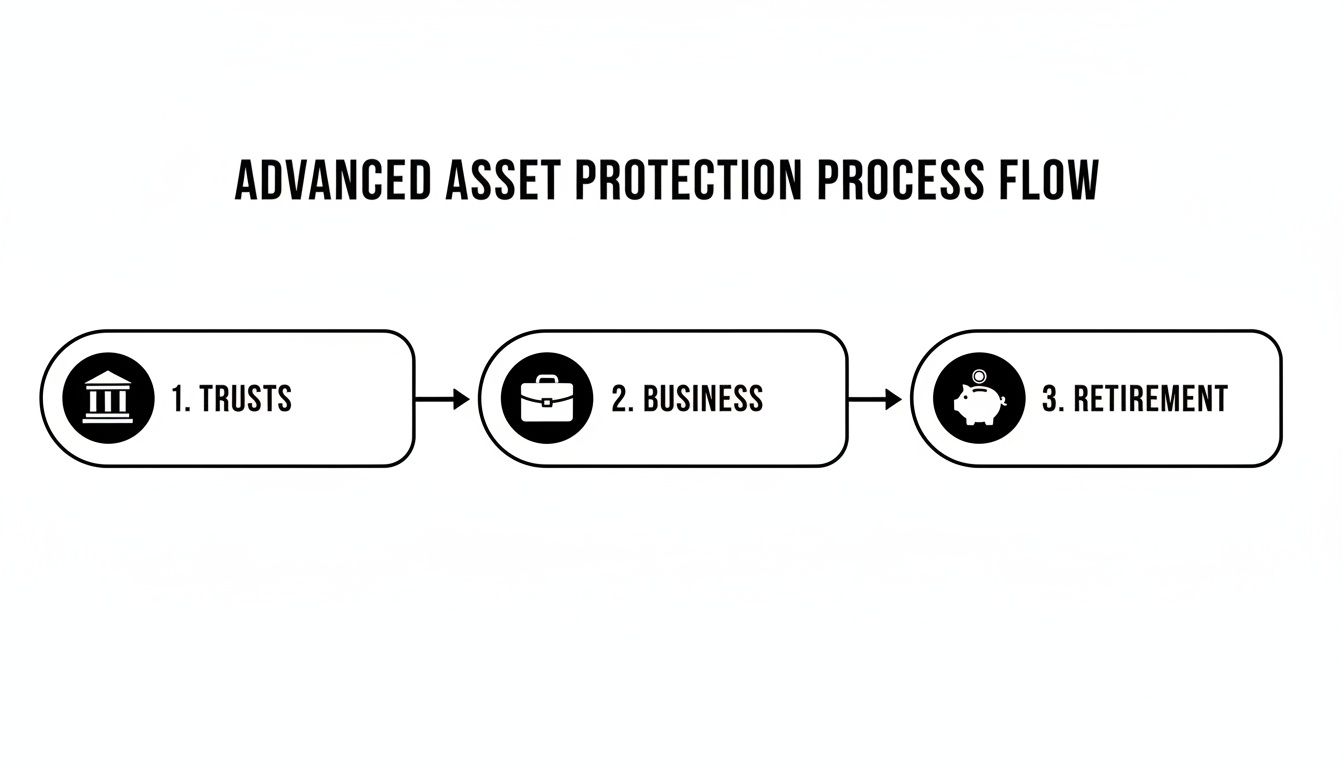
As you can see, protecting significant assets requires a multi-pronged strategy where legal structures work together to create layers of security around everything you've worked so hard to build.
Putting It All Together for Your Financial Security
Navigating how to protect your assets during a Texas divorce can feel overwhelming, but you don't have to go through it alone. By understanding Texas community property law and using the right legal tools—like prenuptial agreements, trusts, and smart business structuring—you can regain control of your financial future. It all comes down to proactive planning and strategic action.
Secure Your Future, Starting Today
Whether you're considering marriage, are in the midst of a divorce, or simply want to be prepared, the steps you take today can bring you peace of mind for years to come. Remember, learning how to protect what's yours isn't about starting a fight; it’s about creating clarity, ensuring fairness, and building the stability you and your family deserve.
Every family's situation is unique. An experienced attorney can help you build a strategy that fits your circumstances, explain your rights under the Texas Family Code, and create a solid plan to safeguard everything you've worked so hard to build.
Common Questions About Protecting Assets
We understand that thinking about divorce brings up urgent questions. When your financial future feels uncertain, clear answers can make all the difference. Here are our responses to some of the most common questions we hear from clients.
Can I Protect My Inheritance from a Divorce in Texas?
Yes, absolutely. Under the Texas Family Code, property you receive through inheritance or as a specific gift is legally considered your separate property. However, the burden is on you to prove it and keep it separate. The single biggest mistake is commingling these funds by depositing them into a joint account.
As a practical step, the moment you receive an inheritance, open a new account solely in your name and keep the funds there. Never use that account for marital expenses. Clean records are your strongest defense.
What Happens If My Spouse Tries to Hide Assets?
Intentionally hiding assets during a divorce is a form of fraud on the community estate, and Texas judges have significant power to penalize a spouse who does this. If we can prove your spouse was dishonest, the judge might award you a larger share of the community property, order your spouse to pay your attorney’s fees, or impose other serious sanctions.
If you suspect something is wrong, tell your attorney immediately. We can use legal tools like depositions and subpoenas to investigate. In many cases, we'll bring in a forensic accountant to trace the money and uncover the truth.
Is My Business a Community Asset if I Started It Before Marriage?
This is one of the most complex areas of Texas property law. The business entity you owned before marriage remains your separate property. However, any increase in its value during the marriage due to your time, talent, and labor is considered community property. This means the marital estate may have a claim for reimbursement for the value you contributed over the years.
Key Takeaway: The best way to avoid this conflict is with a prenuptial or postnuptial agreement that clearly defines how the business and its growth will be treated. Without one, you will almost certainly need a professional business valuation to untangle the separate and community interests.
If you need help navigating divorce, custody, or estate planning in Texas, contact The Law Office of Bryan Fagan today for a free consultation.