
Divorce can be one of life's most difficult transitions, especially when you're worried about losing property you built, inherited, or brought into the marriage. If you're searching for how to protect assets in divorce texas, you probably don't want broad reminders about “keeping records.” You want to know what works when accounts were mixed, real estate was refinanced, or a business became more valuable during the marriage.
Texas law gives you tools, but it also imposes rules. The people who protect assets most effectively are usually the ones who act early, stay organized, and avoid reactive moves that create bigger problems later. The people who struggle are often the ones who wait, transfer property impulsively, or assume that “it's in my name” settles the issue.
A strong asset-protection strategy in a Texas divorce is usually built around three questions. What is community property? What is separate property? And if something is separate, can you prove it clearly enough for a court to treat it that way? Those questions control almost everything else.
The Foundation of Asset Protection in Texas Divorce
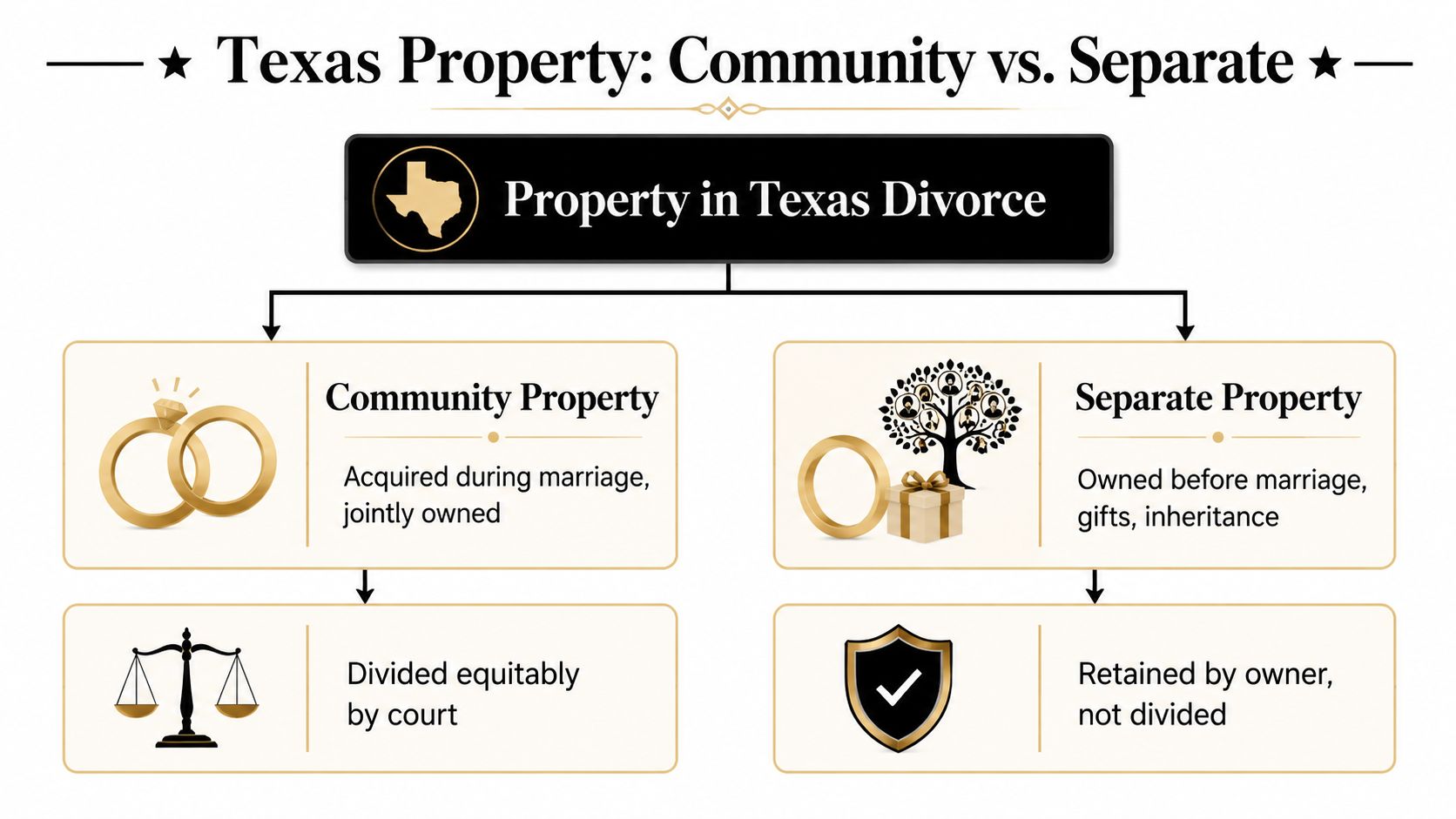
In Texas, the starting point is simple even if the application is not. Texas is a community-property state, which means property acquired during the marriage is generally presumed to be community property, while separate property must be proven by the spouse claiming it, often by clear and convincing evidence. Texas law also makes clear that a court may divide community property and community debt, but it cannot award one spouse's proven separate property to the other, as explained by Texas Law Help's overview of dividing property and debt in divorce.
A useful way to think about this is a shared shopping cart. During the marriage, most things added to the cart are presumed to belong to the marital estate. If you say one item was always yours alone, you need the receipt, the purchase date, and a clean paper trail showing why it never became part of the shared cart.
What counts as separate property
Under Texas Family Code principles, separate property generally includes property owned before marriage, along with certain gifts and inheritances. The legal category matters because the court's power to divide property applies to the community estate, not to separate property that has been properly established.
That sounds straightforward until real life gets involved. A premarital account may continue growing during the marriage. An inherited sum may be used on a house. A vehicle may be paid down with marital earnings. Ownership and reimbursement issues can start to overlap quickly.
Practical rule: If you cannot show when an asset was acquired and how it moved over time, you're already at a disadvantage.
Why the burden of proof matters
The spouse claiming separate property carries the burden. That means you should not assume your spouse has to disprove your claim. In practice, your records have to tell a coherent story.
Helpful records often include:
- Account statements that show premarital balances and later activity
- Deeds and closing documents for real estate purchases or refinances
- Inheritance or gift records that identify the source of funds
- Retirement plan records that distinguish pre-marriage accrual from later accrual
Texas courts also treat retirement benefits earned during the marriage as usually community property, even if retirement hasn't happened yet, according to the same Texas Law Help property division resource.
One of the first conversations I have with clients is not about “winning” property division. It's about identifying what can be proven. That is the difference between a strong position and an expensive argument.
Strategic Planning Before a Divorce is Filed
Some asset protection happens long before anyone mentions divorce. If the marriage is stable but you want clarity, or if stress has started building and you want to reduce uncertainty, planning tools can still matter. The key is using lawful planning devices, not rushed transactions that look like concealment.
Prenuptial and postnuptial agreements
A well-drafted marital property agreement can define rights and expectations before a future dispute becomes a courtroom fight. In second marriages, blended-family situations, or marriages involving a business owner, those agreements often do two things well. They identify what stays separate, and they reduce later arguments about income, appreciation, and debt responsibility.
Consider a common scenario. One future spouse owns a closely held business. The other is entering the marriage with substantial student debt. A prenuptial agreement can set expectations about business ownership, income treatment, and debt allocation. A postnuptial agreement can sometimes address similar issues after marriage, depending on the facts and timing.
Still, these agreements are not magic. They must be drafted carefully, signed properly, and supported by fair disclosure and valid legal structure. They also don't give either spouse a free pass to behave recklessly with records after the marriage begins.
Trusts, title, and the limits of late planning
Trusts and careful titling can help preserve separate assets in some circumstances, especially for family wealth, inherited property, or estate-planning goals. But many people overestimate what title alone can do. Putting only one spouse's name on an account or deed does not automatically resolve whether the asset is community or separate.
Above all, timing matters. Existing guidance often mentions marital property agreements and trusts, but it rarely answers the harder question people ask when divorce risk is already visible. Can you still protect future appreciation, business value, or incentive-based compensation once the marriage is under strain? The answer is fact-specific, and as McClure Law Group notes in discussing asset protection before filing for divorce, last-minute transfers may be attacked as concealment or fraudulent disposition.
A few planning moves are usually productive:
- Review ownership documents early so you know what is titled where
- Separate estate-planning goals from divorce strategy because a trust created for one purpose may not solve a family-law problem
- Document intent carefully if family members are making gifts or transfers
What works and what usually backfires
Here is a useful comparison:
| Approach | What it can do | Where it fails |
|---|---|---|
| Prenuptial agreement | Define expectations before marriage | Weak drafting or poor disclosure can create disputes |
| Postnuptial agreement | Clarify ownership during marriage | Late execution during marital conflict raises scrutiny |
| Trust planning | Preserve inherited or family assets in some settings | Doesn't erase tracing problems if funds are later mixed |
| Retitling assets alone | Organize ownership records | Doesn't automatically change legal characterization |
If planning is still possible, keep it measured and transparent. A lawful agreement drafted before litigation is very different from a hurried transfer made after one spouse starts talking to divorce counsel.
Immediate Actions to Secure Your Assets
When divorce looks imminent, your priority is not to outmaneuver your spouse. Your priority is to preserve information, stabilize accounts, and prevent avoidable mistakes. The most common damage happens in the early stage, when people panic and start moving money without a plan.
Start with documentation, not confrontation
One of the highest-risk failures in Texas divorce cases is commingling. Once separate-property funds are mixed with community funds, the owner has to trace the asset’s origin through records such as bank statements, deeds, and transaction histories. A practical step is to build a complete inventory of assets and isolate premarital, inherited, or gifted property into accounts solely in one spouse’s name, as discussed by The Pollard Firm’s Texas divorce asset-protection guidance.
That means your first moves should be quiet and methodical.
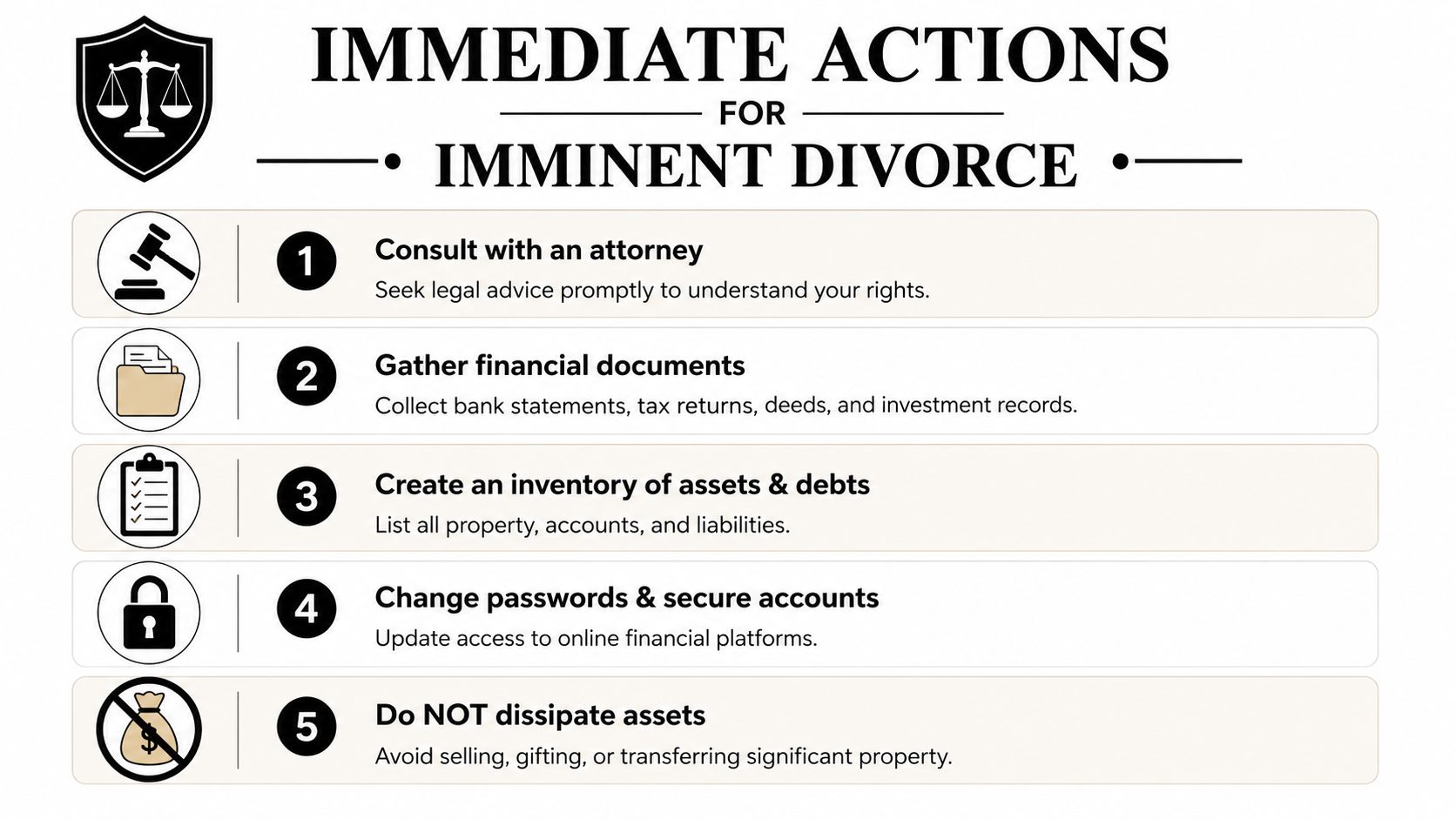
- Download records now including bank statements, brokerage statements, tax returns, loan records, deeds, and retirement plan summaries
- List debts alongside assets because liability allocation matters almost as much as ownership
- Preserve digital access by updating passwords for your own accounts and devices
- Keep inherited or premarital funds isolated instead of using them for ordinary household spending
Know when court protection may be necessary
If you have a real concern that your spouse may sell, transfer, or hide property, temporary court orders may become necessary. Depending on the county and the facts, that may include a temporary restraining order or related temporary relief. Those orders are not automatic, and they are not appropriate in every case, but they can be critical where financial misconduct is a real risk.
If you think assets may disappear, waiting for “more proof” can be costly. The better approach is to discuss the facts promptly with counsel and evaluate whether temporary orders are justified.
A short checklist for the next few days
This is the practical version I’d want a client to follow:
- Make a master inventory. Include real estate, retirement accounts, payroll records, business interests, vehicles, cash, debt, and valuables.
- Save source documents. Don’t rely on online access remaining available.
- Stop mixing funds. Separate money should stay separate.
- Do not sell or gift major property. Courts look closely at unusual transfers.
- Get legal advice before taking a dramatic step. That includes emptying accounts, changing title, or moving business funds.
The safest immediate strategy is disciplined preservation. Rash movement creates evidence problems, credibility problems, and sometimes court sanctions.
Tracing and Proving Your Separate Property
Difficulty often arises in many Texas divorce cases. It is one thing to say an asset began as separate property. It is another to prove that claim after years of transfers, deposits, refinancing, or family spending.
Texas law places the burden on the spouse claiming separate property, and the proof must be clear and convincing. If tracing is incomplete, the asset may be treated as community property or the dispute may shift into a reimbursement fight instead of a straightforward ownership issue. That challenge is especially common with houses, investment accounts, and inherited property, as discussed by Onda Family Law’s analysis of inherited property and tracing issues in Texas divorce.
A practical tracing example
Take a familiar situation. A spouse inherits money during the marriage. Instead of leaving it in a separate account, that money is deposited into a joint bank account. Later, part of the balance is used as a down payment on a home titled in both spouses’ names. Over time, mortgage payments come from regular earnings during the marriage.
At that point, there are several separate questions:
- Was the original inherited money separate property at the time it was received?
- Can the owner trace the inherited funds from receipt into the joint account?
- Can the owner show what portion of the home purchase came from those funds?
- Did later community contributions create a reimbursement issue even if part of the down payment was separate?
That is why “I used inheritance money” is not enough by itself.
What clear and convincing evidence looks like in practice
Courts want a documented path. In a tracing exercise, that usually means building a chronological file:
- Origin records such as probate documents, gift letters, trust paperwork, or premarital account statements
- Transfer records showing where the money moved and when
- Closing documents or purchase contracts tying funds to a later asset
- Follow-up statements proving the money was not absorbed into ordinary spending without a traceable path
A good tracing presentation is organized almost like an audit. Each transaction should connect to the next one without unexplained gaps.
For readers dealing with financial secrecy concerns alongside tracing issues, tools that help identify suspicious account behavior can sometimes support the broader fact-gathering process. A consumer-focused resource like CheatScanX infidelity verification can be useful for learning how hidden financial patterns sometimes surface, although any evidence used in court still has to be gathered lawfully and reviewed with counsel.
Why incomplete tracing changes the case
When tracing breaks down, the dispute often stops being “this is mine” and becomes “I contributed separate funds and should be reimbursed.” That can still matter, but it is not the same outcome. Ownership and reimbursement are different legal theories, and they lead to different settlement positions.
Good tracing is not just recordkeeping. It is a narrative supported by documents.
This video offers additional context on how lawyers analyze property characterization issues in Texas divorce:
If your finances are layered, tracing usually requires collaboration between the client, the attorney, and sometimes a forensic accountant. For a deeper look at that process, see this guide to tracing marital and separate property in a Texas divorce.
Protecting High-Value and Complex Assets
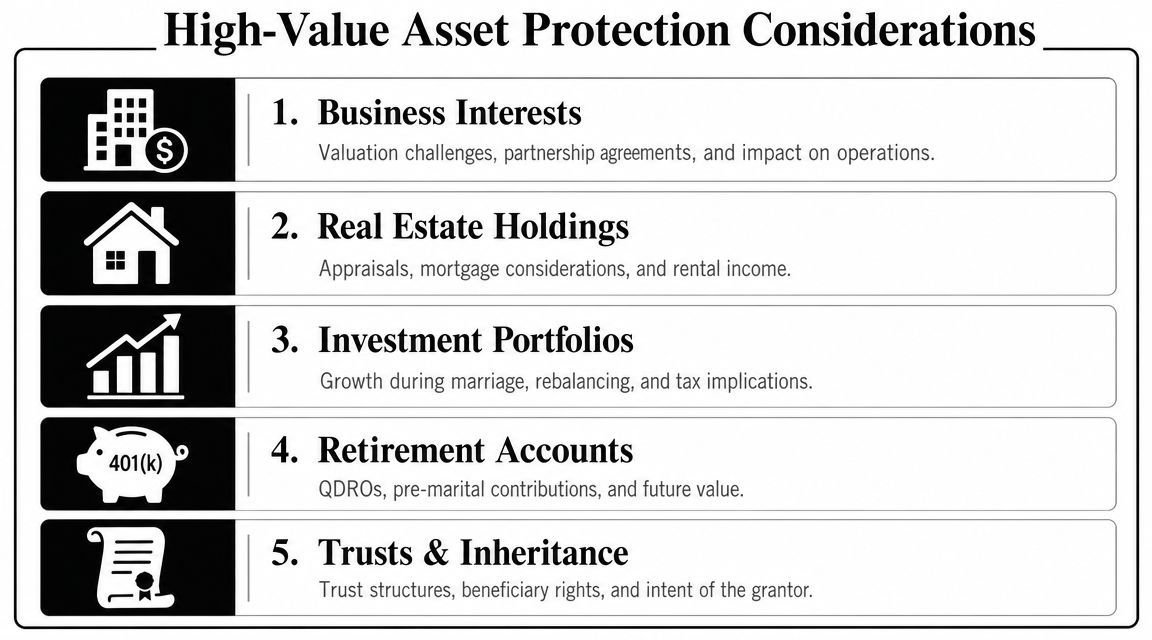
A high-asset divorce usually turns on three questions at once. What is the asset worth, who controls it during the case, and what tax or cash-flow consequences follow a division. That is why business interests, stock compensation, investment real estate, and digital assets require a different plan than an ordinary checking account dispute.
By the time clients reach this stage, the marriage is often already under strain. The instinct to move money, retitle property, or change compensation arrangements is common. In Texas, those last-minute moves can create bigger problems than they solve. The better approach is to preserve records, stabilize operations, and build a valuation and characterization case that will hold up under scrutiny.
Business interests need valuation and control planning
A closely held business can be the most valuable asset in the estate and the easiest one to mishandle. Ownership may be separate, community, or mixed. Income may come through salary, distributions, retained earnings, or owner perks. The spouse who runs the company also has to keep the business operating while the divorce case is pending.
That creates real trade-offs. Pushing for an aggressive valuation discount may reduce the number on paper, but it can also invite a stronger challenge from the other side. Seeking to keep full control of the company may be reasonable, but it usually means offsetting that value with other assets or structuring a buyout. If the company cannot support a lump-sum payout without harming operations, that issue needs to be addressed early, not during mediation after positions harden.
Key documents usually include:
- Formation records and ownership documents
- Corporate tax returns and financial statements
- Shareholder agreements, buy-sell terms, or partnership restrictions
- Payroll, distributions, and compensation records
- Loan documents and any personal guarantees tied to the business
A business case is stronger when the paper trail explains both ownership and value. For a closer look at how that process works, see this guide on valuing a business for divorce in Texas.
Retirement plans, deferred compensation, and equity awards
Retirement accounts often contain layers that matter. Premarital balances, marital contributions, employer matches, rollovers, and post-petition gains may all need separate treatment. A division that looks simple on a spreadsheet can fail if the order does not match the plan’s rules.
Executive compensation adds another layer. Stock options, RSUs, deferred bonuses, and performance awards are often earned over time, not on one date. The question is usually whether the grant compensated past work during the marriage, future work after separation, or both. Grant agreements, vesting schedules, and compensation plans often decide that issue.
Small drafting mistakes here can cost real money.
Real estate portfolios and illiquid property
Rental properties, commercial buildings, mineral interests, and other illiquid assets require more than a title search. A deed may show legal ownership, but the divorce analysis often turns on down payment sources, refinance history, principal reduction during marriage, and who guaranteed the debt. If one spouse wants to keep an income-producing property, the court or opposing side will still ask whether the debt can be refinanced and whether the proposed offset is realistic.
I often tell clients to separate emotional value from financial value. Keeping a property that ties up cash, carries deferred maintenance, or produces weak income can be a poor result even if it feels like a win in settlement.
Digital assets require records, not guesswork
Cryptocurrency cases rise or fall on documentation. Wallet addresses, exchange statements, transfer histories, and tax reporting all matter. If coins were bought before marriage, added to during marriage, moved across platforms, or used in staking or lending, the record needs to show that chronology clearly. Otherwise, valuation disputes and characterization disputes start to overlap.
For clients who actively track holdings, a tool that helps manage your Bitcoin portfolio via CoinStats can make it easier to gather balances and transaction history for counsel and any financial expert.
In high-value cases, the spouse with the cleaner records usually has the stronger settlement position.
A practical framework for complex assets
| Asset type | Main risk | Better approach |
|---|---|---|
| Closely held business | Undervaluation, cash-flow disputes, operational disruption | Get an early valuation review, confirm ownership history, and assess buyout feasibility |
| Retirement plan | Division order errors or incorrect characterization | Match the account history to plan rules before drafting transfer orders |
| Stock options or RSUs | Treating all awards as marital or all as separate | Compare grant terms and vesting periods to the marital timeline |
| Real estate portfolio | Confusion over equity, debt, and reimbursement claims | Gather deeds, closing files, refinance records, and payment history |
| Trust or inheritance interest | Overstating or understating the spouse's actual rights | Review trust language, distributions, and control over the asset |
The common thread is control through proof. High-value property cases are usually decided by records, valuation method, and timing. If you want to protect a business, investment portfolio, or other complex asset in a Texas divorce, act early, keep the paper trail intact, and build a position that can survive both negotiation and courtroom review.
The biggest mistakes usually don't come from obscure legal doctrine. They come from panic, secrecy, and bad instincts. People think they are protecting assets when they are really damaging their credibility.
Hiding assets is not protection
Transferring money to a relative, opening an undisclosed account, delaying bonuses, or moving title right before filing can all create serious problems. A judge may view those actions as concealment, waste, or fraud on the community estate. Even if the move was poorly thought out rather than malicious, the damage to your case can be real.
Short examples show how this goes wrong:
- The cash withdrawal problem happens when a spouse removes funds and cannot explain where the money went.
- The title transfer problem appears when a home, vehicle, or business interest is shifted to a family member during marital conflict.
- The “it's in my LLC” problem arises when someone assumes a business entity shields the underlying value from divorce review.
Negotiation usually rewards prepared people
Most divorce cases resolve through negotiation, mediation, or temporary agreements before trial. That doesn't mean you should be passive. It means your advantage comes from organization.
Bring your lawyer a file, not a story. If you can show account history, source documents, and a logical tracing path, your settlement position is stronger. If your records are incomplete, a realistic strategy may involve compromise, reimbursement arguments, or focused discovery rather than broad accusations.
A useful way to think about the endgame is this:
- Strong evidence supports efficient settlement
- Incomplete evidence requires targeted investigation
- Dishonest behavior invites avoidable litigation
Courts can work with imperfect facts. They are far less patient with evasive conduct.
If emotions are running high, resist the urge to use property as a weapon. Don't cancel insurance, block access to ordinary household funds without advice, or make business decisions intended to punish your spouse. Judges notice conduct. So do mediators.
The most effective form of asset protection in a Texas divorce is lawful, documented, and credible. If your case involves commingled funds, inherited property, a business, or concerns about hidden accounts, get legal guidance before you make the next move.
If you need help navigating divorce, custody, or estate planning in Texas, contact Law Office of Bryan Fagan, PLLC for a free consultation. We can help you evaluate community and separate property issues, organize tracing documents, address urgent concerns about asset preservation, and build a strategy suited for your financial situation and family goals.