

Have you ever had one of those moments where life feels heavier than it should—like sitting at the kitchen table long after dinner, staring at a stack of papers you’re not sure how to begin? That’s where many Texas couples find themselves when facing divorce, even when they agree on everything. They’re ready for a peaceful transition, ready to move forward, but unsure whether the forms in front of them are the right ones or whether a missed signature could send them right back to the beginning. That’s where understanding the Texas Uncontested Divorce Forms becomes the key to reclaiming clarity and peace of mind.
At The Law Office of Bryan Fagan, PLLC, we hear stories like this every day—stories of good people who simply want a respectful, low-conflict path toward the next chapter of their lives. Led by Bryan Joseph Fagan, a South Texas College of Law graduate and trusted authority in Texas divorce and custody law, our firm is built around a simple purpose: empowering individuals and families to navigate life’s hardest transitions with confidence. We do this by providing compassionate counsel, practical education, and legally precise solutions that simplify even the most intimidating parts of the Texas Family Code, including the requirements for agreed divorces under Chapters 6 and 7.
In this guide, you’ll discover how uncontested divorce forms actually work, what they must include, and how choosing the right approach can create the smooth, stable transition you deserve. With decades of combined experience and a mission centered on protecting what matters most, our firm is here to help you move forward with clarity, confidence, and peace.
Let’s begin by exploring how the uncontested process works—and why the right guidance can make this moment feel far less overwhelming.
Key Takeaways
Before diving into the details, here are the most important practical insights to keep in mind:
- Core forms apply to almost every uncontested case: The Original Petition for Divorce, Waiver of Service or Answer, and Final Decree of Divorce are required in nearly every Texas uncontested divorce, with additional forms needed when children, real estate, or retirement accounts are involved.
- Accuracy and detail matter more than you might expect: Judges frequently reject decrees because of vague property descriptions, incorrect child support calculations, or missing signatures—errors that can add months to your timeline.
- County-specific rules can make or break your case: Texas has 254 counties, and local requirements for forms, formatting, and procedures vary significantly; always verify what your county requires before filing.
- Common mistakes are preventable: Most delays come from omitting debts or retirement accounts, using generic online forms not tailored to Texas law, or failing to get required notarizations.
- Attorney review is a smart investment: Even in the most amicable divorces, having a Texas family law attorney review your forms before filing can prevent costly mistakes and future disputes.

Your Family’s Future Starts Here
Don’t navigate your legal journey alone. Schedule a consultation now and get the clarity and support you deserve.
What Are Texas Uncontested Divorce Forms?
Texas Uncontested Divorce Forms are the required legal documents used to initiate, manage, and finalize an agreed divorce in Texas. Once reviewed and signed by a judge, these forms become binding court orders that outline every decision you and your spouse have made—whether dividing community property under Texas Family Code Chapter 7, meeting residency requirements under Chapter 6, or establishing conservatorship, possession, and child support according to Chapters 153 and 154. These forms give the court the information needed to ensure your agreements satisfy Texas legal standards, including the “best interest of the child” test under §153.002.
A divorce is legally considered uncontested only if both spouses agree on all major issues, such as property division, debt allocation, parenting schedules, support obligations, and any spousal maintenance request under Chapter 8. If even one issue remains unresolved or unclear, the case can shift into contested territory, which may require mediation or additional hearings. Because small errors—conflicting terms, missing signatures, or incomplete descriptions—can derail an otherwise uncontested divorce, careful and accurate completion of every form is essential.
The exact forms required depend on your family’s circumstances. While some couples without children or real estate may qualify for the simplified Supreme Court form set, families with minor children, real property, retirement accounts, or significant debt need a more comprehensive document package that fully complies with the latest updates to the Texas Family Code, including the increased child support guideline cap under §154.125(a-1). Many spouses choose to work with attorney-prepared forms to ensure that their Final Decree and supporting documents are enforceable, consistent, and acceptable to both the court and the county in which they file.
For a complete walkthrough of how to prepare these documents properly, you can review Uncontested Divorce Forms in Texas: How to File Them the Right Way. Additional insights—such as those found in the firm’s Texas child support resources—help spouses understand how courts evaluate financial and parenting arrangements. The attorneys at The Law Office of Bryan Fagan, PLLC, a trusted leader in Texas family law, assist clients in preparing precise, legally sound documents that meet both statewide requirements and local county expectations, ensuring their uncontested divorce proceeds efficiently and with confidence.

Required Texas Uncontested Divorce Forms (Complete List)
The exact forms you need will depend on whether you have children, own property, hold retirement accounts, or have other unique circumstances. The following list covers the most common requirements for an agreed Texas divorce. Keep in mind that many counties provide their own versions or require additional coversheets, standing orders, or affidavits.
Original Petition for Divorce
The Original Petition for Divorce is the document that formally opens your case and starts the mandatory 60-day waiting period under Texas Family Code § 6.702. This petition is filed by the spouse who initiates the divorce (the Petitioner) and names the other spouse as the Respondent.
Your petition must include accurate information about both parties, including full legal names, the date of marriage, the date of separation (if applicable), and residency facts. Texas Family Code § 6.301 requires that at least one spouse has lived in Texas for at least six months and in the filing county for at least 90 days before filing. The petition also identifies whether there are minor children and states the grounds for divorce—most commonly “insupportability,” which is the no-fault ground under Texas Family Code § 6.001.
The petition does not need to include every detail of your agreements, but it must be truthful and filed in the correct county and court. Once filed, the clerk assigns a cause number, and the 60-day waiting period begins.
Civil Case Information Sheet (and Similar Coversheets)
Many Texas counties require a Civil Case Information Sheet or similar administrative form at the time of filing. This form helps the clerk classify the case type—such as divorce with or without children—and assign it to the appropriate court. While this form is not a pleading and does not substitute for the petition, failing to include it can delay acceptance of your filing.
Some counties now incorporate this information into e-filing systems, so check your county clerk’s current procedures before filing.
Waiver of Service or Answer
Once the petition is filed, the Respondent must be legally notified of the case. In an uncontested divorce, there are two main options: signing a Waiver of Service or filing an Answer.
A Waiver of Service allows the Respondent to acknowledge receipt of the petition and waive the requirement for formal service by a process server, sheriff, or constable. This saves time and money. The Waiver must be signed after the petition is filed and must be notarized to be valid. TexasLawHelp and county forms provide “Waiver of Service Only” forms specifically designed for agreed cases.
An Answer is a simple response filed with the court indicating that the Respondent received notice and does not oppose the divorce. In uncontested cases, the Answer typically uses standardized language and does not signal a contested proceeding.
Be cautious: signing a broad Waiver without understanding it may waive important rights. If you have any questions about what you are signing, consult an attorney before proceeding.
Final Decree of Divorce
The Final Decree of Divorce is the cornerstone of any agreed case involving Texas Uncontested Divorce Forms, because it is the document that officially ends the marriage and sets out every enforceable term the court approves. Once a judge signs the decree, it becomes a binding order governing property division, debt allocation, conservatorship, possession schedules, child support, medical support, and any approved name changes. Under the Texas Family Code, each of these areas must be drafted with precision to ensure enforceability and compliance with state law, especially when children or significant assets are involved.
Texas law requires the decree to clearly address property and debt division under Chapter 7, including accurate descriptions of which spouse receives specific assets and who is responsible for outstanding liabilities. Parenting provisions must follow the standards outlined in Chapter 153, ensuring that conservatorship terms and possession schedules support the child’s best interests under §153.002. Financial provisions such as child support and medical support must comply with Chapter 154, including the updated guideline cap under §154.125(a-1), which reflects the Legislature’s most recent adjustments to net resource calculations. If either spouse wishes to restore a prior name, the decree must include an order authorizing that change, as required by Chapter 6.
Courts routinely deny or delay approval of decrees that are vague, inconsistent with statutory requirements, or lacking the detail necessary for future enforcement. A decree must contain specific, actionable terms—such as accurate legal descriptions of real estate, precise dollar amounts for support, and clear possession schedules—so that the order can be enforced through contempt if necessary. This level of precision protects both spouses and helps prevent costly litigation in the future.
For families wanting step-by-step guidance on preparing a decree that meets Texas standards, the firm offers a detailed resource: How to File Uncontested Divorce in Texas: Step-by-Step Guide. Additional insights into topics like support calculations can also be found in the firm’s Texas child support articles. As one of Texas’s most trusted family law practices, the attorneys at The Law Office of Bryan Fagan, PLLC ensure that every Final Decree is drafted with accuracy, compassion, and a deep commitment to protecting the future of the families they serve.

Child Support & Parenting Forms (if Children Are Involved)
When you have minor children, additional forms are usually required beyond the Final Decree. These documents ensure that custody, visitation, and support arrangements comply with Texas law and protect your children’s best interests.
Common child-related documents include:
- Parenting Plan: Outlines conservatorship (who makes major decisions), day-to-day care responsibilities, and how parents will communicate about the children.
- Standard Possession Order (SPO) or Custom Schedule: Texas Family Code §§ 153.252–.317 establishes the Standard Possession Order, which many families follow. If you agree to a different schedule, it must be clearly described in the decree.
- Child Support Worksheet: Calculates guideline support based on the obligor’s net resources under Chapter 154. If you deviate from guidelines, you must explain why.
- Medical Support Documentation: Specifies who provides health and dental insurance, how premiums are paid, and how uninsured medical expenses are divided.
- Income Withholding Order (IWO): Directs the obligor’s employer to withhold child support from wages and send it to the Texas Child Support Disbursement Unit.
These forms must align with Texas Family Code Chapters 153 and 154. Courts scrutinize child-related provisions closely, and deviations from guidelines must usually be explained in writing to satisfy the judge that the arrangement is in the child’s best interest.
Marital Settlement Agreement (Optional but Recommended)
A Marital Settlement Agreement (MSA) is a written contract where both spouses list all of their agreements on property, debts, support, and parenting responsibilities. While not strictly required in every case, an MSA serves as the roadmap for drafting the Final Decree and reduces misunderstandings later.
Benefits of a Marital Settlement Agreement include:
- A clearer record of what both parties intended
- Fewer disputes about what was agreed
- Easier drafting of the Final Decree
- Better enforceability for complex property or parenting terms
In many uncontested divorces, the MSA is incorporated into the Final Decree by reference or attached as an exhibit, making it enforceable both as a contract and as a court order.
Additional Forms for Specific Situations
Some uncontested divorces require extra documents based on your financial situation or goals:
- QDRO (Qualified Domestic Relations Order): Required to divide qualified retirement plans such as 401(k)s, pensions, and similar employer-sponsored accounts. QDROs must comply with federal ERISA rules and specific plan requirements. This is a highly technical document that often requires attorney assistance.
- Deed forms for real estate: If the decree awards a house or land to one spouse, a separate deed—such as a Special Warranty Deed—is needed to transfer title. The decree alone does not transfer property ownership.
- Name change forms: Some counties require a separate Order Restoring Name Used Before Marriage, while others allow the decree itself to function as the name-change order.
- Affidavit of Inability to Pay Court Costs: If you cannot afford filing fees, you may file this statement to request a fee waiver.
These documents are areas where attorney help is particularly important, as errors can have long-lasting financial and legal consequences.
How to Complete Texas Uncontested Divorce Forms Correctly
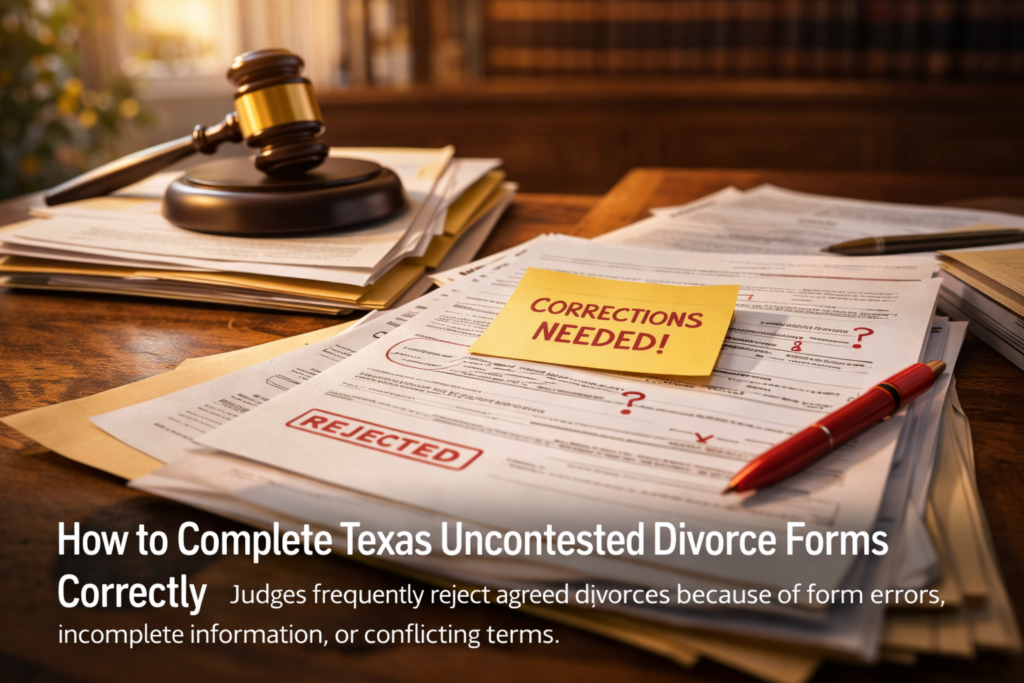
Judges often reject agreed divorces because the Texas Uncontested Divorce Forms were completed incorrectly, contained missing information, or included terms that conflicted with one another. These errors can delay a case for months and may even require additional hearings. Careful, consistent, and detail-oriented preparation is one of the most important steps you can take to ensure your uncontested divorce moves smoothly through the Texas court system. Families navigating these forms can find step-by-step support through the firm’s resource on uncontested divorce services: Uncontested Divorce Lawyer in Houston, Texas.
When completing your forms, always use full legal names exactly as they appear on government documents—driver’s licenses, birth certificates, passports, or immigration records. Judges rely on accurate identification, and inconsistencies across documents can affect enforcement, title transfers, and state vital statistics filings. Information such as marriage dates, separation dates, and children’s birthdates must match across all filings. For children, names must match birth certificates exactly. When listing vehicles, include the year, make, model, and VIN. For real property, Texas courts require the full legal description from the deed, not just a street address.
It is equally important to be precise when listing property and debt. Texas is a community property state under Texas Family Code Chapter 7, and your decree must clearly state which spouse receives which assets and which debts each spouse will be responsible for after the divorce. Judges routinely reject decrees that use vague language such as “we will divide this later,” because this creates ambiguity and increases the risk of post-divorce conflict. Detailed descriptions—such as listing bank accounts by financial institution and the last four digits of the account number, or debts by lender name and account identifier—help ensure enforceability and avoid confusion. When real property is involved, include the subdivision, lot number, block number, and any recording information required under the Family Code and county property standards.
In many uncontested divorces, it is also wise to include indemnification clauses or deadlines for refinancing, transferring title, or dividing accounts, which protects each spouse from future liability if the other does not follow through. For additional guidance on how courts evaluate child support, property division, and other essential issues, families may benefit from reviewing the firm’s educational materials, including the Texas Child Support Resource. With the support of experienced attorneys at The Law Office of Bryan Fagan, PLLC—well known across Texas for educating families and protecting futures—you can complete your forms with confidence and ensure your final orders meet the expectations of both state law and your local court.
Follow Child Support and Parenting Guidelines
Courts usually start from the Texas guidelines for child support and possession under Chapters 153 and 154, especially in uncontested cases. Any agreed deviation from guideline support or standard possession should be clearly explained in the decree or supporting documents.
Child support calculations must use net resources as defined by the Texas Family Code—not gross income. The decree should identify the obligor’s net resources, the guideline percentage applied, the resulting support amount, the payment frequency and start date, and the payment mechanism.
Judges must find that all orders involving children are “in the best interest of the child,” so your forms should be child-centered and realistic.
Use Clear, Enforceable Language
Orders must be specific enough for law enforcement and future courts to understand and enforce without guessing. Use precise terms: dates, deadlines, dollar amounts, times of day, and locations for exchanges. Avoid vague language like “reasonable” or “as agreed.”
For example, instead of “parents will share holidays,” specify which parent has the children on which holidays in which years, including pickup and drop-off times and locations.
Signatures, Notarization, and Final Review
Certain forms—like Waivers of Service and many settlement agreements—must be signed in front of a notary to be valid. Check every page for required initials, signatures, and dates for both spouses and, if applicable, attorneys.
Before filing and before the final hearing, conduct a thorough final review to confirm that all pages, exhibits, and attachments are included and consistent. Missing signatures or attachments are among the most common reasons judges refuse to sign agreed decrees.
Check County and Judge-Specific Requirements
Many counties post local rules and sample orders on the district clerk’s or family court’s website. Look for county standing orders, parenting class requirements, and any special coversheets or affidavits that must accompany divorce forms.
The safest route is to ask the clerk’s office or work with an attorney who regularly practices in your county and knows each court’s preferences. A form that works perfectly in Harris County may be rejected in Bexar County because of different local requirements.

County-Specific Requirements for Texas Uncontested Divorce Forms
Texas has 254 counties, and while state law is the same everywhere, local rules about forms and procedures vary significantly. Failing to follow local rules can delay your divorce even when all agreements are in place.
Examples of Local Rules That Affect Forms
Typical county-level requirements include:
- Special affidavits: Military status affidavits (to comply with the Servicemembers Civil Relief Act), residency affidavits, or affidavits for service by publication
- Parenting class completion certificates: Many counties require both parents to complete a court-approved parenting class before the divorce can be finalized
- Formatting requirements: Specific margins, font sizes, caption styles, or signature block placement
- Mandatory language: Some counties require verbatim standing order language in the decree or petition
- County-specific forms: Large counties like Harris, Bexar, Travis, and Dallas often have their own local forms or preferred decree templates
Virtual vs. In‑Person Hearing Forms
Many Texas counties now offer virtual options for uncontested divorce prove-up hearings, allowing spouses to appear through Zoom or another video platform rather than visiting the courthouse in person. When using Texas Uncontested Divorce Forms, it is important to understand how your county handles these final steps, because some courts require specific notices, virtual-hearing requests, or supplemental forms before setting a remote appearance. Other counties still conduct prove-ups exclusively in person and provide separate checklists for documents that must be submitted beforehand, including draft orders, testimony sheets, and proposed Final Decrees that comply with Chapters 6 and 7 of the Texas Family Code.
In certain counties, spouses may be permitted to finalize an uncontested divorce through a prove-up by affidavit. This option allows a party to submit written testimony in place of appearing before a judge, so long as the affidavit meets statutory requirements regarding residency under Texas Family Code §6.301, grounds for divorce under Chapter 6, and—if children are involved—accurate statements regarding conservatorship and support pursuant to Chapters 153 and 154. Because Texas law now includes updated child support calculations under §154.125(a-1), affidavits must reflect current guidelines to avoid delay or rejection by the court.
Before submitting any documents, it is essential to confirm whether your county requires proposed orders, testimony sheets, parenting plans, or additional exhibits to be uploaded in advance of a hearing. Some courts mandate electronic submission through the e-file system, while others require in-person delivery or email submission to the court coordinator. These procedural differences can significantly impact the timing and approval of your uncontested case, so careful preparation is a must.
To verify your county’s current requirements, you can visit your district clerk’s website, review posted local rules, or call the clerk’s office directly for updated procedures. Additional guidance is available through How to Fill Out Texas Uncontested Divorce Forms: Step-by-Step, a detailed resource prepared by the attorneys at The Law Office of Bryan Fagan, PLLC. Families may also find support through related articles, such as the firm’s Texas Child Support Resource. When navigating county-specific rules—especially in complex or high-asset situations—working with experienced family law counsel provides peace of mind, ensuring your divorce is completed smoothly, accurately, and in full compliance with the Texas Family Code.

Common Mistakes When Preparing Texas Uncontested Divorce Forms
Most delays in uncontested divorces come from preventable paperwork mistakes. Understanding these pitfalls can help you avoid them.
Omitting Debts and Retirement Accounts
Many couples divide bank accounts and vehicles but forget to address credit cards, personal loans, or retirement accounts like 401(k)s and pensions. If debts are not clearly assigned, creditors may still pursue either spouse, leading to disputes long after the divorce is final.
Dividing retirement accounts incorrectly—or without a QDRO when one is required—can cause major financial and tax problems. The receiving spouse may lose rights to retirement benefits if the proper orders are not in place.
Vague or Incomplete Parenting and Support Terms
Generic or “we’ll work it out later” language about visitation, holidays, or transportation leads to conflict. Frequent errors include failing to address medical and dental support, not specifying how uninsured expenses are split, or miscalculating guideline support.
Judges often send parties back to fix these issues before signing the decree, adding weeks or months to the timeline.
Using Generic Online Forms Not Tailored to Texas Law
Non-Texas-specific form websites often ignore Texas Family Code requirements and local rules. These generic forms may use terminology or procedures that do not apply in Texas—such as “custody” instead of “conservatorship”—leading to rejection or unenforceable orders.
Use Texas-specific resources: TexasLawHelp.org toolkits, county forms, and attorney-prepared documents designed for Texas courts.
Missing Signatures, Notarizations, or Required Attachments
Typical oversights include unsigned waivers of service, missing notary acknowledgments, unsigned Final Decrees, or absent exhibits like property lists or possession schedules.
Any missing signature or attachment can prevent the judge from granting the divorce at the final hearing. Create a checklist and review every document twice—ideally with an attorney.
Final Decree Wording Too Vague to Enforce
Vague clauses about refinancing, selling homes, or dividing retirement accounts can spark expensive enforcement litigation years later. For example, “one party will refinance the home as soon as possible” gives no deadline and no remedy if refinancing fails.
Include precise deadlines, contingency plans, and backup remedies. The cost of having an attorney draft a clear decree is often far less than the cost of future enforcement battles.
Why an Attorney Helps With Uncontested Divorce Forms
Many couples want to save money by handling an uncontested divorce themselves, and that goal is understandable. But legal review can be a smart investment that protects your future. An attorney serves as a guide and safety net rather than an adversarial litigator.
Ensuring All Required Forms Are Included
An attorney can identify every form needed for your specific situation—children, property, retirement, debts, immigration issues—and your specific county. Lawyers who practice regularly in Texas family courts know which judges require extra affidavits, disclosures, or modified language.
Making Sure Documents Comply With the Texas Family Code
An attorney cross-checks each provision of your Final Decree and related forms against the Texas Family Code to ensure legality and enforceability. Key areas of compliance include child support guidelines, best-interest standards for children, community property rules, and limits on spousal maintenance.
Protecting Children and Future Financial Stability
Attorneys help design parenting plans that are realistic, child-centered, and tailored to your family’s unique schedule. They can structure property and debt division to protect credit, housing, and retirement security for both spouses.
Drafting Technical Orders Like QDROs and Real Estate Documents
QDROs must meet strict federal and plan rules and are rarely suitable for do-it-yourself drafting. Deeds, deeds of trust, and mortgage-related provisions must be precisely written to avoid title and foreclosure problems. An attorney ensures these technical documents are correct the first time.
Avoiding Missed Deadlines and Procedural Traps
Attorneys track key dates: service deadlines, answer deadlines, the 60-day waiting period, and hearing settings. They also ensure that certified copies and vital statistics forms are handled properly so state records are updated smoothly after your divorce is final.
Why the Law Office of Bryan Fagan PLLC Is the Best Choice
Families across Texas turn to The Law Office of Bryan Fagan, PLLC because of the firm’s deep commitment to educating clients and protecting their futures—values that are especially important when completing Texas Uncontested Divorce Forms. With thousands of divorces handled, including a significant number of agreed and uncontested matters, the firm brings extensive experience to cases involving property division, conservatorship, and support. This experience is grounded in a thorough understanding of the Texas Family Code, including Chapters 6 and 7 governing the dissolution process and community property rules, as well as Chapters 153 and 154, which outline the standards for parenting plans and child support. Families seeking a full overview of these stages can explore the firm’s guide, The Divorce Process in Texas.
The attorneys at this Houston-based family law practice are known for drafting precise and enforceable Final Decrees that satisfy both statewide legal requirements and the nuanced expectations of local courts. Accuracy matters: a decree that is vague or noncompliant with statutory requirements—such as the updated child support guideline cap in §154.125(a-1)—may be rejected by a judge or lead to future enforcement problems. By ensuring full compliance from the beginning, the firm helps clients finalize uncontested cases as soon as legally possible after the mandatory 60-day waiting period in §6.702.
For clients with children, the firm prioritizes child-centered solutions that promote stability and reflect the best-interest standard mandated by §153.002. Whether crafting a possession schedule, allocating decision-making rights, or calculating support obligations under Chapter 154, the attorneys work to ensure that parenting plans are predictable, practical, and tailored to each family’s routines. Flexible communication options, including phone consultations, virtual meetings, and in-office appointments, help reduce stress and make the process more accessible for busy parents.
The Law Office of Bryan Fagan, PLLC also offers cost-effective services for spouses who have already reached agreement, including limited-scope reviews and flat-fee uncontested divorce packages. These options provide professional oversight while keeping the process affordable. By investing in properly drafted documents upfront, clients often avoid costly disputes later—especially disputes involving property division, retirement accounts, or child support enforcement. Additional resources, such as the firm’s Texas Child Support Resource, further support families as they navigate their legal journey with confidence and clarity.

Our Golden Circle: Why, How, and What We Do
The Law Office of Bryan Fagan PLLC operates according to a guiding philosophy that shapes every client interaction.
Why: Our Purpose
The firm’s purpose is to empower Texas families with clarity, confidence, and compassion during one of the most difficult transitions of their lives. The goal is to reduce conflict and confusion so clients can move forward with stability and dignity.
How: Our Approach
The firm pairs compassionate counsel with legal precision, taking time to explain each form in plain English and answer every question. Streamlined document preparation, secure technology, and close coordination with local courts keep cases moving efficiently.
What: Our Services for Uncontested Divorce
Concrete services include drafting and reviewing all Texas Uncontested Divorce Forms, creating tailored Final Decrees, preparing QDROs, handling property and debt division, and designing parenting plans and support orders. The firm also handles filing, communication with the clerk, scheduling and preparing for the prove-up hearing, and post-divorce implementation like deeds and retirement orders.
Actionable Checklist: Completing Texas Uncontested Divorce Forms
Follow these steps to complete your Texas uncontested divorce forms correctly:
- Verify Texas residency: Confirm that at least one spouse has lived in Texas for at least six months and in the filing county for at least 90 days (Texas Family Code § 6.301).
- Confirm true agreement: Make sure you and your spouse agree on all major issues—property, debts, custody, visitation, child support, medical support, and any spousal support.
- Gather key documents: Collect pay stubs, tax returns, bank statements, retirement account statements, mortgage information, vehicle titles, and children’s schedules and insurance cards.
- Identify and prepare all required forms: Original Petition, Civil Case Information Sheet (if required), Waiver or Answer, Final Decree, child-related forms, and any special forms for property or retirement.
- Review county-specific requirements: Check local rules for additional affidavits, parenting classes, virtual hearing procedures, and required local forms.
- Have an attorney review your paperwork: Request a legal review to confirm that your forms comply with the Texas Family Code and local rules and accurately reflect your agreements.
- File the Original Petition: Begin the 60-day waiting period and ensure the Respondent signs a Waiver or files an Answer properly.
- Prepare for your final hearing: Attend in person or virtually, bringing multiple signed copies of the Final Decree and any additional required orders for the judge to sign.

Conclusion: Moving Forward With Confidence
When you step back and look at the whole journey, it becomes clear that the paperwork, the decisions, and the countless questions aren’t really about forms at all—they’re about creating a path forward that feels steady and fair for everyone involved. A Texas uncontested divorce can be one of the most peaceful ways to close a chapter, and when the process is handled with clarity and care, it often opens the door to genuine healing and stability.
If you’re standing at that crossroads now, you don’t have to navigate it alone. Having an experienced Texas family law attorney by your side—someone who understands the law, the courts, and the emotional weight of these decisions—can turn a stressful season into one where you feel informed, supported, and genuinely empowered. That’s the heart of what we do at The Law Office of Bryan Fagan, PLLC: protect what matters most while helping families move forward with confidence.
And as you’re thinking about your next step, here’s a gentle reminder: the decisions you make today shape the freedom and peace you feel tomorrow. Whether you’re ready to schedule a conversation or simply want guidance before moving ahead, we’re here to help you take that next step with clarity and calm. After all, a fresh start should feel like exactly that—a fresh start.
Texas Uncontested Divorce FAQs
Filing an uncontested divorce begins with one spouse submitting an Original Petition for Divorce in a county where at least one spouse has lived for at least 90 days and has been a Texas resident for at least 6 months, as required by Texas Family Code § 6.301. The other spouse typically signs a Waiver of Service or files an Answer, and both spouses prepare a Final Decree of Divorce outlining all agreements on property, debts, parenting, and support. Once the mandatory 60-day waiting period has passed and the judge reviews and approves the paperwork, the divorce can be finalized.
The shortest possible timeframe is 60 days because Texas law imposes a mandatory waiting period under § 6.702. If all forms are correct, both spouses cooperate, and the court’s schedule allows it, many uncontested divorces are finalized shortly after the 60th day. Delays usually happen if paperwork is incomplete, unclear, or not in compliance with the Texas Family Code or county-specific requirements.
Filing fees vary by county but usually fall in the range of a few hundred dollars. Additional costs may include service fees, certified copies of the decree, or specialized orders like QDROs. Parents or spouses who cannot afford filing fees may ask the court to waive costs by filing an Affidavit of Inability to Pay. Many families also choose to hire a Texas family law attorney to draft or review their forms, which adds legal fees but can prevent costly mistakes later.
Texas divorce forms are available through resources like TexasLawHelp.org or some county clerk websites, which may offer county-specific packets. However, these generalized forms do not fit every situation, especially if spouses own real estate, have retirement accounts, share children, or want custom terms. Working with a family law attorney ensures the forms meet Texas Family Code requirements and that the Final Decree is enforceable and acceptable to the court.
Even if spouses agree, a judge must ensure the paperwork complies with Texas law. Judges often reject decrees that are vague, incomplete, or inconsistent with statutes—particularly child support provisions under Chapter 154 and parenting orders governed by § 153.002. Missing signatures, incorrect legal descriptions of property, or use of non-Texas forms can also cause a denial. If residency requirements are not met or jurisdiction is unclear, the judge must also refuse the divorce.
The most efficient and affordable path is a true uncontested divorce where both spouses communicate openly, exchange necessary information, and sign all forms in a timely manner. Couples can save time and money by avoiding unnecessary conflict and ensuring the Final Decree is drafted correctly the first time. While some people attempt a DIY approach, limited-scope legal representation from a Texas family law attorney often prevents errors that could lead to costly corrections or court hearings later.
The “10-year rule” generally refers to spousal maintenance eligibility under Texas Family Code § 8.051 and § 8.054. If a marriage has lasted 10 years or more, the court may consider awarding spousal maintenance if the requesting spouse cannot meet their minimum reasonable needs despite diligent efforts to become self-supporting. Longer marriages may also affect retirement benefits and Social Security considerations, so understanding this rule before finalizing agreements is important.
During a divorce, spouses should avoid hiding assets, draining accounts, ignoring court orders, or involving children in adult conflicts. Posting about the divorce or the other spouse on social media can also create unnecessary problems. Signing documents without understanding their long-term consequences is another common mistake. Honest communication, respect for the process, and a focus on the future generally lead to smoother outcomes and better long-term stability.
Most Texas counties allow electronic filing through state-approved e-filing systems, and many uncontested divorces can be handled largely online. However, an “online divorce” is not fully automatic. Spouses must still meet residency requirements, complete all forms accurately, follow county-specific rules, and appear for a final prove-up hearing either in person or through virtual court. An experienced Texas family law attorney can guide you through the online process and ensure the case proceeds smoothly.