
Going through a divorce can be one of life’s most difficult transitions. The emotional and financial stress can feel overwhelming. When you add the unique complexities of military life—deployments, relocations, and a specific set of federal laws—the process can seem even more daunting. Finding the right military divorce lawyer in Texas is the most important step you can take to protect your rights, your finances, and your family's future. You need an advocate who deeply understands the intersection of Texas family law and the federal regulations that will shape your case.

Understanding Military Divorce in Texas
A divorce is challenging enough on its own. For military families, that emotional weight is often compounded by logistical hurdles that civilian couples don't face. Frequent moves, long deployments, and a separate system of federal rules add layers of complexity. At The Law Office of Bryan Fagan, PLLC, our first goal is to bring clarity and steady guidance to this process, helping you feel supported and understood every step of the way.
Military life places unique stresses on a marriage. The demands of service, including постоянные смены места службы (PCS) and long deployments, contribute to a distinct set of challenges. Divorce rates in the military have hovered around 3% to 4% annually in recent years. You can discover more about these trends and their causes to understand the data better.
How This Guide Can Help You
Think of this guide as your roadmap. We created it to help you understand your rights, not just under Texas law, but also under critical federal regulations like the Servicemembers Civil Relief Act (SCRA). We'll walk you through the most important aspects of a military divorce so you can feel confident in the decisions you make for your future.
Here is some practical, actionable guidance we'll break down for you:
- Establishing Jurisdiction: The first critical question is where to file for divorce. We'll provide a step-by-step explanation of how this works when you or your spouse are stationed out of state or overseas.
- Dividing Military Benefits: A major concern is how military retirement pay is divided in a Texas divorce. We'll explain how courts handle this and other unique benefits.
- Child Custody and Support: Creating a parenting plan that works is hard enough. We'll show you how to build one that can withstand deployments and relocations while providing stability for your children.
- Protecting Your Rights: Active-duty service members have specific legal protections. We’ll ensure you know what they are and how to use them.
Our goal is to cut through the confusion and replace uncertainty with confidence. With the right legal support, you can navigate this process, protect your financial future, and ensure your family is ready for the next chapter.
Where Can You File for a Military Divorce in Texas?
Before a divorce can begin, a court must have the legal authority to hear your case. This is called jurisdiction, and for military families who move frequently, figuring out where to file can feel like a significant hurdle. Understanding your rights under Texas law can make this process far less overwhelming.
The first step is meeting Texas's residency requirements. The law is designed to ensure at least one spouse has significant ties to the state before its courts can dissolve a marriage.
The Texas Residency Rules for Divorce
Under the Texas Family Code § 6.301, you can file for divorce in Texas if either you or your spouse has:
- Lived in Texas for at least the last six months.
- Lived in the specific county where you plan to file for at least the last 90 days.
For military members, there is additional flexibility. Even if you are stationed in another state or deployed overseas, you may still file in Texas if you can prove it is your "domicile"—your legal, permanent home. This is about more than just where you are physically located; it involves showing ties like maintaining a Texas driver's license, being registered to vote in Texas, or owning property here. Your military divorce lawyer in Texas can help you gather the necessary evidence to establish jurisdiction.
What Is the Servicemembers Civil Relief Act (SCRA)?
Once a divorce is filed, a common concern for active-duty members is how they can possibly participate in court proceedings while serving. This is where a critical federal law, the Servicemembers Civil Relief Act (SCRA), comes into play. The SCRA is a legal shield designed to protect service members from being at a disadvantage in civil cases—including divorce—because their military duties prevent them from appearing in court.
If you are on active duty and your spouse files for divorce, you can request a "stay," which is a temporary pause on the court proceedings.
The SCRA gives an active-duty service member the right to request an automatic stay for at least 90 days. This pause is intended to give you the time needed to hire a lawyer and prepare your case, without the risk of a default judgment being entered against you while you are unable to appear.
For example, imagine a civilian spouse files for divorce in Houston while their active-duty partner is deployed in Germany. The deployed spouse receives the divorce papers but cannot respond or attend hearings. Through their attorney, they can invoke their SCRA rights to pause the case until they can meaningfully participate. This is not a way to avoid the divorce, but it is a vital protection that ensures the process is fair for everyone.
Getting these foundational rules right is the first step toward regaining control. A skilled attorney will ensure your case is filed in the correct jurisdiction and that your rights as a service member are protected from the very beginning.
If you need help navigating divorce, custody, or estate planning in Texas, contact The Law Office of Bryan Fagan today for a free consultation.
How Military Retirement Pay Is Divided in Texas
For many military families, the service member's pension is the most valuable asset they have built together. It represents years of shared sacrifice. When a marriage ends, the question of how this hard-earned retirement pay will be handled can be a significant source of stress and uncertainty.
Fortunately, both Texas law and federal law provide a clear framework for this process. In Texas, a military pension earned during the marriage is considered community property, just like a house or a savings account. A Texas court has the authority to divide it in a way that is “just and right” for both spouses, as outlined in the Texas Family Code.
This was made possible by a landmark federal law: the Uniformed Services Former Spouses' Protection Act (USFSPA). This act grants state courts, including those in Texas, the authority to treat the portion of disposable retired pay earned during the marriage as a divisible marital asset.
Understanding How Texas Courts Divide Military Retirement
When a Texas court divides a military pension, it can only consider the portion that was earned during the marriage. For instance, if a service member served for 20 years but was married for 15 of those years, the court only has jurisdiction over the benefits accrued during that 15-year period.
The judge will then issue an order specifying the exact percentage or dollar amount the former spouse is entitled to receive. These calculations can be complex, which is why having an experienced military divorce lawyer in Texas is crucial to ensure the division is accurate and fair.
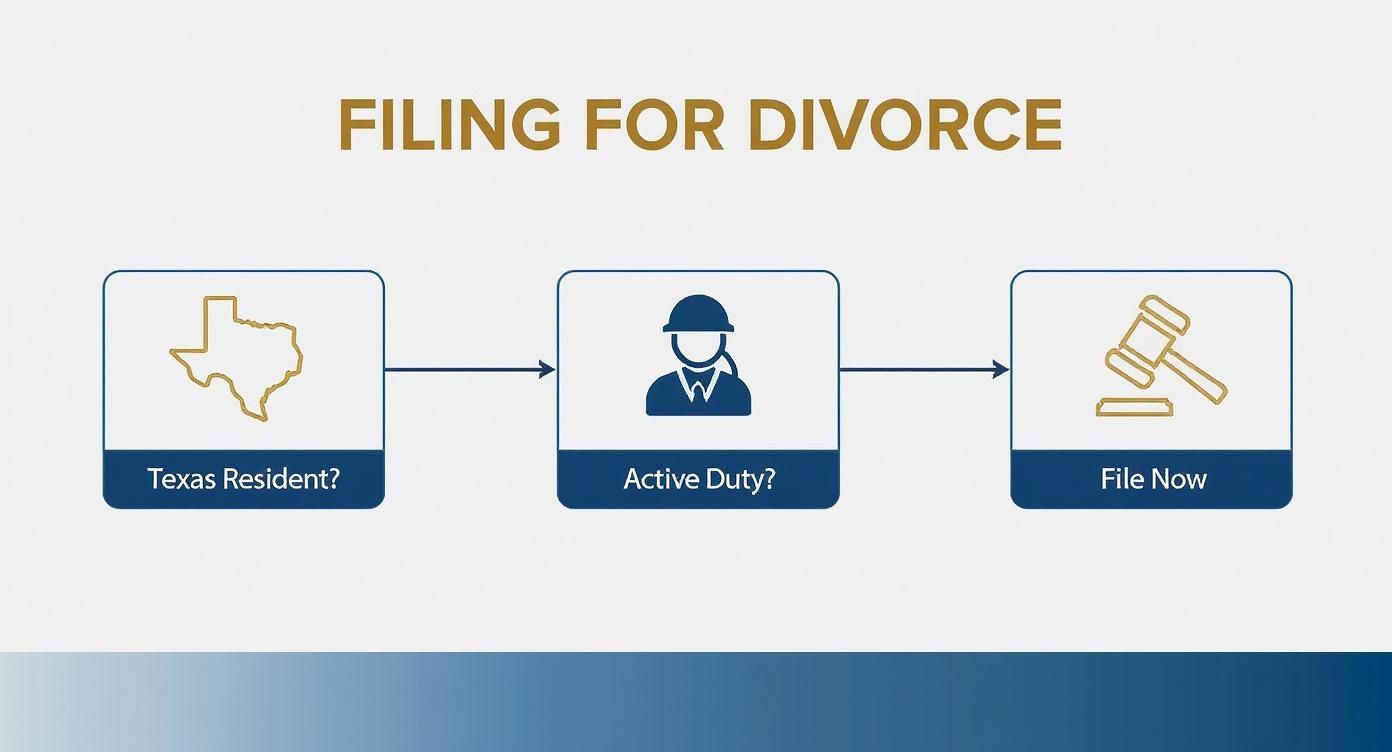
As the infographic illustrates, meeting Texas residency requirements is the first step before any assets, including retirement, can be addressed by the court.
The Misunderstood "10/10 Rule"
There is a great deal of misinformation surrounding the "10/10 Rule." A common myth is that if a couple was not married for at least 10 years that overlapped with 10 years of military service, the former spouse is not entitled to any retirement pay. This is completely false.
The 10/10 Rule has nothing to do with a former spouse's eligibility for a share of the pension. It is purely a rule about the method of payment.
If the 10/10 rule is met, the Defense Finance and Accounting Service (DFAS) can pay the former spouse's share directly. This is an administrative convenience. If the rule is not met, the former spouse is still entitled to their court-ordered share; however, the retired service member must pay them directly. A skilled lawyer will include strong enforcement language in the divorce decree to ensure these payments are made on time.
To clarify, let's review a few scenarios. The table below shows how the 10/10 rule works in practice, focusing only on how the money is paid, not if it is paid.
USFSPA 10/10 Rule Scenarios in Texas Divorce
| Scenario | Marriage & Service Overlap | Does The 10/10 Rule Apply? | How Retirement Pay Is Paid to Former Spouse |
|---|---|---|---|
| The "Classic" Case | Married for 12 years, all of which overlapped with the service member's 20 years of service. | Yes. (12 years > 10 years overlap) | The former spouse can receive direct payments from DFAS. |
| The "Close Call" | Married for 9 years and 6 months, all overlapping with active duty service. | No. (Overlap is less than 10 years) | The retired service member must make payments directly to the former spouse. |
| The "Partial Overlap" | Married for 15 years, but only 8 years of the marriage overlapped with military service. | No. (Service overlap is less than 10 years) | The retired service member is responsible for paying the former spouse's share directly. |
| The "Long Marriage, Short Service" | Married for 25 years, but the service member only served for 9 years during the marriage. | No. (Service time is less than 10 years) | The retired service member pays the former spouse directly. |
As you can see, failing to meet the 10/10 rule does not eliminate a former spouse's right to a share of the retirement; it only changes the payment logistics.
The USFSPA is the federal law that allows Texas courts to divide this critical asset. You can learn more about how the USFSPA impacts Texas divorces for a deeper understanding. Protecting your share of this asset, whether you are the service member or the spouse, requires a firm grasp of both state and federal law. An attorney specializing in these cases is your best advocate to ensure all court orders are handled correctly.
If you need help navigating divorce, custody, or estate planning in Texas, contact The Law Office of Bryan Fagan today for a free consultation.
Creating a Stable Child Custody Plan for Military Families

For military parents, one of the greatest concerns during a divorce is how to provide their children with a stable, loving environment when their own lives are often unpredictable. The guiding principle in every Texas custody case is the "best interest of the child" standard. For military families, achieving this standard requires a unique and forward-thinking approach to planning.
It is not only possible but essential to create a parenting plan that can withstand deployments, relocations, and long-distance communication. The goal is to build a detailed possession order (the legal term for a custody schedule) that provides consistency for your children and protects your rights as a parent.
Building a Military-Specific Possession Order
A standard Texas possession order is often inadequate for a military family. A knowledgeable military divorce lawyer in Texas will help you customize your agreement with provisions that address the "what-ifs" of military life before they arise. This proactive planning helps prevent future conflicts and ensures both parents remain deeply involved in their children's lives.
Your plan should be highly detailed. Here are a few essential components:
- Deployment Provisions: Clearly outline what happens when the military parent deploys. This should specify where the children will live and, just as importantly, guarantee make-up parenting time upon their return.
- Relocation Clauses: You must plan for potential Permanent Change of Station (PCS) moves. The order can establish specific notice requirements and detail how the possession schedule will be modified if a parent moves.
- Communication Protocols: Define how the deployed parent will stay in touch. This includes scheduled video calls, emails, and phone calls to ensure they remain a constant, reassuring presence in their children's lives.
A well-drafted military possession order serves as the ultimate co-parenting rulebook. It anticipates major challenges like deployments and relocations, providing clear solutions before they become emotional battles. This protects your child’s stability and the service member’s parental rights.
How Texas Calculates Child Support for Service Members
Child support is another critical piece of the puzzle. In Texas, support is calculated based on a parent's "net resources," a term that includes more than just base pay. For service members, this calculation requires careful attention to detail.
Under the Texas Family Code § 154.062, the court considers a wide range of income sources. For military personnel, this typically includes:
- Base Pay: The foundation of military salary.
- Basic Allowance for Housing (BAH): This non-taxable allowance is counted as income for child support purposes.
- Basic Allowance for Subsistence (BAS): The non-taxable food allowance is also included.
- Specialty Pays and Bonuses: Any additional pay from special duties or reenlistment bonuses is generally part of the calculation.
It is vital to document all sources of income to ensure the child support calculation is fair and compliant with Texas law. Overlooking allowances like BAH and BAS can result in an incorrect support amount, either disadvantaging the child or placing an unfair burden on a parent.
Planning for Every Contingency
When creating custody arrangements, don't overlook small but important details. For instance, obtaining a passport for a minor may require specific forms like the DS-3053 requiring online notarization, which is particularly relevant for military families who may live or travel internationally.
A comprehensive parenting plan will address these logistics, either by granting one parent the authority to handle them or by establishing a clear process for joint consent. Thinking through these real-world details creates a plan that truly works, helping you avoid future legal disputes and allowing you to focus on what matters most: raising happy, secure children.
Understanding the Unique Challenges in Military Divorce
While every divorce is personal, the process for military families involves a unique set of complexities that a standard legal approach cannot address. Factors like rank, gender, and branch of service can create specific pressures that influence both the emotional journey and the legal strategy.
Acknowledging these military-specific dynamics is the first step toward a fair and equitable resolution. A skilled military divorce lawyer in Texas understands this. They look beyond the legal documents to see the person navigating a difficult transition within a unique culture.
How Demographics Shape Divorce Realities
Statistics can tell an important story about the realities of military divorce. They reveal the distinct stressors that different groups of service members face, from the financial challenges of junior enlisted families to the unique pressures on women in the armed forces.
Data shows that divorce rates vary across the military. Female service members, for example, tend to have higher divorce rates, sometimes reaching 6-7%, compared to their male counterparts, whose rates are closer to the military average of about 3%. Rank also plays a significant role. Enlisted personnel experience divorce more frequently (around 3.5%) than officers (roughly 1.7%). You can explore more on these military divorce rate statistics to see a more detailed breakdown.
This data provides context for your situation. A lawyer who understands these trends can better anticipate the specific challenges you may face, whether they relate to finances or child custody negotiations.
Your circumstances are unique, and your legal strategy must be as well. Acknowledging the specific pressures tied to your rank, gender, or service branch allows your attorney to build a case that is tailored to your life, not just the general rules of divorce.
Translating Insight into a Stronger Legal Strategy
This understanding allows your attorney to offer more than just standard legal advice. They can provide empathetic and targeted representation that speaks directly to your reality.
Here’s how that insight translates into practical legal support:
- For Junior Enlisted Families: An attorney who understands the financial strain on many junior enlisted families can prioritize cost-effective solutions and fight to protect crucial benefits and ensure a fair division of limited resources.
- For Female Service Members: Recognizing the unique career and personal pressures women in the military face, a lawyer can advocate more effectively for fair spousal support and custody arrangements, ensuring their contributions and sacrifices are not overlooked.
- For Officer Divorces: Cases involving officers often include more complex financial portfolios, such as investments and substantial retirement accounts. An attorney familiar with these scenarios will have the financial acumen to navigate high-asset property division with precision.
Ultimately, this deeper level of understanding ensures you feel seen and heard. Your story, with all its military-specific details, becomes the blueprint for a legal plan designed to secure a fair outcome and protect your future.
If you need help navigating divorce, custody, or estate planning in Texas, contact The Law Office of Bryan Fagan today for a free consultation.
Why You Need a Specialized Military Divorce Lawyer
Navigating a military divorce without a specialized lawyer can be incredibly risky. These cases exist at a complex intersection of Texas family law and federal military regulations, where a single mistake can have long-lasting financial and personal consequences.
This is why finding the right legal advocate is so important. You need a guide who not only speaks the language of the law but also understands the unique culture and demands of military life. This real-world knowledge is what transforms a generic legal process into a strategy specifically designed to protect your future.
The Critical Difference of Specialized Counsel
While any family lawyer knows Texas divorce law, a specialized military divorce lawyer in Texas brings an essential layer of expertise. They are fluent in the military regulations that are often unfamiliar to civilian attorneys—from the SCRA and USFSPA to the procedural requirements of DFAS.
This is not just academic knowledge; it is critical to the success of your case. An experienced military divorce attorney knows the right questions to ask and how to anticipate potential issues. For example, they will know exactly how to draft a court order to divide a military pension so that the Defense Finance and Accounting Service (DFAS) will accept it without delays.
The true value of a specialist is their foresight. They can identify the unique challenges of a military case—such as jurisdictional disputes or the need for a deployment-proof custody plan—and address them proactively. This approach can save you from costly and emotionally draining legal battles down the road.
What to Look for in Your Attorney
Choosing your lawyer is the most important decision you will make in this process. This person is more than a representative; they are your guide and staunchest ally. As you consider potential attorneys, ensure they have clear, hands-on experience in these key areas.
Here is what your military divorce lawyer must bring to the table:
- Deep Familiarity with the USFSPA: They should have extensive experience applying the Uniformed Services Former Spouses' Protection Act to fairly divide military retirement pay and Survivor Benefit Plan (SBP) annuities.
- Expertise in SCRA Protections: Your attorney must know the Servicemembers Civil Relief Act inside and out—how to use it to protect an active-duty member’s rights, or if you're the civilian spouse, how to proceed when a stay is requested.
- Experience Drafting Military Possession Orders: They must be skilled at creating detailed, custom child custody plans that address the realities of military life, including deployments, PCS moves, and long-distance communication protocols.
- Proficiency with DFAS Procedures: Your lawyer needs a practical, working knowledge of how to properly submit court orders to DFAS for the direct payment of retirement benefits and child support, ensuring they are not rejected.
A lawyer with this specific skillset doesn't just represent you—they empower you. They ensure you understand your rights, protect your financial stability, and help you build a solid foundation for a secure future for you and your children.
If you need help navigating divorce, custody, or estate planning in Texas, contact The Law Office of Bryan Fagan today for a free consultation.
Your Top Questions About Military Divorce, Answered
A military divorce brings a unique set of challenges and questions. It involves not only Texas law but also a complex web of federal rules and military benefits. Getting clear, straightforward answers is the first step toward taking control of your future. We have compiled some of the most common questions we hear from clients to provide you with the clarity you need.
Can I Keep My TRICARE Health Benefits After Divorce?
This is a significant concern for many former spouses. Your eligibility for continued TRICARE coverage is determined by the "20/20/20 Rule."
To qualify, you must meet all three of these criteria:
- The marriage lasted for at least 20 years.
- The service member served for at least 20 years in the military.
- There was at least a 20-year overlap between the marriage and the military service.
If you meet all three conditions, you can retain your TRICARE benefits as if you were still married. A "20/20/15 Rule" may also provide one year of transitional coverage. If you do not qualify, you can purchase temporary coverage through the Continued Health Care Benefit Program (CHCBP).
What Happens to the SGLI Policy After We Divorce?
A common and costly mistake is assuming that a divorce decree automatically removes an ex-spouse from a Servicemembers' Group Life Insurance (SGLI) policy. It does not.
The service member must take direct action by logging into the SGLI Online Enrollment System (SOES) and formally designating a new beneficiary.
Until the service member manually changes the beneficiary designation, the ex-spouse named on the policy remains legally entitled to the benefits. It is critical to include this as a required action in your divorce settlement to prevent future disputes and ensure everyone's intentions are clear.
Can I File for Divorce While My Spouse Is Deployed?
Yes, you can file for divorce in Texas while your spouse is on deployment, provided you meet the state's residency requirements. However, the Servicemembers Civil Relief Act (SCRA) provides important protections for active-duty personnel.
Under the SCRA, your deployed spouse has the right to request a "stay," which is a legal term for pausing the divorce proceedings. A judge will almost always grant an initial stay of at least 90 days. This is not a means to avoid the divorce but a measure to ensure fairness, allowing the service member time to respond to the lawsuit and participate in their own defense without being disadvantaged by their military duties.
If you need help navigating divorce, custody, or estate planning in Texas, contact The Law Office of Bryan Fagan, PLLC today for a free consultation.