
It often starts quietly. One evening, after the kids are asleep and the house is still, you find yourself sitting across the kitchen table from your spouse, both of you knowing the marriage has changed in ways that cannot be ignored. There is no shouting. No dramatic moment. Just a shared realization that life is about to shift. And almost immediately, one practical question rises to the surface: How Long Does a Divorce Take in Texas?
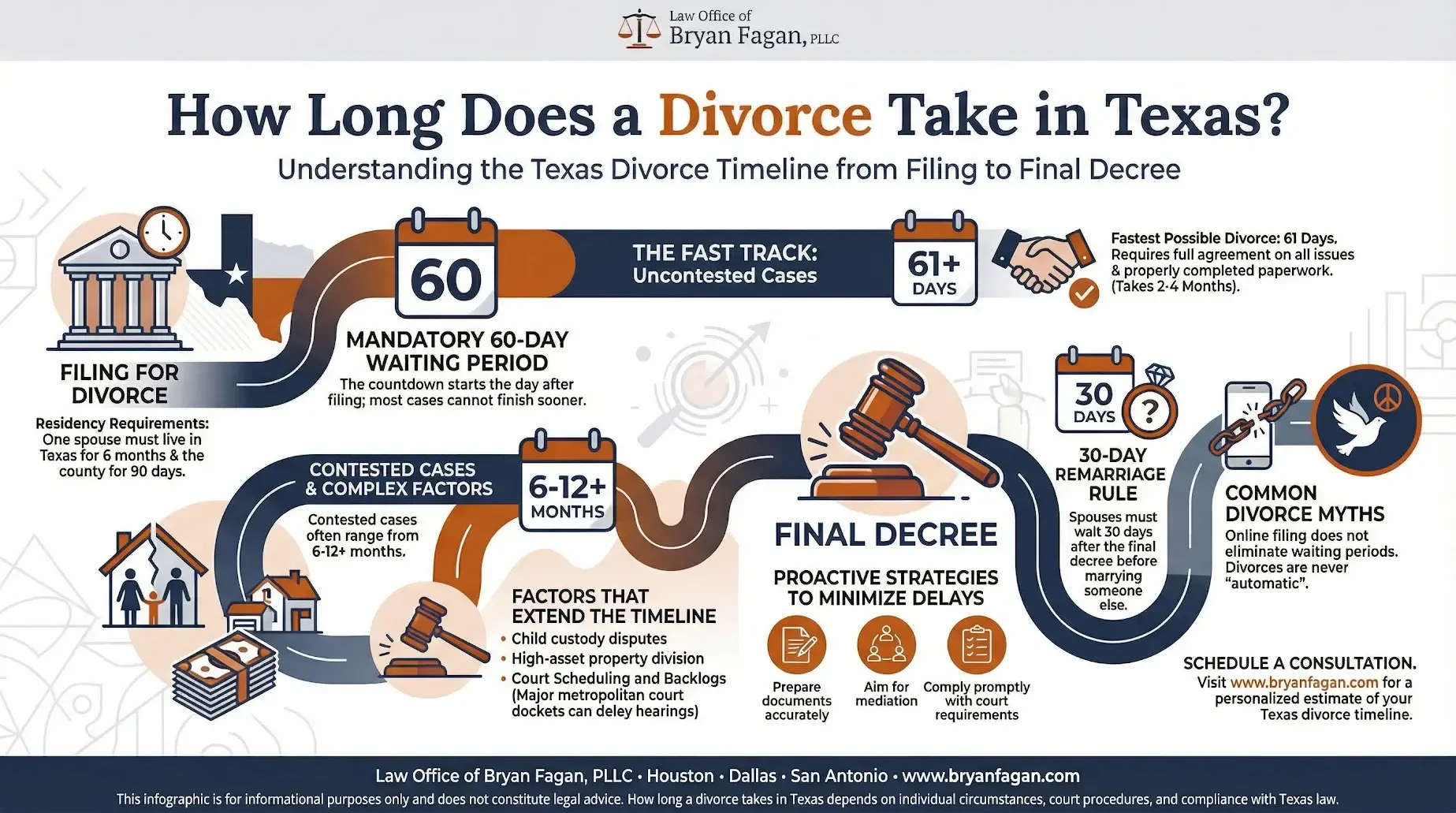
Under Texas Family Code §6.702, there is a mandatory 60-day waiting period before any divorce can be finalized. That is the legal minimum. In reality, most divorces take longer—often two to four months if uncontested, and six months to a year or more when custody or property disputes are involved. The timeline depends on residency requirements, service of process, whether temporary orders are needed, and how willing both parties are to negotiate.
At The Law Office of Bryan Fagan, PLLC, we understand that when clients ask about timing, they are not just asking about paperwork. They are asking when life will feel stable again. They want to know when they can make clear plans, when financial uncertainty will settle, and when the emotional strain of unresolved conflict will ease. Founded by Bryan Joseph Fagan, a South Texas College of Law graduate and recognized authority on Texas divorce and custody law, our firm has guided Texas families through these transitions for more than a decade. We have seen firsthand how clarity about the legal process restores peace of mind.
Texas courts approach divorce with structure and intention. Under Texas Family Code §153.002, when children are involved, the court’s guiding principle is always the best interest of the child. Under §153.134, custody and possession orders must clearly define parental rights and responsibilities. Judges consider stability, safety, and each parent’s role in daily life. These statutes are not just legal formalities—they are designed to protect families during moments of uncertainty.
Our mission is grounded in a simple “Why”: to empower people to reclaim freedom and peace of mind during life’s hardest transitions. We fulfill that mission by offering compassionate counsel, educating families about their rights, and creating innovative legal solutions that simplify what can otherwise feel overwhelming. Divorce is never easy, but it does not have to feel chaotic or directionless.
If you are facing divorce in Houston or anywhere in Texas, understanding the timeline is the first step toward regaining control. In the sections ahead, we will break down what affects how long a divorce takes in Texas, what procedural steps matter most, and how thoughtful legal guidance can help you move forward with confidence and stability.
Key Takeaways
- Texas requires a mandatory 60 day waiting period under Texas Family Code §6.702 before any divorce can be finalized—this timeline cannot be waived except in rare family violence cases.
- Uncontested divorces typically finalize in 2-4 months when spouses agree on all issues and paperwork is properly prepared.
- Contested divorces often take 6-12 months or longer, depending on disputes over child custody, property division, and court scheduling.
- Children add complexity and time because Texas courts prioritize the best interests of minor children in every decision.
- Working with experienced family law attorneys significantly reduces delays by preventing filing errors, managing deadlines, and facilitating efficient resolution.

Your Family’s Future Starts Here
Don’t navigate your legal journey alone. Schedule a consultation now and get the clarity and support you deserve.
How Long Does a Divorce Take in Texas? The Short Answer
Under Texas law, a divorce cannot be finalized in fewer than 60 days from the date the Original Petition for Divorce is filed, as required by Texas Family Code §6.702. This mandatory waiting period applies in nearly every case, with narrow exceptions involving certain findings of family violence. When families ask, How Long Does a Divorce Take in Texas, the 60-day rule is the starting point—but it is rarely the full answer. For a detailed explanation of how this statutory timeline works and when limited exceptions may apply, we encourage reviewing our breakdown of the mandatory Texas divorce waiting period.
While 60 days is the legal minimum, most cases extend beyond that window. Uncontested divorces often conclude within two to four months, provided both spouses reach agreement on property division under §7.001 and conservatorship matters guided by §153.002, which requires courts to prioritize the best interest of the child. Child support must be calculated under Chapter 154 of the Texas Family Code, including the updated maximum net resource cap outlined in §154.125(a-1). Even in cooperative cases, careful drafting of the Final Decree of Divorce and compliance with §153.134—governing parental rights and duties—require thoughtful preparation and court approval.
When disagreements arise over spousal maintenance under Chapter 8, business ownership, retirement accounts, or parenting schedules, the timeline may extend to six to twelve months or longer. Discovery, mediation, and temporary orders hearings exist to ensure fairness and enforceability, but they add procedural steps that lengthen the case. At our Houston-based family law practice, we help clients understand that these stages are protective safeguards built into the legal system, not unnecessary obstacles.
For a broader overview of what to expect from filing through final decree, readers may find our resource on understanding the full Texas divorce timeline helpful. The Law Office of Bryan Fagan, PLLC remains committed to educating families and protecting futures by combining up-to-date Texas Family Code guidance with compassionate, strategic representation. By setting realistic expectations and preparing thoroughly from the beginning, we help families move forward with clarity, confidence, and peace of mind.

The Mandatory 60-Day Waiting Period in Texas
Texas law requires a mandatory waiting period before any divorce can be finalized, and that requirement is set out in Texas Family Code §6.702. Under this statute, a court may not grant a final divorce decree until at least 60 days have passed from the date the Original Petition for Divorce is filed. When families ask, How Long Does a Divorce Take in Texas, the 60-day waiting period is the legal foundation of the answer. This statutory pause is designed to provide structure and allow spouses time to gather financial information, evaluate parenting arrangements, and begin resolving the issues that will shape their futures.
The 60-day clock begins the day after filing with the district clerk. Even when spouses agree on property division under §7.001, conservatorship decisions governed by §153.002, and child support calculated under Chapter 154—including the updated guideline cap under §154.125(a-1)—a judge generally cannot sign the final decree before day 61. Agreement alone does not override the statutory framework. Many common misconceptions about this timeline are addressed in our article on common divorce timeline misunderstandings in Texas.
As our Houston-based family law team regularly explains, the waiting period represents only the minimum threshold. After those 60 days pass, the case must still be finalized through properly prepared pleadings, compliance with conservatorship requirements under §153.134, and in many counties, a brief prove-up hearing. If disagreements remain over spousal maintenance under Chapter 8, custody schedules, or division of complex assets, the case may extend well beyond the statutory minimum. For a step-by-step overview of the process from filing through final decree, we invite readers to review our guide on understanding the full Texas divorce process.
At The Law Office of Bryan Fagan, PLLC, our mission is to educate families and protect futures. By combining up-to-date knowledge of the Texas Family Code with compassionate, practical guidance, we help clients move forward with clarity and confidence—turning legal uncertainty into informed decision-making during one of life’s most challenging transitions.

Limited Exceptions
The waiting period can only be waived in specific circumstances involving family violence. Under Texas Family Code §6.702, a court may waive the waiting period if the respondent has received deferred adjudication or a conviction for family violence against the petitioner or a member of the household, or if a protective order or temporary restraining order is in effect protecting the petitioner.
These exceptions are narrow. For most Texas families, the 60-day waiting period is an absolute floor that applies regardless of how cooperative both parties are.
Purpose of the Waiting Period
Texas lawmakers established this cooling-off period intentionally. The rationale recognizes that ending a marriage is one of the most significant decisions anyone makes. The time spent during these 60 days allows both spouses to:
- Reconsider whether divorce is truly the right path
- Work through temporary emotions that might cloud judgment
- Begin preparing financial documents and parenting plans
- Consult with family law attorneys and financial advisors
During this period, you can complete paperwork, reach agreements, and prepare for your divorce hearing. The waiting period runs concurrently with these preparations—you simply cannot appear before a judge for a final decision until day 61.
How Long an Uncontested Divorce Takes in Texas
An uncontested divorce in Texas typically finalizes in 2-4 months—just over the mandatory 60 day waiting period in ideal circumstances, or slightly longer when court scheduling and paperwork review add time.
An uncontested divorce occurs when both spouses agree on every major issue without requiring the court to make decisions for them. This includes agreement on:
- Division of community property and separate property
- Allocation of debts
- Child custody and conservatorship arrangements
- Possession schedules for minor children
- Child support calculations
- Spousal support or spousal maintenance terms
When spouses agree on all these matters, the divorce process moves efficiently. After the 60-day waiting period, you schedule a brief prove-up hearing where at least one spouse appears before a judge. The judge confirms that the agreement is fair, complete, and in the best interests of any children involved. This divorce hearing often takes only 10-15 minutes.
In ideal situations—organized financial documents, prompt filing, and available court dates—couples in Texas can receive their final divorce decree within 75-90 days. However, minor errors in paperwork, incomplete disclosures, or backed-up court dockets commonly push timelines to the 3-4 month range even for fully cooperative couples.
How Long a Contested Divorce Takes in Texas
When families ask, How Long Does a Divorce Take in Texas, the answer becomes more complex once a case turns contested. While some divorces resolve within a few months, a contested divorce in Texas typically lasts six to twelve months, and in cases involving business valuations, high net worth estates, or significant custody disputes, the timeline can extend to eighteen months or longer. The length of the process is not arbitrary—it reflects the legal safeguards built into the Texas Family Code to ensure fairness and protect children.
A divorce becomes contested when spouses cannot agree on one or more critical issues. Disagreements often arise over who will serve as the primary conservator of minor children under Texas Family Code §153.134, how possession and access schedules will be structured, and how child support will be calculated under Chapter 154, including the updated maximum net resource cap under §154.125(a-1). Other common disputes involve whether certain assets are community or separate property under §7.001, how retirement accounts should be divided, and whether spousal maintenance is appropriate under Chapter 8 of the Code.
Contested cases require additional procedural steps that extend the timeline but serve an important purpose. During the discovery phase, both parties exchange financial disclosures, documents, and written questions to ensure transparency regarding the marital estate. Temporary orders hearings are often held early in the case to establish interim arrangements for conservatorship, child support, and property use while the divorce is pending. These hearings are critical because they provide stability during the process, particularly when children are involved and courts must prioritize the best interest standard outlined in §153.002.
Most Texas district courts require mediation before a trial date is granted. Mediation provides an opportunity for spouses to resolve disputes with the assistance of a neutral third party, and a properly executed Mediated Settlement Agreement is binding under Texas law. In many cases, mediation resolves the majority of contested issues, avoiding the time and expense of trial. If mediation does not result in a full agreement, the case proceeds to trial, where scheduling constraints—especially in large metropolitan counties like Harris, Dallas, Tarrant, and Bexar—can add several additional months before a courtroom becomes available.
At our Houston-based family law practice, we believe that preparation and strategy matter. Even in contested cases, thoughtful planning can prevent unnecessary delay. Families looking for ways to streamline the process can explore our detailed guidance on practical strategies for shortening the divorce waiting period, which explains proactive steps that may help avoid prolonged litigation. For a broader understanding of how procedural stages affect timing, our resource on the Texas divorce timeline offers a comprehensive overview.
At The Law Office of Bryan Fagan, PLLC, our commitment is rooted in educating families and protecting futures. Contested divorces require patience, preparation, and a steady hand. By grounding each case in the current provisions of the Texas Family Code and combining that legal precision with compassionate client communication, our team helps families move forward with clarity, stability, and confidence—even when the road is longer than expected.

Factors That Speed Up a Texas Divorce
Several factors can help you finalize your Texas divorce more quickly:
Early Agreement on Key Issues: When spouses agree on property division, child custody, and support before filing, the divorce process moves at its fastest pace. Consider pre-filing discussions or collaborative approaches.
Prompt Service and Response: After filing the divorce petition, the other spouse must be served. If your spouse signs a waiver of service voluntarily, you eliminate the formal service process and associated delays.
Organized Financial Documents: Complete, accurate financial disclosures prevent the back-and-forth that often delays finalization. Gather tax returns, bank statements, retirement account statements, and property records early.
Successful Mediation: If your divorce involves disputes, approaching mediation with genuine willingness to negotiate often resolves issues in a single session, avoiding months of litigation.
Efficient Legal Representation: Experienced family law attorneys know how to prepare filings correctly the first time, meet all court deadlines, and navigate local procedures efficiently. This prevents rejected paperwork and missed opportunities.
Choosing Appropriate Courts: Filing in less congested courts, when legally appropriate, can reduce scheduling delays. Rural counties often have shorter wait times than major metropolitan districts.
Clear Communication: Maintaining respectful communication with your spouse—even through difficult emotions—helps both parties resolve issues faster than drawn-out conflict.
Factors That Delay a Texas Divorce
Understanding common delay factors helps you avoid unnecessary extensions:
Child Custody Disputes: Disagreements over conservatorship, possession schedules, or geographic restrictions trigger additional court hearings and often require evaluations. Courts take extra time to ensure decisions serve the best interests of children.
Complex Property Division: Cases involving business interests, multiple real estate holdings, stock options, or retirement accounts requiring qualified domestic relations orders take longer. Forensic accountants and appraisers may need to value assets.
Discovery Conflicts: When one spouse believes the other is hiding assets or providing incomplete financial documents, motions to compel discovery add months to the timeline.
Temporary Orders Hearings: Requests for temporary child support, exclusive possession of the family home, or temporary restraining orders create additional court dates before the final hearing.
Emotional Escalation: When anger or hurt drives decision-making, parties may refuse reasonable settlements, request multiple continuances, or engage in unnecessary litigation—all extending timelines dramatically.
Court Backlogs: Major metropolitan courts in Dallas, Houston, Fort Worth, and San Antonio experience significant backlogs. Hearing dates may be scheduled 4-8 months out during busy periods.
Missing or Inaccurate Paperwork: Incomplete filings get rejected by the clerk’s office, requiring refiling and restarting certain deadlines. Simple errors in listing assets or calculating support can delay finalization by weeks.
How Children Affect Divorce Timelines in Texas
When minor children are involved, the timeline of a divorce in Texas often becomes longer and more complex. Families frequently ask, How Long Does a Divorce Take in Texas, and the answer changes significantly when custody and parenting arrangements are at issue. Texas courts are legally required to prioritize the best interest of the child under Texas Family Code §153.002, and that guiding principle adds necessary layers of review and procedural safeguards before a case can be finalized.
Chapter 153 of the Texas Family Code requires detailed parenting plans that address conservatorship, possession schedules, geographic restrictions, and each parent’s rights and duties. Courts must clearly define these responsibilities under §153.134 when appointing joint managing conservators. Child support must be calculated under Chapter 154, including compliance with the updated maximum net resource cap set forth in §154.125(a-1). These statutory requirements ensure that children remain protected and financially supported, but they can extend the timeline of a divorce beyond the 60-day minimum waiting period mandated by §6.702. For additional perspective on how the statutory waiting period interacts with custody matters, our team offers deeper analysis in our discussion of expert insights on the divorce waiting period in Texas.
In contested custody cases, courts may require temporary orders hearings to establish interim conservatorship and support arrangements while the case proceeds. Discovery may be necessary to evaluate each parent’s circumstances, including employment schedules, housing stability, and involvement in the child’s daily life. Mediation is typically required before trial and often focuses heavily on parenting issues. In high-conflict matters, a guardian ad litem or attorney ad litem may be appointed to represent the child’s interests, and courts may order social studies or psychological evaluations when necessary to assess the child’s welfare. These measures are not designed to delay the process but to ensure that decisions reflect careful, child-centered consideration.
While uncontested divorces without children may finalize in as little as two to three months, cases involving agreed parenting plans often take three to four months due to the additional drafting and review required. When custody is contested, timelines commonly extend to nine to fifteen months or more because Texas courts will not rush determinations that shape a child’s stability, education, and emotional development. For a comprehensive overview of the procedural stages that influence timing, families can explore our guide on understanding the Texas divorce timeline.
At our Houston-based family law firm, we understand that longer timelines can feel overwhelming. However, these statutory protections exist to safeguard what matters most—your children’s well-being and long-term stability. By grounding every case in the most current provisions of the Texas Family Code while offering compassionate, practical guidance, The Law Office of Bryan Fagan, PLLC remains committed to educating families and protecting futures throughout Texas.

Can You Speed Up a Divorce in Texas?
You cannot eliminate the 60 day waiting period unless you qualify for the narrow family violence exceptions. No online divorce service, attorney, or amount of agreement between spouses can bypass this legal requirement.
However, you can take meaningful steps to minimize unnecessary delays:
- Prepare thoroughly before filing: Gather financial documents, consider what agreements you can reach, and consult with a divorce lawyer about your specific situation.
- Choose uncontested resolution when possible: Even if you start with disagreements, successful mediation converts a contested divorce into an uncontested one.
- Respond promptly to all deadlines: Missing court deadlines extends your case unnecessarily.
- Work with experienced counsel: Attorneys familiar with local procedures prevent avoidable errors.
One important caution: rushing the divorce process creates risks. Inadequate property division analysis, incomplete disclosures, or poorly drafted parenting plans can create problems that last years after the final decree. Taking appropriate time to address issues properly often saves significant time and attorney fees dealing with modifications or enforcement later.
What Happens After the Judge Signs the Final Decree
Once the judge signs your final divorce decree, your divorce is immediately final under Texas law. The marriage is legally terminated from that moment.
Remarriage: Texas law requires waiting 30 days after the final decree before either spouse may remarry, unless the court grants a waiver or the parties remarry each other.
Post-Decree Tasks: You may need to execute qualified domestic relations orders (QDROs) to divide retirement accounts, transfer real estate deeds, and update beneficiary designations. These steps typically occur within 60-90 days of finalization.
Enforcement: If your former spouse fails to comply with the court order regarding support payments or property transfer, enforcement mechanisms exist including wage garnishment and contempt proceedings.
Modifications: Child support and child custody arrangements can be modified if circumstances change substantially. Property division, however, is generally non-modifiable absent fraud.
Common Myths About How Long Divorce Takes in Texas
Myth: You can get divorced in Texas in a week. Reality: Texas Family Code §6.702 mandates a minimum 60 day waiting period. No divorce can finalize faster regardless of circumstances (except rare family violence exceptions).
Myth: Online divorce services eliminate waiting periods. Reality: Online services may simplify paperwork preparation, but they cannot waive legally required waiting periods. The 60-day minimum applies to all divorces.
Myth: Filing first automatically speeds up your divorce. Reality: Filing first determines venue and gives you initial procedural control, but it does not accelerate the legal timeline. The waiting period runs from filing regardless of who files.
Myth: A judge can waive the waiting period whenever they want. Reality: Judges have discretion in many areas, but the 60-day waiting period can only be waived under the specific family violence provisions in the Texas Family Code.
Myth: If we agree on everything, we can skip court entirely. Reality: Even fully agreed uncontested divorces require at least one spouse to appear for a brief prove-up hearing where the judge confirms the agreement.
How a Texas Divorce Attorney Helps Manage the Timeline
Working with experienced family law attorneys provides significant advantages in managing your divorce timeline:
Preventing Rejected Filings: Attorneys ensure your original petition and all subsequent documents meet local court requirements. Rejected paperwork creates weeks of delay.
Managing Deadlines: Missing response deadlines can result in default judgments or extended litigation. Attorneys track all deadlines and ensure timely compliance.
Strategic Mediation Preparation: Attorneys help clients approach the mediation process effectively, increasing settlement rates and avoiding trial delays.
Efficient Discovery: When financial information is needed, attorneys request relevant documents efficiently without unnecessary motions or disputes.
Court Relationships: Attorneys familiar with local courts understand scheduling patterns and can often secure earlier hearing dates.
Avoiding Unnecessary Hearings: Experienced counsel resolves many issues through negotiation rather than requiring court hearings for every dispute.
Why Choose The Law Office of Bryan Fagan, PLLC
For many families asking, How Long Does a Divorce Take in Texas, the answer depends not only on the law but on the strategy behind the case. Texas Family Code §6.702 establishes the mandatory 60-day waiting period before a court may finalize a divorce, and recent updates to the Code continue to reinforce structured procedures designed to protect families and ensure fairness. At The Law Office of Bryan Fagan, PLLC, we have guided hundreds of Texas families through this process with a focus on clarity, preparation, and long-term stability. For a detailed explanation of how the statutory waiting period applies in uncontested cases, we invite you to review our resource on understanding the 60-day waiting period in Texas divorces.
From your very first consultation, our Houston-based legal team works to provide a realistic and informed timeline based on your unique circumstances. Whether your divorce involves a straightforward property division under Texas Family Code §7.001 or more complex issues such as conservatorship determinations governed by §153.002 and §153.134, we ensure you understand what each stage requires. Child support must comply with Chapter 154, including the updated guideline cap under §154.125(a-1), and spousal maintenance claims fall under Chapter 8. These statutory frameworks shape the pace of every case, and careful compliance prevents unnecessary delay.
At our firm, efficiency does not mean rushing important decisions. It means strategic timeline management, thorough preparation that prevents rejected filings or missed deadlines, and proactive communication that keeps you informed at every stage. We recognize that divorce is both a legal and emotional transition, and we approach each case with compassion and professionalism. For families seeking a comprehensive overview of what to expect from start to finish, our guide on the Texas divorce process timeline offers practical insight.
As a trusted Texas family law practice, we remain committed to educating families and protecting futures. By grounding each case in the most current provisions of the Texas Family Code while providing steady, client-focused guidance, The Law Office of Bryan Fagan, PLLC helps clients move forward with clarity, confidence, and peace of mind—no matter where they reside in Texas.

Actionable Checklist: Managing Your Texas Divorce Timeline
- [ ] Confirm residency eligibility: Verify you or your spouse has lived in Texas for 6 months and your filing county for 90 days
- [ ] Determine contested vs. uncontested status: Assess which issues you and your spouse agree on and which require negotiation
- [ ] Gather financial documents early: Collect tax returns, bank statements, retirement account statements, property records, and debt documentation
- [ ] Respond promptly to all deadlines: Answer served papers within required timeframes (typically the Monday following 20 days after service)
- [ ] Consider mediation: Approach the mediation process with genuine willingness to resolve disputes
- [ ] Consult a Texas divorce attorney: Get professional guidance to avoid common pitfalls and delays
- [ ] Prepare for the long view: Understand that doing things correctly now prevents future complications
Conclusion
Divorce is rarely just about a legal deadline on a calendar. It is about regaining your footing, protecting your children, and creating a stable path forward. Understanding how long a divorce takes in Texas gives you something powerful during an uncertain time: perspective. When you know what to expect, the process feels less overwhelming and far more manageable.
The truth is, every family’s timeline is different. Some cases move quickly with cooperation and clear communication. Others require more time to resolve complex custody or financial issues. What matters most is not simply how fast you reach the finish line, but how thoughtfully you move through the process. The decisions made during these months can shape your financial stability, your co-parenting relationship, and your child’s sense of security for years to come.
If you are facing divorce, you do not have to navigate it alone. Working with an experienced Texas Family Law Attorney can help you avoid unnecessary delays, protect your rights, and design solutions that prioritize stability and peace of mind. At The Law Office of Bryan Fagan, PLLC, our goal is not just to move cases forward—it is to empower families with clarity, confidence, and a steady hand during one of life’s most difficult transitions.
If you are ready for answers tailored to your situation, consider scheduling a consultation with our team. Ask your questions. Share your concerns. Let’s talk through your timeline and your goals so you can move forward with confidence instead of uncertainty. After all, this chapter may be challenging—but with the right guidance, it can also be the beginning of a stronger, more secure future for you and your family.
Frequently Asked Questions
Even if both spouses agree on every issue, Texas law generally requires at least 60 days from the date the Original Petition for Divorce is filed before a judge can finalize the divorce. In many uncontested cases, the total timeline is closer to two to four months. That additional time allows for proper drafting of the Final Decree of Divorce, filing required documents, and scheduling a brief prove-up hearing. Cooperation and accurate paperwork can help keep the process on the shorter end of that range.
Avoid emotional decision-making that could harm your legal position. Do not hide assets, drain bank accounts, rack up new debt, or violate court standing orders. Avoid speaking negatively about your spouse in front of your children or on social media. Courts value stability, cooperation, and transparency. Acting strategically rather than reactively can protect both your case and your peace of mind.
The fastest path is usually an agreed, uncontested divorce where both spouses resolve property, custody, and support issues early. Signing a waiver of service when appropriate and submitting complete, accurate paperwork can prevent delays. While the mandatory waiting period still applies in most cases, preparation and cooperation allow you to use that time efficiently instead of extending the case.
One of the biggest mistakes is letting anger or fear drive decisions. Divorce is not just about the present moment—it shapes your financial future, co-parenting relationship, and long-term stability. Escalating conflict unnecessarily, refusing reasonable settlement offers, or ignoring professional advice can increase costs and prolong the process. A thoughtful, informed strategy often leads to better outcomes.
There is no single “average” cost because each divorce is different. Uncontested divorces are typically more affordable than contested cases involving custody disputes, complex property division, or trial. The level of cooperation between spouses, the complexity of assets, and whether expert witnesses are needed all influence cost. Speaking with an experienced Texas Family Law Attorney can provide a clearer estimate based on your specific circumstances.
The “6 month rule” refers to residency requirements. At least one spouse must have lived in Texas for six months before filing for divorce. Additionally, there is usually a 90-day county residency requirement. If either spouse recently moved or serves in the military, determining proper jurisdiction may affect when and where the divorce can be filed.
A practical approach to the “3 C’s” in divorce is communication, consistency, and clarity. Communication means respectful, focused exchanges—especially regarding children. Consistency means maintaining routines and honoring agreements. Clarity means ensuring all decisions are properly documented in enforceable court orders. Together, these principles reduce confusion and conflict.
Moving out without a plan can unintentionally affect custody arrangements, financial responsibilities, or access to the marital home. It may weaken your position regarding temporary possession or daily involvement with your children. While leaving may be necessary in certain situations—particularly for safety—it is wise to consult with a Texas family law attorney before making that decision.
In many cases, neither spouse is automatically required to leave the marital home unless a court issues a temporary order granting exclusive use to one party. Judges consider factors such as safety, children’s needs, and financial circumstances. Until a court order says otherwise, both spouses may have equal rights to remain in the home, making early legal guidance essential.