 Skip to content
Divorce can be one of life’s most difficult transitions—but understanding your rights and the legal road ahead under Texas law can make it less overwhelming. Taking this journey one step at a time can replace anxiety with a sense of control and empowerment.
Before a single legal document is filed with the court, there are foundational steps you must take. Think of this as laying the groundwork for your case. It’s not just about paperwork; it's about setting the stage for a smoother, more organized, and less stressful process.
Confirming You Can File in Texas
First, you must ensure a Texas court has the authority, or jurisdiction, to hear your case. This is a non-negotiable legal requirement under the Texas Family Code § 6.301. To file for divorce in Texas, at least one spouse must have:
- Lived in Texas for at least the last six months, and
- Lived in the specific county where you plan to file for the last 90 days.
For example, if you have lived in Harris County for the past five years, you meet the residency requirements. However, if you recently moved to Dallas County from Oklahoma four months ago, you would need to wait another two months to meet the six-month state residency requirement before you can legally file your petition.
Contested vs. Uncontested: Which Path Are You On?
One of the most important early considerations is determining whether your divorce will be contested or uncontested. This decision significantly impacts the timeline, cost, and emotional energy required to finalize your case.
An uncontested divorce occurs when you and your spouse agree on all major issues: how property will be divided, who is responsible for which debts, the child custody schedule, and support payments. If you have already worked through these details and reached a consensus, you are on the path to an uncontested divorce. This is almost always a faster, more affordable, and less adversarial process.
A contested divorce, on the other hand, means you disagree on at least one key issue. Perhaps you cannot agree on the value of a family business, the appropriate amount for child support, or who should have the exclusive right to determine the children's residence. These disagreements must be resolved through negotiation, mediation, or, as a last resort, by a judge’s decision at trial, which naturally makes the process longer and more complex.
This infographic breaks down these crucial pre-filing stages to help you see the big picture.
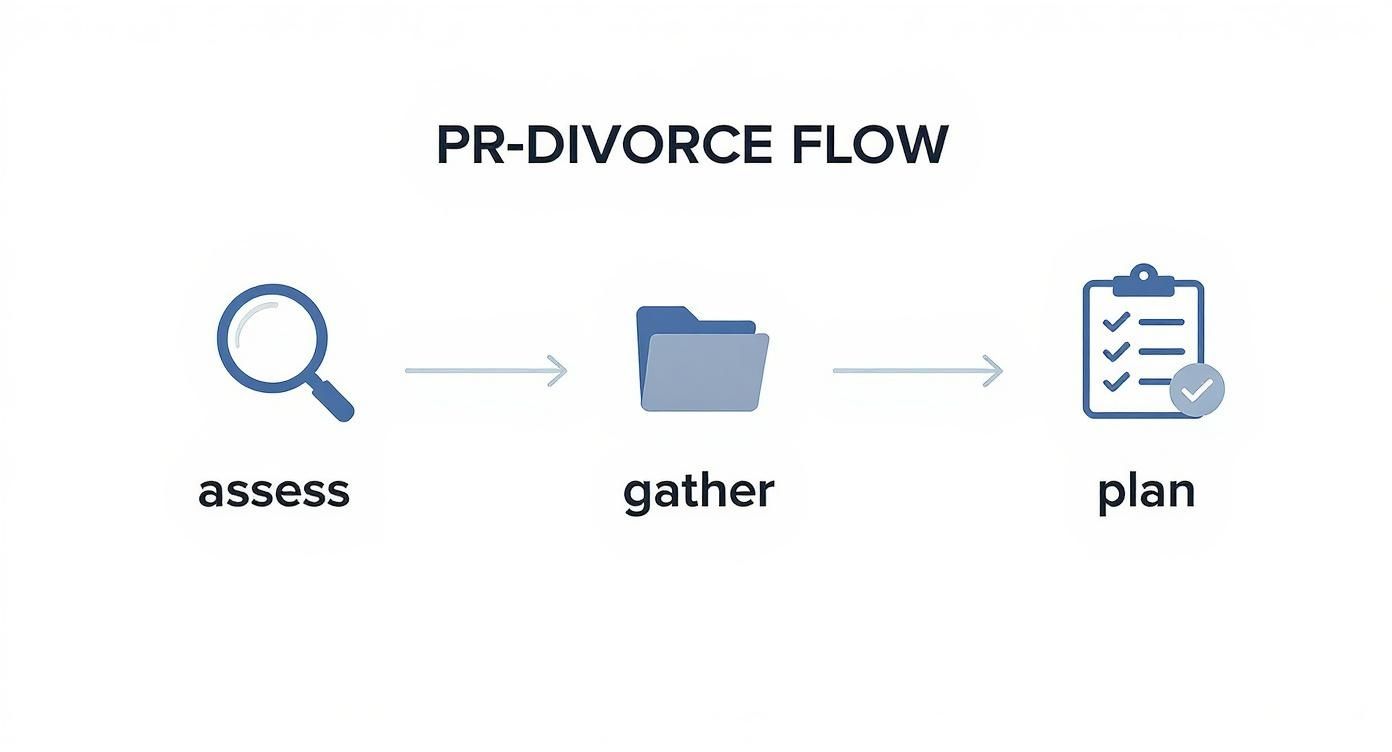
As you can see, figuring out where you stand, getting your documents in order, and planning your strategy are the building blocks for moving forward effectively.
Gather Your Financial Documents—All of Them
Whether your divorce is amicable or contentious, a complete and accurate financial picture is non-negotiable. Begin gathering these documents immediately to save yourself significant time and stress later.
A fair and just division of property is impossible without full financial disclosure. Taking the time to collect these records now is one of the most empowering actions you can take to protect your future.
Create a secure physical or digital file and start collecting the following items:
- Income Information: Recent pay stubs for both spouses, plus federal tax returns for the past three to five years.
- Property Records: Deeds to your home or other real estate, vehicle titles, and recent mortgage statements.
- Bank & Investment Statements: Checking, savings, 401(k), IRA, and any brokerage account statements from at least the past year.
- Debt Information: All credit card statements, car loan paperwork, student loan records, and details on any other outstanding debts.
Having this information organized provides the clarity needed for productive negotiations and is a fundamental step in the divorce process. This preparation allows you and your attorney to build a solid, fact-based strategy from day one.
Drafting and Filing the Divorce Petition

Once you've confirmed you meet Texas residency requirements and have your financial documents in order, it's time to take the first official legal step: preparing and filing the Original Petition for Divorce. This document formally initiates the divorce process and sets the foundation for your entire case. Getting it right from the start is absolutely crucial.
The petition outlines the essential facts for the court and your spouse. It identifies everyone involved, states whether there are children of the marriage, and describes the relief you are asking the court to grant. Think of it as the formal announcement that you are seeking to dissolve the marriage. Interestingly, national statistics show that women initiate about 66% of divorces, often being the ones to take this decisive first step.
Stating the Grounds for Divorce
Your petition must state the "grounds," or the legal reason, for the divorce. Texas law provides for both no-fault and fault-based grounds.
By far, the most common approach is filing on the grounds of insupportability. This is Texas's version of a "no-fault" divorce. As defined in Texas Family Code § 6.001, it simply means that due to conflict or discord, the marriage has broken down to a point where there is no reasonable expectation of reconciliation. In plain English, you and your spouse can no longer get along.
However, you can also file based on specific "fault" grounds, which may include:
- Adultery: Your spouse was unfaithful during the marriage.
- Cruelty: One spouse's behavior makes living together insupportable.
- Abandonment: Your spouse left with the intention of abandoning you and has been gone for at least one year.
- Felony Conviction: Your spouse was convicted of a felony and has been imprisoned for at least one year.
Choosing between no-fault and fault grounds is a strategic decision that can impact property division. An experienced family law attorney can explain the pros and cons to help you determine the best approach for your specific circumstances.
To help you prepare for this initial filing, here is a breakdown of the key sections in a Texas Original Petition for Divorce.
Key Sections of the Texas Original Petition for Divorce
A breakdown of the essential information required in the initial divorce filing document to help you prepare.
| Section Name | What It Means | Example Information Needed |
|---|---|---|
| Identification of Parties | Basic information about you (the Petitioner) and your spouse (the Respondent). | Full legal names, addresses, and sometimes the last three digits of your social security numbers. |
| Jurisdiction | The legal basis for the Texas court to hear your case. | Details confirming you or your spouse meet the state's 6-month residency and county's 90-day residency rules. |
| Dates of Marriage & Separation | Key dates that define the timeline of your marriage. | The date you were married and the approximate date you ceased living together as a married couple. |
| Grounds for Divorce | The legal reason you are seeking a divorce. | Stating "Insupportability" for a no-fault divorce or citing specific grounds like adultery or cruelty. |
| Information on Children | Details about any minor children born or adopted during the marriage. | Children's full names, birthdates, and current addresses. |
| Protective Orders | A request for orders to prevent harassment or threatening behavior. | A statement indicating whether a protective order is needed for the safety of you or your children. |
| Property & Debts | A general statement about community and separate property. | A statement asking the court to identify and divide all community property and confirm separate property. |
| Relief Requested (Prayer) | What you are formally asking the court to grant in the divorce. | Granting the divorce, dividing property, establishing custody orders, ordering child support, etc. |
This table covers the core components, but remember, every situation is unique. Your petition must reflect the specific details of your marriage and what you hope to achieve in the divorce.
Requesting Temporary Orders
While your divorce is pending, life goes on, and urgent issues cannot always wait for a final decree. This is where temporary orders become incredibly valuable. You can request these orders in your initial petition to establish ground rules for how things will work until the divorce is finalized.
Temporary orders are designed to bring stability to a chaotic time. They can address who gets to stay in the house, create a temporary custody schedule for the kids, and decide who pays which bills, preventing financial free-for-alls and fights over the children.
For example, if you have always been the primary caregiver, you could ask the court for temporary orders that give you the exclusive right to determine the children’s residence and to receive temporary child support. This practical guidance helps keep your children’s lives as consistent as possible during a period of major upheaval. For a deeper dive, you can learn more about the Original Petition for Divorce in our detailed guide.
Filing with the District Clerk
Once your petition is drafted and reviewed for accuracy, the next step is to file it with the district clerk's office in the county where you or your spouse reside. Upon filing, you will pay a filing fee, which varies by county. Your case will then be assigned a cause number and a specific court.
If the filing fee presents a financial hardship, you can submit a "Statement of Inability to Afford Payment of Court Costs." If a judge approves this statement, your court costs will be waived. This official filing formally opens your case and initiates the legal process.
Serving Papers and Awaiting a Response
Once you’ve filed the Original Petition for Divorce, the next step can feel daunting: formally notifying your spouse. This is not just a courtesy—it is a critical legal requirement known as service of process. The law mandates it to ensure your spouse receives official notice of the lawsuit and has a fair opportunity to respond. Proper service is essential for your case to move forward correctly.
How you handle this step can set the tone for the rest of your divorce. Knowing your options allows you to choose the path that makes the most sense for your family.
Methods of Serving Divorce Papers
In Texas, there are a few ways to legally serve divorce papers. The method you choose often depends on whether your divorce is cooperative or contentious.
- Personal Service: This is the standard method for contested cases or when a spouse is uncooperative. A neutral third party, such as a sheriff's deputy or a private process server, will personally deliver a copy of the filed petition and a formal citation to your spouse. This creates an official record that they have received the documents.
- Waiver of Service: If you and your spouse are on amicable terms, this is a much simpler and less confrontational option. Your spouse can sign a Waiver of Service, a document that is then filed with the court. By signing it, they acknowledge receipt of the petition and waive the need for formal, in-person service, which saves time, money, and stress.
As a practical example, if a couple has already agreed on major issues, the filing spouse's attorney can simply email the petition and waiver to the other spouse. They sign it, send it back, and the process continues smoothly. Conversely, if one spouse is avoiding communication, a process server may need to locate them at work to ensure the papers are legally delivered.
Receiving the Papers and the Deadline to Respond
The moment your spouse is served, a critical timeline begins. They have a specific amount of time to file a formal response with the court, known as an Answer. This document is their official reply, informing the court and you that they intend to participate in the case.
The deadline for filing an Answer is strict. Under the Texas Rules of Civil Procedure, the response must be filed by 10:00 a.m. on the first Monday after the expiration of 20 days from the date they were served.
Missing this deadline can have serious consequences. If your spouse fails to file an Answer in time, you may be able to proceed with a default judgment. This means the court could grant your divorce and approve the terms requested in your petition without your spouse's input.
This part of the process sets the stage for everything that follows. Handling it with care and precision is vital. To learn more about this crucial step, read our guide on serving your spouse with a petition for divorce.
Establishing Rules with Temporary Orders

A divorce is rarely resolved overnight. While the legal process unfolds, life continues—bills are due, children need their routines, and you and your spouse must find a way to coexist. This transitional phase can feel unstable and uncertain.
To address this, the Texas legal system provides a powerful tool: temporary orders. Think of temporary orders as a set of legally enforceable ground rules that govern your family’s life until the divorce is final, designed to bring stability and predictability to a turbulent time.
Creating Stability During the Divorce
Temporary orders can address a wide range of urgent issues, providing immediate clarity on day-to-day matters. A judge can establish rules for nearly any aspect of your life that requires immediate attention.
Common issues addressed in temporary orders include:
- Child Custody and Visitation: Creates a temporary possession schedule, giving your children consistency and predictable time with both parents.
- Child Support: A judge can order one parent to pay temporary child support to help cover the children's daily needs.
- Use of the Marital Home: The order can decide which spouse gets to live in the family home while the divorce is pending.
- Paying Bills: The order designates who is responsible for paying specific bills, like the mortgage, car payments, and utilities.
- Spousal Support: In some cases, a judge may order temporary spousal maintenance to support a financially dependent spouse.
For instance, in a family where one spouse was the primary breadwinner, we can request temporary orders to ensure the stay-at-home parent receives child support and has funds to pay the mortgage. This practical guidance helps keep the children in their familiar home and maintains normalcy. You can learn more about what to expect in a temporary orders hearing in Texas.
Uncovering the Facts Through Discovery
Once temporary orders are in place, the case moves into the discovery phase. This is the formal, court-supervised process where you and your spouse exchange information and evidence relevant to your case. The goal is to obtain a complete and honest financial picture from both sides so you can reach a fair settlement.
This is where both parties lay their financial cards on the table, using key legal tools to gather all necessary information.
Discovery is not about finding a "smoking gun." It is a systematic process for collecting the financial data needed to make informed decisions and ensure a "just and right" division of your community estate, as required by Texas law.
Common Tools Used in the Discovery Process
While "discovery" may sound intimidating, it is a structured way of requesting information. Your attorney will use specific tools to get the facts needed to protect your interests.
- Requests for Production: A formal, written request for the other party to provide copies of specific documents, such as bank statements, tax returns, credit card bills, property deeds, and retirement account statements.
- Interrogatories: Written questions that your spouse must answer in writing, under oath. For example, we might ask them to list all assets they claim as separate property or provide a detailed breakdown of their monthly expenses.
- Requests for Admission: Statements that your spouse must either admit or deny. This is an effective tool for confirming facts, such as the date of marriage or agreeing that a particular bank account is community property.
- Depositions: Out-of-court testimony given under oath. You, your spouse, and key witnesses may be questioned by the opposing attorney. A court reporter transcribes the testimony, creating a formal record for use in negotiations or court.
Finding Common Ground Through Mediation
The thought of a prolonged, contentious courtroom battle is a common fear for those facing divorce. The good news is that the overwhelming majority of divorces in Texas are settled outside of court. One of the most effective ways to achieve this is through mediation.
Mediation is a structured, confidential negotiation designed to help you and your spouse find common ground and craft solutions you can both live with. The focus is not on winning or losing, but on finding a practical path forward for your family.
How Does Mediation Actually Work in a Texas Divorce?
The process is straightforward. You, your spouse, and your respective attorneys meet with a neutral third-party mediator—often an experienced family law attorney or retired judge with specialized conflict resolution training.
The mediator's role is not to take sides or make decisions for you. Instead, they facilitate productive conversation, help you identify areas of agreement, and brainstorm creative solutions for contested issues.
A typical mediation session involves:
- Opening Remarks: Each side briefly presents their perspective on the unresolved issues.
- Private Meetings (Caucuses): The mediator separates you and your spouse into different rooms, shuttling back and forth to discuss offers and proposals confidentially.
- Guided Negotiation: The mediator uses their skills to help close the gap between offers and guide everyone toward a reasonable middle ground.
This process puts control back in your hands. Instead of a judge making permanent decisions about your life after only a few hours, you and your spouse can build an agreement that fits your unique situation.
Mediation empowers you to be the architect of your own post-divorce life. It can turn what feels like an adversarial fight into a collaborative effort focused on problem-solving, not blaming.
A Relatable Scenario of Mediation in Action
Imagine a couple, Sarah and Tom, disagree on how to divide Tom's 401(k), which has grown significantly during their 15-year marriage. Tom feels he should keep a larger portion since it is from his job, while Sarah believes she is entitled to half of the marital portion to ensure her financial security.
In court, a judge might simply order a standard 50/50 split of the community funds. While that may seem fair, it might not be the best practical solution for either of them.
In mediation, they can explore creative options. The mediator might discover that Sarah's primary concern is having cash for a down payment on a new home, while Tom is worried about the tax consequences of an early withdrawal. After discussion, they might agree that Sarah will receive a larger share of the equity from their home sale in exchange for a smaller portion of the 401(k). This win-win solution addresses both of their needs—an outcome a court order might never achieve.
The Goal: A Mediated Settlement Agreement
If you and your spouse resolve all issues, the mediator will draft a Mediated Settlement Agreement (MSA). This document details every aspect of your agreement, from property division to the parenting plan.
Once both parties sign the MSA, it becomes irrevocable and legally binding. This signed agreement serves as the blueprint for your Final Decree of Divorce. Choosing mediation not only saves time, money, and emotional stress but also results in a custom-built resolution that works for your family's future.
Finalizing Your Divorce with a Decree
After navigating the emotional and legal steps of ending a marriage, you have reached the final stage: creating the Final Decree of Divorce. This is more than just a piece of paper; it is the comprehensive, legally binding court order that officially dissolves your marriage and sets forth the rules for your post-divorce life.
Think of this document as the enforceable roadmap that you and your former spouse will follow for years to come. Ensuring every detail is correct is essential for protecting your future and preventing future conflicts. It meticulously outlines every agreement you've made, leaving no room for ambiguity.
The journey to divorce is a well-trodden path. In the United States, the divorce rate was about 2.3 per 1,000 people in 2020. Statistics show that roughly 45% of first marriages end in divorce, with that number climbing to 60% for second marriages and a staggering 73% for third marriages. The process is heavily regulated, requiring official filing, service of process, and mandatory waiting periods before anything becomes final. If you're interested in the data, you can read the full statistics about global divorce trends.
What Goes into a Final Decree of Divorce
A well-drafted decree is incredibly detailed, covering every aspect of your separation. It is the culmination of all your negotiations and agreements.
Here’s what a Final Decree of Divorce typically includes:
- Division of Assets and Debts: The decree lists every piece of community property—from the house and cars to bank accounts and retirement funds—and explicitly states who receives what. It also assigns responsibility for every debt, including mortgages, credit cards, and loans.
- Child Custody and Possession Orders: For parents, this is the heart of the decree. It details conservatorship (who has the right to make key decisions), lays out a specific possession and access schedule, and establishes the rights and duties of each parent.
- Child Support and Medical Support: This section states the exact amount of monthly child support to be paid, when it's due, and how it will be paid. It also clarifies which parent will provide health insurance for the children and how uninsured medical expenses will be divided.
As you work toward a resolution, it can be helpful to understand how different legal systems approach these matters. For instance, learning about specific legal provisions like Section 13B of the Hindu Marriage Act, which covers divorce by mutual consent, can offer a broader perspective on finalizing agreements.
The Final Step: The Prove-Up Hearing
Once the Final Decree of Divorce is drafted and signed by both you and your spouse, the last official step is a brief court appearance known as a "prove-up" hearing. This is not a trial; it is a short, formal procedure to make everything official.
Usually, only one spouse (the Petitioner) and their attorney need to attend. You will go before the judge, take the stand, and answer a few simple questions under oath.
The prove-up hearing gives the judge the testimony needed to legally grant your divorce. It’s the moment your agreement becomes an official, enforceable court order, offering a profound sense of closure.
A judge will likely ask questions to confirm basic facts and ensure the agreement is fair, such as:
- Confirming your name and that you meet Texas residency requirements.
- Stating that the marriage has become insupportable with no reasonable expectation of reconciliation.
- Verifying that the property division in the decree is a "just and right" division of the marital estate.
- Confirming that the orders for your children are in their best interest.
After you answer these questions, the judge will sign the decree, and at that moment, your divorce is legally final. This hearing, often lasting just a few minutes, marks the official end of one chapter and the beginning of the next, guided by the clear terms you established in your final decree.
Common Questions We Hear About the Divorce Process

As you begin to navigate the divorce process, it is normal to have many questions. Even with a clear plan, you will likely have specific concerns. At The Law Office of Bryan Fagan, our goal is to provide straightforward answers so you can feel more prepared and confident.
This section addresses some of the most frequent questions we receive from clients, offering clarity and empowering you with the knowledge you need.
How Long Does a Texas Divorce Take?
This is often the first question on everyone’s mind. In Texas, there’s a mandatory 60-day waiting period that begins the day after the Original Petition for Divorce is filed. No matter how simple your case is, a judge cannot finalize your divorce before this period ends.
For a completely uncontested divorce where you and your spouse agree on all issues, you may be able to finalize things shortly after the 60 days. However, for a contested divorce involving disagreements over property, business valuations, or child custody, the timeline can extend significantly, often taking from six months to a year or longer, depending on the complexity.
Do I Have to Go to Court to Get Divorced?
While the idea of a dramatic courtroom battle is a common fear, it is not the reality for most people. The vast majority of Texas divorces are settled outside of a formal trial, typically through negotiation or mediation.
However, you will almost certainly need to make at least one brief, formal court appearance for a "prove-up" hearing. This is a simple, non-confrontational step where the judge reviews your Final Decree of Divorce, asks a few basic questions to confirm the details, and signs the order to make your divorce official. It is usually over in just a few minutes.
What is the Difference Between Community and Separate Property?
Understanding how property is categorized is critical to the outcome of your divorce. In Texas, property is sorted into two distinct types:
- Community Property: This includes nearly everything acquired by either you or your spouse from the date of marriage until the date of divorce. According to the Texas Family Code, this property must be divided in a "just and right" manner.
- Separate Property: This is anything you owned before the marriage. It also includes assets you received during the marriage as a personal gift or inheritance.
The burden of proving that an asset is separate property rests on the person making the claim. The law presumes that all property is community property. If you cannot provide clear and convincing evidence to trace an asset back to a separate source, a judge will treat it as community property and divide it.
Getting this distinction right is fundamental to protecting your assets and achieving a fair settlement.
If you need help navigating divorce, custody, or estate planning in Texas, contact The Law Office of Bryan Fagan today for a free consultation.


