 Skip to content
Receiving a family court order that doesn’t feel right can be a devastating blow. Whether the decision involves your children, your property, or your financial future, a ruling that seems unjust can leave you feeling lost and powerless. The finality of the judge's signature on a piece of paper can feel overwhelming, but it's important to know that this may not be the end of the road. While your first instinct might be to fight back, the path forward requires shifting from an emotional reaction to a calm, strategic legal plan.
It's natural to be disheartened by an unfavorable ruling. However, it's crucial to understand that an appeal in Texas is not a second trial. It is not an opportunity to present new evidence or re-argue your case from the beginning. Instead, an appeal is a formal review process where a higher court examines the trial record to determine if a significant legal mistake occurred that changed the outcome of your case.
Is a Texas Family Court Appeal the Right Path for You?

Understanding how to appeal a family court decision begins with a frank assessment: an appeal isn't about whether you disagree with the outcome; it's about whether the law was applied incorrectly.
The appellate court judges were not present in the courtroom during your trial. They did not observe the witnesses or hear the testimony firsthand. For this reason, they give great deference to the trial judge, operating under the assumption that the judge was in the best position to make the right call. Your challenge in an appeal is to overcome this presumption by proving that a specific, reversible error was made.
Distinguishing Disagreement from Legal Error
This is the most critical step in the entire process. You must learn to separate the feeling that the judge made the "wrong" choice from the ability to identify a legitimate, reversible legal error. It's a subtle but vital distinction that forms the foundation of any successful appeal.
For example, you might feel the judge should have granted you primary custody because you genuinely believe you are the better parent. While that feeling is valid, it is not, by itself, grounds for an appeal.
To have a viable appeal, you must be able to point to a concrete mistake in the legal process or the judge's application of the law. In Texas family law, appealable errors typically fall into two main categories:
- Error of Law: This occurs when the judge misinterprets or misapplies the law. For instance, if a judge divides a retirement account that you owned before the marriage as community property, this is a clear misapplication of the Texas Family Code’s principles of separate and community property. The law is specific on this point.
- Abuse of Discretion: This is more subjective but equally important. It means the judge’s decision was so arbitrary or unreasonable that it defies logic. An example would be a judge who completely ignores credible, documented evidence of family violence when determining which parent should have the right to designate the child's primary residence. Such a decision isn't just a poor judgment call; it's a potential abuse of discretion.
An appeal is a review of the trial court’s actions, not a do-over of the trial itself. The focus is on how the decision was made, not just what the decision was.
Real-World Scenarios of Appealable Errors
Let's make these concepts more relatable. Imagine that during your divorce trial, you presented clear and convincing evidence—like bank statements and a will—proving that a large investment account was your separate property because you inherited it from your grandmother. If the judge, without a sound legal basis, classifies it as community property and divides it with your spouse, this isn't just an unfair outcome; it's a potential error of law that you can challenge on appeal.
Here is another scenario involving children. Suppose a judge severely restricts your visitation rights based on an uncorroborated allegation from your ex-spouse but then refuses to allow you to call witnesses or present evidence to disprove the claim. This could be a procedural error—a violation of your due process right to be heard—that provides a strong basis for an appeal.
Deciding to appeal is a significant step involving considerable time, expense, and uncertainty. The first step is often finding a qualified family lawyer with appellate experience who can meticulously review the trial record and provide an objective opinion on whether a reversible error truly exists. Sometimes, an appeal may not even be the most effective tool. In rare situations, other legal remedies might be more appropriate, such as those that might call for a Bill of Review in a Houston-area case.
Protecting Your Right to Appeal After the Ruling
The moment the judge signs the final order, an invisible clock starts ticking. In Texas family law, the actions you take—or fail to take—within the next 30 days can determine the future of your case. A misstep or delay can permanently close the door on your right to appeal, regardless of how significant the trial court's error was. This is not a time for hesitation; it is a time for immediate, strategic action.
Appealing a family court decision involves more than just filing a single document. It begins with laying the proper groundwork immediately after the trial concludes. Two specific legal motions are absolutely essential to preserve your options.
Filing a Motion for a New Trial
Your first instinct might be to immediately take your case to the court of appeals. However, the wisest first move is often to file a Motion for New Trial. This motion is submitted directly to the same judge who just ruled against you, respectfully asking them to reconsider and correct their own mistake.
It may sound counterintuitive to ask the person who made the error to fix it, but this strategy is effective more often than you might think. It gives the trial judge an opportunity to correct a mistake without the time, expense, and public scrutiny of a formal appeal. Judges are human; presented with a well-argued motion, they may recognize the error and amend the ruling.
For example, if the judge mischaracterized a critical piece of financial evidence, treating your separate property inheritance as community property, this motion places that specific error front and center, offering them a simple way to amend the property division. A successful motion could resolve the issue in weeks, rather than the year or more an appeal can take.
Filing this motion also provides a critical strategic advantage: it extends the deadline to file your official notice of appeal from 30 days to a more manageable 90 days, giving your legal team the vital time needed to prepare. You can learn more about how a Motion for a New Trial works in Texas courts.
Why You Must Request Findings of Fact and Conclusions of Law
Imagine a judge divides your community estate with a lopsided 60/40 split in your ex-spouse's favor but provides no explanation for why. You feel it's unfair, but how can you argue on appeal that the judge abused their discretion if you don't know their reasoning? This is precisely where a Request for Findings of Fact and Conclusions of Law becomes your most powerful tool.
This is a formal request that requires the judge to put their reasoning in writing. It compels them to spell out two things:
- Findings of Fact: The specific facts the judge determined to be true based on the evidence and testimony presented at trial.
- Conclusions of Law: The legal rules and principles the judge applied to those facts to reach the final decision.
Let's return to that 60/40 property division. With the judge’s written findings, you might discover they incorrectly classified your small business—started years before the marriage—as community property. That "Conclusion of Law," based on an incorrect "Finding of Fact," is a specific, reversible error you can attack on appeal. Without it, you are left guessing, and an appellate court will not overturn a decision based on speculation.
The Findings of Fact and Conclusions of Law create a roadmap of the judge's thought process. This document is often the most critical piece of evidence you will use to demonstrate a reversible error to the appellate court.
This request must be filed within a strict deadline—within 20 days of the date the judge signs the final judgment. Missing this deadline gives the other side a massive advantage, as the appellate court will be forced to presume that the trial judge had sufficient evidence to support their ruling, making your task infinitely more difficult. These post-trial motions are not mere legal formalities; they are the absolute foundation of a successful appeal.
Mastering the Unforgiving Timelines of a Texas Appeal
When you decide to appeal a Texas family court order, you enter a world governed by a rigid and unforgiving schedule. The appellate system operates on a series of strict, non-negotiable deadlines. Missing a deadline, even by a single day, can be fatal to your case. It doesn't matter how strong your arguments are; the door to appeal can slam shut permanently.
Think of it as a train schedule: if you miss your departure, the train leaves without you, and there isn't another one coming. Success in the appellate world requires mastering this timeline.
The entire process begins the moment the trial judge signs the final judgment or order. From that point, the clock is officially ticking on every action you take.
This timeline illustrates the critical first steps you will face immediately after the judge's ruling.
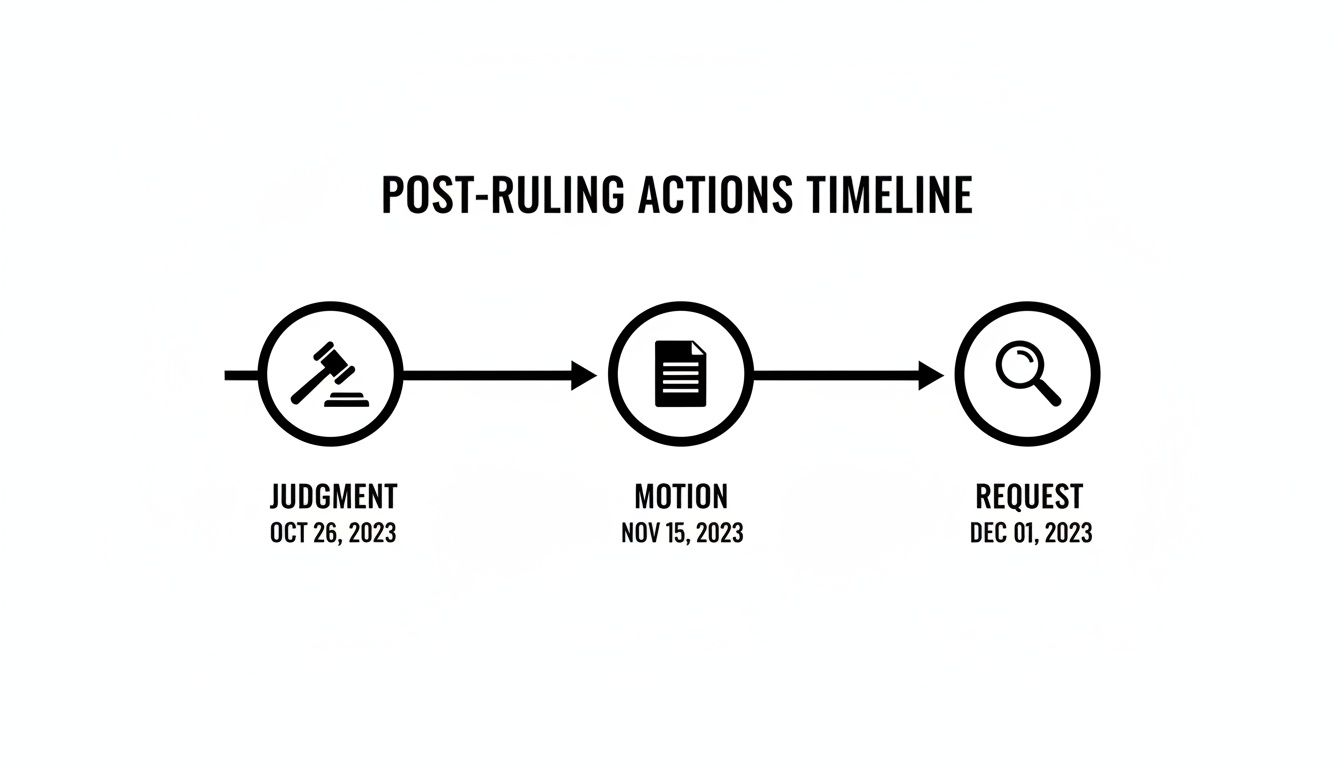
As you can see, filing a post-trial motion, like a Motion for New Trial, is a game-changer. It significantly extends the timeline for initiating your appeal, buying you and your legal team crucial extra time to get organized.
To help you keep these critical dates straight, here is a table summarizing the most important initial deadlines.
Key Deadlines for a Texas Family Court Appeal
| Action Item | Standard Deadline | Deadline if Post-Trial Motion Is Filed |
|---|---|---|
| File Notice of Appeal | 30 days from judgment date | 90 days from judgment date |
| File Clerk's Record | 60 days from judgment date | 120 days from judgment date |
| File Reporter's Record | 60 days from judgment date | 120 days from judgment date |
These deadlines are established by the Texas Rules of Appellate Procedure and are strictly enforced. Careful calendar management is non-negotiable from the moment the final judgment is signed.
Your First Move: Filing the Notice of Appeal
The first and most important deadline is for filing the Notice of Appeal. This is the formal document that informs the trial court and the opposing party of your intent to challenge the judge's decision.
Generally, you have just 30 days from the date the judgment is signed to file this document. It is a hard-and-fast rule.
However, as discussed, filing a timely Motion for New Trial extends this window to a much more manageable 90 days from the judgment date. From a strategic perspective, this extension is a lifesaver. It provides your legal team with the breathing room needed to begin gathering records, analyze the trial, and start building a powerful appellate strategy.
Don't forget the filing fee. Your Notice of Appeal must be accompanied by the court's required fee, and paying it on time is just as critical as filing the notice itself.
Building the Official Court Record for the Appeal
Once your appeal is officially in motion, the next step is to assemble the official record—the complete collection of evidence the appellate court will review. It’s important to remember that an appeal is not a new trial. The higher court is restricted to looking only at what happened in the original proceeding.
This official record comes in two distinct parts, and both have their own deadlines.
- The Clerk's Record: This is a compilation of every document filed in your case. Think of it as the paper trail: the original petition, all motions, discovery responses, exhibits, and the final judgment itself.
- The Reporter's Record: This is the official, word-for-word transcript of everything that was said in court during your hearings and trial. It includes all witness testimony, attorney arguments, and the judge's rulings from the bench.
You are responsible for formally requesting and paying for both records. Typically, the request for the Reporter's Record must be made on or before the day you file your Notice of Appeal. The court reporter will then give you a cost estimate, which you’ll need to pay promptly to get the transcription started.
Both the Clerk's and Reporter's records must be prepared and filed with the appellate court, usually within 60 days of the judgment being signed (or 120 days if you filed a post-trial motion).
The Clerk's Record and Reporter's Record are the entire universe of your appeal. If a piece of evidence, an objection, or an argument isn't contained in these records, the appellate court legally cannot consider it, no matter how important it is.
Hitting Pause on the Original Order with a Supersedeas Bond
While your appeal is moving forward, the original court order remains in full effect. This means you must continue to follow the judge’s rulings on custody, property division, and child support. The appeal itself doesn't automatically freeze the trial court's judgment.
However, you can ask the court to pause, or "supersede," the enforcement of certain parts of the judgment, particularly the financial components.
To do this, you typically need to post a supersedeas bond. This is essentially a financial guarantee, often set at the amount of the monetary judgment plus interest and costs. It assures the other party that if you lose the appeal, the funds will be there to satisfy the judgment.
For instance, if the final decree ordered you to make a large equalization payment to your ex-spouse for the division of property, a supersedeas bond would prevent them from seizing your assets or bank accounts to collect that payment while the appeal is active. Securing this bond is another complex procedural step with its own set of rules and deadlines that must be followed precisely.
Crafting Your Argument: The Appellate Brief

After you've navigated the race against the clock to meet early deadlines and have finally assembled the complete court records, you arrive at the heart of your appeal: the appellate brief. This is where the real legal battle takes place. It is the comprehensive, formal written argument presented to the appellate court, and it is your single best opportunity to persuade the judges that a serious, reversible error occurred at your trial.
It is critical to understand that the brief is not a do-over. You cannot introduce new evidence or attempt to re-argue your entire case. Instead, it is a laser-focused effort to demonstrate to the appellate judges exactly where the trial court went wrong, using only the testimony and evidence already contained in the Clerk's and Reporter's Records.
The Anatomy of a Persuasive Brief
A strong appellate brief is not just a long letter to the court; it follows a very specific structure designed to guide the judges through your argument in a logical, convincing manner. While the Texas Rules of Appellate Procedure dictate the exact requirements, every powerful brief is built on a few core components that tell the story of a legal mistake.
- Issues Presented: This section appears at the beginning and sets the stage for everything that follows. Here, you plainly and concisely state the legal questions you are asking the appellate court to answer.
- Statement of the Case: In this part, you provide a neutral, fact-based summary of what happened at trial. This includes the procedural history of the case and the key facts that are directly relevant to the errors you are claiming on appeal.
- Argument and Authorities: This is the main event. It is the section where you weave together the facts of your case with the law, citing legal precedent (case law) and statutes (like the Texas Family Code) to prove the trial judge made an error that warrants reversal.
Each component builds upon the last, creating a powerful narrative that aims to leave the appellate court with no other conclusion but to rule in your favor.
Bringing the Argument to Life: A Child Custody Example
Let's walk through a practical example. Imagine a parent is appealing a judge’s decision to modify custody, making the other parent the primary conservator. The appealing parent is convinced the judge completely ignored crucial evidence of the other parent’s instability.
An appellate attorney would begin by meticulously combing through the Reporter's Record—the word-for-word trial transcript—to identify the exact testimony supporting this claim. They might find testimony from a teacher describing the child's constant tardiness and visible anxiety on days they were with the other parent.
Then, the legal analysis begins. In the Argument section of the brief, the attorney connects that specific evidence to Texas law. They would cite Texas Family Code § 153.002, the statute requiring that all custody decisions be made in the "best interest of the child."
The argument would be laid out methodically:
- State the legal standard: "Under Texas Family Code § 153.002, the trial court's primary consideration in determining conservatorship must be the best interest of the child."
- Point directly to the evidence: "The record contains undisputed testimony from the child's teacher that the child showed significant signs of distress and neglect while in the other parent's care (Reporter's Record, Page 112, Lines 5-15)."
- Show the error: "By granting the modification despite this compelling evidence of instability, the trial court abused its discretion. Its decision was not supported by the facts on the record and was therefore not in the child's best interest."
This step-by-step approach—linking specific facts from the record directly to established legal principles—is the only way to effectively demonstrate an abuse of discretion or a clear error of law to an appellate court.
The appellate brief is not about emotion; it's about precision. Success depends on building a logical, evidence-based argument that leaves the appellate judges with a clear path to reversing the trial court's error.
What About Oral Argument?
In a small number of cases, the court of appeals may schedule an oral argument. This is a rare and valuable opportunity for your attorney to stand before the panel of appellate judges and answer their questions directly. It is not a time to rehash the entire brief but rather a chance to clarify the most complex points of your case and focus on the key issues the judges are grappling with.
The judges will have already read the briefs from both sides and will arrive with very specific questions. A strong oral argument can clarify a confusing point, emphasize the most critical part of your appeal, and sometimes provide the final push needed to win. It is a highly structured, formal debate that demands intense preparation and a deep understanding of both the case record and appellate law.
What Happens Next? Potential Outcomes and Legal Alternatives
After months of meticulous brief writing, navigating strict deadlines, and waiting, the appellate court finally issues its decision. This is the moment everything has been building towards. Understanding what the court can—and cannot—do is crucial for managing your expectations.
When you appeal a family court decision, you are essentially asking a higher court to review the trial judge’s work for significant legal errors. The outcome is not a simple "win" or "loss." Instead, the court of appeals issues a formal written opinion that will fall into one of three main categories.
The Three Primary Rulings in an Appeal
Each possible outcome lands very differently and will change the trajectory of your case. It is vital to understand what each one means for you and your family.
- Affirm: This is the most common result. When the court of appeals affirms the trial court's judgment, it means they reviewed the case and found no reversible error. The original order stands exactly as it was written, and the appeal is over.
- Reverse and Render: This is a complete victory. The appellate court not only agrees that the trial judge made a serious mistake but also issues a new, correct judgment themselves. This is rare and typically only happens when the legal issue is crystal clear and does not require any new fact-finding by the trial court.
- Reverse and Remand: This is a partial victory. The court finds that the trial judge did make a mistake but sends the case back down ("remands" it) to the same trial court for further proceedings. They will include specific instructions on how to correct the error, which could mean holding a new hearing or even an entirely new trial on that specific issue.
The reality is that winning an appeal is an uphill battle. The legal system is structured to give significant deference to trial court judges, who were in the best position to see the witnesses and weigh the evidence.
Consider the sheer volume of cases. With over 2,400 divorces filed daily in the U.S. and only about 90% of custody disputes settling out of court, the remaining 10% create a flood of potential appeals. This massive caseload makes it even tougher to get a trial court decision overturned. You can discover more insights about family law statistics on Clio.com to get a better sense of the numbers.
Thinking Outside the Box: Powerful Alternatives to a Standard Appeal
Given the time, expense, and low probability of success in a traditional appeal, it is wise to consider whether other legal avenues might achieve a better result. An appeal is not always the only—or even the best—tool available.
Sometimes, the error a trial judge makes is so immediate and damaging that you simply can't afford to wait for the lengthy appeal process to play out. In these extraordinary situations, you need a different kind of legal remedy.
One of the most potent alternatives is a Petition for Writ of Mandamus. This is not a standard appeal; it is an emergency measure. You are asking the appellate court to intervene and order a trial judge to perform a specific action that they are legally required to do but are refusing to do.
For example, imagine your custody case is over, but the judge refuses to sign the final order, leaving your family in legal limbo. You cannot appeal an order that does not yet exist. This is a perfect scenario for a writ of mandamus, which could compel the judge to act.
However, this is a very high legal bar to clear. You must prove three things:
- The trial judge had a clear, non-discretionary legal duty to perform an act.
- You requested that they perform the act, and they refused.
- You have no other adequate remedy, such as a normal appeal.
Beyond these extraordinary writs, sometimes the problem is a simple clerical mistake in the final judgment. In those cases, understanding when a Judgment Nunc Pro Tunc can be used could save you a mountain of time and money. Weighing the commitment of a full appeal against these other strategic options is a critical conversation to have with an experienced appellate attorney.
Common Questions About Texas Family Court Appeals
Stepping into the world of appeals can feel like learning a new language. After enduring a difficult trial, the last thing you want is more confusion. We understand. Let’s address the practical, real-world questions we hear most often from clients who are trying to decide if an appeal is the right next step.
Can I Use the Same Lawyer for My Appeal?
While you technically can use your trial lawyer, it is often not the best strategic move. Trial work and appellate work are two distinct legal specialties requiring different skill sets. A great trial lawyer excels at storytelling, presenting evidence, and thinking quickly in a dynamic courtroom environment.
An appellate lawyer, by contrast, operates in the world of legal research, meticulous record review, and persuasive writing. Their job is not to retell the story but to systematically comb through the trial record—every transcript, exhibit, and ruling—to identify the specific legal errors the trial judge made. They bring a fresh, objective perspective to the case, often spotting issues that the original attorney, who was in the heat of battle, might have missed. For a technical, high-stakes process like an appeal, having a dedicated specialist in your corner is a significant advantage.
Will the Original Order Stop During the Appeal?
No, and this is a critical point that many people misunderstand. A family court order is in full force and effect the moment the judge signs it, and it remains that way while your appeal is pending.
You must continue to comply with every part of the order, from child support payments to possession schedules. Failure to do so can result in an enforcement action against you, which is the last thing you want to face while also managing an appeal. To pause the financial parts of an order (like child support or a property award), your attorney must specifically request and have the court approve a supersedeas bond. This is not an automatic process.
An appeal does not grant you a "time out" from the trial court's judgment. Compliance is mandatory unless a specific stay is granted by the court, which usually requires posting a bond.
How Is an Appeal Different From a Modification?
This is another key distinction. An appeal and a modification are two entirely separate legal tools designed to solve completely different problems.
- An appeal looks backward. It argues that a legal mistake was made during the original trial, leading to a flawed outcome. You are challenging the past decision based only on the evidence and arguments already in the record.
- A modification looks forward. It argues that a material and substantial change in circumstances has occurred since the original order was signed, making the old order unworkable or no longer in the child's best interest. For example, losing your job and needing to lower your child support obligation is a reason to file a modification, not an appeal.
You cannot use an appeal to introduce new life events, and you cannot use a modification to get a do-over of the original trial. They are distinct legal paths for different situations. You can learn more about the specific grounds for modifying child support in Texas.
What Is the Realistic Chance of Winning an Appeal?
To be direct: winning a family law appeal is challenging. Appellate courts give a great deal of deference to the trial judge. The rationale is that the trial judge was the one who observed the witnesses, heard the testimony firsthand, and was in the best position to assess credibility. The statistics for reversal are not high, and the process itself can easily take a year or more to complete.
However, a "win" does not always mean the entire case is overturned. Sometimes, a successful appeal results in the case being sent back (remanded) for a new hearing on a single, specific issue. A good appellate attorney will not just sell you on the dream of winning; they will provide an honest, clear-eyed assessment of your case's strengths and weaknesses so you can make a truly informed decision about how to proceed.
If you need help navigating divorce, custody, or estate planning in Texas, contact The Law Office of Bryan Fagan, PLLC today for a free consultation at https://www.bryanfagan.com.


