
Have you ever had one of those quiet moments at home—maybe washing dishes after dinner or folding laundry—when you realize life has shifted in ways you never expected? Many Texas parents describe that moment as the one where they finally admitted, “Something has to change, but it doesn’t have to become a war.” For couples who want clarity without conflict, understanding the Steps for Uncontested Divorce in Texas becomes the doorway to a calmer, more intentional future.
At The Law Office of Bryan Fagan, PLLC, we’ve seen this moment unfold countless times. A couple sitting at their kitchen table, speaking softly so the kids won’t overhear. Two people who still respect each other, even if the marriage is ending. They’re not looking for courtroom battles or emotional damage. They’re looking for a process rooted in dignity. Led by Bryan Joseph Fagan, a South Texas College of Law graduate and trusted authority in Texas divorce and custody law, our firm has guided thousands of families through exactly this kind of transition—one built on cooperation rather than crisis.
Texas law supports this approach. Under Texas Family Code §153.002, courts prioritize the best interest of the child in every case, and when parents resolve issues amicably, it strengthens the stability and emotional well-being the law is designed to protect. But even uncontested divorces have specific rules, required forms, and procedural steps. Knowing them upfront prevents delays, misunderstandings, and unnecessary stress at a time when what families need most is clarity.
Our mission begins with why: empowering people to reclaim peace of mind during life’s hardest moments. We accomplish this how: through compassionate counsel, practical education, and innovative legal solutions that simplify the entire process. And we deliver this what: family law services that honor your values while protecting what matters most—your children, your property, and your future.
As you continue reading, you’ll discover how uncontested divorce really works in Texas, the steps you must follow, and how thoughtful planning can turn uncertainty into a path toward stability and confidence. No matter where you’re starting, you don’t have to walk this road alone. Let’s take the next step together.
Key Takeaways
Understanding the essentials before you begin can save you time, money, and frustration throughout your divorce case.
- Uncontested divorce defined: Both spouses must agree on all issues—community property division, debts, child custody, visitation schedules, child support, medical support, and any spousal support. Even one unresolved detail transforms your case into a contested divorce.
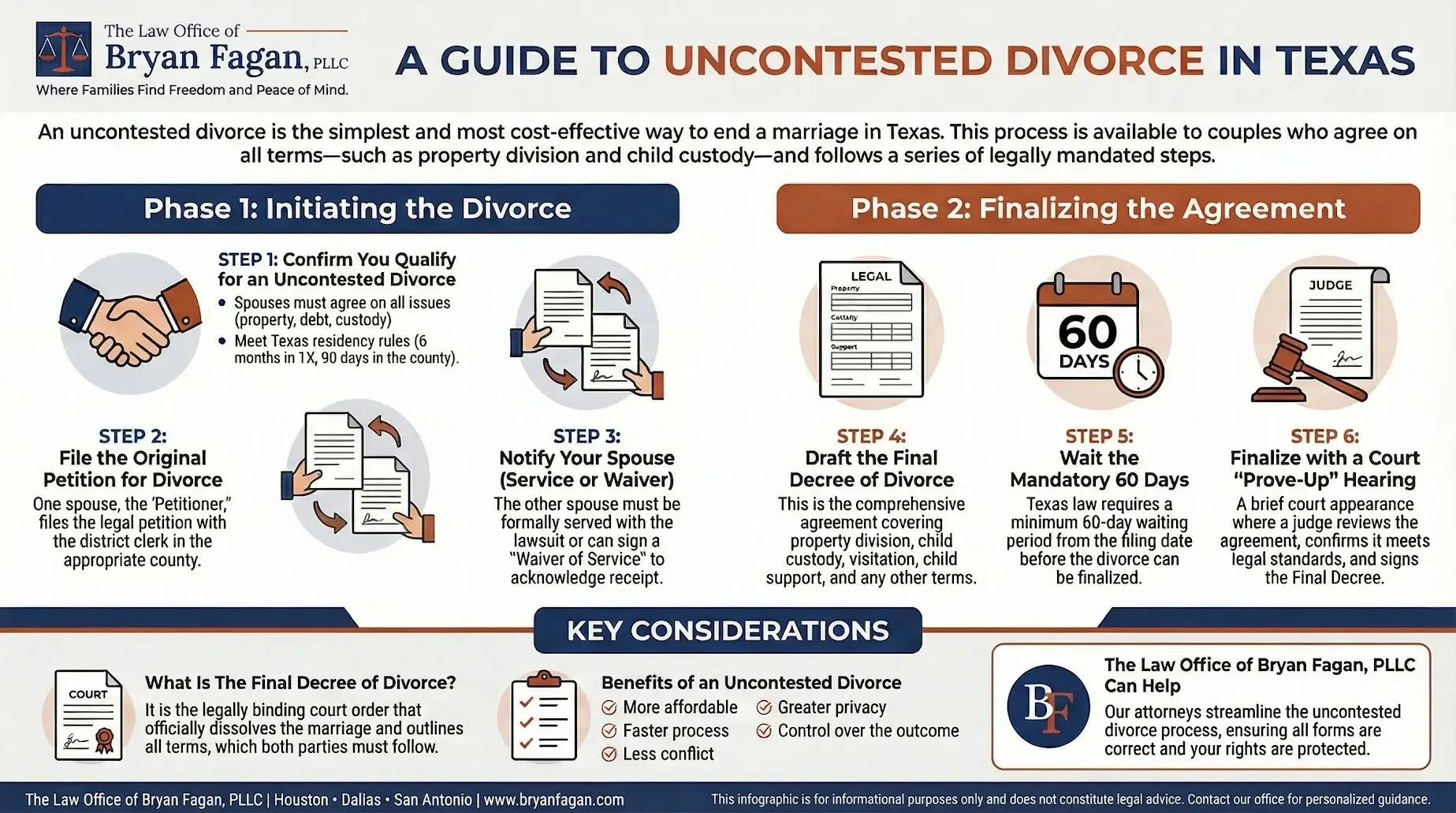
- The legal process at a glance: Complete your divorce forms, file the original petition, serve or waive notice to your spouse, finalize your settlement agreement, prepare the final decree, wait 60 days, and attend a brief court hearing.
- Eligibility requirements matter: At least one spouse must have lived in Texas for six months and in the filing county for 90 days. Both parties must agree on all divorce terms before proceeding.
- Cost savings are significant: Uncontested divorce cost typically ranges from $1,000 to $3,000 including modest attorney fees, compared to $15,000 or more for contested cases requiring discovery, motions, and trial.
- Attorney review prevents problems: Having an experienced divorce attorney review your divorce papers ensures compliance with Texas law and prevents costly modifications or enforcement actions down the road.

Your Family’s Future Starts Here
Don’t navigate your legal journey alone. Schedule a consultation now and get the clarity and support you deserve.
What Is an Uncontested Divorce in Texas?
An uncontested divorce in Texas offers a streamlined, lower-conflict path forward when both spouses can agree on every major issue without asking a judge to decide for them. When you understand the Steps for Uncontested Divorce in Texas, the process becomes far less intimidating and far more empowering. Under the Texas Family Code—including §§6.001, 6.702, and Chapters 153 and 154—courts require complete, voluntary agreements before granting an uncontested divorce. This means both spouses must finalize decisions on property, finances, parenting, and support before filing.
To qualify, spouses must resolve the division of community property and debts, such as homes, vehicles, retirement accounts, loans, and bank accounts. Parents must also comply with Texas Family Code Chapter 153 by agreeing on conservatorship, parenting schedules, holiday time, and decision-making rights. Child support arrangements must meet the guidelines outlined in Chapter 154, including provisions for medical and dental support. If spousal maintenance is part of the agreement, it must meet the latest statutory requirements for eligibility, duration, and amount.
Some couples mistake a default divorce—where one spouse never responds after receiving notice—for a true uncontested divorce. While both may move forward without litigation, a genuine uncontested divorce requires active participation and agreement from both parties. The distinction matters because mutual agreement gives families much greater control over outcomes and reduces the risk of future disputes.
It is equally important to understand what separates an uncontested divorce from a no-fault divorce. Most Texans file under “insupportability,” the no-fault ground established by Texas Family Code §6.001. But even with insupportability, the case becomes contested if the spouses cannot agree on property, custody, or support. When disagreements arise, the process shifts into hearings, discovery, mediation, or even trial—extending the timeline and increasing the financial and emotional cost.
Consider a Houston couple who calmly works through every required topic: she keeps the home, he keeps his 401(k), they follow a standard possession schedule, and child support meets guideline requirements. Because they have resolved all issues voluntarily and clearly, they can move forward with an uncontested divorce—saving significant time, money, and stress. This is where working with knowledgeable counsel makes a critical difference.
For guidance tailored to your situation, families often turn to experienced Houston divorce professionals such as the Uncontested Divorce Lawyers at The Law Office of Bryan Fagan, PLLC. The firm provides comprehensive support to ensure every agreement complies with Texas law and protects long-term stability. To continue learning about family law topics, you may also explore helpful resources like the firm’s article on Texas child custody.

Eligibility Requirements Before Starting the Process
Not every couple qualifies for an uncontested divorce. Before you begin gathering divorce forms and calculating your filing fee, you must confirm you meet Texas residency rules and have genuinely resolved all outstanding issues with your spouse.
Texas Residency and Venue Rules
Texas law imposes specific residency requirements before any court can grant your divorce. Under Texas Family Code §§ 6.301–6.302:
- State residency: At least one spouse must have been a domiciliary of Texas for the preceding six months
- County residency: At least one spouse must have resided in the county where you file for the preceding 90 days
These rules are jurisdictional—meaning the court literally cannot grant your divorce if you fail to meet them. Filing in the wrong county or before completing the residency period is one of the most common mistakes that derails otherwise simple divorce cases.
Example: Sarah moved to Houston four months ago after living in California. Even though she and her husband agree on everything, she cannot file for divorce in Texas yet because she has not met the six-month state requirement. She must wait two more months.
Example: Marcus is an active-duty military service member stationed in another state but maintains Texas as his legal domicile. Under Texas Family Code § 6.303, he may still qualify as a Texas resident for divorce purposes.
Filing at the wrong clerk’s office results in dismissal or transfer, adding weeks or months to your timeline. Always verify your residency status before paying any court fees.
Agreement on All Terms (What You Must Resolve First)
Pursuing an uncontested divorce requires complete consensus on every issue. If either you or your spouse disagree on even a single term, your case becomes contested by definition.
Before filing, you and your spouse must agree on:
- Grounds for divorce: Usually no-fault “insupportability” under Texas Family Code § 6.001
- Property division: How you will divide community property (assets acquired during marriage) versus separate property (pre-marital assets, inheritances, gifts)
- Debt allocation: Who takes responsibility for the mortgage, car loans, credit cards, and other obligations
- Conservatorship: Whether you will have joint managing conservatorship or sole managing conservatorship, and who has the right to designate the children’s primary residence
- Possession and access: A detailed parenting schedule including weekends, holidays, summers, and geographic restrictions
- Child support: Amounts calculated using Texas guideline percentages based on the paying parent’s net resources
- Medical and dental support: Who provides health insurance for the children and how you divide uncovered expenses
- Spousal maintenance or alimony: Whether one or both parties will pay support, and for how long
- Miscellaneous issues: Name changes, who claims children on taxes, and handling of retirement funds
Even a seemingly minor disagreement—like which parent claims a child as a dependent every other year—can prevent your divorce from proceeding as uncontested.
If you mostly agree but remain stuck on a few issues, consider mediation. A neutral mediator can help you reach agreement and convert what might become a contested case into an uncontested one.
When Uncontested Divorce May Not Be Appropriate
Certain situations make an uncontested divorce inappropriate or even unsafe, even when couples understand the Steps for Uncontested Divorce in Texas. Under the Texas Family Code—including §§6.001, 6.502, and Chapters 153 and 154—issues involving safety, coercion, or unfair bargaining require heightened legal protections. If family violence, intimidation, or pressure is present, the agreement cannot be considered truly voluntary. In these cases, Texas law provides tools such as protective orders and temporary injunctions, which are not available in a simple uncontested process.
Financial complexity is another major red flag. When one spouse controls business assets, retirement funds, or marital finances—or when hidden assets are suspected—the statutory protections in §§7.001–7.009 become essential. These provisions allow for discovery, sworn inventories, and transparency measures that help ensure a fair and lawful division of property. Attempting an uncontested divorce without these tools can leave one spouse vulnerable to long-term financial harm.
Concerns involving children also demand careful consideration. Texas Family Code Chapter 153 requires parenting arrangements that protect the child’s best interests, including safety, stability, and emotional wellbeing. If parents disagree about conservatorship, possession schedules, or what is necessary to keep a child safe, judicial review is not just helpful—it is necessary. In these cases, contested proceedings allow the court to evaluate evidence and impose orders that prioritize the child’s needs.
For families facing these circumstances, working with experienced counsel is critical. Texans often rely on trusted legal guidance such as the step-by-step guide from The Law Office of Bryan Fagan, PLLC to understand when an uncontested divorce may not be the safest approach. Those navigating parenting or safety concerns may also benefit from related resources like the firm’s article on Texas child custody. In these more complex situations, legal support ensures your rights are protected, your children are safeguarded, and your future remains secure.

Required Forms and Documents for an Uncontested Texas Divorce
Using the correct Texas-specific divorce forms is critical to avoiding rejection by the local court. Generic forms downloaded from national websites often lack required provisions or use language that does not comply with the Texas Family Code.
Core Divorce Forms Most Couples Need
The specific forms you need depend on your circumstances—particularly whether you have minor children. However, most uncontested divorce cases require:
| Form | Purpose |
|---|---|
| Original Petition for Divorce | Initiates your family law case; identifies parties, states grounds, and requests relief |
| Waiver of Service | Allows your spouse to acknowledge receipt of the divorce petition without formal service |
| Respondent’s Original Answer | Filed by your spouse if not using a waiver; may include a counter petition |
| Final Decree of Divorce | The master document containing all agreements; becomes the court’s enforceable order |
| Settlement Agreement | Written contract detailing all terms of property division and other agreements |
| Parenting Plan | Required when children involved; covers conservatorship, possession, and decision-making |
| Child Support Worksheet | Calculates support using Texas guideline percentages |
| Civil Case Information Sheet | Required in many counties; provides basic case data |
| Information on Suit Affecting Family Relationship (VS-165) | Reports divorce information to Texas Vital Statistics |
Some counties have additional forms or standing orders that must accompany your filing. Always check your local court website for county-specific requirements.
Financial and Supporting Documents to Gather
Having these documents ready speeds up negotiations and ensures accurate drafting of your divorce settlement agreement:
- Recent pay stubs, W-2s, and tax returns for both spouses
- Bank account, credit card, and loan statements
- Retirement account statements (401(k), IRA, pension documents)
- Vehicle titles and registration documents
- Mortgage documents, property deeds, and lease agreements
- Health insurance cards and policy information
- Existing court orders (prior custody orders, protective orders, child support orders)
- Business records if either spouse owns a company
Where to Find Reliable Texas Divorce Forms
When you begin learning the Steps for Uncontested Divorce in Texas, choosing the right forms is one of the most important decisions you will make. Every document—from your Original Petition to your Final Decree of Divorce—must comply with the requirements outlined in the Texas Family Code, including Chapters 6, 7, 153, and 154. These statutes govern everything from jurisdiction and property division to conservatorship provisions and child support obligations. If any form is missing required language, uses outdated terminology, or fails to address elements mandated by law, the court cannot finalize your divorce.
Many generic national form websites do not account for Texas-specific legal requirements. These templated documents often leave out mandatory provisions such as medical and dental support under Chapter 154, do not include the conservatorship and possession language required by Chapter 153, or use waiver language that does not meet the standards of §6.4035. Even small inconsistencies can lead to the clerk rejecting your paperwork or the judge requesting revisions—delaying the process and adding unnecessary stress to an already challenging time.
Because uncontested divorces rely heavily on accurate documentation, having an experienced Texas family law attorney review your forms is an invaluable step. The team at The Law Office of Bryan Fagan regularly helps clients refine and prepare their documents to ensure compliance with current legal standards. This review not only prevents avoidable delays but also helps protect your rights, your financial interests, and your ability to move forward with confidence.
If you want to better understand each stage of the divorce process, the firm offers a comprehensive guide: The Divorce Process Explained. Families can also explore related educational resources, such as the firm’s articles on Texas custody and parenting plans, to make informed decisions about their children’s needs. With proper guidance and legally sound documents, you can navigate your uncontested divorce efficiently and with peace of mind.

Steps for Uncontested Divorce in Texas: Full Legal Walkthrough
This section provides a complete roadmap of the Texas divorce steps for an uncontested case, aligned with 2025 Texas law and current court practices.
Step 1: Decide on Grounds and Confirm You Truly Have an Uncontested Case
Before completing any paperwork, sit down with your spouse and confirm you genuinely agree on all major issues. Most Texas couples choose “insupportability” as their grounds for divorce under Texas Family Code § 6.001—this is the no-fault option stating your marriage has become insupportable due to discord or conflict.
Walk through each category together:
- How will you divide the house, vehicles, and bank accounts?
- Who takes responsibility for which debts?
- If you have children, what custody arrangement works best?
- How will you calculate child support?
- Does either spouse need spousal maintenance?
Consider putting your preliminary agreements in writing, even in bullet-point form. This exercise reveals whether you truly have an agreed divorce or whether underlying disagreements need resolution first.
If significant disagreements emerge, you may need mediation or legal assistance before proceeding as uncontested.
Step 2: Complete the Required Texas Divorce Forms
Gather and complete all necessary forms based on your situation. At minimum, you need:
- Original Petition for Divorce
- Waiver of Service (if your spouse will cooperate) or plan for formal service
- Final Decree of Divorce (begin drafting early; refine as agreements finalize)
- Parenting plan, child support worksheet, and additional forms if children involved
Accuracy and consistency across all documents is vital. Names, dates, property descriptions, and asset values must match exactly between your petition, settlement agreement, and final decree. Inconsistencies are a leading cause of rejection at the final hearing.
Step 3: File the Original Petition for Divorce
Filing your divorce petition is a pivotal moment in the Steps for Uncontested Divorce in Texas, because it officially opens your case and begins the mandatory waiting period required by law. Under Texas Family Code §6.702, every divorce—contested or uncontested—must observe a 60-day cooling-off period to ensure decisions are thoughtful and voluntary. This timeline starts the moment the district clerk accepts and stamps your Original Petition for Divorce, making accuracy and proper filing essential.
To begin, your completed Original Petition for Divorce must be filed in the district clerk’s office of the county where you or your spouse meet residency requirements under Texas Family Code §§6.301–6.302. Filing fees typically range from $300 to $400, depending on the county and whether minor children are involved. For individuals experiencing financial hardship, Texas allows the submission of a Statement of Inability to Afford Payment of Court Costs, which the court may approve to waive filing fees. Many counties also encourage or require electronic filing through the state’s eFileTexas system, offering a more convenient option for families.
Once filed, the 60-day waiting period begins, and the court cannot finalize your divorce until this timeframe has passed, except in limited circumstances involving family violence. This period gives both spouses the opportunity to complete settlement terms, gather required documentation, and finalize the agreements necessary for an uncontested divorce. For residents seeking local guidance, resources such as the Uncontested Divorce Services in Conroe provide additional clarity for Montgomery County families navigating the process.
The attorneys at The Law Office of Bryan Fagan often help clients prepare and file their petitions correctly the first time to avoid delays. Families can also continue learning about the complete divorce journey through resources like the firm’s detailed overview, The Divorce Process Explained. With the right support and a clear understanding of each step, you can move through your uncontested divorce with confidence and peace of mind.

Step 4: Provide Legal Notice to Your Spouse (Service or Waiver)
Even when both you and your spouse agree on everything, Texas law requires proper legal notice. You have two main options:
Option 1: Waiver of Service (preferred for cooperative cases) Your spouse signs a Waiver of Service after your petition is filed and stamped. This document must be notarized and specifically acknowledge that your spouse received notice of the divorce petition and waives their right to formal service.
Option 2: Formal Service If your spouse files an answer instead of a waiver, or if cooperation becomes uncertain, you can hire a process server or constable to formally serve the divorce papers. The server then files a Return of Service with the court.
A properly executed waiver saves time and money. However, generic or improperly drafted waivers can create legal problems and prevent the judge from finalizing your divorce. When in doubt, have an attorney review the waiver before your spouse signs.
Step 5: Finalize the Settlement Agreement and Parenting Plan
With the waiting period underway, focus on finalizing your written agreements. A comprehensive divorce settlement agreement covers:
- Real property: Who keeps the house, how equity is divided, responsibility for mortgage payments
- Personal property: Division of vehicles, furniture, electronics, and personal items
- Financial accounts: Bank accounts, investment accounts, and division of funds
- Debts: Credit cards, loans, and other obligations—clearly specifying who pays what
- Retirement funds: Division of 401(k)s, IRAs, and pensions, including whether a QDRO is needed
- Conservatorship: Whether you will share joint managing conservatorship, who has the right to designate primary residence, and geographic restrictions
- Possession schedule: Standard possession order or custom arrangements, including holidays, school breaks, and summer
- Child support: Monthly amount consistent with Texas guidelines, payment method, and duration
- Medical support: Which parent provides health insurance for the children and how you share uncovered medical expenses
- Spousal maintenance: Whether applicable, the amount, and duration
Using Texas Family Code standards—particularly the best interest of the child for custody matters and guideline support calculations—helps ensure the court approves your agreements.
Step 6: Prepare the Final Decree of Divorce
The final decree of divorce is the master document the judge will sign. It must:
- Reflect every term from your settlement agreement
- Use clear, enforceable language that courts and agencies can interpret later
- Include all required statutory provisions (such as medical and dental support for children)
- Match the terms in your original petition
Courts routinely reject final decrees that are vague, incomplete, or contain illegal provisions (like attempting to waive child support entirely). Given the stakes, having an experienced divorce attorney draft or thoroughly review this document is strongly advisable—especially when children, real estate, or retirement accounts are involved.
Step 7: Wait the Mandatory 60-Day Cooling-Off Period
Texas Family Code § 6.702 imposes a 60-day waiting period from the date the Original Petition for Divorce is filed. This cooling-off period applies even in completely uncontested cases, with narrow exceptions for situations involving family violence with documentation.
Realistically, most uncontested cases finalize within 60–90 days, depending on court schedules and document readiness. Use this time productively:
- Finalize any remaining details in your settlement agreement
- Gather missing financial documents
- Attend parenting classes if required by your local court
- Prepare for the final hearing
Step 8: Schedule and Attend the Final Divorce Hearing (Prove-Up)
Once the mandatory 60-day waiting period has passed and all paperwork is properly prepared, you are ready for one of the final Steps for Uncontested Divorce in Texas—your prove-up hearing. This brief court appearance is typically straightforward, often lasting only 5 to 15 minutes, and is designed to confirm that your divorce meets all legal requirements under the Texas Family Code. During this hearing, the filing spouse testifies to essential facts such as the date of marriage, date of separation, county residency under §§6.301–6.302, and that the marriage has become insupportable under §6.001. If children are involved, the petitioner also confirms that all agreed-upon parenting terms comply with the best-interest standard mandated by Texas Family Code §153.002.
At the hearing, the judge reviews your Final Decree of Divorce to ensure it contains all legally required provisions, including proper conservatorship language under Chapter 153 and complete child support and medical support terms in accordance with Chapter 154. If everything is accurate, lawful, and mutually agreed upon, the judge signs the decree. Once signed and filed by the clerk, your divorce becomes final. Most counties now offer flexibility, permitting in-person or Zoom hearings, and a few may even allow a prove-up by affidavit for very simple uncontested cases.
Texas law does establish one final timeline consideration: there is generally a 30-day waiting period before either spouse may remarry unless the court signs an order waiving this restriction. Understanding this requirement helps families plan their next steps with clarity and confidence. The ability to move through this phase smoothly is one reason why uncontested divorces remain so appealing to Texas couples seeking low-conflict, efficient resolutions.
To help keep your case uncontested all the way through the prove-up stage, you can explore the firm’s guidance in Top Tips for Keeping the Divorce Uncontested in Texas. Families may also find valuable insights in additional educational resources such as The Divorce Process Explained. With the support of experienced attorneys at The Law Office of Bryan Fagan, PLLC, you can approach the final steps of your divorce with reassurance, preparedness, and a clear plan for your future.

Cost Expectations for an Uncontested Divorce in Texas
One of the primary advantages of an uncontested divorce is cost savings. When parties agree on everything, you eliminate the expensive elements that drive contested divorce bills.
Typical Court and Filing Costs
Even in the simplest uncontested case, you will incur some court fees:
- Filing fee: Approximately $300–$400 depending on your county and whether children involved
- Service fees: If formal service is required, expect $75–$150 for a process server or constable
- Certified copies: Courts charge for certified copies of your final decree (usually needed for changing names, titles, and accounts)
- QDRO filing fees: If you need a qualified domestic relations order for retirement accounts, additional fees apply
If you cannot afford payment of court costs, Texas allows you to file a Statement of Inability to Afford Payment requesting a fee waiver. Courts grant these based on financial need.
Attorney Fees and Ways to Save Money
The uncontested divorce cost for attorney fees varies widely based on complexity:
- Simple uncontested cases: Flat-fee packages from many firms make costs predictable
- Cases with children or significant assets: Expect higher fees due to more complex document preparation
- Contested divorces for comparison: Often $15,000–$25,000 or more due to hearings, discovery, and trial
Uncontested divorces save money because:
- There are no contested hearings requiring attorney preparation and court time
- No discovery (depositions, interrogatories, document requests)
- No motions practice or temporary orders hearings
- Attorney hours focus on document preparation rather than litigation
Investing in professional drafting of your Final Decree and settlement agreement pays dividends. Poorly drafted documents lead to modification or enforcement actions that cost far more than doing it right the first time.
Common Mistakes That Complicate or Delay Uncontested Divorces
Many couples expect a simple divorce but encounter unnecessary delays due to avoidable errors. Learning what not to do is just as important as understanding the proper steps.
Paperwork and Form Errors
- Using generic online forms: Templates from national websites often lack Texas-specific provisions; courts reject them regularly
- Omitting required provisions: Forgetting to address medical and dental support for children, for example, prevents the judge from approving your decree
- Inconsistencies between documents: If your petition says one thing about property and your decree says another, the court cannot proceed
Substantive Agreement Problems
- Failing to address retirement accounts: 401(k)s, pensions, and IRAs often require a QDRO for proper division; ignoring this creates problems years later when you try to access funds
- Omitting property or debts: Anything not addressed in the decree becomes uncertain, inviting future disputes
- Deviating from child support guidelines: Courts scrutinize agreements where support is significantly below guidelines; you must provide evidence justifying any deviation
Procedural Missteps
- Filing in the wrong county: Violating residency requirements leads to dismissal or transfer
- Invalid service or waiver: If your spouse is not properly notified, the court lacks jurisdiction to grant your divorce
- Ignoring the 60-day waiting period: Attempting to set a final hearing before the waiting period expires wastes everyone’s time
Not Involving a Lawyer at Critical Points
- Signing agreements you do not understand: Particularly dangerous with retirement benefits, real property, or complex parenting schedules
- Assuming you can fix it later: Post-divorce modifications are limited and expensive; courts only modify custody and support under specific circumstances, and property divisions are essentially permanent

How to Streamline the Uncontested Divorce Process in Texas
With proper planning and organization, you can make your Texas divorce steps smoother and faster.
Practical Tips for a Faster, Smoother Case
- Have honest conversations early: Before filing, discuss every potential issue with your spouse to confirm genuine agreement
- Create a joint inventory: List all assets, debts, and approximate values in a simple spreadsheet you both review
- Draft a parenting plan together: If you have children, sketch out a schedule before starting official paperwork to avoid miscommunication
- Check local court rules: County websites for Harris, Montgomery, Fort Bend, and others provide standing orders and local requirements that differ from statewide forms
When Mediation Makes an Uncontested Divorce Possible
Sometimes couples are close to agreement but stuck on a few issues. Mediation can bridge that gap.
In a typical mediation session (often half-day or full-day), a neutral mediator helps you and your spouse work through disagreements and reach compromise. Unlike an attorney who advocates for one side, a mediator facilitates negotiation without taking sides.
Mediated settlements frequently convert what might have been a contested case into an agreed divorce, saving substantial time and money.
Why Legal Representation Still Matters in an Uncontested Divorce
“Uncontested” does not mean “risk-free.” Texas family law is technical, and even cooperative spouses benefit from professional guidance.
How a Texas Divorce Attorney Protects You
An experienced divorce attorney adds value by:
- Ensuring document compliance: Making certain all forms meet Texas Family Code requirements and local court rules
- Spotting hidden issues: Identifying tax implications, retirement division complexities, debt liability concerns, and enforcement problems you might miss
- Drafting enforceable language: Creating clear terms that actually work when you need to enforce them years later
- Advising on realistic expectations: Explaining whether certain terms (like waiving child support entirely) are legally viable
The Law Office of Bryan Fagan PLLC offers options ranging from full-service representation to limited-scope assistance where attorneys review and refine documents you have prepared—providing flexibility for uncontested divorce Texas clients.
Examples of Problems a Lawyer Can Help You Avoid
- Mortgage liability without ownership: A property division that removes your spouse from the deed but leaves them on the mortgage—creating liability without equity
- Rejected QDROs: Retirement plan administrators reject improperly drafted qualified domestic relations orders years after the divorce, costing additional legal fees to fix
- Unenforceable parenting plans: Vague schedules that seem fine until disputes arise about holidays, new partners, or relocation

The Law Office of Bryan Fagan PLLC: Our “Golden Circle” Approach
Navigating divorce is never just about paperwork—it is about protecting your family’s future during an emotionally challenging time.
Why We Do This Work
We help Texas families navigate divorce with clarity, confidence, and cost efficiency. When couples choose to separate respectfully, we believe they deserve a legal process that honors that choice rather than creating unnecessary conflict.
How We Support Uncontested Divorce Clients
Our approach combines:
- Compassionate representation: Keeping conflict low and communication open throughout the divorce process
- Clear explanations: Breaking down Texas divorce steps, timelines, and court expectations so you always know what comes next
- Thorough document preparation: Creating legally sound agreements that protect you now and remain enforceable later
What We Offer
For clients pursuing an uncontested divorce Texas, we provide:
- Full-service uncontested divorce representation throughout the entire legal process
- Affordable flat-fee packages for agreed divorces when appropriate
- Custody, child support, and property division guidance tailored to your family’s needs
- Mediation and negotiation support to help couples reach agreement when they are close but not quite there
Actionable Checklist: Steps for Uncontested Divorce in Texas
Use this checklist to guide your uncontested divorce from start to finish:
- [ ] Confirm you meet Texas residency requirements (6 months in state, 90 days in county)
- [ ] Talk with your spouse and confirm genuine agreement on all issues
- [ ] Gather financial documents, property records, and parenting information
- [ ] Choose no-fault grounds (“insupportable”) unless advised otherwise
- [ ] Complete all required Texas divorce forms for your situation
- [ ] File the Original Petition for Divorce at the district clerk’s office
- [ ] Pay the filing fee or request a fee waiver
- [ ] Arrange valid service or obtain a properly drafted, notarized Waiver of Service
- [ ] Finalize and sign your settlement agreement and parenting plan
- [ ] Prepare a detailed Final Decree of Divorce matching your agreements
- [ ] Wait out the mandatory 60-day cooling-off period
- [ ] Schedule and attend your final prove up hearing
- [ ] Obtain certified copies of your Final Decree
- [ ] Complete follow-up steps: QDROs for retirement, title transfers, account updates
Conclusion: Moving Forward with Confidence
When you step back and look at everything we’ve covered, one thing becomes clear: you don’t have to navigate this season of life with uncertainty or fear. Understanding your options—especially when you’re considering an uncontested divorce—gives you the clarity and confidence you need to move forward with purpose. And that clarity is often what brings the most peace to families who simply want stability and a healthier path ahead.
If you’re feeling the weight of the decisions in front of you, that’s completely normal. Most people aren’t experts in the Texas Family Code or in managing the emotional side of major life transitions. That’s why having the right guidance matters. Working with an experienced Texas family law attorney can help ensure your paperwork is correct, your rights are protected, and your agreements truly support the future you want for yourself and your children.
As you consider your next step, take a moment to imagine what life could look like when the stress settles and the plan becomes clear. You deserve a process that respects your values, protects your family, and brings you closer to the freedom and stability you’ve been hoping for. Our team at The Law Office of Bryan Fagan, PLLC is here to help you get there—one practical step, compassionate conversation, and informed decision at a time.
Whenever you’re ready, we’re here to talk, answer questions, and guide you forward with the support you deserve.
Frequently Asked Questions About Uncontested Divorce in Texas
Texas requires a mandatory 60-day waiting period after filing the Original Petition for Divorce. Most uncontested divorces wrap up in 60–90 days, depending on how quickly the paperwork is completed, whether the judge requires a brief prove-up hearing, and your county’s court schedule. With proper preparation and attorney guidance, many families finalize their case as soon as the waiting period ends.
You must meet Texas residency rules—six months in the state and 90 days in the filing county—and both spouses must agree on every issue: property, debts, custody, child support, and spousal maintenance. You also must follow required procedures, including filing the correct forms, giving proper legal notice, and presenting a legally sound Final Decree to the court.
Judges may reject an uncontested divorce if paperwork is incomplete, inconsistent, or violates the Texas Family Code. For cases involving children, a judge may deny the decree if the proposed orders are unclear or not in the child’s best interest. Improper service, missing signatures, residency issues, or signs of pressure or hidden assets can also lead to delays or denials.
Court filing fees typically range from $300 to $400. Additional costs may include service fees, certified copies, or retirement orders. Many attorneys offer flat-fee options for uncontested divorces, which usually fall in the low-thousands depending on complexity. While DIY is possible, professional review often prevents costly long-term mistakes.
Texas does not offer automatic divorce, no matter how long spouses are separated. To end a marriage, someone must file a divorce petition, complete the legal process, wait the required 60 days, and receive a signed Final Decree of Divorce from a judge. Separation alone is not enough.
Avoid hiding assets, violating court orders, or making unilateral decisions about the children. Don’t post about your case online or move out of the home without legal advice. Most importantly, never sign agreements you don’t fully understand. These mistakes can jeopardize custody, property rights, and credibility with the court.
Uncontested divorces work best when both spouses are honest, cooperative, and fully informed. Without proper review, one spouse could unintentionally agree to unfair terms—especially involving property or retirement accounts. Cases involving abuse, hidden assets, or high conflict often require stronger legal protections than an uncontested process provides.
Start by confirming residency requirements, gathering financial and family information, and filing an Original Petition for Divorce with the appropriate county clerk. Your spouse must then be served or sign a valid Waiver of Service. From there, you’ll work toward finalizing agreements for your Final Decree. Many people consult a Texas family law attorney early to avoid costly missteps.
Leaving the home too early can unintentionally establish a “status quo” that influences custody decisions. If the other parent stays with the children as the primary caregiver, the court may rely on that arrangement when issuing temporary or final orders. Moving out can also affect access to documents and increase financial strain. Always get legal advice before making this decision unless safety requires immediate separation.