
The knock comes late in the afternoon, just as you’re trying to get dinner started and keep the house moving. A woman stands at the door, badge visible, introducing herself as a Child Protective Services caseworker. Your heart drops. Your mind races. You replay every parenting decision you’ve made, wondering how your family ended up here. In moments like this, fear can take over—but understanding how to stand up for yourself during a Texas CPS case is what turns panic into purpose and uncertainty into informed action.
Standing up for yourself does not mean arguing, hiding, or refusing to cooperate. It means knowing where CPS authority begins and ends, understanding your rights under Texas law, and protecting your family with calm, strategic decisions. Texas courts operate under Texas Family Code §153.002, which requires every CPS and custody decision to focus on the best interest of the child. Parents who are informed, prepared, and supported are far better positioned to protect their children and preserve stability during an investigation.
That belief is at the heart of The Law Office of Bryan Fagan, PLLC. Founded by Bryan Joseph Fagan, a South Texas College of Law graduate and recognized authority on Texas divorce and custody law, our Houston-based firm exists to empower families to reclaim freedom and peace of mind during life’s hardest transitions. Through education, compassionate counsel, and clear legal guidance, we help parents replace fear with clarity. As you continue reading, you’ll learn how to stand up for yourself during a Texas CPS case in a way that protects your rights, supports your family, and helps you move forward with confidence rather than chaos.
Key Takeaways
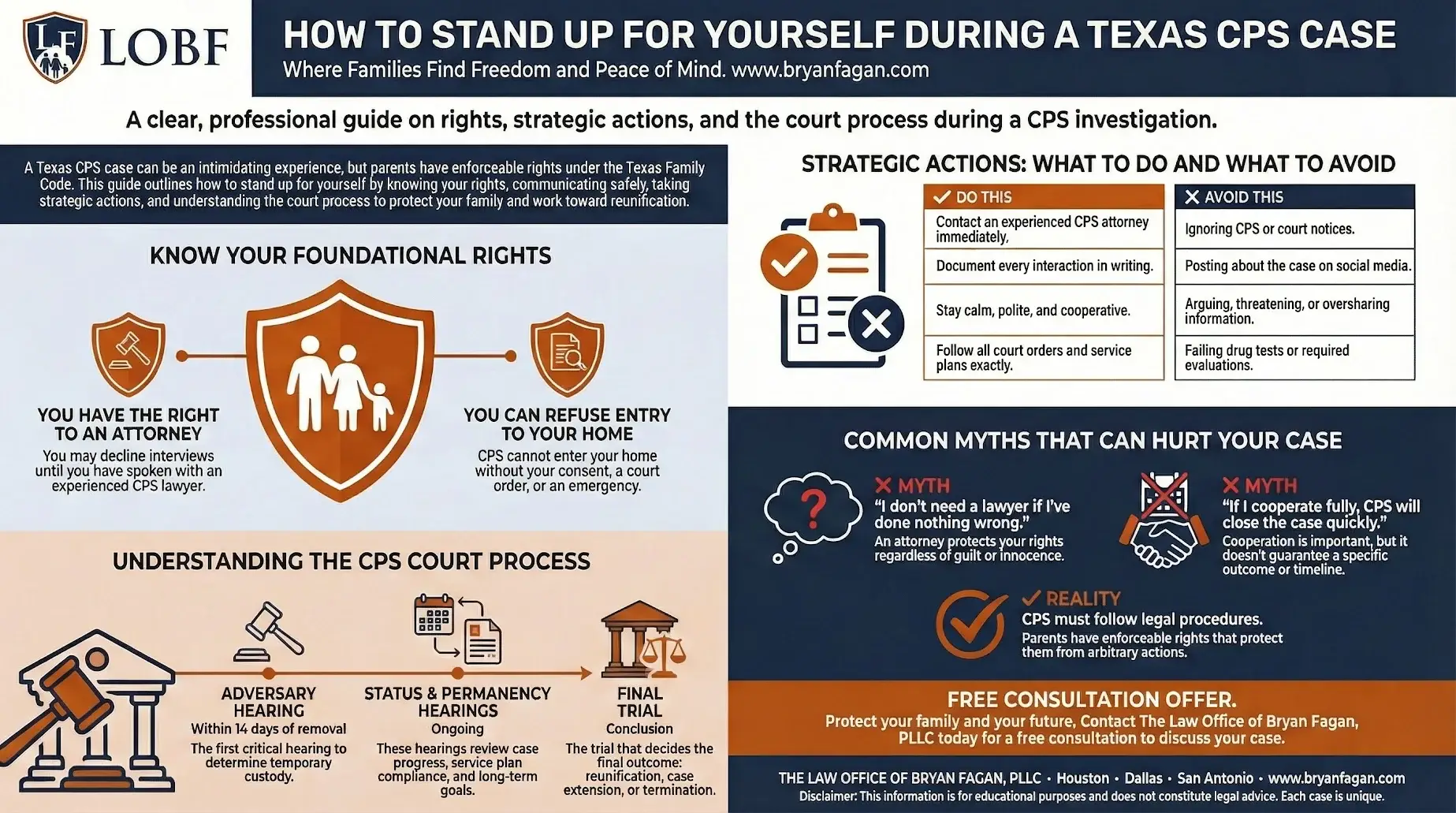
- Parents retain fundamental constitutional rights during CPS investigations, including the right to remain silent, the right to refuse home entry without a court order, and the right to legal representation under Texas Family Code Chapters 261–264.
- Standing up for yourself means strategic, respectful advocacy—not hostility or complete refusal to cooperate, which can harm your case.
- Documentation is your most powerful tool: keep detailed records of every CPS interaction, including dates, times, names, and what was discussed.
- Safety plans are voluntary but consequential—never sign one without understanding the implications or consulting a skilled attorney.
- Early legal representation can prevent costly mistakes and ensure your parental rights are protected from the first CPS contact.

Your Family’s Future Starts Here
Don’t navigate your legal journey alone. Schedule a consultation now and get the clarity and support you deserve.
How to Stand Up for Yourself During a Texas CPS Case: The Big Picture
Texas CPS cases move according to detailed procedures established by the Texas Family Code, but those procedures are balanced by important constitutional and statutory protections for parents. Understanding How to stand up for yourself during a Texas CPS case does not mean refusing cooperation or escalating conflict. Instead, it means recognizing where your rights begin, where CPS authority ends, and how to engage the process with clarity rather than fear. Texas Family Code §261.301 authorizes CPS to investigate allegations of abuse or neglect, but that authority must always be exercised within the bounds of the law.
Under Texas Family Code Chapters 261 through 264, CPS caseworkers are required to respect fundamental constitutional protections, including the Fourth Amendment’s limits on unreasonable searches, the Fifth Amendment right against self-incrimination, and the Fourteenth Amendment guarantee of due process. Texas statutes reinforce these safeguards by requiring court oversight for emergency removals and prompt hearings for parents, as outlined in Texas Family Code §§262.101 and 262.201. When parents understand these protections, they regain agency in a process that can otherwise feel overwhelming and one-sided.
This distinction matters because parents who believe CPS has unlimited power often make decisions driven by panic rather than strategy. They may consent to home entry they could lawfully decline, sign safety plans or other documents without fully understanding the consequences, or volunteer information that later appears in court filings. Standing up for yourself means making informed, deliberate choices—choices grounded in knowledge, not fear. For a deeper explanation of this topic, parents can review our detailed guide, How to Stand Up for Yourself During a Texas CPS Case Under Texas State Law, or explore additional insight in our related resource on what happens during a CPS investigation in Texas. At the Law Office of Bryan Fagan, PLLC, our focus remains on educating families, protecting parental rights, and helping Texans move forward with confidence during some of life’s most difficult moments.

Understanding Your Rights in a Texas CPS Case
Parents in Texas have fundamental legal rights throughout a CPS investigation, and exercising those rights strategically can protect your family without escalating conflict.
Right to Legal Representation You have the right to consult with an attorney at any point during a CPS investigation. If CPS files a lawsuit for child removal or termination of parental rights, you have the right to legal representation, and the court may appoint counsel if you cannot afford one. Early consultation with a lawyer can help you understand what to say, what to avoid, and how to protect your interests.
Right to Remain Silent While CPS can ask questions related to an investigation, you are not required to answer. You may exercise your constitutional right to remain silent or to consult with an attorney before responding. However, this right requires strategic consideration: complete silence may lead CPS to make decisions based on incomplete information or third-party accounts. The goal is thoughtful communication, not reflexive silence.
Right to Refuse Home Entry Under Texas law, CPS must obtain a court order or your consent to enter your home unless there are reasonable grounds to believe your child is in immediate danger. You can politely but firmly ask CPS workers to leave if they do not have a warrant or court order and there is no emergency. This does not prevent CPS from seeking a court order, but it does require them to meet a higher legal standard.
Right to Attend Hearings and Present Evidence If your case proceeds to court, you have the right to attend all hearings, review evidence presented against you, present evidence in your defense, and cross-examine witnesses. These due process protections are guaranteed by law and are essential to protecting your parental rights.
Right to an Adversary Hearing If CPS removes your child, Texas law requires a full adversary hearing within 14 days. This hearing is your primary opportunity to contest removal, present evidence, and argue for your child’s return. The hearing typically occurs in a Texas district court, and you have the right to legal representation throughout.
What CPS Can and Cannot Do Under Texas Law
CPS has legal authority to investigate reports of child abuse or neglect, but that authority operates within constitutional and statutory limits. Understanding these boundaries helps you identify when CPS has overstepped and when to assert your rights.
What CPS Can Do CPS caseworkers can investigate reports of abuse or neglect, interview your child and other family members, request access to your home, and ask you questions about the allegations. They can also recommend services such as parenting classes, counseling, or substance abuse treatment.
What CPS Cannot Do CPS cannot force you to comply with requests without legal grounds. Under Texas Family Code § 261.303, CPS cannot mandate drug testing, require you to sign documents, or force participation in interviews without either a court order or your informed consent. CPS also cannot deny or restrict your visitation rights unless a court orders such restrictions under Texas Family Code § 262.115.
Emergency Removals CPS can remove a child without a court order only if there are reasonable grounds to believe the child is in immediate danger. This is a higher standard than general concern—it requires articulated facts suggesting that delay would risk serious harm. Following an emergency removal, CPS must present the case to a judge within 24 hours or the next business day to justify the action.
A Common Misconception Many parents believe CPS has essentially unlimited power. This is not accurate. While CPS has significant authority, that authority is subordinate to constitutional protections. You cannot waive your constitutional rights through implied consent, and CPS must operate within legal bounds.
How to Communicate With CPS Without Hurting Your Case
Effective communication with CPS can protect your interests without creating unnecessary conflict. The goal is to be calm, factual, and strategic—never hostile, but never careless.
Keep Communication Calm and Factual Remain respectful in all CPS interactions, even when you feel stressed or accused. Statements made in anger or desperation can be misconstrued or used against you. Stick to facts, avoid speculation, and do not guess at answers. If you do not know something, say so.
Avoid Over-Sharing One of the most common mistakes parents make is volunteering information beyond what CPS directly asks. Answer specific questions directly, but do not provide a lengthy narrative or additional details. Anything you say can potentially be used in court proceedings.
Request Written Documentation Ask CPS to provide written documentation of important communications, determinations, or allegations. This creates an official record and prevents disputes about what was said or agreed to.
Document Everything Yourself Keep a detailed record of every CPS interaction: dates, times, names of workers, topics discussed, and your responses. This documentation can be invaluable in court proceedings if disputes arise about what occurred during the investigation.
Safety Plans: When to Agree and When to Get Legal Advice
A CPS safety plan is an agreement between parents and Child Protective Services that outlines specific steps a parent agrees to take—such as limiting unsupervised contact, arranging temporary supervision, or participating in services—to address immediate safety concerns. Understanding How to stand up for yourself during a Texas CPS case starts with recognizing that safety plans are not court orders, but they can still have significant legal consequences. While Texas Family Code §261.301 authorizes CPS to investigate reports of abuse or neglect, and §262.101 governs emergency actions, safety plans often arise before a case ever reaches a courtroom, placing parents in a high-pressure decision-making moment.
Although CPS presents safety plans as voluntary, declining to sign one does not prevent the agency from seeking removal or court intervention. In some situations, a carefully negotiated safety plan may help avoid immediate removal by addressing CPS concerns in the short term. However, once signed, the plan becomes part of the CPS record and may later be referenced in court to show a parent’s acknowledgment of alleged risk factors. Courts evaluating a child’s placement under Texas Family Code §262.201 or ongoing service requirements under §263.102 may look back at safety plan compliance when assessing a parent’s willingness or ability to protect a child.
Signing a safety plan without fully understanding its scope can create long-term problems. If a parent later violates the plan—intentionally or unintentionally—CPS may use that violation as evidence that less restrictive measures failed, strengthening arguments for removal or expanded court involvement. This is especially important in counties where standing orders or local court practices affect how CPS cases proceed alongside family law matters. Parents can gain valuable context by reviewing How Standing Orders Affect Texas Family Law Cases, which explains how local rules can quietly shape legal expectations before a judge ever hears the case.
Before agreeing to any CPS safety plan, speaking with an experienced Texas family law attorney is one of the most effective ways to protect your rights. A knowledgeable legal advocate can explain how the proposed terms interact with the Texas Family Code, identify risks you may not see at first glance, and negotiate provisions that are both realistic and protective of your parental rights. At the Bryan Fagan family law team, our focus remains on educating parents, reducing uncertainty, and helping families make informed decisions that protect their future—because the right guidance at the right moment can change the entire direction of a CPS case.

Preparing for CPS Hearings and Court Involvement
When a CPS case moves into the courtroom, understanding the structure of the process becomes a critical part of How to stand up for yourself during a Texas CPS case. Texas courts follow detailed procedures set out in the Texas Family Code, and each hearing serves a specific purpose in determining whether a child can safely remain with—or be returned to—their family. Parents who understand what each hearing involves are far better positioned to participate meaningfully and protect their rights rather than feeling overwhelmed by the process.
Texas Family Code Chapter 262 governs emergency actions and early court involvement following a child’s removal. Under §262.201, courts must promptly hold an adversary hearing, giving parents the opportunity to challenge removal, present evidence, and cross-examine witnesses. As a case progresses, courts conduct status and permanency hearings under Texas Family Code §§263.201 and 263.306 to monitor compliance with court orders and evaluate long-term plans for the child. These hearings are not formalities; they are checkpoints where judicial decisions can either move a case closer to reunification or further entrench CPS involvement.
Throughout every stage, judges apply the “best interest of the child” standard outlined in Texas Family Code §153.002. This includes evaluating the stability of the child’s home environment, the parent’s ability to meet physical and emotional needs, and the parent’s compliance with court-ordered services. Courts also consider whether parents demonstrate insight, accountability, and a willingness to follow lawful directives. Families seeking a deeper understanding of how CPS evaluates risk and safety before and during these hearings may find helpful guidance in From Questions to Solutions: Mastering CPS Assessments in Texas, which explains how assessments influence judicial decision-making.
Preparation and follow-through matter just as much as courtroom advocacy. Parents should bring clear documentation showing stability and progress, including employment records, housing information, service completion certificates, and evidence of a healthy relationship with their child. Missing deadlines or failing to comply with court orders under Texas Family Code §263.102 can lead to negative findings that are difficult to undo. The Bryan Fagan family law team consistently emphasizes preparation because informed, organized parents are better equipped to demonstrate that reunification is not only possible, but appropriate. For additional context on navigating CPS court proceedings, parents may also benefit from reviewing our resource on what happens during a CPS investigation in Texas, which connects the investigative phase to what ultimately unfolds in court.
Common Mistakes Parents Make in Texas CPS Cases
Avoiding common mistakes is a critical part of How to stand up for yourself during a Texas CPS case, because CPS proceedings are shaped as much by parental conduct as by the underlying allegations. Texas courts expect parents to respond thoughtfully and in compliance with the Texas Family Code, not emotionally or impulsively. Under Texas Family Code §§261.301 and 262.101, CPS investigations and emergency actions are evaluated based on evidence, credibility, and a parent’s demonstrated willingness to protect the child, making strategic decision-making essential from the very beginning.
One of the most common pitfalls is over-sharing information. Parents often believe that offering extra details will prove they have nothing to hide, but statements taken out of context can later be used in court. This is especially risky once a case moves into judicial oversight under Texas Family Code §262.201, where prior statements may be weighed alongside other evidence. A more effective approach is measured, factual communication, ideally with guidance from counsel who understands how CPS records are reviewed by judges.
Another serious misstep is failing to take allegations seriously. Minimizing concerns or delaying action can result in findings that the parent lacks insight into the child’s safety needs. Texas Family Code §153.002 requires courts to focus on the best interest of the child, and parents who appear dismissive of CPS concerns often face increased scrutiny. Consulting an attorney early helps ensure allegations are addressed appropriately and documented responses are aligned with statutory expectations.
Missing court deadlines or failing to attend hearings is equally damaging. Under Texas Family Code Chapter 263, courts track compliance closely, and missed deadlines can lead to contempt findings, reduced visitation, or stronger arguments for continued removal. Similarly, violating a signed safety plan—even unintentionally—can be cited as evidence that less restrictive measures failed, reinforcing CPS claims that court intervention is necessary.
Finally, social media activity remains one of the most underestimated risks in CPS cases. Any post, comment, or message related to the case can be captured and introduced as evidence. Parents are best served by avoiding all public discussion of their situation while the case is pending. For additional perspective on parental advocacy and common CPS pitfalls, readers may find value in this professional discussion on standing up for yourself during a Texas CPS case, which highlights why strategic restraint matters.
At the Bryan Fagan family law team, educating parents on what not to do is just as important as explaining what to do. Families looking for deeper guidance on navigating CPS investigations can also explore our resource on what happens during a CPS investigation in Texas. By understanding these common pitfalls and the legal standards that govern CPS cases, parents place themselves in a stronger position to protect their rights, their children, and their future.
How to Protect Your Relationship With Your Child During a CPS Case
Even during CPS involvement, you have the right to maintain your relationship with your child—and doing so strategically strengthens your case.
Exercise Your Visitation Rights Under Texas Family Code § 262.115, you retain visitation rights unless a court explicitly restricts them. Attend every scheduled visit, be engaged and present, and document the quality of your interactions.
Comply With Services Completing court-ordered or recommended services—such as counseling, parenting classes, or substance abuse treatment—demonstrates your commitment to addressing concerns and can lead to increased or less restrictive visitation.
Communicate Appropriately During visits, focus on your child’s well being. Avoid discussing the CPS case, expressing bitterness, or asking your child to choose sides. Appropriate communication protects both your child and your case.
How a Texas CPS Attorney Helps You Stand Up for Yourself
A Texas CPS attorney plays a critical role as an advocate, protector, and steady guide throughout the life of a CPS case. Understanding How to stand up for yourself during a Texas CPS case often begins with having experienced legal support early, before misunderstandings or rushed decisions shape the direction of the investigation. Under Texas Family Code §§261.301 and 262.101, CPS has authority to investigate and take emergency action when necessary, but parents also retain enforceable rights that must be asserted clearly and correctly from the first point of contact.
One of the most important ways an attorney helps is by explaining rights and risks in plain language. A knowledgeable Texas CPS lawyer evaluates how the facts of your case intersect with statutory requirements under Texas Family Code Chapter 262 and Chapter 263, including court oversight, service plans, and dismissal deadlines under §263.401. This guidance allows parents to develop a thoughtful strategy rather than reacting emotionally, which is especially important when timelines and compliance expectations can directly affect whether a case moves toward reunification or closure.
An attorney also serves as a buffer between parents and CPS, communicating directly with caseworkers to ensure interactions remain professional and legally appropriate. This protects parents from feeling pressured to consent to actions they may lawfully decline and helps ensure CPS stays within the boundaries set by the Texas Family Code. In situations where CPS oversteps—such as entering a home without valid consent, a court order, or an emergency—legal counsel can raise those issues in court and seek to limit or challenge improperly obtained evidence in accordance with constitutional protections and Texas statutory law.
As cases progress, legal representation becomes even more critical in court. A CPS attorney represents parents at hearings governed by Texas Family Code §§262.201 and 263.306, presenting evidence, cross-examining witnesses, and advocating for outcomes that protect parental rights and promote family stability. This advocacy also includes helping parents understand when a CPS case should legally end and what formal closure looks like. For additional clarity on that issue, parents may find it helpful to review How to Know If a CPS Case Is Closed in Texas, which explains how dismissal, reunification, and case closure are handled under Texas law.
At Bryan Fagan’s family law team, the focus remains on education, empowerment, and protecting futures. By combining practical legal strategy with compassionate guidance, the firm helps parents navigate CPS cases with confidence and clarity, ensuring they are informed not only about how to defend their rights, but also about when and how a case can finally—and lawfully—come to an end.

Why Choose The Law Office of Bryan Fagan, PLLC
The Law Office of Bryan Fagan, PLLC brings decades of hands-on experience guiding Texas families through CPS and DFPS investigations with clarity and care. Understanding How to stand up for yourself during a Texas CPS case begins with working alongside attorneys who know not only the law, but also how CPS cases actually unfold in Texas district courts. Under Texas Family Code Chapters 261 through 264, CPS is granted authority to investigate allegations of abuse or neglect, yet that authority is balanced by strict procedural requirements and meaningful protections for parents, including court oversight and clearly defined timelines.
At Bryan Fagan’s family law team, advocacy is calm, strategic, and parent-focused. Our attorneys help families understand how investigative powers under Texas Family Code §261.301 intersect with emergency actions under §262.101, and how those early decisions can shape the entire case. Rather than reacting out of fear, parents are guided to make informed choices that protect their rights and preserve family stability. This approach is especially important when parents feel tempted to withdraw or avoid CPS contact, a reaction that can unintentionally worsen the situation. Families seeking insight on that risk may benefit from reviewing What Happens If You Run From CPS in Texas, which explains why avoidance often leads to stronger CPS intervention rather than resolution.
Clear communication and compassionate guidance remain central to how our firm supports families across Texas. Whether a case involves an investigation, court-ordered services, or contested hearings under Texas Family Code §262.201, the goal is always the same: protecting parental rights while keeping the focus on the child’s best interests. Parents looking to better understand the investigative process itself can also explore our resource on what happens during a CPS investigation in Texas, which provides additional context and practical insight.
Throughout every CPS case, the firm’s mission remains consistent—educating families, reducing uncertainty, and protecting futures. By blending deep knowledge of Texas family law with empathetic, steady advocacy, the Law Office of Bryan Fagan, PLLC helps parents move through CPS involvement with confidence, dignity, and a clearer path forward.
Actionable Checklist: How to Stand Up for Yourself During a Texas CPS Case
- Stay calm and respectful during all CPS interactions
- Do not sign any documents without understanding them and consulting an attorney
- Document all communications with CPS: dates, times, names, topics discussed
- Comply with all court orders and deadlines
- Request written documentation of CPS statements and determinations
- Maintain visitation with your child and document positive interactions
- Complete all court-ordered services and obtain certificates of completion
- Avoid discussing the case on social media
- Contact a Texas CPS attorney immediately upon first CPS contact
Conclusion
Facing a CPS investigation can make even the most confident parent feel off balance, especially when it collides with divorce or custody questions that already carry so much emotional weight. But knowledge changes the experience. When you understand your rights, the process, and the choices in front of you, the situation becomes something you can navigate instead of something that simply happens to you. Standing up for yourself is not about confrontation—it’s about showing up informed, steady, and focused on what truly matters: your family’s stability and your child’s future.
If there’s one idea to carry with you, it’s this: you are not expected to figure this out alone. Texas family law is complex, and CPS cases move quickly, but experienced guidance can bring clarity where there feels like only chaos. Working with a seasoned Texas family law attorney can help you make smart decisions early, avoid common pitfalls, and protect your rights while keeping your child’s best interests front and center.
At The Law Office of Bryan Fagan, PLLC, we believe families deserve more than legal answers—they deserve understanding, honesty, and a path forward that restores peace of mind. If you’re facing a CPS investigation or feeling uncertain about what comes next, reaching out for guidance can be the first step toward regaining control. And if nothing else, remember this: asking questions, getting informed, and advocating for your family isn’t a sign of weakness—it’s exactly what strong parents do.
Frequently Asked Questions
Parents in Texas retain important constitutional and statutory rights during a CPS investigation. You generally have the right to consult with an attorney at any stage, the right to remain silent or decline to answer certain questions, and the right to refuse entry into your home unless CPS has your consent, a court order, or an emergency involving immediate danger. You also have due process rights if the case moves into court, including notice of hearings and the opportunity to present evidence. Knowing these rights helps you respond calmly and strategically rather than out of fear.
Texas law allows parents to represent themselves in family court, often called “pro se” representation. While this is legally permitted, CPS and custody cases involve strict procedural rules, deadlines, and evidentiary standards. Small mistakes can have serious consequences. Many parents choose to consult with a Texas family law attorney even if they plan to handle parts of the case themselves, simply to avoid missteps that could affect their child or parental rights.
In CPS cases, success usually means protecting your child’s safety while preserving or restoring your parental rights. Courts focus on the child’s best interest, not on assigning blame. Strong cases are built through consistency, documentation, and compliance with reasonable court orders or services. Challenging weak evidence, correcting inaccuracies, and presenting proof of stability are often key factors, especially when guided by experienced legal counsel.
Staying positive does not mean ignoring stress—it means managing it constructively. Focus on what you can control, such as following court orders, maintaining routines, and documenting your involvement as a parent. Lean on counselors, trusted friends, or support groups so your child is not carrying your emotional burden. Breaking the process into manageable steps can also help reduce overwhelm and keep you grounded.
One of the biggest mistakes parents make is allowing emotions to drive their behavior. Angry messages, confrontational exchanges, or impulsive decisions often end up hurting a parent’s credibility in court. Judges tend to favor parents who demonstrate maturity, consistency, and a child-focused mindset. Ignoring deadlines or relying on informal agreements that are not legally enforceable can also create serious problems.
The Fourth Amendment protects families from unreasonable searches and seizures. Issues can arise if CPS enters a home, searches private areas, or gathers personal information without valid consent, a court order, or a true emergency. Some parents later realize they felt pressured into cooperating without understanding their right to decline. If there are concerns about how evidence was obtained, a family law attorney can evaluate whether constitutional protections were violated.
Courts often view patterns of instability negatively. Missed visits, inconsistent communication, substance misuse, refusal to follow court orders, or speaking poorly about the other parent in front of the child can all reflect poorly. Judges generally look for parents who show reliability, self-control, and a genuine commitment to the child’s well-being rather than ongoing conflict.
When representing yourself, it is important to avoid speculation, exaggeration, or emotional accusations. Statements like “everyone knows,” “they always lie,” or “I don’t need to follow that order” can undermine credibility. Courts respond better to clear facts, documentation, and respectful communication. Volunteering unnecessary information out of nervousness can also unintentionally harm your case.
Yes, some parents have achieved favorable outcomes while representing themselves, particularly in straightforward cases with strong documentation. However, CPS and contested custody cases are rarely simple. While self-representation is possible, many parents find that working with an experienced Texas family law attorney greatly improves their ability to navigate the process, present evidence effectively, and protect their rights.