

Have you ever tried rearranging the furniture in your living room, only to realize the couch doesn’t fit where you thought it would? At first it seems like a small change, but suddenly the whole flow of the house feels different. Families work the same way—when something big shifts in a parent’s life, the ripple effect can change everything for a child. That’s where Material and Substantial Changes in Circumstances for Custody Modification Suits come into play, and why Texas courts take them so seriously.
The truth is, not every change means a custody order should be rewritten. Courts are looking for those game-changing moments: a parent relocates for work, a remarriage creates a new household dynamic, or a child’s needs evolve in ways the old plan just can’t cover. These are the kinds of changes that can make or break stability for kids, and judges want to ensure any new arrangement actually improves their well-being.
In this article, we’ll break down what counts as a material and substantial change, why Texas law sets a high bar, and how parents can prove their case in court. Along the way, you’ll find insider legal insights, practical steps you can take today, and stories that show how the right legal strategy protects both parents’ rights and children’s futures. At The Law Office of Bryan Fagan, PLLC, we believe families deserve clarity, confidence, and guidance—and that starts with understanding how custody modifications really work.
Key Takeaways
- Custody modifications require proof of a material and substantial change in circumstances, ensuring modifications serve the child’s best interest.
- Common scenarios for custodial changes include parental relocation, changes in employment, exposure to neglect, evolving child needs, and new household dynamics.
- The custody modification process involves filing a petition, gathering evidence, serving the other parent, and potentially engaging in mediation, with strong documentation being crucial for success.

Your Family’s Future Starts Here
Don’t navigate your legal journey alone. Schedule a consultation now and get the clarity and support you deserve.
What Constitutes a Material and Substantial Change in Circumstances?
Under Texas law, a parent seeking to change a custody order must show that Material and Substantial Changes in Circumstances for Custody Modification Suits have occurred since the last order was entered. As outlined in Texas Family Code §156.101, this legal standard ensures custody modifications are not made for convenience but only when genuine, significant life changes affect the child’s well-being. The court’s focus is always on the child’s best interest—ensuring stability, safety, and consistency remain at the center of every decision.
When reviewing a modification request, judges examine how current family dynamics differ from the time of the previous order. Factors such as a parent’s relocation, a change in employment or income, remarriage, evolving medical or emotional needs, or changes in household stability can all be considered. The parent requesting the change carries the burden of proof, meaning they must present convincing evidence—like school records, witness testimony, or expert evaluations—to show that these new circumstances materially affect the child’s life.
Texas courts approach each case with care, weighing both parents’ abilities to provide for the child’s emotional, physical, and educational needs. The modification process is designed to protect children from instability while allowing families to adapt when meaningful changes occur. A well-prepared legal strategy grounded in credible documentation and guided by an experienced attorney can make all the difference in achieving a fair and lasting result.
To learn more about what qualifies as a material and substantial change, explore Understanding Texas Custody and Material and Substantial Change: Key Insights for Parents. You can also visit our Texas Child Custody Resource Center for practical tools and legal guidance. At The Law Office of Bryan Fagan, PLLC, our team is committed to educating families, protecting futures, and helping parents make confident decisions that keep their children’s best interests first.

Examples of Material and Substantial Changes in Circumstances
Certain life events can create Material and Substantial Changes in Circumstances for Custody Modification Suits, prompting Texas courts to reconsider existing custody orders under Texas Family Code §156.101. This statute ensures that custody arrangements reflect the child’s current best interests rather than outdated family conditions. Courts only grant modifications when meaningful, lasting changes have occurred—those that significantly affect the child’s emotional, physical, or developmental well-being.
Examples of qualifying changes include a parent’s relocation that disrupts visitation schedules, major shifts in employment or income that alter financial stability, or exposure to unsafe conditions such as neglect or abuse. Other circumstances—like a child’s evolving medical, educational, or emotional needs, or the creation of a new family structure through remarriage—can also justify revisiting the order. The key is demonstrating that the change is both material (significant) and substantial (not temporary or minor), as required by the Texas Family Code.
Courts evaluate each case individually, weighing how the change impacts the child’s stability, schooling, and emotional security. For instance, a move across Texas may be viewed differently than a minor relocation within the same school district. Similarly, a parent’s improved living situation or consistent sobriety can positively influence the court’s assessment. Understanding these nuances is essential for parents seeking a fair and child-centered outcome.
For a deeper look at how these life events can influence custody, explore Substantial Change in Circumstances and Child Custody in Texas. You can also visit our Texas Child Custody Resource Center to learn how legal professionals at The Law Office of Bryan Fagan, PLLC guide families through complex modification cases with compassion and clarity—helping parents make informed decisions that protect both their rights and their children’s futures.
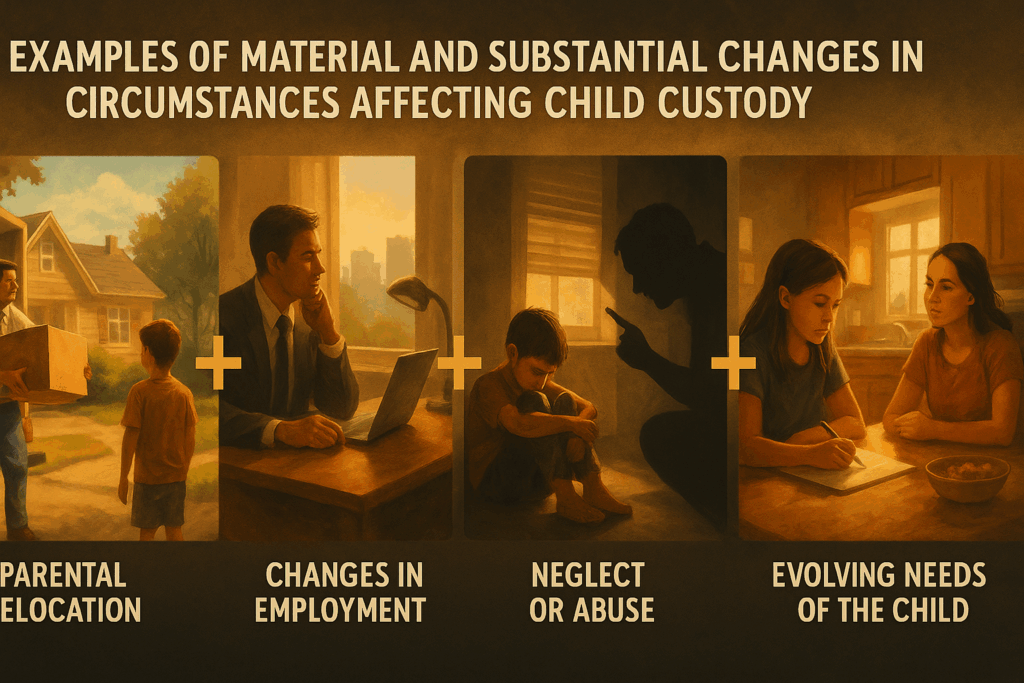
Relocation or Frequent Moves
Relocation or frequent moves by a parent can disrupt established custody arrangements, making it a substantial change in circumstances. For instance, a parent’s job relocation, whether due to a new job opportunity or military duty, can necessitate changes to the child’s primary residence.
Frequent relocations can disrupt a child’s stability, prompting a review of custody to ensure the child’s best interests are maintained.
Employment and Income Changes
Significant changes in a parent’s employment status or income can directly impact their ability to meet the child’s needs, thus justifying a custody modification. For example, a sudden job loss or a significant decrease in income can affect a parent’s ability to provide for the child, necessitating a review of the custody arrangement.
Similarly, a significant increase in income or a sudden change in job opportunity with different hours may also necessitate adjustments to the custody schedule.
Exposure to Neglect or Abuse
Exposure to neglect, abuse, or substance abuse is a serious concern that can warrant a custody modification. Instances of physical harm, emotional abuse, or inadequate supervision can significantly impair a child’s physical health and well-being, including cases of child abuse.
Substance abuse issues, such as severe drug or alcohol dependency, also fall under this category and can justify changes to the custody arrangement to protect the custodial parent and the child.
Child’s Changing Needs
As children grow, evolving medical, educational, or developmental needs may prompt a reassessment of child custody agreements. For instance, a new medical diagnosis or changes in educational requirements can necessitate adjustments to better support the child’s dental support and well-being, including a potential change custody, child support payments, and child support guidelines.
Expert evaluations, like psychological assessments, can offer crucial insights into the children’s best interests in these cases.
Parent’s Remarriage and Household Dynamics
A parent’s remarriage can introduce new family dynamics that significantly impact the child’s living environment, making it a substantial change in circumstances. The introduction of new family members, such as a stepparent or stepsiblings, can create changes that necessitate a review of the existing custody arrangement when parents circumstances change.
Blended families from a parent’s remarriage can prompt adjustments to ensure the child’s best interests are met.
Legal Process for Custody Modification
When life shifts in meaningful ways, Texas law provides a clear path to revisit an old order—but only when the change truly matters. For parents pursuing Material and Substantial Changes in Circumstances for Custody Modification Suits, the process is structured to protect children and promote stability. Under Texas Family Code §156.101, a court may modify conservatorship or possession if circumstances have materially and substantially changed since the last order and if the requested modification is in the child’s best interest (see also §153.002). If you are seeking a change within one year of the prior order, an additional affidavit showing risk of harm or other narrow grounds is required under §156.102.
The first step is filing a petition that clearly states what has changed and why the current order no longer serves your child. From there, build your case with organized proof—parenting logs, communications, medical or counseling records, employment and relocation documentation, and credible witness statements. Courts can issue temporary relief during the case to protect stability, but there are statutory limits on changing the child’s primary residence while a modification is pending under §156.006. Proper notice to all necessary parties is essential; service and joinder requirements are governed in part by Texas Family Code §102.009 and related rules.
Resolving disputes efficiently helps children most. Many families benefit from settlement tools that keep the focus on the child: mediated settlement agreements are expressly recognized in suits affecting the parent-child relationship under Texas Family Code §153.0071, and collaborative options may also be appropriate where both parents are committed to problem-solving outside the courtroom. If settlement isn’t possible, the court will hold a hearing and apply the best-interest standard, weighing the evidence against the legal thresholds before entering a new, enforceable order.
For a step-by-step walk-through of filings, affidavits, service, and hearings, see How to Petition for a Modification After a Change of Circumstances in Texas Family Law, and explore our broader Texas Child Custody Resource Center for practical checklists and guidance. If you’re unsure whether your situation meets the updated Family Code standards, our Houston family law team can evaluate your facts, help you gather persuasive evidence, and pursue a modification that aligns with your child’s long-term well-being.
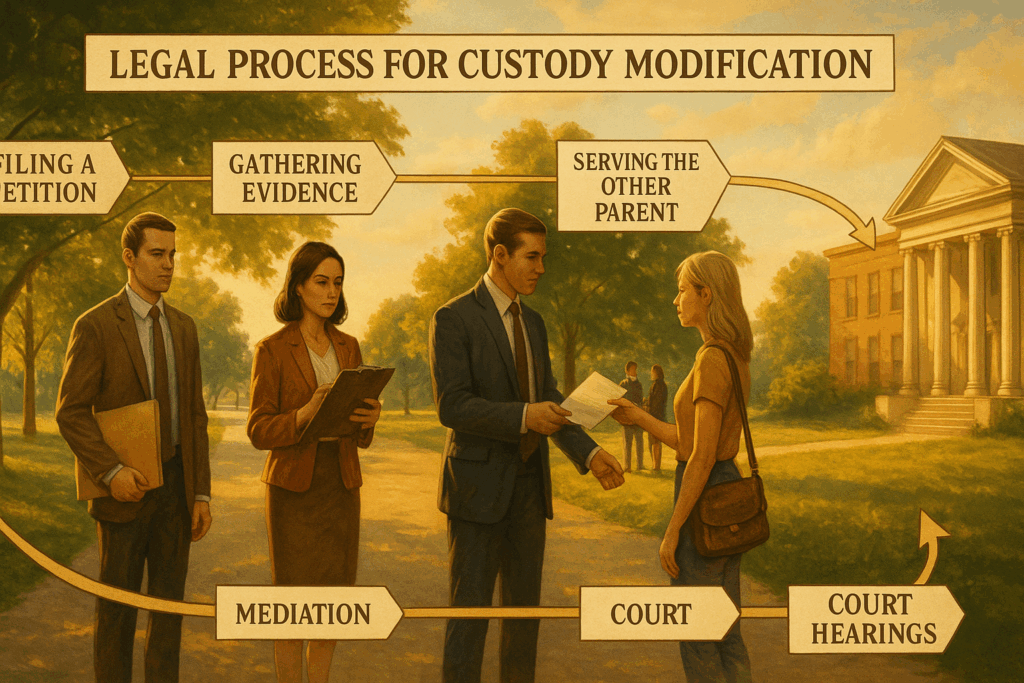
Filing a Petition for Modification
The first step in modifying custody is to complete and file a Petition to Modify the Parent-Child Relationship form, which formally requests changes to the current child custody order. This father petitioned must detail the material and substantial change in circumstances that necessitates the modification.
After the filing is complete, a hearing will be arranged. Both parties will have the opportunity to present their arguments. This step initiates the legal process for custody modification.
Gathering Evidence for Court
Gathering concrete evidence is essential for supporting a custody modification request. Types of evidence can include:
- Direct observations
- Parenting logs
- Financial records
- Medical records
- Witness statements
Judges rely heavily on this evidence to make informed decisions, particularly when a parent’s ability to act threatens the child’s welfare.
Collecting proper evidence can significantly strengthen your case and present evidence.
Serving the Other Parent
Once the petition is filed, it must be served to the other parent by a qualified individual, not by the petitioner themselves. Notice must be served to parties whose rights and duties may be affected. Notifying the other parent properly is crucial for upholding legal procedures and advancing the custody modification process.
Mediation or Collaborative Law Options
Mediation or collaborative law options can provide a less adversarial environment for resolving custody disputes. These alternative dispute resolution strategies can often expedite the custody modification process and potentially reduce legal costs.
Mediation provides a faster and more amicable solution than traditional court settings.
Court Hearings and Final Orders
The final step in the custody modification process involves:
- The court hearing, where both parties present their evidence and arguments.
- Once the court approves the modification, parents must file the signed final order with the court clerk to finalize the changes.
- Keeping a file-stamped copy of the signed order as proof of the modification is important.
If a modification request is denied, consulting an experienced family law attorney for further options is advisable.
Proving Material and Substantial Changes
Proving that Material and Substantial Changes in Circumstances for Custody Modification Suits have occurred is the cornerstone of any request to alter an existing Texas custody order. Under Texas Family Code §156.101, the court may modify conservatorship or possession only when circumstances have materially and substantially changed since the prior order and when the requested modification is in the child’s best interest, a standard reinforced by §153.002. This child-centered focus reflects the latest codified framework in the Texas Family Code and ensures modifications are driven by a child’s needs—not parental convenience.
Because the burden of proof rests on the requesting parent, credible, well-organized evidence is essential. Judges look for objective documentation that demonstrates meaningful change, such as parenting logs and calendars, medical and counseling records, employment or relocation proof, communication records, report cards and attendance data, treatment or sobriety documentation where relevant, and clear witness statements or expert evaluations. Courts may also consider a child’s stated preferences through the in-chambers interview process under §153.009, always weighing those wishes against the best-interest standard.
Procedurally, timing and form matter. If you are seeking to change the child’s primary residence within a year of the last order, an affidavit showing significant impairment or qualifying circumstances is required by §156.102, and courts are cautious about altering primary residence on a temporary basis absent proof of significant impairment under §156.006. Presenting a cohesive narrative supported by admissible records and testimony helps the court see why the existing order no longer serves the child’s stability, safety, and development.
For a practical walkthrough of what evidence to gather and how to build your case, see Does Your Custody Order Need to Be Modified? and visit our comprehensive Texas Child Custody Resource Center. Whether you know it’s time to seek a modification or you’re still weighing your options, the Houston custody attorneys at The Law Office of Bryan Fagan, PLLC can help you evaluate your facts under the current Family Code, assemble persuasive documentation, and pursue a path that protects your child’s future.

Importance of Strong Evidence
Strong evidence is vital for substantiating claims of a substantial change. Insufficient documentation can weaken a parent’s legal position, as courts rely heavily on evidence to make informed decisions.
Judges prioritize the child’s well-being and consider custody modifications based on what benefits the child emotionally, physically, and psychologically.
Documentation and Witness Statements
Maintaining detailed parenting logs, financial records, and medical records can significantly bolster a case for custody modification. Witness testimony and relevant documents can enhance the credibility of a case. Strong evidence, including witness statements and documentation, is crucial to substantiate claims regarding changes that impact the child’s welfare.
Professional Evaluations
Professional evaluations play a crucial role in custody modification suits by providing objective assessments of the child’s needs and parental capabilities. Expert evaluations, such as psychological assessments, offer vital insights into the child’s best interests.
These evaluations provide valuable information to the court, helping to ensure that custody decisions are made in the child’s best interest.
Common Mistakes in Custody Modification Cases
Parents pursuing Material and Substantial Changes in Circumstances for Custody Modification Suits often face emotional and legal challenges, and small missteps can have big consequences. Under Texas Family Code §156.101, courts only grant modifications when a parent proves that circumstances have meaningfully changed since the last order and that the requested modification serves the child’s best interest under §153.002. Unfortunately, many parents weaken their cases by focusing on convenience rather than demonstrating how the change benefits their child’s stability and well-being.
A common mistake is prioritizing parental preference over the child’s needs. Judges consistently look for decisions rooted in what supports the child’s emotional, educational, and physical development—not what fits a parent’s schedule. Another frequent error is poor documentation. Courts rely heavily on credible evidence—parenting logs, medical or counseling records, and school performance reports—to confirm that a real, ongoing change exists. Parents who fail to record these details or provide organized proof often struggle to meet the legal burden required by §156.101.
Timing is another critical factor. Waiting too long to act after a substantial change—such as relocation, remarriage, or health issues—can harm your chances of success. The Family Code also restricts modifications within one year of the prior order unless certain conditions are met under §156.102, such as a risk to the child’s emotional or physical health. Promptly seeking guidance helps ensure compliance with these rules and preserves your ability to present strong evidence.
To better understand how to avoid these pitfalls and pursue the right strategy for your case, read Does Your Custody Order Need to Be Modified?. You can also explore our Texas Child Custody Resource Center for practical tools and attorney insights. At The Law Office of Bryan Fagan, PLLC, our experienced Houston family law attorneys guide parents through every stage of the custody modification process—helping families make informed, timely, and child-focused decisions that protect their futures.

Focusing on Parental Convenience
Focusing on parental convenience rather than the child’s best interests can lead to detrimental outcomes for children. When parents prioritize convenience, the child’s emotional and psychological needs may be overlooked. Legal frameworks prioritize the child’s welfare, and deviating from this can lead to court disputes and penalties.
Lack of Sufficient Documentation
Courts require compelling evidence to substantiate claims of substantial changes; mere assertions are insufficient. Poor documentation can lead to dismissed cases or unfavorable outcomes in custody modification suits in a trial court.
Parents must maintain thorough records, including financial, medical support, and educational documents, as well as witness statements that support order their claims.
Delaying Legal Action
Key points to consider regarding custody modification:
- Waiting too long to file for custody modification after a significant change can jeopardize the chances of a favorable outcome.
- Timely action is crucial following significant changes.
- Parents should avoid informal agreements without court approval.
Consulting an experienced attorney before filing for custody modification ensures the process is handled correctly and swiftly.
How Bryan Fagan’s Attorneys Can Help
Navigating Material and Substantial Changes in Circumstances for Custody Modification Suits can be one of the most emotionally and legally challenging moments in a parent’s life. Under Texas Family Code §156.101, a court may modify a custody or conservatorship order only when there has been a significant and continuing change in circumstances since the last order, and when the modification serves the child’s best interest under §153.002. Determining what qualifies as a “material and substantial” change often requires careful analysis of family dynamics, financial conditions, and the child’s emotional and physical needs—all areas where legal guidance makes a real difference.
At The Law Office of Bryan Fagan, PLLC, our attorneys take the time to understand each family’s unique story before recommending a course of action. Whether the change involves relocation, income adjustments, remarriage, or shifts in a child’s developmental needs, our approach is built on clear communication and compassionate advocacy. We help parents gather and present strong, admissible evidence to meet the requirements of the Texas Family Code and ensure the court sees how the requested modification truly benefits the child’s stability and growth.
Our team also helps clients address related issues that often accompany custody changes—such as child support adjustments, enforcement, or visitation scheduling. Because financial circumstances can evolve alongside custody needs, it’s important to understand how support obligations interact with custody modifications. You can explore our detailed Texas Child Support Resource to learn how Texas courts calculate, modify, and enforce support orders in coordination with custody arrangements.
Families across Texas trust our firm because we don’t just practice family law—we educate and empower our clients through it. Our success stories reflect what happens when personalized legal strategy meets genuine compassion: parents regain stability, children thrive, and families move forward with confidence. The Law Office of Bryan Fagan, PLLC remains committed to guiding parents through the complex process of custody modification with professionalism, empathy, and unwavering dedication to protecting your family’s future.
Personalized Legal Guidance
Personalized legal guidance can significantly influence the outcome of custody modification suits. Consulting an attorney to review the modification documentation can enhance your chances of success. Tailored advice ensures that parents are well-prepared and informed throughout the legal process, addressing their unique circumstances and needs.
Protecting Parental Rights
The attorneys at Bryan Fagan are experienced in representing parents during custody modification suits to ensure their rights are protected. Parents should:
- Maintain thorough documentation of parenting schedules
- Keep records of communications
- Document significant changes in circumstances to support their case.
Strong evidence, including witness statements and expert evaluations, can greatly impact the court’s decision in custody modifications.
Client Success Stories
Client success stories illustrate the positive outcomes achieved with the Law Office of Bryan Fagan PLLC’s guidance. For example, a client was awarded sole physical custody of their children after demonstrating sobriety and stability following a prior drug-related custody decision. Another client successfully retained physical custody of their children and collected $10,000 in attorney fees from the opposing party in a contested case.
These stories highlight the firm’s dedication to protecting parental rights and ensuring the child’s best interests through protective services.
Checklist for Parents Pursuing Custody Modification
Parents considering custody modification should follow a comprehensive checklist to ensure a strong case:
- Document significant changes in circumstances.
- Maintain detailed parenting logs to illustrate a parent’s engagement with their child.
- Record any changes in behavior that may impact custody decisions.
Collecting witness statements and obtaining professional evaluations can provide strong support for a custody modification case. Consulting an experienced custody modification attorney can help parents navigate the complexities of the process and ensure their rights are protected.
Call to Action
Parents who believe substantial changes in circumstances apply to their family law cases are strongly encouraged to schedule a consultation with the Law Office of Bryan Fagan. Understanding material and substantial changes is essential for anyone considering custody modifications.
Consulting with legal help experts can clarify whether significant changes apply to specific custody situations and provide the necessary guidance to pursue a modification suit.
Conclusion:
Life doesn’t stop moving just because there’s a court order in place. Jobs change, families grow, people relocate—and sometimes those shifts mean the old custody plan just doesn’t fit anymore. That’s where understanding material and substantial changes becomes so important. It’s not about winning or losing; it’s about making sure your child has the stability, care, and opportunity they need to thrive.
If you’re reading this and realizing that your family’s circumstances look a little different than they did when the custody order was first signed, you’re not alone. Many parents reach this crossroad and wonder if now is the time to make a change. The good news? You don’t have to figure it out on your own. Our team at The Law Office of Bryan Fagan, PLLC is here to walk you through the process, explain your options under Texas law, and help you take the right steps for your child’s future.
So, whether you’re worried about the legal side, the emotional toll, or just how to keep the peace at home, know this: change doesn’t have to mean chaos. With the right plan—and the right attorney—you can turn a stressful moment into an opportunity to create more stability for your family. And who knows? Years from now, you might even look back and realize this was the moment things started to feel a little lighter.
Frequently Asked Questions
In Texas, a “material” change is a significant shift since the last custody order that directly affects a child’s life or a parent’s ability to care for them. This might include a parent relocating, a new household structure after remarriage, a major work schedule change, or safety concerns. Courts focus on whether the change impacts the child’s stability and well-being.
A “substantial” change means the effect is more than minor or temporary. Common examples include long-term job loss or schedule changes, consistent relocation disrupting routines, family violence or neglect, sobriety or relapse issues, or a child’s new medical or psychological needs requiring special care.
Courts in Texas look for meaningful developments that, had they been present at the time of the original order, could have led to a different decision. Examples include relocation, remarriage, ongoing schedule conflicts, or new health and educational demands.
The biggest mistake parents make is putting their own convenience above the child’s best interest. Judges want to see cooperation, respect, and child-focused decision-making. Hostile communications, withholding the child, or failing to document concerns often backfire in court.
A qualifying change is one that makes the current custody plan unworkable or unfair for the child. Examples include substantial income changes, relocation that complicates visitation, consistent noncompliance with the order, or new therapy or medical needs.
Winning is less about “beating” the other parent and more about proving stability for your child. Parents should keep records, stay respectful in communication, gather school or medical evidence, and show the court how the modification supports the child’s best interests. Partnering with an experienced Texas custody attorney can make all the difference.
If we’re talking about “materials” in custody cases, it usually means evidence. That could include new school records, medical or counseling reports, financial documentation, police or CPS findings, or parenting logs. These new materials help prove substantial changes have occurred.
Changes in circumstances are post-order developments that affect parenting and the child’s stability—like a parent’s relocation, household changes, safety concerns, or ongoing noncompliance with the custody plan. Courts require the changes to be meaningful, not trivial.
In custody law, think of “state” as a family’s life situation. Four common examples are:
A parent relocating far enough to affect the parenting schedule
A parent remarrying and creating a new household dynamic
A dramatic change in work schedule, such as switching to nights or frequent travel
Verified changes in safety or health, such as recovery from substance abuse or new risks to the child