
Divorce can be one of life’s most difficult transitions—but understanding your options under Texas law can make it less overwhelming. Divorce mediation in Texas is a confidential, cooperative process where you and your spouse make decisions about your future with the help of a neutral third party—the mediator. It’s a constructive alternative to a traditional court battle, giving you more control over the outcome of your property division and child custody arrangements.
Choosing a Calmer Path Through Divorce in Texas

Facing a divorce can feel like one of life’s most difficult transitions, filled with uncertainty about your future, your finances, and your family. The idea of a drawn-out, adversarial court battle often adds a heavy layer of stress to an already emotional time.
But there is another way forward. It’s a path that is often calmer, more private, and ultimately more empowering for everyone involved.
Divorce mediation provides a structured yet flexible environment to resolve conflicts with respect. Instead of a judge making life-altering decisions for you, mediation puts you and your spouse firmly in control. You work together to find common ground and craft solutions that are truly tailored to your family’s unique needs.
Key Benefits of Choosing Mediation
This process is designed from the ground up to be less confrontational and more collaborative, which can be invaluable for preserving a functional co-parenting relationship down the road. The primary advantages are significant:
- Greater Control and Flexibility: You and your spouse, not a court, decide the terms of your divorce. This opens the door for creative and personalized agreements that a judge might not be able to order.
- Reduced Conflict and Emotional Stress: Mediation fosters communication and cooperation. This helps lower the immense emotional toll that a contentious court case can take on you and your children.
- Confidentiality and Privacy: Unlike public court proceedings, everything discussed during mediation is private and confidential. This is crucial for protecting your family’s personal and financial details from becoming public record.
A More Efficient and Cost-Effective Approach
Mediation is an increasingly important vehicle for resolving divorce issues in Texas precisely because it typically reduces both the cost and time compared to litigation. Texas family law practitioners and firm surveys consistently report that private mediation often resolves cases in a matter of weeks or just a few sessions.
In sharp contrast, a contested litigated divorce can drag on for months or even years, racking up substantially higher attorney fees and court costs along the way.
To help you see the differences more clearly, let’s compare the two paths side-by-side. This table highlights the fundamental differences between resolving a divorce through mediation versus going to court, helping you quickly grasp the key advantages of mediation.
Mediation vs. Litigation: A Quick Comparison
| Aspect | Divorce Mediation | Traditional Litigation |
|---|---|---|
| Control | You and your spouse make the final decisions. | A judge or jury makes the final decisions for you. |
| Process | Collaborative and cooperative. | Adversarial and confrontational. |
| Privacy | Completely confidential and private. | Public record; court proceedings are open. |
| Cost | Generally much less expensive. | Can be extremely costly due to legal fees. |
| Timeline | Typically faster, often resolved in weeks or months. | Can take many months, or even years, to resolve. |
| Outcome | Creative, flexible solutions tailored to your family. | Limited to what the law allows a judge to order. |
| Relationship | Aims to preserve a functional co-parenting dynamic. | Often damages relationships, making co-parenting difficult. |
As you can see, the benefits of mediation often align perfectly with the goals of families looking for a less damaging way to move forward. It’s about finding a solution, not winning a fight.
By choosing this path, you are not just settling a legal case; you are building a foundation for a new beginning. It allows you to move forward with dignity and a sense of closure, knowing you had a direct hand in shaping your future.
As you consider your options, understanding these fundamental differences is crucial. If you’re leaning toward a more collaborative approach, you might be interested in a deeper look at why to choose mediation in our detailed guide.
How Texas Law Supports Mediation
When you’re facing a divorce, it helps to know the legal system isn’t just pushing you toward a fight. In fact, Texas law actively encourages a much more cooperative route: mediation. This isn’t just a suggestion; it’s a process built into the state’s legal framework, specifically designed to help families find their own solutions outside a combative courtroom.
The Texas Family Code is built on the idea that you and your spouse are the true experts on your family. It recognizes the immense value of letting you shape your own future, rather than having a judge, who knows very little about your lives, impose one upon you.
This preference for mediation is so strong that most Texas judges will actually require you and your spouse to try it at least once before they’ll even consider letting your case go to a full-blown, contested trial. Think of it less as a hurdle and more as a mandatory opportunity the courts give you to settle your differences respectfully and keep control of the outcome.
The Court’s Role in Ordering Mediation
Under the Texas Family Code, Section 153.0071, judges have the full authority to refer any case involving children to mediation. They can do the same for disputes over property division. This judicial power highlights a core belief in Texas family law: peaceful, out-of-court settlements are almost always better for the family, especially when children are involved.
By making this a required step, the courts ensure every couple gets a chance to see if a collaborative process can work for them. It’s the system’s formal nod to the fact that mediation is a proven, effective tool for untangling even the most complicated divorce issues.
“On the written agreement of the parties or on the court’s own motion, the court may refer a suit affecting the parent-child relationship to mediation.” – Texas Family Code § 153.0071
This legal tool empowers the court to steer you away from the emotional and financial drain of a prolonged legal battle and toward a resolution you create yourselves.
Your Discussions Are Legally Protected
So, what makes mediation a safe space to negotiate? Confidentiality. This is one of the most powerful legal protections Texas law offers, and it’s what makes the whole process work.
The Texas Civil Practice and Remedies Code is very clear on this: anything you say during mediation is confidential. It cannot be disclosed later and, critically, it cannot be used as evidence against you in court if you don’t reach a settlement.
This legal shield is everything. It means you can float ideas, make settlement offers, and talk through sensitive issues without the fear of your words being twisted and used against you down the road. It’s this guarantee that allows for the kind of open, honest bargaining that leads to real solutions. To see how this plays out in practice, you can find a detailed breakdown of what to expect in a mediation in a Texas family law case in our in-depth article.
The Mediator’s Neutral Stance
It’s also crucial to understand the mediator’s role, which is legally defined as a neutral facilitator. They aren’t a judge, a referee, or a decision-maker. Their job is simply to guide the conversation, help you navigate sticking points, and illuminate potential paths to an agreement.
A mediator cannot force you to accept any terms. They cannot give legal advice to either of you. Their neutrality is what keeps the process fair and balanced.
Ultimately, the power to make the final decisions stays exactly where it should be: with you and your spouse. This legal structure is what empowers you to take the reins of your own divorce, crafting a final agreement that is truly tailored to your family’s unique needs.
Your Step-by-Step Journey Through the Mediation Process
The thought of walking into a mediation session can feel intimidating, but knowing what to expect can turn that anxiety into confidence. When you have a clear roadmap of how the day will unfold—from the first handshake to the final signature—you can stop worrying about the process and start focusing on finding real solutions for your family.
Let’s walk through the entire mediation process, breaking it down into clear, manageable stages. This journey is designed to be structured but also flexible enough to make sure every issue gets the attention it needs in a calm, controlled setting.
Think of it like this: when a divorce is filed in Texas, the court often sees mediation not just as an option, but as a critical step toward reaching a final agreement before resorting to a costly trial. This visual guide shows how it fits into the legal timeline.
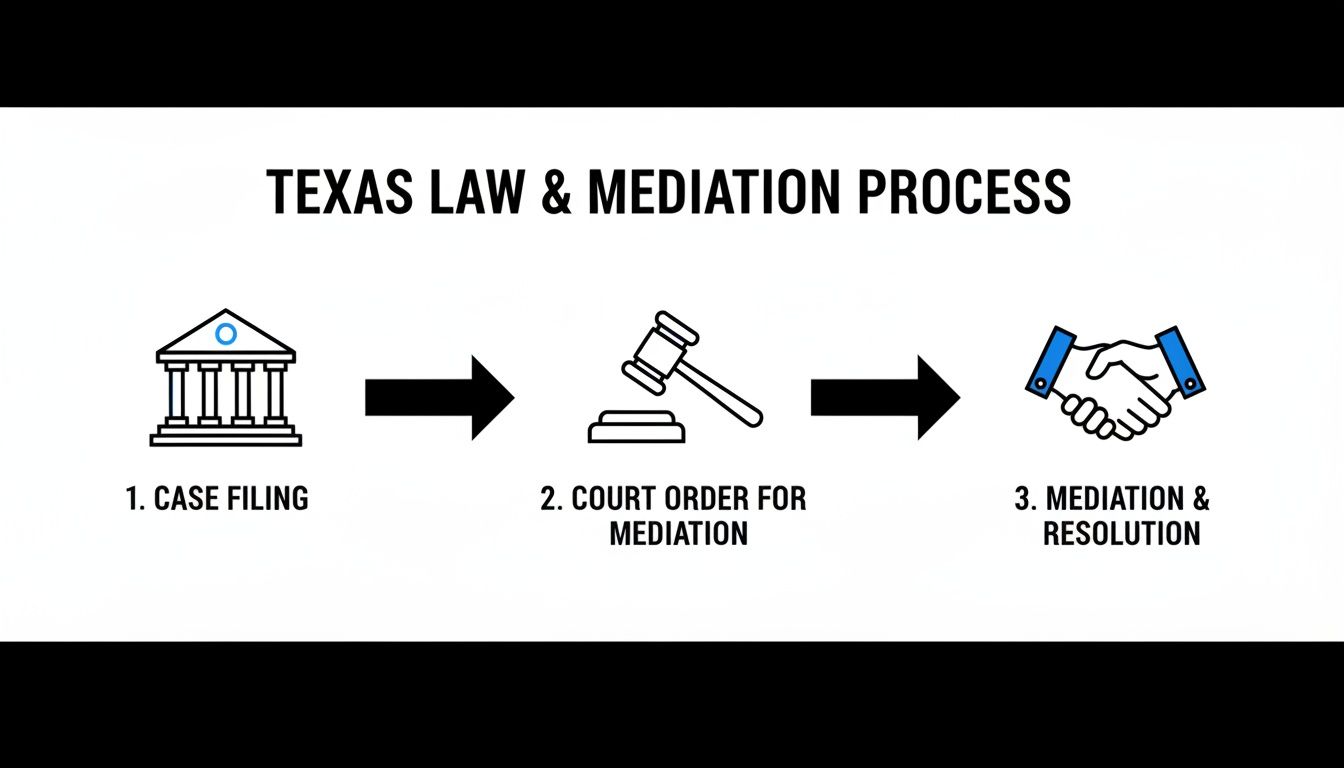
This flow shows how Texas courts build mediation right into the legal process. They want to give you every opportunity to resolve things yourselves.
Stage 1: The Opening Session
The day kicks off with everyone in the same room: you, your spouse, both of your attorneys, and the mediator. The mediator will start by explaining their role as a neutral guide, laying down the ground rules (like confidentiality), and outlining the goals for the day. This is all about setting a cooperative tone and making sure everyone is on the same page.
After that, each side, usually through their attorney, gets to make a brief opening statement. This isn’t the moment to argue your case like you’re in a courtroom drama. Instead, it’s a chance to respectfully outline the key issues and what you hope to achieve.
Stage 2: The Caucus Sessions
Once the opening session wraps up, the process typically shifts to separate rooms. This phase is known as “caucusing.” The mediator will then shuttle between the two rooms, speaking privately with each party and their attorney.
This is where the heavy lifting happens. These private sessions are incredibly effective for a few reasons:
- Honest Conversations: You can speak freely with the mediator about your real concerns, priorities, and where you might be willing to compromise, all without your spouse in the room.
- Reality Checks: The mediator can act as a sounding board, helping you realistically assess the strengths and weaknesses of your position and what the risks of going to trial might look like.
- Neutral Messenger: The mediator carries offers and counter-offers back and forth, helping to take the emotion out of the conversation and prevent the tension that can flare up during direct confrontations.
This back-and-forth continues as long as everyone is making progress. A good mediator uses their experience to help you see issues from a new angle, find creative solutions, and guide both of you toward common ground.
Stage 3: Negotiating the Key Issues
During these private caucuses, you’ll dig into the core issues of your divorce, like dividing property and creating a parenting plan. Let’s look at a common scenario to see how this plays out in the real world.
Example: The Family Home and Holiday Schedules
Imagine Sarah and Tom are in mediation. The two biggest sticking points are what to do with the family home and how to split holidays with their two kids.
- The House: In her caucus, Sarah tells the mediator she wants to keep the house so the kids don’t have to change schools. Her attorney explains that Sarah can qualify for a new mortgage to buy out Tom’s share of the equity. The mediator takes this proposal to Tom. Tom is hesitant; he just wants to sell and get his money quickly. The mediator helps him see that a buyout means no realtor fees and no waiting for a buyer on the open market. He’d get a guaranteed sum of money, probably faster. After a few rounds of negotiating the exact buyout price, they strike a deal.
- The Holiday Schedule: When it comes to the holidays, emotions are running high. Tom’s family has a huge Christmas Eve gathering every single year, and it’s deeply important to him. In his caucus, the mediator helps Tom articulate why it matters so much. When the mediator relays this to Sarah, she starts to understand the emotional significance. In her caucus, she proposes a solution: Tom gets the kids every Christmas Eve, and in return, she gets them for the first full week of winter break.
This is the magic of mediation. A judge would likely just order the house sold and impose a standard, cookie-cutter holiday schedule. Instead, Sarah and Tom were able to craft a solution that worked for their unique financial and emotional needs.
Stage 4: Finalizing the Agreement
Once you’ve reached a verbal agreement on every issue, the work isn’t quite done. The mediator and attorneys will immediately get to work drafting the Mediated Settlement Agreement (MSA). This is the formal, legally binding contract that spells out every single detail of your settlement.
You and your attorney will review every word of the MSA to make sure it perfectly matches the agreements you made. Once you and your spouse have both signed it, the deal is locked in. Under the Texas Family Code, a properly signed MSA is irrevocable, giving you the finality you need to move forward.
This step-by-step process is designed to take you from a place of conflict to a place of resolution, empowering you to close one chapter of your life and begin the next with clarity.
Resolving Key Issues in Your Texas Divorce Mediation

This is where the real work of divorce happens. Mediation is the room where you and your spouse sit down to hash out the critical decisions that will shape the next chapter of your lives. Instead of handing over control of these life-altering choices to a judge, mediation puts the power back in your hands. You get to resolve the core issues—property division, child custody, and financial support—in a way that makes sense for your family.
The idea might feel overwhelming at first, but a good mediation is structured to break down complex problems into smaller, more manageable conversations. With a skilled mediator acting as a neutral guide, you can tackle each topic thoughtfully and constructively, building toward a final agreement that gives everyone clarity and a stable path forward.
Dividing Your Marital Estate with Fairness
In Texas, the starting line for dividing assets is the concept of community property. This legal principle presumes that anything you or your spouse acquired during the marriage belongs to both of you. If you go to court, a judge is required to divide this property in a “just and right” manner, which usually translates to a 50/50 split.
But mediation gives you something a courtroom can’t: flexibility. It lets you get creative with solutions that a judge simply doesn’t have the authority to order.
Practical Example: One spouse is a small business owner and wants to keep the company running without disruption. In mediation, you could agree that they keep the business outright. In exchange, the other spouse might get the family home and a larger portion of the retirement accounts. This kind of custom trade-off protects important assets and helps both of you meet your long-term goals—a win-win that a court couldn’t mandate.
Creating a Child-Focused Parenting Plan
For any parent, nothing matters more than the kids. Mediation is the ideal environment for crafting a detailed Parenting Plan that is built around your children’s best interests, as required by the Texas Family Code.
While a judge can impose a standard possession schedule, mediation lets you design a plan that actually fits your family’s unique rhythm. You can get specific on things like:
- Detailed Visitation Schedules: Go beyond standard holidays. You can map out three-day weekends, school breaks, and even the kids’ birthdays.
- Decision-Making Authority: Get clear on who makes the big calls about school, non-emergency medical care, and religious upbringing to head off future arguments.
- Communication Protocols: Set ground rules for how you’ll communicate with each other about the kids. This alone can drastically reduce future conflict.
Taking this collaborative route helps you build a functional co-parenting relationship, which is one of the greatest gifts you can give your children during this transition.
When you work together on a Parenting Plan, you send a powerful message to your children: even though our marriage is ending, our role as your parents isn’t. That stability is invaluable for their emotional well-being.
Negotiating Financial Support and Stability
Money matters, like child support and spousal maintenance, are naturally a source of anxiety. While Texas has legal formulas for calculating these figures, mediation allows you to create a financial arrangement that reflects your family’s real-world situation.
For instance, the Texas Family Code has a formula for child support based on the non-custodial parent’s income. But in mediation, you might agree to a different amount to specifically cover expenses like private school tuition or a child’s competitive sports league. Our firm has seen firsthand how you can negotiate child support during mediation, and this flexibility is often a game-changer.
The same creative thinking applies to spousal maintenance. When couples sit down to mediate, a huge chunk of the conversation is about money. For those with significant assets, this means carefully navigating the complexities of finance and divorce to land on a fair outcome. It’s also interesting to see how divorce rates across Texas—ranging from around 18.2% in places like Fort Bend County to over 50% in some rural counties—can shape local mediation practices and the context for these financial talks.
What Happens When You Reach an Agreement? The Power of the MSA
After hours of tough negotiations and compromise, a successful mediation ends with one of the most important documents in Texas family law: the Mediated Settlement Agreement (MSA).
This isn’t just a simple summary. Think of it as the blueprint for your entire divorce. It’s the legally binding contract that puts down in black and white every single decision you and your spouse just made about your future.
Getting to this point is a huge accomplishment. It’s the culmination of your hard work to find common ground and figure out a new path forward for your family. Understanding just how powerful this document is will give you a real sense of confidence and closure.
A Contract That’s Set in Stone
The Texas Family Code gives a properly drafted MSA incredible legal muscle. Once you, your spouse, and your attorneys have all signed on the dotted line, the agreement becomes irrevocable. This means neither of you can just wake up tomorrow and change your mind. There’s no “buyer’s remorse” allowed.
This finality is a critical feature of mediation, designed to give you peace of mind and ensure that the resolutions you achieved are secure and will be upheld by the court.
Under Texas Family Code § 6.602, a mediated settlement agreement is binding on the parties if it follows specific rules. This includes a statement, usually in bold or all caps, declaring that the agreement cannot be revoked. This legal safeguard is what turns your negotiated terms into an enforceable reality.
What’s Inside an MSA?
Your MSA is the rulebook for your post-divorce life. A well-drafted MSA will cover everything, including:
- Property and Debt Division: A complete, detailed list of how every asset gets divided—from the house and retirement accounts to the cars and furniture. It also clearly states who is responsible for paying off each debt.
- The Parenting Plan: All the specifics of your child custody arrangement. This covers possession schedules, holiday and vacation plans, and the rights and duties each parent has when it comes to making decisions for the children.
- Child and Medical Support: The exact dollar amount of monthly child support, who will provide health insurance for the kids, and how you’ll split any uninsured medical costs.
- Spousal Maintenance: If it applies to your case, the MSA will spell out the terms of any spousal support, including how much will be paid and for how long.
From Agreement to Final Divorce Decree
Signing the MSA is a huge step, but it doesn’t finalize your divorce on its own. The next step is for your attorney to take that MSA and draft a Final Decree of Divorce. This decree is the formal court order that mirrors the exact terms you agreed to in mediation.
Because you have a signed MSA, the judge is legally required to approve the terms you both agreed upon. You are entitled to a judgment based on your agreement. This is a massive benefit—it means you get to skip a costly, unpredictable trial where a judge who doesn’t know you makes the final calls. Instead, the judge simply signs off on the solutions you created for yourselves.
This final signature transforms your private agreement into an official court order, making it fully enforceable and closing this chapter of your life with certainty.
Preparing for a Successful and Productive Mediation
How you walk into your mediation session—both in terms of your mindset and your preparation—can make all the difference. Being prepared does more than just help you negotiate; it sets a more collaborative tone for the day. Think of it like mapping out a road trip before you leave. Knowing your destination and having a route in mind makes the entire journey smoother.
The key is finding that sweet spot between holding firm on your non-negotiables and keeping an open, flexible mind. Success in mediation isn’t about “winning” every point. It’s about crafting a fair, lasting agreement that lets both you and your ex-spouse move on with a sense of stability.
Gathering Your Essential Documents
Before stepping into the mediation room, you and your attorney must get a crystal-clear picture of your marital estate. Being organized with your finances shows you’re serious and ready to negotiate in good faith.
Start by pulling together these key documents:
- Financial Statements: Grab recent statements for all your bank accounts (checking and savings), retirement accounts like 401(k)s and IRAs, and any investment portfolios.
- Property Information: This includes deeds for any real estate, the most recent mortgage statements, and property tax appraisals.
- Debt Records: Collect statements for all credit cards, car loans, personal loans, or any other debts you and your spouse share.
- Income Verification: You’ll need recent pay stubs for both of you, plus your tax returns from the last two years.
Having this paperwork ready allows your attorney to give you solid advice on the spot and helps the mediator get up to speed on the complete financial landscape.
Defining Your Goals and Managing Emotions
Mediation is as much an emotional process as it is a legal one. It’s completely normal for feelings to be running high, but having a clear set of goals can be an anchor in a storm. Before the session, take time with your attorney to outline your priorities. What’s your ideal outcome for the house? What does a parenting schedule that truly works for you and your kids look like?
It’s also helpful to be aware of the emotional dynamics at play. For instance, demographic data in Texas shows that women file for divorce in roughly 69% of cases, often driven by a mix of economic and social factors that can shape how each person feels coming into the room. You can read more about these trends in these divorce statistics in Texas. A good mediator knows how to manage these emotions and correct any power imbalances, making sure everyone gets a fair chance to speak.
Your attorney’s role during mediation is not to fight, but to advise. They are your strategic guide, helping you understand the long-term consequences of each proposal and ensuring your rights are protected every step of the way.
With your lawyer’s support, you can stay focused on what truly matters to you. This kind of preparation helps you make calm, informed decisions about your future, rather than just reacting emotionally in the heat of the moment. It’s this structured approach that is so fundamental to a productive divorce mediation in Texas.
Common Questions About Divorce Mediation in Texas
Going through a divorce brings up a mountain of questions, and it’s completely normal to feel uncertain about the road ahead. We’ve put together some of the most common questions our clients ask about divorce mediation in Texas to give you clear, straightforward answers. Our hope is to calm some of your concerns and give you the confidence you need to take the next step.
Mediation might sound complicated from the outside, but breaking down these key points can really demystify the process and show you just how helpful it can be.
Is Mediation Required for a Divorce in Texas?
While mediation isn’t automatically required the second you file for divorce, the practical reality is that most Texas courts will order you and your spouse to attend mediation before you can have a full-blown, contested trial. Judges across the state much prefer that couples try to work things out together first.
This approach saves everyone—the courts, and most importantly, the families involved—a tremendous amount of time, money, and emotional energy. In fact, for many counties in Texas, mediation is now a standard, mandatory step built into the local court rules for divorce cases.
How Much Does Divorce Mediation Cost?
The cost of mediation depends on the mediator’s hourly rate and the complexity of your situation. Generally, you can expect a full-day mediation session to cost each spouse somewhere in the range of $1,500 to $4,000 or more.
While this may sound like a lot, it is almost always significantly less expensive than battling it out in court. Litigation costs can skyrocket with multiple hearings, drawn-out discovery phases, and countless attorney hours. The cost of a single, focused day of negotiation in mediation is often a fraction of what it takes to prepare for and go to trial.
What Happens If We Don’t Reach an Agreement?
It happens. If you and your spouse just can’t find a middle ground on everything, your case will simply continue down the path toward trial. The mediator will notify the court that the parties reached an “impasse,” meaning the case didn’t settle.
It’s incredibly important to know that under Texas law, everything said in mediation is confidential. No offer you made or position you took can ever be used against you in court. This protection is crucial.
It’s not always an all-or-nothing situation. Any partial agreements you did manage to make can often be locked in, which narrows down the list of issues a judge will have to decide on. From there, your attorney will shift focus to preparing the remaining unresolved disputes for trial.
As you move past mediation, you’ll naturally have questions about what’s next. A huge piece of starting this new chapter is getting your finances in order. For anyone looking for some direction, understanding financial planning after divorce can be an incredibly valuable resource.
If you need help navigating divorce, custody, or estate planning in Texas, contact The Law Office of Bryan Fagan, PLLC today for a free consultation.