The question if a mother can cancel child support in Texas comes up often in custody and support situations, especially when family circumstances change. Many parents assume child support can simply be “turned off” if both parties agree or if the child’s living situation shifts. In reality, Texas child support law works very differently. Child support is a court-ordered obligation, and only a judge has the authority to modify or end it.
That said, there are several legitimate legal situations where support may be reduced, modified, or terminated. These situations are not automatic, and they usually require a formal court process. Understanding how and when child support can end helps parents avoid legal mistakes, unpaid arrears, or confusion about their rights and responsibilities.
This article breaks down the key reasons child support may end in Texas, how the process works, and what parents should expect if they want to change an existing order.

Can a Mother Cancel Child Support in Texas? The Legal Reality
Before going into specific reasons, it’s important to clear up a common misconception.
A mother (or any custodial parent) cannot simply cancel child support on her own. Even if she no longer wants payments, or the parents reach an informal agreement, the court order remains in effect until it is officially changed.
In Texas, child support is designed to protect the child’s financial needs, not the preference of either parent. This means:
- Payments cannot be stopped unilaterally
- Informal agreements are not legally binding
- Only a court order can modify or terminate support
For example, if both parents agree that support should stop because the child now lives with the father, they still must file a child support modification case. If they don’t, the paying parent could still accumulate arrears even while the child is living elsewhere.
When Child Support Can Be Modified or Ended in Texas
While cancellation is not something a mother can directly do, there are clear legal circumstances where child support may be changed or terminated. These are based on changes in the child’s needs, living arrangements, or legal status.
Before looking at each situation in detail, the table below provides a quick overview of some of the most common reasons child support may be modified or ended in Texas. Keep in mind that while certain events may trigger eligibility for termination, many situations still require a court order before any changes become legally effective.
Quick Overview of Common Reasons
| Situation | Does It Automatically End Support? | Court Action Required? |
|---|---|---|
| Child turns 18 or graduates high school | Yes, usually | Sometimes (to confirm end date) |
| Child moves to other parent | No | Yes |
| Child becomes financially independent | No | Yes |
| Parents agree to stop support | No | Yes |
| Adoption occurs | Yes | Yes (to formalize termination) |
| Parental rights terminated | Yes | Yes |
| Significant change in circumstances | No | Yes |
1. When the Child Turns 18 or Graduates High School

One of the most straightforward reasons child support ends is when the child becomes an adult.
In Texas, child support typically continues until:
- The child turns 18, or
- The child graduates from high school (whichever happens later)
So if a child turns 18 during their senior year, support continues until graduation.
However, support may end earlier if the child is legally emancipated. Emancipation can occur if the child:
- Marries
- Joins the military
- Becomes legally independent through a court order
This is one of the most common natural endpoints for child support, and many parents don’t need to take action unless there are arrears or additional obligations.
2. When the Child Moves in With the Other Parent Full-Time
Another major reason support may be changed is a shift in custody.
For instance, imagine a situation where a child originally lived with the mother, and the father paid child support. Over time, the child decides to live full-time with the father due to school, stability, or personal preference.
In this case, the mother may no longer be entitled to receive child support because she is no longer the primary custodial parent.
However, the key point is this:
Even if the child moves, support does not automatically stop.
A formal modification must be filed to reflect the new living arrangement. Until the court approves the change, the original order still applies.
3. When the Child Becomes Financially Independent
In some cases, a child becomes fully self-supporting before age 18. This could happen if the child:
- Starts full-time employment
- Joins the military
- Becomes financially independent through other means
While financial independence alone does not always automatically terminate support, it can be a strong reason to request a modification.
Texas courts generally consider whether continuing support is still necessary for the child’s welfare. If the child is fully supporting themselves, a judge may decide that ongoing payments are no longer appropriate.
4. When Parents Reach an Agreement (But Court Approval Is Required)
Sometimes both parents agree that child support should stop or be reduced. This often happens in more cooperative co-parenting arrangements.
For example:
- The parents reconcile and live together again
- The child splits time differently than before
- One parent agrees to fully support the child directly
Even in these cases, informal agreements are not enough.
Texas courts require a formal modification because child support is a legal obligation tied to the child’s rights—not just the parents’ agreement.
Without court approval:
- The obligation continues
- Arrears may still build up
- Enforcement actions may still apply
So while agreement is helpful, it is only the first step.
5. When Parental Rights Are Terminated or Adoption Occurs
Child support obligations may also end when there is a legal change in parental rights.
This can happen in situations such as:
- A stepparent adopts the child
- A court terminates parental rights
- A legal adoption replaces the biological parent
Once adoption is finalized, the legal relationship between the biological parent and child may end, along with child support obligations.
However, termination of parental rights is rare and usually requires serious legal grounds, such as neglect or abandonment.
6. When There Is a Significant Change in Circumstances
Texas law allows child support to be modified when there is a “material and substantial change in circumstances.”
This is a broad category that may include:
- Major custody changes
- Significant income changes
- Changes in the child’s needs
- New medical or educational requirements
- Relocation of a parent or child
For example, if the mother loses custody and the child begins living with the father full-time, she may request termination of her right to receive child support.
Or if both parents experience major income shifts, the amount of support may be adjusted rather than eliminated.
Common Misunderstanding: Informal Agreements Do Not End Child Support
Many parents are surprised to learn that child support does not automatically stop simply because both parents agree it should. In practice, families often adjust to changing circumstances without immediately returning to court. A child may begin living with the other parent, one parent may voluntarily cover all expenses, or the parents may decide that support payments are no longer necessary.
Because these arrangements may work well on a day-to-day basis, parents sometimes assume there is no need to formally update the child support order. Unfortunately, that assumption can create serious legal and financial problems later.
Why a Verbal Agreement Is Usually Not Enough
Parents commonly make statements such as:
- “We agreed I don’t have to pay anymore.”
- “She said I can stop sending payments.”
- “We’re co-parenting now, so it’s fine.”
While these agreements may be genuine, Texas courts generally do not recognize them as a replacement for an existing child support order. Child support remains enforceable until a judge signs a new order modifying or terminating the obligation.
This is because child support is viewed as a legal duty established by the court. Even if both parents are acting honestly and cooperatively, the court will typically look to the written order rather than any private arrangement between the parties.
As a result, a parent who stops making payments based solely on a verbal agreement may later discover that the support obligation never legally ended. The longer the issue goes unaddressed, the larger the potential financial consequences can become.
Potential Consequences of Not Modifying the Court Order
Failing to obtain a formal modification can lead to unexpected problems, including:
- Accumulated back child support
- Wage garnishment
- Driver’s license suspension
- Tax refund interception
For example, imagine a father stops paying child support after the child moves into his home full-time. The mother agrees that support is no longer necessary, so neither parent files anything with the court. A year or two later, they discover the original order was never changed. Legally, the support obligation may have continued the entire time, even though the child was no longer living with the mother.
Situations like this illustrate why formal court action matters. A modification order protects both parents by ensuring that the legal record reflects the family’s actual circumstances. Even when everyone agrees on the change, obtaining court approval can prevent future disputes, unexpected arrears, and enforcement actions. For that reason, parents should view a modification not as an unnecessary formality, but as an important step in protecting their rights and avoiding costly problems later.
How the Legal Process Usually Works
When circumstances change, many parents assume that child support will automatically adjust to reflect the new situation. In reality, Texas requires parents to follow a formal legal process to modify or terminate an existing child support order. Until a new order is entered by the court, the original order generally remains in effect.
The exact procedure can vary depending on the circumstances and whether the parents agree on the requested change. However, most cases follow a similar path.
Filing a Request to Modify or Terminate the Existing Order
The process usually begins when a parent files a request with the court asking that the current child support order be modified or terminated. This is often done when there has been a significant change in circumstances, such as a change in custody, a child’s emancipation, or another event that affects the need for support.
In some situations, the parents may both agree that a change is appropriate. Even then, court approval is typically required before the modification becomes legally effective.
Providing Evidence Supporting the Request

A parent seeking a modification or termination generally must provide evidence showing why the change is justified under Texas law.
Depending on the situation, this evidence might include:
- Proof that the child now lives primarily with the other parent
- School or residency records
- Documentation showing the child has reached adulthood
- Evidence of emancipation
- Adoption records
- Financial records demonstrating a substantial change in circumstances
- Other documents relevant to the child’s needs or living arrangements
The type of evidence required will depend on the reason for the requested modification.
Reviewing the Request and Resolving Disputes
If both parents agree on the requested change, the process may be relatively straightforward. In other cases, one parent may oppose the modification or disagree about the facts supporting it.
When disagreements arise, the court may need to review additional evidence, hear testimony, or resolve disputed issues before deciding whether a modification is appropriate.
For example, parents may disagree about when a child actually began living with one parent full-time, whether a change in circumstances is substantial enough to justify modification, or whether support should end altogether.
Court Hearing and Judicial Review
Not every case requires a lengthy court hearing, but the court must ultimately determine whether the requested modification complies with Texas law and serves the child’s interests.
During this stage, a judge may review:
- The existing support order
- Evidence submitted by the parties
- The child’s current circumstances
- Any agreements reached between the parents
- Applicable legal requirements
The judge’s role is not simply to approve whatever the parents request. Instead, the court must determine whether the requested change is legally justified.
Receiving a New Court Order
A modification or termination does not become effective simply because paperwork has been filed. The change generally takes effect only after the court signs a new order.
This distinction is extremely important. Many parents mistakenly believe that filing a request is enough to stop or reduce payments. However, until the court enters a new order, the existing support obligation typically remains enforceable.
As a result, parents should continue complying with the current order unless and until the court approves a modification.
Why Acting Promptly Matters
Parents who experience a major change in circumstances should generally address the issue as soon as possible rather than waiting months or years to seek relief.
For example, if a child begins living full-time with the paying parent, delaying a modification request can create complications because the original support order may continue to govern until the court approves a change. Similarly, parents who rely solely on informal agreements may discover later that the legal obligation never changed.
Taking prompt action helps ensure that the court’s records accurately reflect the family’s current situation and can reduce the risk of future disputes, enforcement actions, or misunderstandings regarding child support obligations.
Final Thoughts
So, can a mother cancel child support in Texas? The short answer is no—not on her own. Child support is controlled by the court, not by private agreement or individual decision.
However, child support can be modified or ended in several clear legal situations, such as when a child becomes an adult, changes households, becomes independent, or when there is a significant change in circumstances.
The key takeaway is simple:
Even when life changes, the court order must change too.
Understanding this helps parents avoid legal problems and ensures that support decisions are fair, enforceable, and aligned with Texas law.
Frequently Asked Questions
A mother can ask the court to modify or terminate child support, but she generally cannot stop a court-ordered obligation on her own. Court approval is typically required before support can legally end.
Usually, child support ends when the child turns 18 or graduates from high school, whichever occurs later. However, support may continue in certain situations, such as when a child has a qualifying disability.
Parents can reach an agreement, but the existing court order remains enforceable until it is officially modified. A judge must generally approve the change for it to become legally effective.
A custody change may justify modifying or terminating child support. However, payments do not automatically stop, and the parent should seek a court-approved modification as soon as possible.
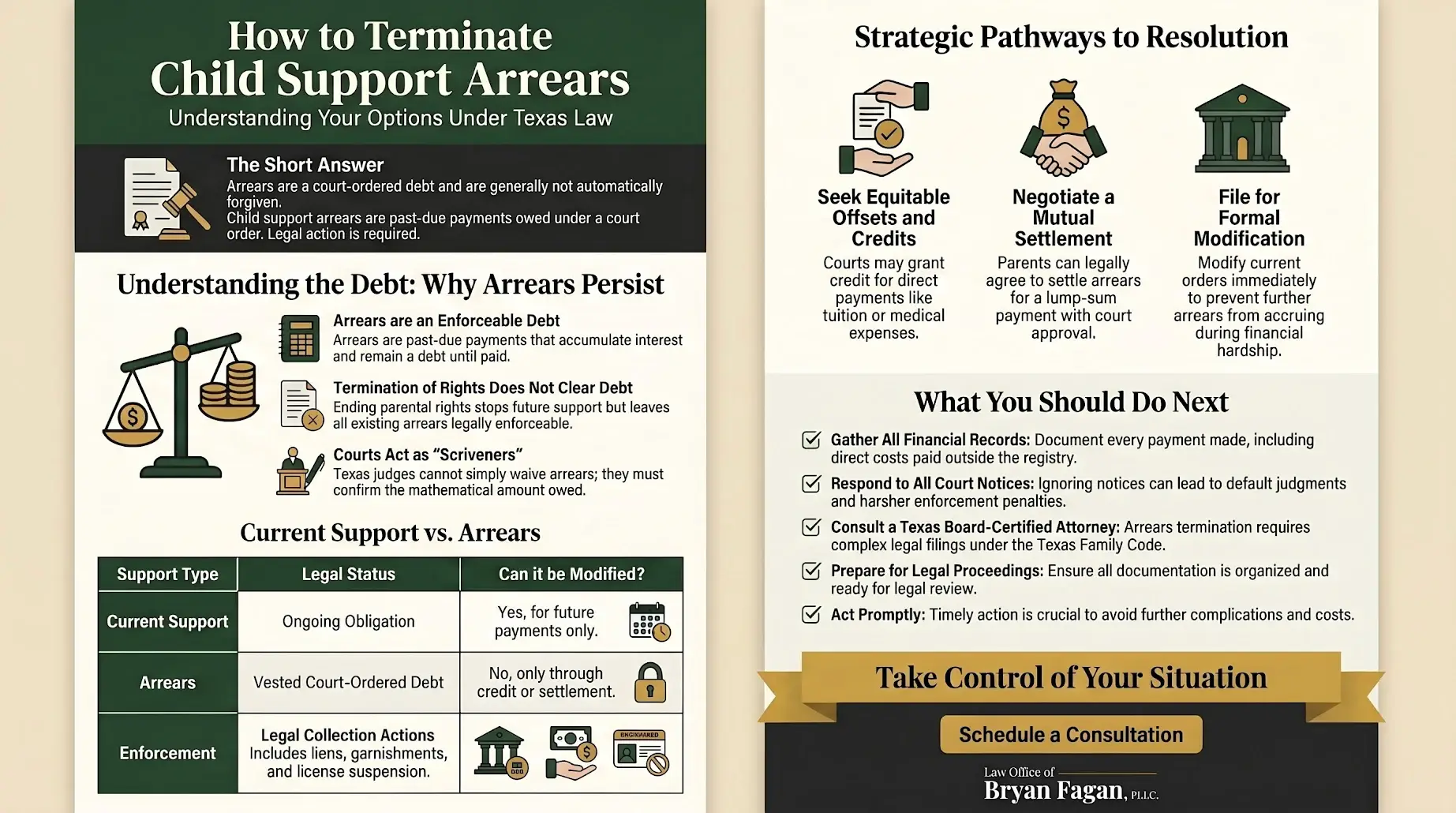
Generally, no. Ending future child support does not automatically erase past-due amounts. Any existing arrears typically remain collectible unless the court orders otherwise under applicable law.
Related Articles
- Child Support Arrears Texas: Your 2026 Legal Guide
- How to Enforce Child Support in Texas: Get Payments Now
- Can Child Support Be Waived in Texas? Get Legal Answers
- What Happens if Child Support Is Not Paid Texas
- How Is Child Support Calculated in Texas? 2026 Guide
- Elon Musk’s Child Support Dispute: What It Means for Parents Like You
- What Should I Consider When Comparing Fixed Fee Versus Hourly Rate Child Support Lawyers
- Filing for Child Support in Texas: A Step-by-Step Guide
- Enforcing a Delinquent Texas Child Support Order: The Real Process, Timelines, and Leverage
- Texas Child Support Calculator Explained: How Texas Courts Determine Payments