
Divorce can be one of life’s most difficult transitions—but understanding your rights and the financial landscape under Texas law can make it feel less overwhelming. Let's be honest: when you're facing a divorce, the cost is a huge concern. It's a question that brings a lot of stress to an already challenging time. While there’s no single price tag for a divorce, getting a handle on the factors that drive the final number is the first real step toward taking back control and making smart decisions for your future.
Facing the Financial Realities of Divorce in Texas
This guide is designed to cut through the uncertainty and give you that sense of control. We will walk you through the key financial pieces, from non-negotiable court fees to what you can expect from legal representation, so you can see exactly where the money goes. Think of it as your financial roadmap through this process.
Every divorce is different, but the biggest factor determining the total cost almost always comes down to one thing: the level of conflict between you and your spouse. An amicable, uncontested divorce where you both agree on the major issues will always be more affordable than a drawn-out fight that ends up in front of a judge.
The most powerful tool for controlling the cost of your divorce is reducing conflict wherever possible. Preparation and a willingness to negotiate are your greatest financial assets.
Here are the key financial elements we'll break down:
- Attorney Fees: This is usually the biggest piece of the puzzle. The final cost depends on your attorney’s hourly rate and just how complicated your situation is.
- Court Costs and Filing Fees: These are the standard administrative fees the Texas court system charges to process your divorce paperwork.
- Mediation and Expert Fees: If you need services like mediation to reach an agreement, property appraisals, or child custody evaluations, these costs can add up.
Understanding what goes into each of these categories is the best way to start protecting your financial future as you move forward.
Breaking Down the Average Texas Divorce Cost
When you start thinking about divorce, one of the first questions that likely comes to mind is, "How much is this going to cost?" It's a critical question, and getting a handle on the potential financial commitment is essential for planning your next steps. While every single case has its own unique twists and turns, we can look at some typical cost ranges in Texas to help you set realistic expectations.
The biggest driver of the final price tag almost always comes down to how much you and your spouse can agree on.
A straightforward, uncontested divorce where you've both already worked out the big issues is always going to be the most affordable way forward. On the flip side, a contested divorce—where there are serious disagreements over kids, property, or support—is going to require a lot more time, negotiation, and legal work. Naturally, that drives up the expense.
This chart really puts into perspective the main financial worries people have when facing a divorce. Attorney fees and court costs are immediate concerns, but the long-term impact on financial security is what keeps many people up at night.
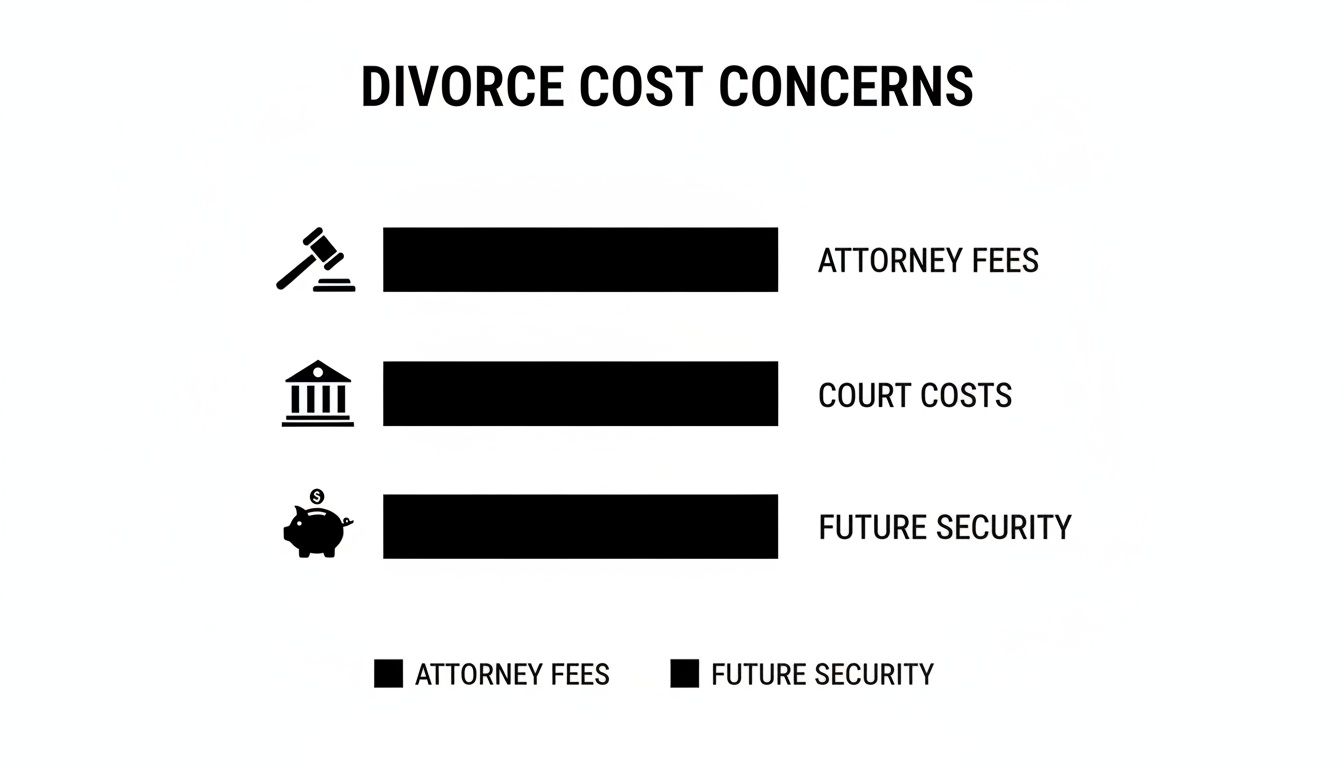
What this shows is that beyond just paying the bills to get the divorce finalized, the real anxiety for many is about what their financial future will look like. It’s a powerful reminder of why getting a fair and well-thought-out settlement is so important.
Estimated Texas Divorce Cost Scenarios
To give you a clearer picture, let's look at how these factors play out in real-world numbers. The table below outlines some common divorce scenarios in Texas and their typical cost ranges, highlighting what makes one more expensive than another.
| Divorce Scenario | Typical Cost Range | Key Influencing Factors |
|---|---|---|
| Simple Uncontested Divorce (No Children) | $3,000 – $8,000 | Full agreement on all issues; minimal attorney involvement; simple property division. |
| Uncontested Divorce (With Children) | $5,000 – $12,000 | Agreement on custody and support; requires drafting a more complex possession order. |
| Moderately Contested Divorce | $12,000 – $25,000 | Disputes over some property or custody issues; requires mediation; more negotiation time. |
| Highly Contested Divorce (With Litigation) | $25,000+ | Major disputes over complex assets, business valuations, or child custody; requires court hearings, depositions, and potentially a trial. |
Keep in mind these are estimates. The final cost will always hinge on the unique details of your situation and the choices you and your spouse make along the way.
How Attorney Fees Shape the Total Cost
So, where does most of that money go? For the vast majority of cases, attorney fees make up the largest chunk of the total cost.
Most family law attorneys in Texas work on an hourly basis, billing for the time they spend on every aspect of your case. This includes everything from phone calls and emails to drafting documents, negotiating with the other side, and appearing in court.
You can learn more about how Texas family law attorneys bill for their services in our detailed guide.
Once you understand this structure, it’s easy to see how reducing conflict directly saves you money. Every argument you avoid and every issue you resolve collaboratively with your spouse means fewer hours your attorney needs to bill. In the long run, working toward an agreement is the single best way to keep your legal fees in check.
The Key Factors That Drive Up Divorce Costs
Understanding what’s really behind the final bill in a Texas divorce is the first step toward getting a handle on it. The total cost can feel like one big, intimidating number, but it’s actually made up of several moving parts. When you break these down, you can see exactly where your money is going—and, more importantly, where you have the most control.

Without a doubt, the largest slice of the pie will almost always be attorney fees. Most family law attorneys bill by the hour, which means you’re paying for the time they spend on your case. That includes everything from phone calls and emails to drafting documents, negotiating with the other side, and showing up in court.
Think of it like hiring a contractor to build a house. The more complex the design and the more changes you make along the way, the more hours they have to bill. It's the exact same principle in a divorce. Every single disagreement that requires your attorney to step in adds to that final invoice.
Attorney Fees and Hourly Billing
Your attorney's hourly rate and the number of contested issues you and your spouse have to work through are the two biggest things that determine the final cost of divorce in Texas. You'll see billing rates anywhere from $100 to over $500 per hour, depending on an attorney's experience, reputation, and where they practice. Nationally, the average for a family law attorney is around $270 per hour, with the total cost per divorce often landing between $11,300 and $12,500. You can discover more insights about divorce budget planning on familylaw-tx.com.
This hourly model is precisely why lowering the conflict level is the single best cost-saving strategy you have. An agreement you both reach after a few hours of negotiation is exponentially cheaper than a drawn-out fight that takes months—and dozens of attorney hours—to settle.
Court Filing Fees
Before your divorce can even get started, you have to pay the court's filing fees. This is just a standard administrative cost the county charges to officially open your case file. Here in Texas, these fees usually run between $250 and $400, though it can vary a bit depending on which county you're in.
While it's one of the smaller line items, it's a non-negotiable first step. It's also worth remembering this fee just covers the initial filing. Other related costs, like paying a process server to formally deliver the divorce papers to your spouse, are separate.
Mediation and Expert Witness Costs
Many of the expenses in a divorce come from needing third-party professionals to help sort out disputes or provide clarity on complicated issues. These costs are especially common in contested cases and can really add up, tacking a significant amount onto your final bill.
"Mediation is often the bridge between a costly court battle and an affordable resolution. It empowers you and your spouse to craft your own agreement with the help of a neutral guide, saving both money and emotional strain."
Here are a few of the most common third-party costs you might encounter:
- Mediation Fees: Texas courts often require couples to try mediation before they’ll let a case go to trial. A professional mediator acts as a neutral guide to help you and your spouse negotiate a settlement. The cost is typically split between both of you and is far, far cheaper than litigating in court.
- Expert Witness Fees: If you can't agree on the value of a major asset—like a family business, real estate, or a complex investment portfolio—you might need to hire an expert. A forensic accountant, for example, can dig into the financial records and provide an objective, professional valuation for the court.
- Custody Evaluator Fees: In really contentious custody battles, a judge might appoint a custody evaluator. This is a neutral expert who conducts a deep-dive investigation into the family's situation and then makes a recommendation to the judge on what's in the children's best interest. A county-run evaluation might cost $1,000–$2,500, but a private evaluator can cost as much as $15,000.
How Children and Property Division Affect Your Bottom Line
While things like attorney hours and court filing fees build the basic cost structure of any divorce, two areas can make expenses skyrocket like nothing else: disagreements over your children and the division of your property.
These are almost always the most emotionally charged parts of a divorce, and it’s that conflict that ends up inflating the final bill. When emotions are running high, it's easy for negotiations to grind to a halt. That stall requires more time, more back-and-forth from the lawyers, and ultimately, more money out of your pocket.
The good news is that the Texas Family Code gives us a clear road map for resolving these issues. The key is navigating them with a level head and a willingness to find some common ground.
The Financial Impact of Child-Related Disputes
When you have kids, your divorce decree has to spell out custody (conservatorship), visitation schedules (possession and access), and child support. If you and your spouse can sit down and create a parenting plan that you both agree on, the process is much smoother and far less expensive.
But when you can’t agree? The costs start to multiply—fast.
Let’s look at a tale of two divorces:
- Cooperative Parents: They might need a few mediation sessions and some guidance from their attorneys to draft a parenting plan. They submit it to the court, and the extra cost for handling custody might only be a few thousand dollars for the added negotiation time.
- Contesting Parents: They are completely stuck. A judge might have to order a formal custody evaluation, where a neutral third-party expert interviews everyone involved—parents, kids, maybe even teachers—before making a recommendation to the court. That process alone can easily add $5,000 to $15,000 (or more) to the divorce bill.
That financial ripple effect is huge. With nearly half of all divorces involving kids under 18, these costs are a real factor for many families. Our own experience and industry studies consistently show that divorces with children are thousands of dollars more expensive. The average cost in Texas can jump from around $15,600 without children to $23,500 or more when kids are involved.
How Property Division Drives Up Costs
Texas is a community property state. In simple terms, this means most of the assets and debts you picked up during your marriage belong to both of you. The law says this property needs to be divided in a "just and right" way, but one person's idea of what’s fair can be wildly different from the other's.
Under Texas Family Code Sec. 7.001, the court is tasked with dividing the community estate in a manner that it deems "just and right, having due regard for the rights of each party and any children of the marriage."
The biggest cost drivers here are disagreements over high-value or complicated assets. Think about the marital home—it's often the biggest asset a couple owns and comes with a ton of emotional attachment. Arguments over who gets to keep the house, how to handle a buyout, or even what its fair market value is can drag a divorce out for months. We have a guide that goes into more detail on dividing up the marital home in a Texas divorce.
If one spouse is keeping the house, it's also critical to understand financial options like a mortgage assumption during a divorce, which can dramatically change your future obligations.
Other complex assets—like retirement accounts, stock options, or a family business—often need expensive professional appraisals just to figure out what they're worth. Each of these steps adds another layer of cost to your final bill.
Practical Ways to Keep Your Divorce Costs Down

While it’s easy to feel powerless as the cost of divorce in Texas adds up, the truth is you have more control over the final bill than you might think. The choices you and your spouse make right from the start can dramatically lower your expenses and pave the way for a more peaceful outcome.
This isn’t about "winning" every single argument. It's about shifting your mindset to achieve a fair and efficient resolution. A financially smart divorce preserves your resources so you can start your next chapter on solid ground.
Come Prepared and Organized From Day One
One of the simplest yet most powerful ways to save money is to get organized. Your attorney bills for their time, and every minute they spend hunting down documents or chasing basic information is a minute you’re paying for.
Before you even walk into that first consultation, start gathering as much financial paperwork as you can. Doing this prep work empowers your legal team to dive right into the core issues of your case instead of billing you for administrative legwork.
Here’s a quick checklist of the essential documents to pull together:
- Income Info: Recent pay stubs, W-2s, and tax returns for both of you.
- Property Records: Deeds for any real estate, car titles, and mortgage statements.
- Financial Accounts: Bank statements, retirement account statements (like 401(k)s and IRAs), and any investment portfolio details.
- Debt Statements: Credit card bills, car loan documents, and student loan records.
Having these documents ready not only saves your attorney expensive billable hours but also gives them a clear financial picture from the very beginning. For more financial strategies, we have a helpful guide with more ideas to help pay for your Texas divorce.
Embrace Amicable Ways to Settle
The single biggest driver of divorce costs is conflict. Hands down. Heading to court to fight it out—known as litigation—is always the most expensive, time-consuming, and emotionally draining path you can take.
Fortunately, Texas law actually encourages less confrontational methods, often called Alternative Dispute Resolution (ADR).
Choosing mediation or collaborative divorce isn’t a sign of weakness; it’s a smart financial and emotional decision. These methods put the control back in your hands, allowing you to craft a lasting agreement without the immense cost and stress of a trial.
Think seriously about these powerful alternatives to a courtroom battle:
- Mediation: In mediation, a neutral third-party mediator helps you and your spouse negotiate a mutually acceptable agreement on all the issues. The entire process is confidential, much faster than going to court, and significantly cheaper.
- Collaborative Divorce: This process involves you, your spouse, and your specially trained attorneys all agreeing from the outset to resolve everything outside of court. It’s a team-based approach focused entirely on finding a settlement that works for everyone.
Both of these routes are designed to dial down the hostility and foster cooperation. That directly translates to lower legal fees and, just as importantly, a more stable co-parenting relationship for the future.
When you’re staring down the path of a divorce, it can feel like one of the most overwhelming times of your life. It’s completely natural for the cost of divorce in Texas to be a major worry weighing on your mind. But here’s the thing: knowledge and preparation are your best friends in this situation. The very first step to getting a handle on the process—and protecting your financial future—is understanding exactly where the costs are coming from.
Believe it or not, the most powerful tool you have for keeping costs down isn’t some complicated legal maneuver; it’s a personal choice. It’s about doing everything you can to lower the temperature and reduce conflict. Every single issue you and your spouse can agree on without a fight is money directly back in your pocket and time saved. You don't have to figure all this out by yourself.
Understanding your options is the first step toward a resolution that protects both your emotional and financial well-being. A peaceful settlement is the most valuable asset you can achieve.
Looking into alternatives like mediation, or even just sitting down to focus on what truly matters to both of you, can clear the way for a fair and reasonable outcome. By taking a smart, informed approach, you can move forward with your head held high, ready to start your next chapter.
If you need someone to help you navigate your specific circumstances, contact The Law Office of Bryan Fagan today for a free consultation. We’re here to help you get a fair outcome with the compassion and expertise you deserve.
Answering Your Top Questions About Texas Divorce Costs
When you're thinking about divorce, the financial side of things can feel like a huge unknown. It’s totally normal to have a lot of specific questions pop up as you try to plan for what’s ahead. Let's clear up some of the most common questions we hear about the cost of divorce in Texas to give you more confidence and a clearer picture.
Our goal here is to cut through the confusion and give you the straightforward answers you need to make smart decisions for your future.
Is an Uncontested Divorce Really Cheaper in Texas?
Yes, absolutely. An uncontested divorce is, without a doubt, the most affordable path to ending a marriage in Texas.
When you and your spouse can agree on all the big issues—like how to divide property, whether anyone needs spousal support, and what the parenting plan will look like—you sidestep the biggest driver of legal fees: conflict. The process shifts from fighting in court to simply getting the legal paperwork done correctly. This teamwork can save you tens of thousands of dollars compared to a contested divorce that gets bogged down in negotiations, hearings, and potentially a full-blown trial.
Can I Make My Spouse Pay My Attorney Fees?
A Texas judge can order one spouse to cover the other's attorney fees, but you should never count on it. It’s not a guarantee.
This is most likely to happen when there's a major gap in income between you and your spouse, which ensures both of you have the resources for proper legal help. A judge might also do it to penalize a spouse who is acting in bad faith—for example, by hiding assets or intentionally dragging things out. Still, you should always budget as if you'll be paying your own way. Assuming a judge will make your spouse pay is a risky gamble.
How Does Mediation Actually Lower Divorce Costs?
Mediation is one of the most powerful tools available for keeping the cost of divorce in Texas under control. Think of it as a structured negotiation, guided by a neutral third-party mediator, designed to help you and your spouse find common ground on your disagreements.
It's far cheaper to hash things out over a few focused mediation sessions than it is to gear up for a courtroom battle. A successful mediation completely bypasses the massive expenses tied to trial preparation, depositions, and multiple court appearances.
In fact, mediation is so effective at helping couples reach a settlement—while saving everyone time, money, and a lot of emotional stress—that many Texas courts require you to try it before they'll even let your case go to a final trial.
What’s the Standard Court Filing Fee in Texas?
To officially kick off a divorce, you'll have to pay a court filing fee. In Texas, this typically runs between $250 and $400, though the exact amount can vary a bit depending on the county you file in.
Just keep in mind, this fee is only the very first step. It’s an administrative cost to get your case on the court's calendar and doesn't include other essential expenses, like paying a process server to formally deliver the divorce papers or any of the attorney fees you'll have along the way.
If you need help navigating divorce, custody, or estate planning in Texas, contact The Law Office of Bryan Fagan today for a free consultation.