 Skip to content
Facing a divorce can be one of life’s most difficult transitions—but understanding your rights under Texas law can make it less overwhelming. It's easy to feel like you're heading for a conflict, but you don't have to navigate this journey through a courtroom battle. Divorce mediation in Texas offers a constructive and frankly, more empowering, alternative. Think of it less like a fight and more like a guided conversation, where you and your spouse craft your own agreements with the help of a neutral professional.
An Introduction to Mediation in Texas Divorce
Divorce is often filled with a deep sense of uncertainty about what comes next. While many people picture heated courtroom dramas, Texas law actually paves a much more peaceful path forward. Mediation provides a private, controlled space where you and your spouse can make the critical decisions about your property, your finances, and most importantly, your children.
Instead of a judge in a black robe handing down orders, a trained mediator is there to facilitate productive discussions and help you find common ground. This process isn't about one person winning and the other losing; it's about building a workable future that serves everyone involved.
In Texas, divorce mediation has become a cornerstone of family law. In fact, most courts will require you to try mediation before they'll even consider letting your case go to a full-blown, expensive trial. This reflects a statewide push towards resolutions that are more efficient and less adversarial. For more context, you can explore some telling Texas divorce and custody statistics on familylaw-tx.com.
Key Benefits of Choosing Mediation
The upsides to this approach are significant, which is why it's so frequently recommended by both judges and attorneys. The entire process is designed to be less stressful and far more collaborative, putting you back in control of the final say. Some of the most compelling benefits include:
- You Control the Outcome: Unlike litigation where a judge decides your fate, mediation keeps the decision-making power exactly where it belongs—in your hands.
- It Is Confidential: Your financial statements and personal family matters stay private. They don't become part of the public record like they would in a courtroom proceeding.
- Preserves Co-Parenting Relationships: By encouraging cooperation instead of fueling conflict, mediation helps lay the groundwork for a healthier, more effective co-parenting dynamic long after the divorce is final.
At its core, this method gives you the tools to dissolve your marriage with dignity and respect. If you want to dig deeper into this, you might find our guide on why you should choose mediation for your divorce helpful.
If you need help navigating divorce, custody, or estate planning in Texas, contact The Law Office of Bryan Fagan today for a free consultation.
A Step-by-Step Guide to the Texas Divorce Mediation Process
It helps to demystify what actually happens in a mediation divorce in Texas. This isn't a courtroom drama full of unpredictable twists; it's a structured negotiation with one clear goal: resolution. Knowing the roadmap can turn anxiety into confidence, empowering you at every turn.
This simple visualization shows the typical path from conflict to a mediated agreement, highlighting how mediation serves as the bridge to a peaceful resolution.
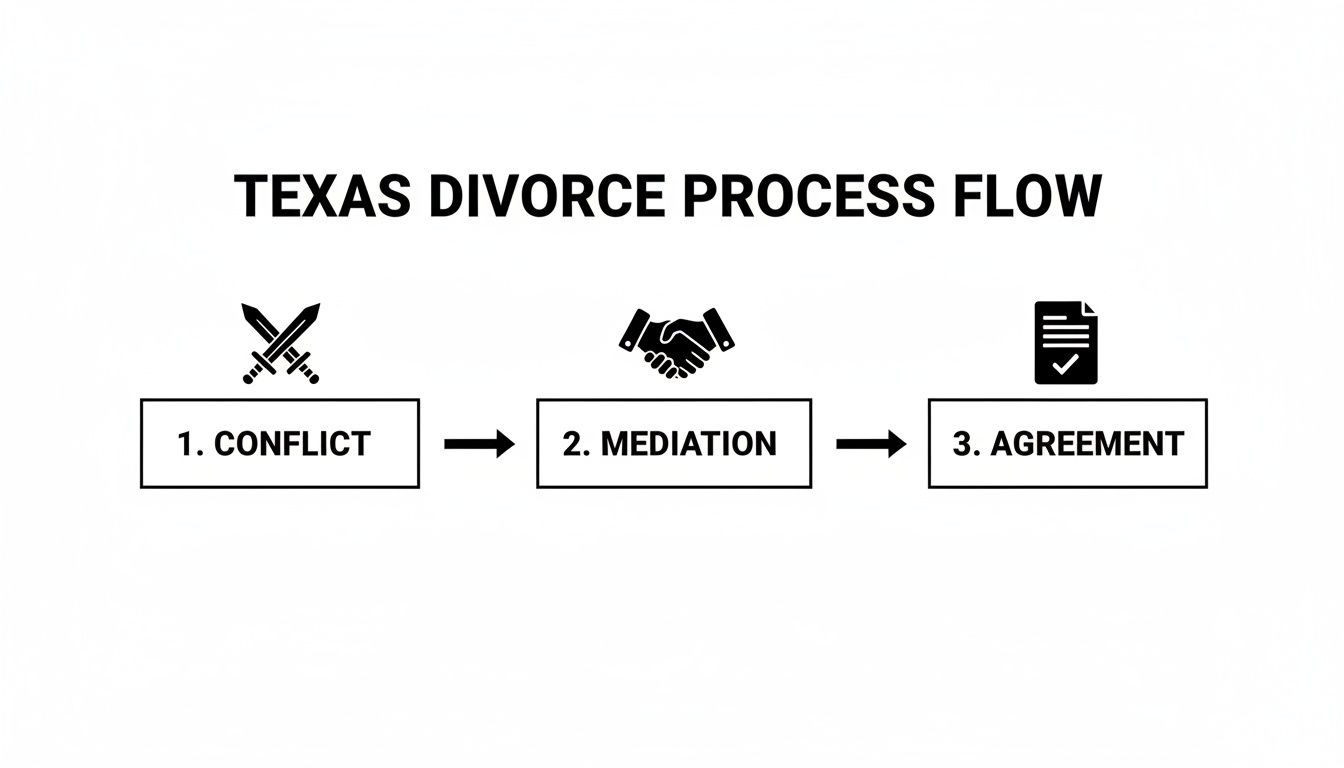
The flow from dispute to handshake illustrates mediation's central role in resolving divorce issues collaboratively so you can move forward with a formal agreement.
The 6 Key Stages of Divorce Mediation in Texas
While every mediation has its own unique rhythm, most follow a predictable set of stages. Understanding this timeline helps you know what to expect and how to prepare for each phase of the negotiation.
| Stage | Objective | Key Actions for You |
|---|---|---|
| 1. The Initial Setup | Select a mediator and schedule the session. | Work with your attorney to agree on a neutral mediator and find a date that works. |
| 2. Opening Statements | Understand the ground rules and set the tone. | Listen to the mediator's introduction and confirm your goals with your attorney. |
| 3. Caucusing & Negotiation | Address key issues through back-and-forth offers. | Discuss offers and counter-offers privately with your attorney; be open to compromise. |
| 4. Problem-Solving | Find creative solutions to sticking points. | Brainstorm options with your attorney and consider the long-term impact of decisions. |
| 5. Drafting the MSA | Formalize the agreed-upon terms in writing. | Meticulously review the Mediated Settlement Agreement (MSA) for accuracy and clarity. |
| 6. Signing the Agreement | Finalize the deal and make it legally binding. | Sign the MSA, making it irrevocable. The agreement is then filed with the court. |
Once these stages are complete, the MSA becomes the foundation for your Final Decree of Divorce, bringing you one step closer to closing this chapter.
Stage 1: The Initial Setup and Mediator Selection
The process usually kicks off once your divorce petition has been filed. You and your spouse might voluntarily agree to mediate, but more often than not, a Texas judge will order you to attend mediation before they'll even consider letting your case go to trial.
The first real step is choosing that neutral, third-party mediator. You, your spouse, and your respective attorneys will collaborate to select a professional who feels like a good fit for your case. This person is typically a family law attorney or a retired judge with specialized training in conflict resolution. Once everyone agrees, the mediator’s office coordinates a date and time that works for all parties.
Stage 2: The Mediation Session Begins
On the day of mediation, you and your attorney will be in one private room, and your spouse and their attorney will be in another. This arrangement, known as caucus-style mediation, is the standard in Texas. It's designed to let you speak freely and confidentially with your lawyer without the added pressure of being in the same room as your spouse.
The mediator starts the day with some opening remarks. They'll explain the rules, emphasize the absolute confidentiality of the process, and clarify their role as a neutral facilitator. They aren't there to take sides or make decisions for you; their only job is to guide the negotiation.
The core principle of mediation is self-determination. The mediator's role isn't to impose a solution but to help both parties discover their own path to an agreement, ensuring the final decisions are truly yours.
Stage 3: Negotiation and Caucusing
The real heart of the process is the back-and-forth negotiation, all managed by the mediator. They will shuttle between the two rooms, carrying offers, counter-offers, and messages. This is where you'll tackle the key issues one by one.
- Property Division: Hammering out how to divide community property and debt.
- Child Custody: Crafting a possession and access schedule that actually works for your family.
- Child Support and Finances: Calculating support obligations and addressing spousal maintenance, if it applies.
A skilled mediator is adept at helping each side see the strengths and weaknesses of their own positions, managing the inevitable emotions, and keeping the focus on practical solutions. They might ask tough questions to help you think through the long-term consequences of your choices, always pushing toward a compromise you can both live with. We dive deeper into these dynamics in our article about mediation in a Texas family law case.
Stage 4: Drafting the Agreement
If you and your spouse manage to reach an agreement on everything, the mediator will draft a Mediated Settlement Agreement (MSA). This is the single most critical document of the day, as it outlines every single term you've agreed upon. You and your attorney will review it with a fine-tooth comb to ensure it perfectly reflects your understanding. As terms get refined, knowing how to redline a contract effectively can be a useful skill for you and your attorney during this collaborative editing phase.
Under Texas Family Code § 6.602, a properly signed MSA is irrevocable. That means once you sign it, you can't just change your mind. This finality is powerful—it provides certainty and keeps the case from falling apart later. After signing, the MSA is filed with the court and becomes the blueprint for your Final Decree of Divorce.
The Financial Realities: Comparing Mediation and Litigation Costs
Let’s be honest: one of the biggest anxieties for anyone facing a divorce is the financial hit. It’s a huge concern, and you deserve a straight answer about what to expect. This is where we can draw a sharp line between the costs of mediation and a traditional courtroom fight here in Texas.
Think of mediation as a strategic investment in a predictable, efficient resolution. Litigation, on the other hand, can quickly feel like you’re writing a blank check with no end date in sight.

The entire point of mediation is to work together and sidestep the expensive, time-sucking motions and hearings that define a court battle. This approach doesn't just save you a significant amount of money; it also cuts down on the profound emotional stress that comes from being locked in a prolonged conflict.
Breaking Down Mediation Costs
In Texas, mediators generally charge for their time in one of two ways: an hourly rate or a flat fee for a half-day or full-day session. The good news is that this cost is almost always split right down the middle between you and your spouse, making it a shared expense from the get-go.
- Hourly Rates: A mediator's hourly rate will depend on their experience and location, but it’s nearly always less than what you’d pay for two separate attorneys to argue for the same amount of time in court.
- Session Fees: Many mediators prefer to offer packages for a half-day (four hours) or a full day (eight hours). This gives you a predictable, upfront cost, which removes the anxiety of watching the clock. It lets everyone in the room focus on what really matters: reaching a solid agreement.
When you stack it up against litigation, the cost-effectiveness of mediation is undeniable. It's not uncommon for mediation to slash the total expense of a divorce by half or more, all while getting the case resolved in a matter of weeks instead of months or years.
While a full-day mediation might cost somewhere between $1,500 to $4,000 per spouse, a litigated divorce can easily soar past $20,000 once you start adding up court fees and ever-increasing attorney bills.
The Hidden Costs of Litigation
The true financial damage of litigation goes way beyond your lawyer’s initial retainer. A court battle is, by its nature, unpredictable. Costs can spiral out of control because of things you simply can't plan for.
A litigated divorce is a process of attrition. It's often not the person with the stronger legal argument who "wins," but the person who can afford to keep fighting the longest. Mediation levels that playing field by focusing on resolution, not resources.
Every single step in the litigation process tacks on another layer of expense. These costs often include:
- Discovery: This is the formal, and often lengthy, process of exchanging information. It can involve costly depositions, where attorneys question witnesses under oath, racking up billable hours.
- Multiple Court Hearings: You and your lawyer might have to show up in court for temporary orders, motions, and other pre-trial issues. Every appearance adds to your legal bill.
- Expert Witness Fees: Need to bring in a forensic accountant to trace assets or a child custody evaluator? Their professional fees can add thousands of dollars to your total cost.
- Trial Preparation: This is the most expensive phase by far. Preparing for and actually conducting a trial can take days and requires an immense amount of your attorney's time.
As you navigate these financial decisions, it’s smart to consider every angle of your marital finances. For example, many clients have questions about protecting themselves from a spouse's financial baggage, including understanding how prenuptial agreements can impact spousal debt.
By choosing mediation, you take back control over these variables and your financial future. If you're worried about the financial side of ending your marriage, our firm offers practical advice on how you are going to pay for your Texas divorce that can give you some much-needed clarity.
Why Texas Courts Champion Mediation: Its Core Benefits
It's no accident that judges across Texas will often order a couple into mediation before they'll even think about hearing a contested divorce case. This isn't just some procedural box to check; it’s a reflection of a deeply held belief in the power of mediation to create better, more lasting outcomes for families.
The legal system in Texas champions this approach because it’s built on benefits that the old way of doing things—fighting it out in court—simply can't match. The big wins in mediation—confidentiality, speed, flexibility, and empowerment—all work together to create a process that’s less about winning a fight and more about building a functional future. For most people, it's the most sensible and humane path forward during one of life's toughest chapters.
The Shield of Confidentiality
One of the most powerful reasons to choose mediation is the absolute privacy it gives you. When a divorce goes to court, your personal and financial life becomes public business. Sensitive details, financial records, and painful accusations are all filed in documents that anyone can look up.
Mediation, on the other hand, is a completely private affair.
Under the Texas Family Code, everything said and any documents created just for the mediation are off-limits. They can't be dragged into court and used as evidence. This legal protection creates a safe harbor where you and your spouse can talk openly without the fear of your words being weaponized against you later.
This level of confidentiality makes it possible to have candid conversations about the truly difficult stuff, from parenting disagreements to complicated financial settlements. It ensures your family's private matters stay exactly that—private.
Gaining Control and Flexibility
In a courtroom, a judge’s hands are often tied. They have to follow rigid legal statutes, which means they might issue a standard possession order or divide property using a strict formula. They have very little room to craft the kind of creative, nuanced solutions that real families actually need.
Mediation flips that script and puts the power back in your hands. You aren't stuck with just the options a judge can order. Instead, you get to design agreements that genuinely fit your unique family situation.
- Custom Parenting Plans: You can build detailed, flexible schedules for holidays, vacations, and school events that actually work for your kids and your co-parenting style, not some one-size-fits-all template.
- Creative Property Division: Need to figure out a plan for one spouse to buy out the other’s share of the family home over a few years? Or split a business in a non-traditional way? Mediation makes those personalized financial arrangements possible.
- Future Planning: You can make agreements about future expenses like college tuition or who pays for a child’s first car—topics a judge might not even have the authority to rule on.
This flexibility empowers you to be the architect of your own post-divorce life, rather than having one forced upon you.
An Efficient and Cost-Effective Path
The speed and lower cost of mediation are a world away from the drawn-out, wallet-draining reality of litigation. A court battle can easily drag on for months, sometimes years, with legal bills piling up at every turn. Mediation is designed to be a far more focused and efficient process, often resolving everything in a single day or just a few sessions.
The widespread practice of Texas courts mandating mediation has completely reshaped how divorces get done. It pushes couples toward settlement in a matter of weeks, avoiding the grueling trench warfare of litigation. While not every county requires it the moment you file, local court rules almost always push for it, which helps conserve precious court resources—a huge need in a state that handles thousands of family law cases every year. To get a better sense of the big picture, you can learn more about Texas divorce trends and mediation's role on divorce.com.
By steering clear of multiple court appearances, exhaustive discovery battles, and the massive expense of a trial, you save a significant amount of money. But just as importantly, you save an immense amount of emotional energy, allowing you and your family to start healing and move forward much sooner.
Divorce mediation offers a structured yet flexible path to resolving disputes without the animosity and expense of a courtroom battle. But how does it stack up against traditional litigation? The differences are stark and can have a profound impact on your family's future.
Mediation vs. Litigation: A Head-to-Head Comparison
To truly appreciate what mediation brings to the table, it's helpful to see it side-by-side with the alternative.
| Feature | Divorce Mediation | Traditional Litigation |
|---|---|---|
| Control | You and your spouse make the final decisions. | A judge makes the final decisions for you. |
| Privacy | Completely confidential. Discussions are private and cannot be used in court. | Public record. All filings and hearings are open to the public. |
| Cost | Significantly less expensive. Fewer legal fees and court costs. | Very expensive. Costs can quickly spiral into tens of thousands of dollars. |
| Timeline | Much faster. Can be resolved in weeks or even a single day. | Very slow. Often takes many months, or even years, to finalize. |
| Tone | Collaborative. Focuses on finding common ground and mutual solutions. | Adversarial. Pits spouses against each other in a "win-lose" battle. |
| Solutions | Flexible & creative. Agreements are tailored to your family's specific needs. | Rigid. Decisions are limited by strict legal statutes. |
| Future Relationship | Preserves co-parenting relationships. Promotes respectful communication. | Damages relationships. Often creates lasting hostility and resentment. |
Choosing between mediation and litigation isn't just a legal decision; it's a choice about how you want to begin the next chapter of your life. While litigation has its place in certain high-conflict situations, for the vast majority of families, mediation offers a more constructive, cost-effective, and empowering way forward.
If you need help navigating divorce, custody, or estate planning in Texas, contact The Law Office of Bryan Fagan today for a free consultation.
Your Checklist for a Successful Mediation Session
Walking into a mediation session prepared is the single most effective thing you can do to turn anxiety into confidence. A good outcome doesn't just happen by accident; it's the direct result of thoughtful, organized preparation. This isn't just about showing up—it's about showing up ready to advocate for your future.
This practical checklist will walk you through exactly what you need to do: gathering your documents, getting clear on your goals, and building a solid strategy with your attorney.

Being organized lets you negotiate from a position of knowledge and strength, making sure no important detail gets overlooked. It also sends a clear message that you’re serious about reaching a fair and final agreement.
Step 1: Gather Your Financial Documents
You can't negotiate what you don't know. Before you even think about stepping into the mediation room, you and your attorney need a complete and accurate picture of your marital estate. Ambiguity is the enemy of progress in these negotiations, so start collecting these essential documents as early as possible.
Here's what your financial prep should include:
- Income Information: Grab recent pay stubs, W-2s, and tax returns for both you and your spouse.
- Asset Documentation: Collect bank statements, retirement account statements (401(k)s, IRAs), investment portfolio summaries, and property deeds.
- Debt Records: Pull together statements for your mortgage, car loans, credit card balances, and any other outstanding loans or liabilities.
- Business Valuations: If a family business is part of the equation, you'll need professional appraisals or detailed financial statements.
Having these figures at your fingertips prevents frustrating delays and empowers you to make smart, informed decisions when offers are on the table.
Step 2: Clarify Your Goals and Priorities
Beyond the cold, hard numbers, mediation is deeply personal. What do you really need to start the next chapter of your life? Answering this question honestly is a huge part of your emotional preparation.
Take some time to think through and write down your goals. It’s incredibly helpful to separate your absolute "must-haves" from your "nice-to-haves." This isn't about creating a list of demands to slap on the table; it’s about gaining clarity on what a successful outcome looks like for you.
Think of your goals as a compass, not a map. A map shows you one rigid path, but a compass lets you adjust your route as you encounter new terrain, always keeping you pointed toward your destination. This kind of flexibility is crucial in mediation.
For instance, is keeping the family home your top priority, or would you rather have a larger share of the retirement assets for long-term security? Is a specific holiday schedule with the kids a non-negotiable? Knowing what truly matters allows your attorney to advocate effectively and helps you recognize a fair compromise when you see one.
Step 3: Develop a Negotiation Strategy with Your Attorney
Your attorney is your most valuable asset when preparing for mediation. They will help you understand your rights under the Texas Family Code and ground your expectations in legal reality—not just what you hope for.
Before the big day, you should meet with your lawyer to:
- Review Your Financials: They will help you organize everything and spot any missing pieces of the puzzle.
- Analyze Potential Outcomes: Your attorney can give you a realistic range of what a judge might order if your case went to trial, which gives you a solid baseline for negotiations.
- Create an Opening Offer: You'll work together to craft a reasonable first proposal that serves as a productive starting point for the discussion.
- Discuss Your "Bottom Line": While you need to be flexible, you should have a clear understanding of your absolute minimum acceptable terms on the most important issues.
This strategic groundwork transforms mediation from a daunting unknown into a manageable negotiation. You'll walk in not just with a binder of documents, but with a clear plan and the confidence to fight for your future.
If you need help navigating divorce, custody, or estate planning in Texas, contact The Law Office of Bryan Fagan today for a free consultation.
When Is Mediation Not the Right Path?
While mediation is an incredibly powerful tool for the vast majority of Texas divorces, it's not a magic wand for every situation. Here at The Law Office of Bryan Fagan, we believe in giving you honest, clear-eyed advice. A big part of that is helping you see when the cooperative setting of mediation just isn't safe or productive for you.
This isn't about avoiding a resolution; it's about picking the right legal path to protect your safety, your rights, and your future. Sometimes, the formal structure and authority of a courtroom aren't just helpful—they're absolutely necessary.
Domestic Violence and a History of Abuse
The biggest red flag, without a doubt, is the presence of domestic violence or a history of abuse. Mediation is built on the idea of a level playing field, where both people can negotiate freely and without being afraid. When one spouse has a history of controlling, intimidating, or hurting the other, that balance of power is completely shattered.
In these situations, the pressure to just "get it over with" can be immense, and a victim of abuse might feel forced to accept a terrible settlement just to make it stop. The court system has safeguards in place—like protective orders and supervised communication—that are specifically designed to protect you in ways mediation simply can't.
Your safety is always priority number one. If there's any history of family violence, litigation provides the structure and protection that mediation lacks. It ensures a judge can step in to keep you and your children safe.
Significant Power Imbalances
Even without physical abuse, a severe power imbalance can grind mediation to a halt. This can show up in a few different ways:
- Financial Control: One spouse has always handled every penny, leaving the other completely in the dark and unable to negotiate from a place of knowledge.
- Emotional Manipulation: A long pattern of emotional or psychological control can make it nearly impossible for one person to stand up for themselves.
- Refusal to Negotiate in Good Faith: If your spouse is determined to be difficult, hide assets, or simply say "no" to every single point, mediation is a dead end. It absolutely requires both people to show up and participate honestly.
When one person is either unable or unwilling to negotiate fairly, the whole process stalls. This is where litigation offers tools like formal discovery to force the disclosure of financial records and court orders to push the case forward when a spouse is being deliberately obstructive. While mediation divorce in Texas is the goal for many, it needs a foundation of mutual respect and good faith—something that, unfortunately, isn't present in every marriage.
Frequently Asked Questions About Divorce Mediation in Texas
Stepping into the world of mediation divorce in Texas is bound to stir up some questions. Feeling a little uncertain is completely normal, and our job is to give you the clear, straightforward answers you need to feel more confident and in control. Here are some of the most common questions we hear from clients just like you.
What Happens If We Don’t Reach an Agreement in Mediation?
This is a big concern for many people, but let's be clear: not reaching a total agreement in mediation is not a failure. Let's say you manage to agree on how to divide your property but just can't see eye-to-eye on a custody schedule. You’ve still made huge progress. This is called a partial agreement.
For whatever is left on the table, your case simply moves forward toward a potential trial. But all the work you did in mediation isn't lost. The partial agreement gets filed with the court, which dramatically narrows down what a judge needs to decide. This still saves you a ton of time, money, and stress compared to battling over every single issue in a courtroom.
Is the Mediated Settlement Agreement Legally Binding?
Yes, absolutely—and this is one of its most powerful aspects. Under Texas Family Code § 6.602, once a Mediated Settlement Agreement (MSA) is signed by you, your spouse, and your respective attorneys, it becomes irrevocable.
What does that mean in plain English? You can't just wake up the next day and change your mind. This finality gives you certainty, ensuring the agreements you worked so hard to reach will be honored by the court and written into your Final Decree of Divorce.
Can I Go to Mediation Without a Lawyer?
Technically, you can, but it is strongly discouraged. Think of your lawyer as your advocate, your legal coach, and your strategic partner all rolled into one. Their job is to make sure your rights are protected and that any deal you sign is fair, enforceable, and legally sound.
Without an experienced attorney in your corner, you could easily agree to terms that aren't in your best interest or overlook critical details that could hurt you financially or affect your rights as a parent for years to come. Having a lawyer by your side isn't just a cost—it's an investment in protecting your future.
How Do We Choose the Right Mediator for Our Case?
Picking the right mediator is usually a joint decision made by you, your spouse, and your attorneys. The best mediators are neutral third parties, often experienced family law attorneys or retired judges who have special training in helping people resolve conflicts.
Here are a few key things to look for:
- Experience: You want someone with a solid track record in Texas family law who has seen it all before.
- Temperament: The mediator should be patient, a good listener, and skilled at keeping things calm when emotions run high.
- Style: Some mediators are very direct and will push for a resolution, while others are more focused on facilitating conversation. Talk with your lawyer about which style would be the best fit for your personalities and the issues in your case.
If you need help navigating divorce, custody, or estate planning in Texas, contact The Law Office of Bryan Fagan today for a free consultation.


