
Guidelines for Property Division Texas rarely feel abstract when you’re standing in the kitchen late at night, staring at the house you once shared and wondering who will still be there when the divorce is over. For many Texas families, the fear isn’t just about money—it’s about whether life will suddenly feel unrecognizable. Will you have to sell the home? Will finances become so tight that everyday routines fall apart? Will your children sense the uncertainty even if you try to shield them from it?
At The Law Office of Bryan Fagan, PLLC, we see these moments every day. Divorce doesn’t begin in a courtroom—it begins in quiet conversations, strained routines, and the weight of not knowing what comes next. Texas law, including Texas Family Code §7.001 and §153.002, sets clear legal standards for property division and the best interest of the child. But understanding how those laws actually play out in real families is where clarity replaces fear. The way property is divided can shape housing stability, financial security, and the emotional tone of a child’s daily life long after the paperwork is signed.
Led by Bryan Joseph Fagan, a South Texas College of Law graduate and a recognized authority on Texas divorce and custody law, our Houston-based firm is guided by one purpose: to help families reclaim peace of mind during life’s most difficult transitions. This article will walk you through how Texas property division works, why it matters far beyond dollars and cents, and how thoughtful legal guidance can protect what matters most—your family’s sense of stability, security, and hope for the future.
Key Takeaways
- Texas is a community property state, meaning most assets acquired during the marriage belong equally to both spouses regardless of whose name appears on the title
- Courts must divide community property in a manner that is “just and right” under Texas Family Code §7.001, which does not automatically mean a 50/50 split
- Separate property includes assets owned before marriage, gifts, and inheritances, but you must prove separate property by clear and convincing evidence
- Commingling separate funds with community funds can destroy your ability to claim that property as separate
- Consulting a Texas divorce attorney before agreeing to any property division terms can protect your long-term financial interests

Your Family’s Future Starts Here
Don’t navigate your legal journey alone. Schedule a consultation now and get the clarity and support you deserve.
What Are the Guidelines for Property Division Texas?
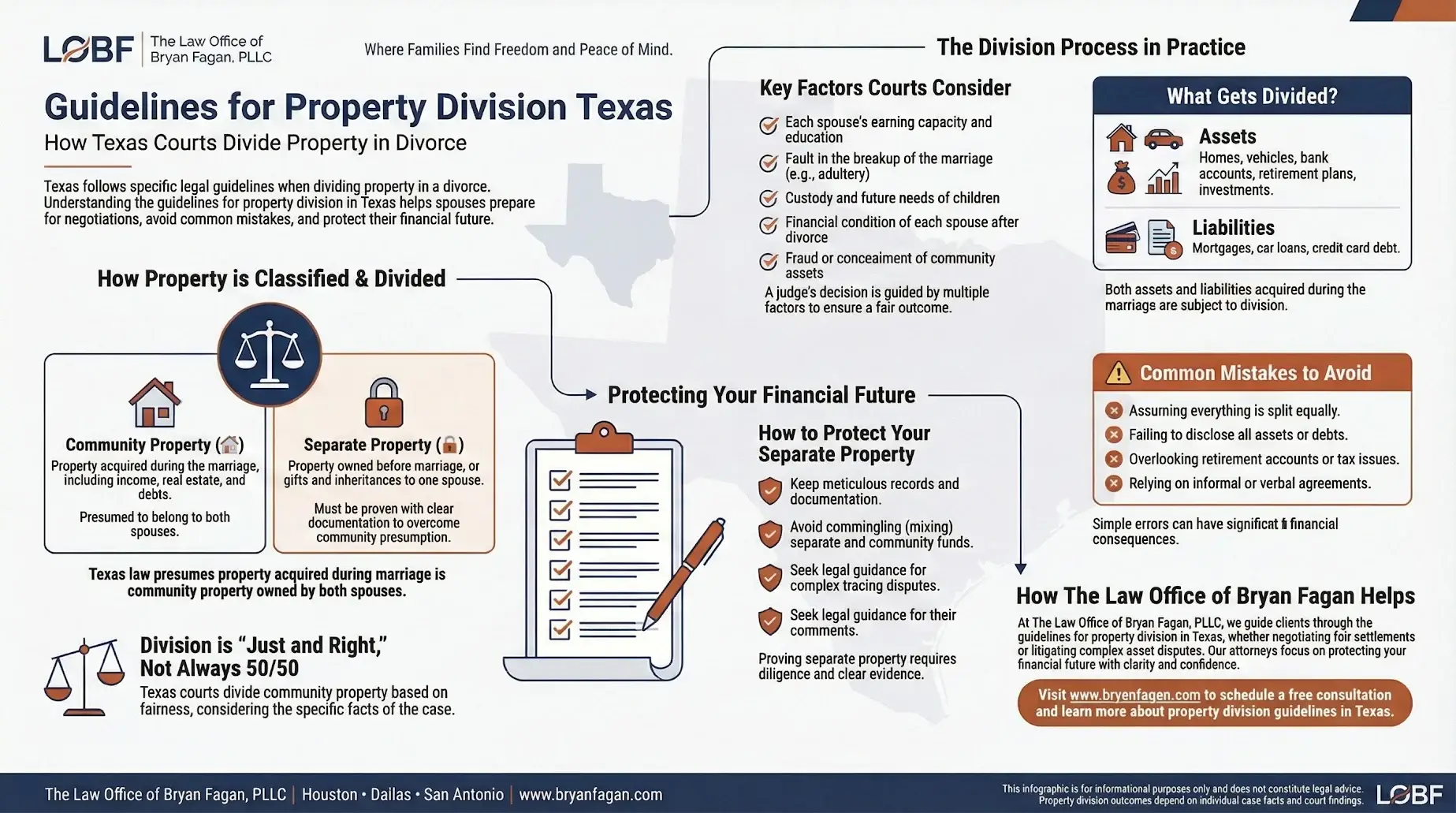
Under Texas law, divorce property division follows a structured legal process that requires spouses to identify everything they own and owe, determine whether each asset or debt is community or separate property, assign accurate values, and then divide the community estate either through agreement or by court order. Texas Family Code §7.001 directs courts to divide community property in a manner that is “just and right,” taking into account the rights of each spouse and any children of the marriage. These Guidelines for Property Division Texas are designed to promote fairness, not rigid formulas, and they reflect the Legislature’s intent to allow flexibility based on the realities of each family’s circumstances.
What often surprises families is that “just and right” does not mean an automatic 50/50 split. Texas judges are granted broad discretion to consider factors such as differences in earning capacity, health conditions, fault in the breakup of the marriage, and child-related responsibilities when dividing property. Recent applications of the Texas Family Code continue to reinforce this discretionary approach, emphasizing that equitable outcomes may require unequal divisions when supported by the evidence. This is why understanding how community and separate property are defined under Texas Family Code §§3.001 and 3.002 is so important, particularly when significant assets or long-term marriages are involved. For a deeper explanation of how courts classify property, readers may find this resource helpful: What Is Considered Separate Property in a Divorce in Texas?.
Rather than a single checklist, the Guidelines for Property Division Texas are best understood as a legal framework built from statutes, decades of Texas case law, and strict evidentiary requirements for proving property claims. The team at the Law Office of Bryan Fagan, PLLC regularly helps families navigate this framework by translating complex legal rules into practical guidance that fits real life. Gaining clarity early in the process can help you anticipate how a Texas district court may view your assets and debts, avoid costly mistakes, and make informed decisions that protect both your financial future and your family’s long-term stability.

Community Property vs. Separate Property in Texas
One of the most important concepts families must understand when applying the Guidelines for Property Division Texas is the distinction between community property and separate property. Texas is a community property state, meaning that assets acquired during the marriage are generally presumed to belong to both spouses, while separate property belongs solely to one spouse. This framework is established under Texas Family Code §§3.001 and 3.002 and continues to guide courts under the most recent updates to the Code. Knowing how property is classified is often the starting point for protecting your financial future during divorce.
Texas law also creates a powerful legal presumption in favor of community property. Under Texas Family Code §3.003, all property possessed by either spouse during or at the end of the marriage is presumed to be community property unless proven otherwise. To overcome this presumption, the spouse claiming separate ownership must provide clear and convincing evidence tracing the asset to a separate source. This is a high evidentiary standard, and courts strictly enforce it, especially in cases involving long marriages, complex finances, or commingled assets. Attorneys at Bryan Fagan’s firm routinely help clients gather and present the documentation needed to meet this burden and avoid having separate property swept into the community estate.
Because these rules can feel overwhelming, education is key. Understanding how courts define and evaluate separate property empowers families to make informed decisions early in the divorce process and avoid costly mistakes later. For a deeper discussion of how Texas law defines separate property and how courts analyze these claims, readers may find this resource helpful: How Is Separate Property Defined in Texas?. By combining compassionate guidance with a clear explanation of Texas property law, the Law Office of Bryan Fagan, PLLC helps clients move forward with confidence, clarity, and peace of mind.
What Qualifies as Community Property
Community property consists of most income and assets acquired by either spouse during the marriage. This includes wages, salaries, and bonuses earned by either spouse while married, regardless of who deposited the paycheck. Real estate purchased during the marriage with community funds is considered community property even if only one spouse’s name appears on the deed.
Retirement accounts and pensions deserve particular attention. Contributions made to individual retirement accounts or employer-sponsored plans during the marriage are community property, even though the account bears only one spouse’s name. Business interests created or substantially grown during the marriage typically constitute part of the community estate as well.
A common misconception involves vehicle titles and bank accounts. The name on the title does not control ownership under Texas law. A car titled solely in one spouse’s name but purchased with marital income is community property subject to division in a divorce.
What Qualifies as Separate Property
Separate property plays a critical role in divorce, and understanding how it is defined under Texas law is essential when applying the Guidelines for Property Division Texas. Texas Family Code §3.001 explains that separate property includes assets owned by a spouse before marriage, property acquired during marriage by gift or inheritance, and certain personal injury recoveries, excluding compensation for lost earning capacity. Texas Family Code §3.003 further establishes a strong presumption that property possessed during the marriage is community property unless a spouse can prove otherwise by clear and convincing evidence, a standard that courts continue to apply consistently under the most recent updates to the Code.
In practical terms, this means assets such as a condominium purchased before marriage and kept in one spouse’s name may remain part of that spouse’s separate estate, just as an inheritance received from a parent during the marriage may qualify as separate property. Items like birthday gifts, jewelry given specifically to one spouse, and portions of personal injury settlements tied to pain and suffering can also fall into this category when properly documented. The attorneys at Bryan Fagan’s firm regularly help clients understand how courts evaluate these distinctions and what evidence is needed to protect separate property claims. For a more detailed explanation, readers may find this resource helpful: What Is Separate Property in Texas?.
What often complicates matters is maintaining the separate character of these assets over time. Commingling separate funds with community accounts or failing to keep records can make it difficult to meet the clear and convincing evidence standard required by Texas law. Additionally, income generated by separate property, such as rent from a premarital home, is generally treated as community property unless a valid marital property agreement states otherwise. By educating families on these nuances, the Law Office of Bryan Fagan, PLLC helps clients make informed decisions that protect their rights, reduce conflict, and support long-term financial stability during and after divorce.
How Texas Courts Decide What Is “Just and Right”
Texas district courts have broad discretion when dividing the marital estate, but this discretion operates within a structured legal framework. The Texas Family Code requires a division that is “just and right,” which means fair under the specific circumstances rather than mathematically equWhen Texas courts divide marital property, they are guided by discretion—but not guesswork. Under Texas Family Code §7.001, judges are required to divide the community estate in a manner that is “just and right,” a standard that focuses on fairness under the family’s unique circumstances rather than a strict mathematical split. These Guidelines for Property Division Texas allow courts to weigh factors such as earning capacity, health concerns, fault in the marriage’s breakup, child-related responsibilities, and the size of each spouse’s separate estate. Recent applications of the Texas Family Code continue to affirm that a fair outcome may be unequal when equity demands it, reinforcing that no two divorces are treated exactly alike.
A critical part of this analysis involves distinguishing community property from separate property, as defined in Texas Family Code §§3.001–3.003. Property owned before marriage, or acquired by gift or inheritance, may qualify as separate property, but only if it can be proven by clear and convincing evidence. Courts carefully evaluate tracing, documentation, and whether commingling has occurred, which often becomes a decisive issue in contested divorces. The attorneys at Bryan Fagan’s firm regularly guide families through these challenges, helping them understand how courts evaluate fairness and ownership under the law. For additional insight into how separate property disputes arise and are resolved, readers may find this resource helpful: Separate Property as an Issue in a Texas Divorce. By understanding how judges apply these principles in real cases, families are better equipped to protect their rights and move forward with clarity and confidence.

Factors Texas Courts Consider
When applying the Guidelines for Property Division Texas, courts take a broad, fact-specific view of what fairness looks like for a particular family rather than relying on rigid formulas. Texas Family Code §7.001 gives judges discretion to divide the community estate in a manner that is “just and right,” and one of the first factors they examine is the length of the marriage. Longer marriages often involve deeper financial interdependence, shared sacrifices, and blended earning histories, which can support a more uneven division when one spouse would otherwise be left at a disadvantage. Judges also closely evaluate each spouse’s current income, future earning capacity, education, and employment opportunities, recognizing that significant disparities may justify awarding a larger share of community property to the spouse with fewer financial prospects.
Health and age are also meaningful considerations under this analysis. When one spouse faces ongoing medical issues, disability, or is nearing retirement with limited resources, courts may adjust the property division to account for those realities. Child custody arrangements frequently intersect with these decisions as well, particularly when stability for children is a concern. Texas courts often consider awarding the marital residence to the primary conservator so children can remain in a familiar environment, even if doing so requires offsetting other assets to reach a fair result. These practical considerations reflect how the Guidelines for Property Division Texas are applied in real life, not just in theory.
Although Texas permits no-fault divorce, fault in the breakup of the marriage can still influence how property is divided. Evidence of adultery, cruelty, or other fault-based conduct may support an unequal division, especially when paired with proof of waste, fraud on the community, or dissipation of marital assets. Courts are also permitted to consider the size and nature of each spouse’s separate property under Texas Family Code §§3.001–3.003, meaning a spouse with substantial separate assets may receive a smaller portion of the community estate to achieve overall equity. For a deeper look at how these factors come together in practice, readers may find this resource helpful: Divorce Property Division in Texas: A Complete Guide to Fair Asset Distribution Under Texas Law.
By understanding how judges weigh these interconnected factors, families are better equipped to set realistic expectations and make informed decisions during divorce. Drawing on decades of experience, the Law Office of Bryan Fagan, PLLC focuses on educating clients about how Texas courts actually apply the law, helping them navigate property division with clarity, compassion, and confidence in their future.
Separate Property Claims and Tracing Issues
Tracing is a critical concept under Texas property law and plays a central role in applying the Guidelines for Property Division Texas. Tracing refers to the process of following the documentary history of funds or assets to prove that a particular item qualifies as separate property under Texas Family Code §3.001. This analysis becomes especially important when separate funds have moved through multiple accounts or were used to purchase assets during the marriage. Because Texas Family Code §3.003 creates a presumption that property possessed during marriage is community property, the spouse claiming separate ownership must overcome that presumption with clear and convincing evidence, a burden courts continue to enforce strictly under current law.
Commingling occurs when separate and community funds are mixed in a way that makes them difficult to distinguish, such as depositing inheritance money into a joint checking account used for household expenses. Once this happens, tracing becomes far more complex and, in some cases, impossible. If a spouse cannot clearly trace the origin of the funds, Texas courts may treat the asset as community property for division purposes, even though its legal character may not have technically changed. This distinction often surprises families and highlights why proactive planning and education are so important when navigating divorce.
Attorneys at Bryan Fagan’s firm regularly see separate property claims weakened by avoidable mistakes, including depositing inherited funds into joint accounts, using community income to pay expenses on separate property without keeping records, or failing to preserve documentation showing how and when an asset was acquired. While forensic accountants can sometimes reconstruct tracing analyses, courts generally view prevention as far more reliable than reconstruction after the fact. These property issues can also intersect with child-related considerations, particularly when housing stability or financial resources affect parenting arrangements governed by Texas Family Code §153.002. For additional insight into how financial and custody decisions overlap, readers may find this resource helpful: Child Custody and Education in Texas. By helping families understand tracing, commingling, and their real-world consequences, the Law Office of Bryan Fagan, PLLC empowers clients to protect their rights and make informed decisions that support both financial security and family stability.
Division of Specific Assets in Texas Divorce
Different types of assets present unique challenges in the property division process. Understanding how courts typically handle specific asset categories helps you prepare for negotiations or trial.
Real Estate and the Marital Home
The family home often carries both financial and emotional significance. Courts have several options for dividing real property: ordering a sale with proceeds divided according to the property settlement, awarding the home to one spouse with an offsetting award of other assets to the other spouse, or allowing one spouse to buy out the other’s interest through refinancing.
When children are involved, courts frequently award the marital home to the primary conservator to maintain stability. However, this depends on the conservator’s ability to afford ongoing mortgage payments, property taxes, and maintenance.
Retirement Accounts and Pensions
Retirement benefits accumulated during the marriage represent community property subject to division. A qualified domestic relations order is typically required to divide employer-sponsored retirement plans like 401(k) accounts without triggering taxes or early withdrawal penalties.
The community property portion includes only contributions and growth during the marriage. If one spouse had an existing retirement account before marriage, tracing is required to separate the premarital portion from the marital portion.
Business Interests and Professional Practices
Closely held businesses present valuation challenges that often require expert testimony. Courts must determine the community’s interest in the business, which may differ from total business value if the enterprise existed before marriage or involved separate property contributions.
Professional practices raise additional questions about personal goodwill versus enterprise goodwill. Personal goodwill tied to the individual practitioner’s reputation may not be divisible, while enterprise goodwill belonging to the business itself is subject to division.
Debts and Liabilities
Courts divide marital debts as part of the community estate along with assets. Debts incurred during the marriage for community benefit are typically allocated between spouses as part of the fair and equitable distribution.
Importantly, the divorce decree does not bind third-party creditors. If the decree orders your spouse to pay a joint credit card but they default, the creditor can still pursue you. Understanding this limitation helps you negotiate protective provisions such as refinancing requirements and indemnification clauses.
Common Myths About Property Division in Texas
Misunderstandings about how Texas handles property division often cause unnecessary stress and lead families to make decisions that do not serve their long-term interests. One of the most common myths is that everything will automatically be divided equally or that property titled in one spouse’s name is off-limits in a divorce. In reality, Texas Family Code §7.001 requires courts to divide community property in a manner that is “just and right,” which allows judges to look beyond labels and consider fairness based on the family’s specific circumstances. The Guidelines for Property Division Texas are designed to promote equity, not assumptions, and relying on myths instead of accurate legal guidance can put valuable rights at risk.
Another frequent source of confusion involves separate property and inheritance. Under Texas Family Code §3.001, certain assets—such as property owned before marriage or received by gift or inheritance—may qualify as separate property, but only if they can be proven with clear and convincing evidence as required by §3.003. Many spouses mistakenly believe inherited property is always protected without question, overlooking how commingling or poor recordkeeping can complicate ownership claims. The attorneys at Bryan Fagan’s firm regularly help families dispel these misconceptions by explaining how courts actually apply the law and what documentation is needed to protect separate assets. For additional clarity on how inherited property is treated under Texas law, readers may find this resource helpful: Who Inherits Separate Property in Texas?.
By replacing myths with accurate information, families are better equipped to make informed decisions during divorce and beyond. Drawing on decades of experience, the Law Office of Bryan Fagan, PLLC focuses on educating clients about how Texas courts truly evaluate property division, helping them avoid costly misunderstandings and move forward with greater confidence and peace of mind.

Myth: “Everything Is Split 50/50”
Texas law does not require equal division. The Texas Family Code mandates a “just and right” division, explicitly authorizing courts to award unequal shares when circumstances warrant. Courts regularly approve 55/45 or 60/40 splits when evidence supports such divisions.
Myth: “My Name on the Title Controls Ownership”
Legal ownership in Texas divorce depends on characterization as community or separate property, not on whose name appears on titles or accounts. A house titled solely in one spouse’s name but purchased with community funds during marriage remains community property.
Myth: “Separate Property Can Never Become Community Property”
While the legal character of separate property does not automatically change, commingling and poor documentation can result in losing separate property claims. Additionally, spouses can intentionally convert separate property to community property through written agreements.
Agreements vs. Court-Ordered Property Division
Texas courts strongly encourage spouses to resolve disputes through negotiation or mediation rather than leaving deeply personal decisions entirely in the hands of a judge. This approach aligns with both the Guidelines for Property Division Texas and the broader public policy reflected in Texas Family Code §6.602, which gives mediated settlement agreements significant legal weight when they meet statutory requirements. Mediation allows families to create tailored solutions that address property division, parenting schedules, and financial concerns in a way that reflects their real priorities instead of a one-size-fits-all court ruling.
Reaching an agreement outside the courtroom offers meaningful advantages. Parents retain control over outcomes, reduce the stress and expense of trial, and avoid the uncertainty that comes with judicial discretion under Texas Family Code §7.001. Just as important, negotiated resolutions can better support co-parenting relationships governed by Texas Family Code §153.002, which prioritizes the best interest of the child. Privacy is another benefit, as mediation keeps sensitive financial and family details out of public court records. For parents seeking a calmer, more constructive path forward, resources like Child Custody Mediation Services in Texas: A Parent’s Complete Guide to Peaceful Custody Resolution provide valuable insight into how mediation works in practice.
Even so, Texas courts do not approve every agreement automatically. Judges retain the authority to reject settlements that are unconscionable, the product of fraud or duress, or contrary to public policy. This is why understanding the long-term legal, financial, and tax implications of any proposed property settlement is critical before signing. Attorneys at Bryan Fagan’s firm regularly help families evaluate negotiated agreements to ensure they are not only enforceable under current Texas law but also truly serve the family’s future stability. With informed guidance, mediation can be a powerful tool for resolving divorce and custody matters with clarity, dignity, and peace of mind.
How a Texas Divorce Attorney Helps Protect Property Rights
Navigating divorce requires more than a surface-level understanding of the law, which is why working with an experienced Texas family law attorney is so important when applying the Guidelines for Property Division Texas. Attorneys help families identify all community and separate property, including complex or easily overlooked assets such as stock options, deferred compensation, closely held business interests, and retirement benefits. By ensuring that the full marital estate is accurately identified, families are better positioned to pursue outcomes that are fair, enforceable, and aligned with Texas Family Code §7.001’s “just and right” standard.
When separate property is at issue, legal representation becomes even more critical. Under Texas Family Code §§3.001 and 3.003, a spouse claiming separate property must meet a clear and convincing evidence standard, often requiring detailed tracing, documentation, and expert support. The attorneys at Bryan Fagan’s firm regularly coordinate with forensic accountants, appraisers, and financial professionals to establish accurate valuations for real estate, businesses, and retirement accounts while protecting clients from unintended commingling or reimbursement pitfalls. This level of preparation helps ensure that property awards reflect both legal rights and long-term financial realities.
Effective advocacy also plays a central role during negotiation and settlement discussions. Skilled counsel builds persuasive arguments grounded in the factors Texas courts consider when determining a just and right division, including earning capacity, health, fault, and child-related needs. Just as important, attorneys help clients avoid agreements that may appear reasonable in the short term but create financial or enforcement problems later. When disputes arise after divorce, understanding how court orders are enforced becomes essential, particularly when property division intersects with custody or possession issues. Families may find additional guidance in this resource: Enforcing Child Custody Orders in Texas: A Complete Guide to Protecting Your Parental Rights.
Understanding the Guidelines for Property Division Texas is an important first step, but successful outcomes depend on strategic advocacy and careful planning. Early consultation with a Texas divorce attorney can prevent costly mistakes, such as signing unfavorable agreements or losing separate property claims due to lack of evidence. By combining legal precision with compassionate guidance, the Law Office of Bryan Fagan, PLLC helps families protect their rights, preserve stability, and move forward with confidence and peace of mind.
Why Choose The Law Office of Bryan Fagan, PLLC
Families facing divorce often need more than legal answers—they need guidance they can trust. Drawing on decades of experience, the Law Office of Bryan Fagan, PLLC has built a reputation for handling complex Texas property division matters involving high-asset estates, closely held businesses, multiple real estate holdings, and substantial retirement accounts. By applying the Guidelines for Property Division Texas within the framework of Texas Family Code §7.001, the firm helps clients understand how courts determine a “just and right” division of community property and how those rules translate into real-world outcomes. This depth of knowledge is reflected not only in successful case results but also in the firm’s commitment to educating families at every stage of the divorce process.
What sets this team apart is an approach that blends legal strategy with practical financial insight. Attorneys routinely collaborate with appraisers, business valuation professionals, and financial planners to ensure assets are accurately valued and long-term interests are protected. Clear, compassionate communication remains central throughout, helping clients make informed decisions even during emotionally difficult moments. For those seeking a broader understanding of what to expect as a case moves forward, resources like Understanding the Texas Divorce Process offer valuable context and reassurance. By combining education, experience, and empathy, Bryan Fagan’s firm continues to empower families to navigate divorce with clarity, confidence, and peace of mind.

Checklist: Guidelines for Property Division Texas
- Identify all assets and debts – Create a comprehensive inventory of everything owned and owed, including real estate, bank accounts, retirement plans, vehicles, business interests, and all liabilities
- Distinguish community vs. separate property – Categorize each item based on when and how it was acquired, noting which assets may require tracing
- Gather documentation early – Collect tax returns, pay stubs, bank statements, loan documents, deeds, titles, retirement statements, and any inheritance or gift paperwork
- Avoid commingling assets – Keep separate property in separate accounts and avoid mixing inherited or premarital funds with marital funds
- Consult a Texas divorce attorney before agreeing to division terms – Have a qualified family law attorney review any proposed property settlement before signing
Conclusion
Divorce can make life feel uncertain in ways you never planned for, especially when the decisions in front of you seem to carry long shadows into the future. Property division isn’t just about who gets what on paper. It’s about creating a foundation that allows your family to move forward with stability, dignity, and a sense of control during a season that can otherwise feel overwhelming. When handled thoughtfully, these decisions can ease tension, reduce conflict, and give everyone—especially children—the breathing room they need to adjust and heal.
If there’s one takeaway worth holding onto, it’s this: you do not have to choose between protecting your financial future and protecting your family’s emotional well-being. Texas law gives you options, and with the right guidance, those options can be shaped into solutions that actually fit your life. Understanding how property division works—and how it connects to the bigger picture of family stability—puts you in a far stronger position than trying to figure it out alone.
At The Law Office of Bryan Fagan, PLLC, our role is to help you replace confusion with clarity and fear with a plan. Whether you’re just beginning to ask questions or already deep into the divorce process, working with an experienced Texas family law attorney can make a meaningful difference in both the outcome and the experience itself. Take a moment to reflect on what stability looks like for your family moving forward—and when you’re ready, we’re here to help you protect it with confidence and compassion.
Frequently Asked Questions
In Texas, property is divided through a process that starts with identifying everything spouses own and owe, classifying each item as community or separate property, valuing the community estate, and then dividing community property in a way the court considers “just and right” under Texas Family Code §7.001. Many couples reach an agreement through negotiation or mediation, which a judge can approve. If no agreement is reached, the court will decide based on the evidence presented and the family’s overall circumstances.
The primary statute governing property division in divorce is Texas Family Code §7.001, which requires courts to divide community property in a “just and right” manner. Other sections of the Texas Family Code define what counts as community property versus separate property and establish the presumption that property possessed during the marriage is community unless proven otherwise.
Not necessarily. In Texas, property ownership in divorce depends on when and how the home was acquired, not whose name is on the deed. If the house was purchased during the marriage with community funds, it is generally community property even if only one spouse’s name appears on the title. If the home was owned before marriage or received as a gift or inheritance, it may be separate property, though reimbursement claims can still arise if community funds were used to pay expenses or make improvements.
The most important steps are keeping clear records and avoiding commingling. Separate property should be held in separate accounts, and documentation such as deeds, inheritance records, gift letters, and bank statements should be preserved. Depositing separate funds into joint accounts or using them for everyday household expenses without proper tracing can make it difficult to prove separate ownership later.
Land can be divided by agreement through deeds, surveys, and buyout arrangements, or by selling the property and dividing the proceeds. If siblings cannot agree, Texas law allows for a partition action, where a court can order the land to be physically divided or sold, depending on what is fair and practical. Because land division involves title issues, access, and potential tax consequences, legal guidance is often he
There is no official “10 10 10 rule” in Texas divorce law. The phrase is often used informally as a decision-making concept, such as considering how a choice will feel in 10 days, 10 months, and 10 years. Texas divorce outcomes are based on statutes and court orders, not informal rules found online. If you’ve heard the term used in a legal context, it’s important to clarify what actually applies under Texas law.
In Texas, separate property is generally not divided in divorce. This includes property owned before marriage, inheritances, and gifts given specifically to one spouse. Certain personal injury recoveries may also qualify as separate property. However, separate assets can still be affected by reimbursement claims, and poor recordkeeping or commingling can make it difficult to prove that an asset is truly separate.
Rule 11 refers to Texas Rule of Civil Procedure 11, which allows parties to make enforceable agreements during a case if the agreement is in writing, signed, and filed with the court, or made in open court and entered into the record. In family law cases, Rule 11 agreements are often used for temporary issues or partial settlements, but they must meet strict requirements to be enforceable.
Dividing estate property usually involves confirming ownership through probate documents, valuing assets accurately, and then distributing property of equal value or selling assets and dividing the proceeds. In some cases, one sibling may keep a particular asset by buying out the others. Clear written agreements and proper transfers are essential, especially when real estate is involved, to avoid future disputes.