 Skip to content
Deciding to end a marriage can be one of life’s most difficult and gut-wrenching transitions. There's no simple yes-or-no answer, and the path forward is often clouded by confusion, sadness, and uncertainty. It usually comes down to recognizing a painful pattern—of unhappiness, disconnection, or conflict—that persists no matter how hard you’ve tried to fix it. This isn't about one bad fight; it's about feeling like the foundation of the partnership has crumbled beyond repair.
If you’re reading this, you are likely looking for clarity in the middle of a very painful time. This guide is here to offer just that, without judgment. We understand this is not a decision anyone makes lightly, as it involves a tangled web of emotional, financial, and family considerations. Our goal is to be a calm, supportive voice to help you look at your situation clearly, from both a personal and a legal standpoint. We'll walk through the persistent signs that a marriage might be over, break down the financial realities under Texas law, and talk honestly about the impact on your well-being and, of course, your children.
Making an informed choice means understanding what a divorce in Texas actually looks like. It’s more than just ending a relationship; it's a legal process with its own set of rules and steps. Simply knowing what those steps are can turn an overwhelming idea into a manageable plan. Throughout this guide, we’ll touch on key principles from the Texas Family Code to help you feel more prepared and in control.
Contemplating the end of your marriage can feel incredibly lonely. It's so important to remember that seeking information is a sign of strength, not failure. You're taking a brave step toward building a stable and healthy future for you and your family.
This process boils down to evaluating a few critical areas of your life:
- Your Emotional and Mental Well-being: How is this relationship impacting your health and happiness day in and day out?
- The Impact on Your Children: Is the tension in your home affecting your kids more than a separation would?
- Financial Stability: What are the community property laws in Texas, and how would your assets and debts be divided?
- Personal Safety: Recognizing when a situation is no longer safe and knowing what legal protections are available to you.
By exploring these topics with both empathy and real-world legal experience, we want to give you the knowledge you need to make the best decision for your future. You are not on this journey alone.
Recognizing the Signs Your Marriage May Be Over
How do you know? How can you tell the difference between a rough patch and a fundamental breakdown of your marriage? This is a question people can struggle with for years, and the answer is rarely a single, dramatic event. More often, it's a slow burn—a pattern of persistent issues that signal the partnership is no longer sustainable.
These signs run much deeper than the occasional argument over chores or finances. They touch the very core of what a marriage is supposed to be.
A major red flag is when you start to feel more like roommates than a married couple. It’s that feeling of living separate, parallel lives under the same roof. Communication shrinks down to just the logistics of who’s picking up the kids or when a bill is due. The emotional intimacy, the shared dreams, and simple affection—it's all gone.
This emotional chasm is often carved out by a complete communication breakdown. It’s not just that conversations are difficult; they feel impossible. Every attempt to talk either escalates into a fight or ends with one or both of you shutting down completely. That pattern leaves you feeling profoundly lonely and misunderstood in your own home.
This chart can help you visualize the path from feeling lost and confused in your marriage to gaining clarity and making an empowered choice about your future.
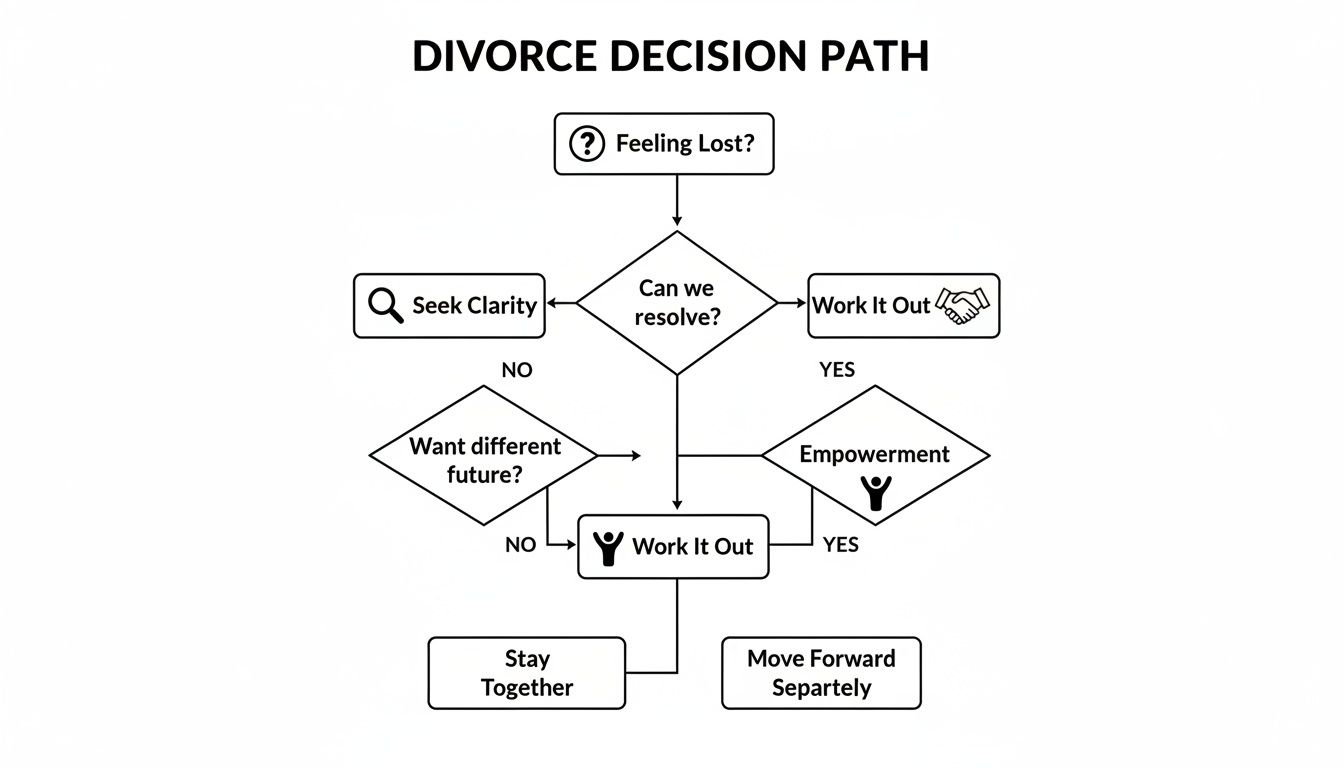
As the flowchart shows, the journey starts with acknowledging the uncertainty but moves toward a resolution through informed steps and, often, with professional guidance.
Distinguishing Marital Challenges from Divorce Red Flags
It's one thing to face challenges; it's another to live with insurmountable red flags. This table can help you see the difference between normal marital speed bumps and the kind of issues that might mean the relationship has run its course.
| Area of Concern | Normal Marital Challenge | Potential Red Flag for Divorce |
|---|---|---|
| Communication | Occasional arguments or misunderstandings. | Complete shutdown, constant fighting, or conversations limited to logistics. |
| Intimacy | Periods of reduced emotional or physical connection due to stress. | A long-term absence of affection, intimacy, and feeling like roommates. |
| Conflict | Disagreements that are eventually resolved, even if difficult. | "The Four Horsemen": contempt, criticism, defensiveness, and stonewalling. |
| Future Vision | Differing opinions on minor goals, like vacation spots or home decor. | Inability to imagine a future together; individual plans that exclude the spouse. |
| Trust | Working through minor breaches of trust, like a forgotten promise. | Major betrayals (infidelity, financial deceit) that shatter the foundation of the relationship. |
Seeing your struggles reflected in the "Red Flag" column doesn't automatically mean divorce is the only answer, but it does signal that the problems are serious and require a deeper evaluation of the marriage's viability.
Chronic Conflict and Resentment
Another major sign is when your home has become a battlefield. If your interactions are defined by criticism, contempt, defensiveness, and stonewalling—what relationship experts famously call the "Four Horsemen"—it’s a sign of deep-seated trouble. This isn't just about disagreeing anymore; it's a dynamic where basic respect has been completely eroded and replaced by hostility.
Over time, this constant, unresolved conflict brews a powerful sense of resentment. You might find yourself replaying past hurts over and over, unable to forgive your spouse for things they did or didn't do. Once resentment takes hold, it poisons any goodwill that's left and can make reconciliation feel utterly impossible. We explore these patterns in more detail in our article on the warning signs of divorce.
A critical sign it may be time to consider divorce is when serious marital problems continue despite sustained efforts to fix them. When issues like repeated infidelity, ongoing emotional abuse, or years of conflict persist despite counseling and clear boundaries, many spouses eventually choose to leave rather than remain in a harmful environment. This is reflected in broader trends; the global share of adults who are divorced has doubled over the past 50 years, and an estimated 41% of first marriages in the U.S. end in divorce. For Texans, this context is legally significant. Texas is a no-fault divorce state, meaning you only need to show that the relationship has become “insupportable” due to conflict, a standard that acknowledges when daily life is defined more by distress than support.
Loss of Trust and Separate Futures
Perhaps the most fundamental sign of all is a profound loss of trust. Trust is the absolute bedrock of a marriage. Once it's shattered—whether by infidelity, financial deception, or a long pattern of broken promises—it is incredibly difficult to rebuild. Without it, you can't feel safe, secure, or vulnerable with your partner.
This erosion of trust often leads to another telling sign: you simply can no longer envision a future together. When you think about your goals, your dreams, and your plans for the next five or ten years, your spouse just isn't in the picture. Instead of a shared path forward, all you can see are two separate journeys.
Sometimes, the strain goes beyond typical communication issues. Underlying neurodevelopmental differences can have a huge impact on a marriage. Understanding how conditions like ADHD and relationship problems can contribute to chronic marital strain is an important piece of the puzzle. When these patterns become deeply ingrained and resistant to change, it may indicate that the very foundation of the marriage has worn away beyond repair.
Prioritizing Your Health, Safety, and Children
A marriage should be a source of strength, not a constant drain that leaves you feeling worn down. When you’re staring down the difficult decision of whether to divorce, one of the most honest questions you can ask is: what is this relationship doing to my health, and to my kids?
If your home is a place of chronic conflict, the toll it takes isn't just emotional. The constant strain can bubble up into serious health problems like anxiety, depression, and a host of other stress-related illnesses. Your well-being isn't a luxury item; it's the foundation of everything. Sometimes, recognizing that the marriage itself is the root cause of your distress is the most powerful reason to consider a change.

The Best Interest of the Child in Texas
Countless parents stay in unhappy marriages "for the kids." It comes from a place of deep love and concern, but it's critical to look at the reality of the situation. Staying together in a home simmering with conflict can be far more damaging to a child's development than the parents separating.
In Texas, family courts make every decision about children based on one guiding principle: the best interest of the child. This isn't just a suggestion; it's the law, spelled out in Texas Family Code § 153.002. It forces judges to put a child’s physical and emotional well-being ahead of everything else.
A home filled with constant fighting, silent tension, or emotional neglect is not a healthy place for a child. A court may very well decide that two separate, peaceful homes are far better for a child's well-being than one toxic household.
When Your Safety Is Non-Negotiable
Beyond the emotional wear-and-tear, there are situations that are simply not up for debate. If your physical safety—or the safety of your children—is at risk, the conversation changes. Domestic abuse, whether physical, emotional, financial, or verbal, isn't something to be endured or "worked through." It's a clear, urgent signal that you need to get out.
Texas law has powerful tools designed to protect victims of family violence. These are legally enforceable orders that can provide immediate safety.
- A Protective Order: This is a court order that can prohibit an abuser from committing further violence, harassing you, or even coming near you, your home, or your children's school.
- A Temporary Restraining Order (TRO): Often one of the first steps in a divorce case, a TRO sets immediate ground rules to stop threats, harassment, or other destructive behavior right from the start.
Your safety is the bottom line. It's non-negotiable. If you are in danger, getting legal protection is a critical, necessary step. For a deeper dive into your options, our guide on domestic violence and staying safe provides detailed information on the legal actions you can take to protect yourself and your family.
An evidence-based sign that it may be time to consider divorce is the toll the marriage takes on your health and your children’s well-being. Studies show that chronic stress inside the home correlates with higher rates of anxiety and depression. When conflict is so intense that it harms children, Texas courts may view a structured custody plan as the healthier option, always prioritizing the “best interest of the child.” This reflects a broader understanding that many people act when the emotional and health costs of staying become too high. Discover more insights about divorce trends from Pew Research Center.
Ultimately, your home should be a safe harbor. If your marriage has turned into a source of fear, anxiety, and constant conflict, it's poisoning the well for everyone living there. Putting your health, safety, and your children's future first isn't selfish. It's a responsible and courageous act.
Understanding the Financial Realities of a Texas Divorce
Money fears are a powerful force. They can keep people stuck in deeply unhappy marriages for years, sometimes even decades. The thought of untangling shared finances, splitting assets, and starting over on your own can feel completely paralyzing. But getting a handle on how Texas law treats the financial side of divorce is the first step toward feeling empowered, not overwhelmed.
The legal process isn’t designed to be a catastrophe. Think of it as a structured framework, a set of rules meant to create a stable and fair financial future for both you and your spouse. Once you learn the basic rules, that fear of the unknown starts to fade.
Community Property vs. Separate Property
Understanding the difference between community property and separate property is the bedrock of how your marital estate will be divided in a Texas divorce.
-
Community Property: This covers almost everything—assets and debts—that you or your spouse acquired from the date of marriage until the date of divorce. It doesn't matter whose name is on the title or who earned the paycheck that bought it. If it was acquired during the marriage, Texas law presumes it belongs to the "community," meaning both of you.
-
Separate Property: This is property that belongs to only one of you. Typically, this includes assets you owned before the marriage. It also covers property you received during the marriage as a specific gift or an inheritance left only to you.
For example, consider a 401(k) account you started five years before you got married. The money in that account on your wedding day is your separate property. But every contribution and all market growth that occurred during the marriage is community property.
How Assets and Debts Are Divided
Under the Texas Family Code, a judge is required to divide your community estate in a way that is “just and right.” While that doesn't automatically mean a perfect 50/50 split, that’s the starting point for almost every case.
Let's look at how this plays out with common assets:
-
The Marital Home: If you bought your house while married, it's community property. Its equity will be divided. This usually means one spouse buys out the other's share, or you sell the house and split the proceeds.
-
Retirement Accounts: All money contributed to pensions, 401(k)s, or IRAs during the marriage is a community asset and is subject to division, no matter whose name is on the account.
-
Credit Card Debt: If credit card debt was accumulated during the marriage for family expenses, it’s almost always considered community debt, and both of you are responsible for it.
A practical sign that it's time to consider divorce is when a marriage becomes economically unworkable, and you need the legal system to protect your financial future. Millions of couples use formal legal processes each year to untangle shared property and debts. For Texans—especially business owners or high-net-worth individuals—this planning is crucial. When you're only staying married to avoid the complexity of dividing retirement accounts or a business, but mistrust makes cooperation unlikely, you are far from alone in turning to the courts to create a clear, enforceable financial structure. Discover more insights about divorce rates from divorce.com.
Spousal Maintenance and Child Support
Beyond splitting what you already have, two other financial factors often come into play: spousal maintenance and child support.
Spousal Maintenance, also known as alimony, is not guaranteed in Texas. A court might order it if one spouse lacks sufficient property from the divorce to meet their "minimum reasonable needs" and meets other strict criteria, such as having been married for 10 years or more.
Child Support, on the other hand, is much more straightforward. It's calculated using a specific formula based on the non-custodial parent's net monthly income and the number of children they are supporting. The purpose is to ensure children receive financial support from both parents.
For a deeper look at this topic, our guide on how to protect your finances in a divorce offers more detailed strategies.
Exploring Your Options Before and During Divorce
Realizing your marriage might be over is a monumental moment, but it doesn't railroad you down a single, inevitable path. The first step toward regaining control is understanding all your options. Whether you're still uncertain or have decided to move forward, there are several avenues to explore, each built for different circumstances.
Alternatives for Couples on the Fence
If you and your spouse are stuck in a painful cycle of wanting to leave one day and wanting to stay the next, a structured, therapeutic approach can help you find a definitive answer.
- Discernment Counseling: This is not typical marriage counseling. It is a short-term process designed to help couples get clear and confident about a direction for their marriage—whether that means reconciliation, separation, or divorce.
- Therapeutic Separation: This involves living apart for a planned period of time, with specific rules and clear goals in place. Guided by a therapist, it gives you both the space to see if the relationship can be repaired without the daily pressures fueling the conflict.
These alternatives can be invaluable, helping you make a final decision you can feel good about, knowing you explored every possibility first.
Sometimes, the most courageous step isn't filing for divorce, but slowing down to consciously decide which path is truly right for your family. Giving yourself the time and space to make an informed choice is an act of profound self-respect and care.
Choosing Your Divorce Process in Texas
If divorce is the necessary path forward, you still have choices about how you get there. The bitter, drawn-out courtroom battle is only one possibility, and for most Texas families, it’s not the best one. The three main ways to handle a divorce are mediation, collaborative divorce, and traditional litigation.
Mediation: A Cooperative Approach
In mediation, you and your spouse sit down with a neutral third-party mediator who helps you negotiate the terms of your divorce. The mediator doesn't make decisions for you; their job is to facilitate a productive conversation and help you find common ground. It's almost always less expensive and faster than going to court.
Collaborative Divorce: A Team-Based Solution
Collaborative divorce is a highly structured process where both you and your spouse—along with your specially trained attorneys—sign an agreement promising not to go to court. You work together as a team, often bringing in financial planners and mental health professionals, to craft a settlement. This approach is designed to preserve amicable relationships, which is a huge benefit if you will be co-parenting.
Traditional Litigation: When the Court Is Necessary
Traditional litigation is the court-based process that becomes necessary when cooperation breaks down, when there are serious issues like domestic violence, or when one spouse refuses to negotiate in good faith. While it can be costly and adversarial, it provides a structured legal framework and a final decision from a judge when you cannot reach an agreement on your own.
Choosing the right path depends on your family’s unique situation, your level of conflict, and what you both hope to achieve.
Taking the First Practical Steps Toward Divorce
Once you've weighed the signs and concluded that divorce is a real possibility, the next question is often, "What do I do now?" This is the moment to shift from emotional reflection to practical preparation.
Taking calm, measured steps now can protect you, your finances, and your family, no matter the final outcome. This isn't about rushing into a final decision; it's about gaining clarity and control.

This process is about being smart and informed. Think of it like preparing for any major financial decision—you wouldn't go into it without having all the relevant information at your fingertips.
Begin Gathering Your Financial Documents
Knowledge is your greatest asset. Before you can understand what a divorce might look like, you need a clear picture of your complete financial situation. Start by making copies of these essential documents.
- Tax Returns: At least the last three to five years of your federal income tax returns.
- Bank Statements: Statements for all checking and savings accounts going back at least a year.
- Investment and Retirement Account Statements: This includes any 401(k)s, IRAs, pensions, or brokerage account statements.
- Loan and Debt Documents: The most recent statements for your mortgage, car loans, student loans, and credit cards.
- Pay Stubs: Recent pay stubs for both you and your spouse, if accessible.
Having these documents organized will be invaluable, whether you end up talking with an attorney, a financial planner, or a mediator. This proactive step helps you see the full scope of your community estate.
Create an Inventory and a Budget
With your documents in hand, the next move is to create an inventory of what you own and what you owe. Make a list of all significant assets (the house, cars, valuable property) and all debts. This exercise helps you see the marital estate from the same perspective a Texas court would.
Just as important is creating a realistic post-divorce budget. What will your income be? What will your expenses look like for housing, utilities, childcare, and healthcare? This tool helps you envision a stable future and figure out what you'll need to achieve it.
Consulting with an experienced Texas family law attorney is the single most important first step you can take. An initial consultation isn't a commitment to file for divorce; it is an information-gathering session to understand your rights, your options, and the legal road ahead.
This initial meeting is your chance to ask tough questions in a completely confidential setting. It allows you to learn about the divorce process, potential outcomes for property division and child custody, and the costs involved.
Taking this step is an intelligent way to protect yourself and your family as you think about the path forward. It’s about gaining clarity and ensuring your next move is a well-informed one.
Frequently Asked Questions About Divorce in Texas
When you're facing the possibility of divorce, your mind is probably swimming with questions. It’s completely normal to feel overwhelmed and unsure about the legal road ahead. Let's walk through some of the most common questions we hear from clients in Texas.
Do I have to prove my spouse did something wrong to get a divorce?
No, you don’t. Texas is a "no-fault" divorce state. This means you can file for divorce simply because the marriage is no longer working. The legal term for this is "insupportability," which means the relationship has broken down due to conflict with no reasonable chance of reconciliation. You do not need to prove fault like adultery or abuse. However, if fault grounds do exist, a judge can consider that when dividing your property.
How long does it take to get a divorce in Texas?
In Texas, there is a mandatory 60-day waiting period after the Original Petition for Divorce is filed. A judge cannot finalize a divorce before this period is over. An uncontested divorce, where you and your spouse agree on all terms, can often be completed shortly after those 60 days. A contested divorce, however, can take anywhere from six months to over a year, depending on the complexity and level of conflict.
Can I make my spouse move out of the house?
During a pending divorce, you cannot unilaterally force your spouse to leave the family home. The house is generally considered community property, meaning both of you have a right to live there until a judge issues an order. The major exception is safety. If there is family violence, you can seek a Temporary Restraining Order (TRO) or a protective order, which can grant you exclusive use of the home and legally require your spouse to leave.
How much does a divorce cost in Texas?
The cost of a Texas divorce can vary dramatically. An amicable, cooperative divorce resolved through mediation might only cost a few thousand dollars. In contrast, a highly contested divorce that goes to trial can be incredibly expensive, with costs easily climbing into the tens of thousands of dollars or more. The two biggest drivers of cost are the level of conflict between you and your spouse and the complexity of your finances and family situation.
If you need help navigating divorce, custody, or estate planning in Texas, contact The Law Office of Bryan Fagan today for a free consultation.


