
Affordable Online Divorce Texas often enters the picture late at night, when the house is finally quiet and you’re staring at your phone wondering how something so personal became so complicated. You’re not looking for drama or a courtroom battle—you’re looking for relief. A way out that doesn’t drain your bank account, tear your family apart, or leave you feeling like you made a mistake you can’t undo. That moment of searching isn’t about being cheap; it’s about wanting peace without chaos.
At The Law Office of Bryan Fagan, PLLC, we’ve seen this moment play out countless times. A parent who wants to do the right thing. A spouse who hopes an online option will keep emotions low and costs predictable. A family trying to move forward without more damage. Texas law allows certain divorces to be handled online, but what many people don’t realize is that affordability in divorce doesn’t come from technology alone—it comes from understanding what Texas courts actually require and where shortcuts quietly create long-term problems. Under Texas Family Code §153.002, courts focus on stability, safety, and the overall well-being of children, even in cases that seem simple on the surface.
Led by Bryan Joseph Fagan, a South Texas College of Law graduate and recognized authority on Texas divorce and custody law, our firm exists for moments like this. Our purpose is to empower families to reclaim freedom and peace of mind during life’s hardest transitions by educating them, simplifying complex legal choices, and protecting what matters most. In this article, we’ll walk you through what Affordable Online Divorce Texas truly means, when it works, when it doesn’t, and how thoughtful legal guidance can help you move forward with clarity instead of regret—so the next chapter of your life starts on solid ground.
Key Takeaways
- Affordable online divorce in Texas works only for fully uncontested cases where both spouses agree completely on property division, debt allocation, child custody, child support, and spousal maintenance before filing.
- Texas requires a mandatory 60-day waiting period for all divorces—no online service can speed this up, regardless of what advertisements claim.
- Online divorce platforms typically cost $300–$600 for document preparation, but court fees, county requirements, and potential errors can significantly increase total costs.
- Generic online divorce forms often fail Texas-specific requirements, including community property rules, QDRO provisions for retirement accounts, and county standing orders.
- A limited-scope attorney review ($400–$600) can prevent thousands in post-divorce enforcement costs while preserving most of your savings.

Your Family’s Future Starts Here
Don’t navigate your legal journey alone. Schedule a consultation now and get the clarity and support you deserve.
Affordable Online Divorce Texas: What It Really Means
An Affordable Online Divorce Texas generally involves using Texas-approved electronic filing systems and document preparation services to complete an uncontested divorce without traditional hourly attorney representation. Texas courts permit electronic filing through eFileTexas, but the authority to grant a divorce still comes from the Texas Family Code. Under Texas Family Code §6.001 and §7.001, spouses must establish legally valid grounds for divorce and present a property division the court considers “just and right,” even when everything is agreed. Technology can simplify paperwork and submission, but it does not replace the legal standards a Texas judge must apply before approving a Final Decree of Divorce.
What many families miss is that affordability does not come from the platform itself—it comes from agreement. Online tools can help prepare and file documents, but they cannot negotiate unresolved disputes, interpret how Texas community property law applies to retirement accounts, or determine whether decisions involving children meet the statutory best-interest standard in Texas Family Code §153.002. If spouses disagree about who keeps the house, how debts are divided, or how conservatorship and possession should work, no online system can resolve those issues without mediation, attorney involvement, or court action.
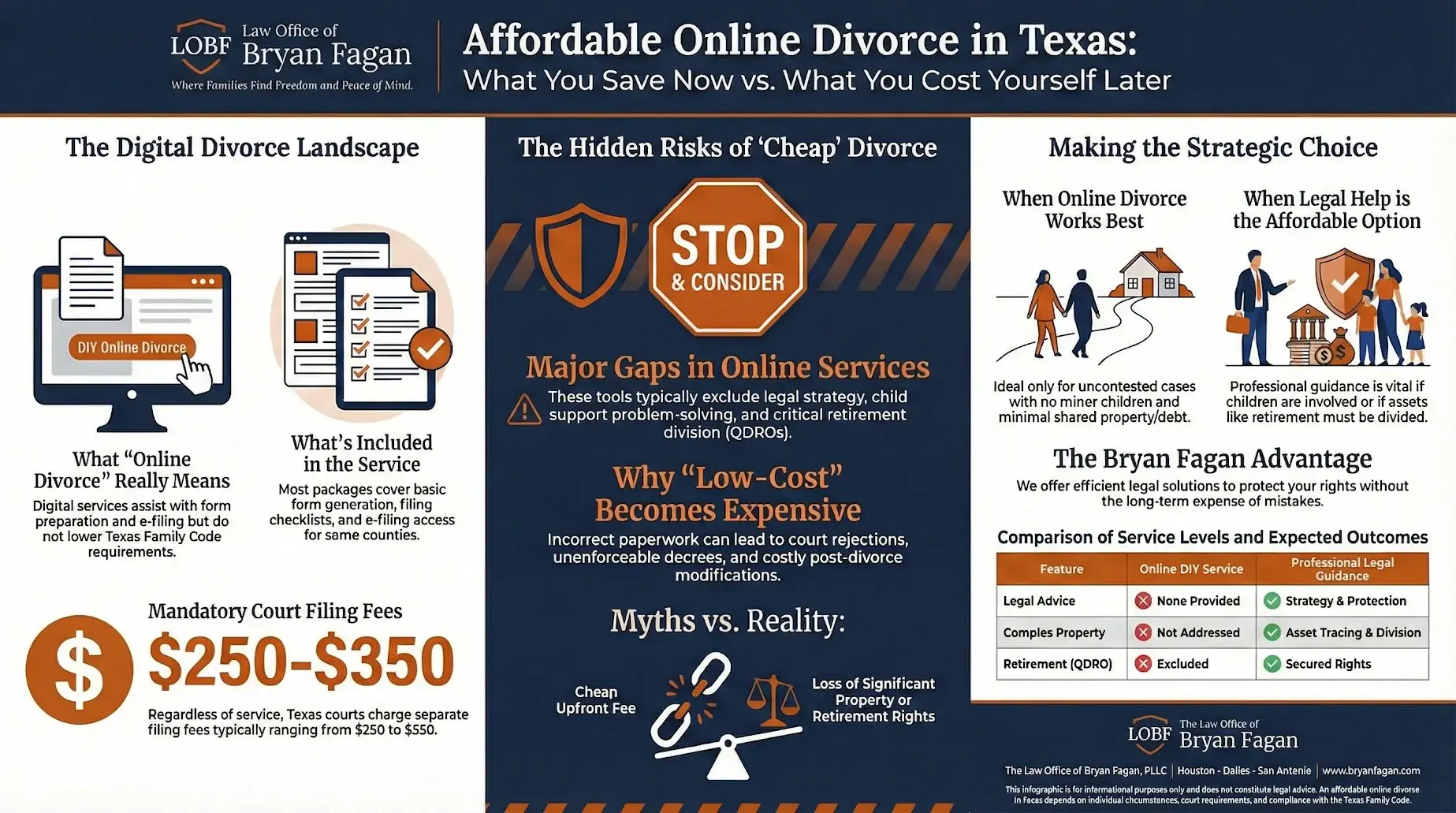
From a practical cost standpoint, an Affordable Online Divorce Texas often includes several predictable expenses. Document preparation services commonly range from $300 to $600, court filing fees typically fall between $250 and $350 depending on the county, and service of process—when a waiver is not signed—can add another $50 to $100. For couples who truly qualify for an uncontested divorce, the total often lands between $600 and $1,050. By comparison, a contested divorce with full attorney representation frequently reaches $5,000 to $15,000 or more, especially when disputes require multiple hearings or detailed evidence under Texas Family Code Chapters 7 and 153.
Attorneys at our firm often emphasize that these savings are only real if the case remains uncontested from start to finish and the documents comply with current Texas law. Errors in drafting property provisions under Chapter 7 or parenting provisions under Chapter 153 can lead to enforcement actions or modification cases that quickly erase any upfront savings. For that reason, many families choose to pair online tools with limited-scope legal guidance to ensure their agreements are enforceable and future-proof.
For families in the Greenway Parks area who want cost-conscious guidance without sacrificing protection, our page on affordable divorce lawyers serving Greenway Parks explains how flat-fee and limited-scope options can help safeguard both finances and long-term stability. You may also find our Texas divorce process guide helpful for understanding how uncontested and contested divorces differ under the Texas Family Code. By approaching online divorce with clear agreements, accurate legal information, and strategic support when appropriate, families are far more likely to achieve true affordability and lasting peace of mind.

Is an Affordable Online Divorce Actually Possible in Texas?
An Affordable Online Divorce Texas is possible, but only when very specific legal conditions are met. Texas law does not distinguish between an online divorce and a traditional one when it comes to legal requirements—the court must still approve every divorce. Under Texas Family Code §6.001, a valid ground for divorce must be established, and under §7.001, the judge must find that the division of marital property is “just and right.” No filing platform or software can bypass these statutory obligations, regardless of how streamlined the process may appear.
For an online divorce to remain truly affordable, both spouses must reach complete agreement before anything is filed. That agreement must cover every major issue the court is required to review, including property division, debt allocation, and—when children are involved—conservatorship, possession, and child support. Parenting and support arrangements must comply with the “best interest of the child” standard set out in Texas Family Code §153.002, while child support must follow the statutory guidelines in Chapter 154, including current medical and dental support requirements under §154.181. Spousal maintenance, if applicable, must also meet the eligibility and duration limits imposed by Chapter 8 of the Family Code.
When all of these issues are fully resolved, Texas law refers to the case as an agreed or uncontested divorce. This is the only scenario in which online divorce tools can offer genuine cost savings. If even one issue remains disputed, the case moves out of the online-friendly category and into mediation, negotiation, or litigation—where costs rise quickly. Our legal team often reminds families that online tools assist with paperwork, not decision-making, and affordability disappears the moment a dispute reaches the courtroom.
Texas residency requirements also play a critical role. At least one spouse must have lived in Texas for a minimum of six months and in the county of filing for at least 90 days before the case can be filed, as required by Texas Family Code §6.301. In addition, the mandatory 60-day waiting period begins on the day the petition is filed and cannot be shortened by any online service. Judges are bound by this statutory cooling-off period, even in the most cooperative cases.
For families weighing whether an online approach truly fits their circumstances, our article The pros and cons of filing for divorce online in Texas provides a deeper look at when online tools help—and when they may create hidden risks. You may also find our Texas uncontested divorce guide helpful in understanding how agreed divorces are handled under current Texas law. Whether you think of us as our firm, our attorneys, or trusted Texas family law counsel, the goal remains the same: educating families, protecting futures, and helping you make informed decisions with clarity and confidence.
What Parts of a Texas Divorce Can Be Done Online
An Affordable Online Divorce Texas approach can work because Texas courts permit many procedural steps to be handled electronically through the statewide eFileTexas system, but it is important to understand exactly what can—and cannot—be done online. Texas law still governs every stage of the case, and judges remain responsible for approving the divorce under the requirements set out in the Texas Family Code. Electronic filing is simply a method of submission; it does not change the legal standards that apply to the divorce itself under Texas Family Code §6.001 and §7.001.
Texas courts allow parties to file the Original Petition for Divorce electronically without physically visiting the courthouse, provided the correct form set is used and all statutory requirements are met. Filing fees can also be paid electronically through eFileTexas, although the amount varies by county because each district clerk sets local fees. Once a case is filed, electronic notifications allow spouses to track filings and court activity in real time, offering convenience and transparency that many families appreciate when pursuing an uncontested case.
When a divorce is fully agreed, Texas courts also permit the electronic submission of a signed Final Decree of Divorce for judicial review and approval. Even in these streamlined cases, judges must confirm that the agreement complies with Texas law, including property division requirements under Texas Family Code §7.001 and, when children are involved, conservatorship and support provisions that meet the “best interest of the child” standard in §153.002 and the child support guidelines in Chapter 154. Some online platforms also assist with coordinating service of process through a constable, sheriff, or private process server when a waiver of service is not signed, although responsibility for proper service ultimately remains with the filing party.
It is also important to remember that while eFileTexas itself is free to use, families are still responsible for standard court filing fees and any service-related costs required by their county. Understanding these limits helps prevent surprises and keeps expectations realistic. Our attorneys often encourage families to review educational resources like our Texas divorce process guide to better understand how electronic filing fits into the broader legal framework.
For readers weighing whether online filing is the right choice, our article The benefits and drawbacks of filing for divorce online in Texas provides additional insight into when online tools add convenience and when they may fall short. Whether you hear us referred to as our firm, our legal team, or trusted Texas family law counsel, the goal remains the same: helping families use technology wisely while staying fully compliant with Texas law and protecting their future.
What Cannot Be Done Online in a Texas Divorce
Understanding the limits of online divorce tools is just as important as knowing when they can be helpful. An Affordable Online Divorce Texas approach can work well for families who have already reached full agreement, but online platforms are not a substitute for legal judgment or advocacy. Texas law places real responsibilities on spouses and courts alike, and those responsibilities do not disappear simply because documents are prepared or filed electronically. Under Texas Family Code §7.001, judges must ensure that community property is divided in a manner that is “just and right,” and no automated system can evaluate whether a proposed division truly meets that legal standard.
Online divorce services also cannot provide legal advice. While they may offer step-by-step instructions for completing forms, they are not permitted to analyze your specific circumstances, recommend strategies, or advise you on your rights under the Texas Family Code. Questions involving conservatorship and possession of children must always be evaluated under the “best interest of the child” standard in Texas Family Code §153.002, and child support calculations must comply with Chapter 154, including required medical and dental support provisions under §154.181. These are legal determinations that require judgment, not just data entry, and errors in these areas often lead to costly enforcement or modification proceedings later.
Dispute resolution is another critical limitation. Online platforms cannot resolve disagreements between spouses about property, debts, or children. If there is no agreement, Texas law requires mediation, negotiation through counsel, or court intervention before a divorce can be finalized. This is especially important in cases involving complex assets such as retirement accounts, businesses, or real estate, where Texas-specific drafting is required to avoid unintended consequences. Generic forms frequently fail to address qualified domestic relations orders (QDROs) or properly characterize separate versus community property, exposing families to long-term financial risk.
Post-filing advocacy is also outside the scope of online services. If a court requests clarification, corrections, or additional documentation, there is no representative to respond on your behalf. Families are often surprised to learn that once documents are submitted, they are responsible for navigating any judicial concerns on their own. Our team frequently sees situations where small drafting issues escalate into major delays or additional hearings simply because no one was there to address the court’s questions promptly and accurately.
For families seeking reliable education and protection, our attorneys often recommend pairing online tools with informed legal guidance. Resources like our Texas child support guidelines overview help parents understand how current statutory caps and calculations apply to their situation, including recent updates to the Texas Family Code that affect support obligations. We also encourage families to stay vigilant about online risks; our article on protecting yourself from online impersonation and scams explains how deceptive online practices can create serious legal and financial problems during an already stressful time.
Whether you hear us referred to as our firm, our legal team, or trusted Texas family law counsel, the goal remains the same: to help families move forward with clarity and confidence. By understanding what online divorce services cannot do—and where Texas law requires more than automation—families are better equipped to make decisions that truly protect their futures.

Online Divorce Services in Texas: Costs vs. Risks
Online divorce platforms advertise aggressively on cost, but what do you actually get? Here’s a realistic breakdown:
| Service Level | Typical Cost | What’s Usually Included | What’s Usually Missing |
|---|---|---|---|
| Basic Online Package | $150–$300 | Standard forms, filing instructions | Texas-specific provisions, QDROs, attorney review |
| Mid-Range Package | $300–$500 | Complete forms, e-filing assistance, customer support | Legal advice, complex property documents |
| Attorney-Assisted Online | $400–$600 | Licensed attorney review, Texas-specific drafting | Full representation, contested case handling |
Why Generic Forms Fail Texas Requirements:
Texas is a community property state, which affects how property division must be characterized in your decree. National online platforms often use generic language that doesn’t properly address:
- Community vs. separate property characterization under Texas Family Code § 3.001
- County-specific standing orders (many Texas counties require these attached to your petition)
- Proper QDRO language for retirement account division
- Texas-mandated child support worksheet calculations
- Medical support and dental insurance provisions for children
How “Cheap” Divorces Become Expensive:
I’ve seen too many cases where a $200 online divorce created $5,000+ in post-divorce problems. Common examples include:
- A spouse losing retirement benefits because the decree lacked proper QDRO language
- Parents returning to court because vague possession schedules created constant conflicts
- One spouse discovering hidden debts weren’t properly allocated and becoming liable
- Child support enforcement actions by the Office of the Attorney General of Texas due to calculation errors
The false economy is real: saving $1,000 on document preparation can cost $10,000 in enforcement or modification litigation later.
Affordable Online Divorce Texas With Children
When minor children are involved, affordable online divorce becomes significantly more complex. Texas courts prioritize children’s welfare, and the Texas Family Code imposes detailed requirements that generic online platforms often fail to address properly.
Additional Requirements for Divorces With Children:
- Detailed parenting plans specifying possession schedules, holiday arrangements, decision-making authority, and dispute resolution procedures
- Child support calculations using Texas statutory guidelines (percentage of net resources)
- Medical support provisions including health insurance, uninsured medical expenses, and dental coverage
- Conservatorship designations clarifying whether parents share joint managing conservatorship or one parent has sole managing conservatorship
Why Online Services Struggle With Child-Related Issues:
Automated questionnaires cannot assess what parenting arrangement serves your children’s best interests. They cannot determine whether standard possession order schedules work for your family’s geography or work schedules. They cannot calculate child support deviations for high-income situations or special needs children.
If you have children, consider at minimum a limited-scope attorney review focused specifically on your parenting plan and child support provisions. This targeted review typically costs $400–$600 and can prevent years of custody-related conflict.
Common Mistakes That Make an Online Divorce Not Affordable
The most expensive online divorces are the ones that seemed cheap at filing but created costly problems afterward. Here are the mistakes I see most often:
Omitting Assets or Debts: Online questionnaires ask what you report. If you forget about a 401(k), a credit card, or a jointly-owned vehicle, the decree won’t address it—creating disputes later about who owns what.
Ignoring Retirement Accounts: Dividing retirement accounts requires a Qualified Domestic Relations Order (QDRO) with specific federal and state-compliant language. Generic online packages typically don’t include QDROs, and improper division can trigger tax penalties.
Submitting Unenforceable Provisions: Vague language like “parents will share time equally” creates immediate conflict when parents disagree about what “equally” means. Texas courts expect specific schedules, times, and procedures.
Assuming Judges Correct Mistakes: Texas district courts don’t review your decree for fairness or completeness. If you agree to unfavorable terms or miss required provisions, the judge signs what you submit.
Needing Post-Divorce Modification: Poorly drafted decrees require modification proceedings that cost far more than hiring an attorney initially. Modification requires proving material and substantial change—a significant legal burden.
How to Make an Affordable Online Divorce Texas Actually Work
An Affordable Online Divorce Texas can work well when it is approached with intention, preparation, and a clear understanding of what Texas law actually requires. The families we work with who have the best outcomes are not simply looking for the cheapest option; they take time to create a complete agreement before filing anything with the court. Texas Family Code §6.001 and §7.001 still govern every divorce, meaning spouses must establish proper grounds and present a property division the judge finds “just and right,” regardless of whether documents are prepared online or on paper.
One of the most important strategic steps is finalizing all agreements before filing. Online tools cannot help you “figure it out later,” and Texas courts will not step in to negotiate unresolved issues for you. Questions involving conservatorship, possession, and decision-making for children must meet the “best interest of the child” standard under Texas Family Code §153.002, while child support must comply with Chapter 154, including updated medical and dental support requirements under §154.181. Filing before these issues are fully resolved often leads to delays, rejected decrees, or expensive post-divorce disputes.
Using Texas-specific resources is another key factor in making an online divorce succeed. The Texas State Law Library and local district clerk websites provide forms, instructions, and standing orders that reflect current statutory requirements and county-level rules. Verifying those local requirements before filing helps prevent common mistakes, such as missing standing orders or improper e-filing procedures, that can stall an otherwise uncontested case. Our attorneys frequently point families to educational materials like our Texas divorce process overview to better understand how these steps fit together under the Texas Family Code.
Many families also find that a limited-scope attorney review provides valuable protection without sacrificing affordability. For a predictable flat fee, a Texas divorce attorney can review online-prepared documents, identify compliance issues under Chapters 7, 153, and 154 of the Family Code, and suggest targeted revisions without taking over the entire case. This approach often prevents far more expensive enforcement or modification proceedings later, particularly when property provisions or parenting language are unclear.
Above all, the most successful Affordable Online Divorce Texas cases focus on enforceability rather than speed. A decree that is clear, specific, and grounded in Texas law is far more valuable than one that is finalized quickly but creates confusion or conflict down the road. For families weighing whether an online approach truly fits their situation, our article Is filing for divorce online in Texas the best option for you? offers additional guidance to help you decide with confidence. Whether you hear us described as our firm, our legal team, or trusted Texas family law counsel, the goal remains the same: educating families, protecting futures, and helping you move forward with clarity and peace of mind.

How a Texas Divorce Attorney Helps Keep Online Divorces Affordable
Hiring an attorney doesn’t have to mean abandoning affordability. Many Texas divorce attorneys offer limited-scope representation specifically for online divorce situations:
Document Review and Risk Identification: An attorney reviews your completed forms, identifies missing provisions, and flags Texas-specific compliance issues before filing.
Enforceable Decree Drafting: An experienced attorney ensures your property division, parenting plan, and support provisions contain clear, enforceable language that Texas courts will honor.
Specialized Document Preparation: QDROs, real property transfer documents, and business division agreements require expertise that online platforms don’t provide.
Prevention of Post-Divorce Disputes: The upfront cost of attorney review is almost always less than the cost of returning to court for enforcement or modification.
Flat-Fee Predictability: Many Texas attorneys offer flat-fee uncontested divorce services, allowing you to know exactly what you’ll pay without hourly billing surprises.
Why Choose The Law Office of Bryan Fagan, PLLC
Families exploring Affordable Online Divorce Texas options often want reassurance that saving money does not mean sacrificing protection. Our legal team understands that concern deeply. Texas law still governs every divorce, regardless of how documents are prepared or filed, and courts must apply the same legal standards set out in the Texas Family Code. Under Texas Family Code §6.001 and §7.001, judges must confirm that legal grounds exist and that marital property is divided in a manner that is “just and right.” Those requirements apply whether a case is filed electronically or handled through traditional methods, which is why experienced guidance can make a meaningful difference.
Our approach is built around helping families navigate online divorce tools wisely while staying fully compliant with Texas law. With extensive experience using the eFileTexas system, our attorneys help clients avoid common filing errors that delay cases or result in rejected pleadings. We also offer flat-fee and limited-scope options designed specifically for uncontested divorces, allowing families to maintain predictable costs while ensuring their agreements meet statutory requirements under Chapters 7, 8, 153, and 154 of the Texas Family Code. Careful drafting is especially important when children or significant assets are involved, as unclear language can lead to enforcement actions or modification proceedings long after the divorce is finalized.
Clear, plain-English communication is central to how our firm serves Texas families. We take time to explain your options, your responsibilities, and the potential consequences of each decision, so you can move forward with confidence rather than uncertainty. Whether you need help reviewing online-prepared documents or understanding how electronic filing fits into the broader legal framework, our statewide practice allows us to assist families in every Texas county with consistent, informed guidance.
For readers who want a clearer picture of how online filing fits into the overall process, our guide The Texas divorce process explained offers a helpful step-by-step overview grounded in current Texas law. Ultimately, understanding Affordable Online Divorce Texas means knowing when technology is sufficient and when professional insight protects your investment, your family, and your future.

Checklist: Affordable Online Divorce Texas
Before filing for an online divorce in Texas, confirm the following:
- [ ] Your divorce is fully uncontested: You and your spouse agree completely on property, debt, children, and support
- [ ] You’ve identified county e-filing requirements: Contact your county clerk about standing orders and local procedures
- [ ] You’ve prepared accurate financial information: Complete inventory of assets, debts, income, and retirement accounts
- [ ] You’ve prepared detailed parenting information (if applicable): Possession schedules, decision-making arrangements, and child support calculations
- [ ] You’ve reviewed all documents carefully: Check every form for accuracy before filing
- [ ] You’ve consulted a Texas divorce attorney: At least for document review before final submission
Conclusion
Divorce is rarely just a legal event—it’s a life transition that affects routines, emotions, and the sense of stability every family depends on. If you’ve been exploring affordable online options, it’s because you’re trying to move forward thoughtfully, not recklessly. And that matters. When done with clarity and intention, an affordable approach can absolutely work. When done without understanding Texas law or long-term consequences, it can quietly create stress that lingers long after the paperwork is signed.
One of the most empowering things you can do during this process is slow down just enough to ask the right questions. Does this plan protect my family tomorrow, not just today? Is it clear, enforceable, and built for real life—not just a checkout screen? Those questions are often where peace of mind begins. Affordable solutions are most successful when they’re paired with informed decisions and experienced guidance.
At The Law Office of Bryan Fagan, PLLC, our role isn’t to push you into unnecessary conflict or expense. It’s to help you understand your options, avoid costly missteps, and move forward with confidence. Whether you’re deciding if an online divorce truly fits your situation or you simply want a second set of trained eyes before finalizing anything, working with an experienced Texas family law attorney can make the difference between temporary savings and lasting stability. When you’re ready to take the next step—whatever that looks like for your family—we’re here to help you do it with clarity, compassion, and a little less weight on your shoulders.
Frequently Asked Questions About Affordable Online Divorce Texas
For most people, the cheapest option is an uncontested divorce where both spouses fully agree on property, debts, and any issues involving children before filing. When there is complete agreement and a Waiver of Service is signed, you can avoid many of the expenses tied to hearings and prolonged litigation. That said, “cheap” can quickly become expensive if documents are incomplete, unenforceable, or don’t follow Texas-specific legal requirements.
A Texas online divorce typically involves two main expenses: document preparation and court filing fees. Online services often charge a few hundred dollars for preparing forms, while court filing fees vary by county. Additional costs may apply if formal service of process is required. The most important factor is whether the paperwork is done correctly the first time—fixing mistakes later often costs far more than the initial savings.
Yes, many parts of a Texas divorce can be handled online, including preparing documents and filing through the state’s e-filing system in many counties. However, every divorce still requires a judge’s approval, and Texas law imposes a mandatory waiting period in most cases. Online tools can help with logistics, but they cannot replace the legal requirements of the court.
Online divorce services can be legitimate if they produce accurate, Texas-compliant documents and follow court procedures. What they cannot do is finalize your divorce on their own or bypass Texas law. A divorce is only legally valid when a Texas judge signs the Final Decree of Divorce.
The 10-10-10 rule is not a legal rule in Texas—it’s a decision-making concept. It encourages people to consider how they will feel about a decision in 10 days, 10 months, and 10 years. During divorce, especially when children are involved, this mindset can help parents avoid choices that seem convenient now but create long-term stress or conflict.
Moving out of the marital home can sometimes affect possession schedules, daily parenting involvement, and practical leverage in the case. While safety should always come first, leaving without a plan can create unintended consequences. Before making that decision, it’s wise to understand how it may impact your rights and your child’s stability under Texas law.
Many uncontested divorces in Texas involve very limited court interaction, and some counties do not require a traditional in-person hearing. However, a judge must still review and sign your divorce decree, and some courts require a brief “prove-up” to confirm the details of the case. The process depends on the county and the specific facts of your divorce.
A do-it-yourself online divorce can work best for simple, uncontested cases with no complex assets, no hidden debts, and clear agreements involving children. The biggest risk is relying on generic templates that don’t fully address Texas community property rules, child support requirements, or enforceable parenting language. Many families choose a limited-scope attorney review to balance affordability with protection.
People often refer to a “10-year rule” because the length of a marriage can affect certain financial considerations, including possible eligibility for spousal maintenance in limited situations. It does not guarantee support or automatically entitle one spouse to additional property. Each case depends on specific facts, income levels, and statutory requirements under Texas law.