Skip to content

Have you ever had one of those moments where life shifts in an instant? Maybe it happens at the kitchen table on a quiet Sunday morning—two people who have shared years together looking at each other and saying, “We can do this differently… and we can do it peacefully.” That’s how one Houston couple described the moment they decided to end their marriage. No yelling, no accusations—just an understanding that the next chapter needed to begin. Their very next question was the one most Texans ask right away: What is the Cost of Uncontested Divorce in Texas, and how do we get through this without our entire lives being turned upside down?
At The Law Office of Bryan Fagan, PLLC, we hear stories like this every day. Couples who want closure without chaos. Parents who want stability without unnecessary conflict. Individuals who simply want clarity in a time that feels heavy enough already. Our “why” has always been to empower people to reclaim peace of mind during life’s hardest transitions, and the financial side of divorce is often a huge part of that worry. The good news? An uncontested divorce in Texas can be straightforward, affordable, and far less stressful—when you understand how the process works and what actually drives the cost.
Led by Bryan Joseph Fagan, a South Texas College of Law graduate and recognized authority on Texas divorce and custody law, our firm blends deep legal knowledge with the compassion people deserve during major life changes. With years of hands-on experience navigating Texas Family Code requirements—like the mandatory 60-day waiting period and filing rules—our team knows exactly how to help families avoid unnecessary expenses, delays, and surprises.
This introduction is your starting point: a clear, honest path toward understanding the true cost of an uncontested divorce, what influences that cost, and how the right guidance can make all the difference. If you’re looking for a way forward that feels grounded, predictable, and dignified, you’re in the right place. Let’s walk through this together—step by step—so you can make confident decisions about your future.
Key Takeaways
• The Cost of Uncontested Divorce in Texas is generally far more affordable than a contested case, especially when both spouses remain cooperative.
• Filing fees vary by county, and additional costs—such as notarization, service of process, or QDRO preparation—depend on the assets and issues involved.
• Staying organized, communicating clearly, and resolving issues early can significantly reduce overall divorce expenses.
• DIY divorce may appear cheaper upfront, but errors in paperwork, property division, or child-related provisions often lead to costly corrections later.
• Working with an experienced Texas family law attorney helps ensure your documents comply with the Texas Family Code and local court rules, preventing delays and protecting your financial interests.
• A flat-fee uncontested divorce package provides predictable pricing and peace of mind during a stressful time.
• With the right guidance and information, you can navigate your divorce with clarity, confidence, and dignity—setting the stage for a stable and hopeful next chapter.

Your Family’s Future Starts Here
Don’t navigate your legal journey alone. Schedule a consultation now and get the clarity and support you deserve.
What Is the Cost of Uncontested Divorce in Texas? (Short Answer)
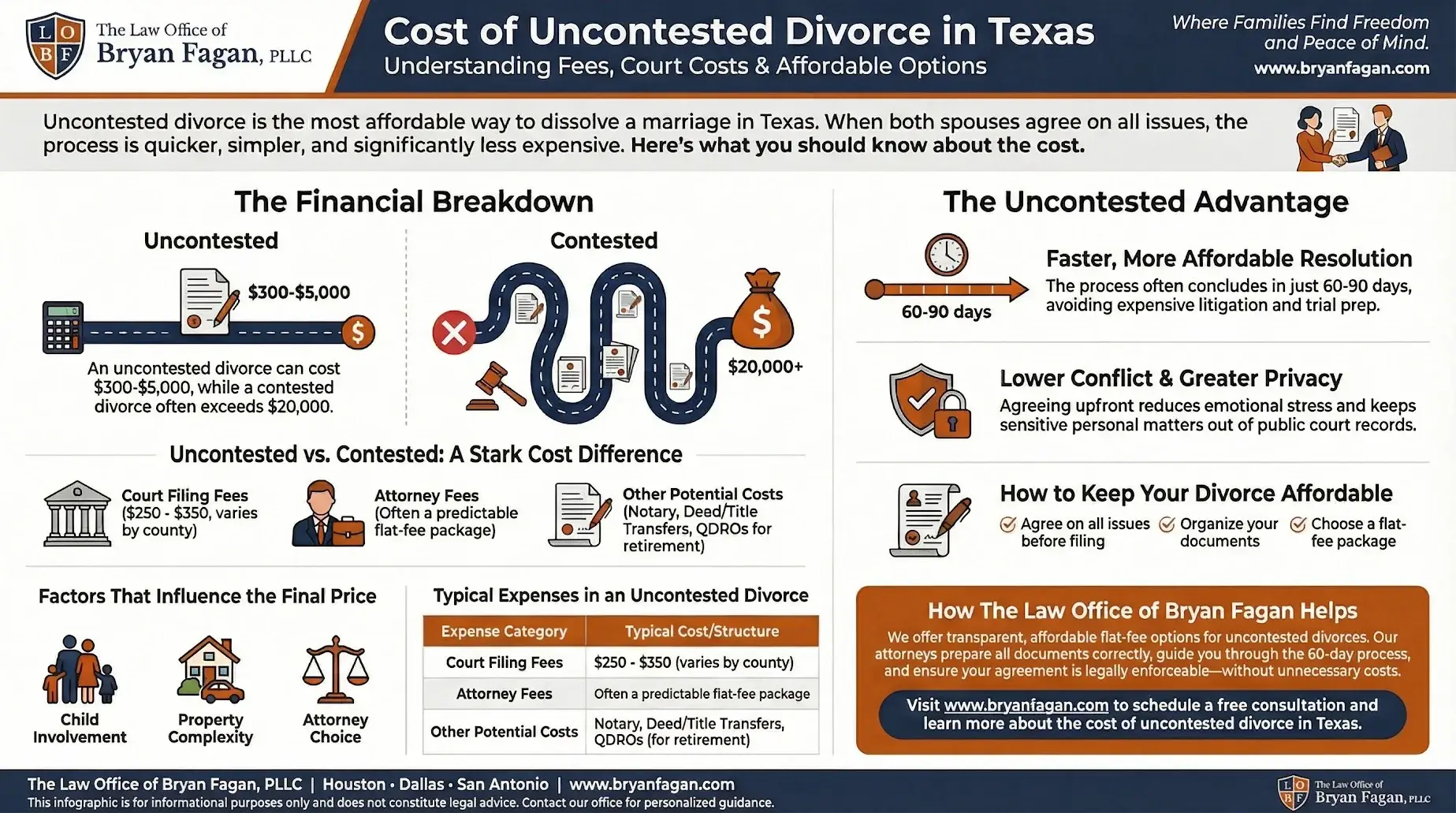
The Cost of Uncontested Divorce in Texas varies widely because each family’s circumstances are different. For some, the total expense may fall between $300 and $600 when limited to filing fees and basic administrative costs. For others—especially when professional legal guidance is involved—the range typically increases to $1,500 to $4,500. Much of this depends on whether your case includes issues such as children, real estate, shared debt, or retirement accounts. For a full breakdown of cost factors, you can review our in-depth guide at How Much Does an Uncontested Divorce Cost in Texas?
Filing fees in most Texas counties range from $250 to $350, with higher costs in larger urban counties like Harris County. Under the Texas Family Code, filing an Original Petition for Divorce initiates the legal process and triggers mandatory court costs. Cases involving no minor children, no real estate, and no retirement accounts can sometimes be completed for under $500, but even simple cases require strict compliance with Texas Family Code provisions—especially those governing property division (§7.001), child support (§154.001–§154.309), and conservatorship (§153.001–§153.317). When these requirements are overlooked or misunderstood, families often face expensive corrections later.
An uncontested divorce requires complete agreement between spouses on all major issues before documents are filed. This includes asset division, debt allocation, parenting plans, guideline child support, and any spousal maintenance terms. Cooperation keeps costs low by minimizing attorney time, avoiding mediation, and preventing litigation. This is why uncontested divorces are significantly more affordable than contested cases, which frequently escalate into litigation costing $11,600 to $21,500 or more—largely due to discovery disputes, multiple court appearances, and expert evaluations.
Because Texas divorce law is detailed and procedural, many families choose to work with an experienced Houston family law team to avoid costly errors and ensure their Final Decree is enforceable. Proper drafting, compliance with statutory requirements, and awareness of county-specific rules can prevent delays, rejected filings, or unexpected expenses. For additional guidance on Texas divorce requirements, you may find our resources on divorce law in Texas helpful as you prepare for this next chapter.

Typical Fees Involved in an Uncontested Divorce
The total cost of your uncontested divorce is made up of several predictable line items. Understanding each component helps you budget accurately and avoid surprises along the way. The sections below define each major cost category and provide approximate Texas-specific ranges as of 2024–2025.
Keep in mind that exact amounts depend on your county. Filing fees in Harris County differ from those in Montgomery County or Bexar County, and even small administrative charges can vary. The Law Office of Bryan Fagan PLLC helps clients estimate all of these costs at the start of representation so you know what to expect before signing any agreements.
Court Filing Fees
Every divorce in Texas starts with paying a filing fee to the district clerk in the county where you file your divorce petition. This is a non-negotiable expense that applies whether you handle your own paperwork or hire an attorney.
In most Texas counties during 2024–2025, expect to pay between $250 and $350 for filing an Original Petition for Divorce. Harris County tends to run on the higher end at roughly $337 to $350, while Travis County (Austin) typically falls around $300 to $350. Montgomery County averages approximately $295. These court costs form the baseline of your divorce filing fees.
Additional court charges may apply depending on your situation. If your spouse must be formally served because they won’t sign a waiver, service fees through a process server usually run $75 to $125 in many Texas counties. You’ll also encounter small charges for certified copies of your Final Decree of Divorce—often $5 to $15 per copy—which you’ll need for updating titles, refinancing property, and other post-divorce tasks. Some counties add e-filing or online payment surcharges as well.
One way to eliminate service costs is having your spouse sign a properly drafted Waiver of Service in front of a notary. This document confirms they received the divorce papers and agree to waive formal service, saving you the expense of hiring a process server.
For low-income Texans, the Statement of Inability to Afford Payment of Court Costs provides a path to request a filing fee waiver. If your household income falls below 150% of the federal poverty guidelines, you may qualify for reduced or waived court fees.
Notary and Administrative Costs
Most uncontested divorces require multiple notarized signatures throughout the divorce process. Common documents needing notarization include the Waiver of Service, sworn Inventory and Appraisement of marital property, and sometimes affidavits regarding military status or residency requirements.
Notary fees in Texas typically range from $6 to $10 per signature at most banks, shipping stores, or UPS locations. Many banks and credit unions offer free notary services to account holders, which can save you money if you plan ahead.
Beyond notarization, you’ll encounter small administrative costs for printing, copying, and postage. Certified copies of your divorce decree usually cost $5 to $15 per copy in most counties, and you’ll likely need several for various purposes after the divorce is final.
While these expenses seem minor individually, they can add $50 to $150 to your overall budget if you don’t plan for them. Building these costs into your estimates from the start prevents unpleasant surprises as you move through the divorce proceedings.
Attorney Fees for Uncontested Divorce
Attorney fees often make up the largest discretionary—but extremely important—portion of the overall budget when evaluating the Cost of Uncontested Divorce in Texas. The real question for many families is not simply whether they can afford an attorney, but whether they can afford the risks of navigating the process alone. Even in amicable situations, the Texas Family Code imposes strict requirements on issues like property division (§7.001), conservatorship and parenting plans (§153.001–§153.317), and child support (§154.001–§154.309). Ensuring these provisions are drafted correctly the first time helps families avoid costly post-divorce corrections or enforcement actions.
For most straightforward uncontested divorces, many Texas family law attorneys offer flat-fee packages ranging from about $750 to $2,500. Cases involving the division of real property, retirement accounts governed by federal ERISA regulations, or complex parenting schedules may fall at the higher end of that range. If unexpected disagreements arise or substantial document revisions are required, attorneys may rely on hourly billing to address those issues. Hourly rates for Texas family lawyers typically range from $225 to $400 per hour depending on experience, location, and the complexity of the case.
Because uncontested divorces are built on cooperation and organization, many families are able to keep their legal fees predictable and contained within flat-fee structures. This is particularly helpful when spouses are motivated to finalize their divorce efficiently. Understanding how long each step of the process takes—including the mandatory 60-day waiting period outlined in Texas Family Code §6.702—can help families plan emotionally and financially. For more insight into timelines, see our resource at How Long Does an Uncontested Divorce Take in Texas?
As a trusted Houston family law team, our office is committed to providing transparent, predictable pricing for uncontested divorces whenever possible. We believe clarity supports peace of mind, and our attorneys are skilled at preparing enforceable Final Decrees that comply with both state law and county-specific requirements. This proactive approach reduces errors, prevents unnecessary hearings, and minimizes future expenses. Families wanting to learn more about protecting their interests may also find value in reviewing our broader Texas Divorce Resources, created to help Texans move forward with confidence and clarity.

Mediation Costs (If Needed)
Many uncontested divorces never require divorce mediation because the spouses have already agreed on everything. However, limited mediation can be helpful when couples need assistance finalizing specific terms—perhaps working out a parenting schedule or resolving small property disagreements—to keep the divorce case from becoming contested.
Realistic Texas mediation costs run about $150 to $350 per hour, with many mediators offering half-day or full-day flat rates. A half-day session typically costs $600 to $1,200, while a full day may run $1,200 to $2,000 depending on the mediator’s experience and the county where you’re located.
For uncontested cases, mediation sessions are usually shorter and more focused than the multi-day mediation marathons common in contested divorces. You might only need a two-hour session to finalize holiday schedules or agree on how to handle a specific debt. Even if mediation adds a few hundred dollars to your budget, it can prevent tens of thousands in contested litigation later—making these mediation costs a worthwhile investment when needed.
Factors That Affect the Cost of Uncontested Divorce in Texas
Not all uncontested divorces are “simple.” Some cases involve significant legal complexity even when both spouses agree on the outcome. Your total cost depends on factors like children’s issues, property and debt complexity, retirement accounts, how prepared you and your spouse are, and your attorney’s experience level.
Understanding these factors helps explain why your quote may be higher or lower than a friend’s who also went through an uncontested divorce process. A couple in Harris County with a house and 401(k) to divide will pay more than a couple renting an apartment with no kids and minimal shared assets.
Whether Children Are Involved
Cases involving minor children require additional documents, calculations, and legal analysis. You’ll need to address conservatorship (who makes decisions for the children), possession and access schedules (when each parent has the children), child support amounts, and medical support provisions including health insurance and uncovered medical expenses.
Texas judges scrutinize parenting plans and child support calculations closely to ensure they comply with the Texas Family Code and local standing orders. Your attorney may need extra time to craft workable holiday schedules, transportation arrangements, and provisions that account for children’s school activities and extracurricular schedules.
Some Texas counties require parenting classes or co-parenting courses before finalizing a divorce with children, adding modest additional expense. More importantly, careful drafting now prevents future modification or enforcement actions. Fixing custody disputes or child support issues later costs far more than doing it correctly the first time—often thousands of dollars in legal fees for what could have been addressed during the original divorce.
Property and Debt Division
Texas is a community property state, which means marital assets and debts accumulated during the marriage must be divided—even in an amicable divorce where both parties agree on terms. The more complex your community property situation, the more time and expertise required to draft a proper settlement agreement.
Examples of items that often require extra work include a marital home in Harris or Montgomery County, multiple vehicles with loans, credit card balances in both names, personal loans, and investment accounts. If you own real estate, appraisals or comparative market analyses may be needed to establish fair values, which adds cost. Asset division involving a family business requires even more detailed attention.
Poorly drafted property division terms create problems that surface months or years after the divorce. You might discover title issues when trying to sell the house, unexpected tax consequences from retirement withdrawals, or disputes over who was supposed to pay which credit card. These post-divorce problems typically cost far more to resolve than addressing them properly in the original divorce decree. If you own a home, have substantial savings, or share significant debt, legal representation pays for itself in avoided headaches.
Retirement Accounts and QDROs
Dividing retirement assets is one of the most technically sensitive aspects of determining the Cost of Uncontested Divorce in Texas, especially when a 401(k), pension, or other employer-sponsored plan is involved. Under Texas Family Code §7.003, retirement benefits earned during the marriage are generally considered community property and must be divided accurately in the Final Decree. Because these plans cannot be split by the decree alone, a separate court order—known as a Qualified Domestic Relations Order (QDRO)—is required to direct the plan administrator on how the benefits should be allocated between spouses. This added step ensures compliance with federal ERISA rules as well as Texas law.
Preparing a QDRO typically involves additional legal fees ranging from $500 to $1,500 depending on the plan type and complexity. Some employers or retirement plan administrators also charge review or processing fees, which are separate from attorney fees and court costs. These expenses are important to consider when evaluating whether an uncontested divorce fits your situation, and our guide on When Does Uncontested Divorce in Texas Make Sense? offers deeper insight into how financial factors can influence that decision.
Unfortunately, generic online divorce services often mishandle retirement accounts because they cannot tailor documents to specific plan requirements. An improperly drafted QDRO or a Final Decree that omits required statutory language may lead to rejection by the plan administrator, forcing spouses to spend additional time and money correcting avoidable errors. Worse, mistakes with retirement division can trigger early withdrawal penalties or unintended tax consequences—issues that can easily cost thousands of dollars and significantly damage long-term financial security.
That is why many Texas families turn to the experienced legal team at our office, where attorneys regularly collaborate with QDRO specialists and plan administrators to ensure retirement divisions are structured correctly from the start. By aligning each step with the Texas Family Code and plan-specific rules, we help clients avoid costly delays and protect future benefits. For additional guidance on protecting your financial future during divorce, you may also find value in visiting our Texas Divorce Resources center, designed to help Texans make informed, confident decisions.

How Prepared and Cooperative the Spouses Are
Couples who come to their attorney with complete financial documents, agreed terms, and a cooperative attitude almost always spend less overall. Organization and communication directly impact how efficiently your attorney can prepare your paperwork.
Before meeting with a lawyer, gather essential documents: pay stubs, tax returns from the last two to three years, bank statements, retirement account statements, mortgage statements, credit card bills, vehicle titles, and insurance information. Having this information ready saves attorney time and reduces billable hours.
Delays matter too. Slow responses to emails, missing signatures, and last-minute changes to agreed terms all increase attorney and court costs. Ongoing conflict—even in a nominally “uncontested” case—can turn a flat-fee matter into a time-consuming, more expensive process. When the parties agree and remain cooperative, the divorce process moves quickly and affordably.
Attorney Experience and Practice Focus
Highly experienced family law attorneys sometimes charge higher hourly rates or flat fees than newer lawyers. However, a higher rate doesn’t always mean a higher total cost. Experienced attorneys typically require fewer hours to complete the same work and avoid expensive mistakes that newer lawyers might miss.
A dedicated family law firm understands local rules, judges’ preferences, and county-specific procedures. This knowledge streamlines the entire process. An attorney who regularly appears in Montgomery County or Harris County courts knows exactly what each judge expects in a Final Decree and can prepare documents accordingly, reducing the chance of rejected filings or required revisions.
When evaluating attorneys, consider value rather than just the lowest quote. A $750 flat fee that results in rejected paperwork and required corrections may ultimately cost more than a $1,500 package that gets everything right the first time.
DIY vs. Attorney-Assisted Uncontested Divorce Costs
Many Texans consider handling their own divorce paperwork to save money, while others prefer attorney support for peace of mind and accuracy. Both approaches have legitimate pros and cons, and the right choice depends on your specific situation—particularly whether you have children, property, or retirement accounts to address.
The following comparison covers cost ranges, time investment, and the risk of mistakes for each approach.
DIY (Do-It-Yourself) Uncontested Divorce
A DIY uncontested divorce in Texas means using standardized forms—often from TexasLawHelp.org or similar resources—and preparing and filing all documents without attorney review. You handle everything from the Original Petition to the Final Decree yourself.
Direct costs can be remarkably low. If you have no children and minimal marital property, your total might be just filing fees ($250 to $350) plus notary and administrative costs, keeping the total often under $500. Some divorcing couples complete the entire process for around $300 in simple, no-children, no-property situations.
The pros of DIY are straightforward: lowest upfront cost, full personal control over the process, and potential eligibility for filing fee waivers if you meet income requirements.
The cons, however, can be significant. DIY divorces carry a higher risk of rejected filings—Texas courts reject an estimated 20 to 30 percent of pro se filings for technical errors. You might overlook important property or separate property classifications, make errors in child support calculations or medical support provisions, or create a divorce decree that’s difficult to enforce later.
Fixing DIY mistakes is where costs spiral. If you omit a retirement account, draft an unclear possession schedule, or miscalculate child support, correcting these issues typically requires a modification or enforcement action. These post-divorce proceedings often cost $2,000 to $5,000 or more—turning your $300 “savings” into a much more expensive mistake.
Attorney-Assisted Uncontested Divorce
When you choose an attorney-assisted approach to your uncontested divorce, you are investing in clarity, protection, and long-term stability—factors that directly shape the Cost of Uncontested Divorce in Texas. In this model, your attorney prepares all necessary pleadings, drafts the Marital Settlement Agreement and the Final Decree of Divorce, and guides you through the final hearing required under Texas Family Code §6.702. Many firms offer flat-fee packages for simple uncontested cases, but the level of service, attention to detail, and legal accuracy can vary significantly. Families evaluating whether attorney representation makes sense can explore key considerations in our in-depth resource: How Much Does an Uncontested Divorce Cost in Texas? Key Considerations Before Filing.
Attorney-assisted uncontested divorces in Texas typically range from $1,000 to $3,500 for straightforward situations. Cases involving real estate, retirement accounts that require Qualified Domestic Relations Orders (QDROs), or detailed parenting plans may exceed this range due to additional drafting and compliance work. These tasks must align with the Texas Family Code, including community property rules under §7.001 and conservatorship and child support requirements under Chapters 153 and 154. When these legal standards are applied correctly, the result is a Final Decree that is enforceable, predictable, and aligned with Texas law.
The advantages of professional legal representation are substantial. You receive documents drafted to meet statutory requirements, accurate child support calculations that reflect the latest Texas Family Code updates, and a property division structure designed to withstand future scrutiny. This significantly reduces the risk of post-divorce disputes or enforcement actions—problems that often arise when forms are incomplete or inconsistent with state guidelines. For families who value peace of mind, efficiency, and long-term financial protection, attorney involvement provides a level of security that DIY services cannot match.
While the upfront investment for legal support may feel heavier than a purely do-it-yourself approach, the long-term savings often outweigh the cost. A skilled Texas family law team can prevent errors that might require costly modifications, additional hearings, or clarifications later. Our office frequently assists clients who attempted a DIY divorce only to discover that their documents failed to comply with Texas requirements, causing delays and unforeseen expenses. Working with an experienced legal team from the start helps ensure your divorce is done right the first time—saving time, money, and emotional strain. Families seeking additional support can explore our broader Texas Divorce Resources to better understand their options and next steps.

Common Mistakes That Increase the Cost of Uncontested Divorce
The most expensive divorces often start as “uncontested” but become costly because of avoidable mistakes. Whether you’re handling paperwork yourself or working with an attorney, understanding these common pitfalls helps you steer clear of unnecessary expenses.
Using Incorrect or Outdated Forms
Texas family law forms change over time, and requirements can vary by county. Using obsolete templates or generic online forms that don’t comply with the Texas Family Code or local standing orders can cause delays or outright rejection by the court.
Many document preparation services and online divorce services use one-size-fits-all templates that don’t account for Texas-specific requirements. When courts require amended petitions or decrees, you add weeks or months to your timeline plus extra filing fees. Working with forms designed specifically for Texas divorce proceedings—and ideally reviewed by someone familiar with your local court—prevents these costly setbacks.
Overlooking Debts, Property, or Retirement Accounts
Failing to list and divide all community property, separate property, debts, and retirement benefits can leave spouses financially entangled long after the divorce is final.
Common oversights include a forgotten credit card in both names, an auto loan that wasn’t addressed, or a 401(k) that the decree never mentions. These omissions don’t just create confusion—they often require a separate suit, motion to clarify, or delayed QDRO to correct. All of these incur additional costs that significantly exceed what it would have cost to handle them properly in the original divorce.
When preparing your divorce papers, create a comprehensive list of every account, debt, and asset. Don’t assume something is “too small to matter.” Even modest oversights can trigger post-divorce disputes.
Incorrect Child Support or Parenting Provisions
Texas has specific child support guidelines based on the paying parent’s net resources, along with mandatory language related to medical support, health insurance, and rights and duties of conservators. Failing to follow these requirements creates problems.
Incorrect child support calculations or missing provisions can result in the judge refusing to sign your divorce decree until corrections are made. This means additional hearings, more attorney time, and extended delays. Worse, improper child support arrangements may later be challenged or modified through enforcement actions—adding thousands in attorney and court costs to address issues that should have been resolved correctly the first time.
Errors in the Final Decree of Divorce
The Final Decree is the controlling document for everything—property division, parenting time, support obligations, and future enforcement. Mistakes here have serious, lasting consequences.
Examples of costly errors include vague move-out deadlines, unclear language about who pays which debts, missing VINs for vehicles being transferred, inconsistent child support terms between sections, or failure to address how the marital home will be handled. Judges may require multiple resets of the final hearing if the decree isn’t in acceptable form, meaning additional time off work and more legal fees.
Procedural Missteps and Missing Documents
Common procedural issues include missing signatures on required documents, no proof of service or waiver, failure to observe the mandatory 60-day waiting period before finalizing, or not bringing required documents to the prove-up hearing.
Each misstep leads to continuances, extra trips to the courthouse, and additional attorney time. Some errors reset your timeline entirely. Careful preparation—ideally with experienced legal guidance—prevents these avoidable costs.
How to Keep the Cost of Uncontested Divorce in Texas as Low as Possible
While certain costs like filing fees are unavoidable, plenty of strategies help you minimize costs and keep your uncontested divorce affordable. The following tips represent practical steps you can start today—before you ever file paperwork.
The Law Office of Bryan Fagan PLLC incorporates many of these cost-saving practices into its flat-fee uncontested divorce services, helping clients stay within budget from start to finish.
Reach Agreement on All Major Issues Before Filing
Before filing your divorce petition, talk through property division, debt allocation, parenting schedules, child support, and any spousal maintenance with your spouse. The more you resolve upfront, the more likely your case stays within an uncontested, flat-fee structure.
Use checklists or worksheets to ensure every major topic is covered. Don’t leave issues unresolved with the assumption you’ll “figure it out later.” Mid-case disputes can transform a straightforward uncontested matter into expensive contested litigation.
Organize Financial and Parenting Documents Early
Gather essential financial documents before meeting with a lawyer: tax returns from the past two to three years, recent pay stubs, bank statements, retirement account statements, mortgage or lease documents, credit card statements, vehicle titles, and insurance information.
Organized documents save attorney time dramatically. When your lawyer doesn’t have to chase down information or wait for you to locate statements, drafting happens faster and more accurately. This preparation also helps prevent overlooked accounts or debts that could cause problems later.
Use Flat-Fee Attorney Services Where Appropriate
Choosing a law firm that offers flat-fee uncontested divorce packages allows you to budget with confidence. You know exactly what you’ll pay for drafting, filing, and the final hearing—no surprises from mounting hourly bills.
The Law Office of Bryan Fagan PLLC provides flat-fee options for many uncontested matters, with clear written scopes of work that explain exactly what’s included. When evaluating any flat-fee offer, ask what’s covered (drafting, filing, limited revisions, final hearing attendance) and what circumstances might shift the case to hourly billing.
Communicate Clearly and Avoid Unnecessary Disputes
Clear and respectful communication between spouses plays a major role in keeping the Cost of Uncontested Divorce in Texas manageable. When spouses stay collaborative, they avoid the emotional escalations that can quickly turn an uncontested matter into a contested—and far more expensive—case. Even small misunderstandings can lead to additional attorney calls, emails, and revisions, which naturally increases legal fees. Families evaluating whether uncontested divorce is the right path can explore key considerations in our detailed guide: Key Considerations Before Filing for an Uncontested Divorce in Texas.
Taking time to document agreements as you reach them can significantly reduce the chance of confusion later. Written summaries help ensure that both spouses remain aligned on property division, parenting schedules, and financial expectations. If disagreements begin to surface, a brief mediation session is often far more cost-effective than prolonged negotiation. Under the Texas Family Code, particularly §§6.602 and 153.0071, mediation is recognized as an approved method for resolving disputes while keeping the process cooperative and affordable.
Before signing anything, it is essential to read every document—including the Final Decree of Divorce—line by line. Mistakes discovered after the divorce is finalized often require modification or enforcement actions, which can be costly and time-consuming. Reviewing the documents carefully ensures compliance with Texas Family Code provisions governing community property (§7.001), conservatorship and possession (§153.001–§153.317), and child support (§154.001–§154.309). Addressing issues before filing is always far less expensive than correcting them later.
Professional review becomes especially important when your divorce involves real estate, retirement accounts, or complex parenting arrangements. These areas have strict statutory and procedural requirements, and errors can result in rejected filings, tax consequences, or unenforceable orders. A trusted Houston family law team can help ensure every document meets state and county standards, protecting you from costly post-divorce problems. For additional educational tools to guide your decisions, our firm offers a full library of Texas Divorce Resources designed to support families navigating this transition with clarity and confidence.

Why Hiring the Law Office of Bryan Fagan PLLC Can Actually Save You Money
Although hiring an attorney involves an initial investment, the long-term financial and legal protection it provides can significantly reduce the overall Cost of Uncontested Divorce in Texas. Families often discover that a single mistake in the Final Decree—such as an unenforceable property division, an incorrect child support calculation under Texas Family Code Chapter 154, or a rejected QDRO governed by §7.003—can result in thousands of dollars in fixes after the divorce is finalized. Working with a dedicated family law team helps prevent these errors and ensures that your rights, assets, and future obligations are clearly and accurately addressed from the beginning.
One of the cornerstones of our practice is transparency. At our firm, clients receive clear, written pricing at the outset of representation, enabling them to understand exactly what services are included. For qualifying uncontested divorces, flat-fee packages typically cover drafting the Original Petition, Waiver of Service, Final Decree of Divorce, and preparation for the required prove-up hearing outlined in Texas Family Code §6.702. This structure eliminates billing surprises and helps families feel more grounded and supported during an already stressful time.
This predictable approach to pricing allows individuals and families throughout Houston and surrounding counties to plan their divorce budget with greater confidence. Instead of worrying about escalating fees, clients can compare the value of comprehensive legal guidance against the risks of taking a do-it-yourself approach. Many who attempt to manage the process alone later find themselves facing modification actions or enforcement proceedings—issues that often cost substantially more than hiring experienced counsel from the outset. Our educational resource, The Divorce Process in Texas, provides an additional overview of what to expect at each step.
As a trusted Texas family law practice, our focus remains on empowering clients with clarity, knowledge, and confidence as they navigate divorce. By aligning our services with the latest updates to the Texas Family Code and offering accessible, client-centered pricing, we aim to protect not only your financial future but your peace of mind. For more support and legal insights, you may also explore our broader Texas Divorce Resources, designed to guide families through each stage of transition with informed, compassionate advocacy.
Accurate, Enforceable Final Decrees and QDRO Support
The firm focuses heavily on getting the Final Decree right—addressing every relevant asset, debt, parenting detail, and support obligation. Cases involving homes, small businesses, retirement accounts, and complex parenting situations receive the attention these issues require.
By preparing enforceable decrees and coordinating QDROs when needed, the firm helps clients avoid costly post-divorce litigation. A well-drafted decree today prevents expensive modification suits, enforcement actions, and confusion years down the road.
The firm’s family-law-focused team knows county-specific procedures, preferred decree formats, and scheduling processes in local courts throughout the Houston area. This familiarity speeds up drafting, filing, and finalizing uncontested divorces.
Staff support from paralegals and legal assistants handles many routine tasks at lower billing rates, increasing overall cost-effectiveness. When your legal team knows exactly what local judges expect, your paperwork moves through the system without unnecessary delays or rejections.
Our Golden Circle: Why, How, and What We Do for Texas Families
Understanding what drives The Law Office of Bryan Fagan PLLC helps you see how the firm approaches your case differently from generic legal services.
Why: Our Purpose
The firm exists to help Texas families navigate divorce as affordably and confidently as possible, with minimal stress and future conflict. The team understands both the emotional toll and financial strain that even an uncontested divorce can cause.
This commitment means making high-quality legal services accessible and understandable for everyday Texans—not just those with unlimited budgets. Every family deserves competent legal guidance through one of life’s most difficult transitions.
How: Our Approach
The firm delivers on its purpose through compassionate, client-focused counseling, efficient document preparation, and cost-conscious solutions tailored to each family’s needs. Clear communication and education about options take priority, along with proactive problem-solving to avoid surprises.
Technology like secure online forms, electronic signatures, and virtual consultations reduces time and travel costs where appropriate. The goal is making the divorce process as streamlined as possible while maintaining the thoroughness that protects your interests.
What: Our Services
Core offerings include full-service representation in uncontested and contested divorces, child support and child custody matters, property division, QDRO preparation, and post-divorce modifications and enforcements.
For uncontested divorce in particular, the firm offers start-to-finish representation—from petition to final hearing—under predictable fee structures. Services extend throughout the greater Houston area and across many Texas counties.
Actionable Checklist: Keeping the Cost of Uncontested Divorce in Texas Low
This practical checklist helps you stay on track and control costs throughout your uncontested divorce process.
Checklist: Steps to a Low-Cost Uncontested Divorce
- Confirm Texas residency: Ensure at least one spouse has lived in Texas for six months and in the filing county (such as Harris, Montgomery, or Fort Bend) for at least 90 days before filing.
- Verify full agreement: Reach written or clearly documented agreement with your spouse on property, debts, parenting, child support, and any spousal maintenance before filing your divorce petition.
- Gather financial records: Collect tax returns from the last two to three years, recent pay stubs, bank and retirement account statements, mortgage or lease information, and insurance details.
- Identify all assets and debts: Create a comprehensive list of real estate, vehicles, bank accounts, retirement accounts, credit cards, and loans so nothing is overlooked in the Final Decree.
- Choose an attorney and fee structure: When possible, select a flat-fee uncontested divorce package from a family law firm like The Law Office of Bryan Fagan PLLC to cap your legal fees.
- Complete accurate forms the first time: Work with your attorney to ensure the Petition, Waiver, Final Decree, and any QDROs or additional orders comply with Texas law and local court requirements.
- Track deadlines and hearings: Observe the mandatory 60-day waiting period, attend your prove-up or final hearing, and promptly pick up certified copies of your Final Decree.
- Implement the decree: Re-title vehicles, refinance or sell property as ordered, divide retirement accounts using QDROs if needed, and update beneficiaries and estate planning documents.
Conclusion: Plan Ahead for the Cost of Uncontested Divorce in Texas
When you strip away the legal forms, court procedures, and dollar amounts, what most people really want during a divorce is clarity—clarity about the process, clarity about the cost, and clarity about what life will look like on the other side. Understanding the Cost of Uncontested Divorce in Texas is a big part of that, and hopefully this guide has given you a clearer picture of your options and a little more breathing room as you think about your next steps. No one expects you to navigate this alone, and you shouldn’t have to.
If you’re feeling that mix of relief and uncertainty that so many Texans describe at this stage, that’s completely normal. A conversation with an experienced Texas family law attorney can make things feel a whole lot lighter. Our team at The Law Office of Bryan Fagan, PLLC is here to answer questions, ease fears, and offer practical guidance that supports your goals—not complicates them. Whether you’re ready to get started or simply want to understand your choices, we’re always just a call or message away.
And if you’re still thinking things through, that’s okay too. Sometimes clarity arrives one honest conversation at a time. When you’re ready, we’re here to walk with you—helping you protect your future, honor your peace of mind, and move confidently into whatever comes next.
Frequently Asked Questions About Uncontested Divorce in Texas
The fastest and most affordable way to divorce in Texas is typically through an uncontested divorce. This is where both spouses agree on every major issue—property, debts, and parenting arrangements if children are involved. You still must go through the mandatory 60-day waiting period after filing, but staying cooperative and organized helps keep costs low. Some families also qualify for filing fee waivers, which can reduce expenses further.
Most Texas counties require a short appearance known as a “prove-up,” where one spouse answers a few basic questions to confirm the agreement. Some judges allow virtual or affidavit-based prove-ups, especially when you’re represented by an attorney who knows local procedures. A brief court appearance is the norm, but not always required in every county.
The fastest you can finalize an uncontested divorce in Texas is generally just over 60 days. That’s because the Texas Family Code requires a 60-day waiting period before a judge can sign the final decree. If your paperwork is complete and your county’s docket isn’t backed up, many uncontested divorces finish between 60 and 90 days.
Divorce isn’t automatically free. Every case begins with court filing fees unless you qualify for a waiver based on financial need. Even with a waiver, you may still pay for notary services, copies, or service of process if needed. If you hire an attorney, legal fees are additional, though uncontested cases are usually far more affordable than contested ones.
Agreed divorces tend to be much more affordable. Costs can range from a few hundred dollars in simple DIY cases to a few thousand dollars when hiring an attorney for flat-fee representation. The final cost depends on your county’s filing fees, the complexity of your property or retirement division, and whether any additional documents like a QDRO are required.
The least expensive way is a true uncontested divorce where both spouses remain cooperative and agree on everything from the start. Some people file on their own using standard forms, which reduces upfront costs but increases the risk of errors that lead to expensive corrections later. Using an experienced attorney on a flat fee is often the best cost-effective balance between affordability and accuracy.
A judge may reject an uncontested divorce if the paperwork is incomplete, inconsistent, or violates Texas law. Missing information about children, incorrect child support calculations, unclear property terms, or procedural issues—like improper service or an invalid waiver—can all lead to delays. Judges must be confident the agreement is fair and legally sound before approving it.
There is no automatic divorce in Texas, regardless of how long you’ve been separated. You must file a petition, complete all required steps, and obtain a signed Final Decree of Divorce from a judge. Separation alone does not end a marriage in Texas.
Most uncontested divorces take between 60 and 120 days. The timeline depends on how quickly documents are prepared and signed, how busy your local court is, and whether any corrections or revisions are needed. With an experienced attorney guiding the process, uncontested divorces tend to move faster and with fewer complications.