 Skip to content
Facing a divorce can be one of life’s most difficult transitions—but understanding your rights and the financial landscape under Texas law can make it less overwhelming. For most people, the most urgent question is, "How much is this going to cost me?" In Texas, the total cost to hire a divorce lawyer can range from a few thousand dollars for a straightforward, amicable split to tens of thousands if your case is complex and ends up in court.
Let's start here: understanding how divorce attorney fees work is the very first step toward managing the financial side of your divorce. We wrote this guide to pull back the curtain on the entire process. Our goal is to replace that anxiety with a clear path forward, empowering you to make smart financial decisions during a challenging time.
This guide will walk you through:
- The different ways lawyers structure their fees, as is common in Texas family law.
- What really drives the cost of a divorce up or down.
- Practical, actionable guidance you can use to manage your legal expenses.
When a marriage ends, disagreements over money often take center stage. In fact, these very conflicts over assets, debts, and support are usually what make a divorce more complicated and, as a result, more expensive.
Financial stress is a major reason why many marriages break down. Being transparent and willing to cooperate on financial matters during the divorce can be one of the single most effective ways to keep the total cost from spiraling out of control.
While you're working through the end of your marriage, it can be helpful to look back at what makes a relationship work in the first place, especially around finances. For a deeper dive into building a solid financial partnership, you might find it useful to review some essential compatibility questions for couples, especially regarding financial matters.
Ultimately, the cost of your divorce comes down to one thing: the amount of your attorney's time your specific situation requires. High-conflict custody battles, dividing complex assets like a family business, or a general unwillingness to cooperate will dramatically increase the hours your legal team must dedicate to your case. Once you understand what drives those hours, you are in a much better position to anticipate and control your legal fees.
How Texas Divorce Attorneys Structure Their Fees
Before we get into the numbers, it’s important to understand how lawyers charge for their time and expertise. Think of it like hiring any other skilled professional—there isn't just one way to pay. Getting a handle on these different fee structures is your first step to discussing divorce attorney fees with confidence and avoiding any surprises down the road.
This is all about moving from a place of anxiety about the cost to one of clarity and control over your finances.
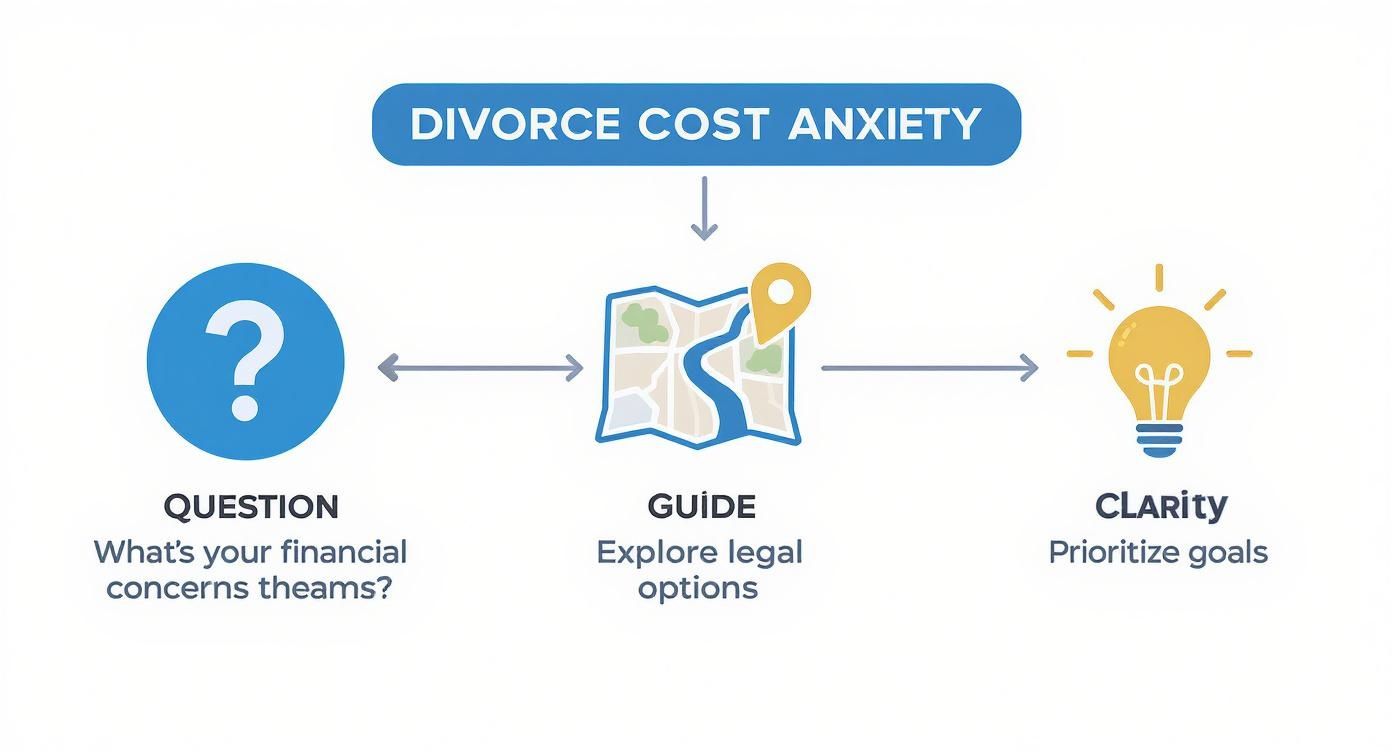
As you can see, the path forward starts with your questions, moves toward expert guidance, and ends with a clear picture of what to expect. Let's break down the most common ways lawyers in Texas get paid.
The Retainer: An Upfront Deposit
Most divorce attorneys in Texas work on a retainer. A retainer is an upfront payment you make to the law firm that gets deposited into a special trust account. It’s crucial to understand this is not the total cost of your divorce. Instead, it works like a security deposit or a down payment that your attorney bills against as work is completed.
Think of it like loading money onto a gift card for legal services. As your attorney and their team work on your case—making phone calls, drafting documents, appearing in court—they draw their hourly fees from that trust account. If the balance drops below a certain level (which will be outlined in your fee agreement), you'll need to replenish it.
Hourly Billing: The Most Common Structure
By far, the most common way family law cases are billed is by the hour. Every professional at the firm, from the senior partner to the paralegals, has a set hourly rate. Their time is usually tracked in small increments, often as little as six minutes (one-tenth of an hour).
This means every email they answer, every phone call they take, and every document they review is carefully recorded and billed against your retainer. While this model is flexible, it also means the total cost is directly tied to the amount of time and conflict involved in your case.
The national average for the total cost of a divorce lawyer is around $11,300, but this number can swing wildly based on your case's complexity and where you live. Divorce attorneys typically charge between $250 to $400 per hour, with the average rate landing at about $313.
Flat Fees: Predictability for Uncontested Cases
In some situations, an attorney might offer a flat fee. This is a single, all-inclusive price for a specific, clearly defined legal service. You'll see flat fees most often in simple, uncontested divorces where both spouses have already agreed on all major issues, like property division and child custody arrangements.
Here’s why it works for those straightforward cases:
- Predictability: The attorney knows exactly how much work is involved because there are no contested issues.
- Simplicity: The case is mostly about drafting the correct legal paperwork and filing it with the court.
- Efficiency: Because everyone is cooperative, there’s no need for drawn-out discovery, tense mediations, or court battles.
However, if a seemingly "uncontested" case becomes contested, that flat fee arrangement will almost certainly switch over to a standard hourly billing model to account for the additional work.
Understanding Interim Attorney's Fees
In a divorce, it is not uncommon for one spouse to have primary control over the couple's finances. To ensure both parties have fair access to legal representation, a Texas court can order the higher-earning spouse to pay for some or all of the other spouse's legal fees on a temporary basis. These are called interim attorney's fees.
This is a powerful tool for leveling the playing field. You can learn more about the specifics in our detailed guide on how interim attorney's fees work in a divorce with no children. The request is made formally through a motion filed with the court, ensuring that a lack of funds does not prevent someone from securing the representation they need.
What Actually Determines the Total Cost of Your Divorce
You have likely heard stories of two couples in seemingly similar situations ending their divorces with vastly different legal bills. This can make budgeting for a divorce feel like a shot in the dark.
The truth is, there’s no price list for divorce. The final cost is a direct result of the specific, unique dynamics of your family and your marriage. Getting a handle on these variables is the first step toward managing your divorce attorney fees. The single biggest factor that drives up the cost of a divorce, bar none, is conflict. The more you and your spouse disagree, the more time your lawyer has to spend drafting motions, preparing for hearings, and gearing up for trial.
Conversely, cooperation is the most powerful cost-cutting tool you have. Every issue you and your spouse can agree upon without involving lawyers is money saved. It is that simple.
The Impact of Conflict and Cooperation
A divorce filled with hostility means a constant volley of communications, formal legal demands for information, and frequent trips to the courthouse. Every one of those actions requires significant attorney time and burns through your retainer. An amicable or collaborative divorce, however, allows you and your spouse to work through problems together, often with a mediator's help, which drastically reduces the hours your legal team needs to be involved.
Let’s look at a practical scenario:
- High-Conflict Scenario: You and your spouse cannot agree on who gets the $5,000 dining room set. This disagreement can easily spiral into hours of back-and-forth emails between lawyers, formal motions, and arguments in court, costing both of you thousands in fees—far more than the furniture is worth.
- Cooperative Scenario: The same couple decides to either sell the furniture and split the proceeds or agree that one person keeps it in exchange for another asset of equal value. They resolve it in one conversation, with zero attorney involvement.
This principle applies to every aspect of your divorce. Choosing to work together will directly and significantly lower your final legal bill.
Complex Property Division
Another major cost driver is the complexity of your marital estate. If your assets consist of a house, two cars, and a savings account, the division process is usually straightforward. But the moment you introduce more complicated assets, the time, effort, and cost begin to climb.
Certain assets demand more specialized work, which adds to the bottom line:
- Business Valuations: If a family business is involved, you will likely need a forensic accountant to determine its true value. This process can be expensive and is often a major point of contention.
- Retirement Accounts: Splitting 401(k)s, pensions, or other retirement funds requires a special court order known as a Qualified Domestic Relations Order (QDRO). This is an extra legal step with its own associated costs.
- Investments and Stock Options: Valuing and dividing investment portfolios, restricted stock units (RSUs), or other complex financial instruments requires specialized analysis.
When you need to bring in outside experts like business valuators or forensic accountants, their fees are in addition to your legal fees. Your attorney will manage these professionals, but it is an added expense to be aware of.
As the Texas Family Code § 7.001 states, all community property must be divided in a "just and right" manner. When dealing with complex assets, simply identifying and valuing everything can become a substantial task, directly adding to your attorney's billable hours and, ultimately, your final cost.
Disputes Over Children
Nothing will drive up the cost of a divorce faster than disputes over children. When parents cannot agree on custody (known as conservatorship in Texas), visitation schedules, or child support, the court must intervene, which is when the legal work—and the bills—escalate.
Contested custody battles can be grueling. They often involve extensive discovery, psychological evaluations, the appointment of an amicus attorney (a lawyer for the children), and sometimes, a full trial. Each of these steps is not only emotionally draining but also incredibly expensive. The court's primary focus is always on the "best interest of the child," but proving what that looks like in a heated dispute can take months of legal effort.
At the end of the day, the more you and your spouse can agree on outside of a courtroom, the more control you have over your final divorce attorney fees. By choosing cooperation, organizing your financial documents, and prioritizing your children's well-being, you can take meaningful steps to make this process more affordable.
How to Read Your Fee Agreement and Attorney Invoices
Think of your fee agreement as the rulebook for your financial relationship with your attorney and the monthly invoices as the play-by-play. Feeling in control of your divorce attorney fees starts with knowing how to read these two critical documents. We want you to feel empowered to review them with confidence, ask smart questions, and know that everything is transparent.

The fee agreement is a legally binding contract that spells out exactly what you can expect, so it is essential to review it carefully before you sign anything or pay your retainer.
Key Terms in Your Fee Agreement
When you receive a fee agreement, take the time to look for these specific sections to get the full financial picture. This document sets the ground rules for every dollar you will spend.
Here are the crucial parts to find:
- Scope of Representation: This section defines exactly what legal services our firm will—and will not—provide. It should clearly state we are representing you in your divorce case, but it might exclude other matters like a separate personal injury claim or a future appeal.
- Hourly Rates for All Staff: The agreement must list the hourly rate for every professional who may work on your case. A senior attorney's rate will be higher than a junior associate's, and a paralegal's rate is lower still. We use this tiered structure to ensure the most cost-effective person handles each task.
- Retainer Details: This part will specify your initial retainer amount and explain the conditions for replenishing it (often called an "evergreen" retainer). It also outlines how you will receive a refund for any unused funds at the end of your case.
- Billing Increments: Most law firms bill in tenths of an hour (six-minute increments). This means a quick two-minute phone call will likely be billed as 0.1 hours.
- Additional Costs: This covers expenses beyond an attorney's time, such as court filing fees, expert witness fees, courier services, and charges for copying documents.
Your fee agreement is more than a formality; it is your primary tool for financial clarity. When you understand its terms from the beginning, you prevent misunderstandings and help build a relationship with your legal team based on trust.
Decoding Your Monthly Invoice
Once we begin working on your case, you will receive a detailed invoice each month. This statement shows the total fees, which are typically deducted from your retainer balance. While the format can seem intimidating at first, it follows a simple logic.
Each line item on your bill should include three key pieces of information:
- Date: The day the work was performed.
- Description: A clear summary of the task (e.g., "Phone call with Opposing Counsel regarding discovery requests" or "Drafted Motion to Compel").
- Time: The amount of time spent on that task, listed in fractions of an hour.
Reading your invoice carefully each month is about being an engaged and informed client. It helps you see how certain actions, like frequent, short phone calls, can add up. If you ever see a charge you do not understand, you should feel completely comfortable asking for an explanation. A good attorney will always be happy to walk you through their billing.
How Divorce Attorney Fees Compare Across Texas
Just as the cost of living varies across Texas, so does the price for professional services like legal help. The divorce attorney fees you'll encounter in a major metro area like Houston or Dallas will naturally be different than what you would find in a smaller Texas town.
Understanding these regional differences is a key part of setting a realistic budget. It’s not arbitrary—it reflects basic economics. Lawyers in big cities have higher overhead costs for office rent, staff salaries, and marketing, which are factored into their hourly rates. Market demand is another factor; more people means a greater need for experienced family lawyers.
A Look at Major Texas Cities
While every law firm has its own fee structure, we can map out a general idea of what to expect across the state. This helps you understand the local legal environment. An attorney in downtown Austin might have a higher starting rate than an equally skilled lawyer in a less populated county, purely because of these market forces.
This pattern is seen nationwide, where legal costs tend to follow the local economy. While Texas is generally considered a more moderate state for legal expenses, you will still see higher rates in the urban hubs.
Here are some typical hourly rate ranges for experienced family law attorneys in Texas's major metropolitan areas. Keep in mind these numbers reflect local market conditions and operational costs.
| Texas Metropolitan Area | Estimated Attorney Hourly Rate Range |
|---|---|
| Houston / The Woodlands | $300 – $550+ |
| Dallas–Fort Worth | $300 – $525+ |
| Austin / San Antonio | $275 – $500+ |
| Other Texas Regions | $225 – $400+ |
Disclaimer: These figures are estimates for experienced family law attorneys and can vary based on the lawyer's reputation, the complexity of the case, and the specific law firm.
These estimates should give you a solid baseline for what to expect as you start your search for the right legal support.
Why Location Matters for Your Budget
Understanding these regional fee structures is about more than just numbers—it’s about making smart choices. If you live in a high-cost area like Dallas, you might be more motivated to explore cost-saving options like mediation. Knowing you are in a region with more moderate rates might give you some peace of mind as you begin this process.
It's also crucial to remember that a higher hourly rate does not automatically mean a higher final bill. An experienced, high-rate attorney in Houston might resolve a complex issue in five hours, while a less experienced, cheaper lawyer elsewhere might take ten. Efficiency and expertise matter.
The key takeaway is to enter consultations prepared for these regional differences. When you receive quotes from different attorneys, you’ll have the right context to compare them not just on price, but on the total value and expertise they bring to your case.
This same principle—where location and case complexity drive costs—applies to other family law issues, too. For instance, the expenses for modifying a child custody order can also shift based on these factors. You can learn more by reading about the average costs associated with hiring a senior attorney for your child custody modification case.
Actionable Strategies to Reduce Your Legal Fees
While you cannot control every aspect of a divorce, you have more power over the final cost than you might think. The choices you make can directly reduce your divorce attorney fees, saving you money and stress. Let's get into some practical advice on how to be an efficient and savvy client.

The goal here is to put you in the driver's seat of your legal budget. When you learn how to prepare for meetings, communicate smartly, and explore cooperative options, you make every dollar of your retainer work harder for you.
Prepare for Every Meeting and Interaction
One of the easiest ways to keep legal fees down is to make your attorney’s time count. Remember, you are paying for their time, so being prepared for every meeting, call, and email is essential.
Before any meeting, write down a clear agenda with your most pressing questions. Gather all your relevant documents beforehand—bank statements, tax returns, deeds, etc. This preparation allows your attorney to dive straight into strategy instead of spending billable hours sorting through disorganized paperwork.
Client Scenario: Imagine a client comes to a property division meeting with a spreadsheet listing all known assets and debts, complete with account numbers and estimated values. This simple act of preparation can easily save an hour or more of an attorney's or paralegal's time. That's a few hundred dollars right back in your pocket.
Communicate Efficiently with Your Legal Team
How you communicate can make a huge difference in your final bill. Sending five separate emails with one question each throughout the day is far less efficient than sending a single, consolidated email with all your questions listed.
Here are a few money-saving communication habits to adopt:
- Bundle Your Questions: Keep a running list of non-urgent questions. Once you have a few, send them in one organized email.
- Be Clear and Concise: Get straight to the point. Provide the facts your legal team needs without excessive emotional commentary, which takes more time to read and process.
- Use the Right Channel: For a simple scheduling question, email the paralegal or legal assistant. Their hourly rate is much lower than the attorney's.
By streamlining your communication, you reduce the number of times your attorney has to open your file, reacquaint themselves with the details, and draft a response—all of which are billable tasks. For more financial strategies, check out our guide on ideas to help pay for your Texas divorce.
Embrace Cooperative Dispute Resolution
The single biggest cost-driver in any divorce is conflict. Every argument that requires your lawyer to intervene adds to your bill. Because of this, embracing methods that solve disputes cooperatively is the most powerful cost-saving move you can make.
Mediation is a perfect example. In mediation, a neutral third-party—the mediator—helps you and your spouse negotiate an agreement that works for both of you. It is a confidential and structured process designed to find common ground.
Here’s why mediation is so effective at cutting costs:
- Reduced Attorney Time: Instead of gearing up for a lengthy court battle, you resolve issues in a few focused sessions, slashing the billable hours needed for trial preparation.
- Faster Resolutions: Mediation can often finalize a divorce in a few months, whereas litigation can easily drag on for a year or more.
- Greater Control: You and your spouse make the final decisions, not a judge. This sense of ownership leads to agreements that people are more likely to be satisfied with long-term.
Choosing to mediate disputes over custody, property, or support is a proactive step toward a more affordable and less adversarial divorce. It allows you to invest your money in your future, not in fighting over the past.
Common Questions About Texas Divorce Attorney Fees
As you navigate the path of a divorce, the financial side can be a significant source of stress. We understand. Over the years, we have found that most of our clients have the same core questions about costs. We've put together straightforward answers to the most common concerns we hear.
Our goal is to demystify attorney fees so you can feel more in control and prepared for the road ahead.
Can I Make My Spouse Pay My Attorney Fees?
This is a common question, especially if one spouse has historically managed the family finances. The short answer is yes, it is possible. Texas law is built on the principle of fairness, which includes ensuring both parties have access to legal representation, regardless of who controls the finances.
The Texas Family Code grants a judge the authority to order one spouse to pay for some or all of the other's legal fees. This is not automatic, however. Your attorney must specifically request this by filing a motion for interim attorney's fees. The judge will then consider each spouse's ability to pay, their financial needs, and the specifics of your case before making a decision they deem fair.
What Is a Retainer and Is It Refundable?
A retainer is essentially a down payment you make to a law firm before they begin working on your case. It is critical to understand that a retainer is not the total cost of your divorce. It is a pre-payment for the legal work to come.
That money is held in a special trust account. As your legal team works on your case—drafting documents, making calls, appearing in court—they bill their time against that retainer balance. If your divorce is finalized and there is money left in that account after the final bill is paid, the remaining balance is absolutely refundable to you. Your fee agreement will outline these terms in detail.
What Happens if I Cannot Afford a Divorce Lawyer?
Facing a divorce with limited finances can feel overwhelming, but please know that you have options. There are several resources in Texas designed to help people who cannot afford to hire a private attorney.
Here are a few paths worth exploring:
- Legal Aid Organizations: Groups like Legal Aid of NorthWest Texas and Lone Star Legal Aid are excellent resources. They offer free (pro bono) or low-cost legal help to individuals who meet their income guidelines.
- Local Bar Associations: Many county bar associations have referral programs that can connect you with lawyers who offer services on a sliding scale based on your income or who take on a certain number of pro bono cases each year.
- Free Consultations: Most reputable family law firms, including ours, offer a free initial consultation. This is an invaluable opportunity to speak with a professional, understand your rights, and discuss a potential game plan for your case without any financial commitment. It is the best first step you can take to gain clarity and direction.
If you need help navigating divorce, custody, or estate planning in Texas, contact The Law Office of Bryan Fagan today for a free consultation at https://www.bryanfagan.com.


