
Contested Divorce in Texas: A Complete Guide to the Litigation Process

It often starts quietly. Dinner gets tense. Conversations become short. One parent sleeps on the couch. The house is still standing, but it no longer feels steady. If you are living in that space right now, wondering what happens next, you are not alone. Contested Divorce in Texas begins the moment two spouses cannot agree on one or more major issues — custody, property division, support — and that disagreement shifts the future from private discussion to formal litigation.
Many parents tell us the same thing during their first consultation: “I never thought we’d end up here.” They are not looking for a fight. They are looking for stability, clarity, and a way forward that protects their children and their financial security. Under Texas Family Code §153.002, courts must determine custody based on the best interest of the child. That standard guides every conservatorship and possession decision. When disputes arise, the courtroom becomes the place where structure replaces uncertainty and legally enforceable solutions replace late-night arguments.
At The Law Office of Bryan Fagan, PLLC, we understand that contested divorce is not just about statutes and procedures. It is about restoring peace of mind during one of life’s most destabilizing transitions. Bryan Joseph Fagan, a South Texas College of Law graduate and recognized authority on Texas divorce and custody law, founded this firm on a clear purpose: to empower people to reclaim freedom and confidence when everything feels uncertain. We accomplish that through compassionate counsel, clear education about your rights, and strategic legal solutions designed to protect what matters most.
If you are facing a contested divorce in Texas, the path ahead may seem overwhelming. But it is not chaotic. It is structured, governed by the Texas Family Code and established court procedures. In the sections that follow, you will learn how contested divorce works, how Texas courts evaluate custody and property disputes, and how thoughtful legal planning can protect your family’s future. Understanding the process is the first step toward regaining control — and toward building a more stable next chapter.
Key Takeaways
- A contested divorce occurs when spouses disagree on even one major issue, triggering formal litigation in Texas district courts rather than the streamlined uncontested docket.
- The divorce process includes filing, service, temporary orders, discovery, mediation, pre-trial motions, and potentially trial—each phase with specific procedural requirements under the Texas Family Code and Texas Rules of Civil Procedure.
- Texas courts require a minimum 60-day waiting period, but contested cases typically take 6 to 18 months depending on complexity, cooperation, and court schedules.
- Mediation resolves approximately 70 to 80 percent of contested cases before trial, often converting contested divorces into agreed decrees with significant cost savings.
- Strategic preparation, full financial disclosure, and experienced legal representation dramatically improve outcomes while reducing emotional and financial costs.
Contested Divorce in Texas: The Short Answer
A Contested Divorce in Texas arises when spouses cannot agree on one or more essential issues—such as conservatorship and possession of children, division of community property, child support, or spousal maintenance—requiring the court to step in and resolve the dispute through formal litigation. Under Texas Family Code §153.002, judges must determine custody based on the best interest of the child. Property division must be “just and right” under §7.001, and child support is calculated in accordance with Chapter 154, including the updated statutory cap adjustments reflected in §154.125. Even a single unresolved issue transforms what might otherwise be a straightforward divorce into a structured legal process governed by the Texas Family Code and the Texas Rules of Civil Procedure.
Unlike uncontested divorces that may conclude shortly after the mandatory 60-day waiting period outlined in Texas Family Code §6.702, contested cases typically involve temporary orders hearings under Chapter 105, formal discovery procedures, mediation, and potentially a final trial where a judge renders binding decisions. Each phase exists to protect children, preserve marital assets, and create enforceable court orders that provide long-term stability. For families in North Houston seeking experienced guidance, working with a dedicated Humble contested divorce lawyer can bring clarity and strategy to what may otherwise feel overwhelming.
At The Law Office of Bryan Fagan, PLLC, the focus is not simply on navigating statutes but on educating families and protecting futures. By combining up-to-date legal knowledge with compassionate, client-centered advocacy, the firm helps individuals move from uncertainty to confidence. If you would like to better understand how Texas courts evaluate custody, property division, and support in a contested case, explore the firm’s comprehensive Texas divorce resource center for additional insight and practical guidance.

What Makes a Divorce “Contested” in Texas?
A Contested Divorce in Texas begins the moment spouses cannot agree on any material term of their separation. Texas courts interpret “contested” broadly—if there is no mutual consent on the terms of the Final Decree of Divorce, the case moves into formal litigation. That process is guided by the Texas Family Code and enforced through structured court procedures designed to protect children, preserve property rights, and ensure fair outcomes. Even one unresolved issue is enough to require judicial involvement, discovery, temporary orders, mediation, and potentially trial.
Child custody disagreements are often the most emotionally charged component of a contested case. Under Texas Family Code §153.002, courts must determine conservatorship and possession based on the best interest of the child. Parents may disagree about joint versus sole managing conservatorship, possession schedules under §153.312 and §153.317 (including the expanded standard possession order updates), geographic restrictions, or which parent has the exclusive right to designate the child’s primary residence. Because these decisions directly affect a child’s daily life, Texas judges carefully evaluate stability, parental involvement, and each parent’s ability to foster a positive relationship with the other parent.
Property division disputes add another layer of complexity. Texas is a community property state, meaning assets acquired during marriage are presumed community property under Texas Family Code §3.003. However, litigation often arises over whether property is separate or community, whether reimbursement claims exist under §3.402, and how to fairly divide marital assets. Chapter 7 of the Texas Family Code requires a “just and right” division under §7.001, which does not necessarily mean a strict 50/50 split. Courts may consider earning capacity, fault in the breakup, and future financial needs when making this determination.
Child support disagreements are governed by Chapter 154 of the Texas Family Code. Section 154.125 provides guideline calculations based on the obligor’s net resources, and recent statutory updates increased the child support cap on net monthly resources effective September 1, 2025. Disputes may arise over income calculation, bonuses, self-employment earnings, or whether deviation from guideline support is appropriate under §154.123. Families navigating these issues can find additional insight through the firm’s comprehensive Texas child support resource center, which explains current statutory standards in clear, practical terms.
Spousal maintenance, addressed in Chapter 8 of the Texas Family Code, is another frequent point of contention. Texas law limits eligibility and duration, requiring proof that the requesting spouse lacks sufficient property to meet minimum reasonable needs and meets statutory criteria under §8.051. Courts also consider factors outlined in §8.052, including the length of marriage and each spouse’s earning ability.
At times, a divorce becomes contested because one spouse refuses to cooperate—evading service, failing to comply with discovery, or attempting to conceal assets. Texas courts have authority under the Texas Rules of Civil Procedure to issue sanctions, compel compliance, or even enter a default judgment when appropriate. Non-cooperation does not stop the process; it simply shifts greater authority to the court.
The key takeaway is simple: agreement on most issues is not enough. If even one matter remains unresolved, the case proceeds through the full litigation framework established by Texas law. The attorneys at The Law Office of Bryan Fagan, PLLC approach contested cases with both precision and compassion, recognizing that behind every legal dispute is a family seeking stability and clarity. In some situations, contested matters intersect with estate or probate concerns, and understanding related legal filings—such as those discussed in this guide to contest information filed in a Texas probate—can provide valuable context for complex property disputes.
Whether the disagreement involves custody, financial support, or division of assets, a contested divorce requires experienced guidance and steady advocacy. Through education, strategic planning, and up-to-date knowledge of the Texas Family Code, the firm helps families move forward with confidence while protecting what matters most.

Step 1: Filing the Original Petition for Divorce
The divorce process begins when one spouse—the petitioner—files an Original Petition for Divorce with the Texas district court. Texas Family Code §6.301 establishes strict residency requirements: at least one spouse must have lived in Texas for six months and in the filing county for 90 days before filing.
The petition states grounds for divorce. Texas allows no-fault divorce based on insupportability (the marriage has become insupportable due to discord or conflict) or fault-based grounds including cruelty, adultery, abandonment, conviction of a felony, or living apart for three years.
Upon filing, Texas Family Code §6.702 triggers a mandatory 60-day waiting period. No court can grant a final divorce decree until 60 days after the petition filing—even if both parties later agree on all terms. This cooling-off period applies to all Texas divorces, though rare domestic violence exceptions exist.
Filing costs typically range from $300 to $500 depending on the county. The petition may also include requests for temporary restraining orders to prevent asset dissipation, harassment, or interference with children.
Step 2: Service of Process and Response
After filing, the other spouse—the respondent—must receive formal notice of the divorce case. Texas Rules of Civil Procedure require service via process server, certified mail, or waiver of service if the respondent agrees to sign.
Once served, the respondent typically has until the first Monday after 20 days to file an Answer with the court. This deadline is strictly enforced. Failure to respond risks default judgment, where the court grants the petitioner’s requests without the respondent’s input—a devastating outcome in contested cases.
The respondent’s Answer often includes a counter-petition outlining their own requests and disagreements. This counter-petition formally establishes the contested issues the court must eventually resolve if the parties cannot reach agreement.
Step 3: Temporary Orders
Contested divorces often take many months or even years to finalize. During that time, families need structure. Either party can file a Motion for Temporary Orders requesting interim arrangements that govern the family until final resolution.
Temporary orders hearings occur early in the case—often within weeks of filing. The court establishes binding arrangements for:
- Temporary custody arrangements: Which parent exercises primary possession, decision-making rights, and visitation schedules
- Temporary child support: Based on statutory guidelines to ensure children’s needs are met during litigation
- Temporary spousal support: When one spouse requires financial assistance before final property division
- Exclusive use of the marital residence: Determining who remains in the family home
- Restraining orders: Preventing asset dissipation, harassment, or interference with the other parent’s access to children
These temporary orders remain in effect until trial or settlement and carry the same enforcement power as final orders. Importantly, temporary orders often influence final outcomes by establishing precedent and demonstrating workable arrangements.
Step 4: Discovery Phase
In a Contested Divorce in Texas, the discovery phase is where facts are uncovered, financial transparency is enforced, and the foundation for settlement or trial is built. Governed by Texas Rules of Civil Procedure 190 through 215, discovery requires both spouses to exchange information relevant to disputed issues such as conservatorship, property division, child support, and spousal maintenance. While this stage can feel intrusive or overwhelming, it exists to ensure fairness and prevent surprises in court.
Texas law presumes that property possessed during marriage is community property under Texas Family Code §3.003 unless proven otherwise. To support a “just and right” division under §7.001, each spouse must provide a sworn inventory and appraisement detailing assets, debts, income, and expenses. These mandatory disclosures protect against hidden accounts or undisclosed liabilities and give the court a clear financial roadmap before issuing orders. In more complex situations—particularly where inheritance, estate disputes, or beneficiary questions overlap with divorce—issues may resemble those addressed in the firm’s guide on contesting a will in Texas, especially when tracing separate property claims.
Interrogatories require written, sworn answers regarding employment history, compensation, retirement accounts, business interests, and other relevant matters. Requests for production compel the exchange of key documents such as tax returns, bank statements, investment portfolios, and electronic communications. Depositions allow attorneys to question parties and witnesses under oath, preserving testimony that may later be presented at trial. These discovery tools ensure that custody decisions under §153.002 and child support calculations under §154.125—including the updated statutory cap on net monthly resources effective September 1, 2025—are based on verified evidence rather than assumptions.
Expert involvement is often necessary in high-conflict or high-asset cases. Forensic accountants may analyze commingled funds or reimbursement claims under §3.402. Business valuation professionals assess closely held companies. Custody evaluators may be appointed to evaluate parental capacity and determine what arrangement best serves the child’s interests. The legal team at The Law Office of Bryan Fagan, PLLC works with qualified experts to present reliable, well-supported findings that strengthen negotiation and trial strategy.
Discovery commonly spans three to six months, although complex matters can extend longer depending on court schedules and the level of cooperation between parties. Attorney fees may increase during this phase due to document review and preparation, but thorough discovery often leads to stronger settlement leverage and more predictable outcomes. When a party fails to comply with requests, courts may issue motions to compel and impose sanctions under Rule 215, reinforcing accountability within the litigation process.
Although discovery can feel demanding, it serves a vital purpose: clarity. When families approach this stage with organization and honest disclosure, they position themselves for fair resolutions and informed decisions. For additional insight into how Texas courts divide marital estates, explore the firm’s Texas property division resource center, which offers practical guidance designed to educate families and protect futures.

Step 5: Mediation
Texas courts frequently mandate mediation before allowing contested cases to proceed to trial. After discovery reveals each party’s position and evidence, a neutral mediator facilitates settlement negotiations.
The mediator does not decide the case or take sides. Instead, they help both parties understand the strengths and weaknesses of their positions, explore creative solutions, and negotiate compromises on contested issues.
If mediation succeeds, the parties sign a Mediated Settlement Agreement (MSA) under Texas Family Code §6.602. Once signed, an MSA is irrevocable and binding—the court must approve it as the basis for the Final Decree of Divorce. This settlement agreement gives parties control over their outcome rather than leaving decisions to a judge.
Mediation resolves approximately 70 to 80 percent of contested cases, according to family law practice estimates. Even when parties initially seem far apart, skilled mediators often find paths to agreement.
If mediation fails, the case proceeds toward trial. However, settlement negotiations often continue—many contested divorces resolve after failed mediation but before trial actually begins.
Step 6: Pre-Trial Motions and Hearings
The period between failed mediation and trial involves significant procedural activity. Attorneys file various motions under Texas Rules of Civil Procedure:
- Motions to compel: Forcing compliance with unanswered discovery requests
- Motions for continuance: Requesting additional time before trial
- Motions in limine: Asking the court to exclude certain evidence at trial
- Pre-trial conferences: Meetings with the judge to narrow issues, finalize exhibit lists, and establish witness schedules
In custody cases, social studies or reports from amicus attorneys (court-appointed advocates for children’s interests) may be submitted for judicial review.
This phase also involves intensive trial preparation: organizing evidence, preparing witnesses, and finalizing legal arguments. Experienced attorneys use pre-trial proceedings strategically—judges sometimes signal likely rulings, creating settlement leverage.
Step 7: Trial
If settlement proves impossible, the contested divorce proceeds to trial in Texas district court. Trials involve sequential presentation of each party’s case:
- Opening statements: Attorneys outline their positions
- Petitioner’s case: Presentation of witnesses, documents, and evidence
- Cross-examination: Opposing attorney questions petitioner’s witnesses
- Respondent’s case: Presentation of witnesses, documents, and evidence
- Cross-examination: Opposing attorney questions respondent’s witnesses
- Closing arguments: Final summaries of each party’s position
The judge (jury trials in family law cases are rare) decides all contested issues based on preponderance of evidence—meaning what is more likely true than not.
For custody disputes, Texas Family Code §153.002 requires the judge to apply the best interest of the child standard. Factors include parental fitness, child preferences (particularly for children age 12 and older), stability, history of family violence, and each parent’s willingness to support the child’s relationship with the other parent.
For property division, Texas Family Code Chapter 7 requires just and right division of community property. While this often approaches 50/50, judges may order disproportionate division based on factors including fault in the breakup, earning capacity disparities, and custody arrangements.
Following trial, the judge renders a decision and signs the Final Decree of Divorce incorporating all rulings. The rendition date starts the clock for any appeals.
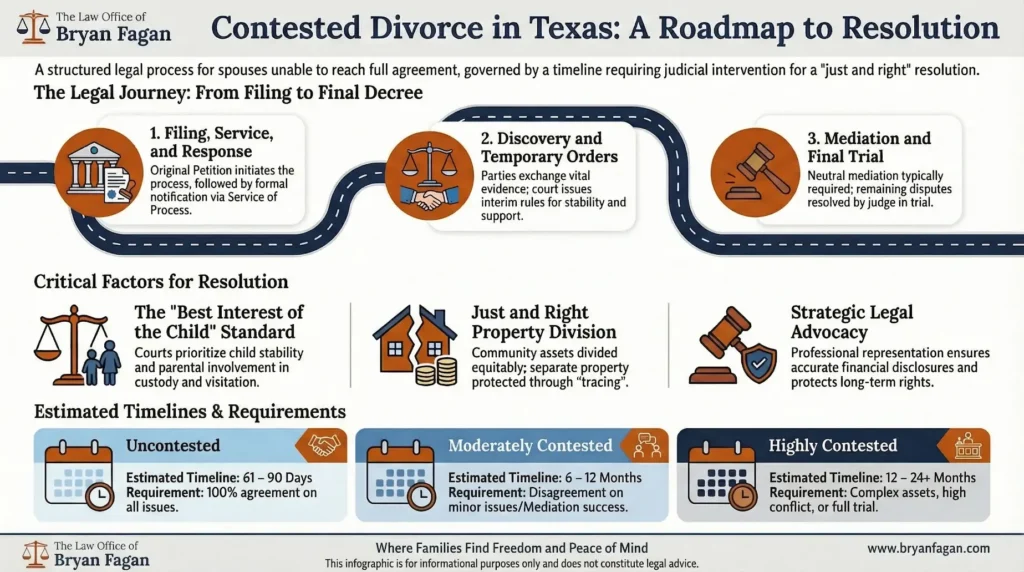
Timeline for a Contested Divorce in Texas
Understanding the timeline of a Contested Divorce in Texas is one of the most important steps in reducing stress and setting realistic expectations. While every family’s situation is unique, the process itself follows a structured path under Texas law. The Texas Family Code requires a mandatory 60-day waiting period from the date of filing before a divorce can be finalized under §6.702. That waiting period applies even if the parties later reach agreement, and it represents the absolute minimum duration for any divorce in the state.
In reality, most contested cases take significantly longer. A typical Contested Divorce in Texas may last between six and eighteen months from filing to final decree. More complex matters—especially those involving high-value community estates under §7.001, disputes over separate property characterization under §3.003, or contested conservatorship decisions under §153.002—can extend beyond two years. The legal framework is predictable, but the pace often depends on how efficiently evidence is gathered and whether disputes can be resolved before trial.
Several practical factors influence duration. Court docket congestion in heavily populated counties such as Harris, Dallas, and Travis can delay hearing settings. Financial complexity—such as business valuation, retirement division, or reimbursement claims under §3.402—adds investigative time. Custody disputes may require evaluations, particularly when courts must determine the child’s best interest under §153.002 or implement possession schedules consistent with §153.312 and §153.317. The updated child support cap reflected in §154.125 may also require detailed financial documentation when support is contested. Cooperation between parties, or lack thereof, significantly impacts how quickly mediation can occur and whether pre-trial motions become necessary.
Texas court data shows that the average family law case pendency is around twelve months, though post-2020 backlogs continue to affect certain jurisdictions. That said, preparation and proactive strategy can meaningfully influence how long a case lasts. Early financial organization, compliance with discovery, and thoughtful negotiation often shorten the path to resolution.
For families in the Atascocita area seeking guidance during this process, working with a dedicated Atascocita contested divorce lawyer provides local insight and structured advocacy. The legal team at The Law Office of Bryan Fagan, PLLC approaches each case with the understanding that time matters—not just legally, but emotionally and financially as well.
If you would like a deeper understanding of how the divorce process unfolds from start to finish, the firm’s Texas divorce overview guide offers additional clarity. While no attorney can eliminate every delay, experienced planning, organized documentation, and steady representation can transform what feels overwhelming into a manageable, structured journey toward a more stable future.

Costs of a Contested Divorce in Texas
Contested divorce costs vary widely based on complexity and conflict level.
Attorney fees: $15,000 to $30,000+ per side in moderately contested cases (hourly rates typically $250 to $500). High-conflict or high-asset divorces often exceed $100,000.
Expert witness costs: $5,000 to $20,000 for business valuations, custody evaluations, forensic accounting, or real estate appraisals.
Court costs: $300 to $500 for filing fees plus additional costs for motions and subpoenas.
Mediation: $3,000 to $10,000 total, typically split between parties.
Emotional and opportunity costs: Time away from work, stress-related health impacts, and strain on parent-child relationships.
Legal fees accumulate quickly because contested cases require extensive attorney involvement at every phase: drafting motions, conducting discovery, preparing for hearings, attending mediation, and preparing for trial. The longer spouses fight, the higher the costs climb.
Common Mistakes in Contested Divorce Cases
Avoiding common pitfalls improves outcomes and reduces unnecessary expense:
Escalating conflict unnecessarily: Treating every issue as a battle inflates costs without improving results. Choose battles strategically.
Hiding assets or incomplete disclosure: Texas courts penalize discovery violations severely. Hidden assets often surface through forensic investigation, resulting in adverse property division and sanctions.
Ignoring deadlines: Missing the deadline to file an Answer risks default judgment. Missing discovery deadlines invites motions to compel.
Refusing reasonable mediation: Courts view mediation refusal unfavorably. Genuine participation often reveals acceptable compromises.
Making emotional decisions: Spite-driven litigation rarely achieves desired outcomes. Strategic thinking protects your interests better than emotional reactions.
Over-communicating in writing: Emails and text messages become evidence. Hostile messages harm credibility and custody arguments.
Listen to Our Texas Family Law Podcast
Prefer listening? In this episode, we discuss Texas contested divorce, including litigation strategies, what to expect during the process, and how to prepare for court proceedings.
When a Contested Divorce Becomes Uncontested
A Contested Divorce in Texas does not always end in a courtroom trial. In fact, many contested cases ultimately transition into agreed resolutions once the parties gain clarity through discovery, temporary orders, or mediation. Texas courts encourage meaningful settlement discussions throughout the litigation process because negotiated agreements often serve families better than judicially imposed outcomes. Even after formal litigation begins under the structure of the Texas Family Code, compromise remains possible at nearly every stage.
Temporary orders issued under Texas Family Code Chapter 105 can establish workable parenting schedules and financial arrangements while the case is pending. Those interim decisions often help parents better understand what a long-term arrangement might look like under §153.002, which requires custody determinations to reflect the best interest of the child. Likewise, discovery conducted in accordance with the Texas Rules of Civil Procedure frequently clarifies financial realities, helping spouses evaluate property division under §7.001 and child support obligations under §154.125, including the updated net resource cap effective September 1, 2025. As evidence becomes clearer, positions often soften and room for agreement grows.
When full agreement is reached, the parties prepare a written settlement reflecting all terms. If mediation produces a binding agreement under Texas Family Code §6.602, that mediated settlement agreement is generally irrevocable once properly executed. The case then moves to the uncontested docket, where a brief prove-up hearing or affidavit process allows the court to review and sign the agreed Final Decree of Divorce. This shift from contested litigation to agreement can significantly shorten the overall timeline while maintaining legal enforceability.
Settlement offers meaningful advantages. Parents retain greater control over conservatorship and possession terms rather than leaving decisions solely to judicial discretion. Legal expenses are typically reduced, emotional strain on children decreases, and sensitive family matters remain more private than they would in open court testimony. The attorneys at The Law Office of Bryan Fagan, PLLC approach negotiations strategically, recognizing that protecting futures sometimes means resolving disputes thoughtfully rather than prolonging them.
For families in South Texas navigating this transition, guidance from a dedicated San Antonio contested divorce attorney can provide both courtroom readiness and skilled negotiation. Even when litigation begins as a Contested Divorce in Texas, settlement remains a powerful and often beneficial outcome.
If you would like additional insight into how mediation works in Texas family law cases, explore the firm’s comprehensive Texas divorce mediation guide. Understanding your options empowers you to move forward with confidence, whether your case resolves through agreement or proceeds to trial.

How a Texas Divorce Attorney Navigates a Contested Case
A skilled family law attorney provides strategic guidance at every phase of contested litigation:
Strategic case planning: Analyzing facts, identifying strengths and weaknesses, and developing litigation strategy tailored to your desired outcome.
Evidence gathering: Conducting thorough discovery, identifying witnesses, and building the evidentiary record needed for hearings and trial.
Temporary orders advocacy: Presenting compelling arguments for custody arrangements, support, and property protection during the pendency of the case.
Custody evaluation preparation: Coaching clients on evaluations and presenting evidence of parenting capacity and children’s best interests.
Negotiation leverage: Using litigation preparation to strengthen settlement positions and achieve favorable agreements.
Trial readiness: Preparing witnesses, organizing exhibits, and presenting persuasive cases when trial becomes necessary.
Experienced representation makes the difference between navigating contested divorce strategically and being overwhelmed by the legal process.
Why Choose The Law Office of Bryan Fagan, PLLC
Families facing a Contested Divorce in Texas deserve more than procedural guidance—they deserve experienced advocacy grounded in knowledge, preparation, and compassion. The attorneys at The Law Office of Bryan Fagan, PLLC bring extensive litigation experience to clients across the state, guiding them from the initial filing through trial, post-judgment motions, and appeal when necessary. Every stage of the process is shaped by the Texas Family Code, including the mandatory waiting period under §6.702, conservatorship standards under §153.002, property division requirements under §7.001, and child support calculations under §154.125, which reflects the updated net resource cap effective September 1, 2025. Understanding how these statutes interact allows families to make informed decisions rather than reactive ones.
When settlement is not possible, strong courtroom advocacy becomes essential. Trial experience matters in disputes over managing conservatorship, geographic restrictions, reimbursement claims under §3.402, and spousal maintenance eligibility under Chapter 8 of the Texas Family Code. Judges expect clear evidence, well-prepared arguments, and a structured presentation of facts. The firm’s litigation team approaches every case with that level of preparation, ensuring that clients are positioned for credibility and stability in court.
Strategic custody litigation focuses on protecting the parent-child relationship while aligning arguments with the statutory best interest standard of §153.002. Whether addressing expanded standard possession orders under §153.317 or resolving disputes regarding educational and medical decision-making authority, the goal remains the same: safeguard children’s futures. In financial matters, the firm handles complex property division involving high-value community estates, closely held businesses, retirement accounts requiring QDROs, and detailed tracing of separate property.
Compassionate communication is equally important. Divorce litigation can feel overwhelming, but clarity reduces fear. By educating clients about each phase of the process, including temporary orders hearings under Chapter 105 and mediation procedures authorized under §6.602, the firm ensures families understand both the legal structure and the practical path forward. For a comprehensive overview of how these stages unfold, clients can review the firm’s detailed Texas divorce process guide, which explains each step in accessible, straightforward language.
Statewide representation allows the legal team to serve families throughout Texas with consistent quality and local insight. From Houston to Dallas, San Antonio to surrounding communities, the mission remains steady: educate families and protect futures. Knowledge empowers better decisions, and experienced advocacy strengthens outcomes. By combining statutory precision with empathetic counsel, the firm helps clients navigate even the most complex contested cases with confidence and clarity.
Actionable Checklist: Contested Divorce in Texas
Prepare strategically for your contested divorce:
- [ ] Gather financial documents: Tax returns, bank statements, investment accounts, retirement statements, property records, debt records
- [ ] Create asset inventory: List all marital property, separate property claims, and valuables
- [ ] Document income sources: Pay stubs, business records, investment income, any cash payments
- [ ] Secure important records: Birth certificates, marriage certificate, vehicle titles, insurance policies
- [ ] Establish separate accounts: Open individual checking account if you have not already
- [ ] Document parenting involvement: Record your role in children’s daily care, education, and activities
- [ ] Consult with a family law attorney: Understand your rights before taking action
- [ ] Avoid social media discussions: Assume everything you post may become evidence
Conclusion
Divorce may begin with conflict, but it does not have to end with chaos. When handled thoughtfully, even a contested divorce can become a structured path toward stability, clarity, and a healthier future for your family. The legal process exists to create order where emotions have made things uncertain — and with the right guidance, that structure can protect your children, your finances, and your peace of mind.
At The Law Office of Bryan Fagan, PLLC, we believe knowledge is empowering. When you understand how Texas courts approach custody, property division, and support, you are no longer reacting out of fear. You are making informed decisions. And when those decisions are guided by an experienced Texas Family Law Attorney who understands both the law and the human side of conflict, the process becomes less overwhelming and far more strategic.
If you are facing a contested divorce in Texas, the next step does not have to be dramatic. It can simply be a conversation. A consultation. A chance to ask questions and gain clarity about your options. Whether your priority is protecting your relationship with your children, preserving financial stability, or simply finding a way forward that feels steady again, our team is here to help.
Transitions are rarely easy, but they can lead to stronger foundations. The future you are building may look different than you expected — but with thoughtful planning and experienced guidance, it can still be secure, peaceful, and filled with possibility. When you are ready, we are here to walk that path with you.
Frequently Asked Questions About Contested Divorce in Texas
Avoid making emotional decisions that can damage your case. Do not hide assets, transfer money without documentation, or destroy financial records. Refrain from posting about your divorce on social media, sending hostile text messages, or involving your children in adult conflict. Courts in Texas expect transparency and stability. Acting impulsively can harm your credibility and impact custody or property outcomes.
Yes, but additional legal steps are required. If you genuinely do not know your spouse’s location, Texas courts may allow service by publication or alternative service methods. However, you must show the court that you made reasonable efforts to locate them. An experienced Texas Family Law Attorney can guide you through the proper procedures to ensure the court’s jurisdiction and protect your case from delays.
A contested divorce begins when spouses disagree on at least one major issue, such as custody, property division, or support. The process typically includes filing the petition, serving the other spouse, temporary orders, discovery, mediation, and possibly trial. Texas Family Code §153.002 requires courts to determine custody based on the best interest of the child, and property division must be “just and right.” The process is structured, even if emotions run high.
The least expensive option is usually an uncontested divorce where both spouses agree on all terms. Filing fees vary by county, and limited attorney involvement reduces costs. However, even in simple cases, a short legal consultation can prevent costly mistakes. Contested divorces cost more because they involve court hearings, discovery, and possibly trial.
“Winning” in a contested divorce means achieving a fair outcome that protects your priorities. Preparation is key. Gather financial documentation, comply with court deadlines, and present credible evidence. Courts value stability, honesty, and the best interests of children. Calm, strategic decision-making often leads to stronger results than emotional confrontation.
While Texas requires a minimum 60-day waiting period after filing, contested divorces often take 6 to 18 months. Complex cases involving custody disputes, business valuations, or extensive discovery may take longer. Court schedules, cooperation between parties, and mediation outcomes all affect the timeline.
In Texas divorce law, the key waiting period is 60 days after filing before a final decree can be granted under Texas Family Code §6.702. The “six-month rule” may refer to residency requirements for filing in Texas. Generally, at least one spouse must have lived in Texas for six months and in the filing county for 90 days before filing for divorce.
Costs vary significantly depending on the level of conflict. Filing fees typically range from $300 to $500 depending on the county. Moderately contested divorces often cost between $15,000 and $30,000 per spouse in attorney’s fees, while complex, high-asset cases can exceed $100,000. Mediation and expert witnesses add additional costs.
Do not ignore court orders, miss deadlines, or refuse to participate in mediation if ordered. Avoid making large financial purchases or moving children without court approval. Keep communication respectful and documented. Thoughtful, strategic actions protect your credibility and your long-term goals.
Typically, each spouse pays their own attorney’s fees. However, Texas courts may order one spouse to contribute to the other’s attorney’s fees in certain circumstances, such as significant income disparity or as a sanction for misconduct. Temporary attorney’s fees may also be awarded during the case to ensure fairness.