 Skip to content
Facing a child custody battle can be one of the most emotionally draining experiences a parent can go through. When you are fighting for your child's well-being and future, the legal system can feel overwhelming and confusing. To get what most people call "full custody" in Texas, you must prove to a judge that naming you the Sole Managing Conservator is what is truly in your child's best interest. This isn't just about saying you're the better parent; it's about providing clear and convincing evidence that a joint decision-making arrangement with the other parent would be unworkable or even harmful to your child.
Understanding What Texas Law Means by "Full Custody"
Navigating a custody dispute is incredibly difficult. Your entire world narrows down to one focus: protecting your child. But the legal system has its own language, and understanding it is the first step toward building a strong case.
First things first: in a Texas courtroom, you won't hear lawyers or judges using the term "full custody." The official legal term under the Texas Family Code is Sole Managing Conservator.

This isn't just legal nitpicking. The distinction is critical because it defines the exact set of rights and responsibilities you are asking the court to grant you exclusively. Understanding this from the start helps you build a much stronger, more focused case.
The Presumption of Joint Custody
It's important to know that Texas law starts with the assumption that it's in a child's best interest for parents to be named Joint Managing Conservators. This arrangement is designed to allow both parents to share in the rights and duties of raising their child.
However, this is just a presumption—a legal starting point. It is not set in stone.
The court's primary duty is to protect the child. If you can provide solid evidence showing that a joint arrangement would be detrimental to your child, a judge can and will set that presumption aside. You can learn more about the specifics of what is joint custody in our detailed article.
What Is a Sole Managing Conservator?
Being named the Sole Managing Conservator (SMC) gives you the exclusive authority to make the major decisions for your child. The other parent, who would typically be named the Possessory Conservator, will still have visitation rights (possession and access) and an obligation to pay child support, but they lose their say in these key areas.
As an SMC, you would have the exclusive right to:
- Decide where the child lives without being limited to a specific geographic area.
- Make all decisions about the child's education, such as which school they attend.
- Consent to all non-emergency medical, dental, and psychological treatment for the child.
- Receive and manage child support payments on the child's behalf.
To better understand the key differences in parental rights, here’s a quick comparison of the two main types of conservatorship in Texas.
Sole vs. Joint Managing Conservatorship At a Glance
| Parental Right | Sole Managing Conservator (SMC) | Joint Managing Conservator (JMC) |
|---|---|---|
| Child's Primary Residence | Exclusive right to designate the child's residence without geographic restriction. | One parent is designated to determine the child's residence, usually within a specific geographic area. |
| Major Decisions | Exclusive authority over education, non-emergency medical, dental, and psychological decisions. | Rights are shared, requiring mutual agreement or one parent having the tie-breaking authority. |
| Child Support | Receives child support payments from the other parent (Possessory Conservator). | One parent is typically ordered to pay child support to the other, based on income and possession schedule. |
| Legal Presumption | Awarded only when joint conservatorship is proven not to be in the child's best interest. | The default legal presumption in Texas is that a joint arrangement is in the child's best interest. |
This table highlights the significant shift in power and responsibility that comes with being named the Sole Managing Conservator.
The heart of every custody case in Texas is the "best interest of the child" standard. This principle, laid out clearly in the Texas Family Code, is the lens through which a judge views every single decision, from visitation schedules to who gets to make medical choices.
To win your case, you must present clear and convincing evidence that giving you these exclusive rights is essential for your child's physical and emotional well-being. According to Texas Family Code § 153.002, the child’s best interest is the single most important factor. This means you have the heavy burden of showing that a joint setup would be actively harmful, or that the other parent has a history of behavior that makes them unfit to share in these critical life decisions.
Meeting the "Best Interest of the Child" Standard
In every Texas custody case, the judge's entire decision boils down to one powerful question: What is in the best interest of the child? This isn't just a feel-good phrase; it's the legal standard laid out in the Texas Family Code, and it's the yardstick against which every piece of evidence and testimony is measured. If you are seeking sole managing conservatorship, you must prove that this arrangement is absolutely essential for your child’s physical and emotional well-being.

While it sounds straightforward, the legal application is complex. To make this determination, Texas courts rely on a specific set of criteria known as the "Holley Factors." These factors give judges a concrete framework to look past what the parents want and focus squarely on the child's world.
The Holley Factors Explained
The Holley Factors, stemming from a landmark Texas Supreme Court case, are a non-exhaustive list of points a judge will consider. Your job is to build a compelling narrative that showcases your strengths across these areas while clearly showing how the other parent's actions or circumstances put your child's well-being at risk.
Here are some of the key factors a judge will weigh:
- The child’s emotional and physical needs, both now and in the future.
- Any emotional or physical danger the child is in or might be in.
- The parental abilities of each person seeking custody.
- The stability of the home environment you can provide.
- Programs available to help parents promote the child's best interest.
- Actions or failures to act by a parent that show the current parent-child relationship isn't a healthy one.
- Any excuses a parent might offer for those actions or omissions.
This isn't a simple scorecard where you just need to "win" more points than the other parent. It's about painting a complete, honest picture for the court, demonstrating why your sole guidance is what your child needs to thrive.
From Legal Theory to Real-World Proof
It’s one thing to know what the Holley Factors are, but it's another to prove them in a courtroom. You have to draw a direct line from your everyday life and parenting decisions to these legal standards. It’s all about showing, not just telling, the judge why you are the parent better equipped to give your child a safe, stable, and nurturing home.
For example, imagine you are seeking sole custody because the other parent leads a chaotic life. You could present evidence showing they have moved five times in two years, forcing your child to bounce between different schools. This directly addresses the "stability of the home" factor.
To counter this, you would provide your own lease agreements, your child's perfect attendance records, and report cards showing they are excelling in a consistent school environment. This creates a stark, powerful contrast for the judge to see.
A judge won't just take your word that you are the more stable parent. They need to see a documented history of reliability, responsibility, and prioritizing the child's needs over personal convenience.
Showing you’re proactive about your child’s safety, for instance by acquiring essential paediatric first aid skills, can also be a powerful testament to your parental abilities. It demonstrates foresight and a deep commitment to being prepared for any situation, reinforcing that you're the parent who can truly meet the child's best interests.
Building Your Case Around Your Child's Needs
Every argument you make in your fight for full custody in Texas must be viewed through your child's eyes. Each piece of evidence you present should directly answer the question, "How does this benefit my child?"
For instance, if the other parent constantly misses the child's doctor's appointments or forgets to give them their daily allergy medication, you're not just pointing out a flaw. You're demonstrating a direct risk to your child’s physical needs and well-being.
Here’s how to connect your actions to the Holley Factors:
- Parental Abilities: Keep a log of who takes the child to the doctor, who attends parent-teacher conferences, and who helps with homework every night. This proves you’re the engaged, primary caregiver.
- Child’s Needs: If your child has special needs, like asthma or a learning disability, show the court that you are the parent who manages their IEPs, therapy appointments, and treatment plans.
- Stability of the Home: Evidence of a safe, clean home is powerful. Photos of your child’s organized room, a well-stocked fridge, and a safe backyard can be surprisingly effective.
- Emotional Danger: If the other parent constantly argues in front of the child, uses inappropriate language, or has a revolving door of new partners, this can be argued as a source of emotional harm. Testimony from a family friend or text messages can back this up.
By systematically linking your strengths—and the other parent’s weaknesses—to these specific legal standards, you build an undeniable case. You shift from being just another parent in a dispute to being a true advocate for your child’s future, giving the court the clear, fact-based evidence it needs to rule in your favor.
Gathering Compelling Evidence for Your Custody Case
A Texas family court judge can only make decisions based on the evidence presented in the courtroom. Your gut feeling that you're the better parent—no matter how true it is—isn't enough to win sole custody. You have to prove it with organized, compelling evidence.
This is where the real work of a custody case happens, long before you ever see a judge. Gathering your evidence isn’t just about collecting papers; it’s about building a solid, undeniable story that shows why granting you sole managing conservatorship is truly in your child's best interest.
Beyond Words: Proving Your Case with Documentation
Your testimony is a powerful piece of the puzzle, but a judge's decision becomes much easier when your words are backed up by hard evidence. Texas courts need documented proof to see the reality of your child's day-to-day life and make a ruling that protects their future.
That’s why you need to start organizing your documents immediately. Judges are looking for clear indicators of who has been the responsible, primary parent. In fact, judges in Texas heavily weigh documentary proof like school records and medical logs that show one parent has consistently handled 70-80% of the child's daily needs.
Your job is to collect the documents that paint this picture clearly and factually.
Key Types of Evidence to Collect
First things first, get organized. Whether you use a physical binder with dividers for each category or a secure folder on your computer, create a system. This will not only make your attorney's job easier but will also give you a sense of control during a very stressful time.
Here are the essential documents you need to start gathering:
- Communication Logs: Keep a detailed record of every text, email, and phone call with the other parent. The goal here is to show patterns. Are they cooperative? Combative? Uninvolved? It's the consistent behavior over time, not just one angry text, that tells the story.
- School and Medical Records: These are incredibly persuasive. Collect everything: report cards, attendance records, emails with teachers, and notes from parent-teacher conferences. Do the same for medical records. Who takes the child to the doctor? Who fills the prescriptions? Who handles the late-night fevers?
- A Parenting Journal: This is your secret weapon. Keep a simple daily or weekly log of important events. Note missed visitations, concerning things the other parent said, or even just positive moments you shared with your child. Stick to the facts. This journal will be invaluable for refreshing your memory when it's time to testify.
It's a common mistake to think you need one "smoking gun" piece of evidence to win. The reality is that it’s the steady, cumulative weight of all your documentation that builds a convincing argument for the court.
Documenting High-Conflict Issues
If your case involves serious issues like family violence, neglect, or substance abuse, your burden of proof is even higher. You cannot just make accusations; you must back them up with solid evidence.
For instance, if you're concerned about the other parent's substance abuse, you'll need more than just your word. You should look for:
- Police reports from any incidents involving drugs or alcohol.
- Photos or videos that document intoxication or paraphernalia (obtained legally).
- Statements from credible witnesses who have seen the behavior firsthand.
- Results from court-ordered drug tests from any past legal issues, if they exist.
Likewise, if neglect is the issue, you'll want to gather things like CPS reports, notes from the school nurse about your child arriving hungry or unkempt, or photos showing an unsafe living environment. This kind of evidence speaks directly to the "physical and emotional danger" standard that is so critical in any case for sole managing conservatorship. To get a better handle on the types of evidence needed, you can learn more about proving a child custody case in our detailed guide.
Building this foundation of evidence takes time, but it is without a doubt the most important thing you can do to protect your child. When you present a clear, fact-based case, you give the judge the tools they need to make a decision that ensures your child has a safe and stable future with you.
If you need help navigating divorce, custody, or estate planning in Texas, contact The Law Office of Bryan Fagan today for a free consultation.
The thought of walking into a Texas family courtroom can be intimidating. It's an environment with its own set of complex rules and procedures that can feel completely foreign. But here’s the thing: understanding the basic roadmap of a custody case can replace that anxiety with a sense of control. When you know what’s coming, you can prepare strategically and keep your focus where it belongs—on your child’s future.
Your legal journey to becoming a sole managing conservator officially begins when you file an Original Petition in Suit Affecting the Parent-Child Relationship. This is the formal document that opens your case with the court. It lays out exactly what you're asking the judge to do and the legal reasons behind your request. Once this petition is filed and then properly served on the other parent, the clock starts, and your case is officially underway.
The Critical First Step: The Temporary Orders Hearing
Not long after the initial filing, the court schedules a temporary orders hearing. This is arguably one of the most pivotal moments in your entire case. At this hearing, the judge will make temporary decisions that essentially create the "new normal" for your family while the legal process unfolds. These orders will determine where your child will live, who gets to make immediate decisions, and what the possession schedule will look like for the time being.
These initial orders often set the tone for the rest of the case, creating a status quo that can be hard to change later. That’s why it’s absolutely critical to present a clear, powerful, and concise argument right out of the gate. A judge has very limited time and needs to see compelling evidence to grant you the authority you’re seeking. To get fully up to speed, you can dive deeper into our guide on what to expect in a temporary orders hearing in Texas.
The Role of Mediation and Key Professionals
While you see dramatic trials on TV, the reality is that the vast majority of Texas custody cases are settled before ever reaching a final trial. This usually happens through a process called mediation. In fact, most judges will require you and the other parent to attempt mediation before they’ll even consider giving you a trial date. It’s a confidential process where a neutral, third-party mediator works with both sides to find common ground and hammer out a settlement.
Coming into mediation with a solid strategy is key. This isn't about giving in; it’s about negotiating from a position of strength, with your child's best interests as the absolute, non-negotiable bottom line.
In more high-conflict cases, the court might bring in other professionals to get a clearer picture. One of the most common is an ad litem attorney, who is appointed by the judge to represent the child's best interests—not the wishes of either parent. This attorney essentially acts as the court's investigator, interviewing you, the other parent, teachers, and even the child to form an independent recommendation. Their opinion carries significant weight and can greatly influence the judge's final decision.
Building a strong case for mediation, hearings, and trial all comes down to solid evidence.
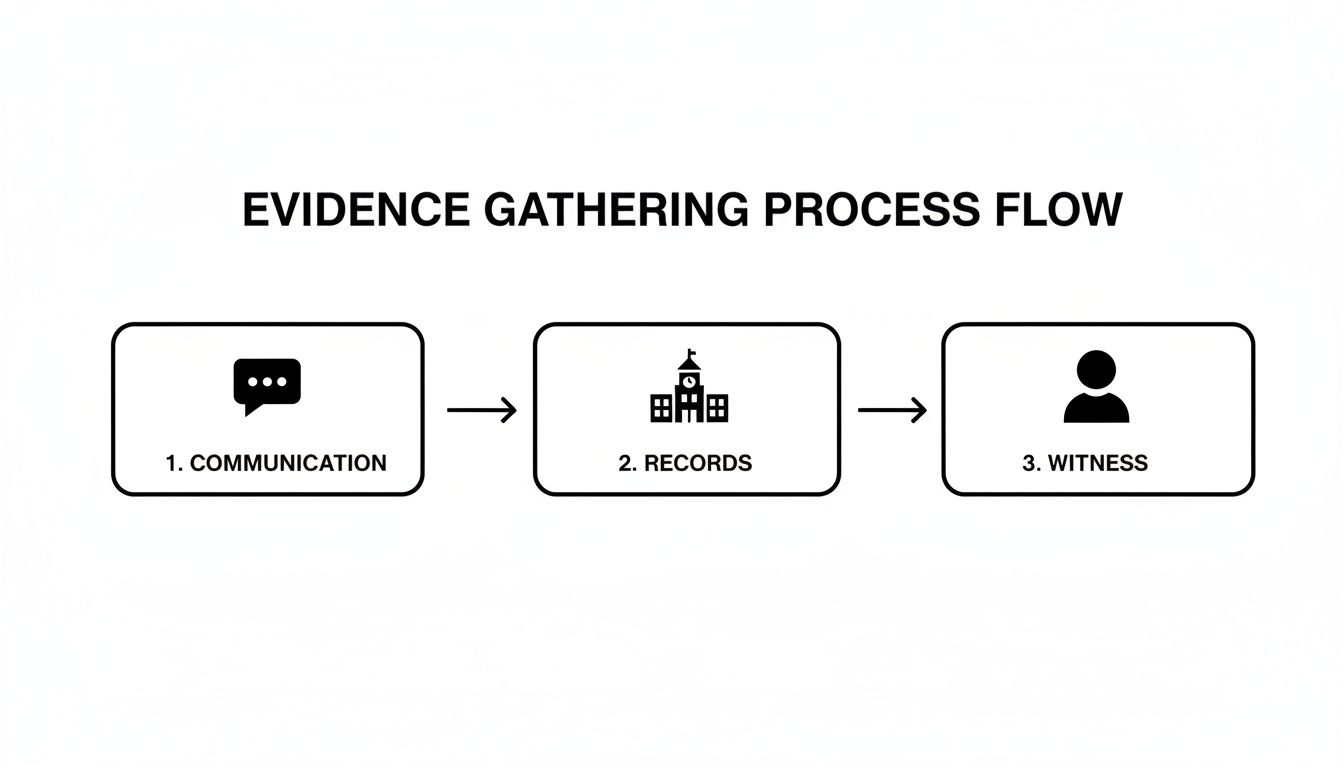
As you can see, a persuasive case is built on three pillars: documented communications (texts, emails), official records (school, medical), and credible witness testimony. Each piece reinforces the others to create a compelling narrative for the court.
Preparing for a Final Trial
If you’ve gone through mediation and still can’t reach an agreement, your case will be scheduled for a final trial. This is your opportunity to present every piece of evidence and testimony to the judge, who will then make a final, legally binding decision. Preparation for trial is everything. It means meticulously organizing your documents, lining up your witnesses, and working hand-in-hand with your attorney to sharpen every single argument.
The Texas Family Court process is a marathon, not a sprint. Every step—from the initial petition to the temporary orders hearing and beyond—is a building block. By understanding the purpose of each stage, you can stay focused and present the strongest case for why you should be named Sole Managing Conservator.
The path can feel long and complicated, but it is structured. The key is to break this process down into a series of manageable steps. Doing so will help you navigate the system successfully and secure the safe, stable future your child deserves.
If you need help navigating divorce, custody, or estate planning in Texas, contact The Law Office of Bryan Fagan today for a free consultation.
High-Conflict Issues That Can Lead to Sole Custody
While Texas courts prefer to keep both parents involved, that preference is set aside when certain high-conflict situations make a joint arrangement unsafe or unworkable for a child.
When a parent's behavior poses a real, tangible threat to a child's physical or emotional well-being, a judge will not hesitate to override the standard presumption of joint conservatorship. These are not minor disagreements over bedtime. They are serious, fundamental problems that compel the court to act decisively to protect the child's best interest.

If you find yourself in one of these challenging situations, your most important job is to provide the court with specific, credible evidence. Vague accusations will not be enough. You must build a fact-based case that leaves no doubt about the risk your child is facing.
Family Violence and Protective Orders
Family violence is perhaps the single most compelling reason a court will grant sole custody. The Texas Family Code is clear on this: if a judge finds that a parent has committed family violence against the other parent or the child, the law automatically presumes it is not in the child’s best interest for that parent to be a joint managing conservator.
This creates a significant legal advantage. The most direct path to establishing this presumption is by obtaining a Protective Order. This is a civil court order specifically designed to stop violence, threats, and harassment. To secure one, you must present hard evidence—police reports, photos of injuries, medical records, or testimony from witnesses who saw the abuse.
Once a Protective Order is issued, the entire dynamic of the case changes. The burden of proof flips. It is now up to the abusive parent to convince the court why, despite a documented history of violence, they should still have a say in major decisions for the child. That is an incredibly difficult argument to win.
Documenting Substance Abuse
When a parent's drug or alcohol abuse puts a child in harm's way, it is a direct threat to their safety. If you are arguing that the other parent's substance abuse is a danger, you need more than just your word for it. You must prove it with concrete evidence.
Here’s what you need to start gathering:
- Police Reports: Any arrest records for DUIs, public intoxication, or drug possession are incredibly persuasive.
- Witness Statements: Testimony from credible people—teachers, family members, friends—who have seen the parent intoxicated while responsible for the child can be powerful.
- Failed Drug Tests: Your lawyer can file a motion to have the court order drug and alcohol testing. A positive test result is hard evidence that's impossible for a judge to ignore.
Consider a real-world scenario: a parent is supposed to pick up a child from school but is too intoxicated to drive. The school calls you, you request a wellness check, and the police document the incident. That chain of events paints a very clear picture of neglect and danger for the court.
Severe Mental Health Issues and Parental Alienation
A parent struggling with severe, untreated mental health issues may not be able to provide a safe and stable home. The key here isn't the diagnosis itself, but proving how the condition negatively impacts the child. This often requires professional input, like medical records or testimony from a therapist or psychologist.
Another incredibly damaging dynamic is parental alienation. This is where one parent wages a campaign to systematically poison the child's relationship with the other parent. Courts recognize this for what it is: a form of emotional abuse.
Evidence of alienation might include:
- Texts or emails where the parent bad-mouths you to the child or makes false accusations.
- Testimony from a counselor who has seen the alienation tactics in action.
- Observations of a child who suddenly and inexplicably refuses to see you after spending time with the other parent.
Tackling any of these high-conflict issues in court requires a sharp, strategic approach. By carefully gathering the right kind of proof, you can demonstrate to the judge why sole managing conservatorship is the only responsible choice to protect your child's well-being.
The Financial Side of a Sole Custody Arrangement
Winning sole managing conservatorship is a major step toward securing your child's future, but the judge’s signature on that court order isn't the final step. Now comes the practical part: ensuring you have the financial stability to give your child the life they deserve. Understanding how Texas handles child support is essential for planning what comes next.
When a judge names one parent the sole managing conservator, the other parent—the possessory conservator—is almost always ordered to pay child support. This isn't a punishment. It's a fundamental legal obligation ensuring both parents financially contribute to their child’s upbringing.
How Texas Calculates Child Support
Texas courts use a specific, formula-based system laid out in the Texas Family Code to calculate child support. The process begins by determining the non-custodial parent's net monthly resources.
"Net resources" is a broad term that includes more than just a pay stub. It can encompass various income streams:
- Wages, salary, commissions, and bonuses
- Income from self-employment
- Money from rental properties
- Retirement benefits and pensions
- Social Security and disability payments (some exceptions apply)
After adding all gross income, the court subtracts items like federal income taxes, Social Security taxes, union dues, and the amount that parent pays for the child's health insurance. The remaining amount is their net monthly resources.
Applying the Statutory Percentages
Once the net resources figure is determined, the court applies a percentage based on the number of children. The guidelines are straightforward: 20% for one child, 25% for two, and 30% for three. It's also important to know that the income cap on net monthly resources is periodically updated, which can change calculations for higher-earning parents. You can get more details on recent updates to the Texas Family Code on this legal blog.
Many people mistakenly think these percentages are just suggestions. They are not. A judge will adhere to these guidelines unless there is compelling proof that doing so would be unfair or not in the child's best interest.
For example, if the other parent has net monthly resources of $6,000 and you have one child, the guideline child support payment would be $1,200 per month ($6,000 x 0.20).
Covering Health Insurance and Medical Expenses
The financial support goes beyond that monthly payment. Your court order will also specify who is responsible for providing health and dental insurance for your child. The parent paying child support is typically the one ordered to maintain this insurance coverage.
The order will also spell out how to split any medical costs that insurance doesn't cover—such as co-pays, deductibles, and prescriptions. Most of the time, judges will order these additional expenses to be split 50/50. This is why it’s absolutely critical to keep detailed records and receipts for every single medical expense. You'll need that paper trail to get properly reimbursed. Finalizing these financial details is a vital part of building a stable new beginning for your child.
Common Questions About Getting Full Custody in Texas
The path to securing your child’s future can feel like a maze, and it’s completely normal to have many questions. When you’re preparing to make the case for sole managing conservatorship, getting clear, direct answers is the best way to build confidence for the journey ahead.
We’ve gathered some of the most common questions we hear from parents in your situation. Understanding these key points helps set realistic expectations and allows you to focus your energy where it matters most.
Can My Child Choose Who to Live With?
This is one of the most frequently asked questions. In Texas, a child who is 12 years of age or older has the right to meet with the judge in private to state their preference on who they’d rather live with. However—and this is a critical point—their preference is not the final word.
A judge will absolutely listen to what a child has to say and consider it as an important piece of the puzzle. However, it's just one of many "Holley Factors" the court must evaluate. The ultimate decision always comes down to what the judge believes is in the child’s overall best interest, taking into account everything from the stability of each home to the parents' abilities.
How Long Does a Custody Case Take?
There is no single answer; the timeline for a custody case in Texas can vary significantly.
- An uncontested case, where you and the other parent have already agreed on all terms, might be finalized in just a few months.
- A high-conflict case, especially one involving serious allegations that proceeds to a full trial, can easily last for a year or even longer.
Factors like the court's schedule, the amount of evidence that needs to be reviewed (discovery), and whether professional evaluations are required (like a custody evaluation) will all impact how long the process takes.
Key Takeaway: While a child’s preference is important, the "best interest of the child" standard is the ultimate deciding factor. A judge will evaluate the maturity of the child and the reasons for their preference alongside all other evidence presented in the case.
What Is a Possessory Conservator?
In a sole custody arrangement, one parent is named the Sole Managing Conservator (SMC). This is the parent who has the exclusive right to make the major decisions for the child. The other parent is typically named the Possessory Conservator.
Think of the Possessory Conservator's role in two parts: they have the right to possession and access (visitation) with the child according to the court-ordered schedule, and they have the legal duty to pay child support. While they absolutely have the right to spend time with their child, they do not get the final say on key decisions like where the child goes to school or major medical treatments.
If you need help navigating divorce, custody, or estate planning in Texas, contact The Law Office of Bryan Fagan, PLLC today for a free consultation at https://www.bryanfagan.com.


