
It often starts with a quiet moment most people never plan for—a kitchen table conversation after the kids are asleep, a long sigh, and the realization that staying married no longer feels possible. In that moment, many Texas parents aren’t thinking about legal theory or court procedure. They’re thinking about peace. About how to end a marriage without turning their family upside down. About finding something—anything—that feels manageable. That search frequently leads to a Standard Texas Divorce Settlement Template, a document that promises order, savings, and a smoother path through an emotionally charged transition. But what many families don’t realize is that the way a divorce agreement is drafted can shape daily life for years to come, especially for children who are quietly absorbing every change around them.
At The Law Office of Bryan Fagan, PLLC, we’ve walked alongside thousands of Texas families facing this exact crossroads. Our firm is led by Bryan Joseph Fagan, a South Texas College of Law graduate and widely recognized authority on Texas divorce and custody law, and our mission is rooted in one guiding purpose: to empower people to reclaim freedom and peace of mind during life’s hardest transitions. Texas courts are legally bound to prioritize the best interest of the child under Texas Family Code §153.002, and judges look closely at whether a divorce settlement provides stability, predictability, and clear structure for family life after separation. A template may offer a starting point, but without careful customization, it can leave families exposed to confusion, conflict, and unnecessary stress long after the divorce is final.
This article is here to give you clarity before mistakes are made. You’ll learn what a Standard Texas Divorce Settlement Template truly is, when it can help, and when it can quietly cause harm—particularly in families with children. More importantly, you’ll see how compassionate, experienced legal guidance can turn a painful ending into a thoughtful plan for the future. As you continue reading, our goal is to help you feel informed, supported, and confident that there is a way forward that protects what matters most.
Key Takeaways
- A Standard Texas Divorce Settlement Template provides organizational structure but must be customized to Texas law and your specific circumstances before any court will approve it
- Texas divorce settlements must comprehensively address property division, debt allocation, child-related provisions, and spousal maintenance to avoid rejection
- Templates work best in truly uncontested divorces with straightforward assets, no children, and complete agreement between both parties
- Generic templates frequently fail due to vague language, missing required terms, and noncompliance with Texas Family Code provisions
- Professional legal review before filing can prevent costly corrections, court delays, and post-divorce litigation that far exceed initial attorney fees

Your Family’s Future Starts Here
Don’t navigate your legal journey alone. Schedule a consultation now and get the clarity and support you deserve.
What Is a Standard Texas Divorce Settlement Template?
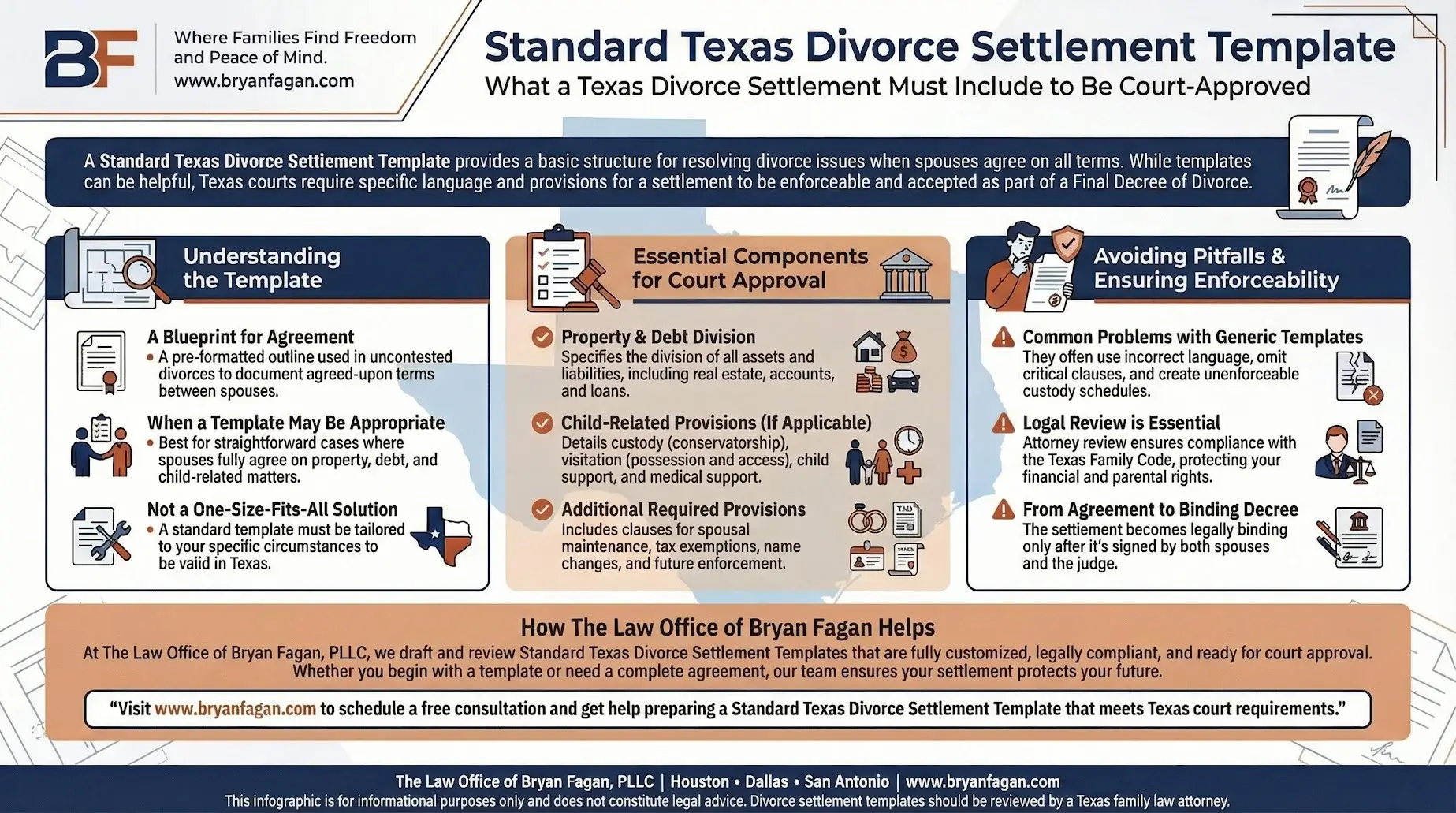
A Standard Texas Divorce Settlement Template is a pre-formatted sample document designed to organize the agreed-upon terms of a divorce into a structure similar to what Texas courts expect. It functions as a framework rather than a final legal instrument, providing sections for property division, debt allocation, child custody arrangements, and support obligations. These templates are most commonly used in uncontested divorces under Texas Family Code §6.701, where both spouses have reached full agreement, or in cases nearing resolution through mediation. When used thoughtfully, a template can help families clarify decisions and reduce uncertainty during an emotionally difficult transition.
What templates do not do is create enforceable rights on their own. A template has no legal effect until its terms are properly incorporated into a Final Decree of Divorce and signed by a judge. Texas courts derive authority to enforce divorce orders from Texas Family Code §7.001 for property division and §153.002 for child-related matters, both of which require judicial review to ensure statutory compliance and, when children are involved, that the agreement serves the child’s best interest. Until a judge signs the decree, a template remains only a draft. Once approved, however, the decree becomes a binding court order, and violations may be enforced through contempt or other remedies authorized by the Family Code.
Templates gained popularity as Texas family law evolved to encourage no-fault divorce and agreed resolutions, reducing the need for contested hearings. Today, many online sources offer “Texas-specific” versions, but quality and accuracy vary widely. Judges routinely reject template-based agreements that rely on vague language, omit required statutory provisions, or fail to reflect current Texas Family Code updates. Family law is not static, and using outdated or generic forms can result in delays, added expense, and unnecessary stress for families already navigating change.
Many families encounter templates after searching online for quick answers, hoping to simplify the process. What those searches rarely explain is that every provision must align precisely with Texas statutes and local court expectations. Judges are not required to approve agreements simply because both spouses agree, especially when conservatorship, possession schedules, or child support are involved. Educational resources like the firm’s Texas divorce guidance help families understand how courts evaluate these agreements in practice.
Divorce planning often overlaps with other long-term decisions, including estate planning and healthcare directives. As families restructure their lives, reviewing tools such as a Texas living will template alongside divorce documents can help ensure consistency and peace of mind. By combining structured tools, updated legal knowledge, and compassionate guidance, this approach empowers families to move forward with clarity while protecting what matters most.

What a Texas Divorce Settlement Must Cover
Texas courts will not approve a divorce settlement that fails to address required elements comprehensively. A judge’s responsibility extends beyond simply accepting what spouses have agreed upon. The court must verify that the agreement complies with Texas law, particularly regarding child welfare and fair property distribution. Understanding what must be covered helps you evaluate whether any template you are considering is adequate for your situation.
Division of Property
Texas is a community property state, which means that assets acquired during the marriage are presumptively owned equally by both spouses. The Texas Family Code §7.001 requires courts to divide community property in a manner that is “just and right.” This does not always mean exactly 50/50, but it does require careful consideration of what each party receives.
Your settlement must distinguish between community property and separate property. Separate property includes assets you owned before marriage, inheritances received during marriage, and gifts given specifically to one spouse. Everything else is typically community property subject to division.
Real property requires particular attention. Any real estate must be described with its full legal description—not just a street address—to avoid title disputes later. Similarly, vehicles should be identified by VIN, and bank accounts by institution name and account number. Investment accounts require the same level of detail.
Retirement accounts present unique challenges. Dividing a 401(k) or pension often requires a Qualified Domestic Relations Order (QDRO), which is a separate court order directing the plan administrator to divide the account. Without a properly drafted QDRO, the account holder’s spouse may face significant tax penalties or lose access to their share entirely. Generic templates rarely address QDRO requirements adequately.
Allocation of Debts
Just as assets must be divided, debts require clear allocation. This includes credit cards, car loans, student loans, and mortgages. The agreement must specify which spouse assumes responsibility for each debt and include liability details that prevent future disputes.
Joint debts present particular complexity. Even if your divorce agreement assigns a joint credit card to your spouse, the creditor can still pursue you if payments are not made. Your settlement should address how to handle these situations and may need to require refinancing certain debts into individual names.
Personal property divisions—furniture, electronics, jewelry, and household items—also need clear documentation. While courts generally care less about who gets the coffee table, vague language like “parties agree to divide personal property fairly” invites conflict and may cause a judge to request clarification.
Child-Related Provisions (If Applicable)
If you have children, your divorce settlement must address conservatorship, possession and access, child support, and medical support. Texas law prioritizes the best interests of the child, and judges will scrutinize any arrangement that appears to compromise child welfare.
Conservatorship determines which parent makes major decisions about the child’s education, healthcare, and religious upbringing. Texas law favors joint managing conservatorship, where both parents share these responsibilities, though one parent is typically designated as having the exclusive right to determine the child’s primary residence.
Possession and access—what many people call visitation—follows the Standard Possession Order unless parents agree otherwise. This schedule gives the non-primary parent the first, third, and fifth weekends of each month, Thursday evenings, alternating holidays, and extended time during summer vacation. Deviations from this schedule are permitted but require justification.
Child support calculations follow statutory guidelines under Texas Family Code §154.125. For one child, the non-custodial parent typically pays 20% of net resources, increasing incrementally up to 40% for five or more children. The 2025 guidelines cap the monthly net resources considered at $9,200. Your agreement must reflect these calculations accurately, or the court may reject it.
Medical and dental support obligations typically require each parent to cover 50% of unreimbursed medical expenses. The agreement must also address health insurance coverage, including which parent provides it and how premiums are shared.
Spousal Maintenance (If Any)
Spousal maintenance—often referred to as spousal support or alimony—is far less common in Texas than many people expect, and the law places clear limits on when it applies. Under Texas Family Code §§8.051–8.304, maintenance is intended as a narrow safety net rather than a guaranteed outcome. In practice, courts look closely at whether a spouse truly lacks the ability to earn enough income to meet minimum reasonable needs and whether additional statutory factors are present, such as a marriage lasting at least ten years or circumstances involving disability or family violence. When families are using a Standard Texas Divorce Settlement Template, these legal thresholds must be addressed carefully to avoid provisions that a judge may later reject.
Even when spousal maintenance is appropriate, Texas law strictly caps both the amount and duration. As of the most recent Texas Family Code updates, maintenance is limited to the lesser of $5,000 per month or 20% of the paying spouse’s average monthly gross income. Duration is tied directly to the length of the marriage and other qualifying factors, typically ranging from five to ten years at most. These limits reflect the Legislature’s intent to encourage financial independence while still providing temporary support where it is genuinely needed.
Any well-drafted settlement agreement should clearly spell out the amount of maintenance, the payment schedule, and the specific events that cause it to end. Texas Family Code §8.056 provides that spousal maintenance automatically terminates upon the recipient’s remarriage or the death of either party, and many agreements also include cohabitation provisions to prevent misuse. Attorneys with deep experience in Texas family law know that vague or overly broad language in this area often leads to enforcement disputes long after the divorce is final.
Divorce planning frequently intersects with broader financial and estate considerations, particularly when long-term support obligations are involved. Families often benefit from coordinating divorce terms with future planning tools, such as guidance found in the firm’s resource on a revocable living trust template, to ensure consistency and peace of mind. Additional educational insight is available through the firm’s library, including practical explanations in its Texas divorce resource center. By combining precise legal drafting with compassionate guidance, this approach helps families resolve spousal maintenance issues in a way that protects stability today while planning responsibly for the future.

When a Standard Texas Divorce Settlement Template Can Be Useful
Despite their limitations, templates do serve legitimate purposes in certain situations. The key is understanding when a template helps versus when it creates more problems than it solves.
Templates work best in truly uncontested divorces. Under Texas Family Code §6.701, an uncontested divorce is one where both spouses fully agree on all terms before filing the original petition. If you and your spouse have already settled every issue—who gets what property, how debts are divided, and all arrangements for children—a template can help organize those decisions into a document.
The ideal template user has straightforward assets: perhaps a joint checking account, two vehicles, some furniture, and minimal debt. There is no real property requiring legal descriptions, no retirement accounts requiring QDROs, and no children requiring custody arrangements. The marriage may have been short, with little community property accumulated.
Consider a hypothetical couple: David and Jennifer married three years ago, have no children, rent their apartment, and each have separate car loans in their own names. They have one joint checking account with $5,000, which they agree to split evenly. Their divorce is genuinely simple. For them, a template provides structure for documenting their agreement before filing the petition and moving toward their prove-up hearing after the 60-day waiting period required by Texas Family Code §6.702.
Templates also serve as useful planning tools for couples entering mediation. Before meeting with a mediator, reviewing a template helps spouses identify all the issues they need to resolve. Which sections apply to their situation? What decisions must they make? This preparation can make mediation sessions more productive and less expensive.
Statistics suggest that 70-80% of Texas divorces settle without trial, according to Texas Judicial Branch data. Many of these couples can benefit from templates as organizational aids—provided they understand the document requires professional review before submission.
Limitations and Risks of Generic Divorce Settlement Templates
Why Templates Are Not Universally Sufficient
No two Texas divorces are identical, which is precisely why a “standard” template cannot address every situation. The term “standard” implies something automatic or universally applicable, but Texas divorce law does not work that way.
Each county in Texas may have specific local rules affecting document formatting and required attachments. Harris County, for example, has stricter formatting requirements than many smaller counties. A template designed for general Texas use may not comply with your particular county’s expectations.
Generic templates from national legal websites often miss Texas-specific requirements entirely. They may not address community property distinctions correctly, may calculate child support using another state’s guidelines, or may use language that Texas courts find unenforceable. The Texas Family Code contains numerous provisions that generic forms simply overlook.
Retirement account division exemplifies this problem. A template might include a line stating that retirement accounts will be divided equally, but without QDRO-specific language and procedures, that division cannot actually occur. Tax implications—particularly for accounts divided incorrectly—can cost thousands of dollars.
Child-related provisions require particular precision. Texas courts apply a best-interest standard under Family Code §153.002, and agreements that fail to protect children’s welfare will not receive approval. Standard possession schedules must be spelled out in detail, not referenced generically. Geographic restrictions on where children can reside, often extending to contiguous counties, must be addressed explicitly.
Common Pitfalls of Generic Templates
Court clerks and experienced family law practitioners across Texas consistently report that a significant percentage of self-represented divorce filings are rejected on their first attempt, and the reasons are remarkably consistent. Families often rely on a Standard Texas Divorce Settlement Template believing it will satisfy court requirements, only to discover that templates frequently omit mandatory provisions or use language that conflicts with the Texas Family Code. Judges are required to apply statutory standards when reviewing agreed decrees, including Texas Family Code §7.001 for a “just and right” division of community property and §154.125 for child support guideline calculations, and any deviation without proper justification can lead to immediate rejection.
Another common issue is vague or ambiguous drafting. Courts do not enforce intentions; they enforce written terms. Phrases such as “fair share” or “equitable division” lack legal meaning without precise details. Texas judges expect specificity down to account numbers, legal descriptions of real property, and clear assignment of debts. When agreements fail to meet this level of clarity, disputes are almost inevitable. What once felt cooperative during drafting can later turn into litigation when enforcement becomes necessary, a risk the Texas Family Code is designed to minimize through clear, enforceable orders.
Missing required terms also derail many template-based filings. For cases involving children, Texas Family Code §§153.002 and 153.134 require courts to ensure that custody and possession provisions serve the child’s best interest and clearly allocate parental rights and duties. Omissions such as geographic restrictions, income withholding provisions for child support, or proper notice addresses signal to the court that the agreement is incomplete. Even in cases without children, failing to address refinancing obligations, deadlines for transferring title, or responsibility for joint debts can leave one spouse exposed long after the divorce is final.
A frequently cited cautionary example involves real estate and debt allocation. Couples sometimes agree that one spouse will keep the marital home and “take over” the mortgage, but the settlement fails to require refinancing into that spouse’s name. When payments later stop, creditors may pursue the other spouse whose name remains on the loan, damaging credit and creating liability for property they no longer own. This type of oversight is especially common when agreements are drafted without legal review, despite Texas courts having no authority to rewrite a decree after it is signed.
The financial consequences of these mistakes add up quickly. While an attorney review of a settlement agreement may cost a few hundred to a couple thousand dollars, post-divorce enforcement actions or modification proceedings often cost several times more, both financially and emotionally. Families navigating divorce are often making multiple life-planning decisions at once, which is why coordinating divorce documents with broader planning tools—such as guidance found in the firm’s resource on a Texas living will planning guide—can provide added clarity and protection. Additional education is available through the firm’s extensive library, including its overview of how Texas courts handle divorce cases, helping families understand what judges expect before problems arise. Taking the time to draft agreements correctly from the start is not just legally sound; it is often the most cost-effective and peace-preserving choice families can make.

How a Texas Divorce Attorney Customizes a Template
Understanding how legal professionals transform generic forms into enforceable agreements helps families see why this step is so critical. An attorney does far more than fill in blanks on a Standard Texas Divorce Settlement Template. Instead, the document is reshaped to reflect a family’s unique circumstances while fully complying with Texas law, court expectations, and long-term practical realities. This level of customization is often what separates agreements that are approved smoothly from those that create problems years later.
The process begins with strict statutory compliance. Experienced counsel replaces generic language with provisions grounded in the Texas Family Code, including §7.001 governing the “just and right” division of community property and §154.125 addressing child support guideline calculations based on net resources. Property descriptions are drafted with precision, using full legal descriptions for real estate and exact identifiers for financial accounts and vehicles. Debt allocations clearly identify balances, creditors, and responsibility, reducing the risk of future disputes or enforcement issues.
Local court requirements are addressed next. Texas family law is applied statewide, but judges in different counties often have distinct expectations for how decrees are structured. Attorneys familiar with these practices know when additional affidavits are required, how possession schedules should be detailed, and what formatting local courts prefer. This attention to county-specific rules helps prevent rejection at the prove-up hearing and allows families to finalize their divorce without unnecessary delays. Additional insight into how Texas courts evaluate divorce filings can be found in the firm’s educational guide on Texas divorce procedures.
When children are involved, careful drafting becomes even more important. Attorneys ensure conservatorship and possession provisions align with the best-interest standard set out in Texas Family Code §153.002 and the allocation of parental rights required under §153.134. Geographic restrictions, customized possession schedules, and guideline-compliant support terms are tailored to protect stability for children while remaining fair to both parents. These details are rarely addressed adequately in template-based agreements, yet they are often the first areas scrutinized by judges.
Complex assets such as retirement accounts also receive focused attention. Instead of a vague reference to equal division, the agreement specifies valuation dates, division methods, and the preparation of a Qualified Domestic Relations Order, ensuring compliance with plan requirements and avoiding unnecessary tax consequences. Forward-looking attorneys also anticipate post-divorce issues by clearly defining termination events for spousal maintenance under Texas Family Code §8.056 and addressing common areas of conflict before they arise.
Divorce planning often intersects with broader financial and family planning, particularly for parents looking to protect their children’s futures. Coordinating divorce documents with estate planning tools, such as guidance found in the revocable living trust resource for parents, helps families maintain consistency and peace of mind across major life transitions. The result of this comprehensive approach is an agreement that integrates seamlessly into the Final Decree of Divorce, meets judicial expectations, and provides lasting clarity and protection long after the case is closed.
Why Choose the Law Office of Bryan Fagan PLLC
With decades of experience handling divorce cases across Texas, the team at The Law Office of Bryan Fagan, PLLC understands exactly what judges look for when reviewing settlement agreements. This experience allows attorneys to transform a Standard Texas Divorce Settlement Template into a court-ready document that complies with the Texas Family Code and avoids the rejection and delays that frequently affect self-prepared filings. By grounding every agreement in statutes such as Texas Family Code §7.001, which governs the “just and right” division of community property, and §153.002, which prioritizes the best interest of the child, the firm helps families move through divorce with greater confidence and predictability.
For couples focused on efficiency and resolution, this approach emphasizes precision over prolonged litigation. Uncontested and mediated divorces are structured to address property division with careful attention to community property rules, retirement accounts, and QDRO requirements, while custody and possession provisions are customized to meet the requirements of Texas Family Code §153.134. Rather than relying on one-size-fits-all language, agreements are tailored to reflect each family’s real-life circumstances, reducing the likelihood of future disputes and enforcement actions. Families who want a clearer understanding of what to expect at each stage can also benefit from the firm’s educational overview of the Texas divorce process.
What sets this approach apart is the balance between technical legal skill and compassionate guidance. Divorce impacts families emotionally as well as legally, and experienced Texas family law counsel recognizes that efficiency and empathy are not mutually exclusive. Clear communication throughout the process helps clients understand not only what their agreements say, but how those terms will function in daily life after the divorce is finalized. This focus on education aligns with the firm’s mission to empower families rather than simply process paperwork.
Whether a family needs full representation or prefers to have an attorney review and customize an agreement they have already prepared, this level of guidance provides meaningful protection for the future. By combining legal precision, up-to-date knowledge of the Texas Family Code, and a supportive client-centered approach, families are better equipped to navigate divorce with clarity and peace of mind while safeguarding what matters most.
Actionable Checklist: Using a Standard Texas Divorce Settlement Template
Use this checklist to evaluate whether a template approach suits your situation and to ensure you take proper steps:
- [ ] Confirm uncontested status: Both spouses must fully agree on all terms before a template-based approach makes sense
- [ ] Identify all assets: List every asset with specifics—account numbers, VINs, legal descriptions for real property
- [ ] Catalog all debts: Document every liability including creditor names, balances, and account information
- [ ] Settle child-related terms if applicable: Reach agreement on custody, possession schedules, child support using Texas guidelines, and medical support
- [ ] Address spousal maintenance if applicable: Determine whether maintenance applies and agree on amount, duration, and termination conditions
- [ ] Use the template for structure only: Treat the template as an organizational tool, not final legal language
- [ ] Customize all provisions to Texas law: Replace generic language with Texas Family Code-compliant terms
- [ ] Have an attorney review before filing: Professional review catches errors that cause rejection and protects long-term interests
- [ ] Prepare supporting documents: Gather required forms including the original petition, waiver of service if applicable, and any temporary orders
- [ ] Incorporate into Final Decree: Ensure your agreement integrates properly into the Final Decree of Divorce the judge will sign
Conclusion
Divorce is rarely just about paperwork. It’s about rebuilding routines, redefining roles, and creating a sense of calm after a season of uncertainty. Tools like a Standard Texas Divorce Settlement Template can be helpful starting points, but real peace of mind comes from knowing that the agreements shaping your future are clear, enforceable, and designed with your family’s long-term well-being in mind. When decisions are made thoughtfully, families are better positioned to move forward without lingering confusion or conflict.
If you’re at a stage where questions are piling up faster than answers, you don’t have to sort through them alone. Working with an experienced Texas family law attorney can turn uncertainty into clarity and help you avoid problems that only become visible months or years down the road. At The Law Office of Bryan Fagan, PLLC, our role is not just to guide you through the law, but to help you feel confident about the choices you’re making for yourself and your children.
As you consider your next steps, take a moment to reflect on what “done right” really means for your family. A little guidance now can prevent a lot of stress later—and sometimes the smartest move isn’t finding the fastest solution, but the one that lets you sleep better at night. When you’re ready for that kind of support, our team is here to help you protect what matters most and move forward with clarity and confidence.
Frequently Asked Questions
In Texas, a wife is not automatically entitled to half of everything, but she is entitled to a “just and right” share of the community property. Community property generally includes assets and debts acquired during the marriage, regardless of whose name is on them. Separate property—such as assets owned before marriage, inheritances, or gifts given specifically to one spouse—usually remains with that spouse, as long as it can be properly proven. Child-related matters and support are based on the child’s best interests, not on either spouse’s entitlement.
The so-called “10 10 10 rule” is not a rule in Texas law. It’s more of a personal decision-making concept people discuss online, often meaning how a decision might feel in 10 days, 10 months, and 10 years. Texas courts do not apply this rule. Instead, judges rely on statutory standards like the best interest of the child and a just and right division of property when deciding divorce cases.
A typical Texas divorce settlement addresses property division, debt allocation, child custody and visitation (if children are involved), and child support or spousal maintenance where applicable. Many agreed settlements divide bank accounts, vehicles, household items, and retirement accounts while setting a parenting schedule and guideline child support. What’s “typical,” however, varies widely based on family circumstances, finances, and the needs of the children.
A 70/30 divorce settlement usually refers to an unequal division of community property where one spouse receives about 70% and the other about 30%. Texas law allows for unequal divisions as long as they are just and right. Factors such as earning capacity, fault in the breakup of the marriage, health, separate property, and child-related needs can all justify an uneven split.
Moving out is not always a mistake, but it can create unintended consequences if done without legal guidance. Leaving the marital home without temporary orders or a written agreement can affect custody routines, access to property, and how a situation is perceived by the court. In some cases—especially where safety is an issue—moving out may be necessary, but it’s usually best to talk with a Texas family law attorney first.
Separate property is generally not divided in a Texas divorce, but it must be proven with clear evidence. This often includes property owned before marriage, inheritances, and certain gifts. However, issues like commingling funds or using community money to benefit separate property can complicate matters and lead to reimbursement claims. Clear documentation is critical.