
On a quiet Sunday morning, Emily and Jacob sat at opposite ends of their living room couch, the weight of unspoken decisions settling between them. After years of trying to make their marriage work, they finally reached the same conclusion: it was time to move forward separately, but with dignity and compassion. They didn’t want a courtroom battle or months of fighting; they simply wanted a clear path that allowed them to part peacefully and protect the life they’d built. Like many Texas couples, they began searching for clarity and quickly found themselves reading about Texas Uncontested Divorce Requirements—the legal framework that makes cooperation possible when emotions are high but intentions are respectful.
At The Law Office of Bryan Fagan, PLLC, we know that every divorce begins with a deeply personal moment like this—one where courage meets uncertainty. Families often tell us they don’t fear the legal process as much as they fear feeling overwhelmed, uninformed, or unprotected. That’s why the Texas Family Code offers a structured, predictable process, especially in uncontested cases where both spouses agree on key issues. When you understand the requirements, the path ahead becomes far less intimidating and far more empowering.
Our mission as a Texas family law firm is rooted in a simple truth: people deserve peace of mind during life’s hardest transitions. We serve that mission by providing compassionate counsel, clear education, and innovative legal solutions that simplify a complex and emotional process. Led by Bryan Joseph Fagan—a South Texas College of Law graduate and recognized authority on Texas divorce and custody law—our firm has become a trusted guide for thousands of individuals navigating divorce with intention and integrity.
In the following sections, you’ll learn exactly what qualifies a divorce as uncontested in Texas, how the legal requirements work, and how parents can protect their children’s stability and well-being throughout the transition. Whether you’re preparing to file or just exploring your options, this guide is here to give you clarity, confidence, and a reassuring sense that you’re not walking this road alone.
Key Takeaways
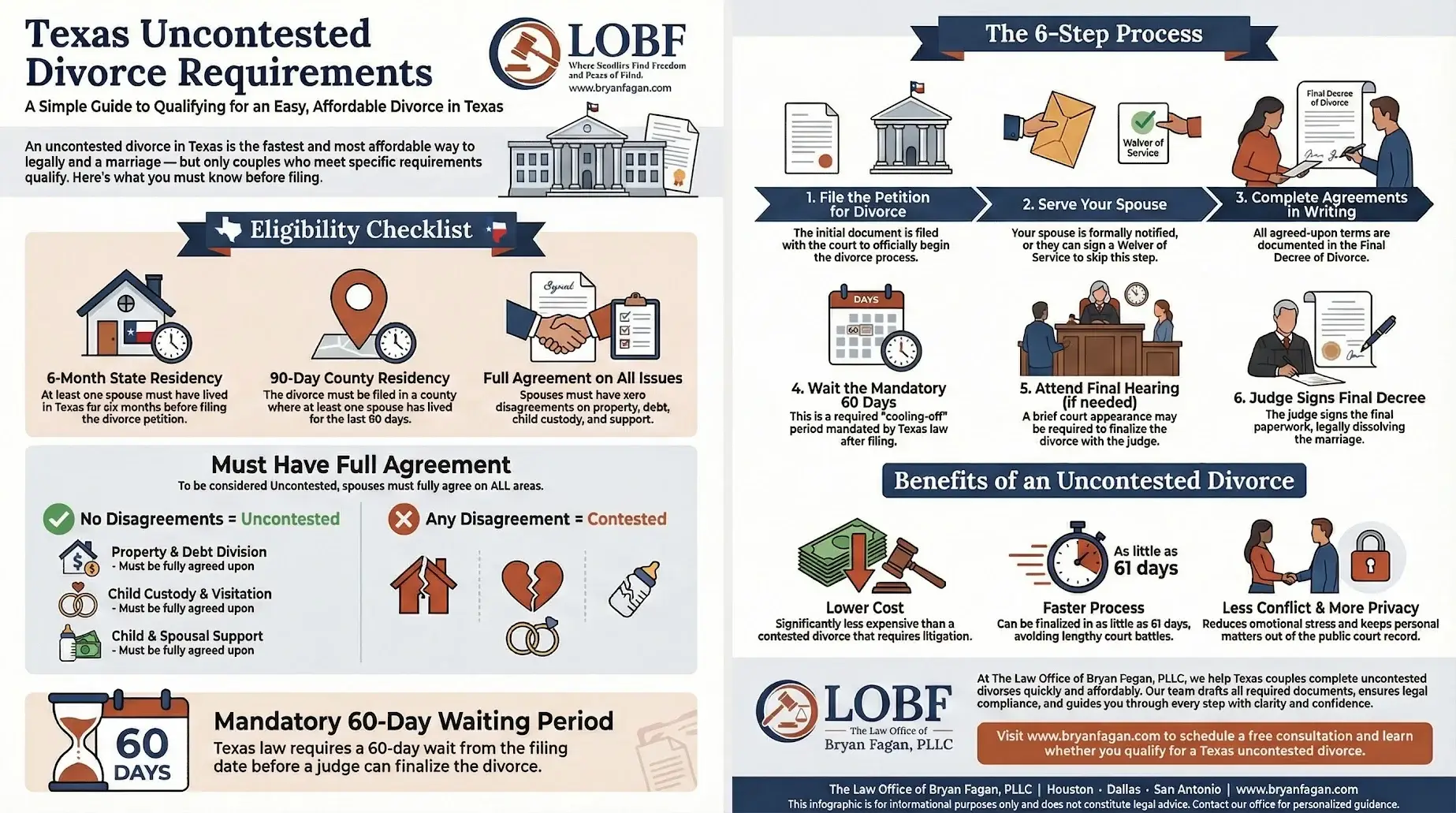
- Complete Agreement Required: An uncontested divorce Texas requires both spouses to agree on all issues including property division, child custody, child support, and spousal maintenance—no “we’ll figure that out later” items allowed
- Residency Rules Apply: At least one spouse must have lived in Texas for six months and in the filing county for 90 days before filing, even in agreed cases
- 60-Day Waiting Period: Texas law mandates a minimum 60-day waiting period from filing to finalization, with limited exceptions for family violence cases
- Proper Documentation Essential: Courts frequently reject Final Decree of Divorce documents that are incomplete, unclear, or don’t comply with Texas Family Code requirements
- Legal Review Recommended: Even in uncontested cases, having an experienced divorce attorney review documents can prevent costly mistakes and future disputes

Your Family’s Future Starts Here
Don’t navigate your legal journey alone. Schedule a consultation now and get the clarity and support you deserve.
What Are the Texas Uncontested Divorce Requirements? (Short Answer)
A divorce qualifies as “uncontested” in Texas when both spouses reach full agreement on every material issue and choose cooperation instead of courtroom conflict. Even though the process is designed to reduce stress and promote collaboration, the law still imposes very specific obligations that must be met before a judge will finalize the case. Understanding Texas Uncontested Divorce Requirements helps couples avoid delays, protect their rights, and ensure their Final Decree is legally enforceable under the Texas Family Code.
Under Tex. Fam. Code § 6.301, at least one spouse must satisfy the state’s residency rules by living in Texas for a minimum of six months and residing in the filing county for at least 90 days. Couples must also reach complete agreement on all issues—including property division, debt responsibility, child custody, possession schedules, child support, and spousal support—in compliance with updated provisions of Chapters 153 and 154 of the Texas Family Code. Once the agreements are finalized, spouses must complete and file the required documents (such as the Original Petition for Divorce, Waiver of Service, and Final Decree of Divorce) and ensure that any child-related forms meet statutory requirements. The court cannot sign the Final Decree until spouses satisfy the mandatory 60-day waiting period under Tex. Fam. Code § 6.702, unless a family-violence exception applies.
It is also essential to understand that “uncontested” does not mean simple. Uncontested only means there are no active disputes requiring judicial intervention—not that the legal standards are relaxed. Every uncontested case must still move through the Texas court system, and the Final Decree must comply with all relevant Family Code provisions to be approved. Couples exploring whether they qualify for uncontested divorce should review the firm’s detailed guide, Key Considerations Before Filing for an Uncontested Divorce in Texas, which expands on these requirements and explains how to avoid common pitfalls.
For spouses who want clarity and confidence as they navigate the process, the legal team at the firm—known statewide for educating families and protecting futures—offers additional resources such as the Texas Divorce Information Center to help ensure every step aligns with Texas law. Even in cooperative cases, tailored legal guidance helps couples safeguard their agreement, prevent future disputes, and move forward with a final outcome that truly reflects their intentions.

Texas Residency Requirements for Uncontested Divorce
Before any Texas court can grant a divorce—even when both spouses completely agree—the court must have proper jurisdiction over the case. This means meeting specific residency requirements that apply regardless of how cooperative your divorce process might be.
Under Tex. Fam. Code § 6.301, at least one spouse must have:
- Lived in Texas for at least six continuous months before filing the divorce petition, and
- Lived in the county where you plan to file for at least 90 days before filing
These requirements apply even when both spouses fully agree on the divorce and all settlement terms. The court simply cannot proceed without proper jurisdiction.
Consider this example: If Maria and James just moved from California to Houston three months ago, they cannot yet file for divorce in Texas—even if they agree on everything. They must wait until one of them has lived in Texas for six full months. Conversely, if Maria has been stationed overseas with the military but maintains Texas as her home state and Harris County as her home county, she may still meet the residency requirements despite temporary absence.
Special rules under Tex. Fam. Code §§ 6.303-6.304 address situations involving military families and Texans temporarily living outside the state. These provisions generally allow military members to maintain Texas residency for divorce purposes when Texas has been their established home.
What happens if you don’t meet residency requirements? The court will likely dismiss your case, requiring you to either wait until requirements are satisfied or file in the correct jurisdiction. This can delay your divorce process and potentially increase costs if you need to start over with new paperwork.
Agreement on All Divorce Issues: The Heart of an Uncontested Case
To meet Texas Uncontested Divorce Requirements, there must be complete agreement between spouses—no unresolved issues can remain for the court to decide later. The moment even one significant issue becomes disputed, your case shifts from uncontested to contested, requiring a different legal process with hearings, temporary orders, and potentially trial.
Property and Debt Division
Texas operates as a community property state under Tex. Fam. Code § 3.002, meaning most property and debts acquired during marriage are presumed to belong to both spouses. For an uncontested divorce, you and your spouse must reach full agreement on:
Asset Division: Who keeps the family home, vehicles, bank accounts, investment accounts, retirement funds, business interests, and personal property. Even couples with modest assets typically have some community property requiring division.
Debt Allocation: How to handle credit cards, personal loans, tax debts, mortgages, and car payments. Remember that assigning debt responsibility in your divorce decree doesn’t automatically release either spouse from obligations to creditors.
Separate Property Confirmation: Any property owned before marriage or acquired during marriage through gift, inheritance, or certain personal injury recoveries should be clearly identified and confirmed as separate property.
Complex Assets: Items like retirement accounts often require additional documentation such as a Qualified Domestic Relations Order (QDRO) to effectuate division.
For example, consider a couple with one rental home, two vehicles, some credit card debt, and modest retirement accounts. While this might seem straightforward, the divorce decree must specify exactly who gets which vehicle (including how titles transfer), how rental property ownership and management will change, who pays which debts, and how retirement accounts will be divided.
Children: Conservatorship, Possession, and Support
When minor children are involved, Texas Uncontested Divorce Requirements become more detailed because Texas courts must ensure that every parenting arrangement protects the child’s emotional and physical well-being. Under Tex. Fam. Code § 153.002, the “best interest of the child” standard guides every decision the court reviews, even in cases where both parents agree on all terms. This means parents must create a complete, child-centered plan that complies with the latest updates to the Texas Family Code and provides the stability judges look for in uncontested matters.
Parents must agree on conservatorship in accordance with Tex. Fam. Code Chapter 153, including whether they will share joint managing conservatorship or one parent will serve as the sole managing conservator. They must also determine who has the right to establish the child’s primary residence and how geographic restrictions will apply. Possession and access must be fully detailed, whether parents choose the Standard Possession Order or request a custom schedule that fits their child’s needs and family routines. Child support obligations must follow the statutory guidelines in Tex. Fam. Code Chapter 154, unless both parents agree—and the court approves—a justified deviation that still serves the child’s best interests. Medical support must also be clearly outlined, including who will provide health insurance, how uninsured expenses will be divided, and how premium costs will be managed. Parents must additionally specify decision-making authority for major issues like education, healthcare, psychological counseling, extracurricular activities, and religious training.
A common example is Jennifer and David, who reached full agreement on joint managing conservatorship and designated Jennifer as the parent with the right to establish their daughter’s primary residence. They adopted a Standard Possession Order schedule and followed Texas guideline child support. Their cooperation reflects exactly what courts expect under uncontested divorce requirements, allowing their case to proceed smoothly because every term is clear, complete, and aligned with their daughter’s best interests.
For families seeking more guidance on creating a strong parenting plan that meets legal expectations, resources such as the Texas Custody and Conservatorship Guide can help address common concerns. Those considering the uncontested process can also explore uncontested divorce options in Conroe and surrounding areas to better understand what the process looks like in their local courts. As one of the most trusted family law teams in Texas, the attorneys at the firm continue to help parents build agreements that reduce conflict, protect children, and support a stable future for the entire family.

Spousal Maintenance / Contractual Support
Texas recognizes two types of support between former spouses:
Court-Ordered Spousal Maintenance: Limited statutory support under Tex. Fam. Code ch. 8 with strict eligibility requirements related to marriage length, disability, or family violence.
Contractual Alimony: Support terms negotiated and agreed to by the spouses as part of their settlement agreement.
For an uncontested divorce, couples must clearly decide:
- Whether any support between spouses will be paid
- The exact amount, frequency, and duration of payments
- Conditions that would terminate support (such as remarriage or cohabitation)
- Whether support can be modified in the future
Vague or poorly drafted maintenance terms often lead to enforcement problems years later, which is why precision in drafting these provisions is crucial.
Required Forms and Documents for an Uncontested Divorce in Texas
Even a “simple” uncontested divorce involves multiple legal documents, and the exact requirements depend on your family’s circumstances. Each county may also have specific local forms or filing requirements.
The complexity of required documentation typically depends on whether your case involves:
- No children and minimal property
- Children but straightforward assets
- Children and complex property like real estate or business interests
Core Divorce Pleadings
Every uncontested divorce in Texas requires a specific set of legal documents, each designed to ensure the court has the information it needs to review the agreement and finalize the case. Understanding these documents is a key part of meeting Texas Uncontested Divorce Requirements, especially now that the Texas Family Code has been updated to strengthen clarity and enforceability in agreed divorces. For many families, knowing what each form does—and why it matters—helps reduce stress during an already challenging time.
The process begins with the Original Petition for Divorce, which formally opens the case and states the legal grounds for ending the marriage. Most spouses choose “insupportability,” the no-fault basis recognized under Tex. Fam. Code § 6.001. This document also identifies both parties, lists any minor children, and requests the court’s final orders on property, conservatorship, child support, and other issues relevant to the case. Many counties additionally require a Civil Case Information Sheet, which helps clerks properly categorize and process the case within the local court system. Once the Petition is filed, the responding spouse must either sign a Waiver of Service—often used in uncontested matters to avoid formal service—or file an Answer confirming their participation. Both options are valid under the procedural rules of the Family Code and help demonstrate to the court that the divorce is cooperative.
The Final Decree of Divorce is the most important document, as it becomes the controlling legal order once signed by the judge. It must include every agreed term involving property division, debt allocation, spousal maintenance (if any), parenting arrangements, possession schedules, child support obligations, and medical support requirements in accordance with Tex. Fam. Code Chapters 153 and 154. Because the Decree governs your post-divorce rights and responsibilities, many families also choose to prepare a separate Marital Settlement Agreement. This agreement outlines all terms in detail and is then incorporated into the Final Decree for enforcement. When drafted correctly, these documents help avoid future disputes and protect both spouses long after the divorce is finalized.
Couples evaluating whether an uncontested approach is the right fit can review the firm’s in-depth guide, When Uncontested Divorce in Texas Makes Sense, which explains when this path is appropriate and how to avoid common pitfalls. For additional clarity on required forms, the firm also provides helpful resources such as the Texas Divorce Document Center, empowering families to make informed decisions at every step. As one of the most trusted divorce teams in Texas, The Law Office continues to support spouses seeking a smoother, more respectful legal process that protects their futures and keeps them in control of their outcomes.

Child-Related and Support Documents (If Applicable)
Cases involving minor children require additional forms and detailed provisions:
Information on Suit Affecting the Family Relationship: This state-required form captures data about children for vital statistics tracking.
Parenting Plan: Detailed conservatorship and possession provisions may be included directly in the Final Decree or prepared as a separate parenting plan document.
Child Support Worksheet: Texas courts expect to see guideline calculations and any explanations for deviations from standard amounts.
Medical Support Provisions: Specific language addressing health insurance coverage and uninsured medical expense sharing.
Income Withholding Order: When child support is ordered, courts often require a separate wage withholding order to facilitate automatic payment collection.
Judges frequently reject divorce decrees that lack required parenting details such as holiday schedules, summer possession arrangements, and pickup/drop-off logistics. The more specific your parenting provisions, the less likely you’ll face enforcement disputes later.
Property and Retirement Division Documents
Certain assets require specialized documentation beyond the basic divorce decree:
Real Estate Transfers: Special warranty deeds or other property transfer documents to implement the property division ordered in your decree.
Vehicle Title Transfers: Documentation to transfer ownership of cars, trucks, or other titled vehicles.
Qualified Domestic Relations Orders (QDROs): Required to divide 401(k) plans, pensions, and other employer-sponsored retirement accounts.
Business Transfer Documents: If one spouse owns business interests that need to be transferred or valued as part of the property division.
Failing to properly handle these supplemental documents is a common and expensive mistake in do-it-yourself uncontested divorces.
The Mandatory 60-Day Waiting Period in Texas
Under Texas law, the mandatory waiting period is a critical part of Texas Uncontested Divorce Requirements and applies to nearly every divorce filed in the state. According to Tex. Fam. Code § 6.702, couples must wait a minimum of 60 days after filing the Original Petition for Divorce before a judge may sign the Final Decree. This waiting period begins the day after filing and reflects the Legislature’s intent to give spouses room to reconsider their decision, seek counseling, explore reconciliation, or finalize important settlement details. Even when both spouses fully agree on all terms, this statutory waiting period cannot be waived except in narrow circumstances defined by the Family Code.
Texas allows limited exceptions for cases involving family violence, including situations where one spouse has been convicted of a family violence offense against the other spouse or where the court has issued a protective order based on family violence findings. However, uncontested divorce is generally not appropriate in these cases due to safety concerns and power imbalances that may affect the voluntariness of any agreement. For most families, the full 60-day period remains in place and serves as an essential safeguard within the uncontested divorce process.
Many couples use this waiting period to prepare the remaining documents required by the court, gather financial statements, finalize their parenting schedules under Tex. Fam. Code Chapter 153, and review their proposed Final Decree of Divorce to ensure compliance with Texas law. It is also an ideal time to consult with experienced counsel to confirm that all agreements are enforceable, complete, and in alignment with the latest updates to the Texas Family Code. Some counties may require specific scheduling procedures for prove-up hearings, which can extend the timeline beyond the statutory minimum, even for cooperative spouses.
For a deeper look into how this waiting period fits into the broader uncontested divorce process, families can explore the firm’s video guide, Uncontested Divorces in Texas: Discovering Tranquil Paths. Additional resources, such as the Texas Divorce Information Center, offer helpful insights on preparing documents, understanding court expectations, and protecting your rights during this time. As a trusted resource for families throughout Texas, The Law Office of Bryan Fagan, PLLC remains committed to making the uncontested divorce process clearer, calmer, and more empowering for every client.

Step-by-Step Process for Filing an Uncontested Divorce in Texas
Successfully completing an uncontested divorce requires careful attention to legal requirements and procedural details. Here’s the typical process from start to finish:
Step 1: Confirm You Meet Texas Uncontested Divorce Requirements
Before filing anything, verify that your situation truly qualifies for uncontested treatment:
- Both spouses meet Texas residency requirements
- No unresolved disputes exist about property, debts, children, or support
- No history of family violence that would make “agreement” unsafe or coerced
- Both parties genuinely want to proceed cooperatively
Consider consulting with an experienced divorce attorney early to confirm whether your case is appropriate for uncontested handling.
Step 2: Prepare and File the Original Petition for Divorce
One spouse (the Petitioner) files the Original Petition in the appropriate district court for your county. This involves:
- Selecting appropriate grounds (typically “insupportability” for no-fault uncontested cases)
- Paying the required filing fee or submitting a Statement of Inability to Afford Payment of Court Costs if you qualify for fee waiver
- Receiving a cause number and court assignment from the clerk’s office
Step 3: Provide Legal Notice to the Other Spouse
The Respondent spouse must receive proper notice of the divorce case through one of these methods:
- Signing a Waiver of Service after the petition is filed (this must be notarized and cannot be signed before filing)
- Being formally served by a constable, sheriff, or process server, then filing an Answer
A properly executed waiver can significantly speed up uncontested cases and reduce court costs.
Step 4: Negotiate and Finalize All Settlement Terms
During the mandatory waiting period, spouses work out complete agreement details on:
- Property and debt division specifics
- Parenting plans and child support calculations
- Any spousal maintenance or contractual support arrangements
Everything agreed upon must be reduced to clear, specific written terms. If you discover disagreements during this phase, you may need mediation or other dispute resolution before proceeding.
Step 5: Draft and Review the Final Decree of Divorce
The Final Decree serves as the controlling legal document for your post-divorce life, so accuracy and completeness are essential. The decree must include:
- Detailed property and debt division
- Comprehensive parenting provisions if children are involved
- Child support and medical support orders
- Any name change requests
- All required statutory language and warnings
Even in otherwise do-it-yourself cases, having a Texas family law attorney review your Final Decree before submission can prevent rejection by the judge or enforcement problems later.
Step 6: Wait Out the 60 Days and Schedule Your Final Hearing
After at least 60 days have passed since filing, you can schedule a “prove-up” hearing. Some Texas counties allow virtual hearings or affidavit prove-ups in agreed cases, while others require brief in-person testimony. Check with your local court coordinator about scheduling procedures and requirements.
Step 7: Attend the Final Hearing and Obtain the Signed Decree
At the prove-up hearing, the Petitioner (and sometimes both spouses) provides brief sworn testimony confirming:
- Residency and jurisdictional requirements
- Grounds for divorce (typically that the marriage has become insupportable)
- Basic agreement terms and their fairness
- That any child-related arrangements serve the children’s best interests
The judge reviews your Final Decree of Divorce and may ask clarifying questions. If satisfied that all legal requirements are met, the judge signs the decree, making your divorce official.
Errors in documentation or missing required provisions can cause the judge to reset your hearing or require corrections, which delays finalization and may increase costs.

When an Uncontested Divorce Cannot Proceed
Some situations are not appropriate for uncontested treatment, even when one spouse prefers to avoid conflict. Attempting to force an uncontested process in these circumstances often backfires, causing delays and additional expenses.
Common situations where uncontested divorce may not be possible include:
Active Family Violence: Cases involving current or recent domestic violence, protective orders, or coercive behavior require careful court oversight to ensure any agreements are truly voluntary and safe.
Significant Parenting Disputes: If parents disagree about primary residence, school choice, supervised visitation, or major decision-making authority, the court must evaluate evidence and make custody determinations in the children’s best interests.
Property Division Conflicts: Disputes over who keeps the family home, how to value a business, or whether one spouse is hiding assets require formal discovery procedures and possibly expert testimony.
Non-Participation: When one spouse refuses to communicate, sign documents, or participate in settlement negotiations, the case may need to proceed through default procedures rather than as an agreed matter.
Complex Asset Portfolios: Multiple real estate holdings, closely held businesses, professional practices, or substantial investment portfolios often require sophisticated legal drafting and expert valuation, even when spouses generally agree.
These situations typically require contested divorce procedures including temporary orders, formal discovery, mediation, and potentially trial. While this may take longer and cost more initially, it often provides better long-term protection and clearer resolution.
Common Mistakes in Texas Uncontested Divorces
Trying to save money by handling everything without professional guidance can actually become more expensive if legal details are missed or handled incorrectly. Here are frequent pitfalls to avoid:
Using Generic Online Forms: Many internet divorce forms don’t comply with Texas Family Code requirements or include mandatory language that Texas courts expect to see. Judges often reject such decrees, requiring costly revisions and additional court appearances.
Inadequate Retirement Account Division: Couples frequently overlook retirement assets or assume they can simply agree “each keeps their own.” Without proper QDROs and court orders, retirement plan administrators cannot legally transfer funds, leaving money inaccessible or improperly allocated.
Vague Parenting Provisions: Divorce decrees with unclear custody and visitation terms like “reasonable visitation” often lead to future conflicts. Texas courts prefer specific, enforceable possession schedules that address holidays, summer vacation, and transportation logistics.
Incorrect Child Support Calculations: DIY filers sometimes misapply guideline percentages, use gross instead of net income, or set support below recommended levels without adequate legal justification. Courts will reject such arrangements until corrected.
Misunderstanding Debt Assignment: Assigning debt responsibility in a divorce decree doesn’t prevent creditors from pursuing both spouses if the assigned party defaults. Couples need to understand these limitations and plan accordingly.
Overlooking Tax Consequences: Property division decisions can have significant tax implications involving capital gains, dependency exemptions, and filing status changes that aren’t immediately obvious but matter greatly later.
Skipping Legal Review: Even cooperative couples benefit from having an attorney review their Final Decree of Divorce before submission to ensure enforceability and completeness.
Consider Rebecca and Tom, who agreed on everything and prepared their own divorce papers. However, their decree failed to address holiday possession, included an unenforceable debt assignment, and lacked required child support warnings. Two years later, they returned to court multiple times to clarify their arrangements, ultimately spending more on litigation than they would have on proper initial representation.
Why Legal Representation Still Matters in an Uncontested Divorce
Many couples hope to handle uncontested divorce cases entirely without attorneys to minimize costs. While this approach can work in very simple situations, legal representation often provides significant value even in cooperative cases.
Ensuring Legal Enforceability: Divorce decrees must anticipate future disputes and contain specific, enforceable language. Attorneys ensure that property descriptions are legally sufficient, parenting provisions are comprehensive, and all required statutory language is included.
Preventing Future Conflicts: Seemingly minor omissions like who pays uninsured medical expenses or how to handle a future home sale can create serious disputes years later. Experienced counsel helps identify and address potential “time bombs” in agreements.
Using Proper Texas Legal Language: Texas courts expect certain standardized wording derived from the Family Code. Attorneys understand local judicial preferences and county-specific requirements that can speed approval and prevent delays.
Protecting Your Rights: Even in amicable situations, spouses may not fully understand long-term implications of waiving retirement benefits, agreeing to below-guideline child support, or accepting unequal property divisions. Legal counsel ensures you make informed decisions about your future financial and parental rights.
Avoiding Costly Delays: Judges frequently reject poorly prepared decrees, forcing multiple court appearances and potentially increasing conflict between spouses. Professional preparation usually allows finalization at the first prove-up hearing.
The Law Office of Bryan Fagan PLLC offers several options for uncontested divorce representation:
- Full-service representation including all document preparation and court appearances
- Limited-scope assistance such as decree review or specific document preparation
- Flat-fee arrangements for straightforward agreed cases
- Consultation services to help you understand your options and requirements
Our extensive experience across Harris, Montgomery, Fort Bend, and surrounding counties means we understand local court procedures and can tailor your documents to meet specific judicial expectations.

Our Mission at The Law Office of Bryan Fagan PLLC
Why We Do This Work: Our purpose is to empower Texas families to navigate divorce and family law challenges with clarity, dignity, and confidence. We believe that ending a marriage doesn’t have to destroy a family, especially when children are involved. Even in uncontested cases, families deserve thoughtful legal guidance that protects their interests and preserves their ability to co-parent successfully.
How We Approach Uncontested Divorces: We provide compassionate counsel that respects our clients’ desire to avoid conflict while still ensuring their legal rights are protected. We educate clients about their options, explain the requirements of Texas law in plain English, and help them make informed decisions about their future. Our approach combines efficiency with thoroughness, recognizing that most families want to move forward quickly but correctly.
What We Offer: Our family law practice focuses on comprehensive services including:
- Uncontested and contested divorce representation
- Child custody and visitation cases
- Child support establishment, modification, and enforcement
- Complex property division including business interests and retirement accounts
- Spousal maintenance and support matters
- Post-divorce modification and enforcement proceedings
Whether your case starts as uncontested and remains cooperative throughout, or whether complications arise requiring more formal legal proceedings, we’re equipped to guide you through every step of the process.
We understand that legal representation is an investment, and we work to provide clear, cost-effective solutions tailored to each family’s circumstances and financial reality.
Actionable Checklist: Texas Uncontested Divorce Requirements
Use this checklist to verify that you’re prepared for an uncontested divorce process in Texas:
Residency and Jurisdiction
- ✅ At least one spouse has lived in Texas for 6+ consecutive months
- ✅ At least one spouse has lived in the filing county for 90+ days
- ✅ You’ve identified the correct district court for filing
Agreement and Cooperation
- ✅ Both spouses agree that the marriage is “insupportable” and want to proceed without blaming each other
- ✅ Complete agreement exists on division of all property (home, vehicles, bank accounts, retirement accounts, investments, personal property)
- ✅ Complete agreement exists on allocation of all debts (credit cards, loans, mortgages, tax obligations)
- ✅ If you have children: detailed agreement on conservatorship, possession schedule, child support amount and method, medical support, and decision-making authority
Documentation and Financial Information
- ✅ You’ve gathered key documents: property deeds, vehicle titles, retirement account statements, recent pay stubs, tax returns, insurance information
- ✅ Both spouses have disclosed all assets and debts honestly
- ✅ Any required QDROs or property transfer documents are planned
Legal Process Requirements
- ✅ Original Petition for Divorce has been properly filed in the correct Texas county
- ✅ Filing fees have been paid or fee waiver approved
- ✅ The other spouse has been properly served or has signed a notarized Waiver of Service
- ✅ All required forms for your county have been completed (Civil Case Information Sheet, family relationship information forms, etc.)
Final Documentation
- ✅ A complete Final Decree of Divorce reflecting all agreements has been drafted
- ✅ The decree includes all required Texas statutory language and provisions
- ✅ Both spouses understand and agree to all terms in the decree
- ✅ At least 60 days have passed since filing the Original Petition
Post-Divorce Planning
- ✅ You have a plan to update beneficiaries on insurance policies and retirement accounts
- ✅ Property transfers and title changes are planned and ready to implement
- ✅ Child support payment arrangements are established if applicable
If you can’t check every box, consider consulting with our experienced family law team to address any gaps or concerns before proceeding.
Conclusion: Moving Forward with Confidence
When you’re standing at a crossroads like divorce, it’s completely normal to feel the mix of relief, worry, hope, and uncertainty that comes with making such a big decision. What matters most is knowing you don’t have to navigate it alone—or guess your way through the legal steps that will shape your family’s future. Understanding the process, especially in an uncontested divorce, gives you something incredibly valuable during an emotional season: clarity. And with clarity comes confidence.
At The Law Office of Bryan Fagan, PLLC, that’s exactly what we want for you. Our mission has always been to educate, empower, and guide families through life’s hardest transitions with compassion and skill. Whether you’re trying to protect your children’s routines, maintain financial stability, or simply move forward with peace of mind, the right legal support can make all the difference in how this chapter unfolds.
If you’re considering taking the next step or just want to talk through your options, we’re here to listen. A conversation with an experienced Texas family law attorney can help you understand your rights, avoid unnecessary stress, and create a plan that truly supports your future. Think of it as giving yourself the room to breathe—and the tools to rebuild with confidence.
Whenever you’re ready, reach out. Your next chapter doesn’t have to feel overwhelming. In fact, it can be the moment everything starts to feel a little clearer.
Frequently Asked Questions About Uncontested Divorce in Texas
To qualify for an uncontested divorce, both spouses must agree on every major issue—property division, debt allocation, conservatorship, visitation, child support, and spousal maintenance (if any). In addition, at least one spouse must have lived in Texas for the last six months and in the filing county for the past 90 days. You’ll also need to complete all required paperwork, observe the 60-day waiting period, and present a Final Decree of Divorce that fully reflects your agreement and meets the standards of the Texas Family Code.
The minimum timeline is just over 60 days because Texas law requires a mandatory waiting period. Most couples finalize their divorce within two to four months, depending on how quickly documents are completed, signed, and scheduled for court review.
The “6-month rule” refers to the residency requirement: at least one spouse must have lived in Texas for the previous six months and in the county of filing for at least 90 days. Without meeting this requirement, a Texas court cannot legally grant your divorce.
Judges typically deny uncontested divorces when the paperwork is incomplete, incorrect, or inconsistent with Texas law. A judge may also deny a divorce if the parenting plan is not in the child’s best interest, the judge suspects one spouse is being pressured, or the residency requirements are not met. Anything unclear or unenforceable in the Final Decree must be corrected before the case is approved.
Costs vary by county and complexity. Filing fees usually range from a few hundred dollars, with possible additional expenses for service of process, notaries, deeds, or retirement division orders. Attorney fees for uncontested cases are significantly lower than contested divorces, and many firms—including ours—offer flat-fee options to keep the process predictable and affordable.
The biggest risk is that one or both spouses may overlook important legal or financial details, such as retirement division, tax implications, or precise parenting terms. Without legal guidance, couples sometimes agree to arrangements they don’t fully understand or that are difficult to modify later. An uncontested divorce only works well when both parties are fully informed and the agreement is fair, detailed, and enforceable.
The “10-year rule” often refers to eligibility for spousal maintenance. In some cases, if a marriage lasted at least 10 years and one spouse cannot meet their minimum reasonable needs, a court may award limited spousal maintenance. Ten years can also affect eligibility for federal Social Security benefits, though that falls outside Texas state law.
Avoid hiding assets, violating court orders, or making major financial changes without legal guidance. Refrain from posting personal details on social media, speaking negatively about the other parent to your children, or signing anything you don’t fully understand. Poor decisions during a divorce can damage credibility with the court and affect long-term outcomes.
Texas does not recognize automatic divorce based on separation. Even if spouses live apart for years, they must still file a petition, meet residency requirements, complete the waiting period, and obtain a signed Final Decree of Divorce. Separation alone does not end a marriage under Texas law.