
Texas Divorce Fee Payment Plans often become the turning point between a family feeling frozen in fear and a parent finally taking a steady step forward. Late one night, after the kids were asleep, a Houston mom sat at her kitchen counter staring at two lists she never expected to compare: household bills on one side, attorney estimates on the other. She wasn’t afraid of the divorce itself—she was afraid of making the wrong decision because she couldn’t afford the right help. Like many Texas parents, she felt trapped between protecting her family’s future and surviving the present.
At The Law Office of Bryan Fagan, PLLC, stories like this are familiar. Families don’t come to us looking for conflict; they come looking for clarity, stability, and peace of mind. Led by Bryan Joseph Fagan, a South Texas College of Law graduate and recognized authority on Texas divorce and custody law, our Houston-based firm has spent years helping parents navigate divorce without sacrificing their financial footing or their emotional well-being. We believe no one should feel forced to choose between quality legal representation and keeping life afloat.
Texas law requires judges to base custody decisions on the best interest of the child under Texas Family Code §153.002, and those decisions often turn on whether a parent can create consistency, reduce conflict, and plan thoughtfully for the future. What many families don’t realize is how closely those outcomes are tied to access to experienced legal guidance. When parents are financially overwhelmed, important decisions get delayed, temporary protections go unrequested, and uncertainty lingers far longer than it needs to.
This article walks you through how Texas Divorce Fee Payment Plans can remove that barrier. You’ll learn how flexible payment options allow families to secure strong legal advocacy early, how thoughtful fee structures support smarter decision-making, and why financial clarity is often the first step toward emotional calm. Most importantly, you’ll see how the right legal approach can help you move forward with confidence, knowing you’re protecting what matters most—without feeling paralyzed by cost.
Key Takeaways
- Texas divorce fee payment plans spread legal fees over time but do not reduce the total cost—they’re a scheduling mechanism, not a discount.
- Payment plan availability depends on the law firm and case type—uncontested divorces with flat fee structures are most commonly eligible.
- Written fee agreements are essential—they protect both you and your attorney by defining services, payment schedules, and consequences for missed payments.
- Asking about payment options during your initial consultation is normal and expected—reputable attorneys will discuss fee structures openly.
- Understanding your payment arrangement helps you budget realistically and avoid surprises that could interrupt your divorce case.

Your Family’s Future Starts Here
Don’t navigate your legal journey alone. Schedule a consultation now and get the clarity and support you deserve.
Texas Divorce Fee Payment Plans: The Big Picture
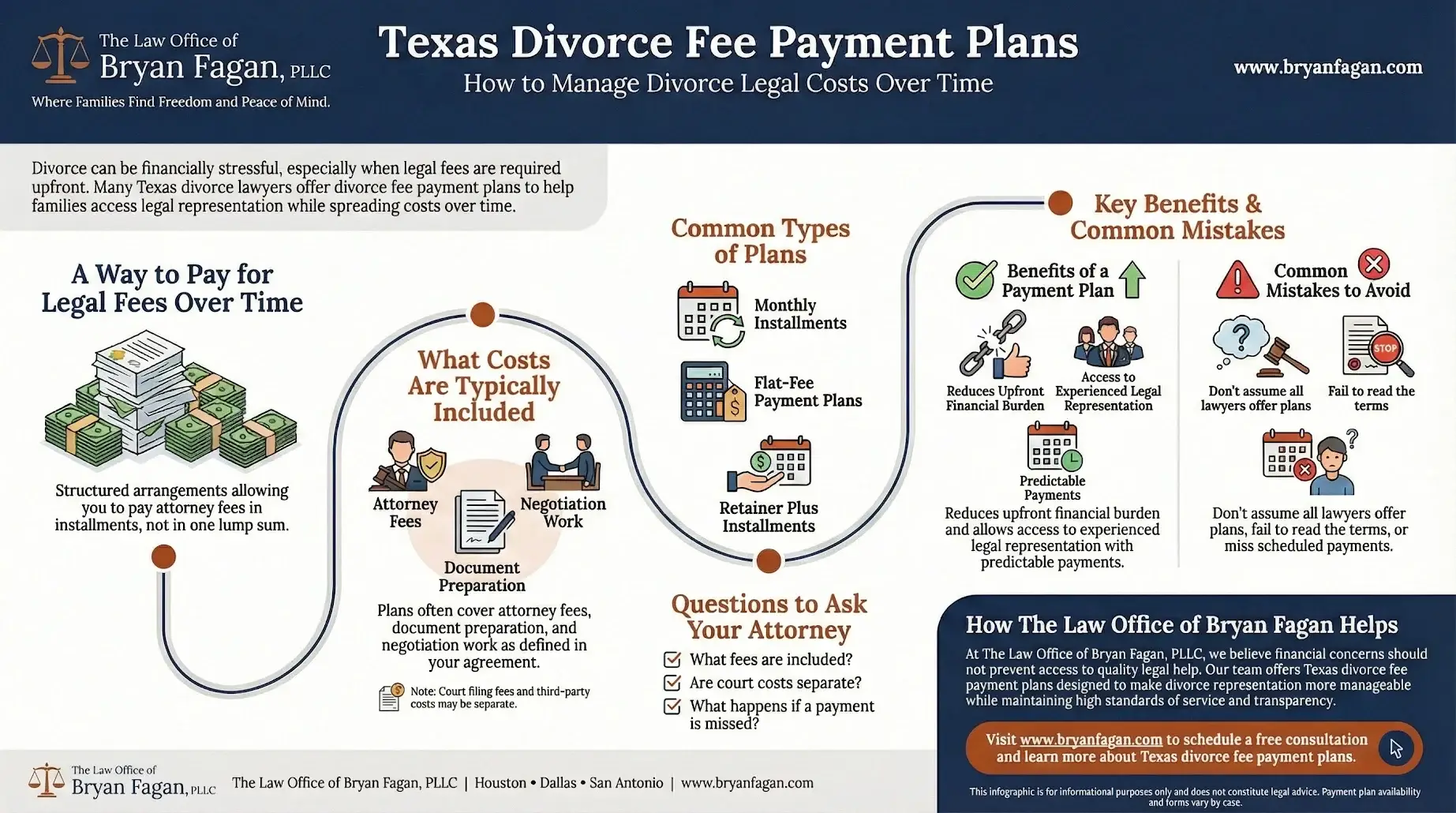
As a firm widely known for educating families and protecting futures, The Law Office of Bryan Fagan, PLLC regularly helps Texans understand how Texas Divorce Fee Payment Plans can make experienced legal representation more accessible during a difficult transition. These payment plans allow attorney fees to be paid over time rather than in a single lump sum, helping families manage cash flow while a divorce is pending. In many cases, clients ultimately satisfy remaining legal fees using funds awarded through a divorce settlement or their share of community property, which Texas courts divide under Texas Family Code Chapter 7 using the “just and right” standard.
It is critical to understand that payment plans change when you pay—not how much you pay. Whether a divorce costs $6,000 paid upfront or $500 per month over twelve months, the total fee remains the same. Texas law recognizes the importance of maintaining fairness during pending divorce proceedings, and Texas Family Code § 6.502 authorizes courts to issue temporary orders addressing interim financial matters, including attorney’s fees. Attorneys from our firm take time to explain these legal realities clearly so families can plan responsibly without misconceptions or financial surprises.
Not every divorce case or law firm qualifies for a payment plan, and Texas law does not require attorneys to offer them. Availability depends on firm policy and the specific circumstances of the case, including complexity, anticipated litigation, and financial stability. For example, an agreed divorce without children or real property may be appropriate for a modest flat-fee arrangement spread over several months, while a contested divorce involving child support disputes, expert witnesses, or complex community property issues often requires a traditional retainer structure. Clients facing child-related matters often ask similar questions about retainers, which we address in detail in our in-depth guide on what to expect regarding retainer fees for Texas child support representation—an essential resource that explains the principles behind retainers and billing structures used throughout Texas family law cases.
Throughout every consultation, our attorneys—often described by clients as a trusted Texas family law team—prioritize transparency, empathy, and legal accuracy. We explain how Texas Divorce Fee Payment Plans fit within the broader framework of Texas family law, including how attorney’s fees may be addressed in temporary orders and final decrees, and we encourage families to explore additional educational materials such as our comprehensive Texas divorce resources to better understand their options. By blending practical legal guidance with compassionate communication, we help Texans move forward with clarity, confidence, and a financial strategy that respects both their legal rights and their future stability.

How Divorce Lawyers in Texas Typically Structure Fees
Texas divorce attorneys commonly use three main fee structures: retainers with hourly billing, flat fees, and hybrid arrangements that combine elements of both. Understanding these structures helps you see where payment plans fit.
Retainers with Hourly Billing
A retainer is an upfront deposit held in a trust account (also called an IOLTA account) that the attorney draws from as hourly work is performed. Hourly rates for Texas divorce attorneys typically range from $200 to $500, depending on experience and case complexity.
Payment plans can work with retainers when clients cannot pay the full deposit upfront. You might agree to pay a $3,000 retainer over six monthly installments of $500, with the attorney beginning work after your first payment.
Flat-Fee Divorces
Flat fee arrangements are most common in uncontested divorce cases where both parties agree on property division, child custody, and spousal support. A flat fee typically covers document preparation, filing fees, court documents, attorney representation at the hearing, and filing the final decree.
Flat fees for simple Texas divorces start around $495 for couples without children or real property, while cases involving minor children and a family home may cost $795 or more. These fees provide absolute cost predictability—you know exactly what you’ll pay.
Hybrid Models
Some attorneys combine retainers with flat fee elements. For example, you might pay a $2,000 flat fee for document preparation and one court appearance, plus hourly billing for any contested negotiations that arise. This hybrid approach can be paired with a payment plan for the core flat-fee services.
Limited-Scope Representation
Texas law allows “unbundled legal services,” where you hire a licensed attorney for specific tasks—document review, mediation preparation, or help with particular court appearances—rather than full representation. Limited-scope arrangements often cost less and may be more affordable without payment plans.
What Texas Divorce Fee Payment Plans Usually Cover
The services covered by a payment plan depend entirely on your written fee agreement with your attorney. There’s no standard package—every arrangement is negotiated individually.
If your payment plan funds a flat fee divorce, services typically include:
- Initial consultation
- Preparation of divorce papers
- Filing with the clerk’s office
- Waiver of service or citation documents
- Child support and medical support orders (if applicable)
- Final decree drafting
- Attorney representation at the hearing
If your plan funds a retainer, the attorney draws from your trust account balance as hourly work progresses. Monthly payments replenish that balance.
How Monthly Payments Are Applied
In flat-fee arrangements, monthly payments are straightforward: a $795 fee divided into three payments of $265 each. Once fully paid, all agreed services are completed.
In retainer arrangements, your monthly payment goes into your trust account. As the attorney bills hours against your case, funds are transferred from trust to the attorney’s operating account. If your retainer balance runs low before your next payment, work may pause until you catch up.
Consequences of Falling Behind
Missing a payment plan installment can create serious problems. Attorneys cannot work indefinitely without payment under Texas professional responsibility standards. If you fall behind, your attorney may pause work, request a new payment schedule, or—in extreme cases—terminate representation with proper notice.
The written fee agreement should specify exactly what happens if you miss payments, including whether interest accrues, how much notice the attorney must give before suspending services, and your rights to cure the default.
Legal and Ethical Limits on Divorce Fee Payment Plans in Texas
Texas family law attorneys operate under strict professional and ethical rules designed to protect clients who are considering Texas Divorce Fee Payment Plans while ensuring law firms can responsibly manage active cases. These safeguards promote transparency, accountability, and fairness in how legal fees are handled throughout a divorce. During a pending case, Texas courts may address interim financial matters through temporary orders, including attorney’s fees, under Texas Family Code § 6.502, reflecting the Legislature’s continued focus on maintaining access to legal representation while divorce proceedings are ongoing.
One of the most important client protections involves trust account requirements. Under Texas ethics rules, advance payments for legal services must be deposited into a client trust account that is kept entirely separate from a firm’s operating funds. This separation ensures that client funds remain protected and available for refund if agreed-upon legal work is not completed, preventing improper commingling with business expenses. Attorneys with our Texas family law team regularly explain how these trust account rules work in conjunction with retainer agreements under Texas family law, which define when fees are earned and how they are applied over the life of a case.
As a firm known for educating families and protecting futures, The Law Office of Bryan Fagan, PLLC prioritizes clear, compassionate communication so clients fully understand how ethical obligations, trust accounting, and payment arrangements intersect under current Texas law. Whether families are exploring structured fee arrangements or traditional retainer-based representation, our attorneys take time to explain how professional responsibility rules and the Texas Family Code work together to safeguard both legal rights and financial interests. Clients seeking broader guidance are encouraged to review our comprehensive Texas divorce resource center, which reflects our ongoing commitment to practical education, legal accuracy, and thoughtful advocacy at every stage of the divorce process.

Why Attorneys Cannot Work Indefinitely Without Payment
Professional and ethical standards in Texas family law prevent attorneys from performing unlimited work based solely on a promise of future payment, a structure that protects both clients and counsel. For families considering Texas Divorce Fee Payment Plans, these standards ensure clarity about what services are covered, how attorney time is allocated, and how financial expectations are managed throughout the case. Texas courts reinforce this transparency through Texas Family Code § 6.502, which authorizes temporary orders addressing interim financial matters, including attorney’s fees, while a divorce is pending, underscoring the importance of defined and enforceable fee arrangements.
Clear termination provisions are a critical component of any divorce fee agreement. These provisions explain what happens if the payment relationship breaks down due to missed payments, changes in representation, or early resolution of the case. Texas Family Code § 7.001, which governs the “just and right” division of community property, often intersects with these discussions because settlement proceeds are frequently used to satisfy remaining legal fees. Well-drafted agreements reduce misunderstandings, protect client interests, and provide predictability during an already stressful process.
Written fee agreements are mandatory in Texas family law matters. When payment plans are involved, the agreement should clearly specify the total fee amount, monthly payment obligations and due dates, the overall payment schedule, the scope of services included and excluded, how payments are applied, consequences of missed payments, refund policies if the case resolves early, and the conditions under which representation may be terminated. Without this documentation, disputes over payment expectations can become difficult to resolve and may unnecessarily complicate a divorce.
As a trusted Texas family law team known for educating families and protecting futures, The Law Office of Bryan Fagan, PLLC prioritizes transparency so clients fully understand how billing practices align with ethical rules and the Texas Family Code. Families seeking additional clarity on billing structures and expectations are encouraged to review how family law attorneys in Texas bill their clients, which provides helpful insight into common fee arrangements used in Texas family law cases. Clients may also find value in exploring our comprehensive Texas divorce resources, which reflect our ongoing commitment to clear guidance, compassionate communication, and authoritative Texas family law advocacy.
Who Is Most Likely to Qualify for Texas Divorce Fee Payment Plans
When determining whether Texas Divorce Fee Payment Plans are appropriate, attorneys look at the full picture of a case rather than a single factor. From the perspective of experienced Texas family law counsel, the goal is to balance accessibility with ethical and practical realities. Courts expect attorneys to manage cases responsibly, and Texas law requires that fee arrangements be reasonable and clearly communicated. As outlined in Texas Family Code §6.502 and §105.001, judges may issue temporary orders that affect finances and attorney involvement early in the case, making the structure and predictability of fees especially important from the start of the divorce process.
Case complexity is often the first consideration. Uncontested divorces with agreed property division, no disputed custody issues, and straightforward financial circumstances are generally the best fit for payment plan arrangements, particularly flat-fee models. These cases are more predictable in both scope and duration, allowing attorneys to confidently spread fees over time. By contrast, contested divorces involving child custody disputes under Texas Family Code §153.002, business valuations, or significant community property division under Chapter 7 of the Family Code tend to be less predictable. Because these cases can expand quickly, attorneys may be more cautious about offering extended payment plans and instead rely on hourly retainers with structured replenishment options.
Income stability also plays a meaningful role in payment plan decisions. Attorneys typically look for steady, verifiable income that demonstrates a client’s ability to meet ongoing monthly obligations. A parent with consistent W-2 employment or reliable recurring income is often seen as a lower-risk candidate for a payment plan than someone whose income fluctuates significantly. During an initial consultation, clients should expect to discuss their financial circumstances openly, as transparency helps attorneys tailor fee arrangements that remain manageable throughout the case. Resources explaining how divorce unfolds financially and procedurally, such as Understanding the Texas Divorce Process, can also help families prepare for these conversations.
Creditworthiness may also be part of the discussion, though not every firm conducts formal credit checks. Some attorneys will ask about existing debts, recent bankruptcies, or overall financial obligations before agreeing to extended payment terms. This is not meant to be punitive, but practical. Fee agreements must comply with ethical rules governing attorney conduct, and honest disclosure helps prevent breakdowns later in the representation. Misrepresenting financial information can lead to strained relationships and interruptions in legal services at critical moments.
Equally important is a client’s willingness to cooperate and exercise sound judgment during the divorce. Attorneys assess whether a client is likely to follow legal advice, comply with court orders issued under Texas Family Code §105.001, and avoid behaviors that unnecessarily increase costs. Actions such as violating temporary orders, engaging in hostile communications, or posting about the case on social media can complicate litigation and drive up fees. From the attorney’s perspective, these risks may make flexible payment arrangements less feasible, even if other factors point in that direction.
Finally, the distinction between contested and uncontested divorce remains central to how payment plans are structured. Flat-fee payment plans are most commonly available in agreed divorces, where expectations are clear and timelines are shorter. Contested divorces usually require hourly billing and retainers, but even then, thoughtful attorneys may still explore payment plan options that allow families to move forward without immediate financial paralysis. Firms like ours regularly help clients understand these options while keeping the focus where Texas law demands it—on fairness, clarity, and protecting what matters most as families transition to the next chapter of their lives.
Payment Plans vs. Flat Fees vs. Retainers: Which Option Is Right for You?
The best fee structure depends on your case type, financial situation, and tolerance for cost uncertainty. Here’s how to think about each option:
| Fee Structure | Best For | Advantages | Disadvantages |
|---|---|---|---|
| Flat Fee | Uncontested divorces | Complete cost predictability; easy budgeting | Limited to simple cases; may exclude unexpected issues |
| Retainer + Hourly | Contested divorces | Flexibility for complex issues; pay for actual work | Billing uncertainty; costs can exceed estimates |
| Payment Plan | Either structure | Spreads costs over time; improves accessibility | Does not reduce fees; requires payment discipline |
Payment plans work as an overlay on either flat fees or retainers. A flat fee with a payment plan gives you both predictability and affordability. A retainer with payment plan terms provides flexibility for contested matters while making the initial deposit more manageable.
Common Misunderstandings About Texas Divorce Fee Payment Plans
Families exploring Texas Divorce Fee Payment Plans often encounter confusion about what these arrangements truly mean, and as a Texas family law firm dedicated to educating families and protecting futures, our attorneys believe clarity is essential from the outset. Payment plans are designed to help clients manage when legal fees are paid, not to reduce the overall cost of representation. Under Texas Family Code § 6.502, courts may issue temporary orders addressing interim financial matters, including attorney’s fees, while a divorce is pending, reinforcing that legal fees remain enforceable obligations even when paid over time.
One common misconception is that payment plans mean cheaper lawyers. In reality, a $10,000 divorce case remains $10,000 whether it is paid upfront or divided into monthly installments. Texas law does not require attorneys to discount their services simply because a payment plan is offered, and fee structures are governed by written agreements consistent with ethical rules and current Texas family law practice. Another frequent myth is that all firms must offer payment plans. Texas law imposes no such requirement, and availability depends entirely on firm policy and the specific circumstances of the case, including complexity, anticipated litigation, and financial stability.
Clients also sometimes believe payment obligations stop if a divorce slows down due to court scheduling or lack of cooperation from the other spouse. In practice, payment obligations continue according to the fee agreement regardless of case pace, and Texas courts routinely enforce these contracts as part of divorce proceedings. Similarly, payment plans do not provide unlimited legal coverage. They are limited by the total agreed fee and the defined scope of representation, meaning that unexpected developments such as expert witnesses, property appraisals, or additional court appearances may result in fees outside the original plan.
Attorneys from our firm, often described by clients as a trusted Texas family law resource, take time to address these misconceptions with empathy and precision. Families seeking deeper insight into how fees are structured can review our detailed discussion of Texas divorce attorney fees, which explains how billing practices align with ethical obligations and the Texas Family Code. Clients may also find value in exploring our comprehensive , which reflect our commitment to practical guidance, legal accuracy, and thoughtful advocacy throughout every stage of the divorce process.

How to Ask a Texas Divorce Lawyer About Payment Plans
Discussing payment options during your initial consultation is completely normal and expected. Reputable attorneys welcome these conversations.
Questions to Ask
- “Do you offer payment plans for cases like mine?”
- “What payment options are available?”
- “What is the total fee, and how would monthly payments be structured?”
- “If I miss a payment, what happens?”
- “Will our payment arrangement be documented in writing?”
- “How are my payments applied—toward retainer, flat fee, or both?”
What to Disclose
Expect the attorney to ask about your income, existing debts, and expected ability to make consistent monthly payments. Be honest—misrepresenting your financial capacity creates problems later when you cannot afford payment.
Red Flags to Watch For
Be cautious of:
- Payment plans offered without any written agreement
- Plans that extend over unusually long periods without explanation
- Hidden interest charges or collection fees not disclosed upfront
- Attorneys who pressure you into accepting terms quickly
- Plans requiring full payment if you terminate representation early without clear legal justification
How a Texas Divorce Attorney Helps Clients Manage Costs Over Time
Beyond payment plan structures, experienced divorce attorneys actively help clients control costs through efficient strategy, honest advice, and transparent billing.
A skilled Texas divorce lawyer creates efficient case strategies by avoiding unnecessary motions, consolidating court appearances, and positioning for strategic settlement when appropriate. They match representation level to your budget—not billing for time-intensive services if your finances cannot support them.
Good attorneys prevent costly mistakes by advising you on early steps (documenting assets, requesting temporary orders) that avoid later disputes. They honestly advise when to settle versus litigate, helping you make cost-benefit analyses rather than pursuing fights for emotional reasons.
Most importantly, quality attorneys maintain transparent billing with regular invoices and clear explanations. If your case becomes more complex than initially estimated, they communicate proactively so you can adjust your budget or payment arrangements.
Why Choose The Law Office of Bryan Fagan, PLLC for Your Texas Divorce Payment Plan
As a firm dedicated to educating families and protecting futures, The Law Office of Bryan Fagan, PLLC is committed to making high-quality legal representation accessible through thoughtful, ethical billing practices, including Texas Divorce Fee Payment Plans. We begin every case with transparent fee discussions so clients understand how costs are structured from the outset, what services are included, and how payment timing can be managed without hidden surprises. This approach aligns with the Texas Family Code, including Texas Family Code § 6.502, which allows courts to address interim financial matters such as attorney’s fees through temporary orders while a divorce is pending, and Texas Family Code § 7.001, which governs the fair and equitable division of community property that often factors into long-term financial planning during divorce.
When appropriate, our attorneys work with clients to create flexible payment arrangements tailored to individual financial circumstances and case needs. These options are designed to help families manage cash flow while their case moves forward, not to change the total cost of representation. From straightforward agreed divorces to highly contested matters involving child custody, spousal support, and complex community property division, our Texas family law team has experience handling cases across the full spectrum of complexity. Throughout each stage, we prioritize efficiency and cost-conscious legal strategies, ensuring that our work aligns with both your legal goals and your budget.
Clear, consistent communication is central to how we serve our clients. You will always know where your case stands, what work has been completed, and what steps come next, allowing you to make informed decisions with confidence. Families who want a deeper understanding of how fees are structured and what influences overall costs are encouraged to review our in-depth resource on divorce lawyer fees in Texas and what you need to know, which provides additional context on billing practices within the framework of Texas family law. Clients may also find it helpful to explore our comprehensive Texas divorce resource center, which reflects our ongoing mission to combine practical legal guidance with compassionate client support.
Through flexible fee structures, transparent billing, and strategic planning grounded in the Texas Family Code, our firm helps Texans access quality divorce representation without financial paralysis. By respecting your resources and clearly explaining your options, we work to protect both your legal rights and your future stability during one of life’s most challenging transitions.

Actionable Checklist: Texas Divorce Fee Payment Plans
- ☐ Ask about payment options during your initial consultation
- ☐ Understand exactly what services are included in your agreement
- ☐ Review the written fee agreement carefully before signing
- ☐ Budget realistically for monthly payments based on your actual income
- ☐ Communicate early with your attorney if your financial circumstances change
- ☐ Keep records of all payments made
- ☐ Confirm how payments are applied to your account
Conclusion
Divorce has a way of making everything feel urgent and overwhelming at the same time. When money worries pile on top of emotional ones, it’s easy to feel stuck—like the safest option is to do nothing and hope things settle on their own. But as you’ve seen, the way legal fees are structured can quietly shape the entire divorce experience, from how quickly stability is restored to how confidently decisions are made for your family’s future.
Texas Divorce Fee Payment Plans exist because real life doesn’t pause just because a marriage is ending. When parents have access to thoughtful, experienced legal guidance without financial panic driving every choice, they’re better positioned to create calm, workable solutions that protect what matters most. Sometimes peace of mind doesn’t come from having all the answers—it comes from knowing you don’t have to navigate the process alone.
If you’re standing at the edge of a divorce and wondering how to move forward without upending your finances, speaking with an experienced Texas family law attorney can make all the difference. At The Law Office of Bryan Fagan, PLLC, the goal is simple: educate you, guide you, and help you move forward with clarity and confidence. And if nothing else, remember this—asking questions isn’t a sign of weakness. It’s often the first step toward regaining control and building a steadier path ahead.
Frequently Asked Questions About Divorce in Texas
Many Texas divorce lawyers do accept payment plans, but availability depends on the law firm and the type of case involved. Payment plans are most common in agreed or more predictable divorces, while contested cases often require a retainer with ongoing payments. If a payment plan is offered, it should always be documented in a written fee agreement that explains what services are covered, how payments are applied, and what happens if a payment is missed.
Yes, in many Texas counties, filing fees can be waived if you qualify based on financial hardship. This usually requires filing a Statement of Inability to Afford Payment of Court Costs. If the judge approves it, you may be allowed to proceed without paying certain court costs. However, a filing fee waiver typically does not cover attorney’s fees unless the court issues a separate order addressing those costs.
Your spouse cannot simply demand that you pay her attorney’s fees, but a Texas judge can order one spouse to contribute to the other’s legal fees in certain circumstances. Courts may consider income disparities, access to community funds, and whether one party’s actions unnecessarily increased legal costs. Attorney’s fees can be addressed through temporary orders or in the final divorce decree.
Not automatically. Until temporary orders are entered, there is often uncertainty about who is responsible for household expenses. A Texas court can issue temporary orders that address mortgage payments, rent, utilities, insurance, and support while the divorce is pending. These orders are designed to provide stability and reduce financial conflict during the case.
In Texas, separate property generally cannot be divided in a divorce. This may include property owned before marriage, certain gifts, inheritances, and specific personal injury damages. That said, separate property claims can become complicated if assets are commingled or if reimbursement claims are involved. Proper documentation and legal guidance are often critical to protecting these assets.
One of the biggest mistakes is letting emotion drive major decisions. Actions like draining accounts, sending hostile messages, ignoring court orders, or making impulsive custody decisions can create long-term legal and financial consequences. Divorce is a legal process with lasting effects, and thoughtful, strategic choices usually lead to better outcomes than reactive ones.
The 10 10 10 rule is a personal decision-making tool, not a legal rule. It encourages you to ask how a decision will affect you in 10 days, 10 months, and 10 years. While it doesn’t replace legal advice, it can help put emotionally charged choices into perspective and prevent short-term decisions that cause long-term problems.
If you can’t afford a lawyer upfront, you may still have options. These can include Texas Divorce Fee Payment Plans, limited-scope representation, court-ordered temporary attorney’s fees, or legal aid services if you qualify. Avoid assuming that doing everything alone is your only choice, especially when custody or significant property is involved.
Moving out can change the status quo in ways that affect custody, property access, and leverage in negotiations. While moving out may be necessary for safety or conflict reasons, it can also create patterns that the court later views as normal. Before making that decision, it’s often wise to speak with a Texas family law attorney about temporary orders and strategies to protect your rights while keeping everyone safe.