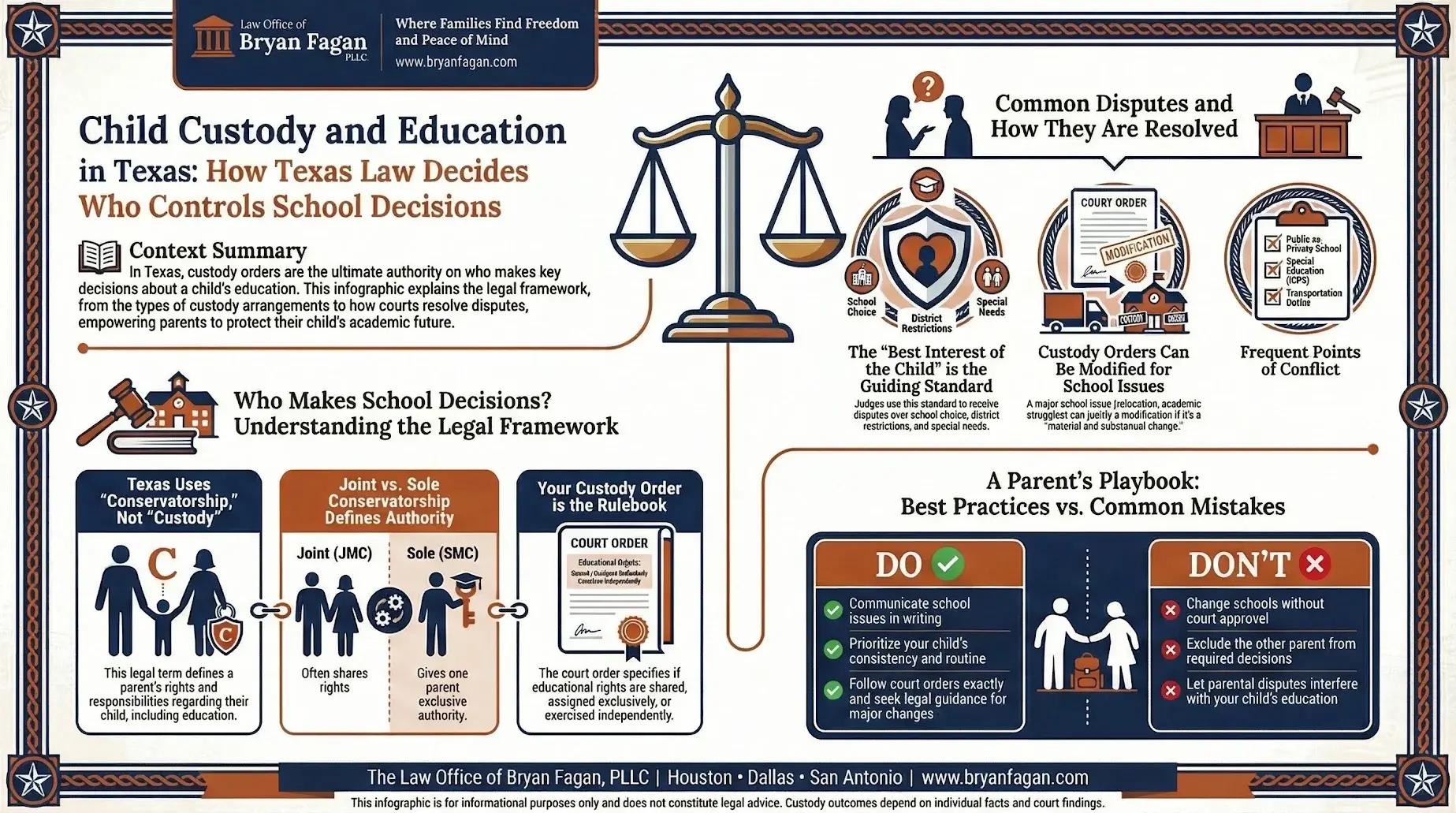

Child Custody and Education in Texas often collide at the most stressful moments of family life—right when parents are already juggling drop-off lines, homework battles, and the quiet worry of whether their child is truly okay. Maybe your child’s grades have slipped since the divorce, or you’re standing in a school office wondering who actually has the legal right to sign that enrollment form. These are not abstract legal questions; they are deeply personal decisions that affect your child’s stability, confidence, and future.
In Texas, courts understand that divorce doesn’t stop at the courthouse doors—it follows children into their classrooms. Under Texas Family Code §153.002, judges are required to prioritize the best interest of the child, and educational stability plays a critical role in that analysis. As Bryan Joseph Fagan, a South Texas College of Law graduate and long-standing authority on Texas custody law, has seen time and again, when parents lack clarity about educational rights and responsibilities, children often pay the price academically and emotionally. Knowing how custody orders intersect with schooling can be the difference between a child thriving or struggling during a family transition.
At The Law Office of Bryan Fagan, PLLC, we believe families deserve more than legal answers—they deserve understanding, reassurance, and a clear path forward. Our mission is to empower parents to reclaim peace of mind during life’s hardest transitions by explaining the law in plain language and helping them make decisions that protect what matters most. In the sections ahead, you’ll learn how Texas custody laws shape educational decisions, why courts value academic continuity, and how thoughtful legal guidance can help your child stay grounded, supported, and successful in school—even during divorce.
Key Takeaways
- Educational decisions in Texas are governed by your custody order, not informal agreements between parents. The Texas Family Code requires courts to specify which parent has authority over school enrollment, special education, and related matters.
- Joint Managing Conservatorship does not automatically mean equal rights on all educational decisions. Many custody orders designate one parent with the exclusive right to make school-related choices or grant final say when parents disagree.
- Non-primary parents retain important educational rights, including access to the child’s records, report cards, and the ability to attend school events and parent teacher conferences—unless a court order specifically restricts these rights.
- Unilateral school changes without proper authority can result in contempt findings, enforcement actions, and damage to your custody case. Always verify your decision making authority before making educational decisions.
- Modifications to custody orders based on education issues require proof of material and substantial change in circumstances, plus evidence that the change serves the child’s best interest.

Your Family’s Future Starts Here
Don’t navigate your legal journey alone. Schedule a consultation now and get the clarity and support you deserve.
How Child Custody and Education Are Linked Under Texas Law
In Child Custody and Education in Texas, educational decision-making authority is not based on informal parenting habits or assumptions—it flows directly from the conservatorship rights and duties spelled out in a court order. Under Texas Family Code Chapter 153, the parent–child relationship defines who has the legal authority to enroll a child in school, approve curriculum choices, and consent to special education evaluations or services. Whether parents are named Joint Managing Conservators or one parent is granted specific exclusive rights under Texas Family Code §153.072, those designations control how educational decisions are made and enforced.
The Texas Family Code continues to emphasize that the best interest of the child is the guiding principle in every custody determination. Section 153.002 requires courts to prioritize a child’s overall well-being, and educational stability is a critical part of that analysis. Judges regularly consider whether a custody arrangement will minimize school disruptions, preserve access to necessary services, and support consistent academic progress. Under updated applications of Texas Family Code §153.134, courts are especially attentive to how possession schedules, geographic restrictions, and decision-making authority affect a child’s ability to remain stable in their school environment, particularly when special education or individualized services are involved.
One issue that frequently surprises parents is that verbal agreements about schooling carry no legal weight unless they are incorporated into a court order. Even if both parents agree—at least initially—on a specific school, homeschooling plan, or special education approach, Texas courts cannot enforce those agreements unless they are formally approved. Educational authority must be clearly stated in the custody order, and unilateral decisions made outside that framework can result in enforcement actions, contempt findings, or even a future modification of conservatorship rights. This becomes especially important in cases involving IEPs and accommodations, which are explored in greater detail in our related resource on how divorce can affect individualized education programs.
At our Houston-based family law practice, our attorneys routinely help parents understand how Texas custody law intersects with real-world education decisions, from school enrollment to special education planning. By grounding custody orders in clear language and current Texas Family Code requirements, families can reduce conflict, protect their child’s academic stability, and move forward with confidence during an already challenging transition.

Key Custody Terms That Affect Education Decisions
Texas uses specific terminology for custody arrangements, and understanding these terms is essential for navigating educational decisions. In Texas, the term “conservatorship” refers to the legal rights and duties granted by the court to a parent or guardian over a child, as defined in Texas Family Code §153.131. This includes decisions about education such as enrolling in public, private, or homeschool settings, consenting to special education plans, and accessing records.
Joint Managing Conservatorship (JMC) is the presumed arrangement under Texas Family Code §153.131(b) unless evidence rebuts this presumption. Under JMC, both parents share certain rights and responsibilities, but this does not necessarily mean equal authority on all matters. Many JMC orders designate one parent with the exclusive right to make educational decisions, or include tie-breaker provisions when parents disagree.
Sole Managing Conservatorship (SMC) is appointed when Joint Managing Conservatorship would not serve the child’s best interest, often in cases involving family violence, substance abuse, or severe parental conflict. Under Texas Family Code §153.005, the sole managing conservator holds exclusive educational authority, including unilateral school selection and teacher communications, while the other parent becomes a possessory conservator with more limited rights.
Educational Rights Under Different Conservatorship Types
The practical differences between conservatorship types significantly impact a parent’s ability to participate in their child’s education:
| Educational Right | Joint Managing Conservator | Sole Managing Conservator | Possessory Conservator |
|---|---|---|---|
| School Enrollment | Shared or designated to one parent | Exclusive authority | No authority |
| IEP/504 Decisions | As specified in order | Exclusive authority | Limited participation |
| School Records Access | Full access under §153.073 | Full access | Full access unless restricted |
| Parent Teacher Conferences | Equal rights to attend | Primary participant | Right to attend |
| Report Cards | Equal access | Automatic receipt | Right to request |
A common misconception is that the non custodial parent or possessory conservator loses all involvement in the child’s education. Under Texas Family Code §153.073, both conservators are entitled to access the child’s records, unless the court order specifically restricts these rights.
Who Has the Right to Make Educational Decisions in Texas?
In Child Custody and Education in Texas, the custody order is the controlling document that determines which parent has educational decision-making authority. Texas courts rely on several structured approaches when assigning these rights under Texas Family Code Chapter 153. In some cases, one parent is granted the exclusive right to make educational decisions, while in others, parents share authority and must reach agreement. Many modern custody orders now include tie-breaker provisions under Texas Family Code §153.072, allowing one parent to make the final decision if a disagreement arises, specifically to reduce repeated litigation and provide consistency for the child.
When a parent is granted exclusive educational authority, that parent may make unilateral decisions regarding school enrollment, curriculum selection, and extracurricular participation without needing approval from the other parent. Texas courts have consistently upheld these decisions when they align with the child’s best interest standard set forth in Texas Family Code §153.002. Even strong objections from the non-deciding parent will not override clearly assigned authority unless evidence shows that the decision harms the child’s academic or emotional well-being.
When parents share educational authority as Joint Managing Conservators, cooperation becomes essential. Major decisions such as changing school districts, enrolling in private school, or altering educational programs generally require mutual agreement. If parents reach an impasse and the custody order does not include a tie-breaker clause, court intervention may be required. In practice, Texas courts increasingly favor detailed parenting plans that anticipate these disputes, and current trends show that a significant majority of joint managing conservatorship orders now include tie-breaker language to protect educational continuity and minimize conflict.
These educational rights cannot be altered through informal agreements or verbal understandings. Texas law requires that any change to decision-making authority be approved by the court through a formal modification under Texas Family Code §156.101. Parents who attempt to reassign educational authority on their own risk enforcement actions and potential changes to conservatorship. Families navigating local school considerations may also find helpful context in the firm’s overview of educational resources in Midtown Houston, which highlights how community-specific factors can intersect with custody planning.
Because education decisions are so closely tied to a child’s stability, clarity in custody orders matters. Parents seeking a deeper understanding of how conservatorship rights shape schooling decisions may benefit from reviewing the firm’s guide on Texas child custody rights and duties. With informed legal guidance and clearly defined authority, families are better positioned to support their child’s academic success while reducing unnecessary conflict.
Child Custody and Education in Texas: Common School-Related Disputes
In Child Custody and Education in Texas, disputes over schooling are among the most common—and emotionally charged—issues parents face during and after divorce. Education decisions shape a child’s daily routine, emotional security, and long-term opportunities, which is why Texas courts expect parents to address these matters carefully and within the structure of their custody orders. When parents understand where conflicts typically arise, they are better positioned to anticipate challenges and protect their child’s academic stability before disagreements escalate.
One frequent source of conflict involves public versus private school decisions. With private school tuition in Texas often exceeding $12,000 per year, these disputes blend educational philosophy with financial responsibility. Texas courts evaluate these disagreements under the best-interest standard set forth in Texas Family Code §153.002, weighing academic benefits, continuity, and each parent’s financial circumstances. Judges may also examine whether private school expenses were addressed in the original custody or child support order, rather than assumed through informal agreements that carry no legal weight.
Homeschooling presents another area where parents often disagree. While homeschooling is permitted under Texas Education Code §25.086, it typically requires mutual consent when parents share educational decision-making authority. Courts tend to favor structured, measurable educational plans, especially when concerns are raised about curriculum quality or social development. In contested cases, judges focus on whether the homeschooling proposal offers sufficient accountability and supports consistent academic progress compared to accredited or traditional school settings.
Special education decisions are often the most complex and emotionally sensitive. Disputes involving IEPs and Section 504 accommodations under Texas Education Code §29.001 frequently arise when one parent seeks services the other questions or opposes. These decisions have a direct impact on a child’s learning and emotional well-being, which is why courts rely heavily on the custody order to determine who has authority to consent, communicate with educators, and participate in planning meetings. Parents seeking localized guidance may also benefit from the firm’s Dallas educational resources for families, which address education-related concerns specific to that region.
Relocation and resulting school district changes are another common flashpoint. Under Texas Family Code §153.134, courts must consider geographic restrictions and the effect a move may have on a child’s education and stability. Unilateral school changes made without proper authority can lead to enforcement actions or even custody modification. Judges place significant weight on whether a proposed move disrupts educational continuity or undermines the child’s established support network.
Extracurricular activities can also create tension when schedules interfere with possession time. Sports, tutoring, and enrichment programs offer meaningful benefits, but Texas courts balance those advantages against each parent’s right to maintain a consistent relationship with the child. When parents cannot agree, courts return to the best-interest standard and the specific rights outlined in the custody order. Parents looking for additional clarity may find it helpful to review the firm’s Texas child custody rights and duties resource, which explains how courts allocate authority and resolve disputes.
Across all of these scenarios, Texas law sends a clear message: parents are expected to follow their court orders, communicate responsibly, and prioritize their child’s educational needs over personal conflict. With informed legal guidance and a child-centered approach, many education-related custody disputes can be resolved proactively—protecting both academic stability and family peace of mind.

Best Interest Standard in Educational Disputes
Texas courts apply the best interest standard when resolving educational disputes, considering factors including the child’s emotional and physical needs, each parent’s abilities, educational stability, and the child’s established school progress. Research shows that mid-year school switches can harm academic progress significantly, so courts generally favor continuity unless compelling reasons justify a change.
Courts do not automatically favor either parent based on gender, primary custody status, or other factors. Instead, Texas judges evaluate evidence holistically, focusing on what arrangement best serves the child’s future.
How Texas Courts Resolve Education Disputes
When educational disputes reach Texas district courts, judges follow a structured approach to resolution. The court first reviews the custody order to determine which parent holds specified authority under Texas Family Code §153.072. If the order is clear, the court enforces it. If ambiguity exists, the court interprets the order in light of the child’s best interest.
Courts assess the child’s educational needs through various means, including amicus attorney reports, testimony from school officials, and expert evaluations. Stability weighs heavily in these determinations—courts recognize that disrupting a child’s education can harm academic performance and social development.
Texas judges evaluate each parent’s involvement in the child’s education, including attendance at parent teacher conferences, communication with the child’s teacher, and participation in school events. A parent who has been actively engaged in the child’s life and education typically receives favorable consideration.
Recent trends following 2025 reforms show stricter enforcement of custody order provisions, with repeated violations potentially triggering modifications under enhanced enforcement rules.
Education Rights of the Non-Primary Parent
Not having primary custody does not mean losing involvement in your child’s education. Under Texas Family Code §153.073, possessory conservators retain the right to access school records, report cards, and information about the child’s academic progress. Section 153.076 protects the right to attend school events, parent teacher conferences, and meetings with school officials.
Approximately 85% of Texas custody orders grant non-primary parents full access to educational information and events. Restrictions on these rights require specific court findings that such access would harm the child.
To exercise these rights effectively, non-primary parents should:
- Provide the school with a copy of the custody order showing parental rights
- Register in the school’s parent portal system
- Request to be added to teacher communication lists
- Attend school events within possession schedule constraints
- Maintain written records of all school-related communications
Modifying Custody Orders Based on Education Issues
Modification of a custody order based on educational issues requires demonstrating a material and substantial change in circumstances under Texas Family Code §156.101, plus showing that the proposed change serves the child’s best interest.
Educational scenarios that may warrant modification include:
- New diagnoses requiring special education services
- Relocation that fundamentally changes school options
- One parent’s consistent failure to support the child’s education
- Significant decline in academic performance under current arrangements
- Discovery that a parent has withheld important educational information
The modification process involves filing a suit affecting the parent child relationship in the court that issued the original order. Success rates hover around 40% according to Office of the Attorney General of Texas statistics, with successful petitions typically supported by concrete evidence such as declining grades, documented communication issues, or expert testimony about the child’s needs.
Common Mistakes Parents Make Regarding Education and Custody
In Child Custody and Education in Texas, understanding common pitfalls can help parents avoid mistakes that jeopardize both their custody case and their child’s academic stability. Education decisions are closely scrutinized by Texas courts because they directly affect a child’s routine, emotional security, and long-term success. When parents act without clarity or cooperation, even well-meaning choices can quickly turn into legal problems that place unnecessary stress on the entire family.
One of the most serious missteps parents make is changing a child’s school without proper authority. Under Texas Family Code §§153.072 and 153.134, educational decision-making rights must be clearly defined in the custody order, particularly when a school change is tied to relocation or a shift in possession schedules. Unilateral enrollment changes can trigger enforcement actions and contempt findings, which may include fines and court-ordered remedies. Even when a parent believes a new school offers better opportunities, Texas courts expect those decisions to follow the legal process outlined in the order. Parents considering a move for academic reasons should first understand how courts analyze these issues, including the factors discussed in the firm’s resource on relocation for better educational opportunities.
Another common mistake is ignoring the specific language of a custody order when making education-related decisions. Texas Family Code §153.002 requires courts to prioritize the child’s best interest, and judges often view disregard for court-ordered boundaries as a red flag. When parents fail to follow provisions governing school choice, communication with educators, or consent for services, it can signal an inability to co-parent effectively, which may weigh against them in future custody proceedings.
Excluding the other parent from educational decisions is particularly risky when that parent has rights under the order. Texas Family Code §153.076 protects each conservator’s right to receive information and participate in matters concerning the child’s education unless the court has specifically limited those rights. Courts take allegations of parental alienation seriously, and recent applications of the Family Code reflect heightened scrutiny when one parent consistently sidelines the other from school-related involvement.
Withholding school information as leverage in a custody dispute almost always backfires. Judges expect parents to communicate and cooperate in ways that support a child’s learning and emotional health. Using report cards, teacher communications, or special education information as bargaining tools undermines credibility and can prompt the court to reconsider how educational authority is allocated. Parents who want to better understand how enforcement works when orders are violated may find helpful guidance in the firm’s overview of Texas child custody enforcement options.
Ultimately, using education as a weapon in custody disputes harms both the child and the parent’s legal position. Texas courts consistently favor the parent who demonstrates cooperation, respect for court orders, and a genuine commitment to educational stability. With informed legal guidance and a child-focused approach, many of these mistakes can be avoided, allowing families to move forward with greater clarity, compliance, and peace of mind.

How a Texas Child Custody Attorney Helps With Education Issues
In Child Custody and Education in Texas, working with an experienced Texas child custody attorney can make a meaningful difference when educational disagreements arise. Education-related disputes often begin with confusion over who has decision-making authority under a custody order, and a knowledgeable attorney can interpret those provisions in light of Texas Family Code Chapter 153. By clarifying rights and responsibilities early, legal counsel helps parents avoid missteps that could escalate into unnecessary conflict or court involvement.
Seasoned family law practitioners frequently resolve education disputes outside the courtroom through negotiation, mediation, and collaborative problem-solving. Texas courts encourage parents to reach workable solutions that support the child’s best interest under Texas Family Code §153.002, particularly when academic stability is at stake. When litigation becomes unavoidable, an attorney can pursue enforcement or modification under Texas Family Code §§153.072, 153.134, and 156.101, advocating for arrangements that protect continuity in schooling and access to appropriate educational opportunities. Parents seeking community-specific insight may also find value in the firm’s overview of educational opportunities in River Oaks, which highlights local considerations that can influence custody and education decisions.
Legal guidance is especially important because custody and education issues rarely exist in isolation. An attorney helps parents understand how the Texas Family Code applies to their unique circumstances, gather relevant evidence such as school records or testimony from educators, and present a clear, child-focused case to the court. Families looking to deepen their understanding of how conservatorship rights affect schooling may also benefit from reviewing the firm’s resource on Texas child custody rights and duties, which explains how courts allocate authority and resolve disputes. With informed advocacy and compassionate support, parents are better equipped to protect their child’s education while navigating the broader challenges of custody and co-parenting.
Why Choose The Law Office of Bryan Fagan PLLC
In Child Custody and Education in Texas, families benefit most from working with a legal team that understands both the letter of the law and the real-life challenges parents face during divorce. The Law Office of Bryan Fagan, PLLC brings extensive experience to custody and education disputes, having represented thousands of Texas families in cases involving school enrollment conflicts, educational decision-making authority, and the long-term academic well-being of children. The firm’s attorneys are deeply versed in Texas Family Code Chapter 153, including §§153.002 and 153.072, and remain up to date on legislative and judicial developments that shape how courts evaluate parental rights and a child’s best interests.
At The Law Office of Bryan Fagan, PLLC, every case is approached with a child-focused, practical strategy designed to protect educational stability while preserving healthy parent–child relationships. Rather than fueling conflict, the firm emphasizes clarity in custody orders, proactive planning, and compassionate communication—an approach that aligns with Texas Family Code §153.134, which governs how courts structure custody and possession arrangements. Parents navigating education-related custody issues during divorce often find it helpful to understand how these decisions fit into the broader legal timeline, and the firm’s resource on the Texas divorce process offers clear guidance on what to expect at each stage.
With statewide representation and a strong commitment to educating families, The Law Office of Bryan Fagan, PLLC serves as both a legal advocate and a trusted guide during difficult transitions. By blending legal precision with empathy and accessibility, the firm helps parents move forward with confidence, knowing their child’s education and future are being thoughtfully protected—even in the midst of change.
Checklist: Child Custody and Education in Texas
Use this checklist to protect your rights and your child’s educational stability:
- ☐ Review your custody order to understand your specific educational rights
- ☐ Identify who has education decision authority and whether tie-breaker provisions apply
- ☐ Communicate school issues in writing to create a clear record
- ☐ Keep education records organized including report cards, IEP documents, and teacher communications
- ☐ Avoid unilateral decisions that could violate your custody order
- ☐ Document the other parent’s educational involvement or lack thereof
- ☐ Consult a Texas child custody attorney if disputes arise or modification becomes necessary
Conclusion
When family life changes, school doesn’t stop—and neither does your child’s need for stability, encouragement, and consistency. Custody decisions may be made in a courtroom, but their impact is felt every morning at the breakfast table, every afternoon at pickup, and every evening when homework comes out. Understanding how Texas law connects child custody and education gives you the ability to make choices that support your child not just legally, but emotionally and academically as well.
If you’re feeling unsure about who has decision-making authority, worried about how a custody arrangement might affect your child’s grades or routine, or simply trying to do right by your child during a difficult season, you’re not alone. These questions are common, and they deserve thoughtful answers. Working with an experienced Texas family law attorney can help bring clarity where there’s confusion and structure where there’s stress—so your child can focus on learning, growing, and being a kid.
At The Law Office of Bryan Fagan, PLLC, we believe peace of mind starts with understanding and continues with compassionate guidance. Whether you’re navigating a new divorce, facing a school-related dispute, or just looking for reassurance that you’re on the right track, our team is here to help you protect what matters most. Sometimes the most important step isn’t having all the answers—it’s knowing you don’t have to figure them out on your own.
Frequently Asked Questions
The biggest mistake parents make in a custody battle is focusing on “winning” against the other parent instead of demonstrating stability, cooperation, and sound judgment. Texas courts are guided by the best interest of the child, and judges quickly notice when a parent’s behavior creates unnecessary conflict or disrupts a child’s routine—especially school attendance, homework consistency, and communication with educators. Emotion-driven decisions often hurt a case more than they help it.
Educational custody refers to which parent has the legal authority to make major decisions about a child’s education. In Texas, this authority comes from the conservatorship provisions in a custody order and may include decisions about school enrollment, special education services, tutoring, and access to school records. Some parents must decide jointly, while others are granted exclusive authority or a final decision-making role if disagreements arise.
Whether a non-custodial parent can enroll a child in school depends entirely on the language of the custody order. In many cases, the parent with the exclusive right to designate the child’s primary residence or make educational decisions controls enrollment. A non-custodial parent usually has access rights but enrolling or changing schools without proper authority can lead to enforcement actions. Reviewing the order before taking action is critical.
In Texas, a parent generally cannot withhold a child from the other parent if there is a valid court-ordered possession schedule in place. Doing so can result in enforcement proceedings and may negatively impact future custody decisions. If a parent believes the child is in danger, the appropriate response is to seek legal guidance immediately rather than unilaterally denying possession.
The “7-7-7 rule” is an informal term sometimes used to describe a rotating parenting schedule, often involving equal time or a repeating weekly structure. It is not an official Texas custody standard. Whether a schedule like this works depends on the child’s age, school demands, travel distance, and the parents’ ability to cooperate. Courts focus less on labels and more on whether the schedule supports consistency and academic stability.
Actions that suggest instability or poor co-parenting tend to reflect poorly in custody cases. This includes violating court orders, refusing to share information, undermining the other parent, inconsistent involvement in school matters, or placing personal conflict ahead of the child’s needs. Texas judges often pay close attention to which parent supports routines like school attendance, homework, bedtime, and respectful communication.
The “70-30 rule” is not a legal rule in Texas, but a shorthand people use to describe a parenting schedule where one parent has the child about 70% of the time and the other about 30%. Courts may approve arrangements like this when they support the child’s educational needs, work schedules, and stability. The key question is always whether the schedule benefits the child, particularly with respect to school routines.
Texas courts do not approach custody as a contest with a winner and loser. Most cases result in joint managing conservatorship, with one parent often designated to determine the child’s primary residence. When courts give one parent more authority, it is typically based on stability, proximity to school, the child’s needs, and each parent’s ability to co-parent effectively. The focus is on creating a workable plan that supports the child’s well-being.
Parents are key participants in the IEP process, but no single parent unilaterally controls it. IEPs are developed by an ARD committee under federal special education law, with parental input required. When divorced parents disagree, the Texas custody order often determines who has authority to consent, communicate with the school, and resolve disputes. When education and custody overlap, legal guidance can help ensure the child’s services remain consistent and protected.