

Picture this: you’re standing in the grocery store checkout line, and your child suddenly drops a box of cereal into the cart. Not the generic brand either—the one with the cartoon character and the toy inside. In that moment, you’re not just thinking about the sugar rush waiting at home, you’re thinking about budgets, bills, and how every dollar counts. That’s real life after divorce. And it’s exactly why understanding Texas Child Support Guidelines Explained matters so much for parents across our state.
Here’s the truth: child support in Texas isn’t about nickel-and-diming parents—it’s about making sure kids don’t feel the financial fallout of a separation. The guidelines create a structure so that both parents contribute fairly, whether it’s groceries, clothes, or keeping the lights on.
In this article, we’ll walk through how Texas courts decide what’s fair, why child support isn’t always as straightforward as the percentages you see online, and what happens when special circumstances—like job loss or multiple households—come into play. Along the way, we’ll share real stories, practical tips, and legal insights that most parents never hear until they’re in the thick of it.
If you’ve ever worried about how divorce might affect your family’s day-to-day stability—or if you’ve caught yourself wondering what happens when payments don’t come in on time—you’re exactly where you need to be. Let’s break it down together.
Key Takeaways
- Texas child support guidelines provide a framework for calculating support amounts based on the financial resources of both parents and the child’s needs, ensuring that children’s welfare is prioritized.
- Calculating child support involves assessing net monthly income and applying percentage guidelines, with specific considerations for high-income parents and special circumstances such as disability or multiple households.
- The Texas Attorney General plays a vital role in enforcing child support orders, while parents are encouraged to keep accurate financial records and seek legal assistance to navigate modifications and compliance effectively.

Your Family’s Future Starts Here
Don’t navigate your legal journey alone. Schedule a consultation now and get the clarity and support you deserve.
Understanding Texas Child Support Guidelines
When it comes to ensuring children are financially supported after a divorce or separation, having Texas Child Support Guidelines Explained clearly is essential. These guidelines, outlined in the Texas Family Code §§ 154.001–154.309, provide a framework for determining child support based on parental income, the child’s needs, and unique circumstances such as medical requirements or multiple households. According to our family law team, the goal is always to prioritize the best interests of the child while ensuring fairness between parents.
The law also recognizes that deviations from the guidelines may be appropriate in certain cases. For example, under Texas Family Code § 154.123, courts may adjust support when considering factors like a child’s age, proven educational or health-related needs, or significant disparities in the parents’ financial resources. As we’ve seen in our work with Texas families, parents are expected to share in providing for essentials—food, clothing, housing, and childcare—even when a formal order is not yet in place. Keeping thorough and accurate financial records is one of the most practical steps you can take to avoid disputes and demonstrate compliance with your obligations.
Our legal professionals have helped many clients understand that while parents may privately agree to child support amounts outside the guidelines, these arrangements can be difficult to modify later and may not always serve the child’s best interest. Courts generally prefer adherence to the statutory percentages set by law, as this promotes consistency and predictability. For parents seeking more detailed guidance, we recommend reviewing our in-depth article on understanding Texas child support payment guidelines.
If you would like to explore how child support fits into broader custody and parenting plan considerations, our attorneys also provide resources on Texas child custody. By understanding the law and working with experienced counsel, you can better protect your child’s stability and your family’s future.
Calculating Child Support in Texas
When it comes to supporting children after divorce or separation, having Texas Child Support Guidelines Explained clearly is essential. Under the Texas Family Code §§ 154.001–154.309, courts calculate child support using net resources, which include wages, bonuses, commissions, self-employment income, and other sources, minus allowable deductions. Judges also factor in health insurance premiums, medical and dental support, and necessary child care expenses. These calculations aim to ensure that children’s needs are met consistently and fairly, regardless of changes in the parents’ relationship.
As our attorneys frequently advise, a child support agreement must be in writing and approved by the court to be enforceable. Even if parents agree privately, obligations cannot be permanently waived, and modifications can only occur under specific legal standards. For instance, Texas Family Code § 156.401 allows modifications if there has been a material and substantial change in circumstances or if three years have passed with at least a 20% or $100 variance from the existing order. This is why courts generally prefer adherence to the statutory guidelines—they provide stability while still allowing flexibility when circumstances change.
Our legal professionals have helped many clients understand that keeping accurate financial records is one of the most practical ways to avoid disputes. Documenting income, expenses, and contributions to your child’s needs not only demonstrates compliance but also provides protection if disagreements arise later. For parents who want step-by-step guidance, our family law team recommends reviewing our detailed resource on the best way to calculate child support in Texas.
According to our family law team, working with an experienced attorney is invaluable when navigating these rules. From helping parents understand their obligations to addressing unique situations such as multiple households or high-income cases, professional representation ensures that calculations are fair and in line with the latest updates to the Texas Family Code. For more information on how child support interacts with custody and parenting plans, visit our Texas child custody resource page.
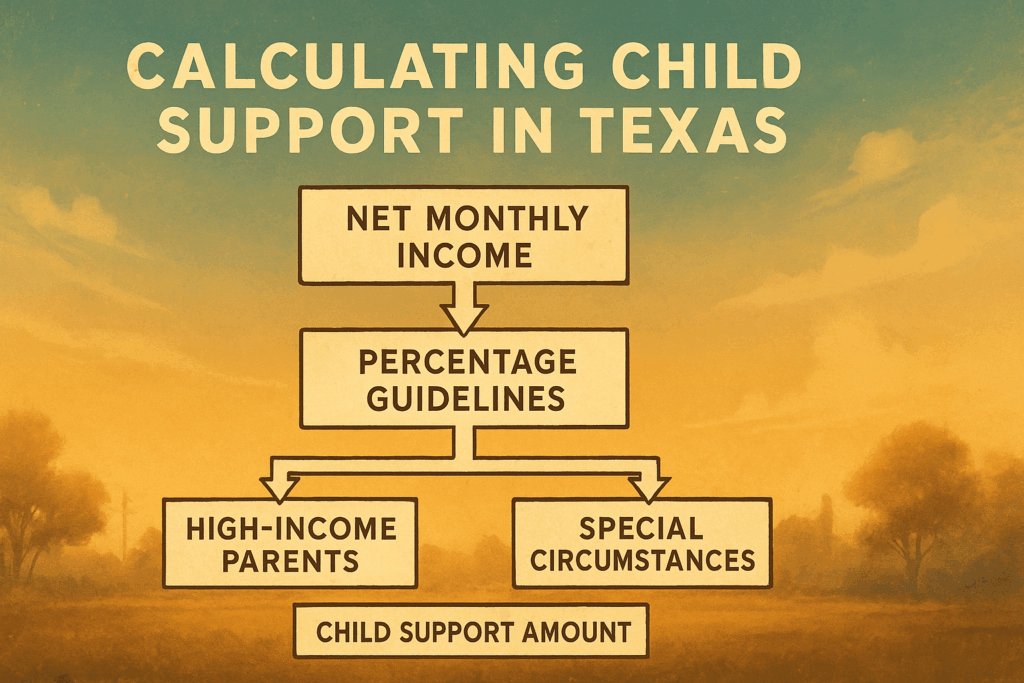
Net Monthly Income
Net monthly income is a critical factor in calculating child support in Texas. It is calculated by taking the total income and deducting allowable deductions to determine monthly net resources. Types of income that contribute to net resources include:
- Wages
- Salary
- Overtime
- Commissions
- Bonuses
- Rental income
- Dividends
- Self-employment income
- Retirement income
- Net income
These various sources of income contribute to the overall financial resources that are considered when calculating child support.
Allowable deductions from gross income can include certain employment-related expenses and specific liabilities, which are subtracted to arrive at obligor’s net resources. If an obligor intentionally becomes underemployed, the court has the authority to consider their earning potential when determining support obligations. This ensures that the child’s needs are met, even if a parent attempts to reduce their income intentionally.
Percentage Guidelines
In Texas, child support percentages are calculated based on the number of children. Typically, the percentage of net monthly income allocated to child support is 20% for one child, 25% for two children, and 30% for three children. These percentages serve as foundational guidelines to ensure that children receive adequate financial support from both parents.
If an obligor’s income exceeds $7,500 per month, the court only applies the child support calculations to the first $7,500. For parents whose net resources are less than $1,000 a month, different guidelines apply to court ordered child support calculated. This ensures that the amount of child support obligations are fair and proportional to the parent’s financial capacity, providing a balanced approach to meet the child’s needs.
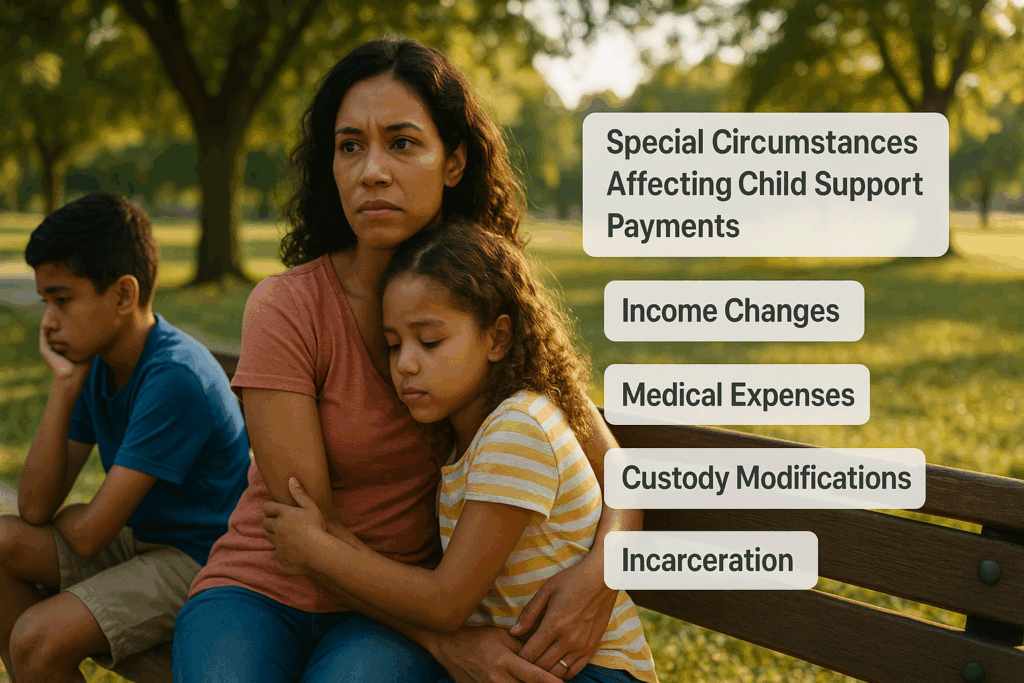
Special Circumstances Affecting Child Support Payments
Life rarely fits neatly into formulas, and child support is no exception. While Texas Child Support Guidelines Explained provide a standard framework under the Texas Family Code §§ 154.001–154.309, special circumstances can require adjustments to ensure fairness and protect a child’s well-being. As we’ve seen in our work with Texas families, situations such as sudden job loss, significant changes in custody arrangements, or even international relocation may alter a parent’s financial ability to meet guideline obligations.
Under Texas Family Code § 156.401, a parent can seek modification of an existing order if there has been a material and substantial change in circumstances. Courts will always evaluate these requests through the lens of the child’s best interests, balancing the need for financial stability with each parent’s ability to contribute. For example, if one parent experiences unemployment, the court may temporarily adjust obligations, but if a child develops special medical needs, support may justifiably increase beyond guideline amounts.
Our legal professionals have helped many clients understand that these modifications are not automatic and require careful preparation, including updated financial documentation and, in some cases, testimony about the child’s evolving needs. For parents navigating these challenges, our family law team recommends reviewing our detailed guide on the best way to calculate child support in Texas, which explains how courts weigh both guideline formulas and exceptions.
According to our family law team, being proactive is key. Whether you are a custodial parent worried about covering new expenses or a noncustodial parent concerned about a sudden reduction in income, seeking timely legal advice ensures that support orders remain both fair and enforceable. For additional information on related issues like custody adjustments, visit our Texas child custody resources. With compassionate guidance and a deep knowledge of the latest updates to the Texas Family Code, our attorneys help families find balanced solutions that protect both financial stability and a child’s future.
High-Income Parents
For high-income parents, child support payment obligations can be based on net resources up to $11,700 per month. The current Texas child support cap is set at $9,200 per month for net monthly income, but by September 1, 2025, this cap will increase to $11,700 per month. These adjustments to the Texas child support guidelines provide high-income parents with clearer expectations while adhering to the child’s proven needs.
Courts consider the child’s proven needs and the obligor’s ability to pay when determining child support obligations exceeding the cap. Income above the Texas child support cap is generally not included unless necessary to meet the child’s needs. Despite higher income levels, parents can still be required to pay child support if proven necessary. Judges have the discretion to deviate from the child support guidelines when considering specific cases.
Disabled Children
For a child to qualify for continuous support due to a disability, the disability must be documented before they turn 18. To qualify for indefinite support as a disabled child in Texas, the child must require substantial care, and the disability must be known before age 18.
Child support can continue beyond a child’s 18th birthday if the child has a disability that requires ongoing care. Child support can be extended beyond the child’s graduation or turning 18 if the child is deemed disabled by the court.
Parents or custodians with a court order have the standing to sue for the support of a disabled child or adult in Texas. When a child is disabled, child support obligations continue even after the child reaches adulthood.
Multiple Households
When a noncustodial parent has children with multiple partners, child support payments may be adjusted:
- Child support guideline amounts may be reduced based on the number of children the noncustodial parent has in other households.
- This ensures that the financial resources are fairly distributed among all the children.
- The goal is to provide adequate support for each child.
The Texas Attorney General Child Support Calculator can be used to calculate child support obligations when the noncustodial parent has children with different partners. This tool helps in determining the appropriate amount of support, ensuring that all children receive fair and proportional financial assistance.
The Role of the Texas Attorney General in Enforcing Support Orders
While parents often focus on how support amounts are calculated, enforcement is just as important. Having Texas Child Support Guidelines Explained means understanding not only the calculation process but also how orders are enforced. The Texas Attorney General’s Office plays a central role in this area, ensuring that children receive the financial support they are entitled to under the law. According to the Texas Family Code §§ 157.001–157.426, enforcement measures may include wage garnishment, property liens, suspension of driver’s or professional licenses, and even denial of vehicle registration renewals when parents fall behind on their obligations.
As our attorneys frequently advise, the Attorney General cannot modify a child support order—that authority rests with the courts under Texas Family Code § 156.401. However, the Attorney General’s Office provides critical enforcement services that hold parents accountable and protect children’s financial stability. These actions are not punitive for the sake of punishment; rather, they exist to ensure that children have consistent resources for their day-to-day needs, from food and housing to medical and educational expenses.
Our legal professionals have helped many clients understand the importance of staying compliant with child support orders. Parents who fail to meet their obligations may face serious consequences, including contempt of court proceedings that can result in fines or jail time. To better prepare, we encourage families to review our comprehensive guide, your go-to guide to understanding Texas child support laws, which covers enforcement alongside calculation and modification issues.
For those seeking additional clarity, our family law team also provides resources on child custody in Texas, as custody arrangements often intersect with enforcement issues. By staying informed and working with experienced attorneys, parents can avoid legal pitfalls, protect their rights, and most importantly, ensure their children’s futures remain secure.

Broader Impact of Divorce on Children
Divorce can have a profound emotional impact on children, leading to feelings of sadness, anger, and confusion. Children of divorced parents may face long-term psychological effects, including an increased risk of depression and anxiety. Behavioral changes such as withdrawal, aggression, or rebellion are common among children experiencing the upheaval of parental separation.
The academic performance of children can also be negatively affected by divorce. Studies show:
- Children between 7 and 14 years old are 16% more likely to exhibit behavioral issues if their parents divorce.
- Divorce can lead to a reduced likelihood of high school completion by 8% among affected children.
- Divorce can lead to a reduced likelihood of college attendance by 12% among affected children.
Consistent support and professional counseling can help mitigate these challenges, providing children with the stability and assistance they need to thrive, ensuring a child’s well being.
Minimizing Educational Disruptions Through Consistent Child Support
Consistent child support fosters financial stability, enabling children to focus on their education and emotional well-being. Regular and fair child support payments can help maintain stability in children’s lives, reducing the need for school transfers and changes in living situations. This stability is crucial for minimizing disruptions in a child’s educational journey, allowing them to concentrate on their studies and achieve their academic goals.
Stable financial support from child support can foster a sense of security in children, allowing them to focus on their education rather than family instability. Adequate child support can help equalize living conditions between households, reducing stress for children during transitions. Consistent child support can also provide the financial resources necessary for children to stay in their current schools, thus minimizing educational disruptions.
Practical Advice for Parents
Parents facing difficulties in making child support payments are encouraged to reach out to the Child Support Division promptly. The firm provides comprehensive resources and educational materials to help parents understand their rights and obligations regarding child support. Bryan Fagan’s attorneys strive to facilitate effective communication between co-parents to reduce conflict and promote cooperative parenting.
Clients have reported feeling relieved and empowered after receiving tailored legal representation for their child support cases, highlighting the reduction of stress during the process. Many families have successfully navigated child support disputes with the guidance of skilled attorneys, achieving fair financial arrangements that meet their unique needs.
Clear communication and responsiveness from legal representatives contribute to positive outcomes in child support cases.
Keeping Accurate Financial Records
Accurate financial records are crucial in child support situations to ensure fair calculations and compliance with obligations. By maintaining clear and accurate financial records, parents can prevent disputes and misunderstandings regarding child support payments.
Organized records of income, expenses, and child-related costs streamline communication and compliance, making the process smoother for all parties involved.
Open Communication with Schools
Regular communication with teachers and school administrators helps parents stay informed about their child’s progress and needs. By maintaining open communication with schools, parents can ensure that their child’s educational needs are met, even amidst family transitions.
Parents have the right to access their child’s school records and communicate with teachers unless restricted by a court order.
Seeking Professional Resources
Seeking counseling or professional resources can significantly help children during transitions such as divorce or child custody changes. Professional guidance can assist children in managing their emotions and adjusting to new family dynamics.
Parents should look for local counselors, therapists, or child support organizations that specialize in transitional support.
How Bryan Fagan’s Office Guides Parents Through Child Support Guidelines
As we’ve seen in our work with Texas families, no two child support cases are alike. That is why our attorneys emphasize personalized legal guidance when helping parents understand and apply Texas Child Support Guidelines Explained. By carefully reviewing each parent’s financial resources, insurance obligations, and childcare costs as outlined in the Texas Family Code §§ 154.001–154.309, our legal team ensures that support calculations are both accurate and fair. This approach not only safeguards a child’s needs but also promotes balance between custodial and noncustodial parents.
Our legal professionals have helped many clients understand that accurate child support orders are essential for long-term stability. With recent updates to the Family Code—including the upcoming increase to the net resources cap from $9,200 to $11,700 effective September 1, 2025—parents need experienced guidance to navigate these changes with confidence. Whether a case involves standard percentage guidelines under §154.125, requests for deviation based on proven needs, or modifications under §156.401, our family law team works to ensure every order reflects both legal accuracy and the child’s best interests.
According to our family law team, parents benefit most when they approach these issues with both compassion and clarity. That is why we provide a range of resources, including our dedicated page on child support in Texas, which offers practical insights for families preparing for or currently navigating support cases. For those dealing with custody matters that overlap with child support, we also recommend exploring our Texas child custody resources.
At The Law Office of Bryan Fagan, PLLC, our mission is simple yet powerful: to educate families, protect futures, and guide parents through difficult transitions with compassion and precision. By blending deep legal knowledge with real-world understanding, we help ensure that every child support order upholds what matters most—the well-being and stability of your child.

Real-Life Examples and Testimonials
Real-life case studies illustrate how effective legal advocacy can lead to successful child support arrangements that prioritize children’s stability and well-being. For instance, one client was able to secure a fair child support arrangement that ensured her children’s educational and emotional needs were met, thanks to the personalized approach of Bryan Fagan’s attorneys.
Testimonials from former clients emphasize the importance of clear communication and responsiveness from their legal representatives, contributing to positive outcomes in their cases. Many clients express appreciation for the legal team’s ability to simplify complex legal processes, making them feel more informed and confident throughout their cases.
Modifying Child Support Orders
When life changes, child support orders often need to change too. Having Texas Child Support Guidelines Explained is important, but knowing how to legally modify an existing order is just as critical. Under the Texas Family Code § 156.401, a parent may request a modification if there has been a material and substantial change in circumstances or if at least three years have passed since the last order, with the current obligation differing by 20% or $100 from the guideline amount.
As our attorneys frequently advise, child support cannot be changed through informal agreements between parents. Modifications must be sought through the court or the Child Support Review Process administered by the Texas Attorney General’s Office. Parents should also understand that requests can work both ways—a petition to reduce payments could result in an increase if the noncustodial parent’s income has grown since the last order was established.
Our legal professionals have helped many clients understand which circumstances may qualify as “material changes.” These can include job loss, new legal responsibilities such as supporting additional children, or significant changes in a child’s medical, educational, or living needs. Courts will always weigh these changes against the child’s best interests, ensuring financial stability and fairness for all involved.
According to our family law team, keeping thorough financial records and documentation is one of the best ways to support a modification request. Custodial parents, in particular, benefit from maintaining a clear record of attempts to notify the other parent about unmet support responsibilities. For a deeper look at this process, we encourage parents to read our comprehensive guide on the effortless Texas child support modification process.
For families navigating custody and support issues together, we also provide resources on Texas child custody, which often intersect with modification requests. By working with experienced attorneys who understand both the legal framework and the emotional realities of family life, parents can move forward with confidence, knowing their child’s needs remain protected under the latest updates to the Texas Family Code.
Medical and Dental Support Obligations
Medical and dental support are additional child support obligations that cover health insurance, dental insurance, and uninsured medical expenses. Courts are required to ensure that children receive adequate medical and dental support as part of any custody or support decision. Parents typically share the cost of uninsured or out-of-pocket medical expenses, with each covering 50%.
The court can mandate cash medical support in addition to standard child support, ensuring all payments are processed through the Texas Child Support Disbursement Unit. Texas law sets maximum limits for insurance costs that obligors must pay, such as 9% of annual net resources for health insurance. Expenses such as health insurance for the child can be deducted when calculating net resources.
Retroactive Child Support
Retroactive child support is intended to provide financial assistance for times when a parent failed to contribute as required. A court can order retroactive child support to cover periods when no support was paid, ensuring that the child’s needs were met during that time. Texas courts typically adhere to a four-year limit for retroactive child support claims unless specific circumstances warrant otherwise.
Under certain conditions, retroactive support can be argued for longer than four years if the obligor was aware of his paternity and attempted to avoid his support obligations. The financial condition of the non-custodial parent during the retroactive period is a key factor in the court’s decision-making process.
Potential financial hardships on the non-custodial parent are evaluated to determine the feasibility of enforcing a retroactive support order.
Conclusion:
At the end of the day, child support isn’t just a legal guideline—it’s a tool to keep kids grounded when life feels uncertain. When parents understand how Texas child support works, they can worry less about paperwork and payments and focus more on what truly matters: building steady, supportive homes where children can thrive.
Every family’s situation is unique, and sometimes the rules feel overwhelming or even unfair. That’s where having a trusted Texas family law attorney makes all the difference. Our team at The Law Office of Bryan Fagan, PLLC is here to help parents find clarity, protect their children’s futures, and create solutions that feel fair and workable for everyone involved.
If you’ve been wondering how child support will shape your family’s next chapter, now is the perfect time to take the next step. Give yourself permission to seek answers, ask for help, and get a plan in place. And if you’re still stressing about that box of cartoon cereal in the grocery cart—don’t worry, you’re not alone. Parenting is messy, but with the right guidance, you don’t have to go through it alone.
Texas Child Support FAQs
What are the guidelines for child support in Texas?
Texas applies percentage guidelines to the obligor’s net monthly resources (after allowable deductions). Generally: 20% for one child, 25% for two, 30% for three, 35% for four, and 40% for five or more. Courts may deviate based on the child’s proven needs and statutory factors, and orders typically also address medical and dental support. See Texas Family Code §§ 154.062, 154.125, 154.181.
What is the new law for child support in Texas?
Effective September 1, 2025, the maximum net resources to which the guideline percentages apply increase from $9,200 to $11,700 per month as published in the Texas Register. This does not eliminate child support; it adjusts the income cap used for calculations in higher-income cases.
What is above the guideline child support in Texas?
Above-guideline support refers to orders exceeding the percentage guidelines when necessary to meet the child’s proven needs. Courts may consider factors like special medical or educational needs, travel costs, or significant income disparity between parents. See Texas Family Code § 154.123.
What is the Texas child support calculation?
Courts determine the obligor’s net resources (wages, bonuses, commissions, self-employment income, etc., minus taxes and allowed deductions), apply the percentage guideline to those net resources up to the cap, adjust for multiple households if applicable, and add medical/dental support obligations. See Texas Family Code §§ 154.061–154.066, 154.125, 154.181.
Do you have to pay child support if you have 50/50 custody in Texas?
Possession time alone does not decide support. Even with 50/50 schedules, a court may order child support when there is an income disparity or to ensure consistent resources in both homes. Child support is based on the child’s best interest and each parent’s ability to pay.
What does child support not cover in Texas?
Guideline child support is intended for a child’s general needs and isn’t itemized. Unless a court order specifically addresses them, extras like extracurriculars, private school tuition, college costs, some travel expenses, and certain uninsured medical costs are not automatically covered. Orders can allocate these expenses by agreement or court decision.
How to not pay child support in Texas?
There’s no lawful way to avoid a valid court order. Support may be reduced or ended only through legal means—such as becoming the primary conservator, disproving paternity before adjudication, or obtaining a modification after a material and substantial change (or after three years with a 20% or $100 variance). Nonpayment risks wage withholding, license suspension, liens, and contempt. See Texas Family Code §§ 156.401, 157.001, 158.001.
Is child support going away in 2025?
No. Child support remains a core requirement in Texas. The 2025 change raises the income cap used for applying guideline percentages to $11,700 per month; it does not end child support.
What is the deadbeat dad law in Texas?
There isn’t a statute called the “deadbeat dad law.” Texas enforces child support orders through income withholding, liens, license suspensions, credit bureau reporting, interception of tax refunds, and contempt (which can include fines or jail). These remedies apply to any nonpaying parent. See Texas Family Code Chs. 157 and 158.