
Have you ever found yourself standing in the kitchen late at night, staring at the same four walls and wondering how something that once felt so solid suddenly became uncertain? For many Texas families, divorce doesn’t begin in a courtroom—it starts in quiet moments filled with questions about the home, the bank account, and what life will look like on the other side of the marriage. Divorce Property Division in Texas is often misunderstood as a purely financial exercise, but in reality, it shapes where families live, how secure children feel, and how much stability remains during a time of emotional upheaval.
At The Law Office of Bryan Fagan, PLLC, we have guided countless Houston families through these exact moments. Led by Bryan Joseph Fagan, a South Texas College of Law graduate and a recognized authority on Texas divorce and custody law, our firm understands that property division is about far more than numbers on paper. Texas law gives judges discretion under the “just and right” standard, while Texas Family Code §153.002 reminds courts to keep children’s best interests at the center of every custody decision. Together, these principles mean that decisions about homes, finances, and resources can have a lasting impact on a child’s sense of security and a family’s ability to move forward.
This article is here to bring clarity where there is confusion and reassurance where there is stress. You will learn how property division works under Texas law, why thoughtful planning matters, and how compassionate legal guidance can help protect both financial and emotional stability. Our purpose is rooted in empowerment—helping you reclaim peace of mind, understand your options, and move through this transition with confidence, knowing you do not have to face it alone.
Key Takeaways
- Texas is a community property state where assets acquired during marriage are presumed to be jointly owned, but separate property remains with its original owner if properly proven
- Courts divide community property using a “just and right” standard rather than an automatic 50/50 split, considering factors like earning capacity, child custody responsibilities, and marriage duration
- The spouse claiming separate property must provide clear and convincing evidence through documentation such as account statements, titles, or tracing records
- Retirement accounts, real estate, business interests, and debts are all subject to division, with special rules applying to each type of asset
- Working with an experienced Texas family law attorney significantly improves your ability to identify, characterize, and protect your property rights

Your Family’s Future Starts Here
Don’t navigate your legal journey alone. Schedule a consultation now and get the clarity and support you deserve.
What Is Divorce Property Division in Texas?
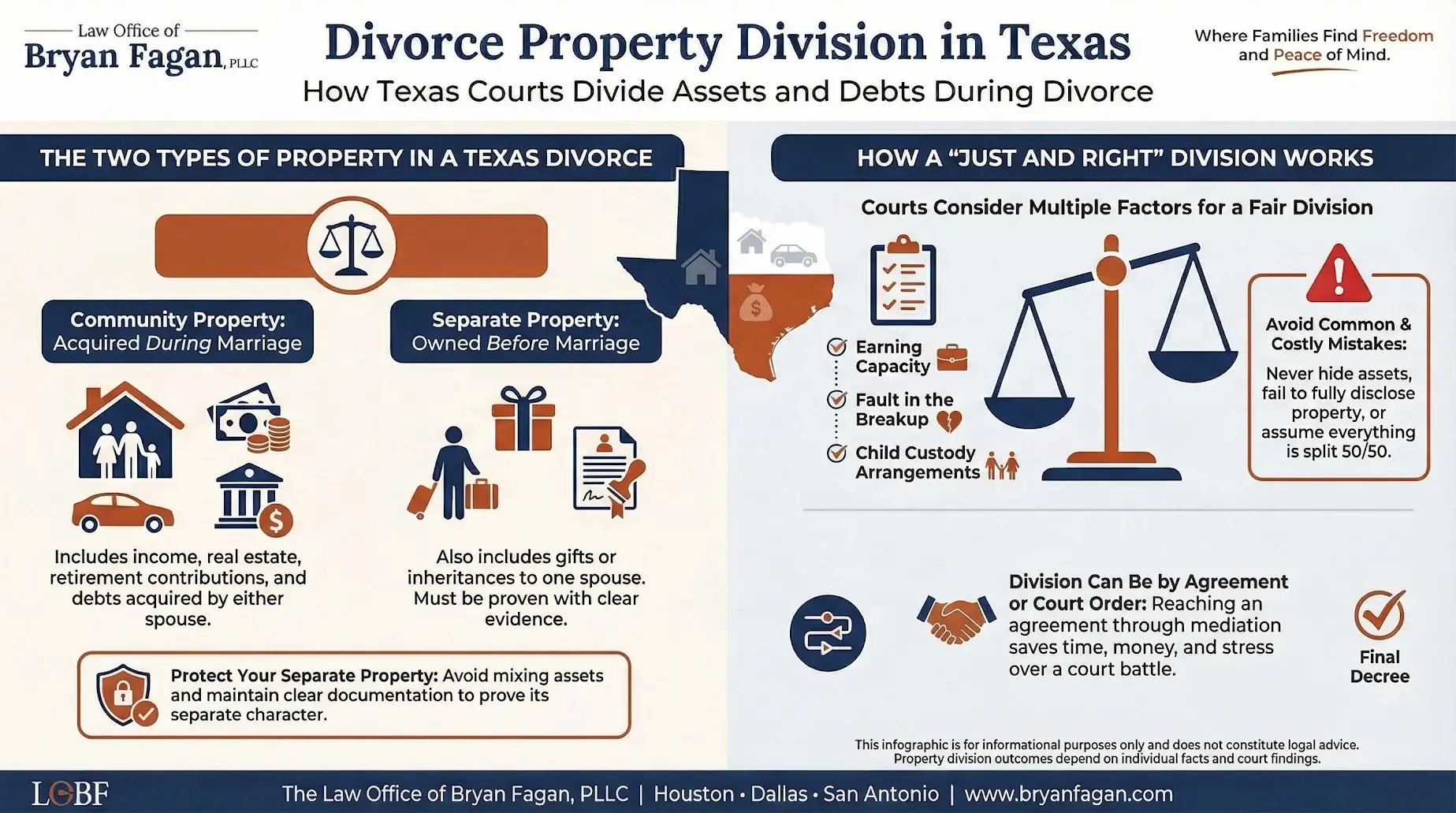
Under Divorce Property Division in Texas, courts are required to identify, characterize, value, and divide all assets and debts when a marriage ends. This process is governed by Texas Family Code Chapter 7, with Section 7.001 directing judges to divide community property in a manner that is “just and right.” Unlike states that require a strict fifty-fifty split, Texas law allows courts to consider the unique circumstances of each family, including financial needs, earning capacity, and the presence of children, to reach a fair result.
Texas operates as a community property state, meaning Texas Family Code §3.002 creates a presumption that most property acquired during the marriage belongs to both spouses. This typically includes wages earned by either spouse, real estate purchased during marriage, retirement accounts funded while married, business interests developed during the marriage, and debts incurred for the benefit of the family. Community property can range from major assets like the family home and retirement savings to everyday items such as vehicles, bank accounts, and household furnishings.
Texas law also provides strong protections for separate property. Under Texas Family Code §3.001, assets owned before marriage, gifts received by one spouse individually, and inheritances remain that spouse’s separate property and are not divided in a divorce. Certain personal injury recoveries, particularly compensation for pain and suffering, may also qualify as separate property. However, the spouse claiming separate property must prove it with clear and convincing evidence, and disputes often arise when assets are commingled or when community funds are used to benefit separate property. For a deeper explanation of how these issues commonly arise, readers can explore Separate Property as an Issue in a Texas Divorce, which breaks down real-world challenges families frequently encounter.
What truly distinguishes Texas from many other states is how judges apply the “just and right” standard. Rather than defaulting to an equal split, courts may consider factors such as the length of the marriage, each spouse’s earning potential, fault in the breakup when proven, and the needs of any children involved. This discretion allows judges to tailor outcomes to a family’s reality, but it also means preparation and informed legal guidance are critical. Many families benefit from reviewing additional resources, such as this overview of community property and divorce in Texas, to better understand how these laws are applied in practice.
From the perspective of our Houston-based family law team, property division is never just about dividing assets on paper. It is about helping families move forward with stability, clarity, and confidence. Understanding how Texas law distinguishes between community and separate property—and how courts exercise discretion under the “just and right” standard—empowers families to protect their futures and navigate divorce with greater peace of mind.

When Is Property Division Required in Texas Divorce?
In Divorce Property Division in Texas, the division of assets and debts is not optional or situational—it is required in every divorce where a couple owns community property or has community debt. Texas Family Code §7.001 mandates that courts divide the community estate in a manner that is “just and right,” while giving due regard to the rights of each spouse and any children of the marriage. This framework reflects Texas’s commitment to fairness rather than rigid formulas, allowing judges to account for the financial and family realities facing each household.
When spouses are able to agree on how to divide their property and debts, they may enter into a negotiated property settlement agreement. Once approved by the court, that agreement is incorporated into the Final Decree of Divorce and becomes legally binding. Reaching agreement often gives families greater control over the outcome, reduces emotional strain, and limits legal expenses. It also allows spouses to thoughtfully address complex issues, such as how to handle commingled assets or debts, which can otherwise create long-term disputes if left unresolved. Families seeking clarity on how mixing assets can affect ownership frequently benefit from reviewing What Happens If You and Your Spouse Mix Community and Separate Property, which explains how commingling can complicate property claims under Texas law.
If agreement cannot be reached, the court must step in and make property division decisions after reviewing evidence from both parties. This includes testimony and documentation related to asset values, property characterization, and financial conduct during the marriage. Texas courts strongly encourage mediation and negotiated resolution before trial, recognizing that settlements tend to preserve resources and reduce conflict. In practice, a significant majority of Texas divorce cases resolve through agreement rather than judicial determination, allowing families to move forward with greater predictability and peace of mind. For additional insight into how courts approach contested cases, many readers find it helpful to explore this overview of how Texas courts divide marital property.
From the perspective of experienced Texas family law counsel, understanding when property division is automatic, when agreement is possible, and when court intervention becomes necessary empowers families to make informed decisions. Whether resolving matters cooperatively or preparing for litigation, knowing how the law works helps protect futures and supports a more stable transition into life after divorce.
How the Property Division Process Works in Texas
The property division process in Texas follows a structured approach involving three main phases: identification, characterization, and valuation. Each phase requires careful attention to detail and thorough documentation.
Identifying All Marital Assets and Debts
The first step requires creating a comprehensive inventory of everything you and your spouse own or owe. Texas law requires initial disclosures of all assets and debts within thirty days of filing for divorce, fostering transparency between parties.
Community property includes real estate purchased during marriage, bank accounts and investment accounts, retirement accounts and pensions, vehicles and personal property, business interests acquired during marriage, and all debts incurred during the marriage. You must also identify separate property, including assets acquired before marriage, gifts, and inheritance.
Hiding assets during divorce proceedings carries serious consequences. Texas courts can impose sanctions, award a larger share of community property to the other spouse, or even find the hiding spouse in contempt of court.
Characterizing Property as Community or Separate
Characterizing property correctly is often the most contested aspect of Texas property division. The law presumes that all property owned at the time of divorce is community property. The spouse claiming property as separate must rebut this presumption with clear and convincing evidence.
This burden requires documentation such as bank statements, titles, account records, or witness testimony demonstrating that the asset qualifies as separate property. For example, if you inherited two hundred thousand dollars during your marriage, you must trace how those funds remained segregated from community funds. If you deposited the inheritance into a joint checking account and used it for family expenses, establishing its separate character becomes significantly more difficult.
The inception of title rule determines property characterization based on when the property was acquired. Property you owned before marriage remains separate, but improvements made with community funds during marriage may create reimbursement claims.
Valuing Assets for Division
Once property is identified and characterized, both spouses must agree on values or present evidence supporting their valuations. Different types of property require different valuation approaches.
Real property typically requires professional appraisals. Retirement accounts and investment accounts use account statements showing current values. Business interests often require forensic accountants or business valuation experts who apply income, market, or asset-based approaches to determine fair market value.
Complex assets like closely held businesses, professional practices, or significant real estate holdings frequently become the focus of property division disputes. These assets may represent significant value but cannot be simply divided in half, requiring creative solutions like buyouts, structured payments, or sales with proceeds divided.
What Issues Can Be Resolved Through Property Division?
In Divorce Property Division in Texas, courts are responsible for addressing nearly every asset and debt acquired during the marriage, ensuring that nothing of significance is overlooked. This process commonly includes dividing the family home and other real estate, retirement benefits such as 401(k)s, pensions, and IRAs, bank and investment accounts, business interests and professional practices, vehicles and recreational equipment, personal property, and all community debts like mortgages, credit cards, and personal loans. Texas Family Code §7.001 gives judges broad discretion to divide these assets in a manner that is “just and right,” allowing the court to tailor outcomes to a family’s specific financial reality rather than relying on a rigid formula.
Certain assets require additional care and legal precision. Retirement accounts, for example, cannot simply be split without consequences. Texas Family Code §7.003 provides the statutory framework for Qualified Domestic Relations Orders, which are essential to dividing retirement benefits without triggering early withdrawal penalties or immediate tax liability. Families navigating this issue often benefit from understanding how retirement division fits into the larger property picture, particularly when long-term financial security is at stake.
Tax consequences also play an important role in property division decisions. Capital gains exposure can significantly affect the true value of an asset after divorce. A spouse who receives an investment account may face tax liability when selling appreciated securities, while a spouse awarded the family home may defer capital gains taxes until a future sale. These considerations highlight why careful planning and informed legal guidance are so important, especially when determining whether to sell assets, transfer them, or use them to offset other property awards.
From the perspective of our Texas family law team, understanding what assets are subject to division—and which may be protected as separate property—is critical to protecting your financial future. Resources such as Why Separate Property Matters in a Texas Divorce help families better understand how separate property claims can shape negotiations and court outcomes. Many readers also find it helpful to review this overview of dividing assets and debts in a Texas divorce to gain additional clarity.
Handled thoughtfully, property division is not just about allocating assets—it is about creating stability and protecting what matters most as families move forward. By understanding the legal rules, tax implications, and strategic considerations involved, families are better equipped to navigate divorce with confidence, clarity, and peace of mind.

Understanding the “Just and Right” Standard in Texas
In Divorce Property Division in Texas, courts are guided by Texas Family Code §7.001, which requires judges to divide community property in a manner that is “just and right, having due regard for the rights of each party and any children of the marriage.” This standard gives Texas judges broad discretion and reflects the reality that no two families share the same financial picture or needs. Rather than applying a rigid formula, courts are empowered to craft property division orders that fit the unique circumstances of the marriage and support long-term stability for everyone involved.
When determining what is “just and right,” Texas courts evaluate a wide range of factors recognized through case law and consistent with the Family Code. These considerations commonly include the length of the marriage, each spouse’s earning capacity and financial contributions, age and health, education and future employment opportunities, and the size and nature of the community estate. Judges also weigh child custody arrangements and which parent has primary responsibility for the children, recognizing that maintaining stability for a child may require awarding one spouse a larger share of certain assets. For families seeking a deeper understanding of why these principles exist, resources like Is Texas a Community Property State? Key Insights You Need to Know provide helpful context on how Texas property laws developed and how they are applied today.
The length of the marriage often plays a significant role in how property is divided. Longer marriages tend to result in divisions that are closer to equal, while shorter marriages may justify more uneven outcomes based on contributions and circumstances. Fault in the breakup of the marriage, such as adultery or cruelty when proven, can also influence the court’s decision and support awarding a greater share of community property to the innocent spouse. These factors demonstrate how the just and right standard allows courts to respond to real-life dynamics rather than treating every divorce the same.
From the perspective of experienced Texas family law attorneys, this discretion underscores the importance of preparation and informed advocacy. Data from Texas divorce cases frequently reflects divisions that fall slightly off from a strict fifty-fifty split, often closer to fifty-two–forty-eight percent, illustrating how judges exercise their authority under the statute. Families who understand how courts evaluate fairness are better positioned to set realistic expectations and make strategic decisions. Additional guidance, such as this overview of how Texas courts divide marital property, can further help families navigate the process with clarity and confidence.
Ultimately, the just and right standard is not about winners and losers. It is about fairness, stability, and protecting futures. By understanding how Texas courts apply this principle in Divorce Property Division in Texas, families can move forward with greater peace of mind, knowing the law is designed to account for their real lives, not just their balance sheets.
Benefits of Understanding Texas Property Division Laws
Knowledge of community property laws and the property division process provides substantial advantages during divorce. Understanding your rights helps you negotiate from an informed position, identify when proposals are unfair, protect assets that rightfully belong to you as separate property, and make strategic decisions about which assets to pursue.
Informed spouses can identify potential reimbursement claims for community funds used to improve separate property. They recognize when complex assets like business interests require professional valuation. They understand how possession schedules for children may affect decisions about the family home.
Preparation significantly reduces conflict and costs. Legal aid statistics show that detailed inventories and appraisals cut disputes by approximately fifty percent. Knowing general rules about property characterization helps you gather documentation early, preserving evidence that may become critical during negotiations or trial.
Common Myths About Property Division in Texas
Several persistent misconceptions about Texas property division lead many people to make poor decisions during divorce. Understanding the truth helps you protect your interests.
Myth: Texas always divides property fifty-fifty. The truth is that Texas courts divide property according to what is “just and right” under the circumstances. While many divisions approach equality, courts regularly order disproportionate splits based on earning capacity, fault, child custody, and other factors.
Myth: The name on the title determines who owns property. Under community property laws, property acquired during marriage generally belongs to both spouses regardless of whose name appears on the title. A home purchased during marriage belongs to the community estate even if only one spouse’s name appears on the deed.
Myth: Separate property is automatically exempt from division. While separate property is not divided, the spouse claiming separate property must prove its character with clear and convincing evidence. Approximately ninety percent of separate property claims fail without adequate documentation.
Myth: You are responsible for debts only in your name. Community debt incurred during marriage for the benefit of the family may be divided between spouses regardless of whose name appears on the account. Courts consider the purpose of the debt and the circumstances of its incurrence.
What Happens If Spouses Cannot Agree on Property Division?
When spouses are unable to resolve disputes through negotiation or mediation, Divorce Property Division in Texas moves into a more formal stage where the court steps in to make binding decisions. At a final hearing, each spouse presents evidence related to asset values, disputes over whether property is community or separate, and the factors a judge must consider under Texas Family Code §7.001. This statute directs courts to divide the community estate in a manner that is “just and right,” giving judges flexibility to tailor outcomes based on the unique circumstances of the family rather than forcing a mechanical split.
Texas judges are granted broad discretion when applying the just and right standard, and that discretion shapes how property division orders are crafted. Depending on the facts, a court may order the sale of property that cannot be physically divided and split the proceeds, award the family home to one spouse while offsetting its value with other assets, or structure buyouts over time to reduce financial strain. Courts may also allocate specific items of personal property to each spouse to reach an equitable result. Families seeking a deeper understanding of how this discretion works in practice often benefit from reviewing Just and Right Property Division in Texas: Your Guide to Fair Divorce Settlements, which explains how courts evaluate fairness in real-world cases.
Because trial judges have such wide latitude, appeals of property division orders are rarely successful. Texas appellate courts will overturn a property division decision only if the trial court clearly abused its discretion, a standard that is met in a very small percentage of cases. This reality makes preparation critical. Presenting clear evidence, accurate valuations, and well-supported arguments at trial is often the only meaningful opportunity to influence the outcome. Many families find it helpful to explore additional guidance, such as this overview of preparing for a contested Texas divorce, to better understand what courts expect when disputes cannot be settled.
From the perspective of our Texas family law attorneys, court intervention is never the first choice, but it is sometimes unavoidable. When it becomes necessary, informed preparation and compassionate legal guidance can make a significant difference. Understanding how judges apply the just and right standard helps families approach trial with clearer expectations and greater confidence, protecting their financial future while navigating one of life’s most difficult transitions.

How a Texas Family Law Attorney Supports Property Division
In Divorce Property Division in Texas, having experienced legal guidance can make a meaningful difference at every stage of the process. A knowledgeable Texas family law attorney helps identify and properly characterize all assets and debts, ensuring that both community and separate property are accounted for under Texas Family Code §§3.001–3.002 and Chapter 7. This includes reviewing financial records, tracing separate property claims, and coordinating accurate valuations for complex assets such as business interests, investment portfolios, and retirement accounts, all of which are essential to presenting a clear and credible picture to the court.
Effective negotiation is another critical role attorneys play in property division matters. By understanding how Texas courts apply the “just and right” standard under Texas Family Code §7.001, attorneys can advocate for settlement terms that reflect fairness without the added expense, stress, and uncertainty of trial. When settlement is not possible, legal counsel prepares clients for litigation by organizing evidence, addressing disputes over property characterization, and presenting persuasive arguments that align with how judges evaluate fairness in real-world cases. Families often benefit from reviewing resources like What Gets Split in Divorce in Texas: A Clear Guide to Property Division to better understand how courts approach these decisions.
Attention to detail is especially important when it comes to finalizing divorce paperwork. Attorneys ensure that Final Decrees of Divorce accurately reflect negotiated agreements or court orders and comply with all statutory requirements. This includes preparing and properly executing Qualified Domestic Relations Orders under Texas Family Code §7.003, which are necessary to divide retirement accounts without triggering unnecessary taxes or penalties. Many families also find it helpful to explore additional guidance, such as this overview of retirement accounts and divorce in Texas, to understand how these technical steps fit into the larger property division process.
From the perspective of our Texas family law team, legal representation is not just about managing paperwork or court appearances. It is about educating families, protecting futures, and providing steady guidance during a challenging transition. With informed advocacy and compassionate support, families are better positioned to navigate property division with confidence and move forward toward greater stability and peace of mind.
Why Choose The Law Office of Bryan Fagan, PLLC
In Divorce Property Division in Texas, having guidance from an experienced legal team can make the difference between confusion and clarity. The attorneys at The Law Office of Bryan Fagan, PLLC bring extensive experience handling property division matters under Texas Family Code Chapter 7, including the application of the “just and right” standard set out in §7.001. Our familiarity with how Texas courts interpret and apply these laws allows us to anticipate issues, explain likely outcomes, and help families make informed decisions during a challenging transition.
Our approach is intentionally client-centered. Rather than overwhelming you with legal jargon, our Texas family law team focuses on education and clear communication so you understand your options at every stage of the divorce process. Whether a case involves a family-owned business, professional practice, retirement accounts, or significant investment portfolios, we help clients identify, value, and protect what matters most while staying grounded in the practical realities of Texas law. Many families find it helpful to review Understanding the Texas Divorce Process to gain a broader perspective on how property division fits into the overall timeline of a divorce.
We proudly provide representation to families across Texas, assisting clients with both straightforward property divisions and highly contested disputes involving asset characterization and valuation. Our role is not only to advocate, but to guide—helping families move through Divorce Property Division in Texas with confidence, preparation, and peace of mind. For those seeking additional insight into how courts evaluate fairness, resources like this overview of how Texas courts divide marital property can further support informed decision-making. By combining experience, compassion, and education, our firm remains committed to protecting futures while helping families take their next steps forward.
Checklist: Preparing for Property Division in Texas
- Gather financial documents including tax returns, bank statements, investment account statements, and retirement account summaries for the past three to five years
- Create a comprehensive list of all assets and debts, including approximate values
- Identify property you believe qualifies as separate property and locate documentation supporting your claim
- Collect records of gifts, inheritances, and assets you owned before marriage
- Document any improvements to separate property made with community funds
- Obtain current mortgage statements and recent appraisals for real property
- Gather business records if either spouse owns a business interest
- Consult with an experienced Texas family law attorney to understand your rights and options
Conclusion
Divorce has a way of turning everyday decisions into heavy ones, especially when they affect where your family will live and how secure the future feels. Property division is not just a legal step—it is a chance to create stability during a season that can otherwise feel unpredictable. With the right information and a thoughtful approach, those decisions can become less overwhelming and more empowering.
You don’t need to have everything figured out at once. What matters is understanding your options and knowing that Texas law gives you tools to protect what matters most. When property division is handled with care and foresight, it can support a smoother transition, reduce conflict, and help everyone involved move forward with greater confidence and peace of mind.
If you’re facing divorce and have questions about how property division may affect your family’s future, working with an experienced Texas family law attorney can make a meaningful difference. At The Law Office of Bryan Fagan, PLLC, we believe informed families make stronger decisions. When you’re ready to take the next step, we’re here to help you find clarity, protect your future, and move forward with steady guidance and support.
Frequently Asked Questions About Divorce Property Division in Texas
Texas is a community property state, which means most property acquired during the marriage is presumed to belong to both spouses. However, this does not mean everything is divided exactly 50/50. Texas courts divide community property in a way that is “just and right,” taking into account factors such as each spouse’s earning ability, who will be caring for the children, the length of the marriage, and whether one spouse wasted or misused community assets. Separate property—such as assets owned before marriage, gifts, or inheritances—is generally not divided, but it must be clearly proven.
Moving out of the marital home can unintentionally weaken your legal position, especially when children are involved. It may disrupt the children’s routines, make it harder to argue for keeping the home, and create a new status quo for parenting time. Judges often look at who has been providing day-to-day stability for the children. While moving out is sometimes necessary for safety or emotional reasons, it is usually wise to speak with a Texas family law attorney first to understand the potential consequences.
In Texas, neither spouse is automatically entitled to “half of everything” based solely on gender. A spouse is generally entitled to a just and right share of the community property, along with confirmation of any separate property. If children are involved, child support will typically apply, and in limited situations, spousal maintenance may be ordered. Each case is different, and outcomes depend on finances, documentation, custody arrangements, and the overall circumstances of the marriage.
The name on the deed does not control ownership by itself in Texas. If the house was purchased during the marriage with community funds, it is usually considered community property—even if only one spouse’s name is on the title. If the home was owned before marriage or acquired as a gift or inheritance, it may be separate property. However, reimbursement claims can arise if community funds were used to pay the mortgage or improve the property. A careful legal analysis is often required.
Separate property is generally not divided in a Texas divorce. This often includes property owned before marriage, gifts given to one spouse individually, inheritances, and certain portions of personal injury settlements. That said, separate property can lose its protected status if it is mixed with community property or used for marital expenses without proper documentation. Clear records and tracing are essential to preserving separate assets.
One of the biggest mistakes people make during divorce is letting emotions drive decisions instead of facts and long-term planning. This can lead to draining accounts, agreeing to unfair property divisions, or making choices that disrupt children’s stability. Divorce is stressful, but informed decisions—made with guidance—are far more likely to protect both your financial future and your child’s well-being.
The 10-10-10 rule is not a legal rule in Texas, but rather a decision-making tool. It encourages people to ask how they will feel about a decision in 10 days, 10 months, and 10 years. It can be especially helpful when deciding whether to fight over certain assets, settle a case, or make housing decisions that affect children. Pairing this mindset with legal advice helps balance emotion with strategy.
There is no single answer. The higher-earning spouse may feel a greater immediate financial impact due to child support, possible spousal maintenance, and loss of shared household expenses. The lower-earning spouse may face challenges rebuilding financial independence and securing stable housing. The goal of property division in Texas is not to punish either party, but to create a fair outcome that allows both households—and especially children—to move forward with stability.
Many people refer to the “Four Horsemen” identified by relationship researcher Dr. John Gottman: criticism, contempt, defensiveness, and stonewalling. These behaviors are not legal grounds for divorce by themselves in Texas, but they often appear in high-conflict cases and can make co-parenting more difficult. Addressing these patterns through counseling, clear boundaries, and structured court orders can help reduce conflict and protect children during and after divorce.