
Texas Residency Requirements for Divorce can feel like an invisible tripwire—one you don’t realize exists until everything suddenly comes to a halt. A parent once sat across from our team after finally finding the courage to file for divorce, confident the hardest emotional decisions were behind them. They had secured housing, separated finances, and taken the first real step toward peace. Then came the shock: the court could not move forward because the residency clock was short by just a few weeks. What should have been a step toward closure turned into months of waiting, uncertainty, and renewed tension at home.
At The Law Office of Bryan Fagan, PLLC, we see this scenario more often than people expect. Texas law is precise about when and where a divorce can be filed, as outlined in Texas Family Code §6.301, but families are rarely warned about how unforgiving these rules can be. Filing too early or in the wrong county does not just slow things down—it prolongs conflict, delays financial clarity, and keeps families emotionally stuck when they are trying to move forward with their lives.
Our firm is led by Bryan Joseph Fagan, a South Texas College of Law graduate and recognized authority on Texas divorce and custody law, and our mission is grounded in one guiding principle: empowering people to reclaim freedom and peace of mind during life’s hardest transitions. We do that by simplifying complex legal rules, offering compassionate counsel, and giving families the confidence that comes from truly understanding their options. When residency requirements are handled correctly from the start, families avoid unnecessary setbacks and gain control over the timeline of their future.
In this article, we will walk you through what Texas Residency Requirements for Divorce really mean, why courts enforce them so strictly, and how they affect everything that follows in a divorce case. More importantly, we will connect these legal rules to real-life stability—helping you understand how the right guidance can reduce stress, prevent costly mistakes, and create a smoother path forward. If you are seeking clarity, reassurance, and a steady hand through uncertainty, this is where that journey begins.
Key Takeaways
- At least one spouse must have lived in Texas for six months and in the filing county for 90 days before the divorce can proceed
- Only one spouse needs to meet both residency requirements—the other spouse may live out of state or even abroad
- Filing without meeting requirements results in automatic case dismissal, forcing you to start over
- Proper documentation and careful timing are essential for successful filing and avoiding delays
- Military families and recent movers face special considerations that require additional planning

Your Family’s Future Starts Here
Don’t navigate your legal journey alone. Schedule a consultation now and get the clarity and support you deserve.
What Are the Texas Residency Requirements for Divorce? (Short Answer)
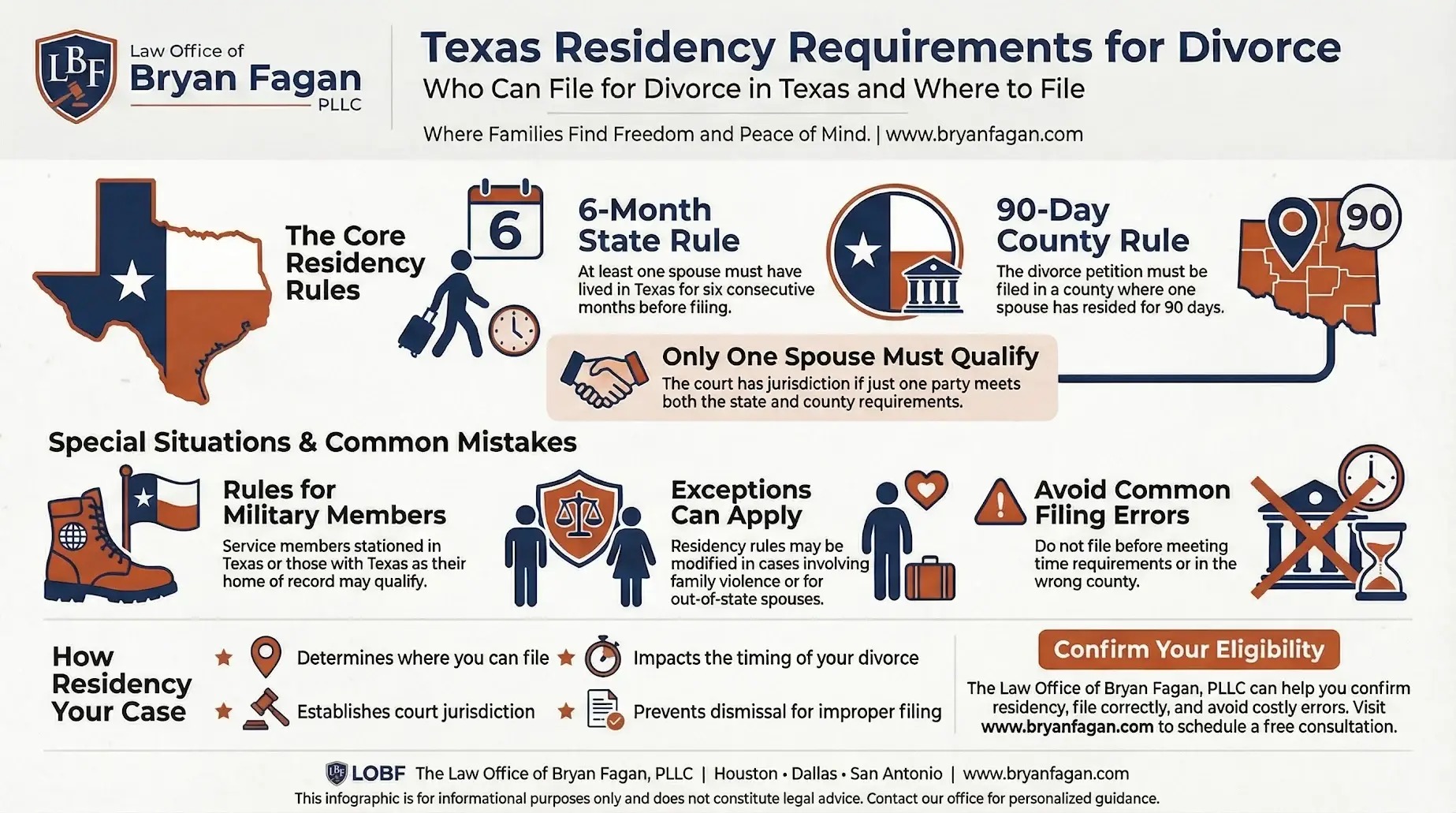
To file for divorce in Texas, at least one spouse must have lived in Texas for at least six months and been a resident of the county where the suit is filed for at least 90 days prior to filing. These requirements come directly from the Texas Family Code Section 6.301.
Here’s the good news: only one spouse needs to satisfy both requirements. If you meet the residency thresholds, you can file even if your spouse lives in another state or another country. The Texas court will have jurisdiction over your divorce proceedings as long as one party qualifies.
These aren’t suggestions or guidelines. They’re mandatory prerequisites. Without satisfying them, no Texas court has the legal authority to grant your divorce, determine child support, establish child custody arrangements, or divide property.
Texas Residency Requirements for Divorce Explained in Detail
Understanding the details behind Texas Residency Requirements for Divorce is one of the most effective ways to avoid delays, dismissals, and unnecessary emotional strain during an already difficult season of life. Texas courts enforce residency rules strictly because they determine whether a judge has the legal authority to hear your case at all. Under the current Texas Family Code §6.301, at least one spouse must meet both the state and county residency requirements before a divorce can proceed, and courts cannot waive these rules—even when both spouses agree to move forward.
A critical point many families miss is that either spouse may satisfy the six-month Texas residency requirement; it does not have to be the spouse who actually files the Original Petition for Divorce. What matters is that one spouse has been domiciled in Texas for the six months immediately preceding the filing date. As attorneys with The Law Office of Bryan Fagan regularly explain, domicile means more than simply being physically present. Texas law requires both physical presence in the state and a genuine intent to make Texas your permanent home. Moving to Texas with plans to stay indefinitely generally satisfies this standard, while living in a hotel, short-term rental, or transitional housing while maintaining a primary residence elsewhere usually does not.
Physical presence is still heavily emphasized by Texas courts, but the law also recognizes that temporary absences are part of everyday life. Business travel, family visits, or short vacations out of state typically do not interrupt residency, as long as Texas remains your true home base. The six-month period must be continuous and is calculated backward from the date you file. For example, if you moved to Texas on January 15, the earliest date you could file for divorce would be July 15. Filing even one day too early can result in dismissal for lack of jurisdiction, forcing families to start over and lose valuable time.
When residency becomes unclear or contested, the consequences can be especially frustrating and costly. Attorneys at our firm frequently guide families through these challenges and help them respond strategically when questions arise. For a deeper look at how courts handle these situations, readers may find our article on how to handle residency disputes in a Texas divorce helpful, as it explains common arguments, evidence courts consider, and practical steps to protect your case. You may also find additional guidance in our broader family law resource center, such as this overview of the Texas divorce process, which explains how residency fits into the larger timeline of a divorce case. By understanding how Texas courts interpret residency under the Family Code and seeking guidance early, families place themselves in a stronger position to move forward with clarity, confidence, and fewer unnecessary setbacks.
Ninety-Day County Residency Rule
Texas has 254 counties, and your divorce case must be filed in the right one. The law requires that the same spouse who meets the six-month state requirement (or the other spouse, if they qualify) has resided in the specific county of filing for at least 90 days preceding the petition.
This rule ensures proper venue and prevents forum shopping between counties. Filing in a county where neither spouse has met the 90-day threshold leads to mandatory dismissal or transfer of your case.
County selection matters strategically. Different Texas courts have varying docket speeds, and judges may have different tendencies on property division, spousal maintenance, and child custody matters. Urban counties like Harris (Houston) often process cases faster than some rural jurisdictions. Understanding your options helps you make informed decisions about where to file your divorce case.
Who Must Meet the Residency Requirements?
Only one spouse needs to meet both the six-month state and 90-day county residency requirements. This single-spouse rule provides significant flexibility, particularly in situations involving out of state spouses or military families.
Consider these practical examples:
- If you’ve lived in Bexar County (San Antonio) for two years and your spouse recently moved to California, you can file for divorce in Bexar County
- If your spouse lives in Texas and meets the requirements but you live abroad, your spouse can file and the court will have personal jurisdiction over the case
- If you recently moved to Dallas County from Austin (Travis County), you may need to wait until you’ve accumulated 90 days in Dallas County—or file in Travis County if you still have connections there through your spouse
This flexibility benefits military spouse situations especially, where one spouse resides at a Texas installation while the other spouse lives elsewhere due to service obligations or personal circumstances.
How to Prove Texas Residency for Divorce
When a divorce case begins, one of the first legal steps involves sworn statements about residency made under penalty of perjury. Texas courts will typically accept those statements at face value when a case is filed, but that initial acceptance does not guarantee the issue is settled. If the other spouse raises a challenge, judges will look closely at whether the Texas Residency Requirements for Divorce have truly been satisfied under Texas Family Code §6.301, which governs both the six-month state residency rule and the 90-day county requirement. This is why experienced guidance and preparation matter long before a hearing ever takes place.
From a practical standpoint, courts expect objective proof that shows both physical presence in Texas and intent to make the state a permanent home. Families are often surprised to learn how quickly a lack of documentation can slow a case or even lead to dismissal. Commonly accepted evidence includes a Texas driver’s license or state-issued identification reflecting a current address, lease agreements or mortgage statements tied to a Texas residence, and utility bills that demonstrate ongoing occupancy. Employment records, voter registration, and tax filings as a Texas resident are also frequently relied upon by judges when residency is questioned.
Affidavits can play an important supporting role as well. Statements from the filing spouse or from third parties who can attest to where and how long someone has lived in Texas may help clarify residency when circumstances are less straightforward. For non-citizens, immigration-related documents showing Texas as the primary domicile may also be relevant. In situations involving safety concerns, such as those addressed through the Texas Attorney General’s Address Confidentiality Program, the state verifies compliance without publicly disclosing an individual’s address, allowing survivors to meet residency requirements without compromising their protection.
Attorneys with our firm often advise clients that the best approach is to gather and organize residency documentation before filing, not after a dispute arises. Even when residency is never formally contested, being prepared helps prevent unnecessary delays and reinforces credibility with the court. For readers seeking a deeper explanation of how judges evaluate proof and apply the law, our article on residency requirements for divorce in Texas offers a comprehensive overview of the issue and how it fits into the broader divorce process. You may also find it helpful to review our broader guidance on the Texas divorce process, which explains how residency interacts with filing timelines and jurisdiction. Understanding these details—and knowing where to turn for reliable information—can make a meaningful difference in keeping your case on track and protecting your future.

Special Situations Affecting Residency Requirements
Standard rules don’t always apply straightforwardly. Several common scenarios require additional understanding and planning.
Military Service Members
Texas Family Code Section 6.303 provides special protections for military families. Time spent outside Texas or the filing county counts toward the six-month and 90-day requirements if the absence was due to military or government duties.
A service member stationed at Joint Base San Antonio can claim Texas residency based on prior domicile, even if deployment kept them physically outside the state. Accompanying military spouses qualify similarly. This makes Texas particularly accommodating for its large military population—over 128,000 active-duty personnel.
If you’re a military spouse considering divorce in Texas, your residency calculations may differ from civilian situations. Military orders serve as proof of your circumstances, and courts are familiar with these cases.
Recent Movers to Texas
If you recently moved to Texas, patience is required. You must wait the full six months from your move-in date before filing. Courts do not consider intent alone without physical presence.
Filing prematurely results in automatic dismissal. This happened to Sarah in our opening story—she filed after 5.5 months, believing her clear intent to remain would satisfy the court. It didn’t. She had to refile, incurring additional court costs (around $300-400) and attorney fees, and losing momentum in negotiations over property division.
If you’re planning a divorce and know you’ll be relocating to Texas, factor the waiting period into your timeline. Consult with a family law attorney before moving to develop a plan that protects your interests during the transition.
Living in Different Counties
When spouses live in different Texas counties, you have filing options. The petition can be filed in the county where either spouse meets the 90-day requirement.
Strategic considerations matter here. Which county’s court has a faster docket? Where will attending hearings be more convenient? If minor children are involved, which location better serves their interests for temporary orders and ongoing proceedings? An experienced attorney helps you determine which county makes the most sense for your specific family law case.
Common Mistakes That Delay Texas Divorces
Residency mistakes are one of the most common—and most avoidable—reasons Texas divorce cases stall or get dismissed altogether. When families are eager to move forward, it is easy to overlook how strictly courts enforce the Texas Residency Requirements for Divorce under Texas Family Code §6.301. That statute requires at least one spouse to have lived in Texas for six months and in the county of filing for at least 90 days before a divorce petition is filed. Filing too early, even by a matter of days, leaves the court without jurisdiction and results in an automatic rejection that forces families to start over.
One frequent error involves county residency. Even long-time Texas residents can run into problems after moving within the state. If you recently relocated to a new county, you may meet the six-month state requirement but still fall short of the 90-day county threshold. Filing in a county where you once lived, but no longer reside, creates venue challenges that courts will not ignore. Texas judges require current, continuous residency, not past connections, when determining whether a case can proceed.
Courts also draw a sharp distinction between intent and proof. While planning to stay in Texas is important, intent alone is never enough. Judges prioritize objective evidence of physical presence, and maintaining a primary residence elsewhere while claiming Texas residency often leads to dismissal. Similarly, temporary living arrangements—such as staying in a hotel, short-term rental, or with friends while “getting settled”—may not establish domicile unless they clearly demonstrate permanence and a genuine move toward making Texas home.
These missteps can extend a divorce timeline by three to twelve months, adding refiling fees, additional attorney costs, and prolonged uncertainty in cases involving property division, child custody, or spousal maintenance. Attorneys with our firm routinely help families avoid these pitfalls by planning filings carefully and confirming residency before any paperwork is submitted. For those navigating a move or change in living situation, our step-by-step resource on navigating filing for divorce while transitioning residency in Texas provides practical guidance grounded in real Texas cases. You may also find it helpful to review our overview of the Texas divorce process, which explains how residency fits into the broader legal timeline. With the right preparation and informed support, families can avoid unnecessary delays and move forward with greater confidence and peace of mind.

How Residency Requirements Affect the Divorce Process
Residency does far more than determine where paperwork is filed—it establishes whether a Texas court has the legal authority to act at all. Under Texas Family Code §6.301, the Texas Residency Requirements for Divorce are what give a court jurisdiction to grant a divorce and make binding decisions that shape a family’s future. When residency is not properly established, judges are prohibited from moving forward, no matter how ready the parties may feel to resolve their case.
Without proper residency, a Texas court cannot grant a divorce, divide marital property under Texas’s community property system, issue orders related to child custody or child support, or award spousal maintenance. Texas Family Code Chapters 7 and 8 govern property division and spousal maintenance, while custody and support determinations fall under Chapter 153. Until residency is satisfied, the court cannot even enter temporary orders designed to protect assets or create short-term parenting arrangements, leaving families in a difficult and uncertain position.
Residency also determines which state’s laws will apply to your divorce. Filing in another state because Texas residency requirements are not yet met means that state’s legal framework governs property division, support, and custody. Some states follow equitable distribution rather than community property principles, and many apply different standards for spousal maintenance and parental rights. Where you file has a direct impact on how your case proceeds and how it ultimately resolves, which is why understanding the timing and strategy behind residency is so important. Families seeking a broader roadmap may find helpful guidance in our overview of the Texas divorce process, which explains how residency fits into each stage of a divorce case.
For parents, residency issues become even more complex when custody is involved. Texas courts must also consider the Uniform Child Custody Jurisdiction and Enforcement Act, codified in Texas Family Code Chapter 152, which determines a child’s “home state” for custody purposes. When parents live in different states or have recently moved, courts may need to coordinate across jurisdictions to decide where custody matters should be heard. Attorneys at our firm routinely help families navigate these overlapping rules and understand how jurisdiction affects their rights and responsibilities. By learning how residency and jurisdiction work together—and by seeking reliable guidance early—families place themselves in a stronger position to move forward with clarity, stability, and confidence.
Why Legal Guidance Matters
Working with an experienced Texas family law attorney before filing is one of the most effective ways to avoid costly residency-related setbacks. Lawyers who regularly handle divorce cases across the state report that a significant portion of initial consultations involve clarifying the Texas Residency Requirements for Divorce, and for good reason. Texas courts strictly apply Texas Family Code §6.301, which sets out the six-month state residency rule and the 90-day county requirement, and early legal guidance helps families avoid filing mistakes that can otherwise lead to dismissal and unnecessary delays.
Before any paperwork is submitted, a knowledgeable attorney will confirm that residency requirements are fully satisfied and supported by proper documentation. This includes reviewing proof of domicile, identifying potential weaknesses if jurisdiction is challenged, and ensuring compliance with the latest interpretations of the Texas Family Code. When questions arise about special circumstances—such as military service under Texas Family Code §6.303, recent relocations, or multiple residences—having an advocate who understands how courts evaluate exceptions can make all the difference. Families navigating these issues may find added clarity in our resource on exceptions to residency requirements in a Texas divorce, which walks through scenarios where standard rules may be applied differently.
Strategic advice also plays an important role when more than one filing location is available. Attorneys at our firm regularly consider docket speeds, judicial tendencies, logistical convenience, and how venue selection can influence the overall direction of a case. These practical considerations often shape timelines and outcomes in ways families do not initially expect. For those seeking a broader understanding of how residency fits into the full divorce timeline, our overview of the Texas divorce process offers helpful context and planning insight.
In complex situations—such as divorces involving out-of-state spouses, frequent travel, or recent moves—legal guidance becomes even more valuable. Discovering months into a case that residency or jurisdiction was flawed can undo hard-earned progress and prolong uncertainty. By seeking informed support early and relying on attorneys who prioritize education and careful planning, families place themselves in a stronger position to move forward with confidence, stability, and peace of mind.

Why Choose the Law Office of Bryan Fagan PLLC
With decades of combined experience guiding families through Texas divorces, our team brings a deep and practical understanding of the Texas Residency Requirements for Divorce and how courts apply them under Texas Family Code §6.301. Attorneys at this firm have helped clients across Texas avoid jurisdictional pitfalls by carefully confirming residency, domicile, and venue before a case is ever filed. That preparation matters because Texas courts strictly enforce these requirements, and getting them right from the start protects both your timeline and your peace of mind.
Families we serve often live, work, or move across multiple Texas counties, which makes filing strategy just as important as eligibility. Our attorneys regularly advise on where to file, how venue can affect scheduling and outcomes, and what documentation best supports residency if it is questioned. For readers who want a closer look at practical ways to satisfy these rules, our guide on top strategies for meeting Texas divorce residency requirements offers step-by-step insight grounded in real-world cases and current Texas law. You may also find it helpful to review our broader overview of the Texas divorce process, which explains how residency fits into the larger legal timeline.
Whether you are a long-time Texas resident, part of a military family navigating service-related moves, or someone who recently relocated to the state, experienced guidance can make a meaningful difference. Our approach is built on clear communication, careful planning, and compassion for what families are facing during transition. By working with attorneys who prioritize education and accuracy, clients gain clarity about their options, confidence in their next steps, and reassurance that their case is being handled with the care it deserves.
Actionable Checklist: Texas Residency Requirements for Divorce
Use this checklist to prepare for filing:
Confirm six months of Texas residency
- [ ] Calculate your Texas move-in date
- [ ] Verify six full months have passed (or will pass before filing)
- [ ] Confirm physical presence throughout (brief trips okay)
Confirm 90 days of county residency
- [ ] Identify your filing county
- [ ] Calculate when you established residence there
- [ ] Verify 90 days have passed in that specific county
Gather proof of residency
- [ ] Texas driver’s license or ID with current address
- [ ] Lease or mortgage documents
- [ ] Utility bills in your name
- [ ] Additional supporting documents (employment records, voter registration)
Choose the correct filing county
- [ ] Confirm you or your spouse meets 90-day requirement there
- [ ] Consider strategic factors (docket speed, location convenience)
- [ ] Consult attorney if spouses live in different counties
File the Original Petition for Divorce
- [ ] Complete required forms accurately
- [ ] Include sworn statements on residency
- [ ] Pay filing fees at clerk’s office
- [ ] Arrange for service on your spouse (if not agreed divorce)
Conclusion
Divorce is rarely just a legal process—it is a turning point in life, often filled with uncertainty, emotion, and the hope for something steadier on the other side. Understanding Texas Residency Requirements for Divorce gives you more than a rulebook; it gives you control over timing, direction, and momentum at a moment when so much can feel out of your hands. When those early steps are handled correctly, families avoid unnecessary setbacks and can focus their energy on healing, planning, and moving forward with confidence.
At The Law Office of Bryan Fagan, PLLC, we believe clarity creates calm. Our role is not simply to file paperwork, but to walk alongside families with practical guidance, honest answers, and compassion rooted in real experience. Whether you are still weighing your options or ready to take the next step, speaking with an experienced Texas family law attorney can help you avoid costly missteps and replace uncertainty with a clear path forward.
If you are feeling unsure about where you stand—or wondering whether now is the right time to act—consider this your invitation to pause, ask questions, and get informed before moving ahead. The right guidance can turn a stressful moment into an empowering one. And sometimes, peace of mind begins with nothing more complicated than a conversation and the reassurance that you do not have to figure this out alone.
Frequently Asked Questions
Proving residency in Texas usually involves showing both where you live and how long you have lived there. Courts commonly accept documents such as a Texas driver’s license or state ID, a lease agreement or mortgage statement, utility bills, pay stubs showing a Texas address, voter registration, or property tax records. In many cases, your sworn statements in the divorce petition are sufficient unless the other spouse challenges residency, but having documentation ready can prevent delays.
Texas law requires that at least one spouse has lived in Texas for at least six months and in the county where the divorce is filed for at least 90 days before filing. Only one spouse needs to meet both requirements. If these thresholds are not met, the court may dismiss the case or require it to be refiled later.
To establish residency for divorce purposes, you generally need six months of living in Texas and 90 days in the county of filing. The clock runs backward from the date you file your divorce petition. Short trips out of state usually do not break residency if Texas remains your primary home.
In most situations, you or your spouse must live in Texas for at least six months before filing for divorce. In addition, there must be 90 days of residency in the specific county where the case is filed. Long-term Texas residents who recently moved counties often meet the state requirement but must wait to satisfy the county requirement.
Proof of residency typically includes documents that show Texas is your home. These may include a Texas driver’s license or ID, lease or mortgage documents, utility bills, bank statements, pay stubs, voter registration, or medical and school records listing a Texas address. No single document is required in every case, but consistency across records is important if residency is disputed.
The six-month rule refers to the requirement that at least one spouse must have lived in Texas for six months before filing for divorce. Texas courts apply this rule strictly because it determines whether the court has the legal authority to hear the case. Filing even a few days early can result in dismissal.
During a divorce, it is important to avoid actions that can harm your case, such as hiding assets, draining accounts, ignoring court notices, violating temporary orders, or posting inflammatory comments on social media. Another common mistake is filing for divorce before meeting residency requirements, which can lead to dismissal and additional costs. Consulting with a Texas family law attorney can help you avoid these pitfalls.
For most divorces in Texas, the shortest residency requirement is six months in the state and 90 days in the county of filing. Certain situations, such as military service, may affect how residency time is calculated, but the minimum thresholds generally still apply.
Texas determines residency by looking at both physical presence and intent to make Texas your home. Courts consider factors such as where you live, work, pay taxes, vote, and maintain personal and financial ties. Temporary absences usually do not defeat residency, but keeping primary ties in another state can raise questions about whether Texas is truly your domicile.