
Child Support Attorneys in Fort Worth Texas

Divorce affects children in ways that are not always obvious at first. Some children become quieter. Others become anxious, frustrated, or withdrawn. Parents often notice changes in sleep, behavior, or daily routines before anyone sees a change in grades. Those reactions are understandable, and they are easier to manage when you understand that Texas family law is designed to promote stability for children during times of change. If you are looking for Child Support Attorneys in Fort Worth Texas, one of the most important things to know is that child support and custody decisions are about much more than money—they are intended to help create the consistency children need to thrive.
Texas courts make child-related decisions based on one guiding principle: the best interest of the child. Under Texas Family Code §153.002, judges consider the overall stability of a child’s life, including the routines, relationships, and support systems that help them grow. Child support provides the financial foundation for many of those needs, while parenting plans help establish the structure that allows children to move between two homes with as little disruption as possible. Understanding how these pieces fit together gives parents a clearer picture of what to expect and where thoughtful legal guidance can make a meaningful difference.
This guide explains how Texas child support works, how parenting arrangements can affect a child’s emotional and academic well-being, and what parents can do to reduce unnecessary disruption during and after a divorce. You’ll also learn how Texas courts approach educational stability in custody cases, when child support may be modified, and how experienced legal counsel can help protect both your child’s future and your peace of mind. If you would rather discuss your family’s specific circumstances, a Legal Strategy Session with the Law Office of Bryan Fagan, PLLC can provide personalized guidance based on your goals and your child’s needs.
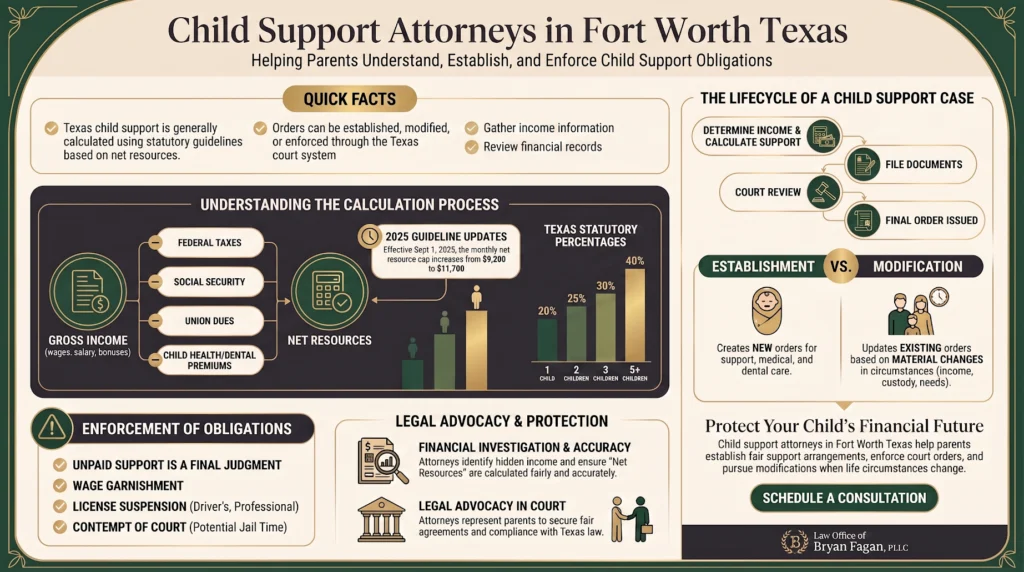
In Texas, guideline child support is a percentage of the paying parent’s monthly net resources under Family Code §154.125: 20% for one child, 25% for two, 30% for three, 35% for four, and 40% for five. As of September 1, 2025, the guideline applies to the first $11,700 of net resources, up from $9,200. Net resources are income minus specific allowed deductions, not gross pay.
Key Takeaways
- Support is a percentage of net resources. Under §154.125, guideline support is 20/25/30/35/40% of the paying parent’s monthly net resources for one through five children .
- The cap rose to $11,700 on September 1, 2025. The guideline percentage applies to the first $11,700 of monthly net resources, up from the old $9,200 .
- Net resources are not gross pay. Under §154.062, you start with nearly all income and subtract only specific allowed deductions to reach the figure the percentage applies to.
- The guideline is a starting point, not a ceiling. Courts can order above-guideline support for a child’s proven needs (§154.126) or deviate from the guideline in either direction (§154.123).
- 50/50 time does not automatically eliminate support. Possession time is a factor, but equal time does not zero out a support obligation by itself.
- Orders can be modified. Under §156.401, you need a material and substantial change, or a three-year and 20%/$100 review trigger ; the 2025 cap increase does not change an existing order automatically.
- Support is enforceable. Unpaid support can be pursued through wage withholding, contempt, license suspension, and liens.

Your Family’s Future Starts Here
Don’t navigate your legal journey alone. Schedule a consultation now and get the clarity and support you deserve.
Our office is available 24/7. Do not hesitate to schedule your free case evaluation by calling 817-406-7230 or contacting us online today.
How Child Support Is Calculated in Texas

Child Support Attorneys in Fort Worth Texas frequently explain that Texas child support is based on a legal formula, not a judge’s personal opinion. Under Texas Family Code §154.125, guideline child support is generally calculated as a percentage of the paying parent’s monthly net resources. The percentage depends on the number of children before the court: 20% for one child, 25% for two, 30% for three, 35% for four, and 40% for five children, with at least the five-child percentage applying when six or more children are involved. Understanding this framework early helps parents make informed decisions and reduces much of the uncertainty surrounding the process.
Unlike many states that combine both parents’ incomes, Texas follows a percentage-of-the-payer model. The court determines the paying parent’s monthly net resources, applies the appropriate statutory percentage, and arrives at the presumptive guideline amount. While that figure is presumed to be appropriate, it is not automatic in every case. The court may consider additional factors when the guideline amount would not adequately serve the child’s best interests, making accurate financial information essential from the beginning.
Calculating net resources is often more involved than reviewing a paycheck. Wages, overtime, bonuses, commissions, self-employment income, rental income, and other earnings may all be considered, while only certain deductions are allowed under Texas law. In straightforward cases, applying the formula may be relatively simple. In more complex situations—such as when income varies significantly, a parent owns a business, or multiple child support obligations exist—a detailed review of the financial evidence can have a meaningful impact on the final support order.
Whether you have lived in Fort Worth for years or are planning a move to Fort Worth while navigating a family law matter, understanding how Texas calculates child support can help you approach the process with greater confidence. Knowing how the guidelines work—and when exceptions may apply—allows parents to focus less on uncertainty and more on creating financial stability for their children.
What Counts as Net Resources
Net resources is the income figure the guideline percentage is applied to, and under §154.062 it is not the same as gross pay. You begin with nearly all income and subtract only specific, limited deductions to arrive at net resources.
Income counted includes wages, salary, overtime, commissions, bonuses, self-employment income, rental income, interest, dividends, and most other recurring income. A few things are excluded, most notably means-tested public assistance like TANF, SSI, and SNAP. From that income, Texas allows only certain deductions to reach net resources: federal income tax (calculated as a single person taking the standard deduction), Social Security and Medicare taxes or mandatory retirement contributions, union dues, and the cost of the child’s health and dental insurance. Notably, Texas does not let a parent deduct things like 401(k) contributions, credit card debt, or ordinary living expenses. Getting net resources right matters enormously, because an error in the income figure or a missed allowable deduction changes the support number every month for years. This is one of the most common places I see people go wrong when they try to calculate support on their own.
The reassuring part: because Texas support runs on a formula, it is predictable. Once we know your net resources and the number of children, we can estimate your guideline number early and talk honestly about whether a deviation applies. You do not have to sit in fear of an unknown figure; the law gives us a starting point we can actually calculate together.
The Child Support Cap and High Earners
Texas caps the amount of net resources the guideline percentage is applied to. As of September 1, 2025, that cap is $11,700 of monthly net resources, raised from the $9,200 figure that had been in place since 2019 .
Here is what the cap actually means, because it is widely misunderstood: it limits the RESOURCES the percentage applies to, not the total support a court can order. If a paying parent’s net resources are at or above $11,700, the guideline percentage is applied to the first $11,700, producing the maximum guideline amount . But under §154.126, when a parent earns above the cap, a court can still order additional support above the guideline based on the child’s proven needs, such as documented private school, medical, or special-needs costs. The 2025 increase matters most for higher earners: a parent whose net resources exceed the old $9,200 cap may now see the guideline applied to a larger base. Importantly, the cap increase does not change existing orders automatically. An order set under the old cap stays as it is unless a parent files to modify it, which I discuss below.
The Guideline Table
The table below shows the guideline percentage for each number of children and the maximum guideline support at the current $11,700 cap. These maximums assume the paying parent’s net resources are at or above the cap; for most parents, the percentage applies to their actual net resources, which are lower.
The guideline percentages have not changed. What changed on September 1, 2025 is the cap on net resources, which rose from $9,200 to $11,700; the new maximums apply to orders finalized on or after that date.
Strategy note: the single biggest lever in most child support cases is the accuracy of net resources. Gather your pay records, tax returns, and proof of the allowable deductions before anyone runs a number, and if you are self-employed or have bonus or variable income, expect that figure to be contested. Getting the income right, and documenting the child’s real medical and care costs, does more for the outcome than anything else.
When Support Differs From the Guideline

Child Support Attorneys in Fort Worth Texas often explain that the guideline amount is the starting point—not necessarily the final answer. Although Texas Family Code §154.123 presumes the guideline calculation is appropriate, a judge may order a higher or lower amount when applying the standard formula would be unjust or inappropriate. To make that decision, the court considers factors such as the child’s unique needs, each parent’s financial resources, parenting time, and whether either parent has legal responsibilities to support other children.
Several situations frequently lead to a different result than the standard guideline calculation. One involves lower-income parents. Under Texas Family Code §154.125(c), when the paying parent’s monthly net resources fall below a statutory threshold, a reduced percentage schedule may apply so that support remains realistic while still meeting the child’s basic needs. Another common situation involves parents who support children in more than one household. Under Texas Family Code §§154.128 and 154.129, the guideline percentages may be adjusted to fairly account for those additional legal obligations rather than treating every case the same.
Higher-income cases present another important exception. When a parent’s monthly net resources exceed the statutory cap, Texas Family Code §154.126 allows the court to order support above the guideline amount if there is evidence of the child’s proven needs. Expenses such as ongoing medical care, specialized educational services, or other documented costs may justify additional support. In straightforward cases, the guideline formula often produces an appropriate result. In more complex situations involving disputed income, multiple households, self-employment, or requests for above-guideline support, the outcome frequently depends on the quality of the financial evidence presented to the court.
Because every family’s circumstances are different, understanding why the guideline may or may not apply helps parents approach negotiations and court proceedings with realistic expectations. Whether you’re traveling to hearings at the Tarrant County Family Law Center or learning more about transportation in Fort Worth to make parenting exchanges and court appearances easier, thoughtful planning can reduce stress while keeping the focus where it belongs—on providing long-term stability for your child.
Our Fort Worth Office
The Law Office of Bryan Fagan, PLLC
204 W Central Ave, Fort Worth, TX 76164
Serving Fort Worth, Tarrant County, and clients across Texas.
Call 281-810-9760Medical and Dental Support
Child support in Texas is not only the base cash amount. A Texas support order also addresses medical and dental support, meaning the order must provide for the child’s health and dental insurance coverage in addition to the guideline payment.
In practice, the court decides who provides the child’s health and dental insurance and how the cost is handled, and the premium the paying parent covers for the child is one of the allowable deductions in the net-resources calculation. Uninsured medical expenses are typically split between the parents. This is an easy piece to overlook when people focus only on the monthly cash figure, but it is a required part of a Texas order and a real cost, so it belongs in the conversation from the start. We make sure the medical and dental support piece is set up correctly, not left vague, because vague medical-support terms are a common source of later disputes.
Does 50/50 Custody Eliminate Support?
No. This is one of the most common misconceptions I hear. Even with an equal, 50/50 possession schedule, Texas courts do not automatically eliminate child support.
Possession time is one factor a court can weigh under §154.123 when deciding whether to deviate from the guideline, and an equal schedule can be part of an argument for a different number. But equal time does not zero out support by itself, especially when the parents earn very different incomes, because the purpose of support is to keep the child’s standard of living consistent across both homes. A higher-earning parent may still owe support even in a 50/50 arrangement. If you are negotiating an equal possession schedule and assuming it cancels support, get advice first, because that assumption is often wrong and can derail an agreement.
Listen to Our Texas Family Law Podcast
Prefer listening? In this episode, we explain how child support works in Texas for Fort Worth families, including how payments are calculated, what factors courts consider, and what parents should know about enforcement and modification.
Warning: do not stop paying, or stop enforcing, a valid child support order on your own. If money is tight, the answer is to file for a modification, not to quietly underpay, because unpaid support becomes a judgment that does not go away and accrues interest. Texas enforces support aggressively through wage withholding, contempt, license suspension, and liens. Self-help on either side almost always makes the situation worse; the court is where support gets changed or collected.
Modifying Child Support

Child Support Attorneys in Fort Worth Texas regularly remind parents that a child support order is not meant to remain frozen if life changes in a meaningful way. Under Texas Family Code §156.401, a court may modify an existing child support order when there has been a material and substantial change in circumstances or when at least three years have passed since the order was established or last modified and the guideline calculation would change by at least 20% or $100. Understanding when a modification is available can help parents protect both their financial stability and their child’s ongoing needs.
A material and substantial change can take many forms. Common examples include losing a job, receiving a significant increase in income, changes in the cost of a child’s medical care or education, or a change in the number of children a parent is legally obligated to support. In straightforward cases, updated financial records may clearly show that a modification is appropriate. In more complex situations—such as disputed income, self-employment, or high-income child support cases—the court may need additional evidence before deciding whether the existing order should be changed.
Parents should also understand that not every legal change happens automatically. For example, the increase in the Texas child support guideline cap that became effective on September 1, 2025, does not automatically increase or decrease existing support orders. A parent who believes the new guideline would affect their obligation must ask the court to modify the order. Likewise, a parent whose income has decreased cannot simply pay less without court approval, because the existing order remains fully enforceable until it is legally changed.
Timing is another factor that many parents overlook. In most cases, a modified child support obligation becomes effective from the date the modification request is filed and the other parent is properly served—not from the date the underlying life change occurred. Acting promptly after a significant change in circumstances can help prevent unnecessary arrearages or missed financial support. If you’re preparing for a consultation about a modification, reviewing our Plan Your Visit to Our Fort Worth Office guide can help you know what to expect before you arrive, allowing you to focus on the financial information and documentation that will be most important to your case.
Enforcing Child Support
When a parent does not pay court-ordered support, Texas provides strong enforcement tools. Unpaid support can be collected through wage withholding, contempt of court, suspension of driver’s and professional licenses, liens on property, and interception of tax refunds.
Most Texas support is already collected through an income withholding order sent to the paying parent’s employer, but when payments fall behind, a motion to enforce brings the issue back to court. Unpaid support becomes arrears that accrue interest and can be reduced to a judgment, and it generally cannot be wiped out in bankruptcy. It is worth understanding the role of the Texas Attorney General’s Child Support Division, the Title IV-D agency, whose Tarrant County office handles many support cases. The OAG can establish, modify, and enforce support, but it represents the State’s interest in the child being supported, not either parent personally. If you want an advocate for your individual position, whether you are owed support or facing an enforcement action, that is where private counsel comes in. We handle both sides: collecting what your child is owed, and responding when an enforcement motion is filed against you.
Child Support Practice in Tarrant County
Child Support Attorneys in Fort Worth Texas know that where your case is filed can influence how it moves through the legal system, even though the child support laws themselves apply statewide. Most Fort Worth child support matters are handled in the Tarrant County family district courts, while many establishment, modification, and enforcement cases involving Title IV-D services are administered through the Texas Attorney General’s Child Support Division. Understanding which court or agency is involved helps parents know what to expect, what documents may be required, and how the process typically unfolds.
The Tarrant County Family Law Center, located in downtown Fort Worth, serves as the primary courthouse for many family law proceedings. Depending on the nature of your case, you may also interact with the Office of the Attorney General or the Tarrant County Domestic Relations Office, both of which provide services related to child support. While these agencies play important roles in establishing and enforcing support obligations, they do not represent either parent individually. Their responsibility is to administer the child support system in accordance with Texas law.
In straightforward cases where income and parenting arrangements are largely undisputed, the process may move efficiently through the court system. In more complex situations—such as contested net resources, requests for child support modification, enforcement actions, or disputes involving self-employment income or multiple households—local court procedures and judicial practices can have a meaningful impact on how a case progresses. Familiarity with the Tarrant County courts, filing requirements, and procedural rules can help parents avoid unnecessary delays and prepare more effectively for each stage of the case.
Because local procedures can change over time, it is also important to understand the governmental offices and resources available to families throughout the process. Our guide to governmental resources in Fort Worth provides helpful information about the agencies and public services that many parents encounter while navigating a child support or family law matter. Knowing how these resources fit into your case can make an already challenging process more manageable while keeping the focus on protecting your child’s long-term stability.
Nearby Counties Where Practice Differs

Child Support Attorneys in Fort Worth Texas often explain that while the child support formula is consistent throughout the state, the way a case moves through the court system can vary depending on where it is filed. Jurisdiction is typically determined by where the child lives or where an existing child support order was entered, meaning the correct county matters from the very beginning. Although Texas Family Code provisions governing child support apply statewide, each county has its own court schedules, filing procedures, and local practices that can influence how quickly a case progresses.
For many families, Tarrant County is the proper venue, but child support matters may also involve Dallas, Denton, Parker, or Johnson County depending on where the parents or children reside or where a prior order exists. In straightforward cases, filing in the correct court helps keep the process efficient and avoids unnecessary procedural issues. In more complex situations—such as modifications after a move, interstate child support under UIFSA, or enforcement of an existing order across county lines—understanding which court has continuing jurisdiction becomes even more important.
Each county’s family courts and Office of the Attorney General Child Support Division operate under the same Texas statutes while following their own local procedures and docket management practices. Having an attorney who regularly appears in multiple North Texas family courts can help parents understand local expectations, prepare the appropriate financial documentation, and navigate issues involving net resources, child support modifications, and enforcement actions with greater confidence.
Whether your case remains in Tarrant County or extends into a neighboring jurisdiction, knowing where your case belongs is an important first step toward protecting your child’s financial future. If you’re ready to discuss your circumstances with our Fort Worth team, you can schedule a consultation at our Fort Worth office to receive guidance tailored to your family’s specific needs and the court handling your case.
Child Support at a Glance
“Child support is a formula, not a mystery. The number that matters is your net resources, and getting that figure right is most of the battle.”
The Child Support Process, Stage by Stage
Here is how a Fort Worth child support matter moves, from setting the first order through modification and enforcement. Tap any stage to see what happens, how long it takes, and what to do.
From First Order to Enforcement, Stage by Stage
Tap any stage to expand what happens, how long it takes, and what to do. For a rough self-serve estimate of your own number, the Texas Attorney General publishes an official online calculator.
Stage 1 — Establish the Order (Calculate Net Resources)
Support starts by determining the paying parent’s net resources under §154.062: nearly all income, minus specific allowed deductions like federal income tax, Social Security or Medicare, union dues, and the child’s health and dental insurance. This net figure is the base the guideline percentage is applied to. Accuracy here drives everything that follows.
Typical timing: at the start of the support case, divorce, or SAPCR.
What to do: gather pay stubs, tax returns, and proof of allowable deductions before any number is run.
Stage 2 — Apply the Guideline (Percentage + Cap)
The guideline percentage for the number of children (20% for one, up to 40% for five) is applied to net resources under §154.125, up to the cap. As of September 1, 2025 the guideline applies to the first $11,700 of net resources. Above the cap, a court can order more for the child’s proven needs under §154.126.
Typical timing: once net resources are set.
What to do: check whether your net resources are near the cap and whether a deviation or low-income schedule applies.
Stage 3 — Add Medical & Dental Support
A Texas order also provides for the child’s medical and dental coverage in addition to the base cash amount. The court decides who carries the insurance and how the cost is allocated, and how uninsured medical expenses are split between the parents.
Typical timing: set at the same time as the base order.
What to do: confirm the medical and dental terms are specific, not vague, to avoid later disputes.
Stage 4 — Modify When Circumstances Change
Under §156.401, support can change with a material and substantial change in circumstances, or through a three-year review when the amount would change by 20% or $100. The September 1, 2025 cap increase does not update existing orders automatically; a parent must file to modify.
Typical timing: any time circumstances change after the order.
What to do: file promptly; a change generally runs from the date of filing and service, not from when your situation changed.
Stage 5 — Enforce If Unpaid
When support goes unpaid, a motion to enforce brings it back to court. Texas tools include wage withholding, contempt, license suspension, liens, and tax-refund interception. Arrears accrue interest and can be reduced to a judgment. The Attorney General can enforce, but represents the State’s interest, not either parent personally.
Typical timing: any time payments fall behind.
What to do: document every missed payment with dates and amounts before filing.
Wherever you are in the process, the next step is getting your numbers right.
Call 281-810-9760Let’s get your net resources right and see what your real number looks like.
Schedule a Confidential ConsultationYour Fort Worth Attorney
Child support matters out of our Fort Worth office are handled by Senior Attorney Bryan Bubis, who represents parents in establishing, modifying, and enforcing support in the Tarrant, Johnson, and Parker county family courts. When you call about a support case in Tarrant County, Bryan Bubis and our Fort Worth team are who you will work with.
Bryan Bubis — Senior Attorney, Fort Worth
15+ Years Family Law · Tarrant, Johnson & Parker County Courts
Bryan Bubis brings more than 15 years of family law experience to child support cases, from establishing an initial order to modifying support after an income change to enforcing an order when payments stop. He is focused on getting the net-resources figure right, applying the current guidelines and cap correctly, and giving parents a realistic, steady read on what to expect rather than an inflated promise.
Bryan represents parents in the Tarrant, Johnson, and Parker county family courts. He works these cases the way I do: pin down the income accurately, handle the exceptions and medical support properly, resolve by agreement where the numbers allow, and litigate when the other side’s figures do not hold up. Read Bryan Bubis’s full profile.
What I Tell Every Parent Worried About Child Support

The first thing I tell them is that the number is knowable. Child support in Texas is not a judge picking a figure out of the air; it is a percentage of net resources, capped at the first $11,700 as of September 1, 2025. Once we pin down your net resources and the number of children, we can get very close to the guideline figure, and most of the fear comes from not knowing that number yet.
The second thing I tell them is that the inputs are everything. The whole case usually turns on net resources, whether income is being understated or overstated, whether the allowable deductions are handled correctly, and whether an exception like the low-income schedule, a multiple-household adjustment, or above-guideline needs applies. That is where a careful attorney earns their fee, because a mistake in the income figure follows you every month for years.
And the third thing is that support is not set in stone, and it is not optional. If your circumstances change, you modify it through the court, not by quietly paying less. If you are owed support, it is enforceable with real tools. Whether you are establishing an order, modifying one after the cap change or an income shift, or enforcing one, call 281-810-9760 or book a Legal Strategy Session with our Fort Worth office, and let’s get your number right.
What to Do About Child Support in Fort Worth
- Gather your income documents: recent pay stubs, last year’s tax return, and records of bonuses or self-employment income.
- Understand that the calculation uses net resources, not gross pay, and identify your allowable deductions.
- Note the number of children before the court, since the percentage depends on it.
- Check whether your net resources are near or above the $11,700 cap, which changes the analysis for higher earners.
- If you have an older order, consider whether the 2025 cap increase or a change in circumstances supports a modification.
- Do not stop paying under a valid order; file for a modification instead if you cannot afford the current amount.
- Keep proof of the child’s medical and dental insurance costs and any uninsured expenses.
- If support is unpaid, document every missed payment with dates and amounts for an enforcement action.
- Decide whether the Attorney General’s office or private counsel fits your situation, remembering the OAG does not represent you personally.
- Book a Legal Strategy Session with our Fort Worth office to get your numbers right and a plan in place.
Bring your income documents to a Legal Strategy Session and we’ll work out your real number together.
Schedule Your ConsultationGet Your Number Right
Child support runs on a formula. Let’s make sure yours is calculated correctly.
Call 281-810-9760 TodayConclusion:
Divorce may change the structure of your family, but it does not have to change your child’s opportunity to thrive. Understanding how Texas child support laws work—and how they fit alongside thoughtful parenting arrangements—allows you to make decisions that provide stability today while protecting your child’s future. If you’re researching Child Support Attorneys in Fort Worth Texas, remember that the right legal strategy depends on more than simply calculating a support payment. In straightforward situations, parents may simply need guidance to establish, modify, or enforce a child support order correctly. In more complex cases, such as disputes involving self-employment income, high-income earners, contested financial records, interstate issues, or requests to deviate from the guideline amount, experienced legal representation can make a meaningful difference in both the process and the outcome.
At the Law Office of Bryan Fagan, PLLC, we believe families make stronger decisions when they understand their options. Our goal is to provide clear answers, practical guidance, and legal strategies tailored to your family’s unique circumstances so you can move forward with confidence rather than uncertainty. Whether you’re preparing for your first child support case or navigating a complicated modification or enforcement matter, our team is here to help you understand the law, evaluate your options, and develop a plan that protects what matters most—your children and their future.
About the Author
Bryan Fagan
Founder & Managing Attorney · Serving Texas families since 2012
I am Bryan Fagan, founder and managing attorney of The Law Office of Bryan Fagan, PLLC, one of the largest family law firms in Texas. I hold a Juris Doctor from South Texas College of Law and an undergraduate degree in business and finance, and I lead a team of more than 170 legal professionals with offices across the state. In child support cases, my aim is to make the numbers clear and make sure they are calculated correctly.
I am also the author of several family law guides, including The Texas Divorce Handbook, because I believe parents make better decisions when they understand the process. Out of our Fort Worth office, our team helps parents establish, modify, and enforce child support in the Tarrant County family courts. If you have a question about child support, I would like to help. Read more about Bryan Fagan.
Questions Parents Ask About Child Support in Fort Worth
Texas calculates guideline child support as a percentage of the paying parent’s monthly net resources under Family Code §154.125. The percentages are 20% for one child, 25% for two, 30% for three, 35% for four, and 40% for five. Net resources means income minus specific allowed deductions, and the percentage applies to the first $11,700 of net resources as of September 1, 2025.
For one child, guideline support is 20% of the paying parent’s monthly net resources. Because the guideline applies to the first $11,700 of net resources as of September 1, 2025, the maximum guideline amount for one child is about $2,340 per month. For a parent earning below the cap, it is 20% of their actual net resources, so the real figure is usually lower.
The maximum guideline support is the guideline percentage applied to the $11,700 cap that took effect September 1, 2025. That is roughly $2,340 for one child, $2,925 for two, $3,510 for three, $4,095 for four, and $4,680 for five. A court can still order above-guideline support beyond these amounts when a higher-earning parent’s child has proven needs under §154.126.
Under §154.062, net resources include wages, salary, overtime, commissions, bonuses, self-employment income, rental income, and most other income, minus specific allowed deductions: federal income tax, Social Security and Medicare taxes, union dues, and the child’s health and dental insurance. It excludes means-tested aid like TANF, SSI, and SNAP. Net resources are not the same as gross pay.
Yes. Effective September 1, 2025, the cap on monthly net resources that the guideline percentage applies to rose from $9,200 to $11,700, the first increase since 2019. The percentages did not change. The new cap applies to orders finalized on or after that date; existing orders do not update automatically, so a parent must file a modification to apply the new cap.
No. An equal possession schedule does not automatically eliminate child support in Texas. Possession time is a factor a court can consider in deciding whether to deviate from the guideline under §154.123, but it does not zero out support by itself. When parents earn very different incomes, a higher-earning parent may still owe support even under a 50/50 schedule, to keep the child’s standard of living consistent.
You file a modification under §156.401. You must show a material and substantial change in circumstances, such as a job loss or income drop, or that it has been three years since the order and the guideline amount would change by at least 20% or $100. Do not simply stop paying; unpaid support becomes an enforceable judgment. File promptly, because a reduction generally starts from the filing date.
Unpaid support is collected by filing a motion to enforce. Texas tools include wage withholding, contempt of court, suspension of driver’s and professional licenses, liens on property, and tax-refund interception. Unpaid support becomes arrears that accrue interest and can be reduced to a judgment. The Attorney General’s Child Support Division can help enforce, or a private attorney can pursue enforcement focused on your individual situation.
Child support in Texas generally continues until the child turns 18 or graduates from high school, whichever is later. Support can continue indefinitely for a child who is disabled and unable to support themselves, under a separate provision. Support does not end automatically just because a child turns 18 mid-year; it typically runs through high school graduation. Confirm the end date in your specific order.
Yes. When a paying parent’s net resources exceed the $11,700 cap, a court can order above-guideline support under §154.126 based on the child’s proven needs, such as documented private school, medical, or special-needs costs. The parent seeking more than the guideline must present real evidence of those needs. Courts can also deviate upward under §154.123 when applying the standard guideline would be unjust or inappropriate.
Yes, until the order is changed. A support obligation stays in force until a court modifies it, so losing your job does not automatically reduce what you owe, and arrears build up in the meantime. The right step is to file a modification quickly under §156.401, because a reduction generally applies from the date you file and serve, not from the date you lost the job.
Whether you’re setting support, changing it, or collecting it, the sooner we look at the numbers the better.
Call 281-810-9760