
Grandparents Rights Attorneys in Fort Worth Texas Help Families Understand Their Options

Being cut off from a grandchild is one of the most painful experiences a family can endure. Whether a son or daughter’s divorce, a custody dispute, a family disagreement, or an unexpected tragedy has left you feeling shut out, it is natural to ask whether there is any legal path to rebuilding that relationship. Grandparents Rights Attorneys in Fort Worth Texas help families understand where they truly stand under Texas law, providing honest answers, practical guidance, and compassionate support during an incredibly emotional time.
The reality is that Texas does not automatically grant grandparents the right to visitation or custody. Instead, the law begins with a strong constitutional presumption that fit parents act in their children’s best interests. While there are limited circumstances in which grandparents may ask a court to intervene, those cases must satisfy specific requirements established by the Texas Family Code and interpreted by Texas courts. Understanding those legal standards—and how they apply to your family’s unique circumstances—is the first step toward making informed decisions rather than acting on false hope or misinformation.
At The Law Office of Bryan Fagan, PLLC, we believe that knowledge empowers families to move forward with greater confidence and peace of mind. Founded by Bryan Joseph Fagan, a graduate of South Texas College of Law and a recognized authority on Texas divorce and custody law, our firm has spent years helping families navigate complex legal challenges with integrity, compassion, and clear legal guidance. In this article, you’ll learn when grandparents may have legal standing, how Texas courts evaluate grandparent visitation and conservatorship requests, what evidence can strengthen a case, and how experienced family law attorneys can help protect the relationships that matter most while always keeping the child’s best interests at the center of every decision.
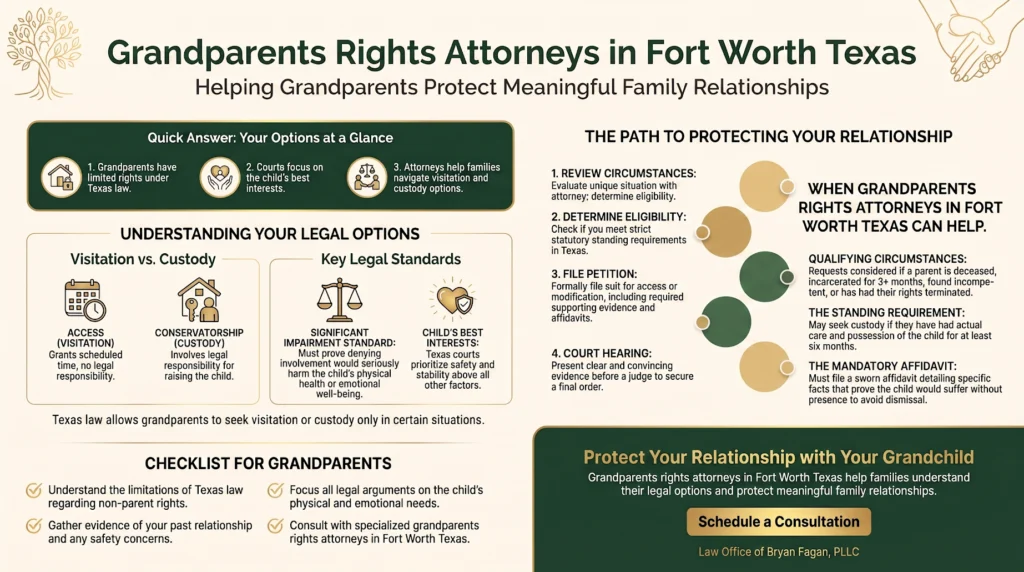
Grandparents do not have automatic rights in Texas. A grandparent may petition a court for possession of or access to a grandchild, but must overcome the legal presumption that a fit parent acts in the child’s best interest — by proving that denying access would significantly impair the child’s physical health or emotional well-being (Texas Family Code §153.433).
Key Takeaways
- Grandparents have no automatic right to visitation or custody in Texas.
- The law presumes a fit parent acts in the child’s best interest — a presumption grounded in the U.S. Constitution.
- To win access under §153.433, a grandparent must prove denial would significantly impair the child’s physical health or emotional well-being.
- A mandatory affidavit must accompany the suit; the court dismisses it unless those facts, if true, would justify relief (§153.432).
- Access is only available in specific situations — for example, when a parent is deceased, incarcerated, or found incompetent.
- Grandparent custody (conservatorship) is a separate and even higher bar.

Your Family’s Future Starts Here
Don’t navigate your legal journey alone. Schedule a consultation now and get the clarity and support you deserve.
Our office is available 24/7. Do not hesitate to schedule your free case evaluation by calling 817-406-7230 or contacting us online today.
What “Grandparent’s Rights” Really Means in Texas

Texas law does not give grandparents automatic visitation or custody rights. Instead, it provides a limited legal process that allows certain grandparents to ask a court for visitation (called possession or access) or, in rare cases, conservatorship. Because parents have a constitutionally protected right to make decisions for their children, grandparents must meet specific requirements under Texas Family Code §153.433 before a court can intervene.
The phrase “grandparent’s rights” can therefore be misleading. Most cases involve grandparent visitation, which allows court-ordered time with a grandchild but does not give grandparents the authority to make parenting decisions. Grandparent conservatorship, often referred to as custody, is a separate and much more demanding legal action that generally applies only when a child’s current living situation places their physical or emotional well-being at risk. In every case, Texas courts begin with the presumption that a fit parent’s decisions are in the child’s best interests, a principle reinforced by the U.S. Supreme Court’s decision in Troxel v. Granville.
A grandparent may seek access by filing an original SAPCR (Suit Affecting the Parent-Child Relationship) or by requesting visitation in an existing custody case through a modification proceeding. Regardless of the procedure, the same legal standard applies, and grandparents must establish both standing and the statutory grounds required by Texas law. In more complex situations—such as when CPS is involved, a parent has died, or multiple custody proceedings overlap—the legal analysis becomes significantly more detailed.
There are also important legal limits. If a child has been adopted by someone other than a stepparent, or if the parental rights of the grandparent’s child have been terminated, the ability to seek grandparent visitation generally ends because Texas recognizes the adoptive family as the child’s new legal family. Families facing these or other complicated circumstances often benefit from addressing related legal planning as well, particularly when aging family members may experience diminished capacity. Our guide to Incapacity Planning Attorneys in Houston Heights Texas explains how proactive planning can help protect loved ones and preserve important family relationships.
At The Law Office of Bryan Fagan, PLLC, we believe families deserve honest answers before deciding whether to pursue litigation. Our goal is to explain what Texas law actually allows, help you understand where your situation fits within the law, and develop a thoughtful strategy that protects both your family’s future and the child’s best interests.
Do Grandparents Have Rights in Texas?
Not automatically — and this is the point most families are surprised by. In Texas, a parent has a fundamental, constitutionally protected right to make decisions about who spends time with their child, including whether the grandparents do. The U.S. Supreme Court confirmed this in Troxel v. Granville, and Texas courts have applied it firmly ever since. When a fit parent decides to limit a grandparent’s contact, the law presumes that decision is in the child’s best interest.
That does not mean a grandparent is powerless — it means a grandparent starts a step behind. To get anywhere, the grandparent must overcome that presumption. And critically, disagreeing with the parent’s decision is not enough; hurt feelings, even a genuinely loving bond, do not by themselves meet the legal standard. The grandparent has to show something more serious, which is where §153.433 comes in.
The honest reality: Texas grandparent access cases are difficult to win, by design. The law is built to protect a fit parent’s authority, so a grandparent and a parent do not walk into court on equal footing. That does not mean your case is hopeless — some situations clearly qualify — but you deserve a candid assessment of yours before investing in a fight, not a promise no lawyer can honestly make.
The Legal Standard for Grandparent Access (§153.433)
Texas Family Code §153.433 is the heart of a grandparent access case. A court may order reasonable possession of or access to a grandchild only if all of the following are true.
1. At least one parent still has parental rights
At the time access is requested, at least one biological or adoptive parent of the child must still have their parental rights intact — not terminated. If both parents’ rights have been terminated, or the child has been adopted (other than by a stepparent), the door to grandparent access generally closes.
2. Overcoming the fit-parent presumption
This is the hard part. The grandparent must overcome the presumption that a parent is acting in the child’s best interest by proving, by a preponderance of the evidence, that denying the grandparent access “would significantly impair the child’s physical health or emotional well-being.” That phrase is doing heavy lifting: it is a high standard, and courts do not treat it as satisfied merely because time with a loving grandparent would be good for the child. The grandparent must show that the absence of that access would cause significant harm.
What does “significant impairment” look like in practice? It is a serious threshold, not a general sense that the child would be better off with more family around. Courts have looked for something closer to real harm to the child’s health or development flowing from the loss of the relationship — for example, where a grandparent had served as a primary caregiver and the sudden severing of that bond would damage the child. A warm relationship, missed holidays, or a grandparent’s own grief at being shut out — painful as those are — generally do not meet the standard on their own. This gap between what feels unfair to a family and what the law will act on is the single most important thing for a grandparent to understand before filing.
3. The parent-child relationship qualifies
The grandparent must be the parent of a parent of the child — and that parent (the grandparent’s own child) must fall into one of specific categories: incarcerated during the three months before the petition is filed, found by a court to be incompetent, deceased, or without court-ordered possession of or access to the child. In other words, the law opens the door mainly where the connecting parent is, for a serious reason, out of the picture.
The Affidavit Requirement (§153.432)
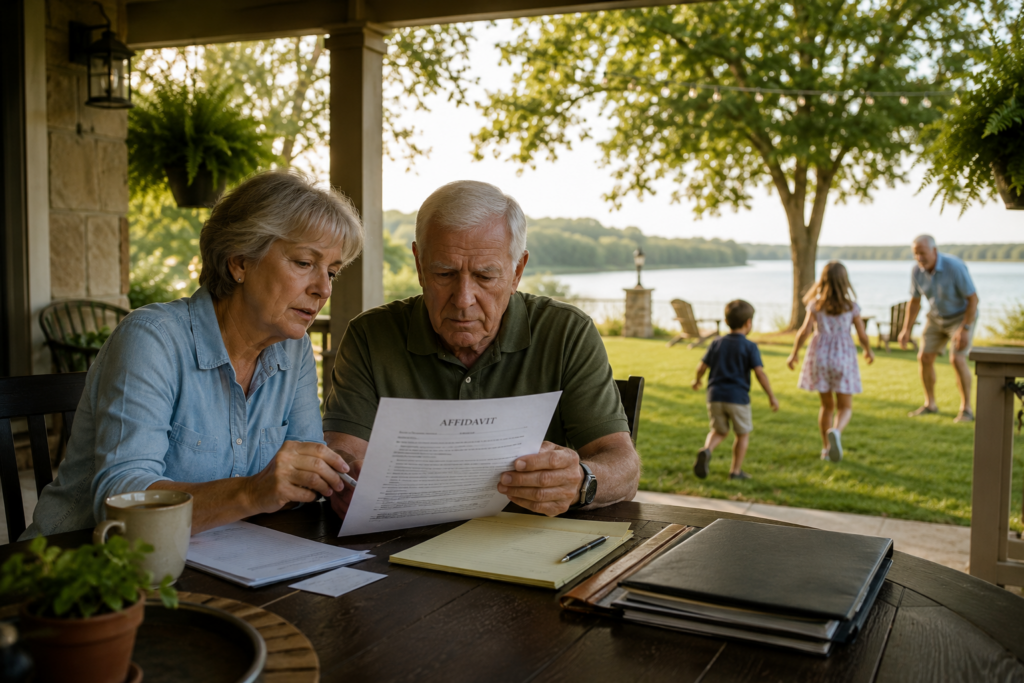
A grandparent seeking court-ordered access must file a sworn affidavit that states specific facts showing that denial of contact would significantly impair the child’s physical health or emotional well-being. This affidavit is a required screening document, not a routine formality. Grandparents Rights Attorneys in Fort Worth Texas use it to explain why the case should be allowed to move forward under Texas Family Code §§153.432 and 153.433.
The affidavit must describe facts based on the grandparent’s knowledge or reasonable belief. General statements such as “we have always been close” or “the child misses me” are usually not enough by themselves. Stronger allegations may involve a long history of daily caregiving, documented emotional decline after contact ended, or other facts directly connecting the loss of the relationship to serious harm.
The judge first reviews the affidavit without deciding the entire case. If the alleged facts, even when treated as true, would not satisfy the statutory standard, the court must deny the requested relief and dismiss the case. In practical terms, the affidavit acts as a gatekeeper by preventing grandparent access claims from proceeding without facts serious enough to overcome the legal presumption favoring a fit parent’s decisions.
In straightforward visitation matters, this may require carefully organizing school, medical, counseling, caregiving, and communication records. In more complex cases involving CPS, a deceased parent, an existing custody order, incapacity, or overlapping family disputes, the affidavit must fit within a broader legal strategy. Families managing responsibilities across generations may also benefit from reviewing our guidance for a Humble family business and farm lawyer when family property or a closely held business creates additional planning concerns.
A careful affidavit cannot guarantee that grandparent visitation will be granted, but a vague or unsupported affidavit can end the case before evidence is presented at a hearing. Our role is to help families understand that risk early, evaluate the facts honestly, and decide whether litigation, mediation, or another path offers the best chance to protect the child’s well-being and preserve important family relationships.
Listen to Our Texas Family Law Podcast
Prefer listening? In this episode, we explain grandparents’ rights in Texas for Fort Worth families, including when grandparents may seek visitation or custody, what legal limits apply, and what courts may consider in these cases.
When Grandparent Access Is Realistically Possible
Reading the standard, you can see the pattern in the situations where grandparents have the strongest footing. Access is most realistically available when the connecting parent — the grandparent’s own son or daughter — is absent for a serious reason: a parent who has died, leaving that side of the family cut off; a parent who is incarcerated; or a parent a court has found incompetent. These are the circumstances the statute specifically contemplates.
By contrast, the harder cases are the common, painful ones: a divorce where the custodial parent simply prefers to limit the other side’s family, or a family estrangement where both parents are present, fit, and united in their decision. In those situations, the fit-parent presumption is at its strongest, and a court is unlikely to override two capable parents. Knowing which category your situation falls into is the difference between a case worth pursuing and a heartache the courts cannot fix — and it is the first thing an honest consultation will tell you.
Common Misconceptions About Grandparent’s Rights
Grandparents often arrive with beliefs that, while understandable, do not match Texas law — and clearing them up early saves a great deal of heartache. A few come up again and again, and each one, left uncorrected, can send a family down the wrong road.
“I have a right to see my grandchild.” Not as a starting point. The right belongs to the fit parent to decide; the grandparent has only a conditional path to ask a court, in limited circumstances. “We were very close, so a court will step in.” A close bond helps paint the picture, but closeness alone does not meet the significant-impairment standard. “The parents are divorcing, so now I can get visitation.” A divorce between two fit parents usually does not open the door on its own; if a parent is still present and capable, that parent’s decisions remain protected. “If I’m denied, I can just keep going back to court.” A case that cannot clear the affidavit screen will be dismissed, and refiling the same weak facts does not change the standard. Understanding these realities is not discouragement for its own sake — it is what lets a grandparent focus energy where the law actually offers a path.
Access vs. Custody: Two Different Cases

Grandparent visitation and grandparent custody are two very different legal proceedings under Texas law. Grandparents Rights Attorneys in Fort Worth Texas help families understand whether they are seeking court-ordered access to maintain a relationship with a grandchild or pursuing conservatorship because a child’s safety and well-being require a more substantial legal intervention. Knowing that distinction at the beginning can help families choose the right legal strategy and avoid unnecessary delays.
Grandparent access, also called possession or visitation, allows a court to order time between a grandparent and grandchild without giving the grandparent parental decision-making authority. These cases are governed primarily by Texas Family Code §153.433, and the grandparent must overcome the strong legal presumption that a fit parent acts in the child’s best interests. By contrast, grandparent conservatorship (custody) involves obtaining legal rights and responsibilities over a child and generally requires a much higher showing under the Texas Family Code, often involving concerns about the child’s safety, neglect, abuse, or other extraordinary circumstances.
In straightforward visitation matters, the focus is usually on standing, the affidavit requirement, and whether denying contact would significantly impair the child’s physical health or emotional well-being. In more complex conservatorship cases, additional issues may arise, including CPS investigations, emergency custody requests, existing SAPCR proceedings, temporary orders, or whether the child has already been living with the grandparent. These cases often require a broader legal strategy because multiple areas of Texas family law may overlap.
If your situation extends beyond visitation and involves questions about who should make important decisions for a child, our Child Custody Attorneys in Fort Worth Texas resource explains how conservatorship, parenting rights, and custody determinations are handled under Texas law. You may also find additional guidance in our article discussing what rights grandparents have in Texas, which explores the legal standards governing grandparent visitation in greater detail. Together, these resources can help you better understand your options before deciding how to move forward.
Grandparent Cases in Fort Worth & Tarrant County
Texas grandparent visitation laws apply statewide, but every case is ultimately decided by the local court where it is filed. Grandparents Rights Attorneys in Fort Worth Texas understand not only the requirements of Texas Family Code §§153.432 and 153.433, but also how grandparent visitation and conservatorship cases move through the Tarrant County family courts. Because judges closely examine issues such as standing, the affidavit requirement, and whether denying contact would significantly impair a child’s physical health or emotional well-being, local experience can make a meaningful difference when evaluating whether litigation is appropriate.
In straightforward visitation matters, families often need guidance on whether they meet the legal requirements to seek possession or access. In more complex cases involving a deceased parent, CPS investigations, emergency custody, existing SAPCR proceedings, or multiple overlapping family law disputes, developing the right legal strategy becomes even more important. Before filing a lawsuit, we believe families deserve a realistic assessment of both the strengths and challenges of their case so they can make informed decisions rather than acting on emotion alone.
Not every grandparent dispute belongs in a courtroom. In some situations, family mediation or negotiated parenting arrangements may preserve important relationships more effectively than contested litigation. When court intervention is necessary, however, we carefully prepare the required affidavit, evaluate the available evidence, and develop a strategy tailored to the legal issues presented. For additional insight into how these issues arise in custody disputes throughout Texas, we encourage you to read our guide on assessing the legal rights of grandparents during child custody cases.
Grandparent visitation cases often overlap with divorce, child custody, child support, or conservatorship proceedings, making it important to view the family’s circumstances as a whole rather than as isolated legal issues. At The Law Office of Bryan Fagan, PLLC, our Fort Worth team coordinates every aspect of a family’s case to help ensure the legal strategy remains consistent from beginning to end. Whether your concerns involve maintaining a relationship with your grandchild or seeking conservatorship to protect a child’s well-being, our mission is to educate, guide, and empower you with honest advice rooted in Texas law.
When Court Isn’t the Best Path
Going to court is not always the best way to preserve a relationship with a grandchild. Grandparents Rights Attorneys in Fort Worth Texas often explain that while Texas law provides a legal pathway for grandparent visitation and conservatorship in limited circumstances, not every family conflict requires—or benefits from—litigation. In many situations, understanding what the law allows can help families choose a solution that protects both the child and important family relationships.
In straightforward visitation matters, family mediation or a negotiated parenting agreement may resolve the dispute more effectively than a courtroom battle. Mediation allows grandparents and parents to work with a neutral third party to discuss concerns, rebuild communication, and create practical visitation arrangements that everyone can support. Because these agreements are reached cooperatively rather than imposed by a judge, they often preserve trust and reduce future conflict.
In more complex conservatorship cases involving CPS investigations, allegations of abuse or neglect, emergency custody, or circumstances that may significantly impair a child’s physical health or emotional well-being, litigation may become necessary. Even then, the decision to file suit should follow a careful evaluation of the legal standards found in Texas Family Code §§153.432 and 153.433, along with the available evidence. A thoughtful legal strategy focuses not only on whether a case can be filed, but whether pursuing court intervention is likely to achieve a meaningful result for the child.
Choosing mediation instead of litigation does not mean giving up your legal rights. In fact, understanding the strengths and limitations of your case often gives families greater confidence during negotiations. When everyone understands how Texas courts evaluate grandparent visitation and conservatorship requests, discussions become more productive because expectations are grounded in the law rather than emotion. For additional insight into how Texas courts balance grandparents’ interests with parental rights, we encourage you to read our guide on Grandparents’ Rights in Texas.
At The Law Office of Bryan Fagan, PLLC, our mission is to help families choose the path most likely to protect a child’s best interests while preserving meaningful relationships whenever possible. Sometimes that path leads to litigation in the Tarrant County family courts, and sometimes it leads to mediation and cooperation outside the courtroom. Our role is to provide honest guidance, practical legal strategies, and the education families need to move forward with confidence and peace of mind.
How Our Firm Helps Fort Worth Grandparents

Knowing where you stand under Texas law before filing a lawsuit can save months of uncertainty and unnecessary expense. Grandparents Rights Attorneys in Fort Worth Texas begin every case by evaluating whether the facts satisfy the requirements of Texas Family Code §§153.432 and 153.433, including standing, the affidavit requirement, and whether the evidence could overcome the fit-parent presumption. Our goal is to give you an honest assessment—not false hope—so you can make informed decisions that protect both your family and your grandchild’s future.
Every grandparent’s situation is different, which means every legal strategy should be different. In straightforward grandparent visitation matters, we determine whether seeking court-ordered possession or access is a realistic option. In more complex cases involving conservatorship, CPS investigations, emergency custody, the death of a parent, or existing SAPCR proceedings, we develop a strategy tailored to the unique legal and factual issues before the Tarrant County family courts.
Your Legal Strategy Session is designed to answer the questions that matter most. After our intake team gathers the details of your situation, one of our attorneys reviews the facts, explains how Texas law applies, discusses the strengths and potential challenges of your case, and outlines practical next steps. Depending on your circumstances, that may include pursuing grandparent visitation, exploring mediation, seeking a modification of an existing order, or determining that litigation is unlikely to satisfy the statutory standard.
Some grandparent cases ultimately become child custody matters rather than visitation disputes. When questions arise about who should make decisions for a child or whether a grandparent may seek conservatorship, our Child Custody Attorneys in Fort Worth Texas resource explains how Texas courts evaluate custody and conservatorship issues. You can also learn more about how grandparents fit into custody proceedings by reading our guide to Grandparents’ Rights in Child Custody Cases in Texas. These resources help families better understand the legal landscape before deciding which path is right for them.
At The Law Office of Bryan Fagan, PLLC, we believe families deserve education before litigation and clarity before commitment. Since 2012, we have helped Texas families navigate difficult family law matters with compassionate guidance, practical legal strategies, and a commitment to protecting what matters most. Whether your case is relatively straightforward or legally complex, our mission remains the same: to empower you with the knowledge and confidence to move forward in your grandchild’s best interests.
Our Fort Worth Office
The Law Office of Bryan Fagan, PLLC
204 W Central Ave, Fort Worth, TX 76164 · Tarrant County
Open 24 hours
Call 817-406-7230How Grandparent’s Rights Work in Texas
Tap each stage to see how a Texas grandparent access case actually moves — and where the law places its highest hurdles. This is a general overview, not legal advice about any particular case. One theme runs through all of it: the law protects a fit parent’s decisions, so a grandparent must clear a high bar at every step. The value of understanding the sequence is knowing, early, whether your situation is one the law can realistically help with — before time and money go into a fight.
1 · Understand where you start — the presumption
Before anything else, know the ground you stand on. Texas law presumes a fit parent acts in the child’s best interest, and that presumption is constitutionally protected. A grandparent begins a step behind a parent, not on equal footing.
This is why an honest evaluation comes first: if both parents are present, fit, and united in limiting contact, the law strongly favors their decision, and that shapes whether a case is realistic at all.
2 · Confirm you fit the statutory circumstances — §153.433
Access is available only in specific situations: at least one parent must still have parental rights, and the connecting parent (your own child) must be deceased, incarcerated, found incompetent, or without court-ordered access to the child.
If your situation does not fit one of these, the case usually cannot proceed — which is important to learn early, before investing in litigation.
3 · Prepare the required affidavit — §153.432
A grandparent suit must include a sworn affidavit with supporting facts showing that denial of access would significantly impair the child’s physical health or emotional well-being. The court dismisses the case unless those facts, if true, would support relief.
This is a genuine screening step, not a formality — the facts have to be serious and specific, which is why careful preparation matters.
4 · Meet the burden in court — significant impairment
If the case proceeds, the grandparent must prove, by a preponderance of the evidence, that denying access would significantly impair the child’s physical health or emotional well-being. A loving bond alone is not enough; the harm from absence is what the court weighs.
This is the highest hurdle, and it is where realistic expectations and strong evidence matter most. Courts look for concrete indications of harm to the child — not the grandparent’s loss, and not a general belief that more family time would be positive. Evidence about the child’s history, needs, and the role the grandparent actually played tends to carry more weight than sentiment.
5 · Consider alternatives to litigation
Court is not the only route, and often not the best one. Family mediation or a negotiated arrangement can sometimes rebuild contact without the cost and conflict of a lawsuit — and without hardening positions between people who still have to share a family.
A good attorney will tell you honestly when a negotiated path is more promising than a court fight. For many grandparents, a restored relationship achieved through agreement is both more durable and less damaging than a court order won over a parent’s objection — and it keeps the door open for the years ahead.
Every family’s situation is different, and this overview is not legal advice about a specific case. To understand how these steps apply to you, speak with a Fort Worth attorney who handles grandparent cases — and ask for an honest assessment first.
Worried about losing contact with a grandchild?
A Legal Strategy Session gives you an honest read on where you stand under Texas law — before you decide anything.
Schedule a Legal Strategy Sessionor call 281-810-9760
Your Fort Worth Attorney
Bryan Bubis — Associate Attorney, Fort Worth
13 Years of Legal Experience · Tarrant, Johnson & Parker County Courts
Bryan Bubis brings 13 years of legal experience across family law, criminal defense, and probate to sensitive family matters, including grandparent access and conservatorship cases. Because these cases turn on careful evaluation of the facts against a demanding legal standard, he brings a measured, realistic perspective — helping grandparents understand not just what they want, but what the law can actually deliver. He earned his Bachelor’s in Business Management from Texas A&M University and his Juris Doctor from Texas A&M School of Law.
Bryan works with clients in the Tarrant, Johnson, and Parker county courts, and he can meet with you at the firm’s Fort Worth office. Read Bryan Bubis’s full profile.
What I Tell Every Grandparent Who Calls

The first thing I tell every caller is that they deserve honest answers, not unrealistic promises. Grandparents Rights Attorneys in Fort Worth Texas know these cases are deeply personal, and Texas law intentionally sets a high standard before a court will interfere with a fit parent’s decisions. That is why we begin by comparing your specific facts to the requirements of Texas Family Code §153.433, rather than encouraging litigation that may not have a legal foundation.
The second thing I explain is that the details of your family situation matter more than most people realize. In straightforward grandparent visitation matters, the key questions often involve standing, the affidavit requirement, and whether denying access would significantly impair the child’s physical health or emotional well-being. In more complex cases—such as when a parent has passed away, CPS is involved, parental rights have been terminated, or an existing SAPCR or custody order is already in place—the legal analysis becomes much more involved, and every fact can influence the outcome.
The third thing I tell families is that going to court is not always the best solution. Mediation or a carefully negotiated agreement can sometimes preserve family relationships better than contested litigation while avoiding additional emotional and financial strain. When litigation is appropriate, however, it should be pursued with a clear understanding of both the legal standard and the evidence necessary to support the case.
Because every family’s circumstances are unique, we encourage grandparents to educate themselves before making important legal decisions. Our resource on Grandparents’ Rights in Pinehurst, TX provides additional insight into how Texas courts evaluate grandparent visitation and conservatorship issues, helping families better understand the legal principles that apply across the state.
At The Law Office of Bryan Fagan, PLLC, our mission is to help families move forward with confidence through education, compassionate guidance, and practical legal strategies. Whether your case may be resolved through mediation or requires litigation in the Tarrant County family courts, our commitment remains the same: providing straightforward advice that protects children’s best interests while helping grandparents understand what is realistically possible under Texas law.
Conclusion
As you can see, Texas grandparent rights cases are rarely simple. They involve constitutional protections for parents, detailed statutory requirements, and deeply personal family relationships that deserve thoughtful consideration. Whether you are trying to preserve a meaningful bond with your grandchild or simply understand whether the law offers a path forward, having accurate information is the best place to begin. Grandparents Rights Attorneys in Fort Worth Texas can help you evaluate your circumstances honestly, explain how Texas law applies to your family, and identify the legal and practical options available to you. In straightforward situations, a clear explanation of your rights and responsibilities may be enough to help you make an informed decision. In more complex cases—especially those involving conservatorship, CPS, allegations of abuse or neglect, multiple ongoing family law proceedings, or questions about standing and constitutional rights—a comprehensive legal strategy can make a meaningful difference.
At The Law Office of Bryan Fagan, PLLC, we believe every family deserves clarity before making life-changing decisions. Our team is committed to educating families, developing strategies tailored to each unique situation, and helping clients protect the relationships that matter most. If your case involves questions about grandparent visitation, custody, or another complex family law issue, we invite you to schedule a Legal Strategy Session with one of our experienced Texas family law attorneys. Together, we can evaluate your situation, answer your questions, and help you move forward with confidence, knowing your decisions are guided by both the law and your family’s best interests.
About the Author
Bryan Fagan
Founder & Managing Attorney · Serving Texas families since 2012
I am Bryan Fagan, founder and managing attorney of The Law Office of Bryan Fagan, PLLC, one of the largest family law firms in Texas. I earned my Juris Doctor from South Texas College of Law, I am an elected member of the College of the State Bar of Texas, and I lead a team of more than 170 legal professionals with offices across the state.
I am also the author of The Texas Divorce Handbook, because I believe families make better decisions when they understand the law that affects them. Grandparent cases are some of the most emotional we handle, and families deserve straight answers about a difficult area of law. Out of our Fort Worth office, our team helps grandparents across Tarrant County understand their real options. If you have a question, we would like to help. Read more about Bryan Fagan.
Frequently Asked Questions
Not automatically. Texas presumes a fit parent acts in the child’s best interest, so grandparents have no automatic right to visitation or custody. A grandparent may petition a court for access, but must overcome that presumption by meeting the standard in Texas Family Code §153.433.
Sometimes. A court may order access if at least one parent still has parental rights, the grandparent proves that denying access would significantly impair the child’s physical health or emotional well-being, and the connecting parent is deceased, incarcerated, found incompetent, or without court-ordered access to the child.
It is difficult by design. Because a fit parent’s decisions are constitutionally protected, grandparents and parents do not start on equal footing. Proving “significant impairment” is a high standard, and a loving relationship alone does not meet it. An honest evaluation of your facts is the best starting point.
It is possible but harder than access. Custody (conservatorship) requires meeting separate standing rules under §102.003–102.004 and generally arises where the child’s situation with the parents is harmful or the child has been living with the grandparent. It is a separate, more demanding case than visitation.
Under §153.432, a grandparent filing for access must attach a sworn affidavit with facts alleging that denial of access would significantly impair the child’s physical health or emotional well-being. The court must dismiss the suit unless those facts, if true, would justify relief under §153.433.
The death of the connecting parent is one of the specific situations that can open the door to a grandparent access case. A divorce alone usually does not, if both parents remain fit and involved — the surviving fit parent’s decisions are still protected. The details of your situation determine which applies.
Want to know where you really stand?
Get an honest assessment of your grandparent’s rights case from our Fort Worth team — before you decide your next step.
Schedule a Legal Strategy Sessionor call 281-810-9760