
Family Law Mediation Attorneys in Fort Worth, Texas

A husband walked into our Fort Worth office convinced his divorce was headed for an all-out courtroom battle. Every conversation with his spouse had turned into an argument, and he expected months of hearings, mounting attorney’s fees, and a judge making deeply personal decisions about his property, his children, and his future. What he did not realize was that many contested family law cases in Texas never end in a trial. If you are searching for Family Law Mediation Attorneys in Fort Worth Texas, you are often looking for a way to resolve those disputes through thoughtful negotiation rather than prolonged litigation.
Mediation gives families the opportunity to step away from the courtroom and toward practical solutions. Guided by a neutral mediator and supported by experienced legal counsel, parents and spouses can negotiate agreements on issues such as conservatorship, parenting time, child support, property division, and spousal maintenance in a confidential setting. In Texas, a properly executed Mediated Settlement Agreement (MSA) can become binding under the Texas Family Code, making preparation and experienced legal representation essential before any agreement is signed.
At The Law Office of Bryan Fagan, PLLC, we believe family law is about more than resolving legal disputes. Our mission is to help people reclaim freedom and peace of mind during life’s most difficult transitions by providing compassionate guidance, practical education, and strategic legal representation. Led by Bryan Joseph Fagan, a South Texas College of Law graduate and recognized authority on Texas divorce and custody law, our team has helped thousands of Texas families navigate mediation with confidence while protecting what matters most.
In this guide, you’ll learn how family law mediation works in Fort Worth and throughout Texas, when mediation is appropriate, what happens during the process, how Texas courts treat mediated settlement agreements, and how experienced legal counsel can help you reach a resolution that protects your rights, your future, and your family.
Family law mediation in Texas is a confidential process where a neutral mediator helps you and the other party settle a divorce or custody case without a trial. Most Tarrant County family cases go through it. If you reach a mediated settlement agreement that meets Family Code §6.602 or §153.0071, it is binding and generally cannot be revoked, and the court will usually enter judgment on it.
Key Takeaways
- Most family cases settle at mediation. Texas public policy favors resolving disputes out of court (Civil Practice & Remedies Code §154.002), and Tarrant County family courts generally expect mediation before a contested trial.
- A mediated settlement agreement is binding. Under Family Code §6.602 for divorce and §153.0071 for child issues, an MSA with the right language is binding and generally cannot be revoked, and a party is entitled to judgment on it.
- Mediation is confidential. Under §154.073, what is said in mediation is generally privileged and cannot be used against you later, which lets both sides negotiate honestly.
- You keep control of the outcome. Instead of a judge deciding your property or parenting schedule, you and the other party design the agreement yourselves, which usually holds up better over time.
- It is faster and cheaper than trial. Mediation often resolves in a single day or two, avoiding months of litigation cost and the public exposure of a courtroom.
- Preparation decides the result. The party who walks in with organized documents and clear priorities settles on better terms; mediation rewards readiness, not volume.
- It is not for every case. Where there is a history of family violence, you can object to referral and safety measures apply, and mediation may not be appropriate.

Your Family’s Future Starts Here
Don’t navigate your legal journey alone. Schedule a consultation now and get the clarity and support you deserve.
Our office is available 24/7. Do not hesitate to schedule your free case evaluation by calling 817-406-7230 or contacting us online today.
What Family Law Mediation Is in Texas

Family Law Mediation Attorneys in Fort Worth Texas help families resolve divorce, child custody, child support, conservatorship, and property division through a confidential process that keeps decision-making with the people who know the family best. A neutral mediator guides the discussion, but cannot force either side to agree. Under Texas Civil Practice and Remedies Code §154.023, any settlement must be voluntary, which means the final decision remains yours.
Texas encourages mediation because it can reduce conflict, expense, and uncertainty. Civil Practice and Remedies Code §154.002 recognizes peaceful dispute resolution as an important policy, especially in cases involving children. In practice, mediation often takes a half or full day, with each party and their attorney in separate rooms while the mediator moves between them to discuss offers, concerns, and possible solutions.
Mediation also gives families flexibility that a courtroom cannot always provide. Parents and spouses can work through parenting plans, possession schedules, child support, spousal maintenance, community property, and separate property in a way that fits their lives. For families moving to Fort Worth, mediation can also help them understand how family law disputes are commonly handled in Tarrant County while creating a plan that supports stability during transition.
Preparation is what turns mediation from a conversation into a strategy. In straightforward cases, that may mean organizing basic financial records and setting clear goals. In more complex cases involving high-conflict custody, business interests, relocation, or significant assets, careful planning helps you negotiate from strength and avoid signing an agreement that does not protect your future.
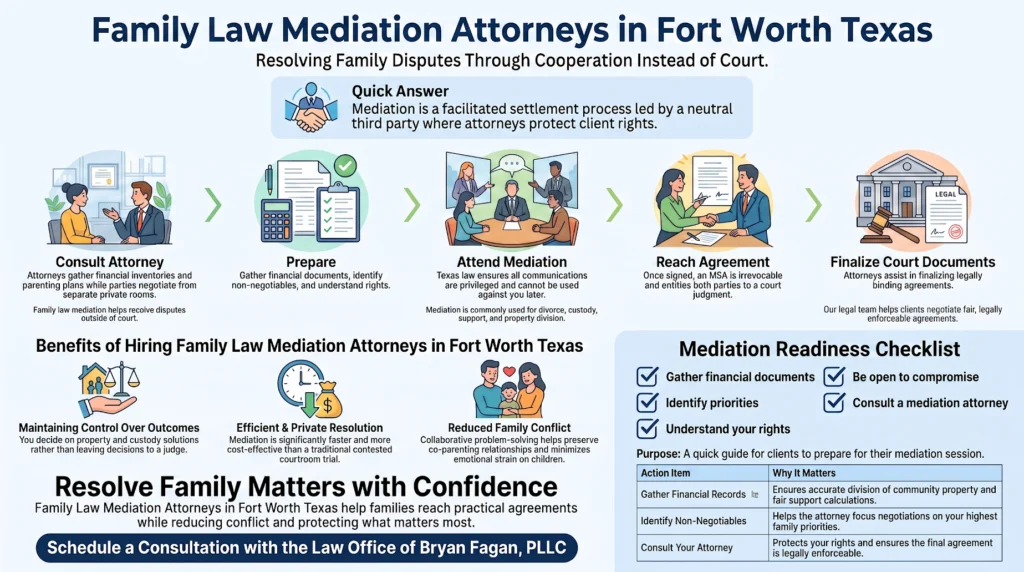
What I can tell you from experience: the vast majority of the family cases I handle in Tarrant County resolve at mediation, not at trial. Clients who arrive dreading a courtroom fight are often surprised to leave a single mediation session with a complete, binding agreement, and with far more control over the result than a judge would ever have given them.
When Mediation Is Ordered or Expected
In Texas, a court can refer your family case to mediation either on the parties’ agreement or on its own motion, under Family Code §6.602(a) for divorce and §153.0071(c) for cases involving children. In Tarrant County, most contested family cases are expected to attempt mediation before the court will set a contested final trial.
That means mediation is rarely optional in practice, even when it is not strictly mandatory. Judges want to see that the parties made a genuine effort to resolve the case before consuming trial time, and many standing scheduling practices build a mediation deadline into the case. This is good news, not bad: it gives you a structured, low-risk chance to settle on your own terms before the expense and uncertainty of trial. You can also choose to mediate voluntarily and early, before positions harden, which is often the smartest move. I help clients decide when to mediate for maximum leverage rather than simply waiting for a court deadline.
Not sure whether mediation fits your case? Let’s talk it through before you commit to a path.
Schedule a Legal Strategy SessionWhat Mediation Can and Cannot Resolve

Family Law Mediation Attorneys in Fort Worth Texas help families resolve most of the issues that arise in a divorce, custody, or post-divorce case without the need for a contested trial. Mediation can address property division, conservatorship, parenting plans, possession schedules, child support, spousal maintenance, and many other disputes through voluntary settlement negotiations. While the mediator helps facilitate communication, neither the mediator nor the court can force you to accept an agreement, allowing both parties to remain in control of the final outcome.
In straightforward divorce cases, mediation often resolves nearly every issue in a single session, including who keeps the marital home, how retirement accounts and community property are divided, and how parenting responsibilities will be shared. Even when disagreements remain, reaching a partial settlement narrows the issues for the Tarrant County Family Courts, reducing litigation costs and allowing everyone to focus on the matters that truly require judicial intervention. Many families also find it helpful to review our guide on Tarrant County assault cases when family violence allegations affect whether mediation is appropriate.
Mediation does have important limits. It is generally not the right solution when emergency court action is necessary, such as requests for temporary restraining orders, emergency protective orders, or situations involving immediate threats to a child’s safety. Likewise, if family violence is alleged, one spouse refuses to participate in good-faith negotiations, or assets are being intentionally concealed, the court may need to become involved before meaningful settlement discussions can occur. These situations require careful legal strategy to protect both your rights and your family’s well-being.
The key is recognizing which disputes can be resolved collaboratively and which require immediate judicial intervention. In more complex custody disputes, cases involving significant assets, business interests, or safety concerns, mediation may still play an important role, but only after the appropriate protections are in place. Understanding those distinctions allows families to pursue the most effective path toward a durable resolution while protecting what matters most.
The Mediated Settlement Agreement and Why It’s Powerful
The mediated settlement agreement, or MSA, is what makes Texas mediation so effective. Under Family Code §6.602 for divorce and §153.0071 for cases involving children, an MSA is binding and generally cannot be revoked if it meets three requirements, and a party is then entitled to judgment on it.
Those three requirements are specific: the agreement must contain a prominently displayed statement, in boldfaced type, capital letters, or underlined, saying it is not subject to revocation; it must be signed by each party; and it must be signed by each party’s attorney who is present when it is signed. Meet those, and under §6.602(c) and §153.0071(e) a party is entitled to judgment on the agreement notwithstanding the usual rules that let people back out of a settlement. In cases involving children, the court must generally render an order on the MSA, with only a narrow exception where a party was a victim of family violence that impaired their decision-making and the agreement is not in the child’s best interest, both of which must be shown (the standard the Texas Supreme Court confirmed in In re Lee). Compared to many other states, where a mediated deal can be unwound more easily before judgment, this binding, generally irrevocable quality is a distinctive Texas strength, and it is exactly why you should never sign an MSA you do not fully intend to live with.
Warning: a mediated settlement agreement with the required non-revocation langua
Warning: a mediated settlement agreement with the required non-revocation language is binding the moment it is signed. You generally cannot change your mind the next morning, and the court will usually enter judgment on it. Do not sign an MSA until you fully understand every term and are prepared to live with it, which is exactly why you want your own attorney in the room.
Confidentiality in Mediation
Mediation in Texas is confidential. Under Civil Practice & Remedies Code §154.073, communications made during the mediation process are generally privileged and cannot be disclosed or used as evidence later, which is what allows both sides to negotiate openly.
That protection matters, because it means an offer you make to settle cannot be thrown back at you in court if mediation fails. You can explore compromises, float numbers, and discuss priorities without handing the other side ammunition for trial. There is one important limit: confidentiality does not override the legal duty to report suspected abuse or neglect of a child, the elderly, or a disabled person, which applies to everyone including the mediator. Within that boundary, what happens in mediation stays in mediation, and that freedom is a large part of why the process works.
How Mediation Compares to Going to Court

Family Law Mediation Attorneys in Fort Worth Texas help families resolve disputes more quickly, privately, and collaboratively than a traditional courtroom trial. Unlike litigation, where a judge decides the outcome after hearing evidence, mediation allows both parties to negotiate solutions that fit their family’s unique circumstances. In many cases, this means greater flexibility, lower costs, and agreements that parents are more likely to follow because they helped create them.
The differences become even more significant over time. A contested divorce or custody trial in the Tarrant County Family Courts can take months to reach a final hearing, while mediation often resolves most or all issues in a single day. Mediation is also confidential under Texas Civil Practice and Remedies Code §154.073, allowing settlement discussions to remain private instead of becoming part of the public court record. When an agreement meets the requirements of Texas Family Code §§6.602 or 153.0071, the resulting Mediated Settlement Agreement (MSA) is generally binding and can carry the same legal effect as a court judgment.
In straightforward divorce cases, mediation often resolves parenting plans, conservatorship, child support, and property division without the emotional and financial burden of trial. In more complex disputes involving high-value assets, business ownership, relocation, or high-conflict custody issues, mediation still provides an opportunity to narrow disagreements before asking a judge to decide the remaining issues. If you’re preparing to visit our Fort Worth office, our Plan Your Visit – Fort Worth Office guide can help you know what to expect before your consultation.
Perhaps the greatest advantage of mediation is that it encourages long-term cooperation instead of creating lasting conflict. Parents who build agreements together often establish stronger communication for future co-parenting, reducing the likelihood of repeated trips back to court for modifications or enforcement actions. By approaching family law with preparation, education, and practical strategy, mediation gives many Texas families the opportunity to move forward with greater confidence, stability, and peace of mind.
Listen to Our Texas Family Law Podcast
Prefer listening? In this episode, we explain family law mediation in Texas for Fort Worth families, including how mediation works, the benefits of resolving disputes without court, and what to expect during the process.
Strategy note: prepare for mediation as seriously as you would for trial. Walk in with organized financial documents, a clear list of priorities, and a realistic bottom line worked out with your attorney in advance. The party who is prepared sets the terms of the conversation; the party who improvises reacts to them.
The Mediator’s Role and How We Represent You
The mediator is a neutral third party who does not represent either side and cannot give you legal advice or decide your case. Their job is to facilitate a settlement, which is exactly why you want your own attorney representing you in the process.
Mediators are usually chosen by agreement between the parties, often experienced family lawyers or former judges with mediation training, and courts maintain rosters of qualified neutrals. Because the mediator stays neutral, they will not tell you whether a proposed deal is good for you, protect your legal rights, or make sure the MSA says what you think it says. That is my role. I prepare you before mediation, sit with you during it, pressure-test every offer against what a court would likely do, and make sure any agreement you sign is drafted to be enforceable and to mean what you intend. Our Fort Worth team represents clients through mediation in Tarrant County family cases and prepares each one to settle from strength. When you are ready, a Legal Strategy Session is where that preparation starts.
The Law Office of Bryan Fagan, PLLC
204 W Central Ave, Fort Worth, TX 76164
Serving Fort Worth, Tarrant County, and clients across Texas.
Call 281-810-9760The Mediation Process, Stage by Stage
Here is what family law mediation actually looks like from referral to final order. Tap any stage to see what happens, how long it takes, and what to do.
From Referral to Final Order, Stage by Stage
Tap any stage to expand what happens, how long it takes, and what to do.
Stage 1 — Referral or Agreement to Mediate
The case reaches mediation either because the parties agree to it or because the court refers it, on its own motion or on request, under Family Code §6.602(a) for divorce and §153.0071(c) for cases involving children. In Tarrant County, most contested family cases are expected to mediate before a contested trial is set.
Typical timing: once the case is filed and issues are defined.
What to do: decide with your attorney whether to mediate early for leverage or wait for a court deadline.
Stage 2 — Preparation
This is where cases are won. You and your attorney gather financial documents, define your priorities, and set a realistic bottom line based on what a court would likely do. A mediator or mediation service usually sends forms and an agreement to mediate to complete before the session.
Typical timing: the days and weeks before the session.
What to do: organize records, rank your priorities, and rehearse your position with your attorney.
Stage 3 — The Mediation Session
On mediation day, each side and their attorney are usually in separate rooms while the neutral mediator moves between them carrying offers and narrowing the gap. Everything said is confidential under Civil Practice & Remedies Code §154.073, so you can negotiate openly. The mediator facilitates but cannot impose a decision.
Typical timing: a half or full day.
What to do: stay focused on resolution, lean on your attorney to test each offer, and be patient as it moves.
Stage 4 — Reaching the MSA
If you settle, the terms are written into a mediated settlement agreement. Under §6.602 and §153.0071, the MSA is binding and generally irrevocable if it carries a prominently displayed non-revocation statement and is signed by both parties and their attorneys. If you do not fully settle, partial agreements narrow what is left for the court.
Typical timing: the end of the mediation session.
What to do: read every term carefully; do not sign until you understand and accept all of it.
Stage 5 — After the MSA: Judgment & Final Order
A compliant MSA entitles a party to judgment on it, and the attorneys draft a final decree or order that adopts the agreement for the judge to sign. In cases involving children the court must generally render an order on the MSA, subject only to a narrow family-violence exception. A divorce still cannot be finalized before the 60-day minimum waiting period.
Typical timing: days to weeks after mediation, plus the waiting period.
What to do: review the final decree against the MSA to confirm it matches before it is entered.
Wherever you are in this process, the next step is a conversation.
Call 281-810-9760When Mediation Is Not Appropriate

Family Law Mediation Attorneys in Fort Worth Texas understand that mediation is not the right solution for every family law case. While Texas strongly encourages mediation, protecting the safety of you and your children always comes first. If there are allegations of family violence, credible threats, or an immediate need for court intervention, the case may require judicial action before meaningful settlement discussions can take place.
Texas law provides important safeguards in these situations. Under Texas Family Code §§6.602 and 153.0071, a party may object to mediation based on family violence, and when mediation proceeds in cases involving children, the court can require protective measures such as separate rooms, staggered arrivals, or other accommodations to promote safety. If your circumstances involve serious allegations of violence or criminal conduct, you may also find it helpful to learn more about Tarrant County homicide cases and how criminal proceedings can affect related legal matters.
Mediation may also be inappropriate when one party refuses to negotiate in good faith, intentionally conceals financial information, dissipates community assets, or when an emergency protective order or temporary restraining order is necessary to prevent immediate harm. In more complex custody disputes involving ongoing safety concerns or significant power imbalances, careful litigation strategy often needs to come before settlement negotiations. Recognizing these circumstances early helps ensure that families pursue the legal process best suited to protecting their rights and their future.
Choosing the right path is one of the most important decisions you’ll make during a family law case. When mediation is appropriate, it can resolve disputes efficiently while preserving relationships and reducing conflict. When it is not, understanding your legal options from the beginning allows you to focus on protecting yourself, your children, and the long-term stability of your family.
Mediation Practice in Tarrant County
Family Law Mediation Attorneys in Fort Worth Texas regularly help clients navigate a court system where mediation is often an expected part of the divorce and custody process. While Texas law does not require mediation in every case, the Tarrant County Family Courts frequently encourage or order parties to participate before a contested trial is scheduled. This gives families an opportunity to resolve disputes through confidential negotiation instead of leaving every important decision to a judge.
Mediation has become an integral part of how family law cases move through the Fort Worth courts. Parties typically agree on an experienced mediator who facilitates settlement discussions involving conservatorship, parenting plans, child support, property division, and other disputed issues. In straightforward divorce cases, mediation may resolve nearly every outstanding matter. In more complex disputes involving high-conflict custody, substantial assets, business interests, or post-divorce modifications, selecting the right mediator and preparing thoroughly can significantly improve the chances of reaching a durable agreement.
Local court procedures also matter. Scheduling orders, mediation deadlines, and standing orders may differ depending on the court handling your case, making familiarity with Tarrant County practice an important advantage. Before mediation begins, it is also helpful to understand what to expect when visiting our office. Our Plan Your Visit – Fort Worth Office guide provides directions, parking information, and details to help make your consultation as comfortable and stress-free as possible.
Every mediation strategy should be built around your family’s unique circumstances—not a one-size-fits-all approach. By combining local court knowledge with thoughtful preparation and practical legal guidance, mediation often gives Texas families the opportunity to resolve disputes more efficiently, preserve important relationships, and move forward with greater confidence and peace of mind.
Nearby Counties Where Practice Differs
The Texas mediation statutes are the same statewide, but local court practice on mediation deadlines, approved mediators, and scheduling differs enough between metroplex counties to matter for your case. Where your case is filed follows residency, not preference.
For Fort Worth families, cases sometimes reach into Dallas, Denton, Parker, and Johnson counties, and each has its own family courts, local rules, and mediator rosters. Some counties impose an automatic standing order on filing where Tarrant’s practice may differ, and mediation deadlines and expectations vary by court. Our attorney Bryan Bubis practices in the Tarrant, Johnson, and Parker county courts, so we can guide you through mediation wherever your case belongs. We represent clients in family law mediation across the metroplex and statewide.
Your Fort Worth Attorney
Family law mediation out of our Fort Worth office is handled by Senior Attorney Bryan Bubis, who has spent his career resolving family cases without unnecessary courtroom fights. When you call about mediation in Tarrant County, Bryan Bubis and our Fort Worth team are who you will work with.
Bryan Bubis — Senior Attorney, Fort Worth
15+ Years Family Law · Tarrant, Johnson & Parker County Courts
Bryan Bubis brings more than 15 years of family law experience to mediation, representing clients through divorce, custody, and support matters and working to resolve them efficiently rather than dragging families through avoidable litigation. He understands what Tarrant County judges and mediators expect, and he prepares each client to walk into mediation with a clear strategy and a realistic bottom line.
Bryan represents clients in the Tarrant, Johnson, and Parker county family courts. He works these cases the way I do: prepare thoroughly, settle from strength at mediation whenever a fair result is possible, and stay ready to try the case when it is not. Read Bryan Bubis’s full profile.
What I Tell Every Family Who’s Nervous About Mediation

Family Law Mediation Attorneys in Fort Worth Texas often remind clients that mediation is not about giving in—it is about taking control. Instead of asking a judge to make decisions that will affect your family for years, mediation gives you the opportunity to negotiate solutions that fit your circumstances. That is one reason so many divorce and custody cases in Tarrant County are resolved through mediation rather than a contested trial.
Preparation is what separates a productive mediation from a frustrating one. When a Mediated Settlement Agreement (MSA) satisfies the requirements of Texas Family Code §§6.602 or 153.0071, it is generally binding, making it important to understand every term before signing. In straightforward divorce cases, organizing financial records and identifying your priorities may be enough. In more complex custody disputes involving significant assets, relocation, or high-conflict parenting issues, developing a thoughtful legal strategy beforehand can make a meaningful difference in the outcome.
Mediation is often described as the middle ground between prolonged litigation and simply accepting whatever the other side proposes. It protects your privacy, encourages practical problem-solving, and frequently preserves healthier co-parenting relationships long after the case is over. If you’re planning to visit our office, our guide to transportation in Fort Worth can help you plan your trip and arrive prepared for your consultation.
The most important message I share with families is simple: every case deserves a strategy that fits the people involved. Whether your mediation involves a straightforward parenting plan or a more complex dispute requiring careful negotiation, understanding your options before you begin allows you to move forward with greater confidence, protect what matters most, and build a stronger foundation for the future.
What to Do Before Your Family Law Mediation in Fort Worth
- Gather your financial records: bank and retirement statements, tax returns, pay stubs, and a list of property and debts.
- Write down your priorities in order, separating what you must have from what you would like to have.
- Work out a realistic bottom line with your attorney, informed by what a Tarrant County court would likely do.
- If children are involved, think through a concrete parenting schedule, not just a general wish.
- Understand that a signed mediated settlement agreement is binding and generally cannot be revoked.
- Bring your own attorney to prepare you and represent you in the session; the mediator cannot advise you.
- Raise any history of family violence or safety concern with your attorney well before mediation is scheduled.
- Come rested and ready for a long day; mediation can run several hours as offers move back and forth.
- Keep your focus on resolution, not on winning every point, since partial agreements still narrow the case.
- Book a Legal Strategy Session with our Fort Worth office to prepare before you walk into the room.
Resolve It Without the War
A calmer, faster, more private path is available. Let’s see if mediation is right for you.
Call 281-810-9760 TodayConclusion:
Every family law case presents a different path forward, and choosing that path wisely can shape your family’s future long after the legal process ends. Whether you are considering divorce, working through a custody dispute, or trying to resolve post-divorce issues, Family Law Mediation Attorneys in Fort Worth Texas can help you understand your options and determine whether mediation is the right approach. In straightforward situations, mediation often provides an efficient way to reach lasting agreements while preserving time, money, and relationships. In more complex cases involving high-conflict parenting, significant assets, business interests, or concerns about family violence, experienced legal strategy becomes even more important to protect your rights while pursuing a practical resolution.
At The Law Office of Bryan Fagan, PLLC, we believe families make better decisions when they have clear information and trusted guidance. Our goal is not simply to help you resolve today’s legal issue, but to help you move forward with confidence and peace of mind. If your case involves questions about mediation, custody, property division, or another Texas family law matter, a Legal Strategy Session can help you better understand your options, identify the approach that fits your circumstances, and build a strategy designed to protect what matters most to you and your family.
About the Author
Founder & Managing Attorney · Serving Texas families since 2012
I am Bryan Fagan, founder and managing attorney of The Law Office of Bryan Fagan, PLLC, one of the largest family law firms in Texas. I hold a Juris Doctor from South Texas College of Law and a bachelor’s degree in business finance from the University of Phoenix, and I lead a team of more than 170 legal professionals with offices across the state. In custody cases, my aim is always to keep the focus where the law puts it: on what is genuinely best for the child.
I am also the author of several family law guides, including The Texas Divorce Handbook, because I believe parents make better decisions when they understand the process. Out of our Fort Worth office, our team helps parents with conservatorship, possession, modification, and enforcement matters in the Tarrant County family courts. If you are facing a custody case, I would like to help. Read more about Bryan Fagan.
Questions Families Ask About Family Law Mediation in Fort Worth
Family law mediation is a confidential process where a neutral mediator helps you and the other party settle a divorce or custody case without a trial. Under Civil Practice & Remedies Code §154.023, the mediator facilitates negotiation but cannot impose a decision. Any agreement is one you choose. Most Tarrant County family cases go through mediation, and it usually takes place over a half or full day.
A court can order mediation on its own motion or on the parties’ agreement under Family Code §6.602 and §153.0071. In Tarrant County, most contested family cases are expected to attempt mediation before the court will set a contested trial. So while it is not always strictly mandatory, in practice you should expect to mediate, and mediating early is often the smartest move.
Mediation is almost always far less expensive than a contested trial. You typically share the mediator’s fee, charged by the half or full day, and pay your own attorney for preparation and representation. Because mediation often resolves a case in a day or two rather than months of litigation, the total cost is usually a fraction of taking the same case to trial. I give you a realistic estimate at your consultation.
The mediation session itself usually lasts a half or full day. Preparing for it, gathering documents and settling your priorities, takes longer and is where much of the work happens. If you reach a mediated settlement agreement, it can resolve the case quickly, though the divorce still cannot be finalized before the 60-day minimum waiting period. Compared to a contested trial that can take many months, mediation is fast.
Yes. Under Family Code §6.602 for divorce and §153.0071 for child issues, a mediated settlement agreement is binding if it states in bold, capitalized, or underlined text that it is not subject to revocation, is signed by each party, and is signed by each party’s attorney present at signing. If it meets those requirements, a party is entitled to judgment on it, and the court will usually enter an order adopting it.
Generally, no. A mediated settlement agreement with the required non-revocation language is binding the moment it is signed, and you cannot simply revoke it the next day. In cases involving children, a court can decline to enter judgment only in a narrow family-violence circumstance where the agreement is not in the child’s best interest. Never sign an MSA you are not ready to live with.
If you cannot reach a full agreement, the case simply continues toward a contested hearing or trial on the unresolved issues. Nothing you offered in mediation can be used against you, because the process is confidential under §154.073. Even a partial agreement helps, because settling some issues narrows what the judge has to decide, which saves time and money. Mediation is low-risk: you either settle or you are no worse off.
Yes. Under Civil Practice & Remedies Code §154.073, communications made during mediation are generally privileged and cannot be disclosed or used as evidence later. This lets both sides negotiate openly without fear that an offer will be used against them in court. The one limit is that the legal duty to report suspected abuse or neglect of a child, elderly, or disabled person still applies to everyone, including the mediator.
You are not legally required to have one, but you should. The mediator is neutral and cannot advise you, protect your rights, or tell you whether a deal is fair. Your attorney prepares you, pressure-tests every offer against what a court would likely do, and makes sure any agreement you sign is enforceable and says what you intend. Because a signed MSA is binding, having your own lawyer in the room protects you from a deal you will regret.
Yes. Custody (conservatorship), possession schedules, and child support can all be mediated under Family Code §153.0071. In fact, Texas policy gives special consideration to resolving parent-child matters cooperatively. A mediated agreement on children is binding, and the court must generally honor it, with only a narrow family-violence exception. Designing your own parenting plan almost always works better than having a judge impose one.
Texas law protects you. Under §6.602 you can object to a mediation referral based on family violence, and the case generally cannot be sent to mediation unless a court finds the objection unsupported after a hearing. If mediation does go forward, §153.0071 requires safety measures such as separate rooms and no face-to-face contact. If safety is a concern, tell your attorney early so it is handled the right way; mediation may not be appropriate for your case.
Still have a question I didn’t cover? Bring it to a Legal Strategy Session and we’ll work through it together.
Schedule Your Consultation