Transportation in Fort Worth, Texas: A New Resident’s Guide
Have you ever driven through an unfamiliar part of a city and realized your GPS could tell you where to turn, but not how to feel about where you were going? For many parents rebuilding life after divorce, that moment feels all too familiar. Transportation in Fort Worth Texas isn’t just about highways, rail lines, or the fastest route across town. It becomes part of a family’s daily routine, influencing everything from parenting exchanges and work commutes to the simple comfort of knowing you’ll arrive on time for the moments that matter most.
When parents begin living in separate households, even ordinary trips can become more complicated. A thirty-minute drive that once seemed insignificant may suddenly affect parenting schedules, extracurricular activities, family dinners, or the ability to respond when life throws an unexpected curveball. Texas courts recognize that stability matters, which is why custody decisions are guided by the child’s best interest under Texas Family Code § 153.002. Judges often look beyond addresses on a map to evaluate how a family’s day-to-day routine will support consistency, healthy relationships, and long-term well-being.
At the Law Office of Bryan Fagan, PLLC, we understand that every legal decision has a human story behind it. Founded by Bryan Joseph Fagan, a graduate of South Texas College of Law and a recognized authority in Texas divorce and child custody law, our firm has helped thousands of Texas families navigate life’s most difficult transitions with confidence and compassion. We believe that educating families empowers them to make informed decisions, reclaim peace of mind, and build a stronger future. That commitment reflects why we do what we do: protecting what matters most while helping parents find practical solutions that reduce conflict and create lasting stability.
As you continue reading, you’ll discover how transportation, relocation, parenting schedules, and custody arrangements intersect under Texas law, why thoughtful planning can help preserve consistency for children, and how experienced legal guidance can help your family move forward with greater clarity, confidence, and hope.
Quick Answer
Fort Worth is a car-oriented city connected by I-35W, I-30, and the I-820 loop, with public transit run by Trinity Metro — a bus network plus TEXRail (downtown to DFW Airport) and the Trinity Railway Express (Fort Worth to Dallas). Most residents drive, but rail and bus are practical for airport trips, downtown, and Dallas commutes. New residents usually choose a neighborhood around their commute first.
Key Takeaways
- Fort Worth is car-oriented; a personal vehicle is the default for most trips.
- Trinity Metro is the region’s public transit agency — bus, TEXRail, and (with DART) the Trinity Railway Express.
- TEXRail connects downtown Fort Worth to DFW International Airport; the TRE connects Fort Worth to downtown Dallas.
- I-35W, I-30, and the I-820 loop are the main arteries; congestion and construction are real, so plan commutes around them.
- Pick your neighborhood around your commute — transit coverage and drive times vary a lot by area.

Your Family’s Future Starts Here
Don’t navigate your legal journey alone. Schedule a consultation now and get the clarity and support you deserve.
Fort Worth Transportation at a Glance
| Transit agency | Trinity Metro (Fort Worth & Tarrant County) |
|---|---|
| Commuter rail | TEXRail (to DFW Airport) & Trinity Railway Express (to Dallas) |
| Main highways | I-35W, I-30, I-820 loop, SH-183/121 (Airport Freeway) |
| Toll option | NTE TEXpress lanes on parts of I-35W and Loop 820 |
| Primary airport | Dallas/Fort Worth International (DFW) |
| General-aviation airports | Fort Worth Meacham International, Fort Worth Spinks |
| Downtown transit hub | Fort Worth Central Station, 1001 Jones Street |
| Trip-planning app | Trinity Metro GoPass |
How People Get Around Fort Worth
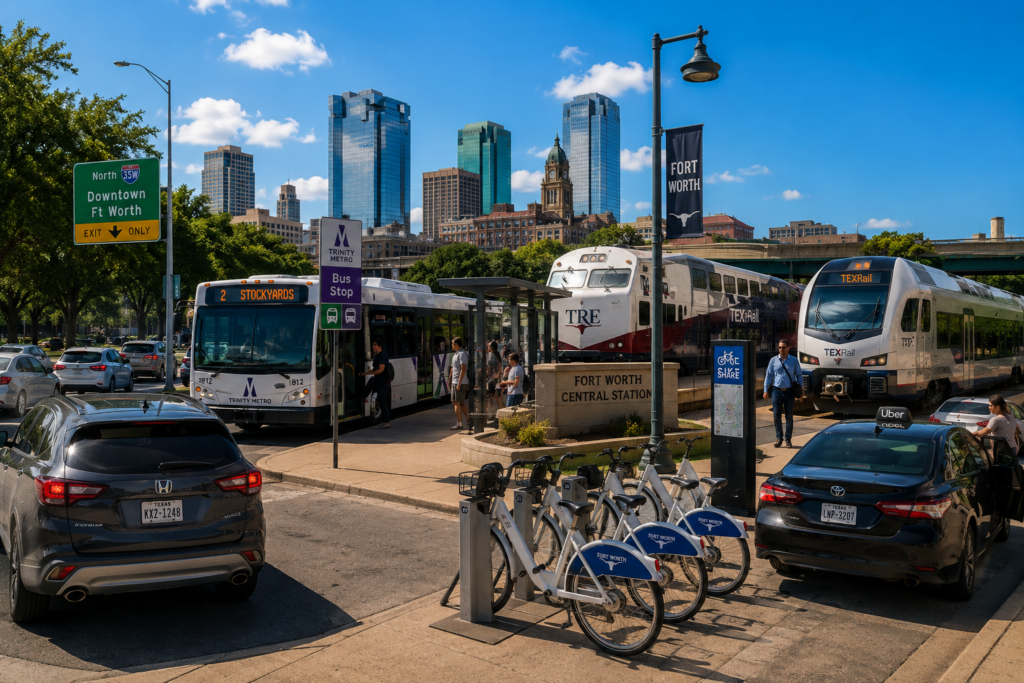
Transportation in Fort Worth Texas revolves around personal vehicles, but the city also offers a growing network of public transportation that makes commuting and regional travel more convenient. Most residents drive to work, shopping, medical appointments, and family activities, while Trinity Metro buses, TEXRail, and the Trinity Railway Express (TRE) provide practical alternatives for traveling to Downtown Fort Worth, DFW International Airport, and Dallas. Depending on your neighborhood, rideshare services, ZIPZONE on-demand transit, and bike-sharing programs can also complement your daily transportation needs.
Fort Worth’s major roadways—including I-35W, I-30, and Loop 820—connect the city with surrounding communities such as Keller, Benbrook, Burleson, Saginaw, White Settlement, Crowley, Haltom City, North Richland Hills, and Grapevine. Choosing a home near your workplace or frequently visited destinations can significantly reduce commute times and improve your quality of life. Families who regularly travel throughout the Metroplex may also find it helpful to compare commuting options by exploring our guide to Transportation in Dallas, which highlights how transportation systems differ between the region’s two largest cities.
For parents navigating divorce, relocation, or child custody matters, transportation is more than simply getting from one place to another. In straightforward situations, parents who live close together often find it easier to maintain consistent parenting schedules. In more complex cases involving relocation, longer commutes, or parents living in different counties, travel time can become an important factor when developing a parenting plan. Texas courts focus on the child’s best interests under Texas Family Code §153.002, making practical transportation planning an important part of creating long-term stability.
Understanding how Fort Worth’s transportation system works before choosing a neighborhood or adjusting a parenting schedule can help families avoid unnecessary stress. By considering commute times, transit options, and everyday travel needs early in the process, parents can build routines that promote consistency, reduce conflict, and provide children with the stability they need to thrive.
Major Highways & Driving
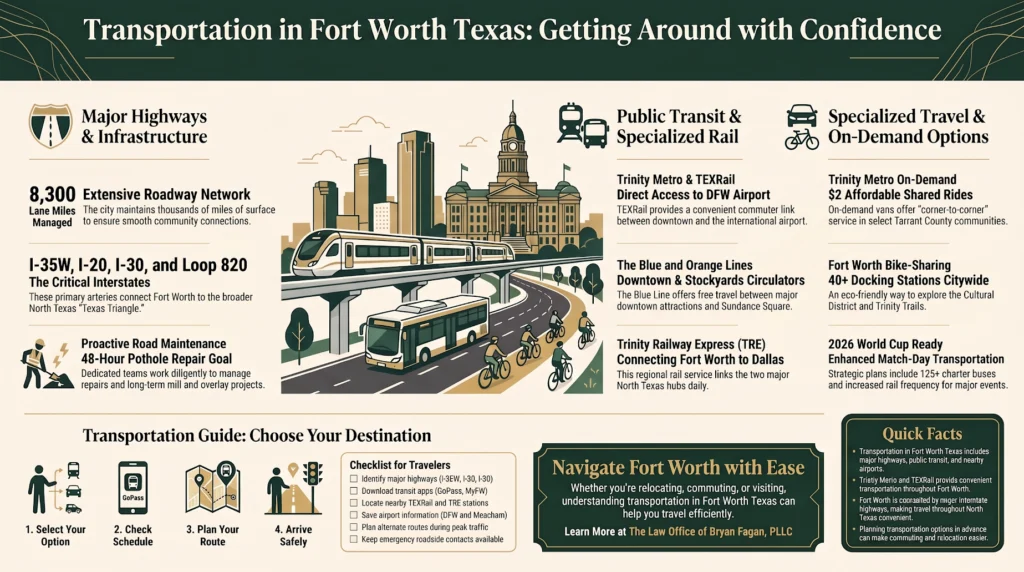
Fort Worth’s road network is anchored by a few major routes every new resident learns fast:
- I-35W — the main north–south interstate through Fort Worth, connecting toward Denton to the north and Hillsboro to the south.
- I-30 — the main east–west route, linking downtown Fort Worth toward Arlington and Dallas.
- I-820 (Loop 820) — the loop that circles the city, locally called “820”; segments are known by direction (“North Loop 820,” “East Loop 820”).
- SH-183 / SH-121 (Airport Freeway) — the primary route toward DFW Airport and the northeast suburbs.
- NTE TEXpress lanes — optional toll lanes on parts of I-35W and Loop 820 (the North Tarrant Express) for faster travel when traffic is heavy.
Traffic is a real consideration: local drivers report recurring congestion on I-35W, I-820, and I-20, worsened at times by ongoing construction. Building your commute into your neighborhood choice pays off.
Toll Roads & Express Lanes
Parts of the Fort Worth highway network include optional toll lanes — most notably the NTE TEXpress lanes on segments of I-35W and Loop 820, built as part of the North Tarrant Express. They run alongside the free general-purpose lanes and let drivers pay for a faster trip when traffic is heavy; pricing changes dynamically with congestion. A few orientation points:
- They’re optional. The free general lanes always run beside the TEXpress lanes — you choose when the time savings is worth the toll.
- Pricing is dynamic. Toll rates rise and fall with traffic, so the cost of the same trip varies by time of day.
- A toll tag usually costs less than pay-by-mail billing — confirm current tag compatibility and rates with the tollway authority before you rely on it.
- Verify current details. Toll systems and rates change; check the operator’s site for what applies now.
Parking in Fort Worth
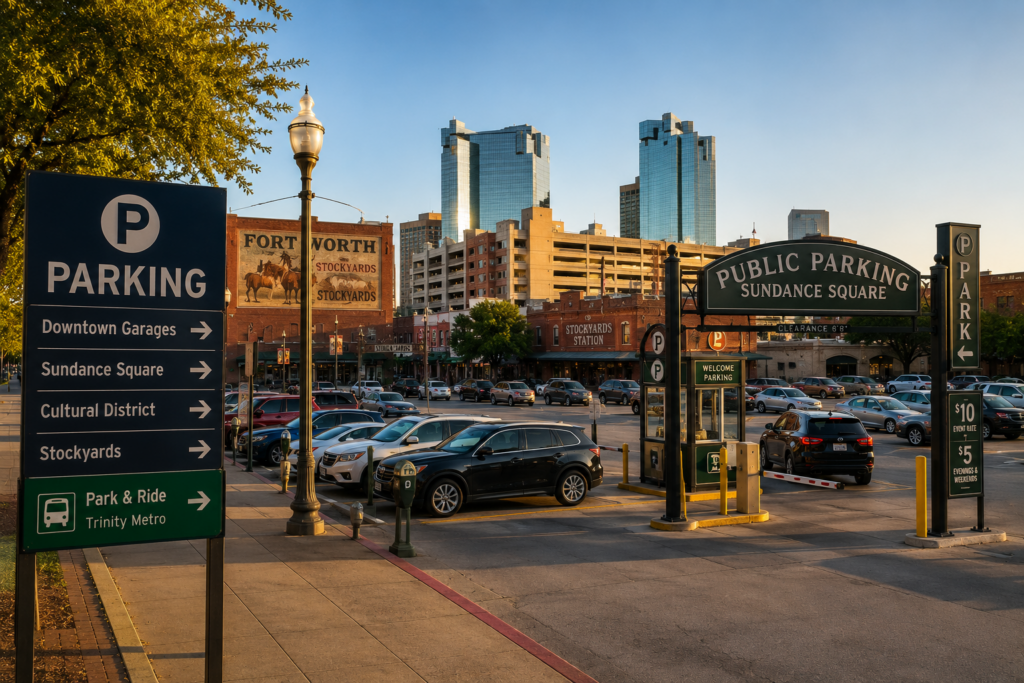
Transportation in Fort Worth Texas includes convenient parking options that make getting around easier than in many large metropolitan areas. While parking is generally plentiful throughout the city, availability and pricing vary depending on whether you’re visiting Downtown Fort Worth, entertainment districts, or residential neighborhoods. Planning where to park before you leave can save time, reduce stress, and make daily routines or family outings more enjoyable.
Downtown Fort Worth and Sundance Square offer a combination of public parking garages, surface lots, and metered street parking, with garages often providing the most convenient choice during concerts, sporting events, and festivals. The Cultural District and the Historic Stockyards also have dedicated parking areas, although they can fill quickly on weekends and during special events. Families relocating from other parts of Texas may find it helpful to compare local parking and commuting expectations with our guide to Transportation in Richmond, TX, especially if they are evaluating different communities before making a move.
Most suburban neighborhoods throughout Tarrant County provide free and readily available parking, making everyday errands, school activities, and parenting exchanges more convenient. Trinity Metro also operates several park-and-ride locations, allowing commuters to drive part of the way before continuing by bus or rail. For families balancing work schedules and custody arrangements, these facilities can offer a practical alternative to navigating downtown traffic every day.
In straightforward situations, convenient parking simply makes daily travel more efficient. In more complex family circumstances involving relocation, parenting schedules, or longer commutes between households, parking availability and travel time can become meaningful factors when planning exchanges and maintaining consistent routines. Considering these practical details before choosing a neighborhood or adjusting a parenting plan can help reduce unnecessary stress and create greater stability for everyone involved.
Biking & Walking
Fort Worth is more walkable and bikeable in some areas than newcomers expect, though it’s not a car-free city:
- Trinity Trails — an extensive trail system along the Trinity River, popular for recreation and some commuting, linking neighborhoods, parks, and the Cultural District.
- Fort Worth Bike Sharing — a bike-share program operated in coordination with Trinity Metro for short trips.
- Walkable pockets — downtown/Sundance Square, the Near Southside, and parts of the Cultural District are pleasant on foot.
- Plan by neighborhood — walkability varies widely, so if car-free living matters to you, prioritize it when choosing an area.
Public Transit: Trinity Metro
Trinity Metro is the public-transportation provider for Fort Worth and Tarrant County. Its services include a citywide bus network, the TEXRail commuter line to DFW Airport, joint operation of the Trinity Railway Express to Dallas, ACCESS paratransit, ZIPZONE on-demand rideshare in select zones, Fort Worth Bike Sharing, and vanpools. Fares, schedules, and coverage change, so confirm current details on the Trinity Metro site or the GoPass app before you rely on a route.
Rail Options at a Glance
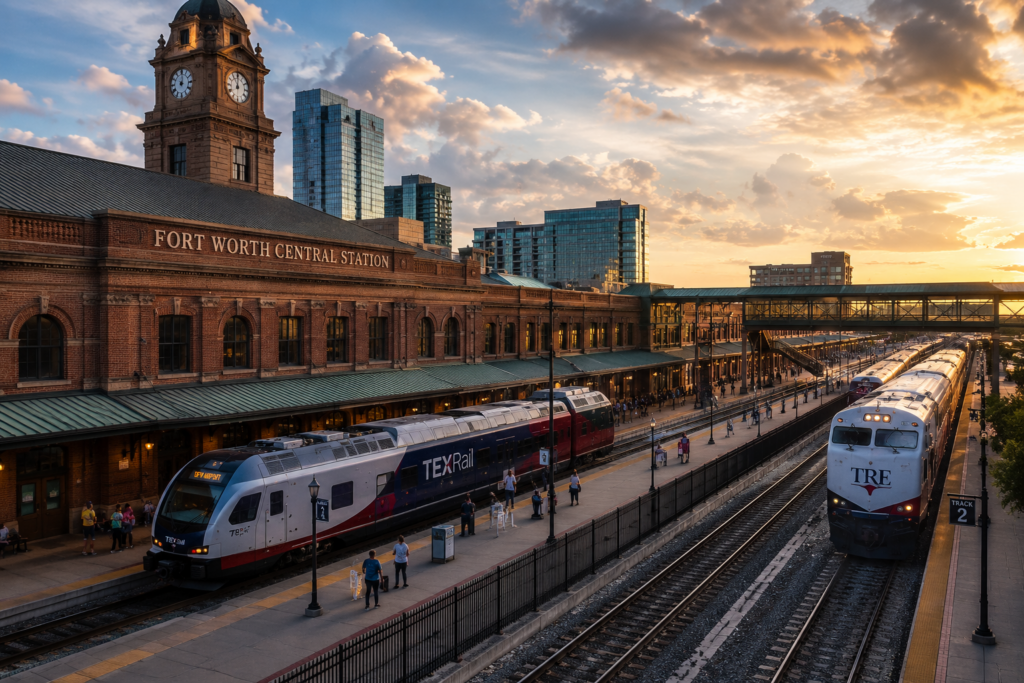
Transportation in Fort Worth Texas includes two convenient commuter rail lines that connect the city to major destinations throughout the Dallas–Fort Worth Metroplex. TEXRail offers direct service between Downtown Fort Worth and DFW International Airport, while the Trinity Railway Express (TRE) provides a reliable connection between Fort Worth and downtown Dallas. These rail options give residents, commuters, and visiting families an alternative to driving on busy highways such as I-30 and I-35W.
Fort Worth Central Station, located at 1001 Jones Street, serves as the region’s primary transportation hub. From one location, travelers can access TEXRail, the TRE, Amtrak’s Texas Eagle and Heartland Flyer routes, Greyhound bus service, and numerous Trinity Metro bus routes. Before traveling, it’s always wise to confirm current schedules, fares, and service updates through Trinity Metro or the appropriate transportation provider, especially during holidays, special events, or severe weather.
For families relocating to Fort Worth or coordinating parenting schedules after divorce, commuter rail can provide a dependable transportation option for work, airport travel, or long-distance visitation. In straightforward situations, rail service may simply reduce commute times and parking expenses. In more complex custody matters involving parents who live in different cities or frequently travel between Fort Worth and other parts of Texas, dependable transportation can help support consistent parenting schedules while reducing unnecessary stress. Families interested in transportation safety and protecting children during travel may also find our article on the Audrii Cunningham case to be a valuable reminder of why thoughtful planning and child safety should remain a priority whenever children are on the move.
| Line | Route | Best For | Station |
|---|---|---|---|
| TEXRail | Downtown Fort Worth (T&P Station) ↔ DFW Airport Terminal B, via North Richland Hills & Grapevine | Airport trips, northeast suburbs | Find station |
| Trinity Railway Express (TRE) | Fort Worth ↔ downtown Dallas (jointly run by Trinity Metro & DART) | Dallas commutes and events | Find station |
Airports
Fort Worth residents have strong air-travel access:
- Dallas/Fort Worth International (DFW) — one of the world’s busiest airports, reachable by car via SH-183/121 or car-free via TEXRail to Terminal B.
- Fort Worth Meacham International — a general-aviation airport north of downtown.
- Fort Worth Spinks — a general-aviation airport in far south Fort Worth.
- Dallas Love Field — a second major commercial option in Dallas, about an hour away depending on traffic.
For DFW specifically, TEXRail offers a car-free option to Terminal B, while driving via SH-183/121 is the fastest route for most — weigh parking cost and time against the train fare for your situation. Confirm current TEXRail schedules and DFW parking options before travel; both change.
Planning Your Commute
The single most useful transportation decision a new resident makes is choosing a home around the commute, not the other way around. A few practical points:
- Match neighborhood to route. Living near I-35W, I-30, or a TEXRail/TRE station shapes your daily travel more than the home itself.
- Test-drive the commute. Try the actual trip at rush hour before committing to an area.
- Consider rail for Dallas or airport trips. The TRE and TEXRail can beat driving-and-parking for those specific routes.
- Factor in tolls. The NTE TEXpress lanes save time but cost money; decide whether the trade-off fits your budget.
- Plan around construction. Ongoing highway projects shift traffic patterns; check current conditions.
Typical Trips: What to Expect
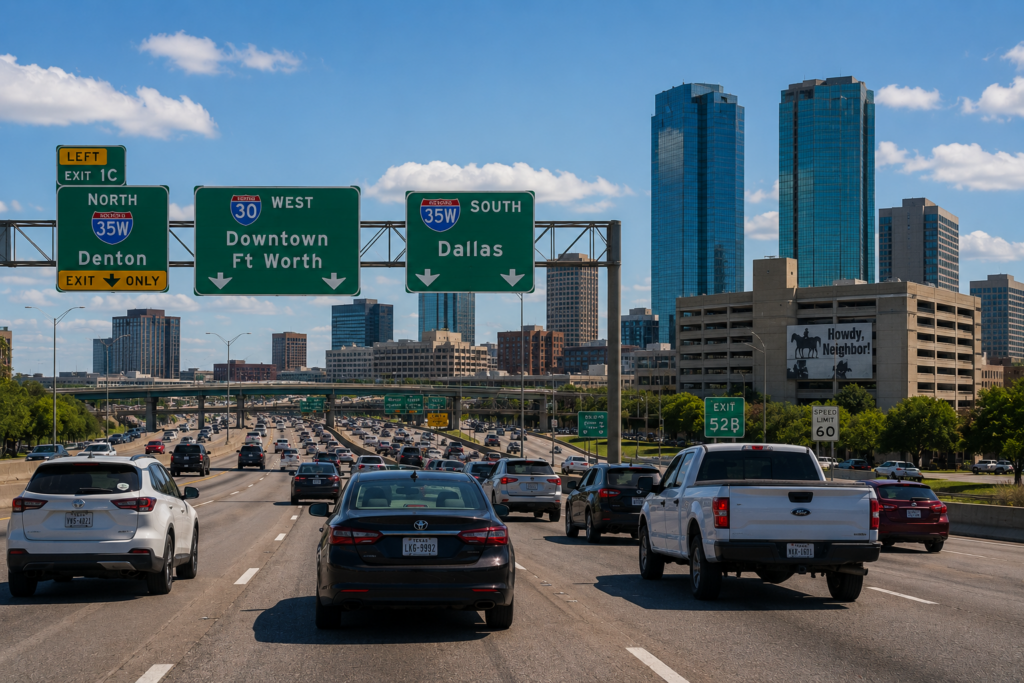
Transportation in Fort Worth Texas can vary considerably depending on the time of day, your destination, and current traffic conditions. While general commute estimates can help you compare neighborhoods, the most accurate way to evaluate a route is to drive it yourself during the hours you expect to travel. Rush-hour congestion, construction projects, weather, and special events can all affect travel times throughout Fort Worth and Tarrant County.
If you’re relocating, test your daily commute before signing a lease or purchasing a home. Consider the routes you’ll use most often, including trips to work, childcare, shopping, medical appointments, and extracurricular activities. Families moving from other parts of Texas may also benefit from comparing regional travel patterns by reviewing our guide to Transportation in Cypress, which highlights how transportation needs can differ between growing suburban communities and a major metropolitan area like Fort Worth.
For parents sharing custody, commute times often influence much more than convenience. In straightforward situations, a predictable drive can make parenting exchanges and daily routines run smoothly. In more complex cases involving relocation, long-distance visitation, or parents living in different counties, travel time may affect parenting schedules and should be considered when developing or modifying a parenting plan. By planning ahead and checking current road conditions through navigation apps such as Google Maps, Waze, or TxDOT traffic updates, families can reduce stress and create routines that better support long-term stability.
| Trip | Relative Time | How |
|---|---|---|
| Within downtown / central Fort Worth | Short | Walk, drive, bus, or bike-share |
| Suburb to downtown (rush hour) | Moderate to longer | Drive (I-35W/I-30) or park-and-ride |
| Fort Worth to DFW Airport | Moderate | Drive (SH-183/121) or TEXRail |
| Fort Worth to downtown Dallas | Longer | Drive (I-30) or Trinity Railway Express |
| Fort Worth to nearby suburbs | Short to moderate | Drive; some served by bus |
Transportation for Families
Moving with kids adds a few transportation considerations worth thinking through early:
- ›School routes & zoning — confirm how your children will get to school (bus, drive, or walk) for the specific address, since campus assignments follow zoning, not neighborhood lines.
- ›Commute vs. school run — weigh both trips when choosing a home; a great work commute that adds a long school run can offset itself.
- ›Car seats & rideshare — plan for car-seat needs if you’ll rely on rideshare with young children.
- ›Teen drivers — Texas licensing and the area’s car-oriented layout mean transportation independence matters for older kids.
- ›Activities & access — factor drive times to activities, childcare, and family healthcare into where you settle.
Accessible & On-Demand Transit
For riders who need it, Trinity Metro ACCESS provides paratransit service, and ZIPZONE offers on-demand, app-based rideshare within select zones — useful where fixed bus routes don’t reach. Eligibility, zones, and booking work differently from the fixed-route bus, so check current requirements with Trinity Metro.
New Resident Transportation Checklist
The practical steps to get your household mobile after the move:
- ☐Map your daily commute and test-drive it at rush hour
- ☐Choose a neighborhood that fits your route and transit needs
- ☐Get a Texas driver’s license
- ☐Register your vehicle in Texas
- ☐Download the Trinity Metro GoPass app for tickets and trip planning
- ☐Locate the nearest TEXRail or TRE station if you’ll use rail
- ☐Set up a toll tag if you’ll use TEXpress or other toll lanes
- ☐Identify your route to DFW Airport (car or TEXRail)
- ☐Check ZIPZONE or paratransit options if fixed routes don’t reach you
Relocating to Fort Worth with your family? Our family-law team put this guide together as part of helping families settle in. If your move also involves custody, divorce, or other family-law questions, you can schedule a consultation with our Fort Worth team whenever you’re ready.
Moving Because of Divorce or Child Custody?
If your move involves a court order, parenting plan, or relocation dispute, it’s important to understand how Texas family law may affect where you can move and what approvals you may need.
Schedule a Consultation Learn About Texas Relocation LawsLiving Near Fort Worth?
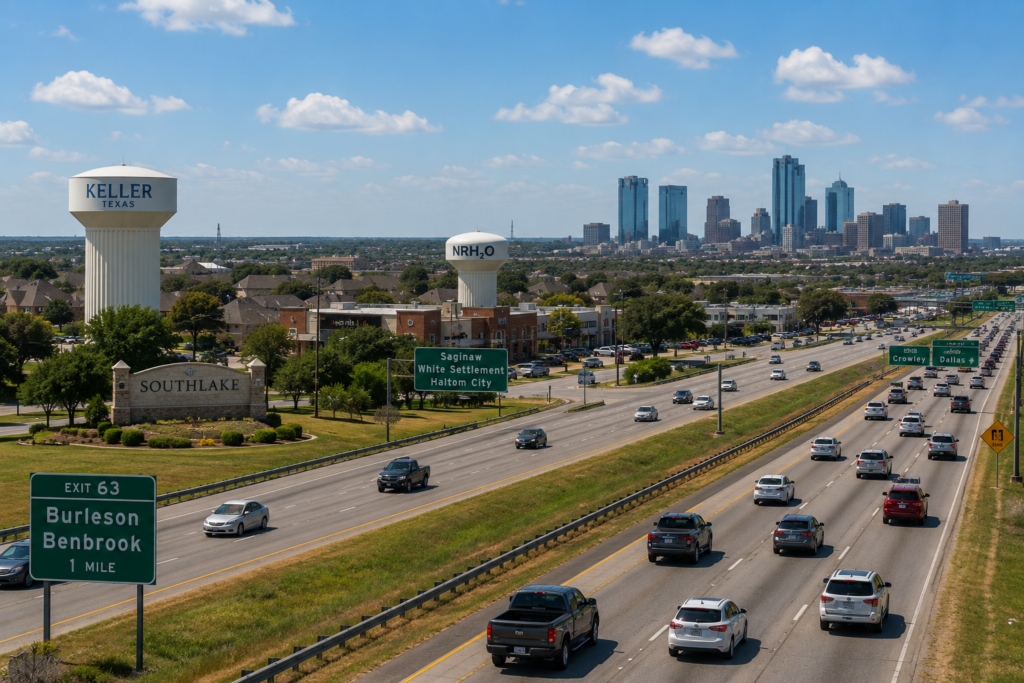
Transportation in Fort Worth Texas extends well beyond the city limits, making it possible for many families to live in nearby communities while commuting into Fort Worth for work, school, or parenting exchanges. Popular suburbs such as Benbrook, Keller, Saginaw, Burleson, White Settlement, Crowley, Haltom City, North Richland Hills, and Grapevine each offer different commuting experiences based on their proximity to major highways, Trinity Metro routes, and TEXRail stations. Before choosing a neighborhood, compare commute times during peak traffic rather than relying solely on mileage.
Communities like North Richland Hills and Grapevine provide convenient access to TEXRail, making airport trips and regional travel easier without relying entirely on a personal vehicle. Other suburbs are better connected by I-35W, I-30, Loop 820, or the North Tarrant Express, giving drivers multiple options for reaching Downtown Fort Worth and other employment centers. Families considering different regions of Texas may also find it helpful to compare commuting patterns with our guide to Transportation in Humble, where transportation needs reflect a different part of the Greater Houston area.
For parents sharing custody, where each parent lives can influence far more than the daily commute. In straightforward situations, nearby homes often make parenting exchanges simpler and help children maintain consistent routines. In more complex cases involving relocation, long-distance visitation, or geographic restrictions, transportation planning can become an important part of creating a parenting schedule that supports the child’s best interests under Texas Family Code §153.002. Choosing a home with convenient transportation access today can help reduce conflict and provide greater stability for your family tomorrow.
Our Fort Worth Office
The Law Office of Bryan Fagan, PLLC
204 W Central Ave, Fort Worth, TX 76164 · Tarrant County
Open 24 hours
Call 817-406-7230 Map & DirectionsGetting Around, One Step at a Time
You don’t have to master all of the transportation in Fort Worth, Texas at once. Most new residents start with one decision — choosing a home that fits their commute — and everything else follows: the driver’s license, the toll tag, the GoPass app, the airport route.
Between the interstate network and Trinity Metro’s growing bus and rail system, Fort Worth gives families more ways to get around than many expect. Plan your commute first, confirm current routes and fares with each provider, and you’ll be settled and moving in no time. Welcome to Fort Worth.
Listen to Our Texas Family Law Podcast
Prefer listening? In this episode, we provide a 2026 transit guide for Fort Worth families, including local transportation options, commuting considerations, and helpful information for getting around the city.
Your Fort Worth Attorney
Bryan Bubis — Senior Attorney, Fort Worth
15+ Years of Experience · Tarrant, Johnson & Parker County Courts
Bryan Bubis is the Senior Attorney at the Law Office of Bryan Fagan’s Fort Worth office, bringing more than 15 years of family-law experience to divorce, child custody, and property-division cases in Tarrant County. His combination of legal training and a business education makes him especially effective in cases involving significant assets, business interests, or complex financial matters.
He earned his Bachelor of Business Administration from Texas A&M University and his Juris Doctor from Texas Wesleyan University School of Law (now Texas A&M University School of Law), and is admitted to the State Bar of Texas.
Read Bryan Bubis’s full profile · Plan your visit to the Fort Worth office.
Conclusion:
Whether you’re evaluating Transportation in Fort Worth Texas because you’re planning a move, adjusting to life after divorce, or creating a parenting schedule that works for everyone involved, the decisions you make today can have a lasting impact on your family’s future. In straightforward situations, parents are often able to create practical custody arrangements that keep daily routines consistent while minimizing unnecessary conflict. In more complex cases, such as relocation disputes, long-distance parenting plans, disagreements over school placement, or significant changes in living arrangements, experienced legal guidance can help develop solutions that protect your child’s best interests while complying with Texas law.
At the Law Office of Bryan Fagan, PLLC, we believe families deserve more than legal representation—they deserve clear answers, thoughtful strategies, and compassionate advocates who understand the challenges they are facing. Our goal is to educate and empower you so you can make informed decisions with confidence and peace of mind. If your case involves questions about custody, relocation, parenting schedules, or how transportation challenges may affect your family’s future, our team is ready to help you understand your options and develop a strategy designed to protect what matters most.
People Also Ask
Trinity Metro provides Fort Worth’s public transit — a citywide bus network, the TEXRail commuter line to DFW Airport, the Trinity Railway Express to Dallas (run jointly with DART), ACCESS paratransit, ZIPZONE on-demand rideshare, bike share, and vanpools.
You can drive via SH-183/121 (Airport Freeway) or take Trinity Metro’s TEXRail commuter line, which runs from downtown Fort Worth to DFW Airport’s Terminal B through North Richland Hills and Grapevine.
Yes. The Trinity Railway Express (TRE), operated jointly by Trinity Metro and DART, runs between Fort Worth and downtown Dallas. In Fort Worth you can board at the T&P Station or Fort Worth Central Station.
For most residents, yes — Fort Worth is a car-oriented city and a personal vehicle is the default. Public transit is practical for specific trips like the airport, downtown, or Dallas commutes, but coverage varies by neighborhood.
The main arteries are I-35W (north–south), I-30 (east–west), and the I-820 loop around the city, along with SH-183/121 (Airport Freeway). The NTE TEXpress toll lanes offer optional faster travel on parts of I-35W and Loop 820.
Fares vary by service and change over time — for example, TEXRail has offered single-ride and day-pass options, with a day pass valid across rail and bus in Tarrant County. Confirm current fares on the Trinity Metro site or the GoPass app.
Fort Worth Central Station at 1001 Jones Street is the downtown intermodal hub, connecting TEXRail, the Trinity Railway Express, Amtrak, Greyhound, and many Trinity Metro bus routes. The historic T&P Station also serves the TRE and TEXRail.
Fort Worth has real congestion on major routes like I-35W, I-820, and I-20, at times worsened by ongoing construction. Many residents plan commutes around peak times or use back roads and toll lanes.
Dallas/Fort Worth International (DFW) is the primary commercial airport; Fort Worth Meacham International and Fort Worth Spinks serve general aviation; and Dallas Love Field is a second commercial option about an hour away.