
Few Decisions Carry More Lasting Consequences Than Terminating a Parent’s Rights

Few legal decisions carry more lasting consequences than permanently ending the relationship between a parent and a child. Whether you are considering a voluntary relinquishment, hoping to complete a stepparent adoption, responding to a Child Protective Services (CPS) case, or defending against allegations that could forever change your family, the Termination of Parental Right Attorneys in Fort Worth Texas at The Law Office of Bryan Fagan, PLLC help families understand what Texas law permits, what it requires, and what options may be available before irreversible decisions are made.
The most important thing to understand is this: Texas courts do not terminate parental rights simply because parents disagree or because one parent wants the other removed from a child’s life. The law begins with the presumption that preserving the parent-child relationship serves a child’s best interests. Before that relationship can be permanently severed, a court must find clear and convincing evidence of specific statutory grounds and determine that termination truly protects the child’s welfare. That high legal standard reflects how seriously Texas treats one of the most fundamental relationships recognized by law.
At The Law Office of Bryan Fagan, PLLC, we believe families deserve more than answers to legal questions—they deserve guidance that brings clarity during life’s most difficult transitions. Since founding the firm in 2012, Bryan Joseph Fagan, a graduate of South Texas College of Law, has helped thousands of Texas families navigate complex family law matters with honesty, compassion, and practical legal counsel. Our mission is to empower parents through education and thoughtful legal strategies that protect children, preserve stability whenever possible, and help families move forward with confidence.
In this guide, you’ll learn when termination of parental rights may be appropriate, who has standing to file these cases, what evidence Texas courts consider, how judges determine a child’s best interests, and how issues such as divorce, custody, adoption, and family stability can influence these life-changing decisions. Whether you are seeking to protect your parental rights or determine whether termination is appropriate in your family’s circumstances, understanding the law is the first step toward making informed decisions with confidence.
Quick Answer
In Texas, termination of parental rights permanently ends the legal parent-child relationship. A court must find, by clear and convincing evidence, both a statutory ground and that termination is in the child’s best interest. It happens voluntarily, by a signed affidavit, or involuntarily by court order, and usually alongside an adoption or a CPS case.
Key Takeaways
- Termination permanently ends the legal parent-child relationship.
- There are two paths: voluntary relinquishment (§161.103) and involuntary termination by court order (§161.001).
- A court must find clear and convincing evidence of a statutory ground and that termination is in the child’s best interest.
- You generally cannot terminate a parent’s rights just to avoid child support or remove an ex.
- Termination usually happens alongside an adoption or a CPS case.

Your Family’s Future Starts Here
Don’t navigate your legal journey alone. Schedule a consultation now and get the clarity and support you deserve.
Our office is available 24/7. Do not hesitate to schedule your free case evaluation by calling 817-406-7230 or contacting us online today.
What Termination of Parental Rights Means

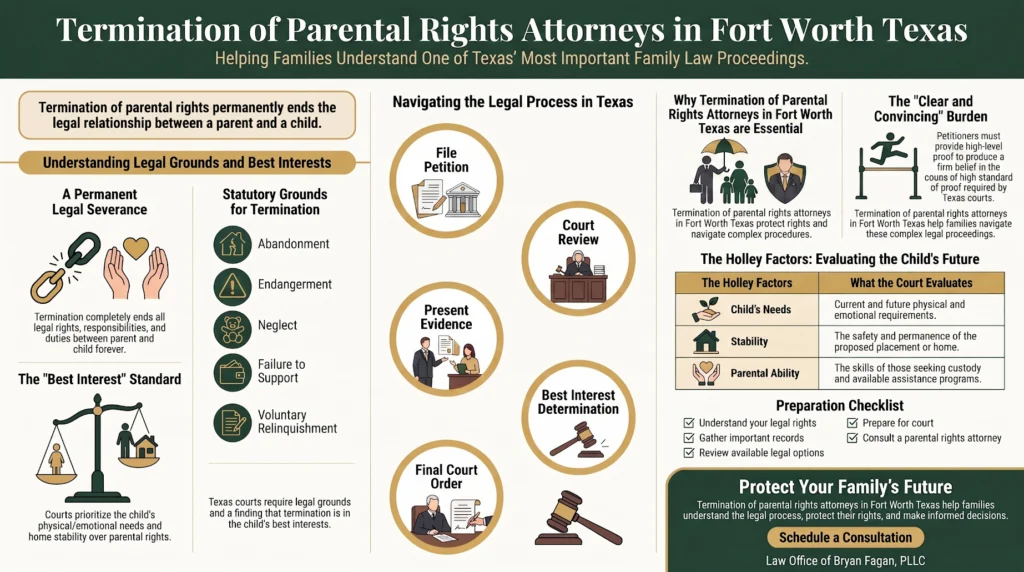
Termination of Parental Right Attorneys in Fort Worth Texas help families understand that terminating parental rights permanently ends the legal relationship between a parent and a child. Unlike a custody order, which changes how parents share rights and responsibilities, termination completely removes a parent’s legal status and can only occur after a court determines the strict requirements of Texas Family Code Chapter 161 have been satisfied. Texas law intentionally sets a high standard because the parent-child relationship is one of the most important legal relationships the courts protect.
Whether the case involves a voluntary relinquishment under §161.103 or an involuntary termination under §161.001, a judge must determine that a statutory ground exists and that termination is in the child’s best interest before parental rights can be permanently severed. Courts do not terminate parental rights simply because parents disagree or because one parent wants the other removed from the child’s life. Instead, they carefully evaluate the evidence using the clear-and-convincing standard required by Texas law.
Termination reaches far beyond custody or visitation. A parent generally loses the right to make educational, medical, and religious decisions, seek conservatorship or visitation in the future, and participate in many aspects of the child’s legal upbringing. Because these consequences are permanent, Texas courts approach every termination case cautiously and treat it as a remedy of last resort rather than a routine family law proceeding.
In straightforward situations, termination may occur as part of a stepparent adoption or another agreed adoption where a new parent is prepared to assume legal responsibility. In more complex cases involving CPS, allegations of abuse, neglect, abandonment, or endangerment, the court may review medical records, witness testimony, psychological evaluations, and DFPS investigations before deciding whether termination truly serves the child’s welfare. Every family’s circumstances are different, which is why the legal strategy often depends on the specific facts of the case.
For families in Fort Worth and Tarrant County, understanding both Texas law and local court procedures helps replace uncertainty with informed decision-making. If you’d like to see how these same legal principles apply in another Texas community, read our guide on Termination of Parental Rights in Willis. You may also find our resources on Child Custody and Stepparent Adoption helpful for understanding how these areas of Texas family law often intersect with termination proceedings.
Key Terms, Defined
Conservatorship — the Texas term for the legal rights and duties of a parent or guardian; what other states call custody.
Managing conservator — the person with the primary right to make decisions for and, usually, to have primary care of the child.
Affidavit of relinquishment — a sworn document by which a parent voluntarily gives up parental rights, signed no sooner than 48 hours after the child’s birth.
Best interest of the child — the guiding standard in Texas family cases; the court’s central question in any termination.
Clear and convincing evidence — a high burden of proof, greater than the usual civil standard, required to terminate parental rights.
Statutory grounds — the specific reasons listed in the Family Code that can justify an involuntary termination.
Voluntary vs. Involuntary Termination
Every termination case is either voluntary or involuntary, and the difference shapes everything that follows. In a voluntary case, a parent agrees to give up their rights, usually so that a stepparent or another adoptive parent can step in. In an involuntary case, someone asks the court to end a parent’s rights over that parent’s objection, and the court can do so only if strict statutory requirements are met.
Which path might apply?
↓
↓
↓
Either way, the right next step is to speak with a Fort Worth family law attorney about your situation.
Involuntary Termination: The Legal Standard (§161.001)
A Texas court may involuntarily terminate parental rights only when two legal requirements are satisfied: the court must find clear and convincing evidence of at least one statutory ground for termination, and it must also determine that termination is in the child’s best interest. Both findings are required under Texas Family Code Chapter 161. Proving misconduct alone is not enough—the court must conclude that permanently ending the parent-child relationship is necessary to protect the child’s welfare.
The law identifies specific grounds for involuntary termination, including abandonment, endangerment, certain criminal conduct, failure to support a child, and, in limited circumstances, an inability to safely care for a child because of a mental or emotional condition. These cases focus on a parent’s actions and the impact those actions have on the child’s safety, stability, and emotional well-being—not ordinary disagreements between parents. When the Department of Family and Protective Services (DFPS) brings a case, the court also considers whether reasonable efforts were made to preserve the family before seeking permanent termination.
Who may file a termination case depends on the circumstances. A parent, DFPS, or another person with legal standing under the Texas Family Code may be able to bring the case, and in contested matters the court may appoint a guardian ad litem or attorney ad litem to represent the child’s interests. In straightforward cases, the legal questions may be relatively limited. In more complex cases involving CPS investigations, abuse or neglect allegations, multiple caregivers, or psychological evaluations, the court carefully weighs all of the evidence before making a permanent decision.
Because every family’s circumstances are different, understanding how the law applies to your specific situation is essential before taking the next step. If your case involves contested termination, a planned stepparent adoption, or questions about your parental rights, schedule a Legal Strategy Session to discuss your options with an experienced Texas family law attorney. Families preparing for long-term care or incapacity issues may also find our guide to Incapacity Planning Attorneys in Houston Heights, Texas helpful, while our CPS Defense and Stepparent Adoption resources explain how these related areas of Texas family law often intersect with termination proceedings.
Voluntary Relinquishment (§161.103)

Termination of Parental Right Attorneys in Fort Worth Texas frequently help parents understand that voluntarily relinquishing parental rights is a formal legal process—not simply a personal decision or signed document. Under Texas Family Code Chapter 161, a parent may voluntarily relinquish their rights by signing an affidavit that complies with §161.103, but the affidavit alone does not terminate the parent-child relationship. A judge must still determine that granting the termination is in the child’s best interest before issuing a final order.
Texas law includes strict safeguards because the consequences are permanent. An affidavit of voluntary relinquishment cannot be signed until at least 48 hours after the child’s birth, and whether it may later be revoked depends on how the document is written. Some affidavits remain revocable for a limited period, while others become irrevocable if they name the Department of Family and Protective Services (DFPS) or a licensed child-placing agency as managing conservator or expressly provide for irrevocability. These legal requirements help ensure that parents fully understand the significance of the decision before moving forward.
In straightforward cases, voluntary relinquishment most often occurs as part of a stepparent adoption or another planned adoption where a relative or adoptive parent is prepared to assume permanent legal responsibility for the child. In more complex situations, particularly when CPS is involved or multiple family members have standing, the court carefully evaluates whether termination promotes the child’s long-term safety, stability, and emotional well-being. Simply deciding that you no longer wish to be a parent is not, by itself, a legal basis for terminating parental rights under Texas law.
Because voluntary relinquishment permanently changes a family’s legal future, careful planning is essential before signing any affidavit. Families should understand how termination affects custody, inheritance rights, decision-making authority, and future legal relationships before proceeding. If your family is also planning for the long-term protection of family assets, a closely held business, or a multigenerational family enterprise, our guide to Family Business and Farm Planning in Humble, Texas explains how proactive legal planning can help preserve what matters most for future generations.
Common Misconceptions
Termination is one of the most misunderstood areas of family law, in part because it is so emotionally charged and so often discussed casually. A few beliefs come up again and again, and each one, left uncorrected, can lead a family badly astray — toward a filing that will fail, or away from a step that might have helped.
“I can sign away my rights whenever I want.” Not quite — a voluntary relinquishment has strict timing rules, and a court must still approve the termination; it generally requires someone ready to step into the parenting role. “Terminating rights automatically ends child support.” No. Ending rights does not erase a support obligation by itself, and you cannot terminate simply to escape support. “The other parent can remove me without going to court.” No. Only a court can terminate parental rights, and only on clear and convincing evidence. “A new spouse automatically replaces the other parent.” No — a stepparent becomes a legal parent only by adopting, which requires a proper termination first. Clearing up these misconceptions early saves families real heartache.
Real Situations We See
These anonymized examples show the common contexts in which termination arises. Each illustrates a situation, not a promised result — every case turns on its own facts and a court’s judgment.
A father has had no contact with his child for several years, the mother has remarried, and her husband wants to adopt the child he has helped raise. A parent struggling with circumstances they cannot overcome considers voluntarily relinquishing so a relative can provide a permanent home. And in a very different posture, a parent receives notice that the Department of Family and Protective Services has filed a case alleging endangerment. Each of these calls for different advice, and each is a reason to talk with an attorney before acting.
What these situations share is that the right move is rarely obvious from the inside. The father in the first example may assume adoption is simple, when the termination that must come first can be the harder part. The struggling parent in the second may not realize a court still weighs the child’s best interest even in a voluntary case. And the parent facing CPS in the third needs to understand the process quickly, because these cases move on the court’s timeline, not the family’s. A candid early conversation turns an overwhelming situation into a set of understandable next steps.
What Happens Next? The General Process
Every case differs, but a termination matter generally moves through a recognizable sequence of stages. This is the shape of the process, not a promise of timing or outcome.
1. Consultation — an attorney reviews your situation and explains your options.
2. Investigation & preparation — gathering the facts and documents the case will need.
3. Petition filed — the case is opened in the appropriate court.
4. Service — the other parties are formally notified.
5. Hearing — the court considers the evidence and arguments.
6. The court’s decision — the court decides whether the statutory standard has been met.
7. Final order — if granted, the order sets out the result and any related terms.
Termination Cases in Fort Worth & Tarrant County

Termination of Parental Right Attorneys in Fort Worth Texas know that local court procedures can significantly influence how a case progresses. For Fort Worth families, termination of parental rights, adoption, and many CPS matters are generally heard in the Tarrant County Family Courts, where judges apply the standards set forth in Texas Family Code Chapter 161 and carefully evaluate whether termination is supported by clear and convincing evidence and serves the child’s best interests.
Termination proceedings are often connected to a larger legal matter rather than standing alone. In straightforward cases, a voluntary termination may be the first step toward a stepparent adoption or another planned adoption that provides a child with a permanent legal family. In more complex cases involving the Department of Family and Protective Services (DFPS), allegations of abuse, neglect, abandonment, or endangerment, termination may be one part of a broader child protection case involving conservatorship, permanency planning, and the child’s long-term safety.
Every family’s circumstances are different, which is why these cases require a strategy that considers the entire legal picture. A procedural mistake during a termination case can delay an adoption, while decisions made in a CPS proceeding may affect future custody, visitation, and parental rights. Understanding how these issues work together helps Fort Worth families move through the legal process with greater confidence and fewer surprises.
Although Texas law applies statewide, each community has its own local practices and resources. To learn more about how these same legal principles apply in another area, visit our guide to Termination of Parental Rights in Houston Heights, Texas. If your case involves expanding your family after a successful termination proceeding, our Fort Worth Adoption Attorneys resource explains the next steps in creating a permanent legal relationship, while our CPS Defense resources provide guidance for families navigating child protection investigations.
Listen to Our Texas Family Law Podcast
Prefer listening? In this episode, we explain termination of parental rights in Texas for Fort Worth families, including the legal grounds that may apply, how the court process works, and what parents should know before moving forward.
When to Call an Attorney Right Away
· The Department of Family and Protective Services (CPS) has filed a petition involving your child.
· You received notice of a termination proceeding.
· A stepparent adoption is planned in your family.
· The other parent has disappeared and you need to understand your options.
· There are domestic violence or safety concerns involving the child.
How Our Firm Helps Fort Worth Families
Termination of Parental Right Attorneys in Fort Worth Texas provide more than legal representation—they provide the clarity families need to make informed decisions during one of the most significant events in Texas family law. At The Law Office of Bryan Fagan, PLLC, our role is to evaluate whether termination is legally appropriate, explain the options available under Texas law, and develop a strategy tailored to your family’s unique circumstances. Whether the case involves a voluntary relinquishment, a contested termination, a CPS investigation, or a stepparent adoption, we focus on protecting your child’s best interests while helping you understand every step of the process.
In straightforward cases, the legal path may involve coordinating a termination with an adoption or preparing the required documents for court approval. In more complex cases involving abuse or neglect allegations, multiple caregivers, conservatorship disputes, or contested evidence, our attorneys work to build a comprehensive strategy that addresses every issue before the court. Because these matters often intersect with adoption, child custody, and CPS proceedings, we approach each case as part of your family’s broader legal future rather than as a single isolated lawsuit.
Since 2012, The Law Office of Bryan Fagan, PLLC has grown into one of the largest family law firms in Texas, serving families across Fort Worth, Tarrant County, and communities throughout the state. Founded by Bryan Joseph Fagan, a graduate of South Texas College of Law, our firm is committed to educating families, protecting children, and helping clients move forward with confidence through compassionate guidance and practical legal solutions. If you’re considering termination of parental rights or simply trying to understand your options, the first step is gaining reliable information. You can schedule a Legal Strategy Session to discuss your situation with an experienced Texas family law attorney, and if your case also involves the end of a marriage, our guide on the cheapest way to get a divorce in Texas offers additional insight into navigating related family law issues while protecting your future.
Our Fort Worth Office
The Law Office of Bryan Fagan, PLLC
204 W Central Ave, Fort Worth, TX 76164 · Tarrant County
Open 24 hours
Call 817-406-7230How Termination of Parental Rights Works in Texas
Tap each stage to see how a Texas termination case generally works and which part of the Family Code applies. This is a general overview, not legal advice about any particular case. One theme runs throughout: termination is permanent, so the law surrounds it with a high standard and careful procedure. Knowing the sequence helps a family understand where they are and what a court will be looking for at each step.
1 · Identify the path — voluntary or involuntary
First, determine whether the parent agrees. A voluntary case proceeds by an affidavit of relinquishment; an involuntary case asks a court to end rights over a parent’s objection. The path shapes the standard, the evidence, and the strategy.
In most voluntary cases, someone is ready to adopt — termination and adoption travel together.
2 · Voluntary: the affidavit of relinquishment — §161.103
A parent who agrees signs an affidavit of relinquishment, no sooner than 48 hours after the child’s birth. Depending on how it is written, it may be revocable before the 11th day, or irrevocable for a set period or when it names an agency as managing conservator.
Even a signed affidavit is not the end — a court must still approve the termination.
3 · Involuntary: statutory grounds — §161.001
In a contested case, the petitioner must prove at least one statutory ground — such as endangerment, abandonment, or failure to support — by clear and convincing evidence.
Proving a ground is only half the test; the best-interest finding is required too.
The grounds center on serious conduct or conditions affecting the child, not on ordinary conflict between parents. When the Department of Family and Protective Services brings the case, the law adds further requirements, including findings about efforts to keep the family together.
4 · The best-interest finding
Texas courts begin from the premise that children belong with their parents. The court weighs the whole picture — the child’s needs, the parent’s conduct, and stability — before deciding whether termination is in the child’s best interest.
This requirement is why a loving-but-imperfect situation does not automatically lead to termination.
5 · The court’s order — and its permanence
If the standard is met, the court enters a final order of termination. Where an adoption is involved, the adoption often proceeds in the same context, giving the child a permanent legal parent.
Because reinstatement is very rarely available, the order is, for practical purposes, permanent — which is why every step deserves care. A parent who is unsure, on either side of a case, is far better served getting advice before the final hearing than trying to unwind an order afterward.
Every family’s situation is different, and this overview is not legal advice about a specific case. To understand which path applies to you and what it involves, speak with a Fort Worth attorney who handles termination and adoption cases.
Facing a termination question?
A Legal Strategy Session is the place to understand your options and protect what matters most.
Schedule a Legal Strategy Sessionor call 281-810-9760
What I Tell Every Parent Facing Termination
Termination of Parental Right Attorneys in Fort Worth Texas often begin with the same conversation: termination of parental rights is permanent, and permanent decisions deserve careful thought. Texas courts do not allow termination simply because parents disagree, want to avoid child support, or hope to gain an advantage in a custody dispute. Under Texas Family Code Chapter 161, termination is reserved for situations where the legal requirements are satisfied and the child’s best interests truly support such a life-changing outcome.
The second point I emphasize is that every case is different. In straightforward cases, a voluntary relinquishment connected to a stepparent adoption may follow a very different path than a contested termination involving the Department of Family and Protective Services (DFPS), allegations of abuse or neglect, or a dispute over conservatorship. The facts, the evidence, and the legal strategy all depend on your family’s unique circumstances, which is why understanding the complete picture is far more important than relying on assumptions or advice from someone else’s experience.
Finally, I remind every parent that they do not have to navigate this process alone. Whether you are seeking termination, defending your parental rights, or trying to understand how Texas law applies to your situation, informed decisions begin with reliable guidance. You can schedule a Legal Strategy Session with our Fort Worth team to discuss your options, and if you’d like to see how these same legal principles apply in another Texas community, visit our guide to Termination of Parental Rights in Shenandoah, Texas. Our goal is to help you move forward with clarity, confidence, and a strategy focused on protecting what matters most—your family.
Your Fort Worth Attorney
Bryan Bubis — Associate Attorney, Fort Worth
13 Years of Legal Experience · Tarrant, Johnson & Parker County Courts
Bryan Bubis regularly helps families in Tarrant County navigate parental-rights matters involving adoption, conservatorship, and contested family litigation, bringing 13 years of legal experience across family law, criminal defense, and probate. Because termination is permanent and emotionally weighty, he focuses on giving families a clear, honest picture of what the law allows before any step is taken. He earned his Bachelor’s in Business Management from Texas A&M University and his Juris Doctor from Texas A&M School of Law.
Bryan works with clients in the Tarrant, Johnson, and Parker county courts, and he can meet with you at the firm’s Fort Worth office. Read Bryan Bubis’s full profile.
Conclusion
Every family arrives at this point from a different place, which is why there is no one-size-fits-all answer when it comes to terminating parental rights. In straightforward situations, such as a stepparent adoption where everyone agrees on the path forward, the legal process may focus primarily on ensuring the statutory requirements are met. In more complex cases involving CPS investigations, contested allegations, questions about abandonment or endangerment, or disputes over a child’s best interests, the strategy often requires a deeper evaluation of the facts, evidence, and long-term consequences. If your case involves unique legal or family circumstances, understanding your options before making permanent decisions is one of the most important investments you can make in your child’s future. The Termination of Parental Right Attorneys in Fort Worth Texas at The Law Office of Bryan Fagan, PLLC are committed to helping families understand not only what the law allows, but also the approach that best fits their individual situation.
At The Law Office of Bryan Fagan, PLLC, we believe informed families make stronger decisions. Our role is not simply to guide clients through the legal process—it is to provide the clarity, education, and strategic counsel that help parents move forward with confidence during life’s most difficult transitions. Whether you are exploring your legal rights, responding to a termination petition, or considering whether termination is appropriate as part of an adoption or another family law matter, our team is here to help you understand the road ahead and develop a strategy designed to protect what matters most: your family and your future.
About the Author
Bryan Fagan
Founder & Managing Attorney · Serving Texas families since 2012
I am Bryan Fagan, founder and managing attorney of The Law Office of Bryan Fagan, PLLC, one of the largest family law firms in Texas. I earned my Juris Doctor from South Texas College of Law, I am an elected member of the College of the State Bar of Texas, and I lead a team of more than 170 legal professionals with offices across the state.
I am also the author of The Texas Divorce Handbook, because I believe families make better decisions when they understand the law that affects them. Termination is the most serious step in family law, and families facing it deserve clarity and honesty above all. Out of our Fort Worth office, our team helps parents across Tarrant County understand their options. Read more about Bryan Fagan.
Frequently Asked Questions
It is a court order that permanently ends the legal relationship between a parent and a child, including rights to custody, visitation, and decision-making. Under Texas Family Code Chapter 161, it can be voluntary or involuntary, and a court must find that it is in the child’s best interest.
Texas Family Code §161.001 lists specific grounds, such as endangerment, abandonment, failure to support, certain criminal conduct, and inability to care for the child due to a mental or emotional condition. A court must find a ground by clear and convincing evidence and that termination is in the child’s best interest.
Sometimes. A parent may sign an affidavit of voluntary relinquishment under §161.103, no sooner than 48 hours after the child’s birth. A court must still approve the termination, and it generally happens in the context of an adoption, where someone is ready to assume the parenting role.
No. Texas does not allow termination simply to end a child support obligation or to remove an ex from the picture. Termination requires statutory grounds and a best-interest finding, and it usually requires another parent ready to step in, such as through a stepparent adoption.
Yes. Termination permanently ends the legal parent-child relationship, and reinstatement of parental rights is very rarely available in Texas. Because it cannot easily be undone, it is a step to approach with full understanding and legal guidance.
It is strongly recommended. Termination is legally complex and permanent, the standards are strict, and it usually interacts with adoption or CPS matters. An attorney can tell you honestly whether termination fits your situation and handle the case or the defense properly.
Not on her own. Only a court can terminate a parent’s rights, and only on statutory grounds proven by clear and convincing evidence, with a best-interest finding. Disagreement or a desire to exclude the other parent is not a basis for termination.
It varies by case and by county. A straightforward, agreed relinquishment tied to an adoption moves faster than a contested involuntary case, which can take considerably longer. An attorney can give you a realistic sense once they understand your facts.
Only in very limited circumstances. Texas law treats termination as permanent, and reinstatement is rare and tightly restricted. This is a major reason to be certain before pursuing or agreeing to termination.
Understand your options before you act
Termination is permanent — get honest guidance from our Fort Worth team first.
Schedule a Legal Strategy Sessionor call 281-810-9760