
Paternity Actions Attorneys in Fort Worth Texas Help Families Build a Strong Foundation for Their Children’s Future

Establishing paternity is one of the most important steps a family can take—it gives a father the legal right to be a parent, gives a child the security of having two legally recognized parents, and opens the door to custody, visitation, child support, and meaningful involvement in a child’s life. Those legal protections often provide the consistency children need to thrive during times of change, including after a separation or divorce. Whether you are a father seeking to protect your relationship with your child or a parent looking to establish support and stability, the Paternity Actions Attorneys in Fort Worth Texas at The Law Office of Bryan Fagan, PLLC help families establish parentage the right way under Texas law.
One of the most important things to understand from the beginning is that legal fatherhood is not always automatic in Texas. When parents are unmarried, paternity must usually be established either voluntarily through an Acknowledgment of Paternity or through a court proceeding under Chapter 160 of the Texas Family Code. Once paternity is legally established, a father gains enforceable parental rights and responsibilities, while a child gains important legal protections, including the ability to receive financial support, inherit from both parents, access family medical history, and benefit from an active relationship with both parents whenever appropriate.
At The Law Office of Bryan Fagan, PLLC, we believe that informed parents make stronger decisions for their families. Founded by Bryan Joseph Fagan, a graduate of South Texas College of Law and a recognized authority on Texas family law, our firm has helped thousands of Texas families navigate difficult transitions with compassionate guidance and practical legal solutions. In this guide, you’ll learn how paternity is established, how it affects custody, visitation, and child support, and why creating a strong legal foundation today can help protect your child’s stability, well-being, and future for years to come.
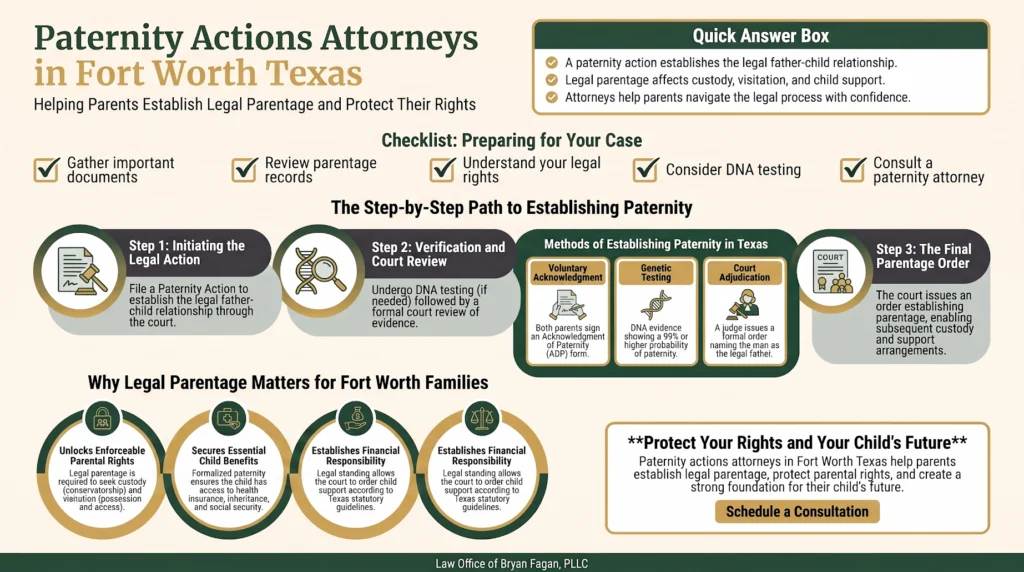
A paternity action establishes the legal father of a child. In Texas, paternity can be established voluntarily, when both parents sign an Acknowledgment of Paternity, or through a court case to adjudicate parentage that may involve genetic testing. Once established, the father has full parental rights and duties, including custody, visitation, and child support (Texas Family Code Chapter 160).
Key Takeaways
- When parents are unmarried, paternity is not automatic — it must be established.
- There are two main paths: a voluntary Acknowledgment of Paternity, or a court case to adjudicate parentage.
- A husband is presumed to be the father of a child born during the marriage (§160.204).
- A valid Acknowledgment of Paternity is the legal equivalent of a court judgment (§160.305) — signing it is a serious step.
- Establishing paternity unlocks custody, visitation, and support — and benefits for the child.
- Timing matters: an acknowledgment can be rescinded within 60 days, and challenges have deadlines.

Your Family’s Future Starts Here
Don’t navigate your legal journey alone. Schedule a consultation now and get the clarity and support you deserve.
Our office is available 24/7. Do not hesitate to schedule your free case evaluation by calling 817-406-7230 or contacting us online today.
What a Paternity Action Is

A paternity action is the legal process of establishing a child’s legal father under Texas Family Code Chapter 160. For families seeking guidance from Paternity Actions Attorneys in Fort Worth Texas, this process is about much more than biology—it creates a legally recognized parent-child relationship that gives a father enforceable rights and responsibilities while providing a child with important legal protections, including financial support, inheritance rights, access to family medical history, and the opportunity to build a stable relationship with both parents whenever appropriate.
Texas law recognizes several ways to establish legal parentage. Under Texas Family Code §160.201, the parent-child relationship may arise through the marital presumption, an Acknowledgment of Paternity (AOP), a court order adjudicating parentage, or adoption. For unmarried parents, the most common paths are signing an Acknowledgment of Paternity when both parents agree or filing a suit to adjudicate parentage when paternity is disputed. If you’d like to learn more about the voluntary process, read our guide on Acknowledgment of Paternity: The Journey Toward Fatherhood in Texas.
In straightforward situations, an Acknowledgment of Paternity under Texas Family Code §§160.301–160.305 may establish legal fatherhood without ever going to court. In more complex cases—such as when another man is a presumed father under §160.204, when DNA testing is necessary, or when custody and child support are contested—a Suit to Adjudicate Parentage under §160.601 allows the court to determine legal parentage and resolve related issues in the same proceeding.
Establishing paternity is often the first legal step toward protecting a family’s future. Once legal parentage has been established, parents can address conservatorship, possession and access, parenting plans, medical support, and child support based on the best interest of the child. Understanding which legal path fits your family’s circumstances helps create greater certainty today while protecting your child’s future for years to come.
The Presumption for Married Fathers (§160.204)
If the parents are married, the law usually does the work automatically. Under Texas Family Code §160.204, a man is presumed to be the father of a child if he is married to the mother and the child is born during the marriage — or within 301 days after the marriage ends by death, annulment, or divorce. The presumption also applies in some situations where a couple married around the time of birth, or married afterward and the father voluntarily asserted his paternity.
A presumed father is treated as the legal father unless the presumption is rebutted, which can happen only through a court adjudication or through a valid denial of paternity filed alongside another man’s acknowledgment. For most married couples, this means paternity is simply not an issue. It is when parents are unmarried — or when the presumption is disputed — that a paternity action becomes necessary.
Path One: The Acknowledgment of Paternity
When both parents agree on who the father is, the simplest route is a voluntary Acknowledgment of Paternity, often called an AOP. Under §160.301, the mother and the man claiming to be the biological father may sign an AOP to establish the man’s paternity. It is often signed at the hospital when the child is born, but it can be completed later, and there is no filing fee (§160.306).
What surprises many people is how powerful that signature is. Under §160.305, a valid AOP filed with the state’s vital statistics unit is the legal equivalent of a court adjudication of paternity — it confers on the acknowledged father all the rights and duties of a parent. In other words, signing an AOP is not a formality or a preliminary step; it is a legal determination of fatherhood with the same force as a judge’s order. That is why it deserves careful thought rather than a quick signature at a stressful moment.
The law does build in a short safety valve. A signed acknowledgment can be rescinded within 60 days, or before the date of a court proceeding involving the child, whichever comes first. But once that window closes, the acknowledgment hardens into a determination that can be challenged only on narrow grounds. For parents who are certain, the AOP is genuinely the easiest path there is — no court, no fee, no hearing. The caution is only for the situation where certainty is not really there, because the ease of signing can obscure how permanent the consequences are.
Signing is a serious legal step. Because an Acknowledgment of Paternity carries the same weight as a court judgment, it should be signed only when both parents are confident about who the father is. If there is any genuine uncertainty, the court route — with genetic testing — exists precisely so that no one is committing to a lifelong legal relationship based on assumption. When you are unsure, talk to an attorney before you sign, not after.
Path Two: A Court Case to Adjudicate Parentage

A court case to adjudicate parentage is the legal process used when parents disagree about paternity, when a child’s legal father is uncertain, or when a court order is needed before issues such as custody, visitation, or child support can be resolved. For families working with Paternity Actions Attorneys in Fort Worth Texas, this process provides a legally binding determination of fatherhood under Texas Family Code §160.601, creating the foundation for parental rights and responsibilities. To better understand why establishing legal parentage is so important, read our guide on Establishing Paternity: The First Step in Texas.
Under Texas Family Code §160.602, a parentage action may be filed by the child’s mother, the man whose paternity is being questioned, the child in certain circumstances, or a government agency responsible for child support enforcement. If the child does not already have a presumed, acknowledged, or adjudicated father, the case generally may be filed at any time. When paternity is disputed, the court may order DNA testing through an accredited laboratory using strict chain-of-custody procedures, giving the judge reliable scientific evidence before determining legal parentage.
In straightforward situations, where genetic testing confirms the biological father and no competing claims exist, the court can establish legal fatherhood and address conservatorship, possession and access, parenting plans, child support, and medical support within the same proceeding. In more complex cases—such as when another man is presumed to be the father, multiple individuals claim parental rights, or custody and child support are being decided together—the court process provides a structured way to resolve every issue based on the facts and the best interest of the child.
A court-ordered adjudication does more than answer a biological question—it creates legal certainty for everyone involved. Once parentage has been established, a father can enforce his parental rights, a child gains important legal protections, and both parents have a clearer path toward resolving custody, visitation, and support. While every family’s circumstances are unique, obtaining a legally recognized parent-child relationship often provides the stability needed to move forward with confidence and protect a child’s future.
Acknowledgment vs. Court Case: Which Path?
The right path depends mostly on one thing: whether everyone agrees on who the father is. This comparison lays out the practical differences.
Either way, the end result is the same in legal weight: an established legal father. The difference is the road you take to get there, and which one fits depends on the facts of your situation and whether paternity is agreed or in dispute.
Why Establishing Paternity Matters
Establishing paternity is not just paperwork — it unlocks rights and protections for everyone involved, which is why it is the foundation of a father’s rights in Texas. For the father, legal paternity is the prerequisite to seeking custody (conservatorship) and visitation (possession and access). Without it, an unmarried father generally has no standing to ask a court for time with his child. With it, he can pursue the same parental rights any parent can.
For the child, the benefits are just as real: the right to child support, eligibility for the father’s health insurance and government benefits, inheritance rights, access to the father’s medical history, and the simple security of a legal relationship with both parents. And for a mother seeking support, establishing paternity is the necessary first step before a court can order the father to contribute. Because paternity is the gateway to custody and child support, it is often the first case a family needs to resolve, and getting it settled opens the door to everything that follows.
Common Paternity Situations

Paternity questions often arise in a few common situations, and recognizing which one applies to your family can make it easier to determine the right legal path. Families working with Paternity Actions Attorneys in Fort Worth Texas are often seeking answers about parental rights, child support, custody, or legal fatherhood after circumstances have changed. For a more detailed overview of the process, read our guide on How to Establish Paternity in Texas.
In straightforward situations, an unmarried father wants to establish legal parentage so he can pursue conservatorship, possession and access, and play an active role in his child’s life. If both parents agree on the child’s biological father, an Acknowledgment of Paternity may establish legal fatherhood without going to court. If the child’s mother is seeking child support, establishing paternity is also the first step before a court can issue support, medical support, or other orders that protect the child’s financial well-being.
In more complex cases, paternity itself may be disputed. A man may be unsure whether he is the biological father, another individual may already be the presumed father under Texas Family Code §160.204, or the child’s mother and alleged father may disagree about parentage. In these situations, a Suit to Adjudicate Parentage under Texas Family Code Chapter 160 allows the court to order accredited DNA testing, determine legal parentage, and resolve related issues such as custody, visitation, parenting plans, and child support based on the child’s best interests.
Choosing the right approach early can save time, reduce conflict, and provide greater certainty for both parents and children. Whether your goal is to establish father’s rights, obtain child support, challenge an existing presumption of paternity, or clarify legal parentage before addressing custody, understanding your options allows you to move forward with confidence and protect your child’s future with a legal strategy tailored to your family’s circumstances.
Changing or Challenging Paternity
Because establishing paternity is such a consequential step, the law puts limits on undoing it. A signed Acknowledgment of Paternity can be rescinded within 60 days (or before a court proceeding involving the child, whichever comes first). After that window closes, it can be challenged only on narrow grounds — fraud, duress, or a material mistake of fact — and even then within limits set by the statute.
Where a man is a presumed father, a challenge to his paternity generally must be brought within four years, subject to specific exceptions. These deadlines exist to give children stability, so they are strictly applied. If you believe an acknowledgment or a presumption is wrong — or you are being asked to sign something you are unsure about — this is a situation where getting legal advice quickly genuinely matters, because the window to act may be shorter than you expect.
It is worth understanding why the law is built this way. Once a child has a legal father, that relationship carries real consequences — support, inheritance, benefits, and the child’s sense of identity — so the law is reluctant to unwind it lightly. That is a feature, not a flaw: it protects children from having a parent appear and disappear based on shifting circumstances. But it also means the responsibility to get paternity right sits at the front end, when the acknowledgment is signed or the case is filed, rather than later. Disestablishing paternity — whether because of fraud, a mistaken assumption, or new genetic evidence — is possible in some circumstances but is legally difficult and fact-specific, and it is not something to attempt without counsel. If you are facing that situation, the most important thing is to talk to an attorney before a deadline passes.
Listen to Our Texas Family Law Podcast
Prefer listening? In this episode, we explain how paternity is established in Texas for Fort Worth families, including the legal process, the rights and responsibilities that may follow, and what parents should know before taking action.
Paternity Cases in Fort Worth & Tarrant County
The Family Code applies statewide, but a contested paternity case is filed and heard in a specific court — for Fort Worth families, the Tarrant County courts. An attorney who practices in these courts knows how local judges handle genetic-testing orders, how paternity is combined with custody and support requests, and how to move a case efficiently so a father’s relationship with his child is protected without unnecessary delay.
Our Fort Worth office helps mothers and fathers across Tarrant County and the surrounding region establish paternity through whichever path fits — a straightforward acknowledgment, or a court case when the facts require one. Because paternity so often travels with custody and support, we handle those pieces together, so you are building one coherent plan for your family rather than a series of disconnected cases.
Timing and local practice both matter here. A contested paternity case moves through the Tarrant County courts on their schedule, and how genetic testing is ordered and how quickly a temporary order can protect a father’s time with his child depend on knowing that local process. For a father, delay can mean months of lost time with a child that no later order gives back; for a mother, it can mean support that should have started sooner. Handling the case efficiently, in the right court, with the right requests made early, is where experienced local counsel earns its place — and it is what our Fort Worth team does every day.
How Our Firm Helps Fort Worth Families

Choosing the right legal approach early can make a significant difference for both parents and children. Families who work with Paternity Actions Attorneys in Fort Worth Texas receive guidance tailored to their unique circumstances, whether they are establishing legal parentage through an Acknowledgment of Paternity, resolving a disputed parentage action, or addressing related issues involving custody, visitation, child support, or medical support. If you’d like to learn more about the voluntary process, read our guide on What Is an Acknowledgment of Paternity?.
At The Law Office of Bryan Fagan, PLLC, our goal is to help you understand every available option before important decisions are made. In straightforward situations, that may mean preparing and filing an Acknowledgment of Paternity correctly to establish legal fatherhood without court intervention. In more complex cases—such as disputed parentage, court-ordered DNA testing, questions involving a presumed father, or custody and child support issues pending before the Tarrant County Family Courts—we develop a legal strategy designed to protect your parental rights while keeping your child’s best interests at the center of every decision.
We also believe that informed parents make better decisions. Whether you have questions about signing paternity documents, challenging an existing determination, amending a birth certificate, or understanding how legal parentage affects conservatorship and future parenting plans, we explain the process in plain English so you can move forward with confidence rather than uncertainty.
Getting started begins with understanding your family’s circumstances. During a Legal Strategy Session, we review your goals, answer your questions, identify the legal path that best fits your situation, and create a practical plan to help protect your relationship with your child today and for years to come.
Our Fort Worth Office
The Law Office of Bryan Fagan, PLLC
204 W Central Ave, Fort Worth, TX 76164 · Tarrant County
Open 24 hours
Call 817-406-7230How a Paternity Case Works in Texas
Tap each stage to see how paternity is established in Texas and which part of the Family Code governs it. This is a general overview, not legal advice about any particular case. The path splits early depending on one question: do both parents agree on who the father is? From there, the process moves toward an established legal father either quickly, through a signed acknowledgment, or more formally, through a court case. Knowing which stage applies to you is the first step toward handling it well.
1 · Start with the presumption — §160.204
First, check whether a presumption already applies. If the parents are married and the child was born during the marriage (or within 301 days of it ending), the husband is presumed to be the father, and paternity is usually not in question.
When the parents are unmarried, there is no presumption, so paternity must be established affirmatively — which leads to one of the two paths below.
2 · If everyone agrees: the Acknowledgment — §160.301
When both parents agree on paternity, the mother and the father sign an Acknowledgment of Paternity, often at the hospital, and file it with the state. There is no filing fee and no court hearing.
Remember the weight of it: a valid acknowledgment is the legal equivalent of a court judgment of paternity, so it should be signed only when both parents are confident.
3 · If it’s disputed: file to adjudicate — §160.601
When paternity is uncertain or contested, a party files a suit to adjudicate parentage. The child, the mother, the man whose paternity is in question, or a government agency may bring the case.
This is the formal court route, and it is designed to reach a reliable answer when the parties do not agree.
4 · Genetic testing, if the court orders it
In the court route, the judge can order genetic testing. Under the Family Code, the paternity of a presumed, acknowledged, or adjudicated father can be disproved only by admissible genetic testing excluding him or identifying another man.
Testing gives the court a reliable basis for its determination when paternity is genuinely in dispute.
5 · The order — and what comes with it
Whether through an acknowledgment or a court order, the result is an established legal father with full parental rights and duties. Because paternity is the gateway to custody, visitation, and support, those issues are often decided in the same proceeding.
From here, a father can pursue his relationship with his child, and a child gains support, benefits, and the security of two legal parents. It is worth remembering the timing rules that follow: an acknowledgment can be rescinded only within a short window, and challenges to a presumed father’s status face a general four-year deadline — so once paternity is set, it tends to stay set.
Every family’s situation is different, and this overview is not legal advice about a specific case. To understand which path fits you — and what signing or contesting means for your rights — speak with a Fort Worth attorney who handles paternity cases.
Need to establish or respond to paternity?
A Legal Strategy Session is the place to figure out which path fits and protect your rights from the start.
Schedule a Legal Strategy Sessionor call 281-810-9760
What I Tell Every Parent About Paternity
The first thing I tell every parent is that establishing legal parentage is about protecting a child’s future as much as protecting a parent’s rights. Families who meet with Paternity Actions Attorneys in Fort Worth Texas are often surprised to learn that legal fatherhood does not happen automatically when parents are unmarried. Once paternity is legally established, a father can pursue conservatorship, possession and access, and meaningful involvement in his child’s life, while the child gains important legal protections such as financial support, inheritance rights, and access to family medical history. For additional insight into the process, visit our guide on Paternity Actions in Shenandoah, Texas.
The second thing I emphasize is that an Acknowledgment of Paternity is a legally significant document. In straightforward situations, where both parents agree about the child’s biological father, signing an acknowledgment under Texas Family Code §§160.301–160.305 can be an efficient way to establish legal parentage. In more complex cases—if paternity is disputed, another man is a presumed father, or you have genuine doubts about biological parentage—it is often wiser to pursue a court determination and, if appropriate, DNA testing before making a decision that may be difficult to challenge later.
Finally, I remind parents that paternity is rarely an isolated legal issue. Once legal parentage is established, questions about custody, visitation, child support, parenting plans, and long-term parental responsibilities usually follow. Taking the time to understand the complete picture from the beginning helps families make informed decisions, reduces unnecessary conflict, and creates a stronger foundation for protecting what matters most—the well-being and future of their children.
Your Fort Worth Attorney
Bryan Bubis — Associate Attorney, Fort Worth
13 Years of Legal Experience · Tarrant, Johnson & Parker County Courts
Bryan Bubis brings 13 years of legal experience across family law, criminal defense, and probate to paternity and parentage matters, from voluntary acknowledgments to contested court cases. Because paternity so often connects to custody and support, he helps parents see the whole picture and build a plan that protects both their rights and their child’s interests. He earned his Bachelor’s in Business Management from Texas A&M University and his Juris Doctor from Texas A&M School of Law.
Bryan works with clients in the Tarrant, Johnson, and Parker county courts, and he can meet with you at the firm’s Fort Worth office. Read Bryan Bubis’s full profile.
Conclusion
Every family’s path is different, and the right legal approach depends on the facts of your situation. In straightforward situations, where both parents agree on paternity, establishing legal parentage may be accomplished through a properly completed Acknowledgment of Paternity. In more complex cases, where paternity is disputed, genetic testing is needed, custody and child support are contested, or questions arise about an existing legal father, experienced legal guidance can help protect both your rights and your child’s future. If your case involves unique circumstances, taking the time to understand your options now can help you avoid unnecessary conflict and create greater stability for your family in the years ahead.
The Paternity Actions Attorneys in Fort Worth Texas at The Law Office of Bryan Fagan, PLLC are committed to helping families move forward with confidence through education, compassionate guidance, and thoughtful legal strategy. Whether you are seeking to establish your parental rights, protect your child’s well-being, or create a parenting arrangement that supports long-term stability, our team is here to help you understand the law, evaluate your options, and build a plan that protects what matters most. A Legal Strategy Session is an opportunity to receive clear answers tailored to your family’s circumstances and take the next step with confidence and peace of mind.
About the Author
Bryan Fagan
Founder & Managing Attorney · Serving Texas families since 2012
I am Bryan Fagan, founder and managing attorney of The Law Office of Bryan Fagan, PLLC, one of the largest family law firms in Texas. I earned my Juris Doctor from South Texas College of Law, I am an elected member of the College of the State Bar of Texas, and I lead a team of more than 170 legal professionals with offices across the state.
I am also the author of The Texas Divorce Handbook, because I believe families make better decisions when they understand the law that affects them. Paternity is often the first legal step a family takes, and getting it right protects a father’s relationship with his child for a lifetime. Out of our Fort Worth office, our team helps parents across Tarrant County establish paternity and the rights that come with it. If you have a question, we would like to help. Read more about Bryan Fagan.
Frequently Asked Questions
Paternity is established in one of two main ways for unmarried parents: voluntarily, when both parents sign an Acknowledgment of Paternity, or through a court case to adjudicate parentage, which may include genetic testing. Married fathers are usually established automatically by the presumption in §160.204.
It is a legal document that the mother and the man claiming to be the biological father sign to establish paternity, often at the hospital. Under §160.305, a valid, filed Acknowledgment of Paternity is the legal equivalent of a court judgment and gives the father all parental rights and duties.
Not always. If both parents agree and sign an Acknowledgment of Paternity, no genetic testing is required. Testing typically comes into play in the court route, where a judge can order genetic testing when paternity is disputed or uncertain.
Legal paternity is the prerequisite to a father’s rights in Texas. Once established, a father can seek custody (conservatorship) and visitation (possession and access), and he takes on the duty to support the child. Without established paternity, an unmarried father generally has no standing to ask a court for those rights.
Within limits. An Acknowledgment of Paternity can be rescinded within 60 days, or before a court proceeding involving the child if that comes first. After that, it can be challenged only on narrow grounds such as fraud, duress, or a material mistake of fact, and deadlines apply.
If a child has no presumed, acknowledged, or adjudicated father, a paternity suit can generally be filed at any time. Where a man is a presumed father, a challenge usually must be brought within four years, subject to exceptions. Because deadlines can be strict, it is always best to act promptly.
