
Divorce Modifications Attorneys in Fort Worth, Texas

Divorce Modifications Attorneys in Fort Worth Texas help families solve a problem that almost every parent eventually faces: the order made sense when it was signed, but life kept moving. The parent who once worked a predictable Monday-through-Friday schedule is now on rotating shifts. One family stays in the same neighborhood while the other moves across town. A child who once needed bedtime stories now needs rides to advanced classes, tutoring, sports practices, or counseling appointments. The routines that worked a few years ago no longer fit the family you have today. When that happens, Texas law gives parents a way to ask the court to update an order so it reflects today’s reality—not yesterday’s.
One of the biggest misconceptions I hear is that every part of a divorce decree can be changed later. It can’t. Orders involving conservatorship, possession, child support, and, in some situations, spousal maintenance may be modified when there has been a material and substantial change in circumstances. The property division, however—who received the home, retirement accounts, or other assets—is generally final. Knowing whether your situation calls for a modification, an enforcement action, or no court action at all is the first step toward making informed decisions for your family.
I am Bryan Joseph Fagan, founder of The Law Office of Bryan Fagan, PLLC and a graduate of South Texas College of Law. For years, my team has helped Texas parents navigate post-divorce modifications with one goal in mind: protecting children while helping families move forward with clarity and confidence. In many cases, the reason parents seek a modification is not simply because schedules have changed, but because those changes are beginning to affect a child’s daily life—including emotional well-being, consistency at home, and academic success. Texas courts decide these cases by focusing on what serves the child’s best interests, and understanding how those decisions are made can help parents protect both their legal rights and their children’s future.
In this guide, I’ll explain what can and cannot be modified, how Texas courts evaluate requests to change custody, visitation, and child support, why educational stability often becomes an important consideration, and the practical steps parents can take to create arrangements that support their children’s long-term success.
The Short Answer
In Texas, you can modify the parts of a divorce decree that deal with children, child support, and spousal maintenance when there has been a material and substantial change in circumstances under Family Code §156.101. The property division in a final decree generally cannot be re-divided — if a former spouse won’t hand over what they were awarded, the remedy is enforcement, not modification.
Key things to know about divorce modifications in Fort Worth
- Custody, possession, child support, and spousal maintenance can be modified. The property division generally cannot.
- The core standard is a material and substantial change in circumstances since the last order (§156.101), and, for the children’s issues, that the change serves the child’s best interest.
- Child support has a second path: a three-year / 20%-or-$100 review even without a material change (§156.401).
- Spousal maintenance can be modified, but generally only reduced — never increased above the original order (§8.057).
- Changing the child’s primary residence within one year of the order requires a special sworn affidavit (§156.102).
- Modifying is not the same as enforcing. A violated order is enforced; an order that no longer fits your life is modified.
- You cannot change an order by informal agreement — only a new court order changes the order, no matter what you and your ex agree to.

Your Family’s Future Starts Here
Don’t navigate your legal journey alone. Schedule a consultation now and get the clarity and support you deserve.
Our office is available 24/7. Do not hesitate to schedule your free case evaluation by calling 817-406-7230 or contacting us online today.
Can you modify a Texas divorce decree?

Yes—but only the parts of a divorce decree that Texas law treats as ongoing rather than final. Divorce Modifications Attorneys in Fort Worth Texas help parents determine whether an order involving conservatorship, possession, child support, or spousal maintenance can be modified after a material and substantial change in circumstances under Texas Family Code Chapter 156. By contrast, the division of marital property is generally final once the divorce decree is signed and cannot be re-divided through a modification proceeding.
The key is understanding which legal issues are designed to evolve with your family’s changing circumstances. Texas courts recognize that children grow, parents change jobs, incomes fluctuate, and families relocate. Someone moving to Fort Worth may find that an existing parenting schedule, geographic restriction, or exchange location no longer works. In those situations, the court may modify custody, possession, or support orders when doing so serves the best interests of the child under Texas Family Code §153.002. Property awards, however, generally remain fixed, and disputes over those provisions are typically addressed through enforcement rather than modification.
Before filing, it is important to determine whether your circumstances require a modification, an enforcement action, or another legal remedy. In straightforward situations, updating a parenting plan or child support order may be relatively simple. In more complex cases involving relocation, contested custody, or multiple requested changes, a thoughtful legal strategy can help protect your rights while providing the stability your family needs moving forward.
The biggest myth about modifications is that “everything in a divorce can be revisited.” It can’t — the children’s issues, support, and maintenance can change; the property division is final.
Not sure whether your issue can be modified or needs enforcement? Bring your decree to a confidential consultation.
Schedule a Confidential ConsultationThe “material and substantial change” standard
Almost every modification turns on one phrase: a material and substantial change in circumstances since the last order (§156.101). Texas courts set this bar on purpose — they do not want a child’s life disrupted every time a parent is frustrated, so a modification takes a genuine, significant shift, not just disagreement with the existing order. The change is measured from the date of the last order (or the mediated or collaborative agreement it was based on) to today.
The statute does not hand you a checklist — “material and substantial” is judged case by case — but the changes courts commonly accept include a significant change in either parent’s income, a job loss, a relocation, a remarriage or a new household, a serious change in the child’s medical or educational needs, or a parent’s conduct affecting the child. What wins is not the story but the proof: a clean, side-by-side comparison of the circumstances at the time of the last order versus now, backed by records. The parent who arrives with the old order in one hand and dated documentation of what changed in the other is in a far stronger position than the one describing how they feel about the arrangement. Two additional grounds apply specifically to changing who designates the child’s primary residence: a child twelve or older can tell the judge their preference, and a conservator who has voluntarily given up primary care for at least six months can trigger review.
The reassuring part: if your life has genuinely changed, the law has a path. Texas keeps the bar high to protect stability, but it exists precisely so that orders can catch up to real life. Once you walk me through what has changed since your last order and when, I can tell you early whether it is likely to clear the material-and-substantial bar and which order we would be changing.
Modifying custody and conservatorship
Conservatorship — who has which rights and duties for the child, and who designates the primary residence — can be modified on a material and substantial change that serves the child’s best interest (§156.101). There is one important timing rule: if you are asking to change the person with the exclusive right to designate the child’s primary residence within one year of the current order, you must file a sworn affidavit meeting specific grounds — that the child’s present environment may endanger their physical health or emotional development, that the primary parent is the one seeking or agreeing to the change, or that the primary parent has voluntarily relinquished care for at least six months (§156.102). Without an adequate affidavit, the court will not even set a hearing.
This section is the overview; the deep mechanics of a conservatorship change — the best-interest factors, joint-managing-conservator presumptions, and how Tarrant County courts handle these disputes — live on our Fort Worth child custody page. If your question is about who makes decisions or where the child primarily lives, start there.
Modifying possession and visitation

A Texas court can modify a possession or visitation schedule when there has been a material and substantial change in circumstances and the requested change is in the best interests of the child under Texas Family Code §156.101. Divorce Modifications Attorneys in Fort Worth Texas frequently help parents update parenting schedules after a relocation, changes in work hours, evolving educational or extracurricular commitments, or other life changes that make the existing order difficult to follow. The goal is not to disrupt a child’s routine but to create a possession schedule that better reflects the family’s current circumstances while promoting stability and meaningful parenting time.
Many visitation modifications begin because the original schedule simply no longer fits everyday life. A parent may move beyond the geographic restrictions in the existing order, begin working nights or rotating shifts, or find that a child’s activities make exchanges under the current schedule impractical. In straightforward situations, parents can often resolve these issues through an agreed modification or mediation. In more complex cases involving contested parenting time, relocation, or disagreements over the child’s best interests, the court carefully reviews the evidence before deciding whether a new schedule is appropriate. If you’re planning to meet with our team, our Plan Your Visit to Our Fort Worth Office guide explains what to expect before your appointment.
Texas possession orders include detailed rules governing standard possession, expanded possession, holiday schedules, summer parenting time, and distance-based possession when parents live farther apart. Because every family is different, a modification should be tailored to your child’s unique needs and your family’s current routine. For a more in-depth explanation of parenting schedules, possession rights, and how courts evaluate requests to change visitation, visit our Fort Worth Parental Visitation Attorneys resource.
Modifying child support
Child support is the one modification with two paths to court (§156.401). The first is the familiar material and substantial change — typically a real change in either parent’s income, the child’s needs, or the number of children a parent supports. The second is unique to support: even without a material change, you can seek review if it has been three years since the order was set or last modified and the guideline amount would differ from the current order by 20% or $100 per month.
I am keeping this deliberately short, because the actual support math — net resources, the guideline percentages, and the current cap on the resources those percentages apply to — lives on our Fort Worth child support page, and that is where you should go to run your number. This overview exists to tell you that support is modifiable and how the triggers work; the calculation detail is one click away.
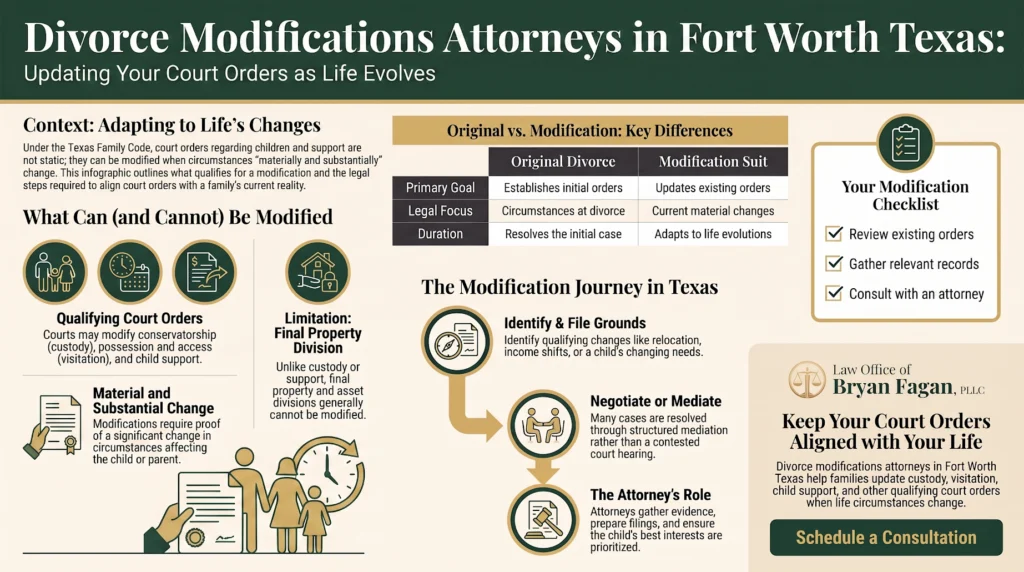
Strategy note: the standard is met with evidence, not frustration. Before you file, build the side-by-side: the facts as they existed on the date of your last order versus the facts today, with records for each — pay stubs, tax returns, the child’s new expenses, proof of the move. Courts modify on a documented change, and the parent who arrives with dated proof of what shifted almost always fares better than the one telling a story.
Modifying spousal maintenance
Court-ordered spousal maintenance may be modified when there has been a material and substantial change in circumstances affecting either former spouse, as provided by Texas Family Code §8.057. Divorce Modifications Attorneys in Fort Worth Texas frequently help clients evaluate whether a significant job loss, reduction in income, serious illness, disability, or the receiving spouse becoming self-supporting justifies a change in maintenance. However, Texas law places important limits on these modifications. A court may reduce the amount or shorten the duration of court-ordered maintenance when appropriate, but it generally cannot increase the original amount or extend maintenance beyond the limits established in the divorce decree.
Timing also matters. A modification only affects maintenance payments that come due after a motion to modify has been filed. Waiting several months after losing a job or experiencing another substantial change does not eliminate the obligation to pay the amount required under the existing order during that time. It is also important to distinguish court-ordered spousal maintenance from contractual alimony. Contractual alimony is based on the agreement between the spouses and is governed by the terms of that agreement rather than Texas Family Code §8.057, making the available legal remedies very different.
Determining which type of support you have is often the first step in developing the right legal strategy. In straightforward cases, the issue may simply involve documenting a qualifying financial change. In more complex matters involving disputed income, self-employment, disability, or multiple post-divorce issues, careful preparation can significantly affect the outcome. If you’re ready to discuss whether your maintenance order may be modified, you can schedule a consultation with our Fort Worth office to review your circumstances and better understand your options under Texas law.
What cannot be modified: the property division

The property division in a Texas divorce decree is generally final and cannot be modified after the divorce is complete. Divorce Modifications Attorneys in Fort Worth Texas regularly help parents understand the difference between orders that can change—such as conservatorship, possession, child support, and certain spousal maintenance provisions—and those that cannot. Once the court has divided the marital estate, including the family home, retirement accounts, investment assets, or business interests, that division usually cannot be revisited simply because one spouse later believes it was unfair. This distinction is a fundamental part of Texas family law and is reflected in Texas Family Code Chapter 9, which allows courts to enforce property divisions but not rewrite them.
That does not mean you are without a remedy if your former spouse refuses to comply with the decree. Texas courts may issue orders requiring the transfer of awarded property, clarify ambiguous language, or enter a money judgment to enforce the original decree, but they cannot alter the substantive division of property that was previously ordered. If your divorce involved a closely held company, ranch, or other family enterprise, preserving those assets often requires careful planning long before the divorce is finalized. Families facing those issues can learn more by visiting our Humble Family Business & Farm Lawyer resource.
Choosing the correct legal remedy is often just as important as the facts of your case. In straightforward situations, enforcement simply ensures each party receives the property already awarded by the court. In more complex matters involving retirement accounts, real estate, business ownership, or disputed transfers, understanding the difference between enforcement and modification can prevent costly mistakes. If your former spouse is not complying with the property provisions of your divorce decree, our guide to Property Division Enforcement in Texas explains how Texas courts enforce existing orders while preserving the finality of the original property division.
Modification vs. enforcement
These two get confused constantly, and filing the wrong one wastes months. You modify an order when the order itself no longer fits — the schedule doesn’t work, the support number is out of date, circumstances have changed. You enforce an order when the order is fine but the other person isn’t following it — they’re withholding the child on your weekend, not paying the support they owe, or refusing to hand over awarded property. Modification changes the order going forward; enforcement compels compliance with the order as written.
Sometimes you need both, and the facts decide. A parent who lost a job and can’t pay the current support needs a modification; a parent owed months of unpaid support under a workable order needs enforcement. And occasionally the same situation calls for both at once — you enforce the arrears your ex already owes while simultaneously modifying the order going forward to a number that fits the new reality. Part of what I do at the first meeting is make sure we file the right thing, because the right remedy for the wrong problem gets you nowhere.
Warning: do not stop paying support or start keeping the child on a different schedule just because your circumstances changed or the order feels unfair. Until a judge signs a new order, the existing order is still in force, and violating it can put you in contempt — even if you would have won the modification. Keep following the current order to the letter while your modification is pending. Self-help turns a winnable modification into an enforcement case against you.
You can’t just agree to change it
This is the trap that costs good, cooperative co-parents the most. You and your ex agree, in good faith, to a new schedule or a lower support payment — a handshake, a text thread, maybe a signed note. Then the relationship sours, one of you goes back to the original order, and the informal deal turns out to be worth nothing. Only a court order changes a court order. An agreement between the two of you, however sincere, does not modify the decree and is not enforceable as a modification.
The good news is that agreement makes the court process easy. When both parents want the same change, we put it in an agreed modification order the judge signs, and it becomes binding and enforceable. You get the arrangement you both wanted and the protection of an order. The lesson is not “don’t agree” — it is “get your agreement into an order,” so the version of your ex a year from now is bound by it.
Tarrant County modification practice

Most post-divorce modifications are filed in the court with continuing, exclusive jurisdiction, which is usually the same Tarrant County court that issued your original divorce decree or most recent modification order. Divorce Modifications Attorneys in Fort Worth Texas help parents navigate modifications involving conservatorship, possession, visitation, child support, and spousal maintenance under Texas Family Code Chapter 156. Although the legal standards apply statewide, local court procedures—including scheduling, mediation requirements, temporary orders, and standing orders—can differ, making familiarity with Tarrant County practice an important advantage.
Every family’s circumstances are different. In straightforward cases, parents may be able to resolve a modification through an agreed order or mediation. In more complex matters involving contested custody, relocation, emergency temporary orders, or significant changes affecting a child’s well-being, careful preparation and strong evidence are often essential to demonstrate why the requested modification serves the child’s best interests. Parents facing long-term health concerns or the possibility of incapacity may also find it helpful to explore our Incapacity Planning Attorneys in Houston Heights resource to better understand how proactive planning can protect both children and caregivers.
Our Fort Worth office represents families throughout Tarrant County, including Arlington, Grapevine, Mansfield, Keller, Bedford, and North Richland Hills, as well as nearby communities in Parker, Johnson, Denton, and Dallas counties. Whether you’re considering a simple parenting schedule adjustment or a complex custody modification, understanding the local court process is an important first step toward developing a legal strategy that protects your family and supports your child’s future.
Listen to Our Texas Family Law Podcast
Prefer listening? In this episode, we explain how family court orders can be modified in Texas for Fort Worth families, including when changes may be allowed, what legal standards may apply, and how to request a modification through the court.
How a Modification Works, Stage by Stage
The Texas Modification Process
Tap any stage to see what happens, roughly how long it takes, and what to do. This walks through the modification process — it does not predict whether your change will be granted, which depends on your specific facts and the court.
1. Identify which order to change
What happens: First we pin down what you are actually trying to change — conservatorship/custody, the possession schedule, child support, or spousal maintenance — because each has its own rules and its own deep page. The property division is generally off the table (it is final), so if that is your issue, the path is enforcement, not modification.
Typical timing: The first conversation. Getting this right saves months of filing the wrong thing.
What to do: Bring your current order and be specific about which term is not working.
2. Confirm a material and substantial change
What happens: Most modifications require a material and substantial change in circumstances since the last order (§156.101). We compare the facts on the date of your last order with the facts today — income, home, work schedule, the child’s needs. Child support has a second path: a three-year review where the guideline amount would differ by 20% or $100 (§156.401).
Typical timing: Before filing. The strength of the case is set here.
What to do: Assemble dated records for the change — courts modify on documented evidence, not on the order feeling unfair.
3. Keep following the current order
What happens: Until a judge signs a new order, the existing one is still binding. Stopping support or changing the schedule on your own — even if you expect to win — can put you in contempt and turn your modification into an enforcement case against you.
Typical timing: The entire time the modification is pending.
What to do: Follow the current order to the letter and document that you are doing so.
4. File the modification
What happens: We file a petition to modify in the court with continuing, exclusive jurisdiction — usually the court that issued your original order. If you are changing the child’s primary residence within one year, a sworn §156.102 affidavit must be attached or the court won’t set a hearing. If both sides agree, we can submit an agreed modification order for the judge to sign.
Typical timing: Agreed modifications can move quickly; contested ones follow the court’s docket.
What to do: If you and your ex agree, get it into an agreed order — an informal deal does not change the order.
5. Modify vs. enforce — choose the right remedy
What happens: If the order no longer fits, you modify it. If the order is fine but your ex won’t follow it — withholding the child, not paying support, refusing to hand over property — you enforce it. Property-division non-compliance is enforced under Chapter 9, which can compel delivery or grant a money judgment but cannot rewrite the division.
Typical timing: Decided at the outset; sometimes both are filed.
What to do: Let us match the remedy to the problem — the right remedy for the wrong problem gets you nowhere.
Wherever you are in this process, we can help you file the right thing and get your order updated.
Schedule a Confidential ConsultationOur Fort Worth Office
The Law Office of Bryan Fagan, PLLC
204 W Central Ave, Fort Worth, TX 76164
Serving Fort Worth, Tarrant County, and clients across Texas.
Hours: Mon–Fri 8am–8pm
Call 281-810-9760Ready to update an order that no longer fits your life? Let’s build the modification the right way.
Call 281-810-9760Bryan Bubis — Senior Attorney, Fort Worth
15+ Years Family Law · Tarrant, Johnson & Parker County Courts
Bryan Bubis brings more than 15 years of family law experience to post-decree modifications — changing custody and possession orders after a move or a change in a child’s needs, modifying support up or down when incomes shift, adjusting maintenance, and enforcing orders when the other side won’t follow them. He is focused on filing the right thing the first time: sorting whether a client needs a modification or an enforcement, and building the material-and-substantial-change case with documentation.
Bryan represents clients in the Tarrant, Johnson, and Parker county family courts. He works these cases the way I do: identify the right order and the right remedy, document the change since the last order precisely, resolve by agreed order where both sides want the same thing, and litigate when they don’t. Read Bryan Bubis’s full profile.
What I tell every client whose life has changed
The first thing I tell every client is that a divorce order is meant to provide stability—not to lock your family into circumstances that no longer exist. Divorce Modifications Attorneys in Fort Worth Texas help parents understand that Texas law allows custody, visitation, child support, and certain spousal maintenance orders to be modified when there has been a material and substantial change in circumstances under Texas Family Code §156.101. Whether you’ve changed jobs, relocated, experienced a significant change in income, or your child’s needs have evolved, the court can consider updating the order if doing so serves the child’s best interests. Even practical issues, such as increased travel time for custody exchanges because of changing transportation in Fort Worth, can become part of the broader discussion about whether an existing parenting schedule remains workable.
The second thing I explain is that modification cases are won with evidence—not frustration. Judges look for objective proof that circumstances have genuinely changed since the last order, such as employment records, financial documents, school records, medical records, or other reliable documentation. In straightforward cases, parents can often resolve these issues through an agreed modification or mediation. In more complex matters involving contested custody, relocation, or multiple requested changes, careful preparation and a well-developed legal strategy become even more important.
Finally, I remind every client to keep following the current court order until a judge signs a new one. Changing a possession schedule on your own, withholding parenting time, or stopping child support payments can create unnecessary legal problems and even lead to an enforcement action. The right approach is to identify the appropriate legal remedy, gather the necessary evidence, and build a strategy that protects your children while giving your family the opportunity to move forward with greater stability and confidence.
What to do about a divorce modification in Fort Worth
- Identify which order you need to change — custody, possession, support, or maintenance — or whether you actually need enforcement.
- Pinpoint the material and substantial change and the date it happened, measured from your last order.
- Gather dated records proving the change: pay stubs, tax returns, the child’s new expenses, proof of a move.
- Keep following the current order to the letter while any modification is pending.
- For a support change, be ready to run the current guideline number to test the 20%-or-$100 threshold.
- If changing the child’s primary residence within a year, prepare the §156.102 affidavit.
- Don’t rely on an informal agreement — if you and your ex agree, get it into an agreed order.
- Confirm you’re filing in the court with continuing, exclusive jurisdiction over your case.
- Decide whether the change is contested; it drives both cost and timeline.
- Book a Legal Strategy Session with our Fort Worth office to file the right thing the first time.
When Life Changes, the Order Can Too
If your order no longer fits your life, Texas gives you a path. Let’s make sure you take the right one.
Call 281-810-9760 TodayConclusion:
Life doesn’t pause after a divorce, and your court orders shouldn’t force your family to live in the past. Divorce Modifications Attorneys in Fort Worth Texas help parents determine whether a change in custody, visitation, child support, or spousal maintenance is appropriate when circumstances have materially changed. In straightforward situations, an agreed modification may be enough to restore stability. In more complex cases involving relocation, contested custody, changing educational or medical needs, or high-conflict co-parenting, a carefully developed legal strategy and strong supporting evidence can make a meaningful difference in protecting your child’s best interests.
At The Law Office of Bryan Fagan, PLLC, we believe families make better decisions when they understand their options. Whether your case can be resolved through cooperation, mediation, or requires courtroom advocacy, our goal is to provide practical guidance that helps you move forward with confidence while protecting what matters most. If you’re preparing to take the next step, our Governmental Resources in Fort Worth guide offers helpful local information alongside our family law resources. Every modification begins with understanding your unique circumstances, identifying the right legal remedy, and building a strategy designed to create lasting stability for your family.
About the Author
Bryan Fagan
Founder & Managing Attorney · Serving Texas families since 2012
I am Bryan Fagan, founder and managing attorney of The Law Office of Bryan Fagan, PLLC, one of the largest family law firms in Texas. I hold a Juris Doctor from South Texas College of Law and an undergraduate degree in business and finance, and I lead a team of more than 170 legal professionals with offices across the state. In modification cases, my aim is to make clear what can and cannot be changed, and to make sure my client files the right thing the first time.
I am also the author of several family law guides, including The Texas Divorce Handbook, because I believe people make better decisions when they understand the process. Out of our Fort Worth office, our team helps clients modify and enforce post-decree orders in the Tarrant County family courts. If you have a question about changing an order, I would like to help. Read more about Bryan Fagan.
Questions Fort Worth families ask about modifications
You can modify the parts dealing with children, child support, and spousal maintenance when there has been a material and substantial change in circumstances since the last order (§156.101). The property division in a final decree generally cannot be re-divided. If a former spouse won’t turn over awarded property, the remedy is enforcement under Chapter 9, not modification. Which side of that line your issue falls on determines everything.
It is a genuine, significant shift in circumstances since your last order — not just disagreement with it. The statute doesn’t define it precisely, so courts decide case by case, but commonly accepted changes include a real income change, a job loss, a relocation, a remarriage, or a serious change in the child’s needs. It is measured from the date of the last order to today, and proven with records.
You file a petition to modify in the court with continuing, exclusive jurisdiction — usually the court that issued your original order — and show a material and substantial change in circumstances since that order. Keep following the current order while the modification is pending. Gather dated records proving the change before you file, since courts modify on documented evidence, not on the fact that an order feels unfair.
Yes. Conservatorship and possession can be modified on a material and substantial change that serves the child’s best interest (§156.101). If you are changing who designates the child’s primary residence within one year of the order, a special sworn affidavit is required (§156.102). The deep mechanics — best-interest factors and Tarrant County practice — are on our Fort Worth child custody page.
Yes, by two paths (§156.401): a material and substantial change — usually an income change or a change in the child’s needs — or a three-year review, where it has been three years since the order and the guideline amount would differ by 20% or $100 per month. Support can go up or down. The actual calculation lives on our Fort Worth child support page.
Yes, on a material and substantial change in either party’s circumstances (§8.057), but only downward — a modification cannot increase the amount or extend the duration beyond the original order. A job loss or income drop is the common basis for the paying spouse. The change reaches only payments accruing after you file, so waiting to file means continuing to owe the original amount.
Generally no. The just-and-right division of property in a final decree is final and not subject to modification — you cannot ask a court to re-divide assets later because the split feels unfair. If a former spouse won’t turn over property you were awarded, the remedy is enforcement under Chapter 9, which can compel delivery or grant a money judgment but cannot alter the original division.
It depends on whether the modification is agreed or contested. An agreed modification, where both sides want the same change and sign off, is far less expensive than a contested one that requires discovery, temporary orders, and a hearing. County filing fees and service costs apply on top of attorney’s fees. In a consultation we can give you a realistic range once we know which order and how contested it is likely to be.
Not on a handshake. An informal agreement between you and your ex does not change a court order and is not enforceable as a modification — if the relationship sours, either of you can revert to the original order. But when you both want the same change, we can put it in an agreed modification order the judge signs, which is binding and enforceable. Get the agreement into an order.
You modify an order when the order itself no longer fits your life — the schedule, the support number, the circumstances have changed. You enforce an order when the order is fine but the other person isn’t following it — withholding the child, not paying support, refusing to hand over property. Modification changes the order going forward; enforcement compels compliance with it as written. Filing the wrong one wastes months.
There is no general waiting period — you can file whenever a material and substantial change has occurred. But one timing rule applies: to change the person who designates the child’s primary residence within one year of the order, you must file a special sworn affidavit meeting specific grounds (§156.102), or the court will not set a hearing. Other modifications have no such one-year restriction.
Bring your current order and what’s changed to a Legal Strategy Session, and we’ll map your options.
Schedule Your Consultation